
Chapter 20 Test Bank – Static Key
1. In a merger, two or more companies are combined to form an entirely new entity.
2. One motivation to merge is through tax savings.
3. U.S. is different from other countries in regards to what is considered taxable income. If income is
earned overseas, the company still has to pay tax to the U.S. government regardless if the income has
already been charged tax in another country.
4. Risk-averse investors may discount the future earnings of the merged firm at a higher rate if they move
in different directions during business cycles.
5. One potential advantage of a merger to the acquiring firm is the “portfolio effect,” which attempts to
achieve risk reduction while perhaps maintaining the rate of return for the firm.
6. The potential of a tax loss carry forward has no effect when considering the acquisition of a company.

7. Too much diversification has led many companies to sell off companies previously acquired during the
merger boom.
8. Mergers often improve the financing flexibility that a larger company has available.
9. A tax loss carry forward of $1,000,000 for company ZZZ is not usually worth $1,000,000 in today’s
dollars to a firm that might acquire company ZZZ.
10. The stock market’s reaction to divestitures may actually be positive if the divestiture is perceived to rid
the company of an unprofitable business, or if it seems to sharpen the company’s focus.
11. The portfolio effect of a merger is greatest for the stockholders of the firm being acquired.
12. The desire to expand management and marketing capabilities is a direct financial motive for an
acquisition.
13. Synergy is said to take place when the merged companies are greater than the individual companies
working separately.

14. Synergy effect is said to happen when the merged companies are able to work together and eliminate
some of the repeated divisional tasks, proving that the company is better off being merged.
15. Vertical integration usually represents acquisition of a competitor.
16. An example of horizontal integration is as if Macy’s and JC Penny were to merge.
17. Antitrust policy can preclude the acquisition of a competitor.
18. Most mergers are horizontal in nature in order to avoid the potential antitrust complications involved
with the elimination of competition.
19. In a horizontal merger, the integration that occurs comes from acquiring companies that supply
resources to the company‘s production process.

20. While a horizontal merger may improve profitability, it will not necessarily reduce the portfolio risk of the
acquiring company.
21. Horizontal integration is usually prohibited or severely restricted by government antitrust regulations.
22. Synergy is the greatest and most easily measured nonfinancial benefit in a merger.
23. Selling stockholders during a merger may receive a price well above current market or book value.
24. A motive for selling stockholders may be the bias against smaller companies.
25. A cash purchase of one company by another is similar to a capital budgeting decision.
26. Following a merger, the change in the risk profile of the merged companies may influence the price
earnings ratio just as much as the change in the overall growth rate.

27. Stockholders of acquired firms in mergers tend to be more concerned with future earnings and
dividends exchanged than with the market value exchanged.
28. By using cash instead of stock, a company may diminish the perceived dilutive effects of a merger.
29. If the purchasing firm’s price earnings ratio is greater than the acquired firm’s price earnings, the
surviving firm will automatically get an increase in earnings per share.
30. The earnings-per-share impact of a merger is influenced by relative price-earnings ratios and the terms
of exchange.
31. A “takeover tender offer” describes the attempted purchase of a firm with the consent of that firm’s
management.
32. A “takeover tender offer” lets a company attempt to acquire a target firm against its will.

33. For mergers occurring after 2001, goodwill must be amortized and written off over 40 years or less.
34. For mergers occurring after 2001, goodwill is valued and placed on the balance sheet as an asset and
impairment is the only way to devalue it.
35. Goodwill is created when the purchasing firm pays more than what the acquired firm is worth.
36. The existing management of a firm is almost always ready to accept an offer for the purchase of the
firm at a price above the market price.
37. If an acquiring firm’s merger proposal was rejected by a target firm’s management and board of
directors, the acquiring firm could utilize a tender offer to gain control of the target firm.
38. Leveraged takeovers occur to firms that have an unusually large cash to total assets position.
39. “Poison pills” are strategies that reduce the value of a firm if it is taken over by a corporate raider.

40. Leveraged buyouts are restricted to “outside” tender offers.
41. The “two-step buyout” procedure allows the acquiring firm to pay a lower total price than if a single offer
is made.
42. The “two-step buyout” procedure induces stockholders to delay their reaction to the offer, since they will
receive a higher price later.
43. After a merger has been announced, subsequent cancellation generally causes the potential acquiree’s
stock to decline in value.
44. Although corporate managers have a responsibility to act in the shareholders’ best interest,
management frequently opposes acquisitions due to personal motives.
45. One of the reasons that companies merge with other companies is to secure access to a competing
industry.

46. Multinational mergers provide economic and political diversification, which can lead to a higher cost of
capital for the new firm.
47. Selling stockholders generally receive a price below the current market value of their prior stock during
a merger.
48. It is possible to merge with a company so that the merger results in the same earnings per share but
still lowers the new firm’s cost of capital.
49. A business combination of two or more companies in which the resulting firm maintains the identity of
the acquiring company is defined as a
50. Which one of the following types of mergers is most likely to lead to diversification benefits?
51. When a tobacco firm merges with a steel company, it would be called
20-9
52. Which of the following is NOT a potential benefit of a merger?
53. The rising ratio of divestitures to new acquisitions that occurred in the past suggests that
54. The direct financial motives for merger activity include all of the following EXCEPT:
55. The Celluloid Collar Corporation has $210,000 in tax loss carry forwards. The Bowstring Shirt
Company, a firm in the 30% tax bracket, would be willing to pay (on a non-discounted basis) the sum of
______________ for Celluloid Collar Corporation’s carry forward alone.
56. Synergy is said to occur when the whole is
20–10
57. Synergy is said to occur when the merged company is
58. Synergy is
59. In planning mergers, there is a tendency to _____ synergistic benefits.
60. Which of the following is NOT a motive for stockholders of the acquired company to sell?
61. Which of the following type of merger decreases competition?
20–11
62. Which of the following type of merger goes against the antitrust policy?
63. Which of the following is NOT a financial motive, but rather an operating motive for merging and
consolidation?
64. An example of a horizontal merger would be
65. The elimination of overlapping functions and the meshing of two firms’ strong areas or products creates
the managerial incentive for mergers known as
66. Selling stockholders who are offered cash or another company’s stock in a merger may be willing to
part with the shares because
67. Nonfinancial motives for mergers include
68. Which of the following terms is not specifically related to an unfriendly buyout?
69. Aardvark Software Inc. can purchase all the stock of Zebra Computer Services for $1,200,000 in cash.
Zebra is expected to generate net after-tax cash flows of $100,000 per year for each of the next 12 years.
Based solely on the facts provided, Aardvark should
70. Which of the following is NOT a form of compensation that selling stockholders could receive?
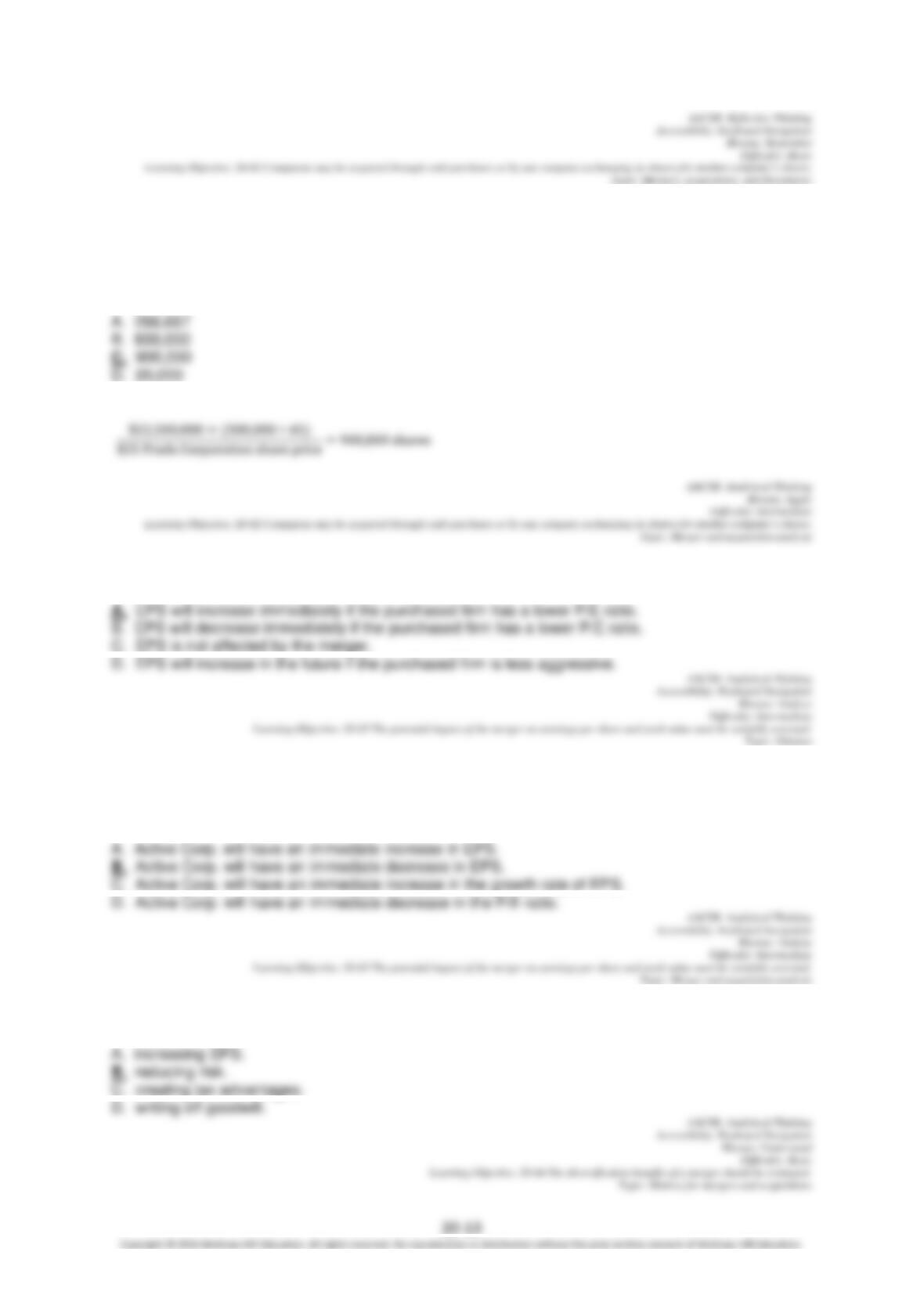
71. The Prada Corporation is considering a merger with the Stone Company, which has 500,000
outstanding shares selling for $30. An investment banker has advised that to succeed in its merger, Prada
Corp. would have to offer $45 per share for Stone’s stock. Currently, Prada Corp. stock is selling for $25.
How many shares of Prada Corp. stock would have to be exchanged to acquire all of Stone Company’s
stock?
72. Earnings per share of the purchasing firm usually goes in which direction during a merger?
73. In the event that Active Corp., which has a low P/E ratio, acquires Basic Corp., which has a higher P/E
ratio, we could be assured that one of the following would occur, with everything else being equal. Which
one would occur?
74. The portfolio effect in a merger has to do with
75. White knights
76. The price that a company has to pay to purchase another firm is usually
77. The typical merger premium is _______.
78. The two-step buyout is a recent merger ploy that has which of the following characteristics?
79. Under a two-step buyout procedure
20–15
80. In regard to two-step buyouts,
81. Which of the following is NOT a potential challenge to a merger?
82. Under the Financial Accounting Standards Board’s SFAS 141 and 142, which of the following
occurred?
83. Which of the following is NOT a method of avoiding a takeover?
Chapter 20 Test Bank – Static Summary
Category
# of Questions
AACSB: Analytical Thinking
26
AACSB: Ethics
1
AACSB: Reflective Thinking
92
Accessibility: Keyboard Navigation
118
Blooms: Analyze
1

20–16
Blooms: Apply
10
Blooms: Evaluate
2
Blooms: Remember
84
Blooms: Understand
21
Difficulty: Basic
53
Difficulty: Challenge
4
Difficulty: Intermediate
61
Learning Objective: 15-01 Investment bankers are intermediaries between corporations in need of funds and the
investing public. They also provide important advice.
45
Learning Objective: 15-02 Investment bankers, rather than corporations, normally take the risk of successfully
distributing corporate securities and for this there are costs involved..
42
Learning Objective: 15-03 Distribution of new securities may involve dilution in earnings per share.
11
Learning Objective: 15-04 Corporations turn to investment bankers and others in making the critical decision about
whether to go public (distribute their securities in the public markets) or stay private.
16
Learning Objective: 15-05 Leveraged buyouts rely heavily on debt in the restructuring of a corporation.
4
Topic: Basics of issuing securities
13
Topic: Costs of issuing securities
20
Topic: Dealers and brokers
1
Topic: Dilution
10
Topic: Ethics, governance, and regulation
1
Topic: Financial market regulation
5
Topic: Historical performance
3
Topic: Initial public offerings
8
Topic: International transactions
4
Topic: Private placements and leveraged buyouts
10
Topic: Raising capital
3
Topic: Types of offerings
8
Topic: Underwriting
32