
Chapter 20 – Income Inequality and Poverty
20-1
CHAPTER 20
Income Inequality and Poverty
A. Short-Answer, Essays, and Problems
1. How equal is the distribution of personal income by households in the United States?
2. Complete the following table of the distribution of personal income by households in a recent year. What
does the data indicate about the equality of income distribution in the United States?
(1)
Personal income
class
(2)
Percentage of all
households in this
class
(3)
Percentage of all
households in this and all
lower classes
Under $10,000
6
_____
$10,000–$14,999
5
_____
$15,000–$24,999
12
_____
$25,000–$34,999
12
_____
$35,000–$49,999
16
_____
$50,000–$74,999
21
_____
$75,000–$99,999
13
_____
$100,000 and over
15
_____
3. What is a Lorenz curve? How is it constructed?
4. How can the degree of income inequality be shown by a Lorenz curve?
5. Explain how the Gini ratio is measured and what it means.
6. How does the time dimension affect income inequality?
7. After looking at this year’s Census figures on income, your friend Eddie remarks disgustedly, “Income
inequality is such a major problem in this country.” How might you use the consideration of time to
temper his statement?
8. How do government programs affect the distribution of income in the United States?
9. The following table shows the percentage of income received by quintile. In the graph below, draw a
Lorenz curve using the before taxes and transfer data and a Lorenz curve for the after taxes and transfer
data. Label the Lorenz curves and each axis of the graph.
Percentage of income received, 1999
Quintile
Before taxes and
transfers
After taxes and
transfers
Lowest 20%
1.1
4.9
Second 20%
7.0
10.5
Third 20%
14.0
15.9
Fourth 20%
23.0
22.8
Highest 20%
54.8
46.0

Chapter 20 – Income Inequality and Poverty
20-2
10. List the various causes of income inequality in the United States.
11. How do preferences and risk contribute to income inequality?
12. Consider the following situations. Explain how each will affect the earning ability of those discussed.
(a) Lucy has always been more goal–oriented than her brother Frank. For example, during high school
Lucy wouldn’t hesitate to pull an all-nighter to make sure she was prepared for a test, while Frank
would only study until he got bored and decided to go out with his friends.
(b) Roger works as a dentist, while his friend Hugh is a policeman.
(c) Sarah and Jackie are roommates together in college and both are hoping to get into law school after
graduation. Sarah’s dad is a businessman and Jackie’s dad is a prominent lawyer.
13. What is the difference between income and wealth? How can wealth contribute to income inequality?
14. Is saying that “there is growing income inequality” just another way of saying that “the rich are getting
richer, and the poor are getting poorer”? Explain your answer.
15. What have been the trends in income inequality since 1970?
16. What factors have contributed to growing inequality in incomes in the United States?
17. (Consider This) Explain the importance in understanding the difference between income inequality and
consumption inequality.
18. What is the major argument in the case for income equality?
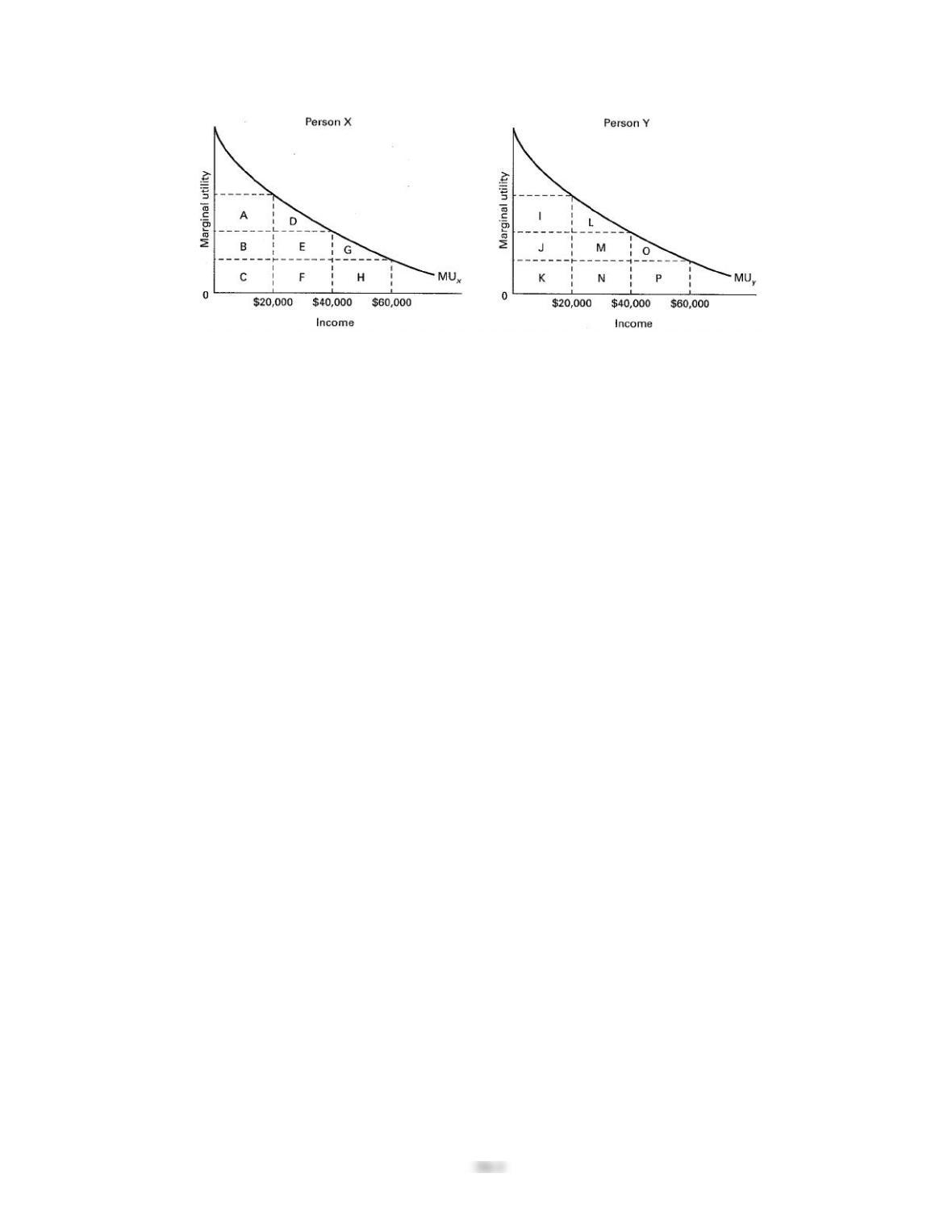
19. Answer the next two questions on the basis of the below diagrams which show identical “marginal utility
from income” curves from person X and person Y.
(a) If $80,000 in income is distributed such that person X has only $20,000 to spend and person Y has
$60,000 to spend, what will be the effect on marginal utilities?
(b) If the $80,000 in income were redistributed from situation A where person X spends $20,000 and
person Y spends $60,000 to a situation B where they both spend $40,000, what would the utility gain
or loss be for persons X and Y? Answer by specifying the areas in the graph.
Chapter 20 – Income Inequality and Poverty
20. What are the major arguments in the case for income inequality?
21. What is the argument for income inequality?
22. (Consider This) Use a pizza pie analogy to discuss the tradeoff between income equality and economic
efficiency.
23. Use a leaky bucket to discuss the tradeoff between income equality and economic efficiency.
24. Who are the poor in the United States? How many people and what groups are most affected by poverty?
25. What have been the poverty trends in the past forty-five years?
26. What are some measurement issues involved in accurately measuring poverty?
27. Evaluate and explain: “If poverty is defined as an absolute deficiency of income, the poor are far better off
today than they were four decades ago. But if poverty is viewed as relative deprivation, of being worse off
than the people to whom a poor person compares himself or herself, then poverty today may be more
painful than four decades ago.”
28. What is the difference between social insurance and public assistance in income maintenance programs?
What are examples of each type of government program?
29. At the present time Social Security beneficiaries are limited in the amount of income they can earn and still
receive full benefits. Should this limitation be abolished? Justify your answer.
30. “The welfare state is not a mechanism which provides something for nothing; every piece of social
insurance must be paid for.” Evaluate and explain. Can you think of any circumstances in which
unemployment compensation might provide “something for nothing?”
31. What are the merits and demerits of unemployment compensation as a built-in stabilizer? Can you think of
any changes in unemployment compensation that might improve its effectiveness as a stabilizing
technique?
32. What conditions gave rise to the Temporary Assistance to Needy Families (TANF) program?
33. What were four major provisions of the Temporary Assistance to Needy Families (TANF) reform of the
welfare system?
34. Define labor market discrimination. How much of the differences in the earnings of workers are explained
by discrimination?
35. What are four types of labor market discrimination?

Chapter 20 – Income Inequality and Poverty
20-4
36. How can discrimination be viewed as resulting from a preference or taste for which the prejudiced
employer is willing to pay? What will determine whether the prejudiced employer hires nonpreferred
workers in this model?
37. Suppose an employer is considering hiring either a white worker or an African-American worker for a
position. Consider the following conditions and decide which worker the employer is likely to hire.
(a) The employer is prejudiced against African-Americans and it costs him a disutility of $3/hour to hire
the African-American. Suppose the African-American is willing to work for $9/hour, while the white
worker will work for $11/hour. Whom will the employer hire?
(b) The employer is prejudiced against African-Americans and it costs him a disutility of $2/hour to hire
the African-American. Suppose the African-American is willing to now work for $8/hour, while the
white worker will work for $11/hour. Whom will the employer hire?
(c) The employer has no preference between the white and African-American workers. Suppose the
African-American and the white workers are both willing to work for $12 an hour. Whom will the
employer hire?
38. How might competition eradicate discrimination? Historically, has this been observed?
39. Explain the concept of statistical discrimination and give an example of it. How can it lead to
discrimination even in the absence of prejudice?
40. “Job discrimination may actually result from rational decision making on the part of firms and not because
of prejudice.” Explain this statement.
41. Describe the economic effects of occupational segregation on the wages of women and minorities. How
does this type of segregation affect the domestic output of the economy?
42. “Discrimination based on gender may cause a regrettable redistribution of income in favor of males and at
the expense of females, but it entails no loss to society as a whole.” Evaluate.
43. Suppose there are only three labor markets (A, B, and C) in the economy and each of these markets is
purely competitive. The table below contains the demand (or marginal-revenue-product) schedule for labor
in each of these three markets. Assume there are 24 million homogeneous workers in the economy and that
one-half of these workers are male and one-half are female.
Labor Markets A, B, and C
Wage rate (marginal revenue
product of labor per hour)
Quantity of labor
(millions per hour)
$13.00
4
12.00
5
11.00
6
10.00
7
9.00
8
8.00
9
7.00
10
6.00
11
5.00
12
(a) What would the wage rates be if the 12 million female workers could only work in labor market C
because of labor market discrimination, while half the 12 million male workers are employed in labor
market A and the other half in labor market B?
(b) Now what would happen to wage rates in each market if discrimination was eliminated and the
amounts of labor were equal in each market?
(c) What would happen to domestic output in each market and for society?
44. Describe the cost of discrimination to society. How is the cost of discrimination illustrated in a production
possibilities curve?
Chapter 20 – Income Inequality and Poverty
20-5
45. (Last Word) What happened to the median and average family wealth from 1995 to 2007? What happened
to the distribution of wealth over this period?
Chapter 20 – Income Inequality and Poverty
B. Answers to Short-Answer, Essays, and Problems
1. How equal is the distribution of personal income by households in the United States?
2. Complete the following table of the distribution of personal income by households in a recent year. What
does the data indicate about the equality of income distribution in the United States?
(1)
Personal income
class
(2)
Percentage of all
households in this
class
(3)
Percentage of all
households in this and all
lower classes
Under $10,000
6
_____
$10,000–$14,999
5
_____
$15,000–$24,999
12
_____
$25,000–$34,999
12
_____
$35,000–$49,999
16
_____
$50,000–$74,999
21
_____
$75,000–$99,999
13
_____
$100,000 and over
15
_____
Under $10,000
6
$10,000–$14,999
5
$15,000–$24,999
12
$25,000–$34,999
12
$35,000–$49,999
16
$50,000–$74,999
21
$75,000–$99,999
13
$100,000 and over
15
3. What is a Lorenz curve? How is it constructed?
Chapter 20 – Income Inequality and Poverty
20-7
4. How can the degree of income inequality be shown by a Lorenz curve?
5. Explain how the Gini ratio is measured and what it means.
6. How does the time dimension affect income inequality?
7. After looking at this year’s Census figures on income, your friend Eddie remarks disgustedly, “Income
inequality is such a major problem in this country.” How might you use the consideration of time to
temper his statement?
8. How do government programs affect the distribution of income in the United States?
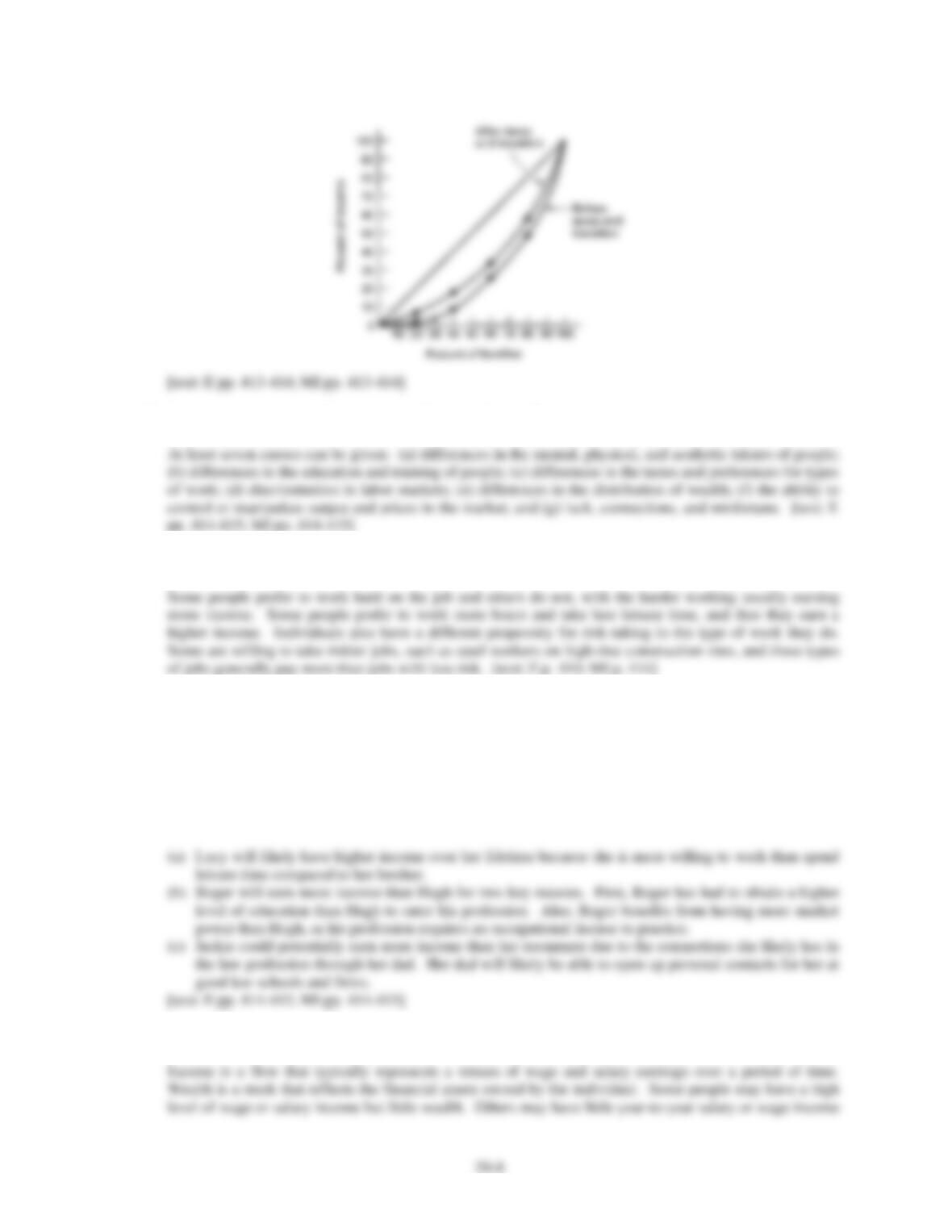
9. The following table shows the percentage of income received by quintile. In the graph below, draw a
Lorenz curve using the before taxes and transfer data and a Lorenz curve for the after taxes and transfer
data. Label the Lorenz curves and each axis of the graph.
Percentage of income received, 2008
Quintile
Before taxes and
transfers
After taxes and
transfers
Lowest 20%
0.9
4.2
Second 20%
7.0
10.5
Third 20%
14.5
16.4
Fourth 20%
24.2
24.1
Highest 20%
53.5
44.8
Chapter 20 – Income Inequality and Poverty
10. List the various causes of income inequality in the United States.
11. How do preferences and risk contribute to income inequality?
12. Consider the following situations. Explain how each will affect the earning ability of those discussed.
(a) Lucy has always been more goal-oriented than her brother Frank. For example, during high school
Lucy wouldn’t hesitate to pull an all-nighter to make sure she was prepared for a test, while Frank
would only study until he got bored and decided to go out with his friends.
(b) Roger works as a dentist, while his friend Hugh is a policeman.
(c) Sarah and Jackie are roommates together in college and both are hoping to get into law school after
graduation. Sarah’s dad is a businessman and Jackie’s dad is a prominent lawyer.
13. What is the difference between income and wealth? How can wealth contribute to income inequality?
Chapter 20 – Income Inequality and Poverty
14. Is saying that “there is growing income inequality” just another way of saying that “the rich are getting
richer, and the poor are getting poorer”? Explain your answer.
15. What have been the trends in income inequality since 1970?
16. What factors have contributed to growing inequality in incomes in the United States?
17. (Consider This) Explain the importance in understanding the difference between income inequality and
consumption inequality.
18. What is the major argument in the case for income equality?
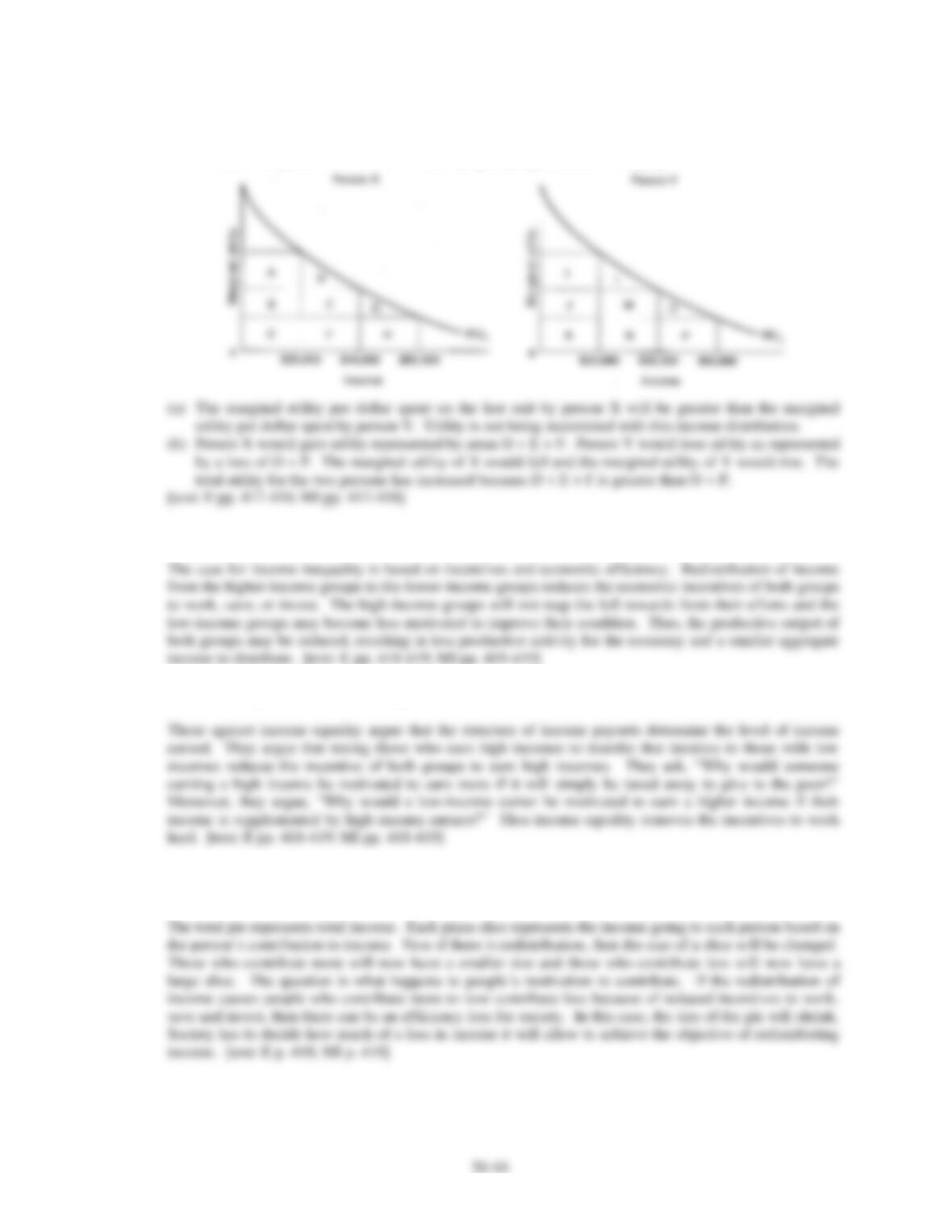
19. Answer the next two questions on the basis of the below diagrams which show identical “marginal utility
from income” curves from person X and person Y.
Chapter 20 – Income Inequality and Poverty
(b) If the $80,000 in income were redistributed from situation A where person X spends $20,000 and
person Y spends $60,000 to a situation B where they both spend $40,000, what would the utility gain
or loss be for persons X and Y? Answer by specifying the areas in the graph.
20. What are the major arguments in the case for income inequality?
21. What is the argument for income inequality?
22. (Consider This) Use a pizza pie analogy to discuss the tradeoff between income equality and economic
efficiency.
Chapter 20 – Income Inequality and Poverty
20–11
23. Use a leaky bucket to discuss the tradeoff between income equality and economic efficiency.
24. Who are the poor in the United States? How many people and what groups are most affected by poverty?
25. What have been the poverty trends in the past forty-five years?
26. What are some measurement issues involved in accurately measuring poverty?
27. Evaluate and explain: “If poverty is defined as an absolute deficiency of income, the poor are far better off
today than they were four decades ago. But if poverty is viewed as relative deprivation, of being worse off
than the people to whom a poor person compares himself or herself, then poverty today may be more
painful than four decades ago.”
Chapter 20 – Income Inequality and Poverty
28. What is the difference between social insurance and public assistance in income maintenance programs?
What are examples of each type of government program?
29. At the present time Social Security beneficiaries are limited in the amount of income they can earn and still
receive full benefits. Should this limitation be abolished? Justify your answer.
30. “The welfare state is not a mechanism which provides something for nothing; every piece of social
insurance must be paid for.” Evaluate and explain. Can you think of any circumstances in which
unemployment compensation might provide “something for nothing?”
31. What are the merits and demerits of unemployment compensation as a built-in stabilizer? Can you think of
any changes in unemployment compensation that might improve its effectiveness as a stabilizing
technique?
Chapter 20 – Income Inequality and Poverty
32. What conditions gave rise to the Temporary Assistance to Needy Families (TANF) program?
33. What were four major provisions of the Temporary Assistance to Needy Families (TANF) reform of the
welfare system?
34. Define labor market discrimination. How much of the differences in the earnings of workers are explained
by discrimination?
35. What are four types of labor market discrimination?
36. How can discrimination be viewed as resulting from a preference or taste for which the prejudiced
employer is willing to pay? What will determine whether the prejudiced employer hires nonpreferred
workers in this model?
Chapter 20 – Income Inequality and Poverty
37. Suppose an employer is considering hiring either a white worker or an African-American worker for a
position. Consider the following conditions and decide which worker the employer is likely to hire.
(a) The employer is prejudiced against African-Americans and it costs him a disutility of $3/hour to hire
the African-American. Suppose the African-American is willing to work for $9/hour, while the white
worker will work for $11/hour. Whom will the employer hire?
(b) The employer is prejudiced against African-Americans and it costs him a disutility of $2/hour to hire
the African-American. Suppose the African-American is willing to now work for $8/hour, while the
white worker will work for $11/hour. Whom will the employer hire?
(c) The employer has no preference between the white and African-American workers. Suppose the
African-American and the white workers are both willing to work for $12 an hour. Whom will the
employer hire?
38. How might competition eradicate discrimination? Historically, has this been observed?
39. Explain the concept of statistical discrimination and give an example of it. How can it lead to
discrimination even in the absence of prejudice?
40. “Job discrimination may actually result from rational decision making on the part of firms and not because
of prejudice.” Explain this statement.
Chapter 20 – Income Inequality and Poverty
20–15
41. Describe the economic effects of occupational segregation on the wages of women and minorities. How
does this type of segregation affect the domestic output of the economy?
42. “Discrimination based on gender may cause a regrettable redistribution of income in favor of males and at
the expense of females, but it entails no loss to society as a whole.” Evaluate.
43. Suppose there are only three labor markets (A, B, and C) in the economy and each of these markets is
purely competitive. The table below contains the demand (or marginal-revenue-product) schedule for labor
in each of these three markets. Assume there are 24 million homogeneous workers in the economy and that
one-half of these workers are male and one-half are female.
Labor Markets A, B, and C
Wage rate (marginal revenue
product of labor per hour)
Quantity of labor
(millions per hour)
$13.00
4
12.00
5
11.00
6
10.00
7
9.00
8
8.00
9
7.00
10
6.00
11
5.00
12
(a) What would the wage rates be if the 12 million female workers could only work in labor market C
because of labor market discrimination, while half the 12 million male workers are employed in labor
market A and the other half in labor market B?
(b) Now what would happen to wage rates in each market if discrimination was eliminated and the
amounts of labor were equal in each market?
(c) What would happen to domestic output in each market and for society?
Chapter 20 – Income Inequality and Poverty
20–16
44. Describe the cost of discrimination to society. How is the cost of discrimination illustrated in a production
possibilities curve?
45. (Last Word) What happened to the median and average family wealth from 1995 to 2007? What happened
to the distribution of wealth over this period?