Microeconomics, 12e (Parkin)
Chapter 20 Uncertainty and Information
1 Decisions in the Face of Uncertainty
1) Expected wealth is a weighted average in which the weights are
A) average utilities.
B) marginal utilities.
C) total utilities.
D) probabilities.
2) For a risk averse person, an increase in wealth brings ________ total utility of wealth and
________ marginal utility of wealth.
A) higher; higher
B) higher; lower
C) lower; higher
D) lower; lower
3) A risk averse person’s utility of wealth curve has a
A) positive slope and becomes steeper to the right.
B) positive slope and becomes flatter to the right.
C) negative slope and becomes steeper to the right.
D) negative slope and becomes flatter to the right.
4) For a risk averse person, the marginal utility of wealth
A) decreases as wealth increases.
B) increases as wealth increases.
C) decreases as wealth decreases.
D) remains constant as wealth increases.
5) The assumption that the marginal utility of wealth diminishes implies that
A) total utility falls when wealth increases.
B) the marginal utility of wealth is negative.
C) total utility increases with wealth and each additional unit of wealth increases total utility by a
smaller amount.
D) total utility increases with wealth and each additional unit of wealth increases total utility by
the same amount.
6) Assuming that the marginal utility of wealth diminishes implies that
A) you have more total utility with $100 than with $1,000.
B) you have more total utility with $1,000 than with $1,001.
C) an additional dollar increases your total utility more if you only have $100 than if you have
$1,000.
D) an additional dollar does not increase your total utility regardless of your wealth.
7) If Ringo is risk averse, at a wealth of $200,000 his utility of wealth curve has a ________
slope and his marginal utility of wealth is ________ than at a wealth of $100,000.
A) negative; smaller
B) negative; larger
C) positive; smaller
D) positive; larger
8) An increase in Meta’s wealth from $3,000 to $6,000 raises her utility from 80 units to 100
units. If she is risk averse, with a wealth of $9,000 her utility might be
A) 99 units.
B) 114 units.
C) 120 units.
D) 126 units.
9) An increase in Todd’s wealth from $2 million to $4 million raises his utility from 400 units to
500 units. If he has a utility of wealth curve with the typical shape showing risk aversion, then
with a wealth of $6 million his utility might be
A) 500 units.
B) 570 units.
C) 600 units.
D) 620 units.
10) Diminishing marginal utility of wealth leads to risk aversion because at a given level of
wealth a dollar gained
A) is worth more in additional utility than a dollar lost.
B) is worth less in additional utility than a dollar lost.
C) is worth as much in additional utility as a dollar lost.
D) does not add to total utility.
11) George is considering buying shares of Intel. If the company does well, he will gain $100,
but if the company does poorly, he will lose $100. George is risk averse, so for George the
magnitude of the pain of losing $100 will ________ the pleasure of gaining $100.
A) equal
B) be less than
C) be greater than
D) None of the above answers are correct because we cannot compare the pain of losing to the
pleasure of gaining.
12) For a risk-averse individual, as wealth increases, total utility ________ and marginal utility
________.
A) increases; increases
B) increases; decreases
C) decreases; increases
D) decreases; decreases
13) For a risk-averse individual, as wealth increases, total utility
A) increases at a decreasing rate.
B) increases at a constant rate.
C) increases at an increasing rate.
D) is constant.
14) The slope of the utility of wealth curve of a risk-averse person
A) increases as wealth increases.
B) decreases as wealth increases.
C) is constant.
D) is negative.
15) A risk-averse person’s marginal utility of wealth
A) increases as wealth increases.
B) decreases as wealth increases.
C) is constant.
D) is negative.
16) Expected utility is a weighted average in which the weights are
A) average incomes.
B) marginal incomes.
C) total incomes.
D) probabilities.
17) Pedro’s utility of wealth is 6 units for $10,000 and 10 units for $20,000. A friend gave him a
lottery ticket for his birthday. The ticket won, giving him either $10,000 with probability 0.5 or
$20,000 with probability 0.5. Pedro’s expected utility from the lottery ticket is
A) between 6 and 8 units.
B) equal to 8 units.
C) between 8 and 10 units.
D) equal to 10 units.
18) You took a summer job as a salesperson in a shoe store with the knowledge that you will
either make $2,000 or $3,500 with probabilities 0.4 and 0.6 respectively. What is your expected
income for the summer job?
A) $2,000
B) $3,000
C) $5,000
D) $2,900
19) If an individual has a 0.3 probability of receiving $10 and a 0.7 probability of receiving $20,
the expected income is
A) $20.
B) $7.
C) $14.
D) $17.
20) Jason is a Web page designer. He estimates that this summer, he has a 0.6 probability of
making $10,000 and a 0.4 probability of making only $2,000. What is Jason’s expected income
this summer?
A) $12,000
B) $6,800
C) $6,000
D) $10,000
21) Christy is a telemarketer. She estimates that this summer, she has a 0.2 probability of earning
$10,000, a 0.5 probability of earning $5,000, and a 0.3 probability of earning only $1,000. What
is Christy’s expected income?
A) $7,256
B) $5,333
C) $4,800
D) $4,000
22) Dana wants to try working as an independent contractor this summer. She has a 50 percent
chance that she will make $10,000 and 50 percent chance that she will make nothing. What’s
Dana’s expected income from taking this job?
A) $10,000
B) $7,000
C) $5,000
D) zero
23) Adriana wants to try working as an independent contractor this summer. She has a 50 percent
chance that she will make $9,000 and 50 percent chance that she will make nothing. What’s
Adriana’s expected income?
A) $4,000
B) $4,500
C) $2,000
D) $3,000
24) Joe is contemplating a job where, with probability 0.6, he will make $100,000 and with
probability 0.4 he will make $30,000. What is Joe’s expected income from taking the job?
A) $12,000
B) $60,000
C) $72,000
D) $90,000
25) You took a job as a salesperson in an insurance company with the knowledge that you have
0.5 chance of making $2,000 a month or $3,000 a month. How much will you make each month?
A) definitely $2,500
B) definitely $2,000
C) definitely $3,000
D) either $2,000 or $3,000
26) Hostess Brands is selling off its assets after liquidation. A potential buyer for the Twinkies
brand has found that the total revenue will be $3 billion a year if the brand is managed well and
$1 billion a year if the brand is managed poorly. There is .6 (or 60 percent) chance of managing
the brand well and a .4 (or 40 percent) chance of managing the brand poorly. What is the
expected total revenue?
A) $0.4 billion
B) $1.2 billion
C) $1.8 billion
D) $2.2 billion
Income
(dollars)
Total
utility
0
0
100
100
200
150
300
175
400
190
500
198
600
200
27) James has a utility of wealth schedule in the above table. He is offered a job selling video
games at Games Galore. James’ compensation depends on how much he sells. In a poor sales
period, a salesperson makes $100 per month. In a good sales period, a salesperson makes $600
per month. James is told by the manager that, in any given month, there is a 25 percent chance of
a poor sales period and a 75 percent chance of a good sales period. What is James’ expected
income from taking this job?
A) $100
B) $350
C) $475
D) $600
28) James has a utility of wealth schedule in the above table. He is offered a job selling video
games at Games Galore. James’ compensation depends on how much he sells. In a poor sales
period, a salesperson makes $100 per month. In a good sales period, a salesperson makes $600
per month. James is told by the manager that, in any given month, there is a 25 percent chance of
a poor sales period and a 75 percent chance of a good sales period. What is James’ expected
utility from taking this job?
A) 100
B) 150
C) 175
D) 200
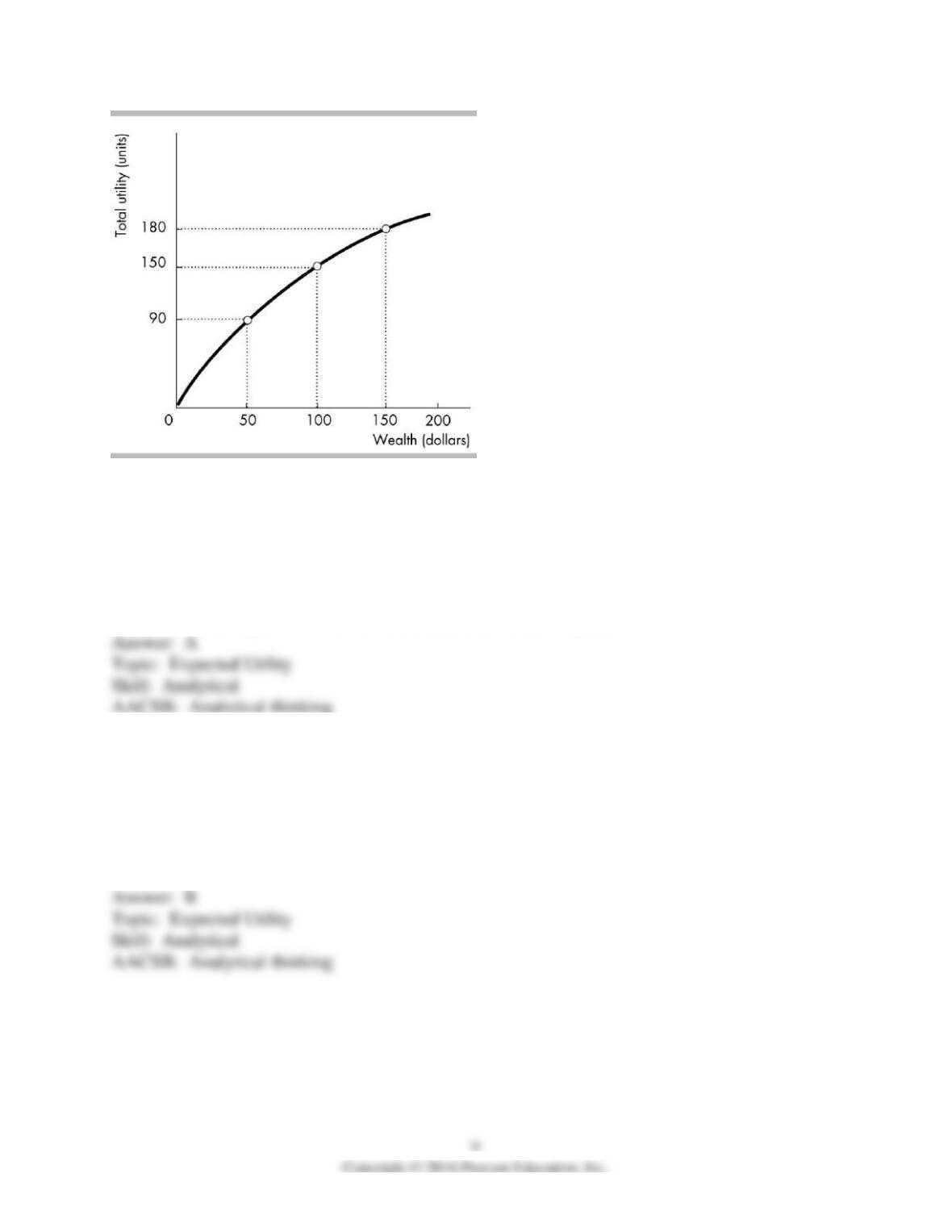
29) Nancy’s utility of wealth curve is given in the above figure. Option A gives Nancy $100 for
sure. Option B gives Nancy $50 half the time and $150 half the time. Nancy’s expected utility of
option A
A) is greater than the expected utility of option B.
B) is the same as the expected utility of option B.
C) is less than the expected utility of option B.
D) could be either greater or less than the expected utility of option B.
30) Nancy’s utility of wealth curve is given in the above figure. She is faced with a risky
proposition which yields an income of $50 one-third of the time, $100 one-third of the time, and
$150 one-third of the time. Her expected utility is
A) 100.
B) 140.
C) 150.
D) 420.
31) Dana’s utility of wealth is 65 units at $3,000, 80 units at $5,000, and 95 units at $9,000.
Starting from zero wealth, he must choose between options A and B. Option A gives him $5,000
for sure. Option B gives him $3,000 with probability 0.5 or $9,000 with probability 0.5. Dana
will
A) choose option A.
B) choose option B.
C) be indifferent between option A and option B because they have the same risk.
D) be indifferent between option A and option B because they have the same expected utility.
32) Jessica must choose option A or option B. Option A gives her $10,000 for sure. Option B
gives her $5,000 if a fair coin toss shows heads and $15,000 if it shows tails. If Jessica is risk
averse her utility of wealth curve becomes
A) flatter as her wealth increases and she will choose option A.
B) flatter as her wealth increases and she will choose option B.
C) steeper as her wealth increases and she will choose option A.
D) steeper as her wealth increases and she will choose option B.
33) Pablo must choose among options A, B, and C. Option A gives him $10,000 for sure. Option
B gives him $4,000 with probability 0.5 or $16,000 with probability 0.5. Option C gives him
$8,000 with probability 0.5 or $12,000 with probability 0.5. If he receives diminishing marginal
utility from wealth, Pablo will
A) choose option A.
B) choose option B.
C) choose option C.
D) be indifferent among options A, B, and C.
34) Nick has two job offers, one as a financial planner and one as an economist for a regional
bank. The income that Nick would expect to earn as a financial planner depends how effective he
is in getting clients. He estimates that he would receive either $80,000 and a utility of 75, with a
probability of .50, or he would earn $30,000 and a utility of 35, with a probability of .50. The
economist job would pay $45,000 per year and has a utility of 55. The expected income as a
financial planner is ________ and as an economist is ________.
A) $60,000; $45,000
B) 55; 55
C) $80,000 and $30,000; $45,000
D) $55,000; $45,000
35) Nick has two job offers, one as a financial planner and one as an economist for a regional
bank. The income that Nick would expect to earn as a financial planner depends how effective he
is in getting clients. He estimates that he would receive either $80,000 and a utility of 75, with a
probability of .50, or he would earn $30,000 and a utility of 35, with a probability of .50. The
economist job would pay $45,000 per year and has a utility of 55. To maximize his expected
utility, which job should Nick take?
A) Nick is indifferent between the two jobs.
B) Nick is better off if he takes the economist job.
C) Nick is better off if he takes the job of financial planner.
D) Nick should look around for another job.
Wealth
(thousands of
dollars)
Total utility
0
0
10
50
20
90
30
120
40
140
36) Gunnar can work as a campus security officer at a guaranteed salary of $20,000 per year or
as a real estate agent. If Gunnar works as a real estate agent, there is a 50 percent chance that he
will earn $10,000 per year and a 50 percent chance that he will earn $30,000 per year. Based on
the table above, Gunnar’s expected utility if he works as a real estate agent is
A) 170.
B) 85.
C) 20.
D) 90.
37) Gunnar can work as a campus security officer at a guaranteed salary of $20,000 per year or
as a real estate agent. If Gunnar works as a real estate agent, there is a 50 percent chance that he
will earn $10,000 per year and a 50 percent chance that he will earn $30,000 per year. Based on
the above table, to maximize his expected utility, Gunnar will
A) choose to work as a campus security officer.
B) choose to work as a real estate agent.
C) be indifferent between being a campus security officer and being a real estate agent.
D) It is impossible to tell which job he would prefer without additional information.
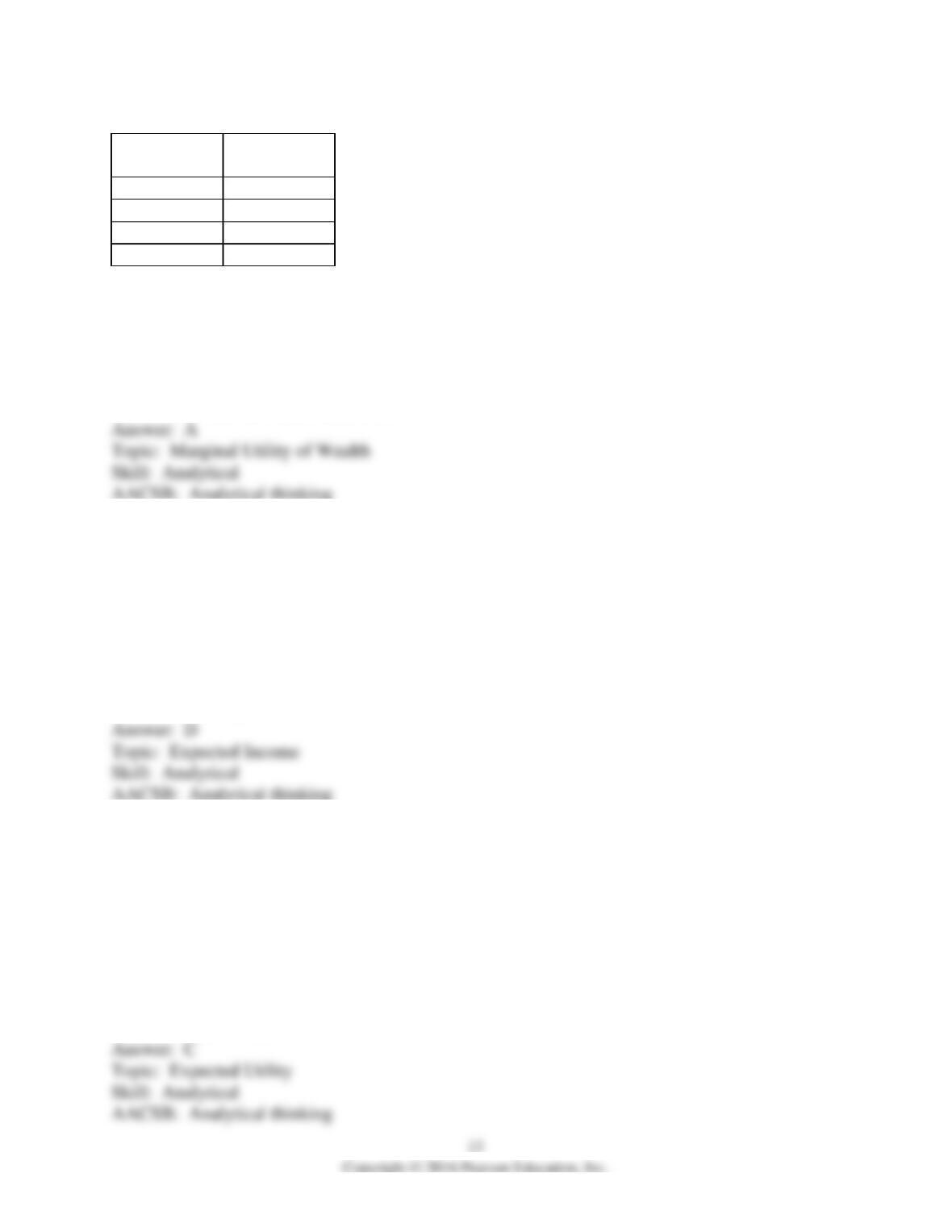
Wealth
(dollars)
Total
utility
5,000
130
10,000
170
15,000
190
20,000
200
38) Andrew’s utility of wealth schedule is given in the above table. The table indicates that his
marginal utility of wealth ________ as his wealth increases.
A) diminishes
B) is constant
C) increases
D) increases first and then diminishes
39) Andrew’s utility of wealth schedule is given in the above table. Andrew is offered a job as a
cook which pays $10,000. He is also offered a job as a server which will pay $5,000 if tips are
poor and $15,000 if tips are good. There is a 50 percent chance that tips will be poor and a 50
percent chance that tips will be good. The expected income from the job as a cook is ________
and from the job as a server is ________.
A) $10,000; $15,000
B) $5,000; $5,000
C) $10,000; $5,000
D) $10,000; $10,000
40) Andrew’s utility of wealth schedule is depicted in the above table. Andrew is offered a job as
a cook which pays $10,000. He is also offered a job as a server which will pay $5,000 if tips are
poor and $15,000 if tips are good. There is a 50 percent chance that tips will be poor and a 50
percent chance that tips will be good. Given the nature of Andrew’s job offers and his utility of
wealth schedule, Andrew’s expected utility from working as a cook is ________ and from
working as a server is ________.
A) 170 units; 170 units
B) 130 units; 190 units
C) 170 units; 160 units
D) 200 units; 190 units
41) Andrew’s utility of wealth schedule is depicted in the above table. Andrew is offered a job as
a cook which pays $10,000. He is also offered a job as a server which will pay $5,000 if tips are
poor and $15,000 if tips are good. There is a 50 percent chance that tips will be poor and a 50
percent chance that tips will be good. Andrew will accept the offer that
A) maximizes his expected income.
B) maximizes his expected utility.
C) maximizes both his expected income and expected utility.
D) has the highest weighted average of income and utility.
42) Andrew’s utility of wealth schedule is depicted in the above table. Andrew is offered a job as
a cook which pays $10,000. He is also offered a job as a server which will pay $5,000 if tips are
poor and $15,000 if tips are good. There is a 50 percent chance that tips will be poor and a 50
percent chance that tips will be good. Given the nature of Andrew’s job offers and his utility of
wealth schedule, Andrew will
A) accept the offer to work as a server.
B) accept the offer to work as a cook.
C) be indifferent between working as a cook or a server.
D) be unable to reach a decision about which offer to accept.
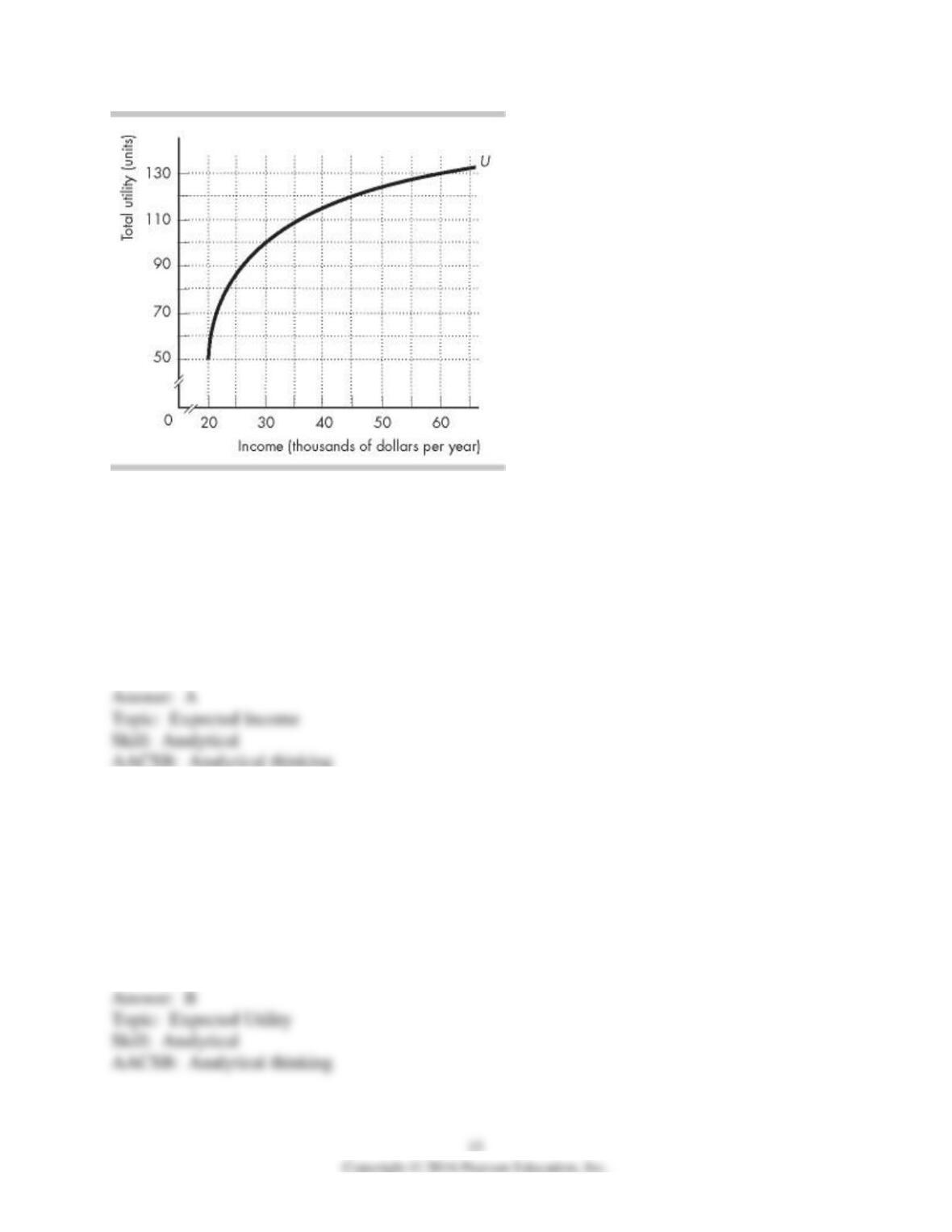
43) Lucy works as a college instructor for a fixed annual salary of $30,000. She is considering
quitting this job and becoming a real estate broker. Lucy believes that as a realtor she has a 40
percent chance to make $60,000 per year and a 60 percent chance to make $25,000 a year. The
figure above shows Lucy’s total utility of wealth curve (U). Lucy’s expected annual income from
real estate brokerage is
A) $39,000.
B) $42,500.
C) $33,000.
D) $47,500.
44) Lucy works as a college instructor for a fixed annual salary of $30,000. She is considering
quitting this job and becoming a real estate broker. Lucy believes that as a realtor she has a 40
percent chance to make $60,000 per year and a 60 percent chance to make $25,000 a year. The
figure above shows Lucy’s total utility of wealth curve (U). Lucy’s expected utility from real
estate brokerage is
A) 117.
B) 103.
C) 110.
D) 93.
45) Lucy works as a college instructor for a fixed annual salary of $30,000. She is considering
quitting this job and becoming a real estate broker. Lucy believes that as a realtor she has a 40
percent chance to make $60,000 per year and a 60 percent chance to make $25,000 a year. The
figure above shows Lucy’s total utility of wealth curve (U). Lucy will decide to ________ and
she will definitely make this choice because it gives her a greater expected ________.
A) keep her current job; income
B) keep her current job; utility
C) quit her job and become a realtor; utility
D) quit her job and become a realtor; income
46) Lucy works as a college instructor for a fixed annual salary of $30,000. She is considering
quitting this job and becoming a real estate broker. Lucy believes that as a realtor she has a 40
percent chance to make $60,000 per year and a 60 percent chance to make $25,000 a year. The
figure above shows Lucy’s total utility of wealth curve (U). Of the following, what minimum
salary raise (if any) should Lucy’s current employer offer her to persuade her to stay?
A) No raise is necessary as Lucy is better off with her current salary than with her expected
income as a realtor.
B) $8,000
C) $5,000
D) $3,000
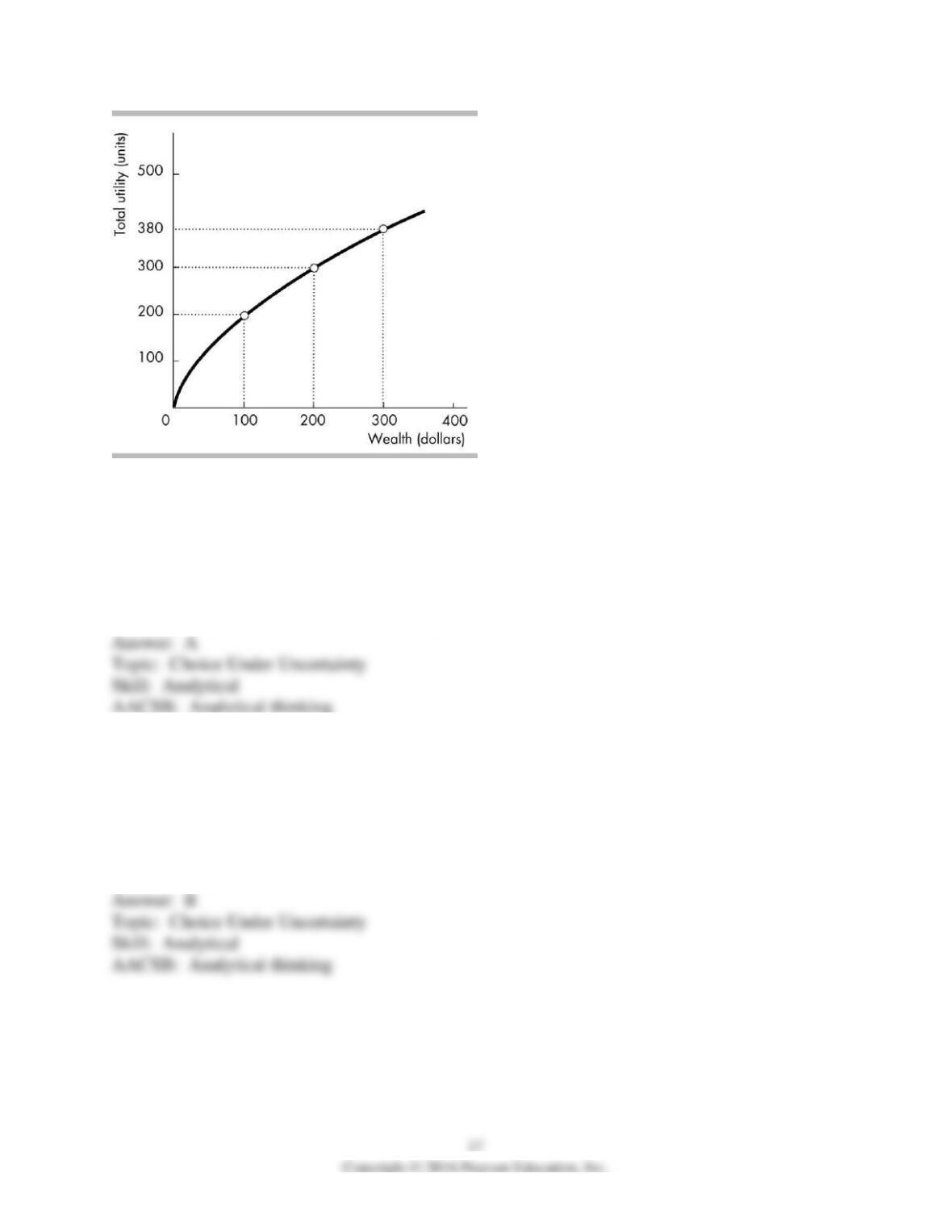
47) Marylou, whose utility of wealth curve is shown in the figure above, faces two options.
Option A yields her $200 for sure. Option B has a 0.4 probability of yielding $100 and a 0.6
probability of yielding $300. Marylou
A) picks option A.
B) picks option B.
C) is indifferent between option A and option B.
D) needs more information to make a choice.
48) Marylou, whose utility of wealth curve is shown in the figure above, faces two options.
Option A yields $200 for sure. Option B has a 0.3 probability of yielding $100, and a 0.7
probability of yielding $300. Marylou, who is
A) picks option A.
B) picks option B.
C) is indifferent between option A and option B.
D) needs more information to make a choice.
49) Stan, who is risk averse, can invest in project A or project B. Project A returns $3,000 with
probability 1/2 and $9,000 with probability 1/2. Project B returns nothing with probability 1/2
and $12,000 with probability 1/2. For Stan, project A has
A) greater expected wealth and greater expected utility than project B.
B) lower expected wealth and lower expected utility than project B.
C) the same expected wealth and the same expected utility as project B.
D) the same expected wealth but higher expected utility than project B.
50) Mel’s utility of wealth is 130 units at $3,000, 160 units at $5,000, and 190 units at $9,000.
Starting from zero wealth, he must choose between options A and B. Option A gives him $5,000
for sure. Option B gives him $3,000 with probability 0.4 or $9,000 with probability 0.6. Mel
A) will choose A.
B) will choose B.
C) is indifferent between A and B.
D) needs more information to make a choice.
51) Rhonda’s utility of wealth is 65 units at $5,000, 80 units at $7,000, and 95 units at $10,000.
Starting from zero wealth, she must choose between options A and B. Option A gives her $7,000
for sure. Option B gives her $5,000 with probability 0.6 or $10,000 with probability 0.4. Rhonda
A) will choose A.
B) will choose B.
C) is indifferent between A and B.
D) needs more information to make a choice.
52) The cost of risk is the amount by which expected wealth must increase to give the same
________ as a no-risk situation.
A) marginal wealth
B) marginal utility
C) expected utility
D) expected wealth
53) If Shaniq is a risk averse, then
A) her cost of risk exceeds $0.
B) she has diminishing marginal utility of wealth.
C) she is willing to buy insurance if the cost of insurance is low enough.
D) all of the above.
54) If Pearl is a risk averse, then
A) expected utility has nothing to do with her choices.
B) she does not have diminishing marginal utility of wealth.
C) she will not buy insurance.
D) risk is costly to her.
55) Option A provides $9,000 with probability 50 percent or $11,000 with probability 50
percent. Option B provides $8,000 with probability 50 percent or $12,000 with probability 50
percent. For most people the cost of risk associated with B is
A) less than that associated with A.
B) the same as that associated with A.
C) exactly twice that associated with A.
D) more than twice that associated with A.
56) Kedran is indifferent between option A, which gives her $10,000 for sure, and option B,
which gives her $5,000 with probability 0.4 or $15,000 with probability 0.6. Kedran’s cost of risk
for option B is
A) zero.
B) $1,000.
C) $5,000.
D) $10,000.
57) Nicole is indifferent between option A, which gives her $20,000 for sure, and option B,
which gives her $10,000 with probability 0.5 or $32,000 with probability 0.5. Nicole’s cost of
risk for option B is
A) zero.
B) $1,000.
C) $2,000.
D) $20,000.
58) Goldie is indifferent between option A, which gives her $9,000 for sure, and option B, which
gives her $3,000 with probability 1/3 or $18,000 with probability 2/3. Goldie’s cost of risk for
option B is
A) zero.
B) $1,000.
C) $3,000.
D) $4,000.
Wealth
(dollars)
Jimmy’s total
utility (units)
0
0
100
200
200
300
300
350
400
375
500
387
600
393
700
396
59) Of the choices given below, Jimmy, whose utility of wealth schedule is given above, prefers
A) option A: $300 with certainty.
B) option B: 50 percent chance of $200 and 50 percent chance of $400.
C) option C: 50 percent chance of $200 and 50 percent chance of $700.
D) option D: 90 percent chance of $400 and 10 percent chance of $0.