Chapter 20 Test Bank KEY
1. One reason governments impose taxes is to:
2. One of the primary aims of taxation is:
3. Many tax-funded programs are intended to:
4. Which of the following is not an example of a commonly tax-funded program?
5. An example of a tax-funded program primarily intended to stimulate economic growth is the:
6. An example of a tax-funded program intended to provide basic human needs is the provision of:
7. In deciding which programs the government should fund with tax revenues there is:
8. Taxes change behavior for all of the following reasons except they:
9. When a tax is present in a market, the price paid by consumers:
10. An example of a tax specifically designed to reduce consumption of a good is a tax on:
11. An example of a tax specifically designed to reduce consumption of a good is a tax on:
12. The primary intent of the tax on tobacco is to:
13. When a tax alters consumers’ incentives, it is:
14.
20-4
15.
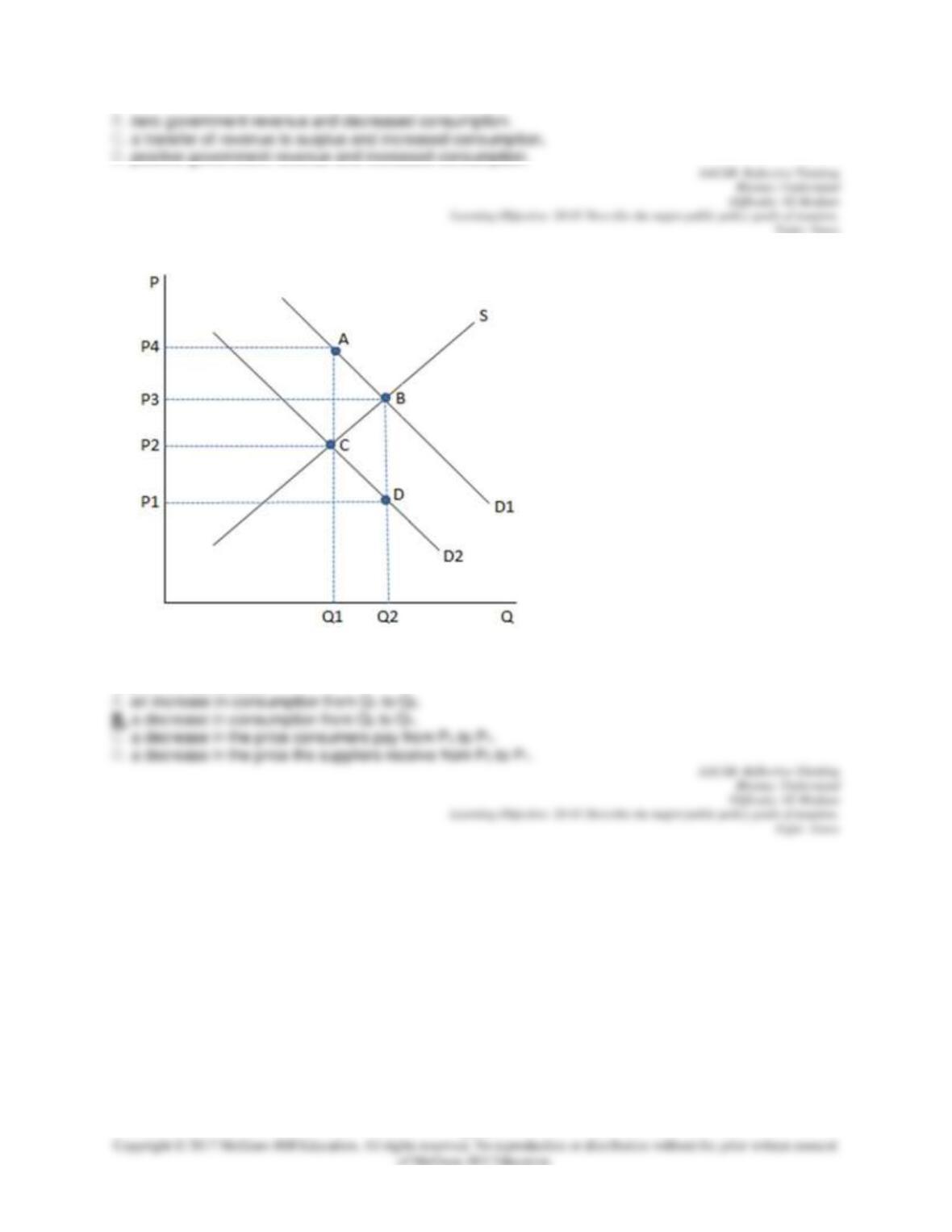
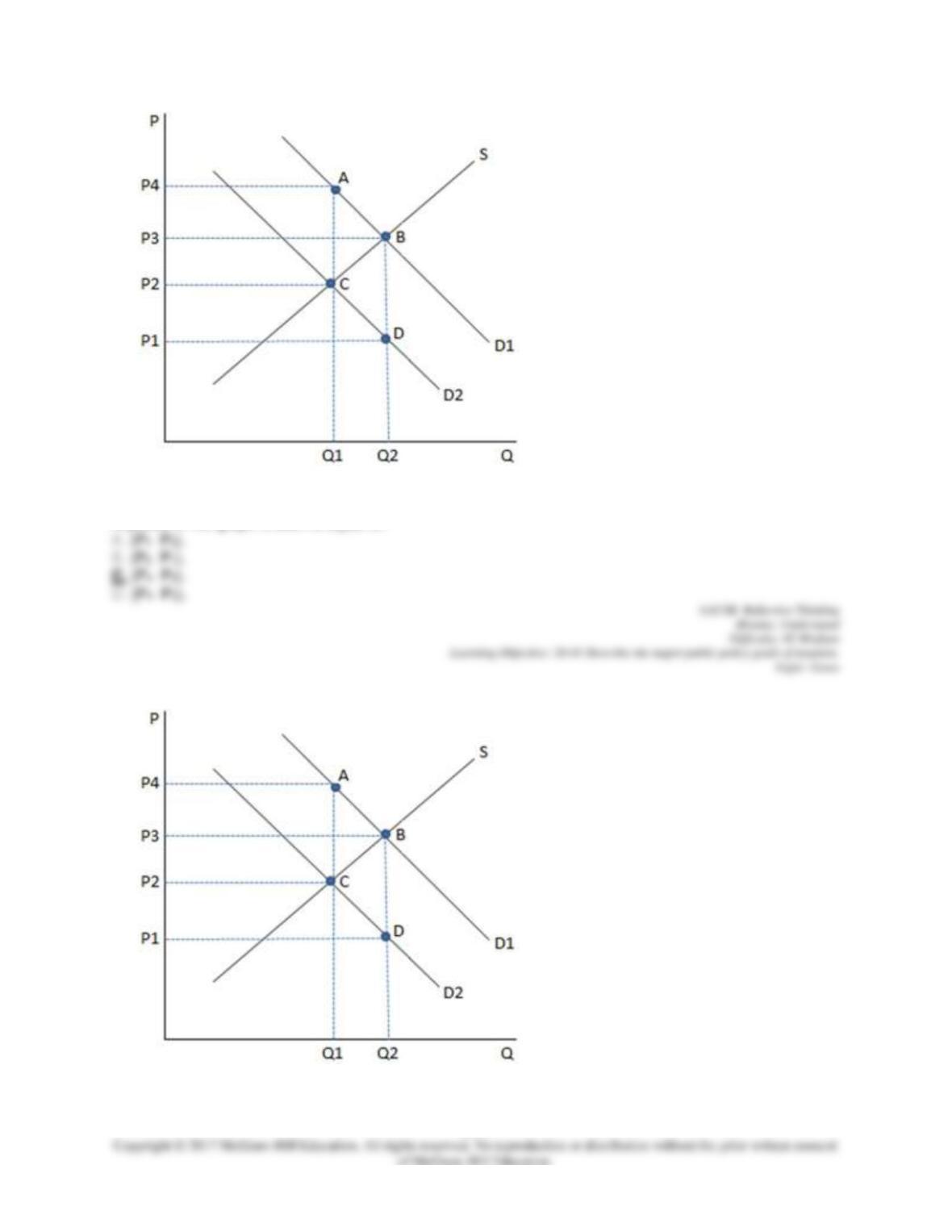
This graph depicts a tax being imposed, causing demand to shift from D1 to D2. According to the graph
shown, the tax caused:
20-5
16.
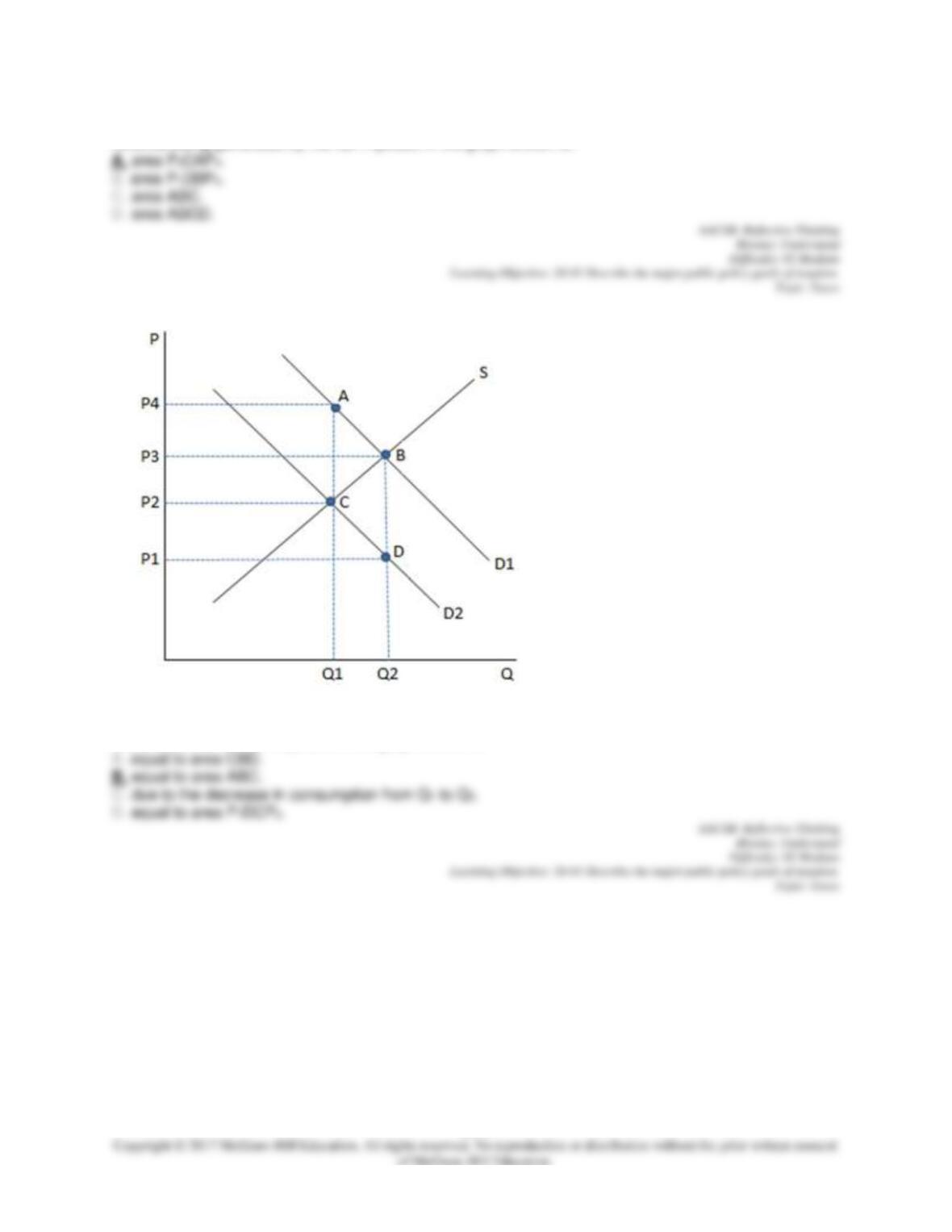
This graph depicts a tax being imposed, causing demand to shift from D1 to D2. The amount of the tax
imposed in the graph shown is equal to:
17.
20-6
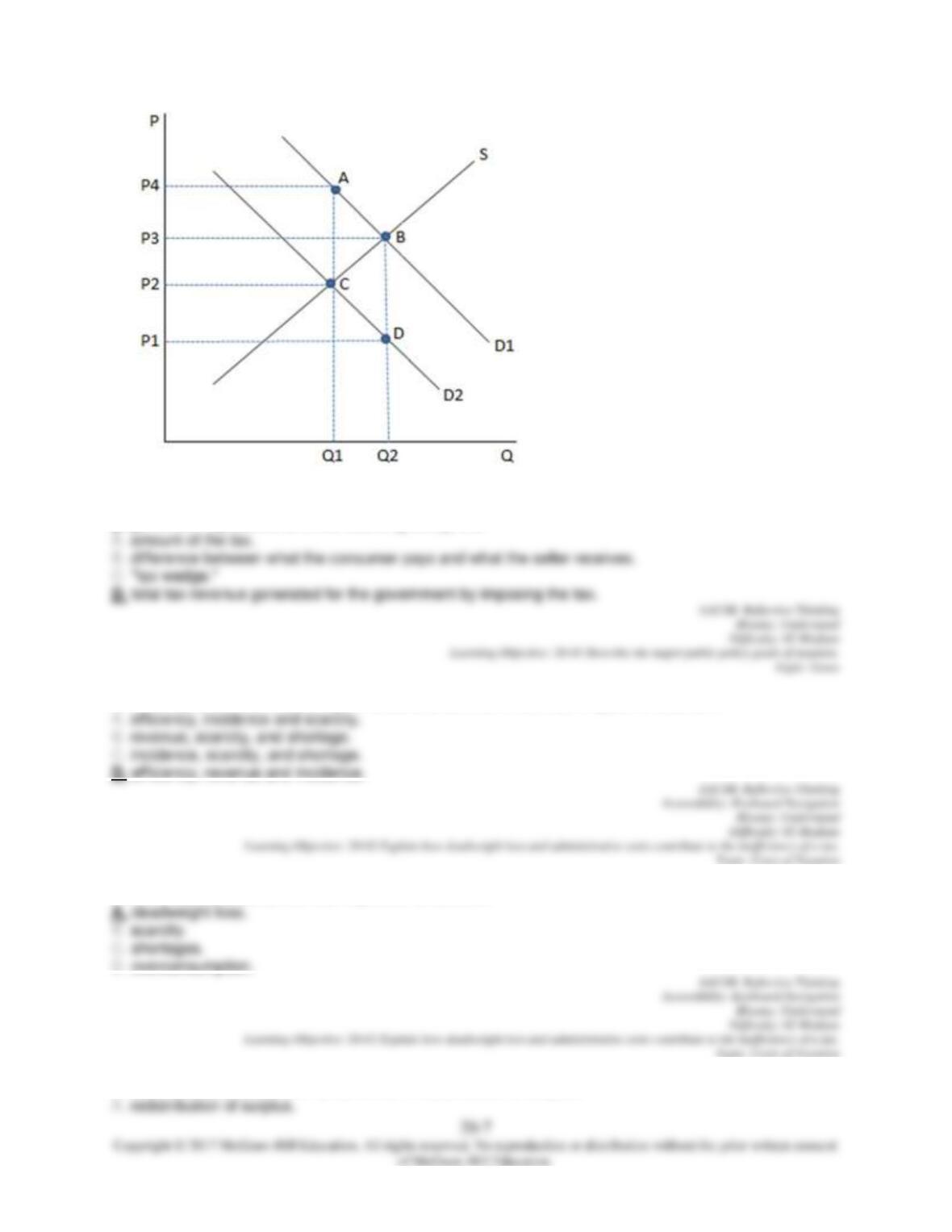
This graph depicts a tax being imposed, causing demand to shift from D1 to D2. The amount of tax
revenue being generated by the tax imposed in the graph shown is:
18.
This graph depicts a tax being imposed, causing demand to shift from D1 to D2. The deadweight loss
associated with the tax imposed in the graph shown is:
19.
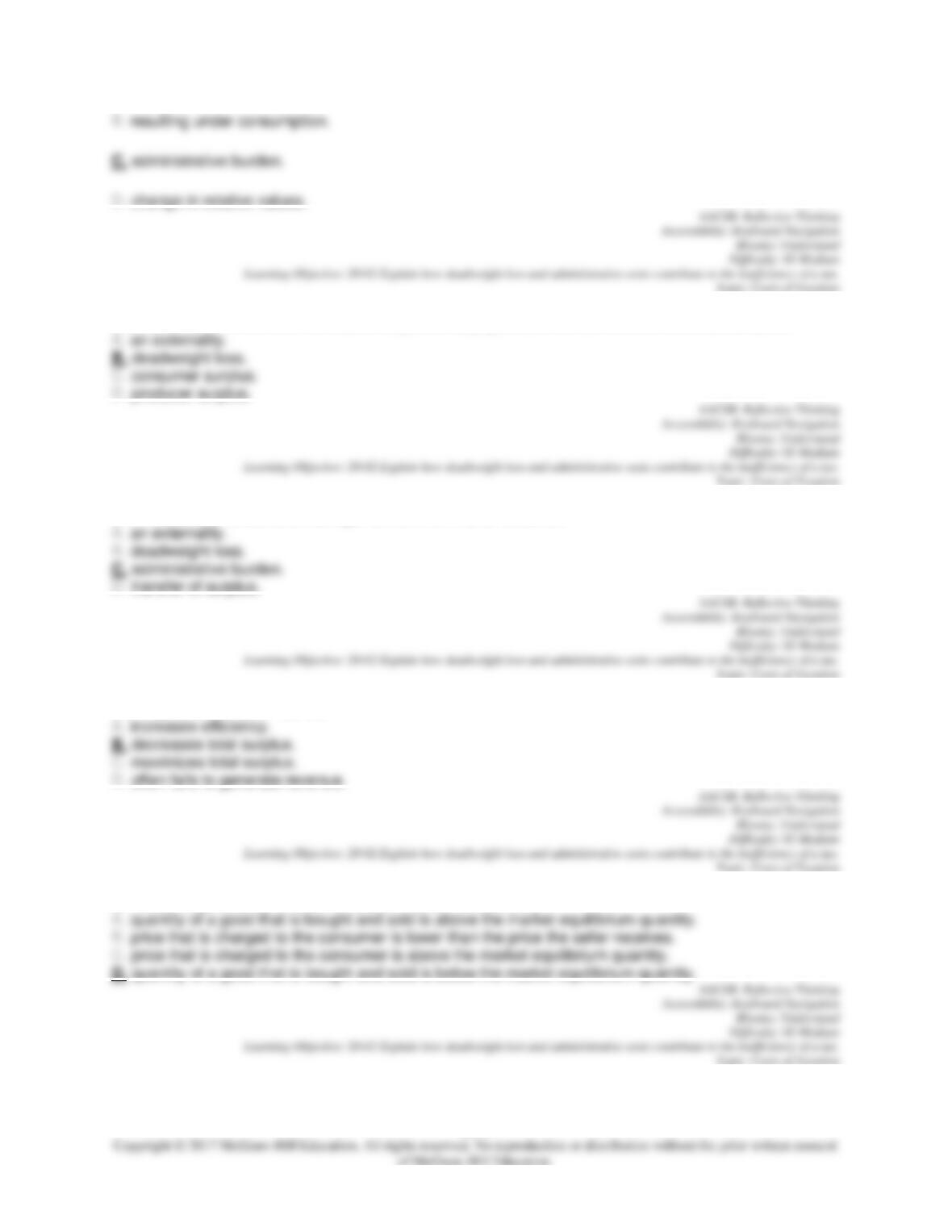
This graph depicts a tax being imposed, causing demand to shift from D1 to D2. The distance AC in the
graph shown represents all of the following except the:
20. Concepts useful in evaluating the costs and benefits of alternative types of taxes are:
21. One cost associated with the imposition of taxes is:
22. One cost associated with taxes is the: A redistribution of surplus.
20-8
23. The difference between the loss of surplus to taxpayers and the tax revenue collected is called:
24. The effort to collect and manage revenue from taxes is called:
25. A tax in an efficient market:
26. Deadweight loss as a result of taxation occurs because the:
27. The total amount of surplus lost due to taxation is:
20-9
28. Part of the surplus lost to market participants when a tax is imposed is:
29. When a tax is imposed, the surplus that is lost to buyers and sellers but converted into tax revenue
is:
30. When a tax is imposed, the surplus that is lost to buyers and sellers but converted into tax revenue
is:
31. The surplus that is lost and not converted to tax revenue when a tax is imposed is:
32. When a tax is imposed, some of the lost surplus becomes tax revenues and the rest is:
33. When a tax is imposed and some of the lost surplus becomes tax revenues, the group that benefits
is:
34. How much deadweight loss a tax causes is primarily determined by:
35. The deadweight loss a tax causes depends on all of the following except:
36. Considering a given increase in price due to a tax, the more price elastic the supply curve is, the:
37. Considering a given increase in price due to a tax, the less price elastic the demand curve is, the:
38. In order to minimize deadweight loss generated by taxation, a tax should be placed on goods that
are:
39. Deadweight loss is minimized when a tax is levied on something for which people:
40. A lump-sum tax:
41. An example of a lump-sum tax is a(n):
42. A lump-sum tax is:
43. If the primary goal in implementing a tax is to maximize efficiency and minimize deadweight loss, the
government should impose a(n):
44. In the real world, lump-sum taxes are:
45. In the real world, lump-sum taxes are:
46. Lump-sum taxes reduce the total amount of revenue that can be raised because:
47. All taxes carry which of the following costs?
48. The administrative burden of taxes is:
49. The logistical costs associated with implementing a tax are called the:
50. The administrative burden of a tax is:
51. In general, more efficient taxes have:
52. In general, the more complex the tax the:
20–14
53. The federal income tax _______________ compared to a state sales tax.
54. The federal income tax _____________ compared to a state sales tax.
55. To calculate tax revenue:
56. A new toll of $0.50 per car is in place on a bridge, and 1,000 cars have used the bridge. Total tax
revenues would be:
57. A bridge that typically gets 1,000 cars per day is installing a new toll next week of $0.50 per car. The
tax revenues generated will be:
58. Imposing taxes in markets where demand and supply are price inelastic:
59. For any given tax, the revenue generated is:
60. For any given tax, imposing a tax in a market with a highly inelastic demand will:
61. The market for cigarettes likely has a:
62. Taxing the market for alcohol at the same rate as the market for juice will likely:
63. When raising taxes, the price effect tells us that the:
64. When raising taxes, the quantity effect tells us that the:
65. The _____________ tells us when the government raises taxes, it gets more revenue per unit sold.
66. The __________ tells us when the government raises taxes, the higher tax rate causes fewer units to
be sold.
67. It is more likely at lower tax rates than higher tax rates that the:
68. In general, raising taxes has:
69. If the price effect outweighs the quantity effect, then a tax:
70. If the ________ effect is greater than the ___________ effect, a tax cut will increase revenues.
71. A $0.50 tax on lemons currently generates $200 in revenues per day. If the tax were increased to $2,
the revenues generated would drop to $70. This tells you that in this range of tax rates the:
72. Raising taxes:
73. When considering different tax levels, the revenue-maximizing point will be reached more:
74. When considering the interplay of the price and quantity effect of different tax levels, we realize that:
75. The Laffer curve demonstrates that raising tax rates:
76. The idea that people change their behavior in response to taxes is
77. The question of how people’s behavior changes in response to taxes:
78. Most research suggests that the elasticity of the labor supply with respect to taxes is:
79. When tax rates fall, people tend to:
80. Research shows that people rearrange their income from different sources to reduce their:
81. The tax rate that maximizes the government’s revenues is:
82. The concept of incidence is used to: