
Chapter 20 – Economic Growth and Development
Chapter 20 Economic Growth and Development
Multiple Choice
1. A country’s real GDP can increase for brief periods of time
A) only if its aggregate demand increases.
B) only if its aggregate supply increases.
C) if either its aggregate demand or its aggregate supply increases.
D) only if both its aggregate demand and its aggregate supply increases.
2. In order for a country’s real GDP to increase without inflation or deflation over long periods
time
A) its aggregate demand must increase.
B) its aggregate supply must increase.
C) either its aggregate demand or its aggregate supply must increase.
D) both its aggregate demand and its aggregate supply must increase.
3. The U.S. represents less than 5% of the world’s population, but produces a share of the
world’s output almost equal to
A) 5%.
B) 10%.
C) 25%.
D) 50%.
4. Expected deflation can reduce Aggregate demand by
A) reducing the purchasing power of money.
B) reducing the willingness to purchase big-ticket items.
C) increasing nominal interest rates.
D) reducing the government’s budget deficit.
5. Aggregate demand is increased by
A) increased interest rates.
B) increased taxes.
C) a stronger currency.
D) increased consumer confidence.

Chapter 20 – Economic Growth and Development
6. Aggregate demand is reduced by
A) increased government spending.
B) decreased interest rates.
C) reduced taxes.
D) a stronger dollar.
7. As real GDP increases, ceteris paribus, the slope of the aggregate supply curve
A) increases.
B) remains unchanged.
C) decreases.
D) is always zero.
8. Aggregate supply can usually be increased as workers
A) work smarter, better and more efficiently.
B) work harder.
C) are provided with better education, tools, and technology.
D) work smarter, better and more efficiently when provided with better education, tools, and
technology.
9. Aggregate Supply increases when
A) raw materials prices rise.
B) government regulations proliferate.
C) wages rise.
D) wages fall.
10. Aggregate Supply decreases when
A) worker productivity increases.
B) raw materials prices fall.
C) technology improves.
D) wages rise.

Chapter 20 – Economic Growth and Development
11. The ultimate source of long-term growth in already developed countries is
A) increased worker productivity.
B) larger and more powerful government.
C) a workforce that always works harder.
D) unrestricted immigration.
12. From 1990 to 2004, developed countries that experienced larger increases in Real GDP
tended also to experience higher rates of
A) population growth.
B) deflation.
C) unemployment.
D) productivity growth.
13. From 1990 to 2004 among developed countries, a 1 percentage point increase in productivity
growth was associated with increased per capita GDP growth of
A) 0.01%.
B) 0.30%.
C) 1.50%.
D) 3.00%.
14. Increases in worker productivity usually reflect
A) increased education and improved equipment.
B) management that pushes workers to work longer and harder.
C) elimination of unemployment benefit programs.
D) growth of labor unions.
15. Increases in worker productivity usually reflect policies that encourage
A) population growth.
B) consumption.
C) investment in physical and human capital.
D) extensive government regulation of business.

Chapter 20 – Economic Growth and Development
16. Investment in physical and human capital is typically encouraged by
A) lower taxes on interest income.
B) lower taxes on investment returns.
C) lower taxes on returns to education.
D) all of the options are correct.
17. Sustainable economic growth depends upon
A) investment, not saving.
B) saving, not investment.
C) both saving and investment.
D) neither saving nor investment.
18. The greatest threat to continued growth in the developed countries might be
A) low interest rates.
B) low inflation rates.
C) moderate marginal tax rates.
D) restrictive regulatory policies.
19. Among countries with per capita gross national income in 2006 less than $2,000,
A) the Gini coefficient of income inequality tends to be lower.
B) the consumer price inflation rate tends to be lower.
C) agriculture tends to produce a larger share of GDP.
D) high-income households tend to consume a smaller share of GDP.
20. Among countries with per capita Gross national income in 2006 less than $2,000,
A) high-income households tend to account for a larger share of aggregate consumption.
B) the consumer price inflation rate tends to be lower.
C) agriculture tends to produce a smaller share of GDP.
D) all of the options are correct.

Chapter 20 – Economic Growth and Development
21. Among countries with per capita gross national income in 2006 greater than $24,000,
A) high-income households tend to consume a larger share of GDP.
B) the consumer price inflation rate tends to be lower.
C) services tend to represent a smaller share of GDP.
D) agriculture tends to produce a larger share of GDP.
22. Overall income disparity can be measured by the
A) difference between GDP and GNI.
B) Gini Index.
C) growth rate in real GDP.
D) population growth rate.
23. Without adjusting for “purchasing power parity”, real GDP tends to understate income in
developing economies by
A) underestimating saving.
B) ignoring government deficit spending.
C) omitting non-market transactions.
D) all of the options are correct.
24. Which of the following is far more likely to be an important part of actual production in the
Sudan than it is in the United States?
A) Underestimating saving
B) Government deficit spending
C) Non-market transactions
D) All of the options are correct
25. In developing economies, the fraction of the economy in non-market transactions can be as
much as
A) 10 percent.
B) 25 percent.
C) 50 percent.
D) 75 percent.

Chapter 20 – Economic Growth and Development
26. Using the cost of a similar market basket of goods across countries to compare an economic
variable like gross national income applies the concept of
A) private equity financing.
B) the Heritage Foundation Index of Economic Freedom.
C) the Gini Index.
D) purchasing power parity.
27. The Solow Growth Model predicts that
A) rich nations will grow faster than poor nations.
B) the rich will get richer and the poor will get poorer.
C) the rich will get poorer and the poor will get richer.
D) poor nations will grow faster than rich nations.
28. If the central prediction of the Solow Growth Model is valid,
A) per capita Real GDP differences among nations will increase.
B) per capita Real GDP differences among nations will diminish.
C) economic freedom as measured by the Heritage Foundation Index will decrease.
D) population growth rates in rich countries will increase.
29. Among countries with per capita GDP in 2006 greater than $24,000,
A) the political structure tends to be relatively democratic.
B) tax rates tend to be extremely high.
C) governments tend to be repressive and corrupt.
D) all of the options are correct.
30. Among countries with per capita GDP in 2006 less than $2,000,
A) rates of basic literacy tend to be low.
B) central banks tend not to be independent.
C) the government tends to be relatively corrupt.
D) all of the options are correct.

Chapter 20 – Economic Growth and Development
31. Low wages and low-cost land in developing countries will not attract foreign investment in
manufacturing facilities if the developing countries
A) permit unrestricted repatriation of profits.
B) protect their central banks from political control.
C) lack well-developed infrastructure.
D) all of the options are correct.
32. Among countries with per capita GDP in 2004 less than $2,000,
A) inflation rates tend to be high.
B) central banks tend to be weak or non-existent.
C) the ruling party typically can print money when it wants.
D) all of the options are correct.
33. Among countries with Per Capita GDP in 2004 less than $2,000, the opportunity cost of
increased education and literacy for young workers might be measured as
A) new palaces and more soldiers for the ruling party.
B) increased consumption among the educated elites.
C) increased investment in improved infrastructure.
D) shortages of food or health care for the poor.
34. Since the 1960s, some of the best examples of transition from developing to developed
economies can be found in
A) East Asia.
B) West Asia.
C) Western Europe.
D) North America.
35. Since the 1960s, development coincided with political liberalization in
A) China.
B) South Korea.
C) North Korea.
D) Saudi Arabia.
Chapter 20 – Economic Growth and Development
36. Since the 1960s, development proceeded without many natural resources in
A) Canada.
B) Saudi Arabia.
C) Japan.
D) all of the options are correct.
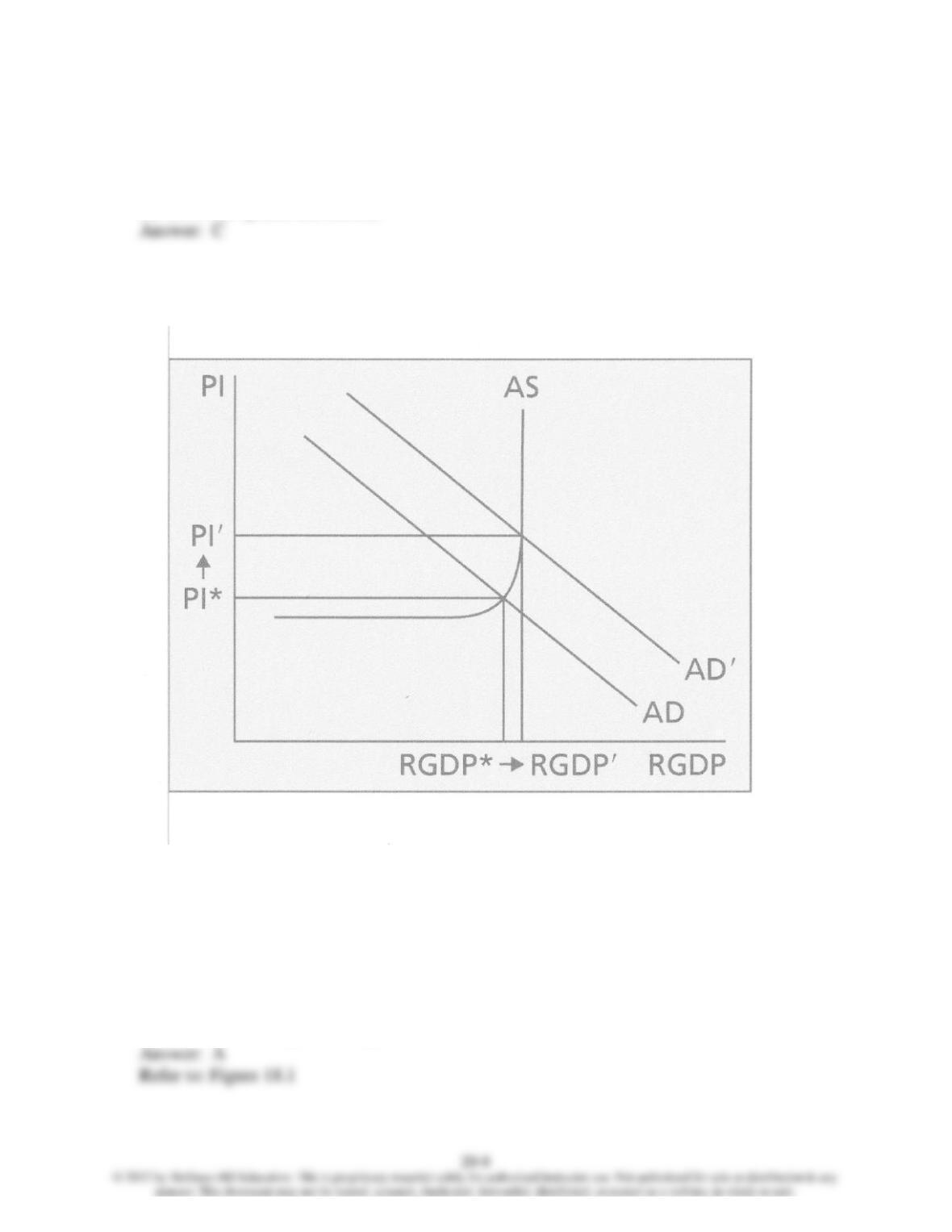
Refer to Figure 18.1 for Questions 37 thru 39.
Figure 18.1
37. In Figure 18.1, the increase in Real GDP might reflect
A) increased consumer confidence about future job security.
B) reduced government spending.
C) a stronger currency.
D) reduced worker productivity.
Chapter 20 – Economic Growth and Development
38. In Figure 18.1, the increase in Real GDP might reflect
A) a stronger currency.
B) reduced government spending.
C) reduced worker productivity.
D) the end of a period of price deflation.
39. In Figure 18.1, the increase in Real GDP might reflect
A) elimination of “welfare as we know it”.
B) adoption of sound fiscal and monetary policies.
C) a stronger currency.
D) reduced worker productivity.

Chapter 20 – Economic Growth and Development
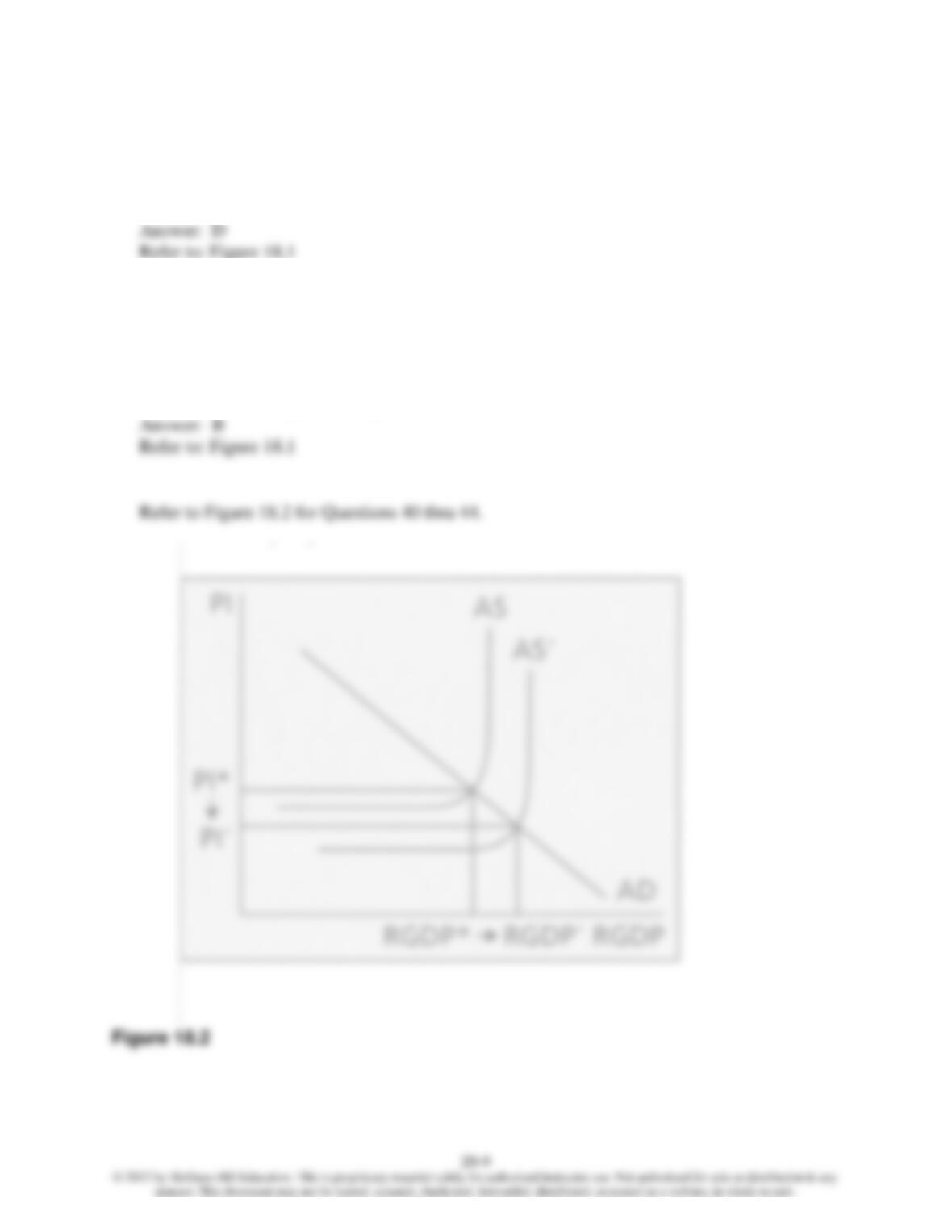
40. In Figure 18.2, the increase in Real GDP might reflect
A) increased marginal tax rates on capital income.
B) increased raw materials prices.
C) increased education among workers.
D) increased standards of environmental protection.
41. In Figure 18.2, the increase in Real GDP might reflect
A) lower marginal tax rates on capital income.
B) increased current government spending.
C) increased consumer confidence.
D) increased standards of environmental protection.
42. In Figure 18.2, if Aggregate Demand does not change, the increase in Real GDP will be
accompanied by
A) a higher price level.
B) no change in the price level.
C) a lower price level.
D) lower real wages.
43. In Figure 18.2, the increase in Real GDP might reflect
A) increased consumer confidence.
B) increased current government spending.
C) a weaker currency.
D) increased worker productivity.
44. In Figure 18.2, the increase in Real GDP is unlikely to
A) result from capital accumulation.
B) occur repeatedly in the future.
C) occur in developed economies.
D) result from a better-educated workforce.

Chapter 20 – Economic Growth and Development
45. International comparisons of Gross National Income using the concept of purchasing
power parity are based upon the
A) relative cost of purchasing a similar market basket of goods.
B) Gini Index of income disparity in the different countries.
C) relative stock market values in the different countries.
D) national unemployment rates in the different countries.
46. Suppose a developing country is falling further behind the developed countries that it
neighbors. As an economic consultant you are called to look at its policies to recommend
changes. If you saw all of the following on your visit, which of them could be an explanation
for the slow growth in the economy?
A) You see that new companies must bribe local officials to move their exports to the docks.
B) You see that the central bank does not pay attention to what the elected officials want.
C) You see that the roads, bridges, and ports are in great shape thanks to the work of the
World Bank.
D) You see that literacy rates rival those of its developed neighbors
47. Suppose a developing country is falling further behind the developed countries that it
neighbors. As an economic consultant you are called to look at its policies to recommend
changes. If you saw all of the following on your visit, which of them could be an explanation
for the slow growth in the economy?
A) You see that new companies require few licenses to move their exports.
B) You see that the central bank leadership is tied very closely to the party of the elected
officials.
C) You see that the roads, bridges, and ports are in great shape thanks to the work of the
World Bank.
D) You see that literacy rates rival those of its developed neighbors
48. Suppose a developing country is falling further behind the developed countries that it
neighbors. As an economic consultant you are called to look at its policies to recommend
changes. If you saw all of the following on your visit, which of them could be an explanation
for the slow growth in the economy?
A) You see that new companies require few licenses to move their exports.
B) You see that the central bank does not pay attention to what the elected officials want.
C) You see that the roads, bridges, and ports are in terrible shape.
D) You see that literacy rates rival those of its developed neighbors
49. Suppose a developing country is falling further behind the developed countries that it
neighbors. As an economic consultant you are called to look at its policies to recommend

Chapter 20 – Economic Growth and Development
changes. If you saw all of the following on your visit, which of them could be an explanation
for the slow growth in the economy?
A) You see that new companies require few licenses to move their exports.
B) You see that the central bank does not pay attention to what the elected officials want.
C) You see that the roads, bridges, and ports are in great shape thanks to the work of the
World Bank.
D) You see that literacy rates are much below those of its developed neighbors
50. Suppose a developing country is falling further behind the developed countries that it
neighbors. As an economic consultant you are called to look at its policies to recommend
changes. If you saw all of the following on your visit, which of them could be an explanation
for the slow growth in the economy?
A) You see that new companies require few licenses to move their exports.
B) You see that the central bank does not pay attention to what the elected officials want.
C) You see that the roads, bridges, and ports are in great shape thanks to the work of the
World Bank.
D) You see that companies have to get official approval to remove their profits back to their
home country.
51. How does the inability of foreign investors to repatriate profits impact a developing
economy?
A) It inhibits government control of its economy.
B) It fosters corruption
C) It inhibits foreign investment.
D) It harms a countries ability to construct infrastructure.
52. If a country allows foreign investors to repatriate profits, it will impact its economy by
A) increasing aggregate demand.
B) decreasing aggregate demand.
C) increasing aggregate supply.
D) decreasing aggregate supply.
53. If a country resolves its corruption issues that had inhibited the ability of local businesses to
be as productive as possible, it will impact its economy by
A) increasing aggregate demand.
B) decreasing aggregate demand.
C) increasing aggregate supply.
D) decreasing aggregate supply.

Chapter 20 – Economic Growth and Development
54. If a country increases its basic literacy rates, it will impact its economy by
A) increasing aggregate demand.
B) decreasing aggregate demand.
C) increasing aggregate supply.
D) decreasing aggregate supply.
55. If a country gets grants that improve its port facilities allowed for greater exports, it will
impact its economy by
A) increasing aggregate demand.
B) decreasing aggregate demand.
C) increasing aggregate supply.
D) decreasing aggregate supply.
56. If a country replaces its politically-controlled central bank with one that is independent this
will decrease inflation expectations and thereby increase investment. This will impact its
economy by
A) increasing aggregate demand.
B) decreasing aggregate demand.
C) increasing aggregate supply.
D) decreasing aggregate supply.
57. If a country that has experienced political instability (coups, revolutions, etc.), begins to
experience a stable period of elections and peaceful transitions of government, it will impact
its economy by
A) increasing aggregate demand.
B) decreasing aggregate demand.
C) increasing aggregate supply.
D) Increasing both aggregate demand and aggregate supply.
58. If a country gets grants that improve its roads and bridges which allows for greater exports,
it will impact its economy by
A) increasing aggregate demand.
B) decreasing aggregate demand.
C) increasing aggregate supply.
D) decreasing aggregate supply.

Chapter 20 – Economic Growth and Development
59. If a country faces starvation among its people and therefore cannot afford to improve its
infrastructure (thereby inhibiting exports) it will impact its economy by
A) increasing aggregate demand.
B) decreasing aggregate demand.
C) increasing aggregate supply.
D) decreasing aggregate supply.
60. If a country civil war among its people and therefore cannot afford to improve its
infrastructure (thereby inhibiting exports) it will impact its economy by
A) increasing aggregate demand.
B) decreasing aggregate demand.
C) increasing aggregate supply.
D) decreasing aggregate supply.