International Economics, 9e (Husted/Melvin)
Chapter 2 Tools of Analysis for International Trade Models
2.1 Multiple-Choice Questions
1) ________ analysis by economists refers to the attempt to answer questions such as what are
the effects of a tax on production and consumption decisions.
A) Positive
B) Negative
C) Normative
D) Investigative
2) ________ analysis by economists refers to the attempt to answer questions such as should a
tax be imposed.
A) Positive
B) Negative
C) Normative
D) Investigative
3) Economists use general equilibrium models of an economy to explain
A) consumption levels.
B) production levels.
C) relative prices.
D) All of the above.
4) If individuals have money illusion then they
A) think that money is worthless.
B) ignore the effects on their income or wealth of some price changes in the economy.
C) they base their production and consumption decisions on relative rather than absolute prices.
D) Both B and C.
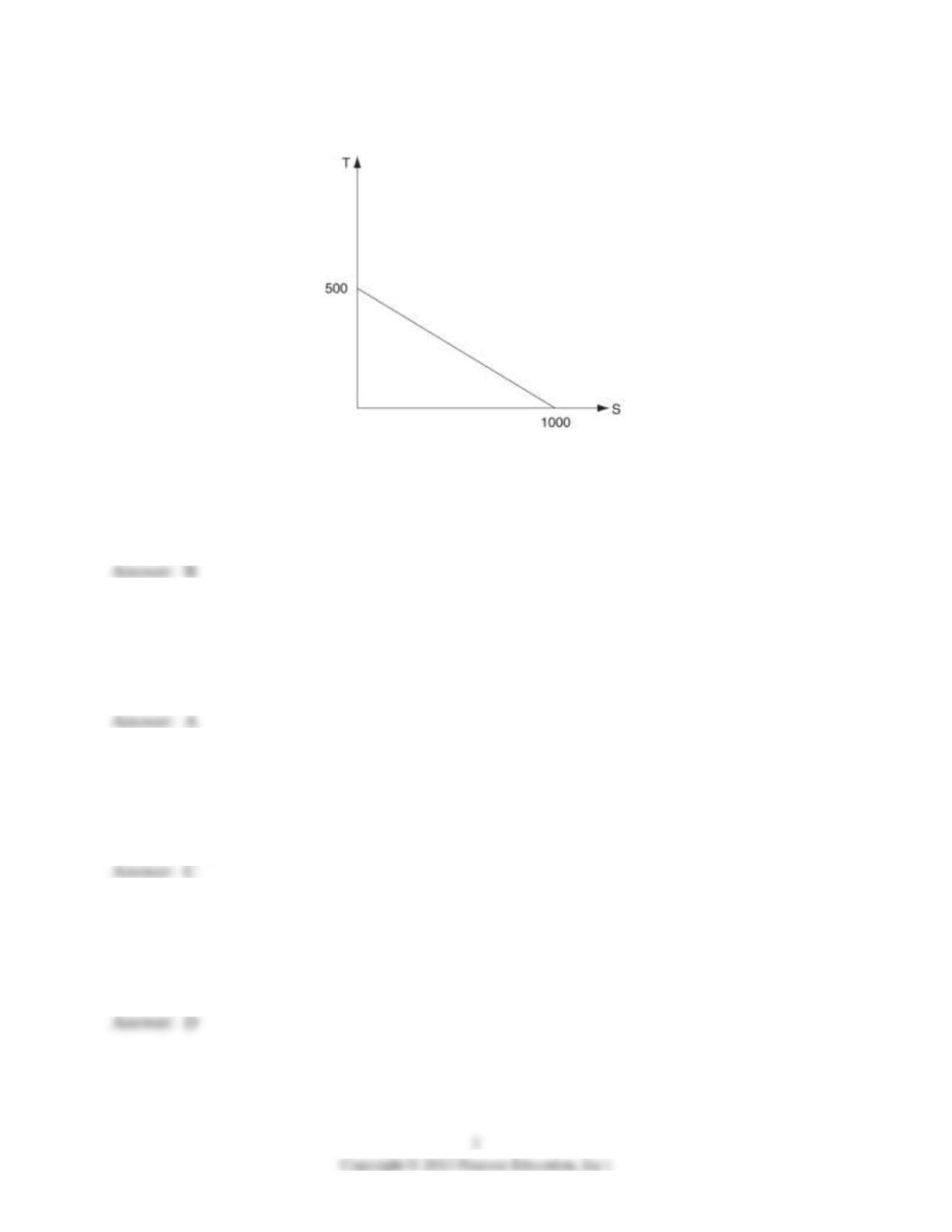
Answer the question(s) below based on the following diagram.
5) Refer to the figure above. The relative price of S (in terms of T) is
A) 2.
B) 1/2.
C) 500.
D) 1000.
6) Refer to the figure above. The relative price of T (in terms of S) is
A) 2.
B) 1/2.
C) 500.
D) 1000.
7) Refer to the figure above. If the relative price of S were to increase, then the price line would
A) shift out in a parallel fashion.
B) shift in in a parallel fashion.
C) become steeper.
D) become flatter.
8) Refer to the figure above. If the relative price of T were to increase, then the price line would
A) shift out in a parallel fashion.
B) shift in a parallel fashion.
C) become steeper.
D) become flatter.
9) If a country has a bowed out (concave to the origin) production possibility frontier, then
production is said to be subject to
A) constant opportunity costs.
B) decreasing opportunity costs.
C) first increasing and then decreasing opportunity costs.
D) increasing opportunity costs.
10) If a country has a straight (downward sloping) production possibilities frontier, then
production is said to be subject to
A) constant opportunity costs.
B) decreasing opportunity costs.
C) first increasing and then decreasing opportunity costs.
D) increasing opportunity costs.
11) Indifference curves are downward sloping because
A) when some of one good is taken away the consumer must be compensated with more of the
other.
B) higher prices mean less quantity demanded.
C) higher indifference curves mean higher utility.
D) Both A and B.
12) An indifference curve
A) is a locus of bundles of goods such that each good in every bundle yields equal satisfaction.
B) is a locus of bundles of goods such that the consumer is indifferent between each good in
every bundle.
C) is a locus of bundles of goods such that the consumer is indifferent between each of the
bundles.
D) All of the above.
13) Using community indifference curves to reflect tastes of the community
A) is a simple extension of indifference curve analysis because people are so different.
B) cannot usually be done because the community may have inconsistent tastes even though its
residents do not.
C) is a simple extension of indifference curve analysis if people are all alike.
D) Both B and C.
14) In autarky, when a community maximizes its standard of living, its consumption point is
A) below the production possibility frontier.
B) on the production possibility frontier.
C) above the production possibility frontier.
D) can’t tell without more information.
15) In autarky equilibrium,
A) production equals consumption.
B) exports equal imports.
C) there is no international trade.
D) All of the above.
16) In autarky, when a community maximizes its standard of living, its production point is
A) below the production possibility frontier.
B) on the production possibility frontier.
C) above the production possibility frontier.
D) Can’t tell without more information.
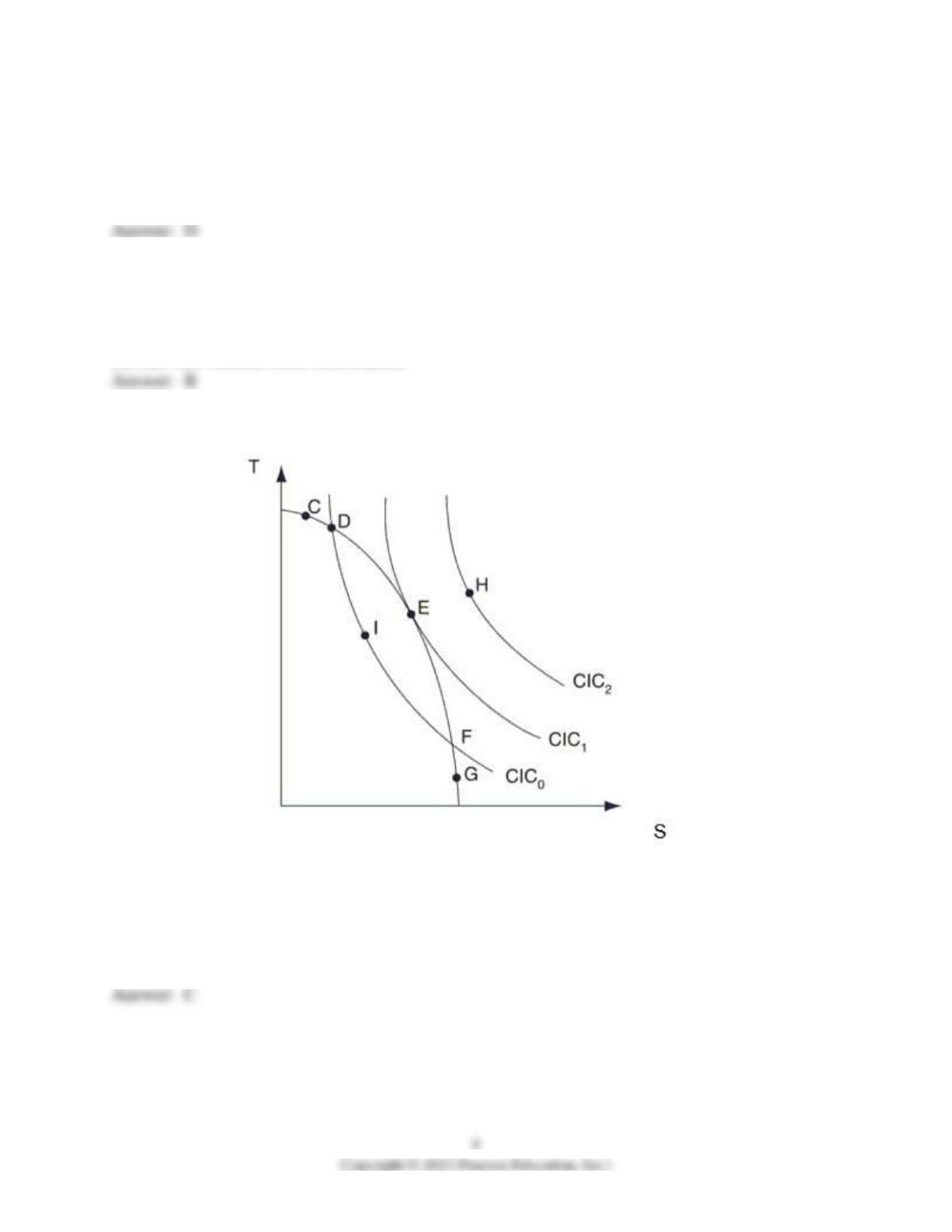
Answer the question(s) below based on the following diagram.
17) Refer to the figure above. In autarky, the economy would be in general equilibrium at point
A) I.
B) D.
C) E.
D) F.
18) Refer to the figure above. If tastes were to change so that S became more preferred relative
to T, then, in autarky, production and consumption would move from their initial equilibrium to
a point such as
A) C.
B) D.
C) E.
D) F.
19) Refer to the figure above. Which of the following is true?
A) The relative price of S is higher at G than at D.
B) The relative price of T is higher at C than at F.
C) A move from C to D would raise community satisfaction.
D) All of the above are true.
20) Refer to the figure above. Which of the following is true?
A) Demand plays no role in price setting in this model.
B) Given autarky prices, GDP is maximized by producing at point E.
C) So long as the country is on its production possibility frontier, GDP is maximized.
D) Both A and C are true.
21) Refer to the figure above. In autarky equilibrium, the relative price is given by the slope of
the production possibility frontier at point
A) D.
B) E.
C) F.
D) Can’t answer without more information.
22) Real GDP changes when
A) all prices change by the same proportion, but all outputs remain constant.
B) some but not all prices change, but outputs remain constant.
C) some outputs change, but prices remain constant.
D) Both B and C.
23) If the autarky price of S were lower in country A than in country B, then if trade were
allowed
A) A would likely export S to B.
B) A would likely import S from B.
C) neither country would want to trade.
D) None of the above.
24) If the autarky price of S (in terms of T) were lower in country A than in country B,
A) A has a comparative advantage in S.
B) B has a comparative advantage in T.
C) A has a comparative disadvantage in T.
D) All of the above.
25) If a country is subject to increasing opportunity costs, its national supply curve (i.e. the locus
of national output levels of S at various relative prices of S) will have a ________ slope.
A) flat
B) positive
C) negative
D) bowed out
26) If the relative price of S in terms of T is 2 and S has a nominal price of $1, then the nominal
price of T is
A) $2.
B) 50 cents.
C) 1/2 S.
D) Need more information to answer.
27) If the relative price of S in terms of T is 2 and S has a nominal price of $1, then the relative
price of T is
A) $2.
B) 50 cents.
C) 1/2 S.
D) Need more information to answer.
28) A diagram that shows the maximum amount of one type of good that can be produced in an
economy, given the production of the other is known as
A) an indifference curve.
B) the tradeoff schedule.
C) the production possibility frontier.
D) the balance of trade.
29) Which of the following is a Nobel Prize winning economist who argued that theories should
be tested based on the validity of their predictions?
A) Milton Friedman.
B) Ben Bernanke.
C) Alan Greenspan.
D) Larry Summers.
30) A situation in which a country does not take part in international trade is known as
A) autarky.
B) openness neglect.
C) indifference tradeoff.
D) protectionist point.
2.2 True or False Questions
1) If individuals have money illusion, they react to changes in certain prices without regard to
simultaneous changes in other prices.
2) If an economy is characterized by increasing opportunity costs, increasing the production of S
by constant amounts results in a constant decrease in the production of T.
3) Production under increasing opportunity costs can result from the two industries using factors
of production in different combinations.
4) The absolute value of the slope of the production possibilities frontier at the production point
provides a measure of both the relative price of S in terms of T and the opportunity cost of
producing one more units of S calculated in terms of output of T foregone.
5) Indifference curves intersect at the point of utility maximization.
6) General equilibrium occurs in autarky at the point where the community indifference curve
intersects the production possibilities frontier.
7) Per capita real GDP levels provide one possible measure of a country’s standard of living.
8) If country A produces S at a lower relative price than country B, A is said to have a
comparative advantage in S.
9) If the relative price of S were to rise, then an individual’s indifference curve would rotate
toward the T axis.
8
10) If a country were to experience an increase in its factors of production, its production
possibilities frontier would shift outward.
11) As of 2009, most countries in the world live in autarky.
12) An indifference curve represents the collection of goods and services that an individual has
no desire to consume.
13) Normative analysis involves value judgments.
2.3 Essay Questions
1) Explain why indifference curves have the following properties:
(a) downward slope
(b) convex to the origin
(c) higher curves reflect higher utility
(d) non-intersecting
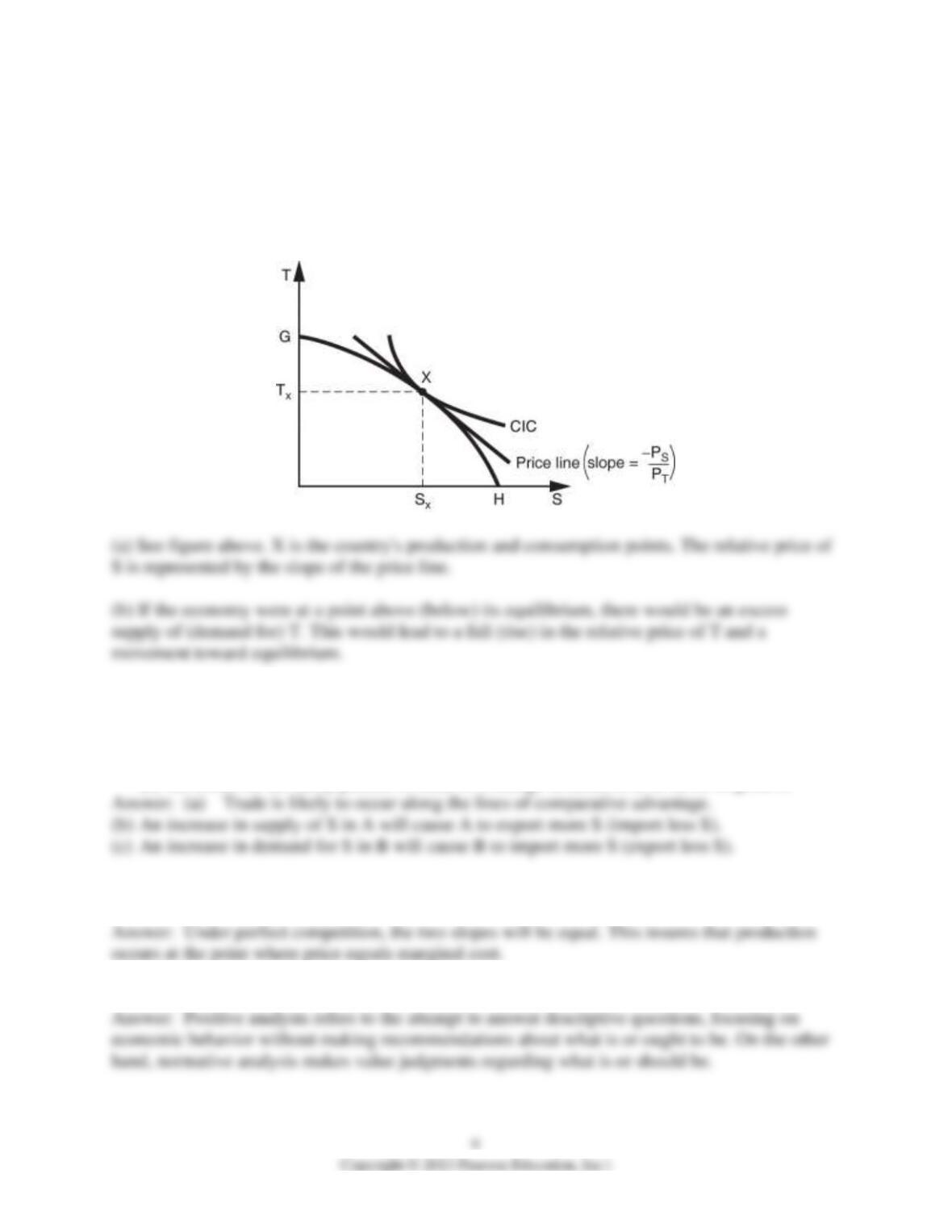
2) Use a diagram to describe how general equilibrium is reached when a country is subject to
increasing opportunity costs. In your answer,
(a) find and label the country’s equilibrium production and consumption points and the
relative price of S at equilibrium.
(b) explain carefully how the economy would move to equilibrium if it were not initially in
equilibrium. Answer:
3) Use national demand and supply curves to show
(a) the incentives for trade to begin between nations.
(b) the effect on the likely pattern of trade of a change in technology in A that causes A’s
national supply curve to shift out.
(c) the effect on the likely pattern of trade of a change in tastes in B in favor of good S.
4) Explain the relationship between relative prices and the slope of a country’s production
possibilities frontier.
5) What is the difference between positive and normative analysis?