9) The uses-of-saving identity shows that if the government budget deficit rises, then one of the
following must happen.
A) Private saving must rise, investment must fall, and/or the current account must fall.
B) Private saving must rise, investment must fall, and/or the current account must rise.
C) Private saving must rise, investment must rise, and/or the current account must fall.
D) Private saving must fall, investment must rise, and/or the current account must rise.
10) Suppose that private saving is $1590 billion, investment is $1945 billion, and the current
account balance is -$489 billion. From the uses-of-saving identity, how much is government
saving?
A) -$134 billion
B) -$844 billion
C) $844 billion
D) $134 billion
11) Suppose that national saving is $1456 billion, investment is $1945 billion, and private saving
is $1590 billion. How much is the current account balance?
A) $489 billion
B) $221 billion
C) -$221 billion
D) -$489 billion
12) In the mid-to-late 1980s, the United States had “twin deficits” because both ________ and
________ were negative.
A) government saving; private saving
B) saving; investment
C) the current account; investment
D) government saving; the current account
13) How does chain weighting lead to a different measurement of real GDP than the methods
used by the BEA prior to 1996? What are the advantages of chain weighting? What are the
disadvantages?
14) In a given year, a country’s GDP = $3843, net factor payments from abroad = $191, taxes =
$893, transfers received from the government = $422, interest payments on the government’s
debt = $366, consumption = $3661, and government purchases = $338. Calculate the values of
private saving, government saving, and national saving.
2.4 Real GDP, Price Indexes, and Inflation
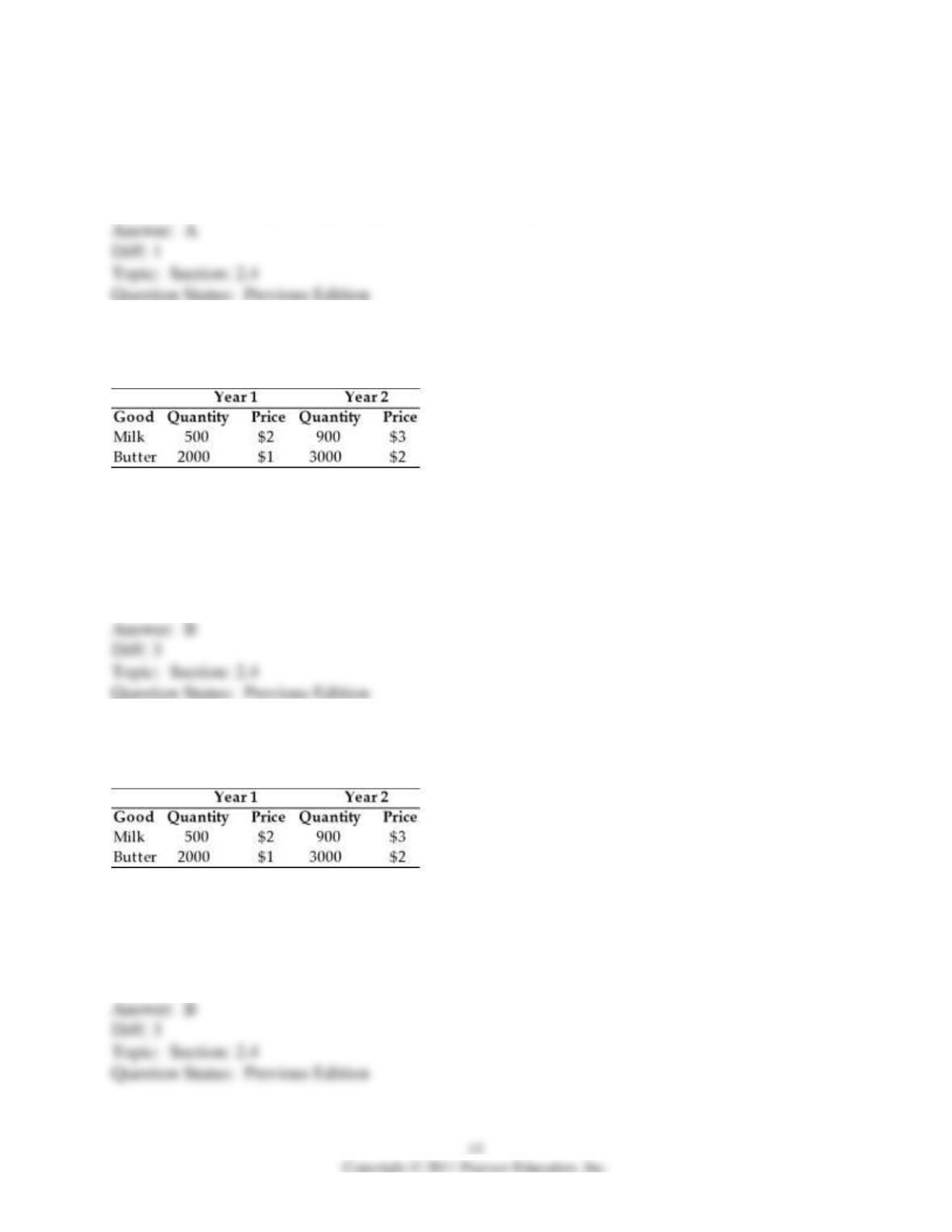
1) The country of Old Jersey produces milk and butter, and it has published the following
macroeconomic data, where quantities are in gallons and prices are dollars per gallon.
Between Year 1 and Year 2, nominal GDP grew by
A) 60.0%.
B) 65.5%.
C) 83.3%.
D) 190.0%.
2) The value of real GDP in the current year equals
A) the value of current-year output in prices of the base year.
B) the value of current-year output in prices of the current year.
C) the value of base-year output in prices of the base year.
D) the value of base-year output in prices of the current year.
3) The country of Old Jersey produces milk and butter, and it has published the following
macroeconomic data, where quantities are in gallons and prices are dollars per gallon.
Between Year 1 and Year 2, the percent change in real GDP (based on Year 1 as a base year)
was
A) 58%.
B) 60%.
C) 130%.
D) 190%.
4) The country of Old Jersey produces milk and butter, and it has published the following
macroeconomic data, where quantities are in gallons and prices are dollars per gallon.
Between Year 1 and Year 2, the GDP deflator (based on Year 1 as a base year) rose
A) 60.00%.
B) 81.25%.
C) 83.33%.
D) 123.00%.
5) Currently, the U.S. national income and product accounts (NIPA) use what type of price index
to calculate real GDP?
A) Fixed-weight
B) Variable-weight
C) Chain-weight
D) Heavy-weight
6) If nominal GDP for 2009 is $6400 billion and real GDP for 2010 is $6720 billion (in 2005
dollars), then the growth rate of real GDP is
A) 0%.
B) 0.5%.
C) 5%.
D) 50%.
7) If the price index was 100 in 2000 and 120 in 2010, and nominal GDP was $360 billion in
2000 and $480 billion in 2010, then the value of 2010 GDP in terms of 2000 dollars would be
A) $300 billion.
B) $384 billion.
C) $400 billion.
D) $424 billion.
8) Nominal GDP in 1970 was $1,035.6 billion, and in 1980 it was $2,784.2 billion. The GDP
price index was 30.6 for 1970 and 60.4 for 1980, where 1992 was the base year. Calculate the
percent change in real GDP in the decade from 1970 to 1980. Round off to the nearest
percentage point.
A) 36%
B) 97%
C) 136%
D) 169%
17
9) Nominal personal consumption expenditures in the United States were $1760.4 billion in 1980
and rose to $3839.3 billion in 1990. The price index for personal consumption expenditures was
58.5 for 1980 and 92.9 for 1990, where 1992 was the base year. Calculate the percent change in
real personal consumption expenditures (rounded to the nearest percentage point) in the decade.
A) 37%
B) 59%
C) 118%
D) 137%
10) Nominal gross private domestic investment was $1888.0 billion in 2008 and rose to $2057.4
billion in 2009. The chain-weight price index for gross private domestic investment was 106.6
for 2008 and 110.3 for 2009, where 2005 was the base year. Calculate the percent change in real
gross private domestic investment (rounded to the nearest percentage point) from 2008 to 2009.
A) 1%
B) 3%
C) 4%
D) 5%
11) A disadvantage of chain-weighting is that
A) past inflation rates change whenever the base year changes.
B) past growth rates of real GDP change whenever the base year changes.
C) it causes output growth to slow.
D) the components of real GDP don’t sum to real GDP.
12) The U.S. inflation rate ________ in the 1960s and 1970s, ________ in the 1980s, and
________ in the 1990s and 2000s.
A) was steady; rose sharply; fell
B) was steady; rose sharply; remained high
C) rose; fell sharply; remained low
D) rose; fell sharply; rose again
13) Two years ago, the GDP deflator for Old York was 300, and today it is 330.75. Based on this
information the annual average inflation rate for the two years was
A) 5%.
B) 5.125%.
C) 10%.
D) 10.25%.
14) If the price index last year was 1.0 and today it is 1.4, what is the inflation rate over this
period?
A) -4%
B) 1.4%
C) 4%
D) 40%
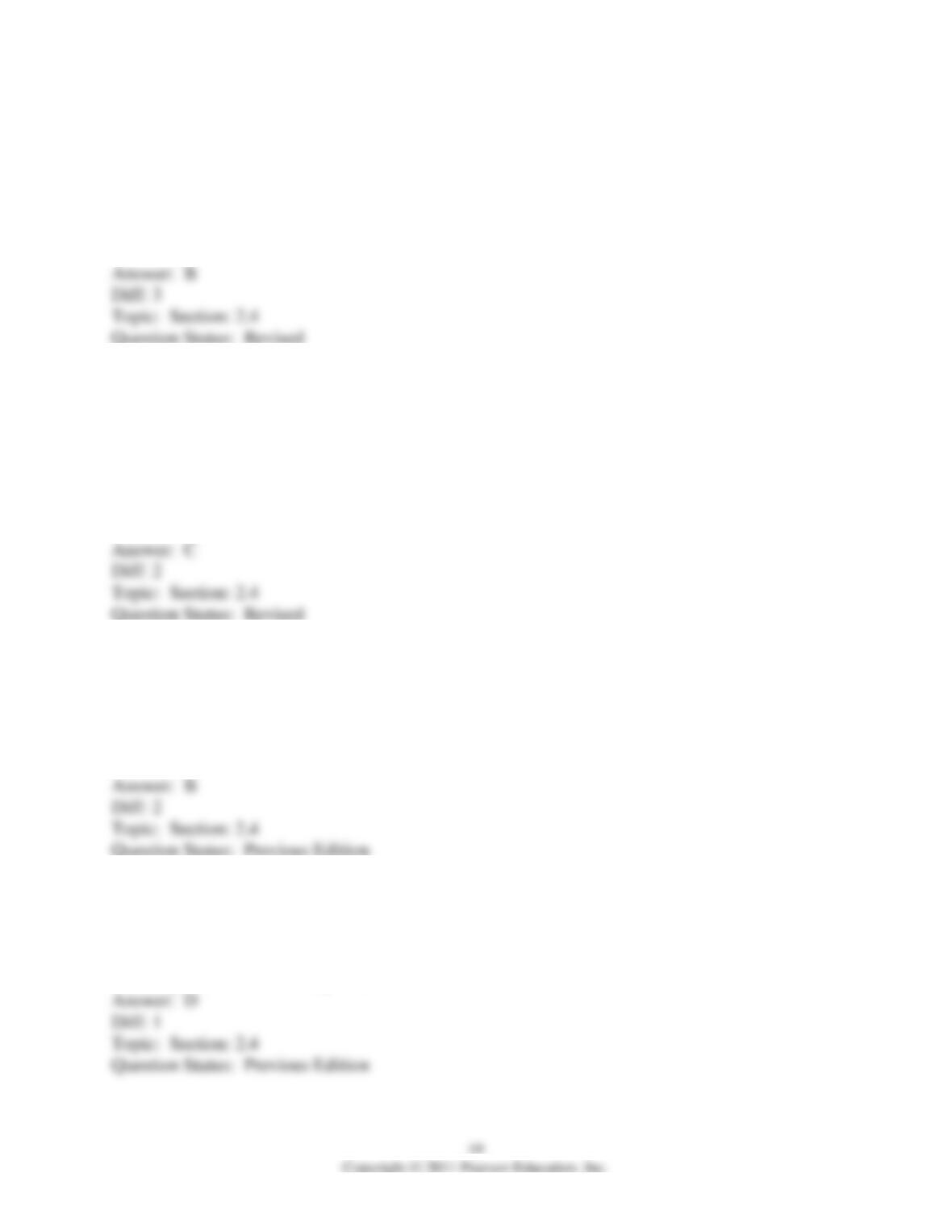
15) You are given information on the consumer price index (CPI), where the values given are
those for December 31 of each year.
In which year was the inflation rate the highest?
A) 2006
B) 2007
C) 2008
D) 2009
16) The consumer price index (CPI) was 180 for 2009 when using 1995 as the base year (1995 =
100). Now suppose we switch and use 2009 as the base year (2009 = 100). What is the CPI for
1995 with the new base year?
A) 18.0
B) 55.6
C) 80.0
D) 111.2
17) Nominal government purchases were $2226.2 billion in 2008 and rose to $2372.8 billion in
2009. Real government purchases were $1940.6 for 2008 and $1958.0 for 2009, where 2005 was
the base year. Calculate the percent change in the chain-weight price index for government
purchases (rounded to the nearest percentage point) from 2008 to 2009.
A) 2%
B) 4%
C) 6%
D) 8%
18) The Boskin Commission concluded that the CPI overstates increases in the cost of living by
________ percentage point(s) per year.
A) Less than 1
B) 1 to 2
C) About 3
D) Over 4
19) The CPI may overstate inflation for all the following reasons except
A) problems measuring changes in the quality of goods.
B) substitution by consumers towards cheaper goods.
C) problems measuring the quality of services.
D) changes in Social Security benefits.
20) The Fed prefers to focus on inflation based on which price index?
A) personal consumption expenditures price index
B) consumer price index
C) GDP deflator
D) producer price index
21) What is the difference between nominal and real economic variables? Why do economists
tend to concentrate on changes in real magnitudes?
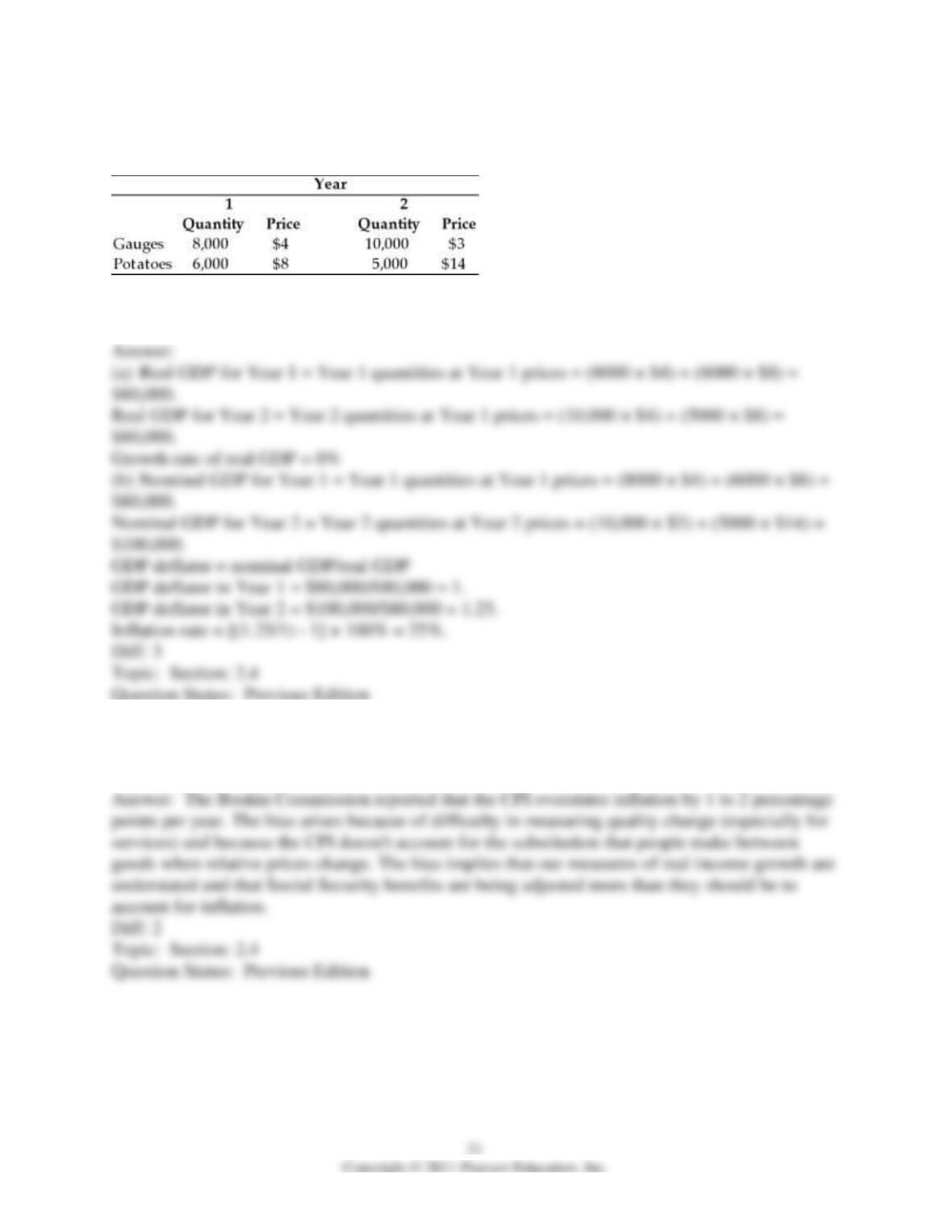
22) The country of Myrule has produced the following quantity of gauges and potatoes, with the
price of each listed in dollar terms.
(a) Using Year 1 as the base year, what is the growth rate of real GDP from Year 1 to Year 2?
(b) Based on the GDP deflator, what is the inflation rate from Year 1 to Year 2?
23) By how much does the CPI overstate true increases in the cost of living, according to the
Boskin Commission? What are the main reasons for this bias in the CPI? What are the economic
implications of the bias?
24) In 1975, Richard Petty won the NASCAR race in Richmond, earning $6,265. In 2006, Dale
Earnhardt, Jr., won the race, earning $239,166. The CPI index was 52.5 in 1975 and 198.7 in
2006 (base year = 1982-1984). Calculate the real earnings (based on base year 1982-1984) of
both Petty and Earnhardt.
2.5 Interest Rates
1) The nominal interest rate minus the inflation rate is the
A) depreciation rate.
B) real interest rate.
C) discount rate.
D) forward rate.
2) By Marks buys a one-year German government bond (called a bund) for $400. He receives
principal and interest totaling $436 one year later. During the year the CPI rose from 150 to 162.
The nominal interest rate on the bond was ________, and the real interest rate was ________.
A) 9%; 1%
B) 9%; -1%
C) 36%; 24%
D) 36%; 12%
3) The expected real interest rate (r) is equal to
A) nominal interest rate minus inflation rate.
B) nominal interest rate minus expected inflation rate.
C) expected nominal interest rate minus inflation rate.
D) nominal interest rate plus expected inflation rate.
4) In 2008, inflation exceeded expected inflation. In 2009, expected inflation exceeded inflation.
Therefore the real interest rate was ________ than the expected real interest rate in 2008 and the
real interest rate was ________ than the expected real interest rate in 2009.
A) less; less
B) less; greater
C) greater; less
D) greater; greater
5) In 2008, expected inflation exceeded inflation. In 2009, inflation exceeded expected inflation.
Therefore the real interest rate was ________ than the expected real interest rate in 2008 and the
real interest rate was ________ than the expected real interest rate in 2009.
A) less; less
B) less; greater
C) greater; less
D) greater; greater
6) If the expected inflation rate was 2.5%, the expected real interest rate was 4.0%, and the actual
inflation rate turned out to be 3.2%, then the real interest rate equals
A) 1.7%
B) 3.2%
C) 3.3%.
D) 4.7%
7) By Marks buys a one-year German government bond (called a bund) for $400. He receives
principal and interest totaling $436 one year later. During the year the CPI rose from 150 to 162,
but he had thought the CPI would be at 159 by the end of the year. By Marks had expected the
real interest rate to be ________, but it actually turned out to be ________.
A) 8%; 1%
B) 6%; 3%
C) 3%; 1%
D) 1%; 3%
8) Historical analysis of real interest rates in the United States shows that
A) real interest rates were unusually low in both the 1970s and 1980s.
B) real interest rates were unusually high in both the 1970s and 1980s.
C) real interest rates were unusually low in the 1970s and unusually high in the 1980s.
D) real interest rates were unusually low in the 1980s, spurring the economic growth that
occurred during the Reagan administration.
9) The nominal interest rate is 7%, today’s price level is 150, and you expect the price level to be
156 one year from now. What is the expected inflation rate? What is the expected real interest
rate?
10) Loretta agrees to lend Ted $500,000 to buy computers for his consulting firm. They agree to
a nominal interest rate of 8%. Both expect the inflation rate to be 2%.
(a) Calculate the expected real interest rate.
(b) If inflation turns out to be 3% over the life of the loan, what is the real interest rate? Who
gains from unexpectedly high inflation, Loretta or Ted?
(c) If inflation turns out to be 1% over the life of the loan, what is the real interest rate? Who
gains from unexpectedly low inflation, Loretta or Ted?
11) You took out a loan one year ago at a nominal interest rate of 7.5%. The CPI stood at 173.2
at the time and you expected it to rise to 178.6 over the year. Today the CPI is actually 179.5.
Calculate the expected real interest rate on the loan and the real interest rate on the loan.