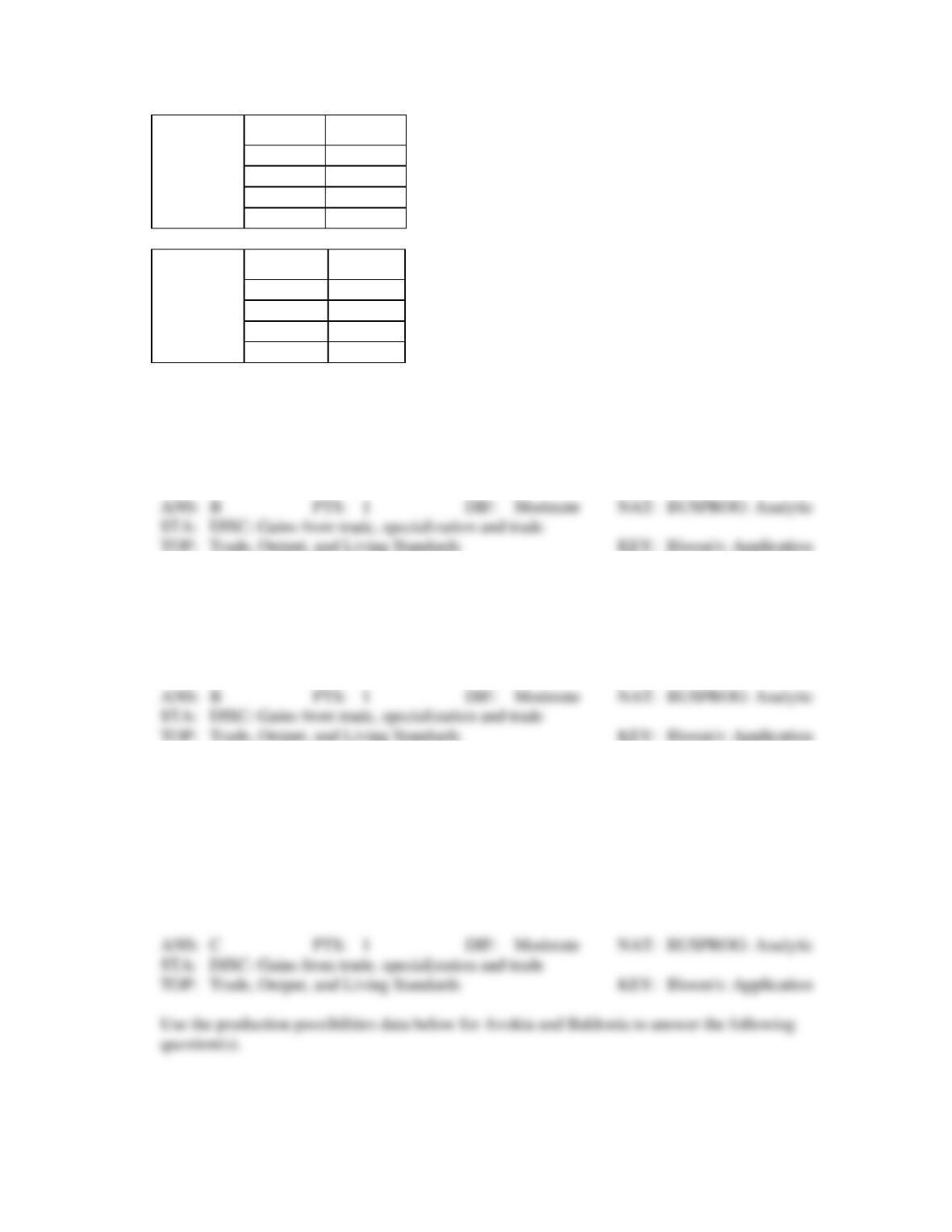
Table 2-1
Lebos
Food
Clothing
0
6
2
4
4
2
6
0
Slavia
Food
Clothing
0
9
1
6
2
3
3
0
170. Refer to Table 2-1. Which of the following is true?
a.
Lebos has the comparative advantage in both goods.
b.
Lebos has the comparative advantage in food.
c.
Slavia has the comparative advantage in food.
d.
It would be impossible for Lebos and Slavia to gain from trade.
171. Refer to Table 2-1. Which of the following would be a mutually agreeable rate of exchange?
a.
1F = 1C
b.
1F = 2C
c.
1F = 3C
d.
No exchange rate would be mutually agreeable.
172. Refer to Table 2-1. According to the law of comparative advantage, both Lebos and Slavia could gain
if
a.
Lebos produced all of the food and clothing and Slavia did not produce anything.
b.
Lebos specialized in producing clothing, Slavia specialized in producing food, and they
traded.
c.
Lebos specialized in producing food, Slavia specialized in producing clothing, and they
traded.
d.
Slavia and Lebos were both were self-sufficient and did not trade.
Table 2-2
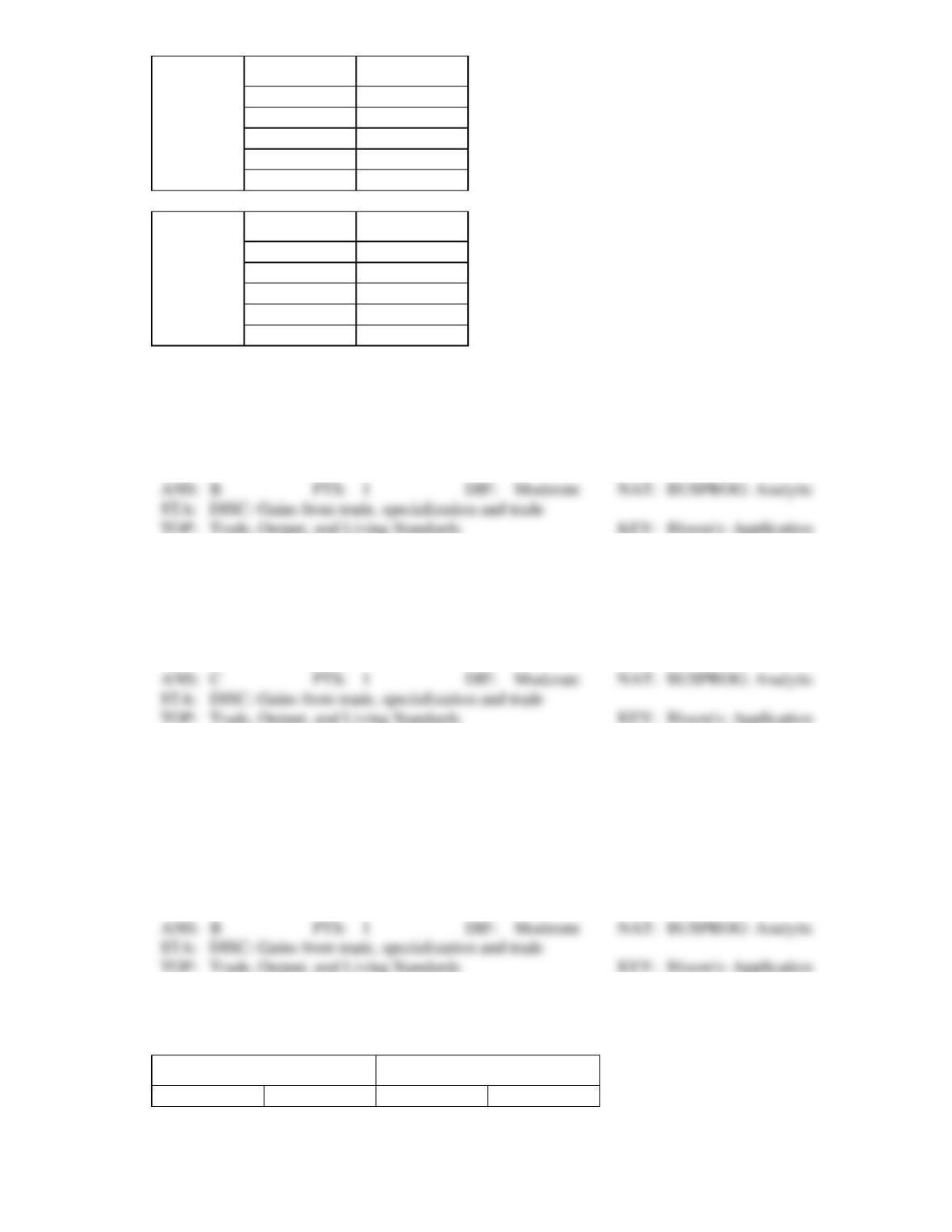
Avokia
Oranges
Apples
0
16
1
12
2
8
3
4
4
0
Baldonia
Oranges
Apples
0
8
1
6
2
4
3
2
4
0
173. Refer to Table 2-2. Which of the following is correct?
a.
Avokia has the comparative advantage in both goods.
b.
Baldonia has the comparative advantage in oranges.
c.
Avokia has the comparative advantage in oranges.
d.
It would be impossible for Avokia and Baldonia to gain from trade.
174. Refer to Table 2-2. Which of the following would be a mutually agreeable rate of exchange?
a.
Baldonia trades one orange to Avokia for every one apple.
b.
Baldonia trades one orange to Avokia for every two apples.
c.
Baldonia trades one orange to Avokia for every three apples.
d.
Baldonia trades one orange to Avokia for every four apples.
175. Refer to Table 2-2. According to the law of comparative advantage, both Avokia and Baldonia could
gain if
a.
Avokia produced all of the apples and oranges and Baldonia did not produce anything.
b.
Avokia specialized in producing apples, Baldonia specialized in producing oranges, and
they traded.
c.
Avokia specialized in producing oranges, Baldonia specialized in producing apples, and
they traded.
d.
Baldonia and Avokia were both were self-sufficient and did not trade.
176. Use the table below to choose the correct answer. The table outlines the production possibilities of
Robinson Crusoe and Joe Friday.
Friday
Crusoe
Good Y
Good X
Good Y
Good X
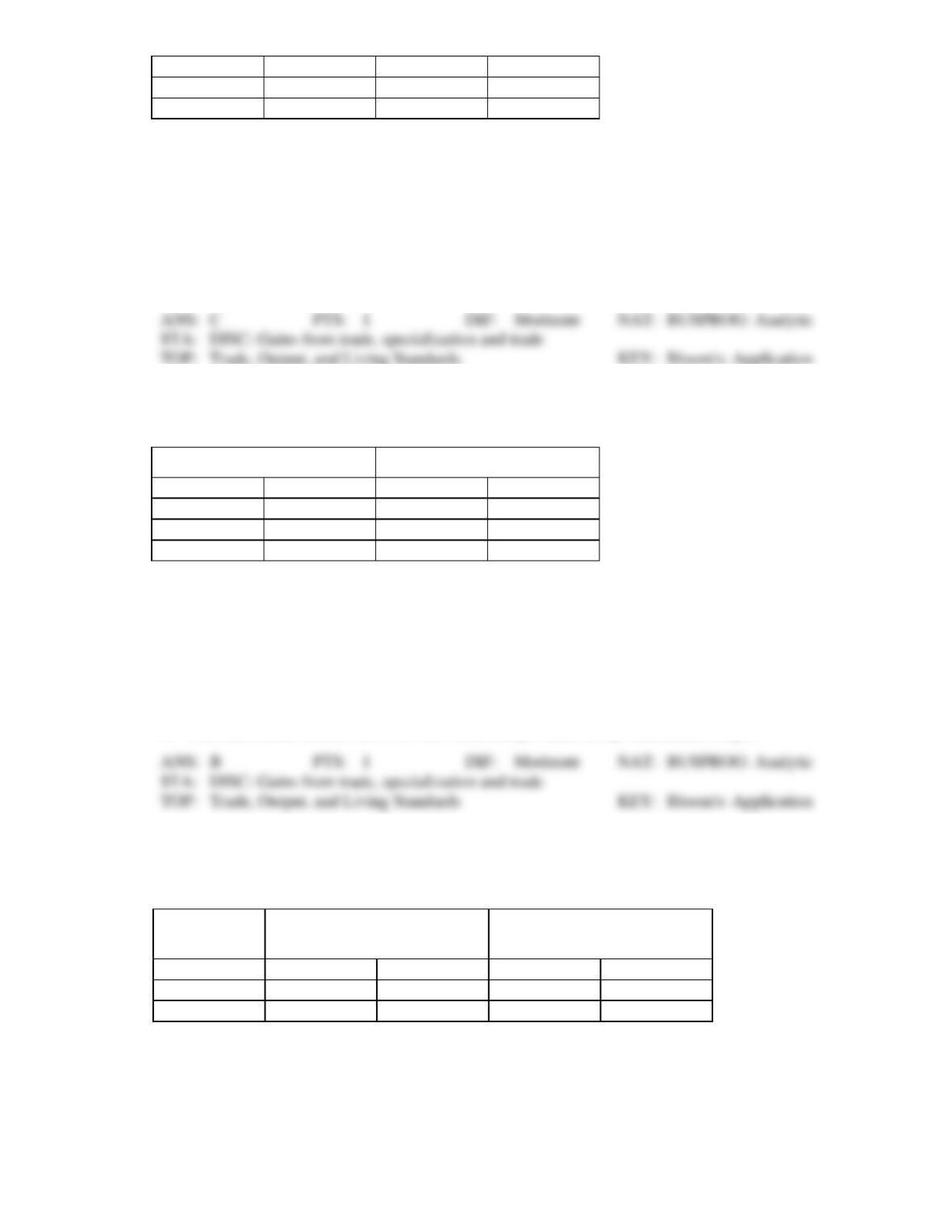
1
3
2
3
2
2
4
2
3
1
6
1
If Crusoe and Friday want to maximize their consumption possibilities,
a.
Crusoe should specialize in producing good X and Friday in producing good Y, but no
trade should be allowed.
b.
Crusoe should specialize in producing good X and Friday in producing good Y; trade
should occur to maximize joint consumption.
c.
Crusoe should specialize in producing good Y and Friday in producing good X; trade
should occur to maximize joint consumption.
d.
Not enough information is provided to conclusively answer this question.
177. Use the table below to choose the correct answer. The table outlines the production possibilities of
Robinson Crusoe and Joe Friday.
Friday
Crusoe
Good Y
Good X
Good Y
Good X
2
3
1
3
4
2
2
2
6
1
3
1
If Crusoe and Friday want to maximize their consumption possibilities,
a.
Crusoe should specialize in producing good X and Friday in producing good Y, but no
trade should be allowed.
b.
Crusoe should specialize in producing good X and Friday in producing good Y; trade
should occur to maximize joint consumption.
c.
Crusoe should specialize in producing good Y and Friday in producing good X; trade
should occur to maximize joint consumption.
d.
both individuals should strive for self-sufficiency, which always maximizes output.
Use the production possibilities data below to answer the following question(s).
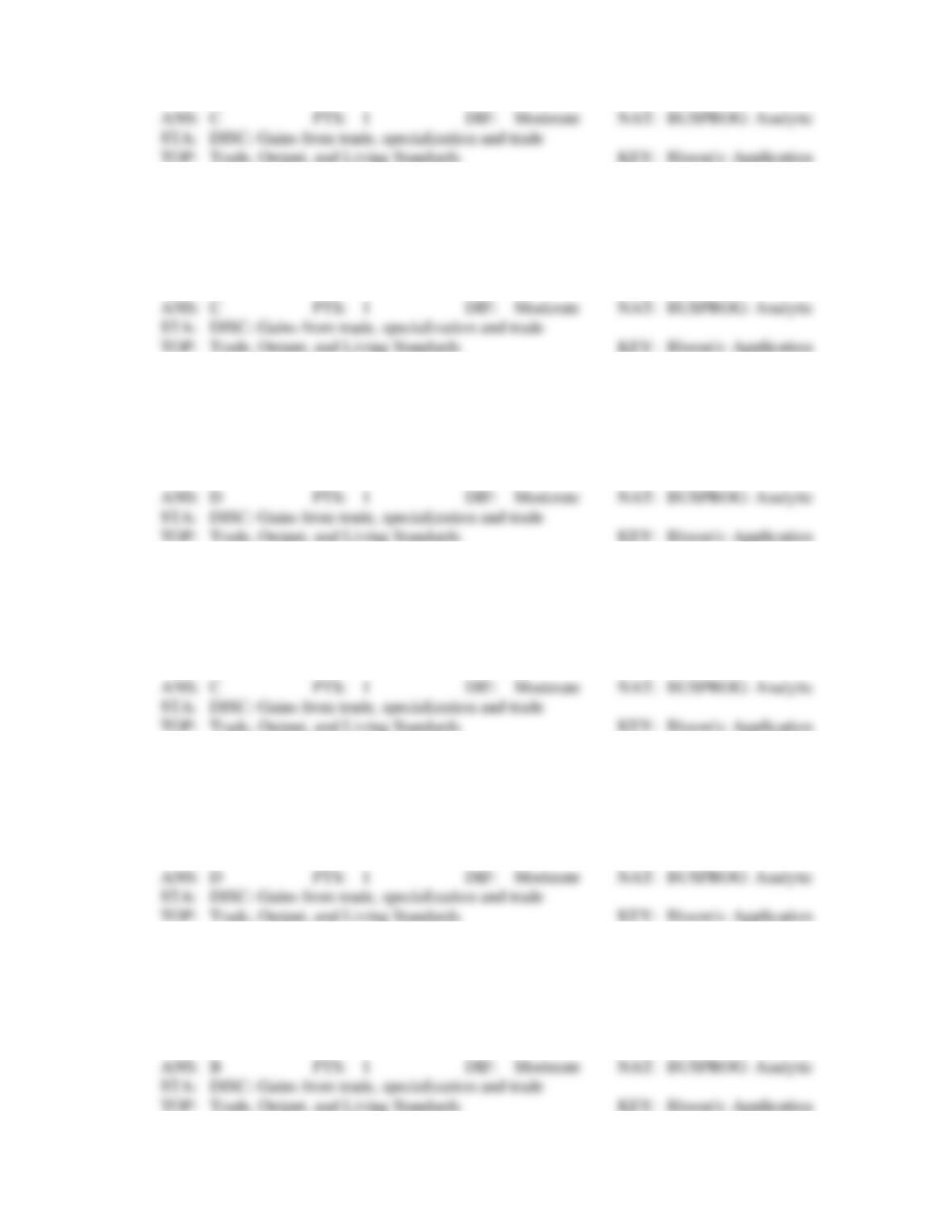
Table 2-3
Labor Hours Needed to
Make 1 Pound of:
Pounds produced in 40 hours:
Meat
Potatoes
Meat
Potatoes
Farmer
8
2
5
20
Rancher
4
5
10
8
178. Refer to Table 2-3. The opportunity cost of 1 pound of meat for the farmer is
a.
1/4 hour of labor.
b.
4 hours of labor.
c.
4 pounds of potatoes.
d.
1/4 pound of potatoes.
179. Refer to Table 2-3. The opportunity cost of 1 pound of meat for the rancher is
a.
4 hours of labor.
b.
5 hours of labor.
c.
4/5 pounds of potatoes.
d.
5/4 pounds of potatoes.
180. Refer to Table 2-3. The opportunity cost of 1 pound of potatoes for the farmer is
a.
8 hours of labor.
b.
2 hours of labor.
c.
4 pounds of meat.
d.
1/4 pound of meat.
181. Refer to Table 2-3. The opportunity cost of 1 pound of potatoes for the rancher is
a.
5 hours of labor.
b.
4 hours of labor.
c.
5/4 pounds of meat.
d.
4/5 pound of meat.
182. Refer to Table 2-3. The rancher has a comparative advantage in
a.
neither good, and the farmer has a comparative advantage in both goods.
b.
both goods, and the farmer has a comparative advantage in neither good.
c.
potatoes, and the farmer has a comparative advantage in meat.
d.
meat, and the farmer has a comparative advantage in potatoes.
183. Refer to Table 2-3. The farmer and the rancher both could benefit if the farmer were to specialize in
a.
meat and the rancher were to specialize in potatoes.
b.
potatoes and the rancher were to specialize in meat.
c.
neither good and the rancher were to specialize in both goods.
d.
none of the above; they cannot both benefit by specialization and trade.
184. Suppose you can type a paper in two hours or mow the lawn in four hours, while it takes your friend
Ann eight hours to type a paper or two hours to mow the lawn. Which of the following is true?
a.
You have a comparative advantage in typing.
b.
You have a comparative advantage in mowing the lawn.
c.
You and Ann could save time if you mowed her lawn while she typed your paper.
d.
You and Ann cannot gain from specialization and trade.
185. If Shawn can produce donuts at a lower opportunity cost than Sue, then
a.
Shawn has a comparative advantage in the production of donuts.
b.
Sue has a comparative advantage in the production of donuts.
c.
Shawn should not produce donuts.
d.
Shawn is capable of producing more donuts than Sue in a given amount of time.
186. If Shawn can produce more donuts in one day than Sue can produce in one day, then
a.
Shawn has a comparative advantage in the production of donuts.
b.
Sue has a comparative advantage in the production of donuts.
c.
Shawn has an absolute advantage in the production of donuts.
d.
Shawn should produce donuts and Sue should spend her time on a different activity.
187. Two individuals engage in the same two productive activities. In which of the following circumstances
would neither individual have a comparative advantage in either activity?
a.
One individual’s production possibilities frontier is steeper than the other individual’s
production possibilities frontier.
b.
One individual is faster at both activities than the other individual.
c.
One individual’s opportunity costs are the same as the other individual’s opportunity costs.
d.
None of the above is correct; one of the two individuals always will have a comparative
advantage in at least one of the two activities.
188. Suppose you can type a paper in two hours or mow the lawn in four hours. It takes your friend Ann
eight hours to type a paper of the same length and five hours to mow the same size of lawn. Which of
the following is true?
a.
Ann is the high-opportunity cost producer of both typing and mowing.
b.
Since you can type papers and mow lawns faster than Ann, you and Ann cannot benefit
from specialization and trade.
c.
You and Ann could expand output and gain from trade if she specialized in mowing lawns
and you specialized in typing papers.
d.
You and Ann could expand output and gain from trade if she specialized in typing papers
and you specialized in mowing lawns.
189. Sean can build sandboxes twice as fast as Matt. Sean can assemble swing sets three times as fast as
Matt. The law of comparative advantage suggests that
a.
Sean can gain only at Matt’s expense.
b.
Matt can gain only at Sean’s expense.
c.
both can gain if Sean specializes in assembling swing sets and Matt in building sandboxes.
d.
both can gain if Sean specializes in building sandboxes and Matt in assembling swing sets.
190. If Kim can either wash 10 cars or wax 2 cars during a day, and Vince can either wash 17 cars or wax 2
cars during a day, then according to the law of comparative advantage,
a.
Vince’s opportunity cost of waxing a car is less than Kim’s.
b.
their total output can be expanded if Kim specializes in waxing and Vince in washing.
c.
their total output can be expanded if Kim specializes in washing and Vince in waxing.
d.
it would be impossible for Vince and Kim to increase their total output through
specialization and mutual exchange.
191. If Kim can wash 10 cars or wax 2 cars during a day, and Susan can wash 8 cars or wax 2 cars during a
day, then according to the law of comparative advantage,
a.
Susan’s opportunity cost of waxing a car is greater than Kim’s.
b.
their total output can be expanded if Susan specializes in waxing and Kim in washing.
c.
their total output can be expanded if Susan specializes in washing and Kim in waxing.
d.
it is impossible to expand total output through specialization and mutual exchange in this
case.
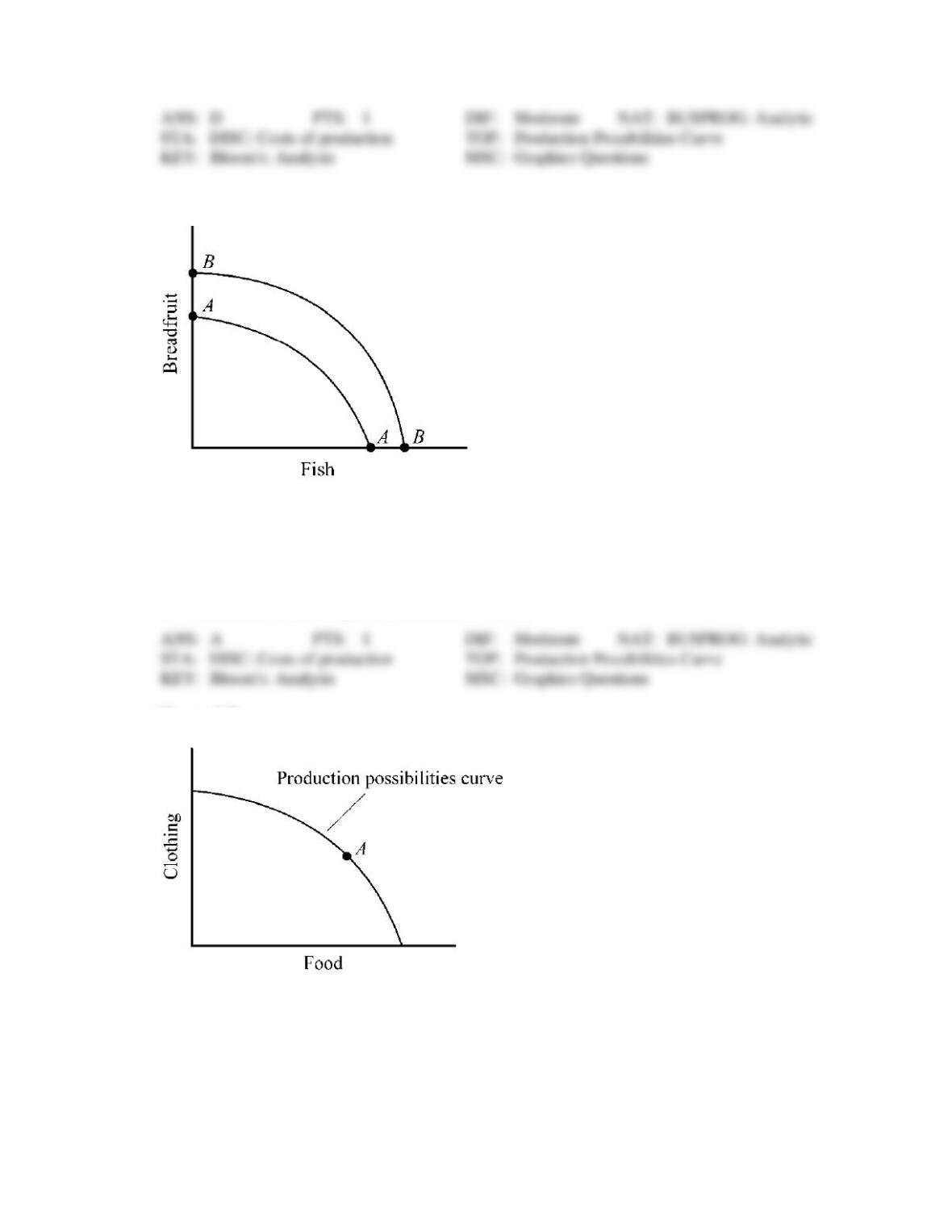
Figure 2-1
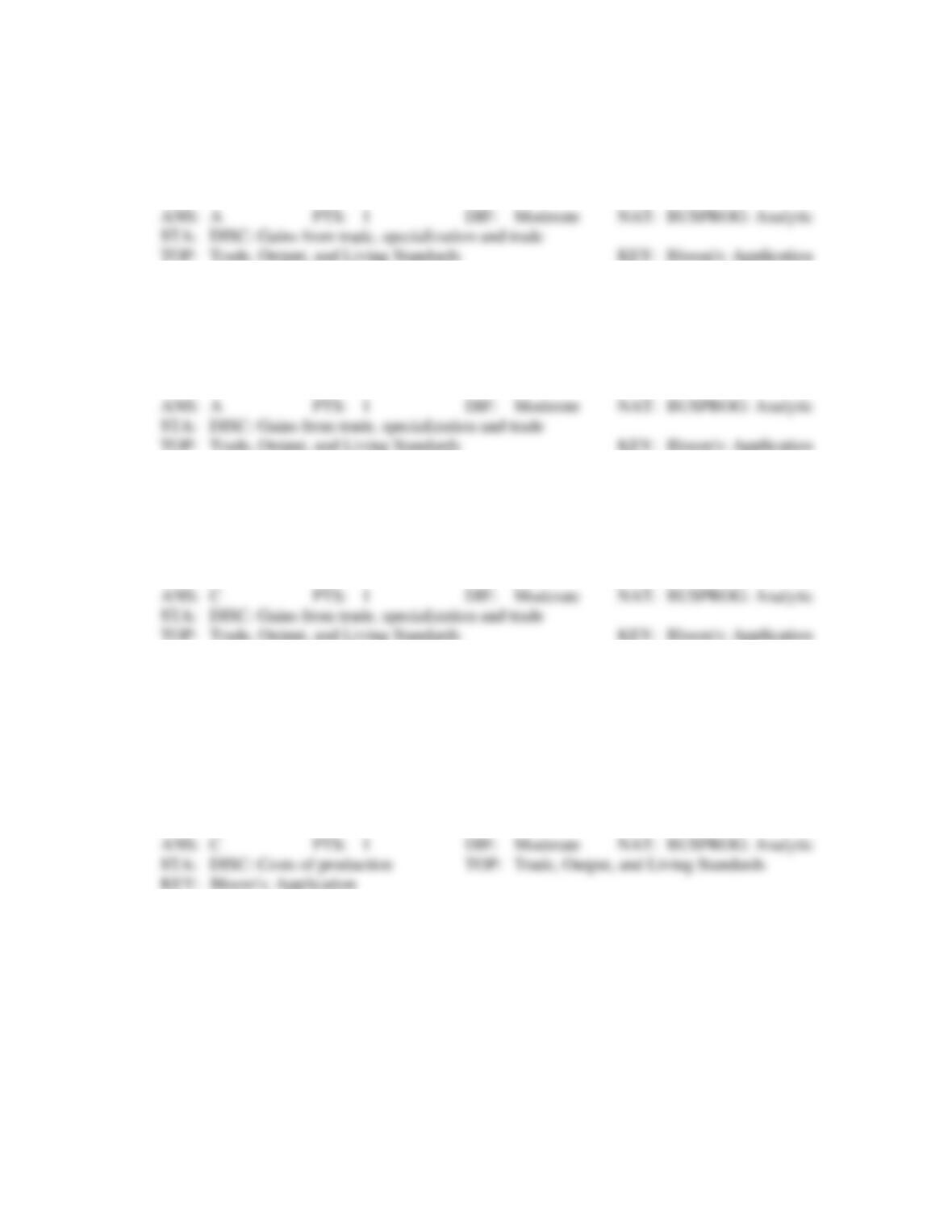
192. In Figure 2-1, point A is
a.
unattainable.
b.
inefficient.
c.
efficient.
d.
preferable to point B.
Figure 2-2
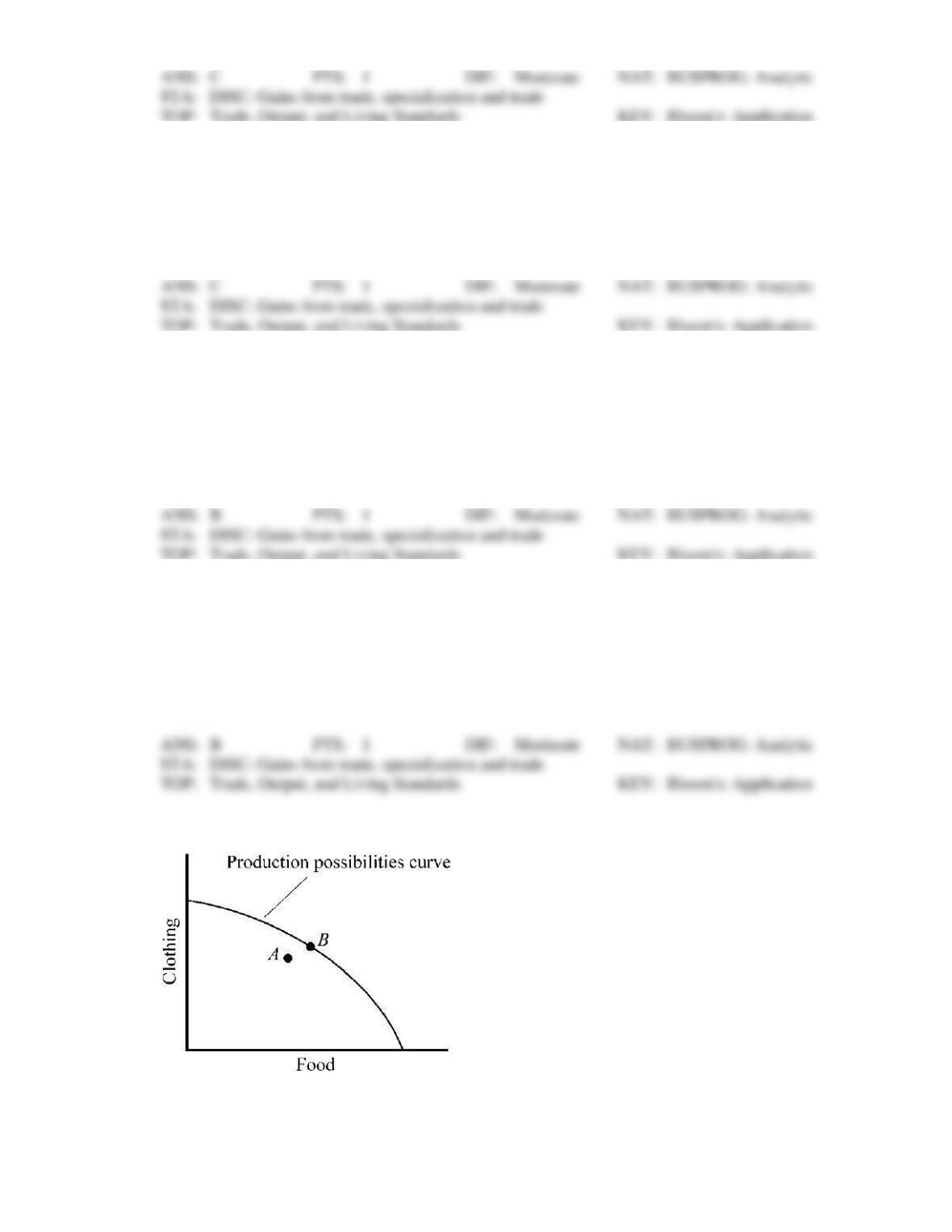
193. Which of the following would most likely cause the production possibilities curve for breadfruit and
fish to shift outward from AA to BB in Figure 2-2?
a.
a decrease in the labor force of the country
b.
a sudden change in consumer preferences for more fish and less breadfruit
c.
a major technological advance
d.
a decrease in the capital stock
Figure 2-3
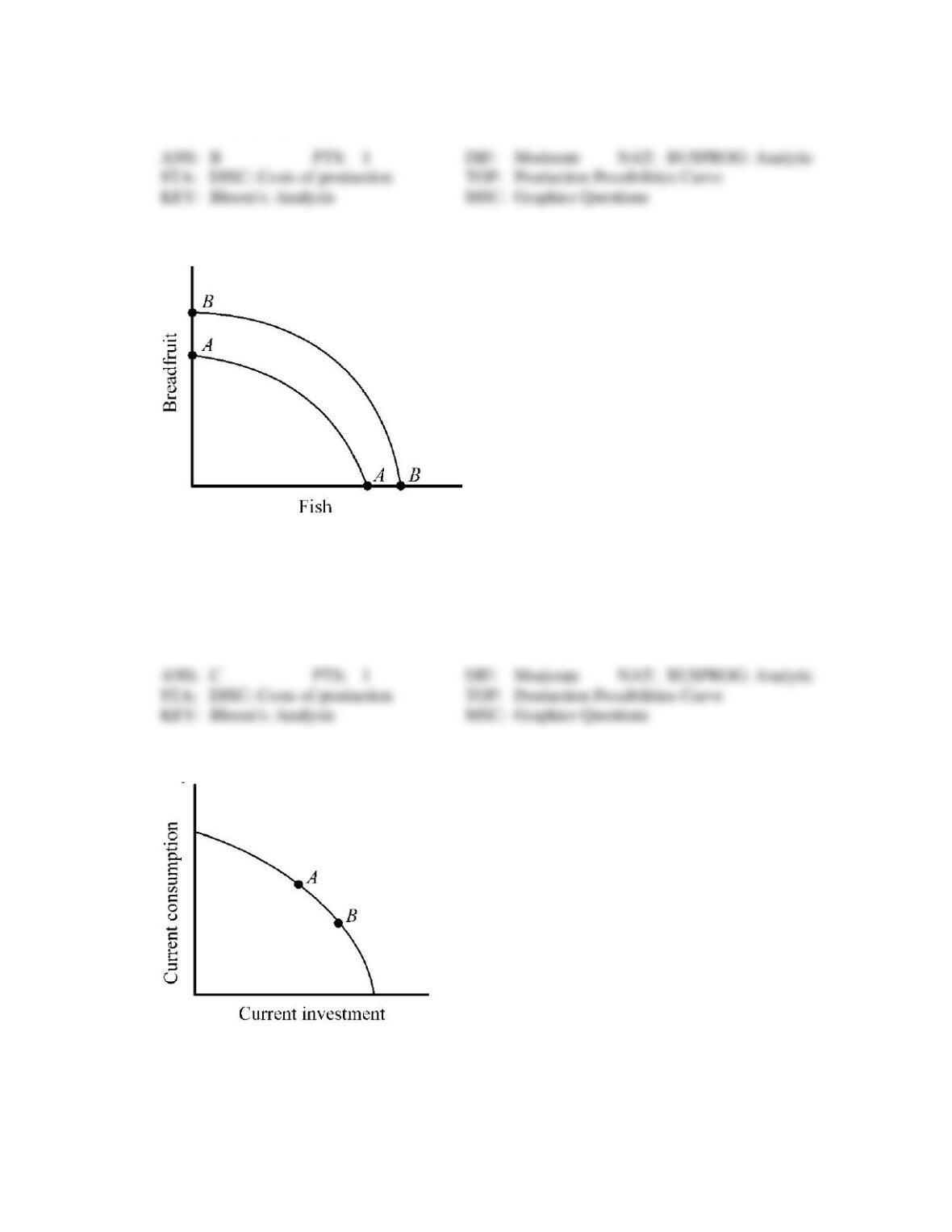
194. Points A and B in Figure 2-3 indicate consumption and investment for two economies. Other things
constant, which of the economies is likely to grow more rapidly in the future?
a.
economy A
b.
economy B
c.
They can be expected to grow at the same rate.
d.
This is uncertain since growth is not influenced by the factors indicated in this example.
Figure 2-4
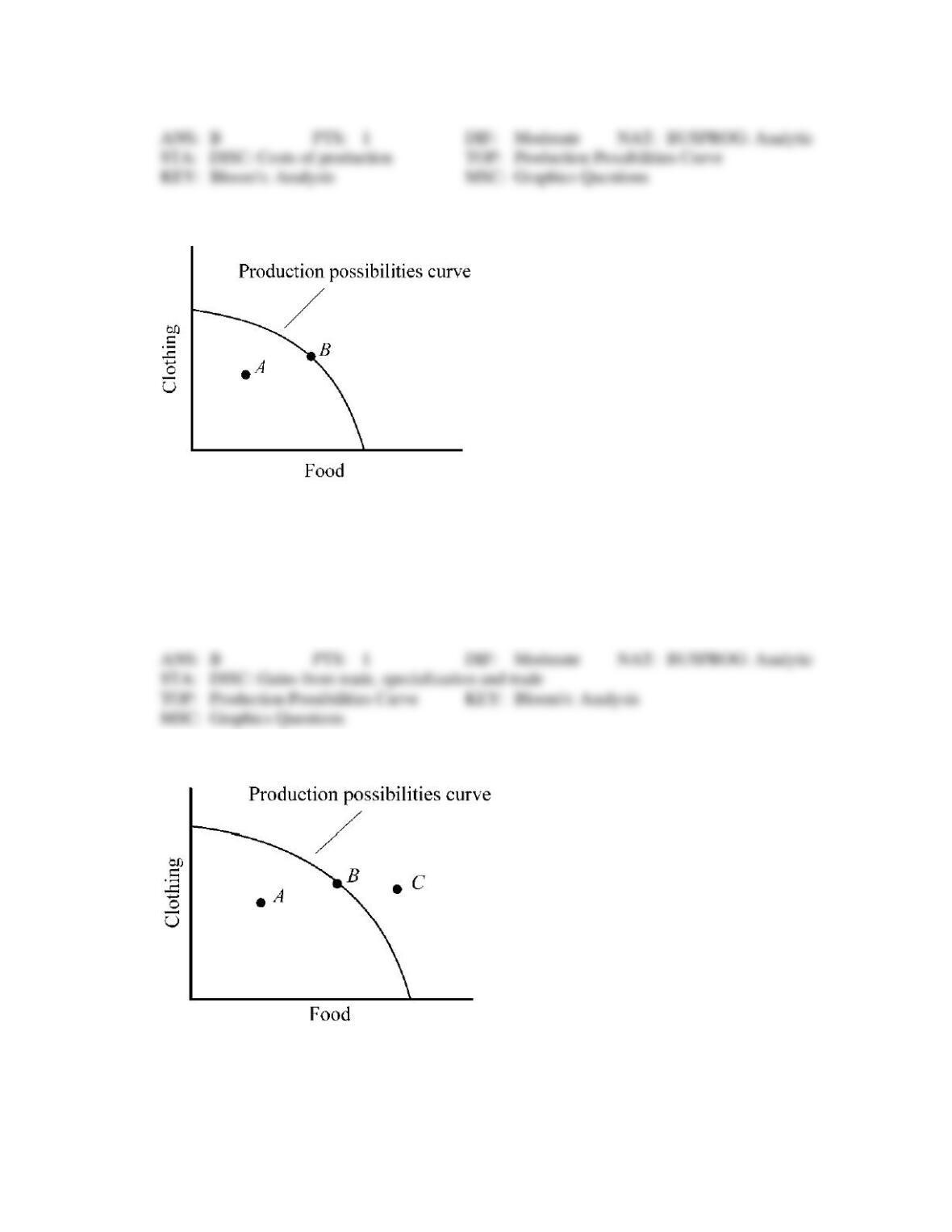
195. Which of the following is true of Figure 2-4?
a.
If the economy operates at point A, it is impossible to produce more of both food and
clothing.
b.
If the economy operates at point B, it is impossible to increase the output of clothing
without giving up food production.
c.
If the economy operates at point A, resources are being used efficiently.
d.
If the economy operates at point B, resources are being used inefficiently.
Figure 2-5
196. In Figure 2-5, which of the following is true?
a.
Point A is inefficient.
b.
Point B is efficient.
c.
Point C is unattainable.
d.
All of the above are true.
Figure 2-6
197. Which of the following will most likely shift the production possibilities curve for breadfruit and fish
outward from AA to BB in Figure 2–6?
a.
an improvement in the form of economic organization
b.
lower investment and a reduction in the country’s capital stock
c.
an increase in the price of breadfruit
d.
a decrease in the average number of hours worked
Figure 2-7
198. If an economy operates at point A on the production possibilities curve shown in Figure 2–7,
a.
to produce more food, it would have to reduce its production of clothing.
b.
to produce more clothing, it would have to reduce the production of food.
c.
it is operating efficiently.
d.
all of the above would be correct.
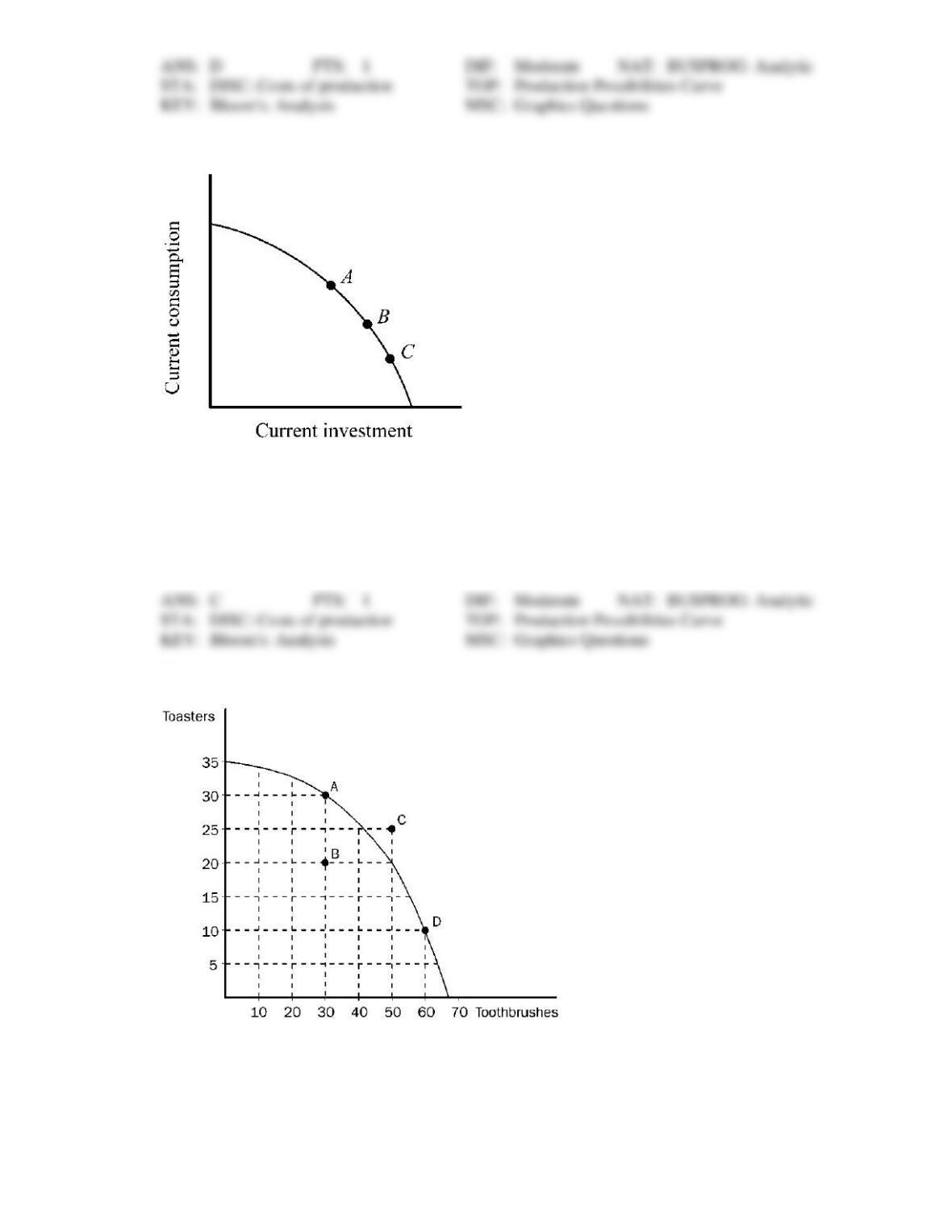
Figure 2-8
199. Points A, B, and C in Figure 2-8 indicate consumption and investment for three economies. Other
things constant, which of the economies is likely to grow more rapidly in the future?
a.
economy A
b.
economy B
c.
economy C
d.
They would all be expected to grow at the same rate.
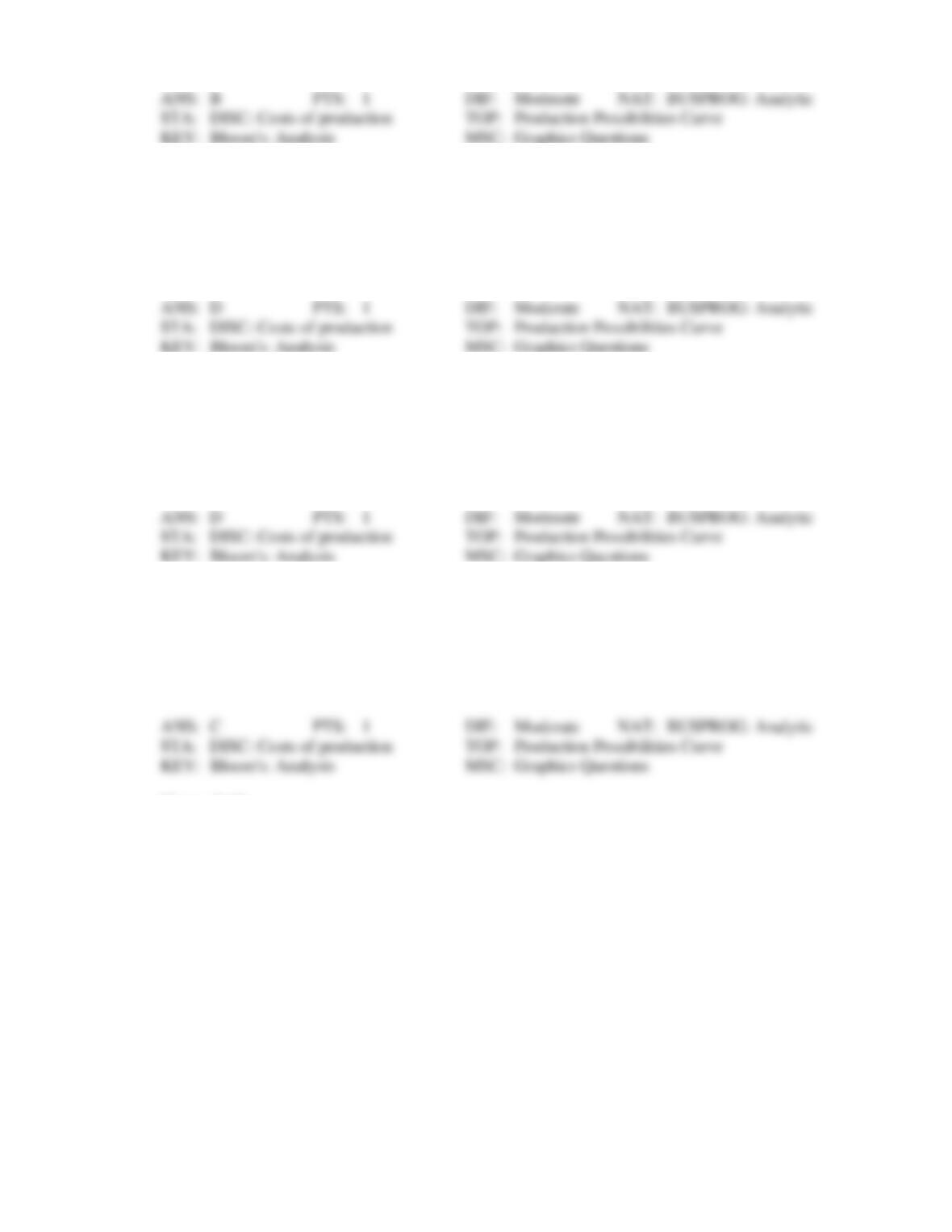
Figure 2-9
200. Refer to Figure 2-9. If the economy moves from point A to point D, the opportunity cost is
a.
10 toasters.
b.
20 toasters.
c.
30 toasters.
d.
30 toothbrushes.
201. Refer to Figure 2-9. The opportunity cost of obtaining 15 additional toasters by moving from point D
to point C is
a.
10 toothbrushes.
b.
20 toothbrushes.
c.
30 toothbrushes.
d.
none of the above; the economy cannot move from point D to point C.
202. Refer to Figure 2-9. The opportunity cost of obtaining 10 additional toasters by moving from point B
to point A is
a.
10 toothbrushes.
b.
20 toothbrushes.
c.
30 toothbrushes.
d.
zero, since the economy has the additional resources to produce 10 additional toasters.
203. Refer to Figure 2-9. Suppose the economy is producing at point B. Which of the following statements
would best explain this situation?
a.
The economy lacks the resources to produce at a more desirable point.
b.
The economy’s available technology prevents it from producing at a more desirable point.
c.
There is widespread unemployment in the economy.
d.
Any of the above statements would be a legitimate explanation for this situation.
Figure 2-10
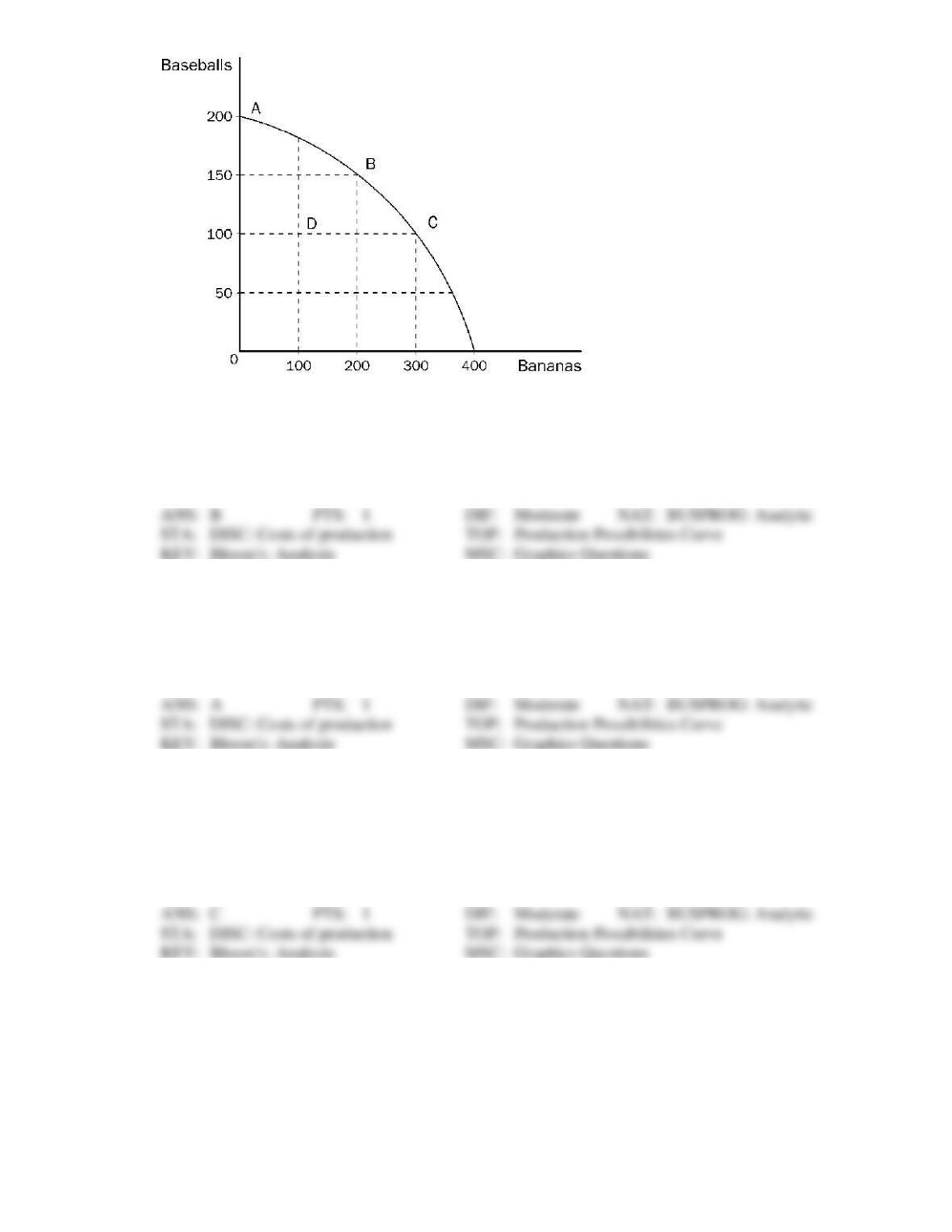
204. Refer to Figure 2-10. What is the opportunity cost of the movement from point A to point C?
a.
50 baseballs
b.
100 baseballs
c.
100 bananas
d.
300 bananas
205. Refer to Figure 2-10. A movement from point C to point D could be caused by
a.
unemployment.
b.
a decrease in society’s preference for bananas.
c.
fewer resources available for production of bananas.
d.
All of the above are correct.
206. Refer to Figure 2-10. If this economy put all available resources into the production of bananas, it
could produce
a.
200 bananas and also 150 baseballs.
b.
300 bananas and also 100 baseballs.
c.
400 bananas and no baseballs.
d.
It is impossible to know unless we know the quantity of resources available.
207. Refer to Figure 2-10. If the economy moves from point C to point B, then which of the following
statements is correct?
a.
The economy benefited from a technological advance in the production of baseballs.
b.
The opportunity cost of each additional baseball is 2 bananas.
c.
The opportunity cost of each additional banana is 2 baseballs.
d.
The move involves no opportunity cost; it simply reflects the desires of the economy’s
citizens.
208. The opportunity cost to the United States of placing a man on the moon was
a.
the loss of government revenues that were allocated to the mission.
b.
the cost of all production involved in the space program.
c.
the loss of utility from the highest valued bundle of products that had to be forgone
because of the moon mission.
d.
less than zero, because the long-run benefit of the project will be greater than the cost.
209. When Benjamin Franklin wrote, “Remember that time is money!” he understood
a.
the incentives created by property rights.
b.
the law of comparative advantage.
c.
the concept of opportunity cost.
d.
that watches cost money.
210. An airline ticket from Seattle to Miami costs $525. A bus ticket is $325. Traveling by plane will take 5
hours, compared with 25 hours by bus. Thus, the plane costs $200 more but saves 20 hours of time.
(Hint: Note how we are “thinking at the margin” here by looking at the changes.) Other things
constant, an individual will gain by choosing air travel if, and only if, each hour of her time is valued
at more than
a.
$10 per hour.
b.
$13 per hour.
c.
$20 per hour.
d.
$105 per hour.
211. Which of the following best describes the implications of the law of comparative advantage? If each
person sells goods for which he or she has the greatest comparative advantage in production and buys
those for which his or her comparative advantage is least, the
a.
total output available to each person can be expanded by specialization and exchange.
b.
total output will fall.
c.
buyers of goods will gain at the expense of sellers.
d.
sellers of goods will gain at the expense of buyers.
212. Keri decided to sleep in today rather than attend her 9 a.m. economics class. According to economic
analysis, her choice was
a.
irrational, because economic analysis suggests you should always attend classes that you
have already paid for.
b.
irrational, because oversleeping is not in Keri’s self-interest.
c.
rational if Keri has not missed any other classes.
d.
rational if Keri values sleep more highly than the benefit she expects to receive from
attending the class.
213. Which of the following is not one of the basic economic questions that all economies must answer?
a.
What will be produced?
b.
To whom will the goods produced be allocated?
c.
How will goods be produced?
d.
Which government agency will set the prices of the goods produced?
214. The owners of private property will
a.
use their property for selfish ends, taking no account of the impact their behavior has on
others.
b.
use their property in ways that others value because the market will generally reward them
with profits (or a higher selling price) if they do so.
c.
find very little incentive to take care of the property or conserve it for the future.
d.
lose profits when they take the wishes of others into consideration.
215. Ken values his boat at $5,000, and Monica values it at $8,000. If Monica buys it from Ken for $7,000,
which of the following is true?
a.
Ken gains $2,000 of value, and Monica gains $1,000 of value.
b.
Ken gains $7,000 of value, and Monica loses $7,000 of value.
c.
Ken gains $7,000 of value, and Monica gains $3,000 of value.
d.
Ken and Monica both gain $7,000 of value.
216. When collective decision making (the political process) is used to resolve economic questions
regarding the allocation of resources,
a.
decentralized decision making is present.
b.
central planning and political bargaining will replace market forces.
c.
individual preferences are of no importance.
d.
economic equality will result.
217. The law of comparative advantage suggests that
a.
individuals, states, and nations can all benefit if they trade with others.
b.
free trade among nations is harmful to an economy.
c.
each economy should strive to be self-sufficient.
d.
each country should attempt to produce roughly equal amounts of all goods.
218. When resources are being used wastefully or inefficiently, the
a.
production possibilities curve shifts inward.
b.
production possibilities curve shifts outward.
c.
economy is operating at a point inside its production possibilities constraint.
d.
economy is operating at a point outside its production possibilities constraint.
219. Which of the following is a transaction cost?
a.
price of a ticket to a concert
b.
price of food eaten before a concert
c.
time spent standing in line to buy the ticket
d.
price of a T-shirt at the concert
220. Middlemen, such as grocers, stockbrokers, and Realtors,
a.
specialize in reducing transactions costs.
b.
provide nothing of value to either the buyer or the seller.
c.
have no effect on economic output in society.
d.
do not exist in capitalist economies.
221. Private property rights exist when property rights are
a.
exclusively controlled by the owner or owners.
b.
transferable to others.
c.
protected by legal enforcement.
d.
all of the above.
222. When an economy is operating efficiently, the production of more of one good will result in the
production of less of some other good because
a.
consumers do not want more of both goods.
b.
resources are limited (scarce) and efficiency implies that all are already in use.
c.
the production possibilities curve shifts inward as more of one good is produced.
d.
technological improvement can only improve the production of a single good.
223. Which of the following would allow the production possibilities curve for an economy to shift
outward?
a.
a better social organization of economic activity, such as conversion from socialism to
capitalism
b.
an increase in the labor force or resource base
c.
more investment leading to better technology and more innovation
d.
all of the above
224. “If I didn’t have a date tonight, I would save $10 and spend the evening playing tennis.” The
opportunity cost of the date is
a.
the other things that could be purchased with the $10.
b.
the other things that could be purchased with the $10 plus the forgone value of a night of
tennis.
c.
dependent upon how pleasant a time one has on the date.
d.
the forgone value of a night of tennis.