Thinking Like an Economist 443
81. The effects of borrowing by the federal government would be studied by a microeconomist rather
than a macroeconomist.
a. True
b. False
82. The effects of foreign competition on the U.S. textile industry would be studied by a
microeconomist rather than a macroeconomist.
a. True
b. False
83. A macroeconomist, rather than a microeconomist, would study the effects on a market from two
firms merging.
a. True
b. False
444 Thinking Like an Economist
84. Microeconomics and macroeconomics are closely intertwined.
a. True
b. False
85. When economists are trying to explain the world, they are scientists, and when they are trying to
help improve the world, they are policy advisers.
a. True
b. False
86. Economists acting as scientists make positive statements, while economists acting as policy
advisers make normative statements.
a. True
b. False
Thinking Like an Economist 445
87. Normative statements describe how the world is, while positive statements prescribe how the
world should be.
a. True
b. False
88. Positive statements are descriptive, while normative statements are prescriptive.
a. True
b. False
89. Positive statements can be evaluated using data alone, but normative statements cannot.
a. True
b. False
446 Thinking Like an Economist
90. Evaluating normative statements involves values as well as facts.
a. True
b. False
91. “Society would be better off if the welfare system were abolished” is a normative statement, not a
positive statement.
a. True
b. False
92. “Other things equal, an increase in supply causes a decrease in price” is a normative statement,
not a positive statement.
a. True
b. False
Thinking Like an Economist 447
93. “Minimum wage laws result in unemployment” is a normative statement, while “the minimum
wage should be higher” is a positive statement.
a. True
b. False
94. “The US should not restrict employers from outsourcing work to foreign countries” is a
normative statement.
a. True
b. False
95. Trade-offs are involved in most policy decisions.
a. True
b. False
448 Thinking Like an Economist
96. Since 1946, the president of the United States has received guidance from the Council of
Economic Advisers.
a. True
b. False
97. The Council of Economic Advisers consists of thirty members and a staff of several dozen
economists.
a. True
b. False
98. The duties of the Council of Economic Advisers are to advise the president of the United States
and to determine U.S. monetary policy.
a. True
b. False
Thinking Like an Economist 449
99. The Council of Economic Advisers’ Economic Report of the President discusses recent
developments in the economy and presents the council’s analysis of current policy issues.
a. True
b. False
100. The President counts among his economic advisors the Congressional Budget Office.
a. True
b. False
101. Economists at the U.S. Department of the Treasury help design U.S. coins and paper money.
a. True
b. False
450 Thinking Like an Economist
102. Economists at the U.S. Department of Justice help enforce the nation’s antitrust laws.
a. True
b. False
103. Economists work both inside and outside the administrative branch of the U.S. government.
a. True
b. False
104. The Congressional Budget Office, which is staffed by economists, provides Congress with
independent evaluations of policy proposals.
a. True
b. False
Thinking Like an Economist 451
105. There is only one explanation for why economists give conflicting advice on policy issues, and it
is that they have different values about what policy should try to accomplish.
a. True
b. False
106. Economists may disagree about the validity of alternative positive theories about how the world
works.
a. True
b. False
107. Different values are not a reason for disagreement among economists.
a. True
b. False
452 Thinking Like an Economist
108. In surveys of professional economists, fourteen propositions were endorsed by an overwhelming
majority of respondents.
a. True
b. False
109. Because almost all economists oppose policies that restrict trade among nations, policymakers do
not restrict imports of certain goods.
a. True
b. False
110. According to John Maynard Keynes, an economist must possess a rare combination of skills
including being a mathematician, historian, statesman, and philosopher.
a. True
b. False
Thinking Like an Economist 453
111. In economics, graphs serve two purposes: they offer a way to visually express ideas, and they
provide a way of finding and interpreting patterns when analyzing economic data.
a. True
b. False
112. Examples of graphs of a single variable include pie charts, bar graphs, and time-series graphs.
a. True
b. False
113. A pie chart is a way to display information regarding two variables.
a. True
b. False
454 Thinking Like an Economist
114. In the ordered pair (10,30), 10 is the y-coordinate and 30 is the z-coordinate.
a. True
b. False
115. In the ordered pair (10,30), 10 is the horizontal location of the point and 30 is the vertical location
of the point.
a. True
b. False
116. Two variables that have a positive correlation move in the same direction.
a. True
b. False
Thinking Like an Economist 455
117. Two variables that have a negative correlation move in opposite directions.
a. True
b. False
118. When two variables move in opposite directions, the curve relating them is upward sloping, and
we say the variables are positively related.
a. True
b. False
119. When two variables move in the same direction, the curve relating them is downward sloping, and
we say the variables are negatively related.
a. True
b. False
456 Thinking Like an Economist
120. When a variable that is named on an axis of a graph changes, the curve shifts.
a. True
b. False
121. When a variable that is not named on either axis of a graph changes, we read the change as a
movement along the curve.
a. True
b. False
122. The concept of slope can be used to answer questions about how much one variable responds to
changes in another variable.
a. True
b. False
Thinking Like an Economist 457
123. The slope of a line is equal to the change in the x-variable divided by the change in the y-variable.
a. True
b. False
124. The slope of an upward-sloping line is positive, and the slope of a downward-sloping line is
negative.
a. True
b. False
125. The slope of a horizontal line is infinite, and the slope of a vertical line is zero.
a. True
b. False
458 Thinking Like an Economist
126. The slope of a line is the ratio of the vertical distance covered to the horizontal distance covered
along the line.
a. True
b. False
127. If a line passes through the points (20,5) and (10,10), then the slope of the line is 1/2.
a. True
b. False
128. If a line passes through the points (20,5) and (10,10), then the slope of the line is –2.
a. True
b. False
Thinking Like an Economist 459
129. Changes in one variable on a graph might be caused by the other variable on the graph or by a
third omitted variable.
a. True
b. False
130. Deciding that A causes B when in fact B causes A is a mistake called omitted variable bias.
a. True
b. False
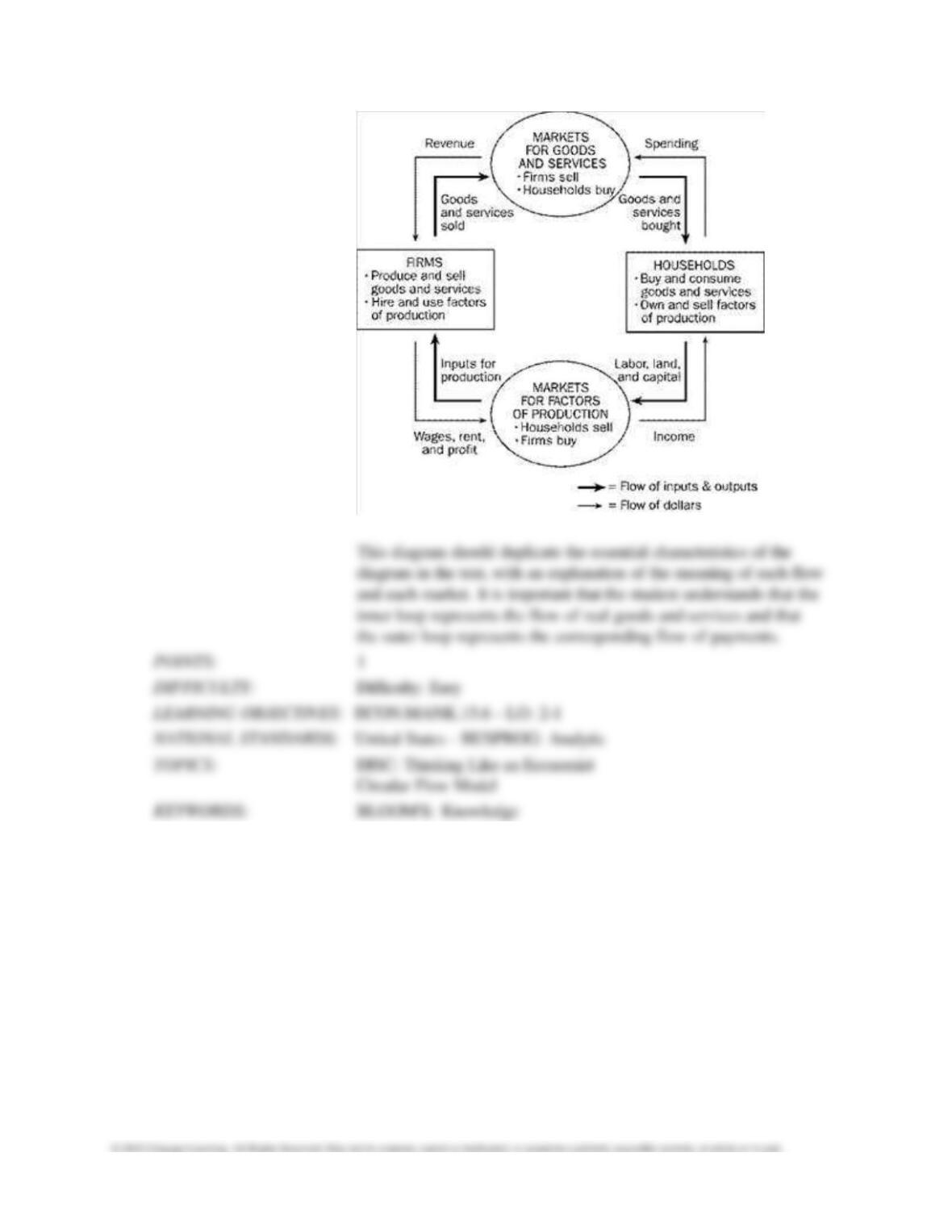
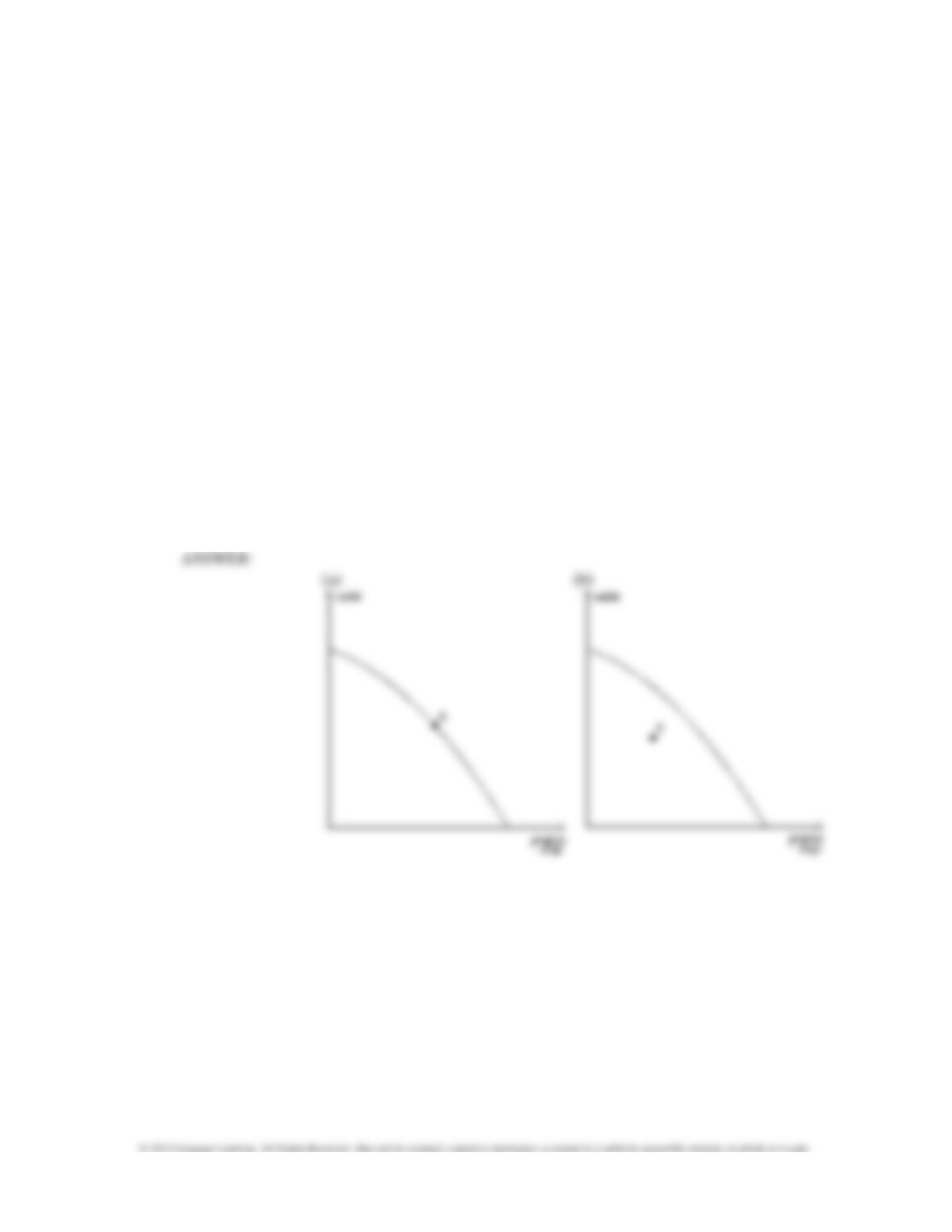
131. Using the outline below, draw a circular-flow diagram representing the interactions between
households and firms in a simple economy. Explain briefly the various parts of the diagram.
460 Thinking Like an Economist
ANSWER:
Thinking Like an Economist 461
132. The prairie dog has always been considered a problem for American cattle ranchers. They dig
holes that cattle and horses can step in, and they eat grass necessary for cattle. Recently,
ranchers have discovered that there is a demand for prairie dogs as pets. In some areas, prairie
dogs can sell for as high as $150 each. Cattlemen are now fencing off prairie dog towns on their
land so these towns will not be disturbed by their cattle.
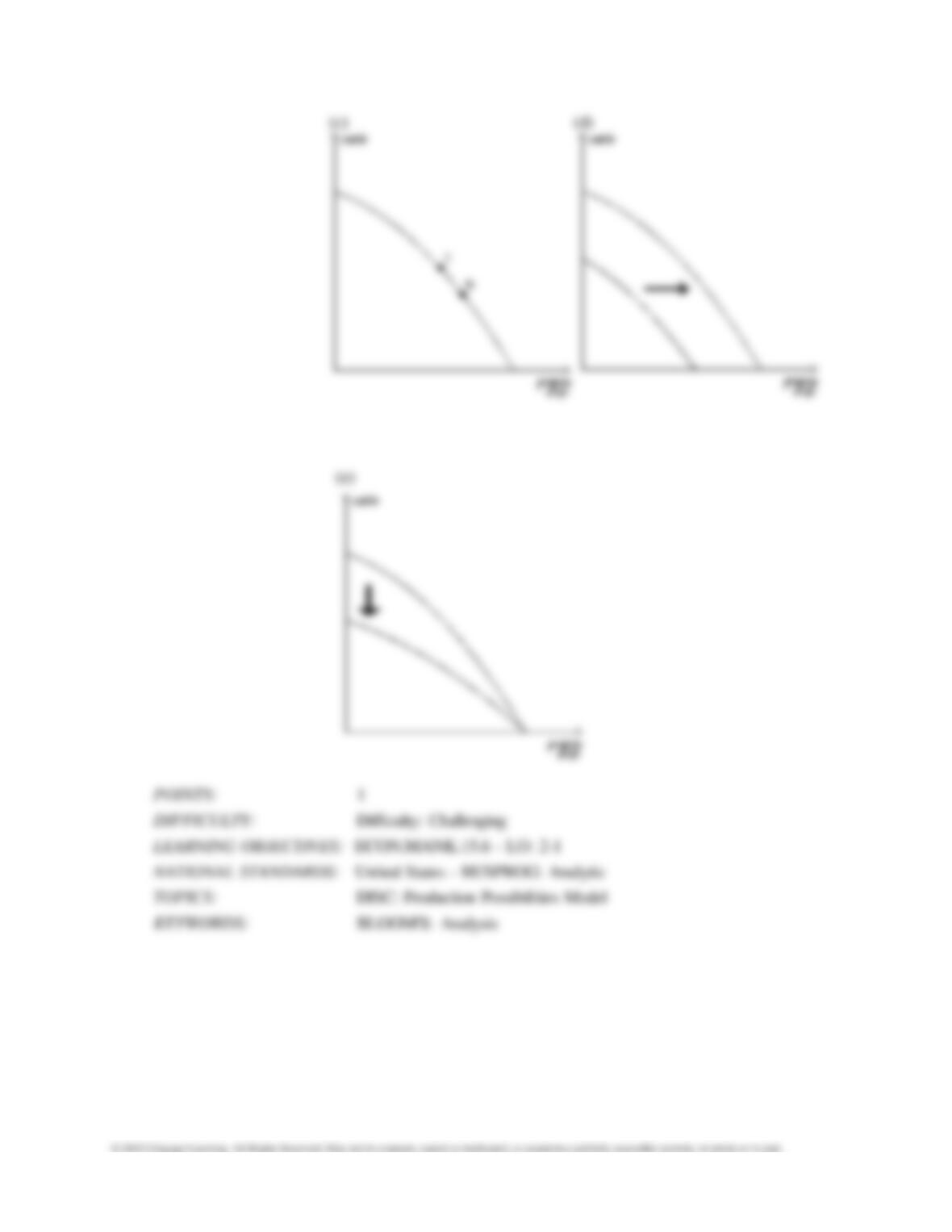
Draw a rancher’s production possibilities frontier showing increasing opportunity cost of cattle
production in terms of prairie dog production. Using a separate graph for each situation, show
what would happen to the initial production possibilities frontier in each of the following
situations:
a. The outcome is efficient, with ranchers choosing to produce equal numbers of cattle and prairie
dogs.
b. As a protest against the government introducing the gray wolf back into the wild in their state,
ranchers decide to withhold 25 percent of the available grassland for grazing.
c. The price of prairie dogs increases to $200 each, so ranchers decide to allot additional land for
prairie dogs.
d. The government grants new leases to ranchers, giving them 10,000 new acres of grassland each
for grazing.
e. A drought destroys most of the available grass for grazing of cattle, but not for prairie dogs
since they also eat plant roots.
462 Thinking Like an Economist