11
Barro
Chapter 2
1. Nominal GDP measures the dollar value of all goods and services that an economy produces in a
particular period of time.
2. GDP is a complete measure of economic welfare.
3. GDP ignores welfare changes due to environmental damage.
4. Value added is the difference between costs of production and the price of a product.
5. The difference between GDP and NNP is the depreciation of capital.
6. Nominal GDP measures the total value of goods and services, adjusted for inflation.
7. GDP in constant dollars uses prices from a base year, so that prices do not vary over time.
8. Business inventories are included in the GDP component of private domenstic investment.
9. A flow variable measures the dollar amount of goods at a specific point in time.
10. Conceptually, GDP measured by income, product, and value added each equal the same amount.
MULTIPLE CHOICE
1. Nominal GDP measures the:
a.
dollar value of all goods and services
produced in an economy at a point in time.
c.
dollar value of all goods and services
produced in an economy during a

12
specified time period.
b.
the constant dollar value of all goods and
services produced in an economy at a
point in time.
d.
the constant dollar value of all goods and
services produced in an economy during a
specified time period.
2. Imputed rental income is:
a.
the money people receive from renting
property.
c.
what an owner occupied house would
fetch on the market if the owner rented it.
b.
the money businesses pay for renting
property.
d.
the money businesses receive from renting
property.
3. In an economy with two goods, beer and pizza, if pizza costs $10 per pie and beer costs $5 per six
pack and if 100 six packs of beer and 200 pizzas are produced in a year, then nominal GDP that year
would be:
a.
$2,000.
c.
$1,500.
b.
$2,500.
d.
none of the above.
4. In an economy with two goods, burgers and pizza, if pizza costs $15 per pie and burgers costs $5 per
burger and if 1000 burger and 200 pizzas are produced in a year, then nominal GDP that year would
be:
a.
$24,000.
c.
$16,000.
b.
$8,000.
d.
none of the above.
5. Real GDP is GDP:
a.
in constant dollars.
c.
that considers income distribution.
b.
in current dollars.
d.
that includes the value of leisure.
6. Real GDP equals:
a.
nominal GDP times the implicit price
level.
c.
the current dollar value of all goods and
services produced in an economy during a
particular time period.
b.
nominal GDP divided by the implicit price
level.
d.
real GDP time the implicit price level.
7. The implicit price level is:
a.
the ratio of nominal to real GDP.
c.
the ratio of real to nominal GDP
b.
the product of real and nominal GDP.
d.
the difference between real and nominal
GDP.
8. If real GDP is 120 and nominal GDP is 180, then the implicit price level is:
a.
.56.
c.
60.
b.
1.5.
d.
21600.
9. If real GDP is 200 and nominal GDP is 160, then the implicit price level is:
a.
0.8
c.
40.
b.
1.25
d.
32000.
10. GDP does not:
a.
consider changes in the distribution of
income.
c.
assign value to leisure time.
b.
include most nonmarket goods.
d.
all of the above.
11. Personal consumption expenditure includes:
a.
services.
c.
imports.
b.
residential structures.
d.
all of the above.
12. Gross private domestic expenditure includes:
a.
fixed investment.
c.
residential structures.
b.
change in business inventory.
d.
all of the above.
13. Net exports of goods and services equals:
a.
imports times exports.
c.
imports minus exports.
b.
exports minus imports.
d.
all of the above.
14. Personal Consumption expenditure includes:
a.
changes in business inventories.
c.
imports.
b.
nondurables.
d.
all of the above.
15. Gross private domestic investment includes
a.
durable goods.
c.
financial assets.
b.
residential structures.
d.
all of the above.
16. Government purchases include:
a.
state and local government purchases.
c.
federal government debt.
b.
tax receipts.
d.
all of the above.
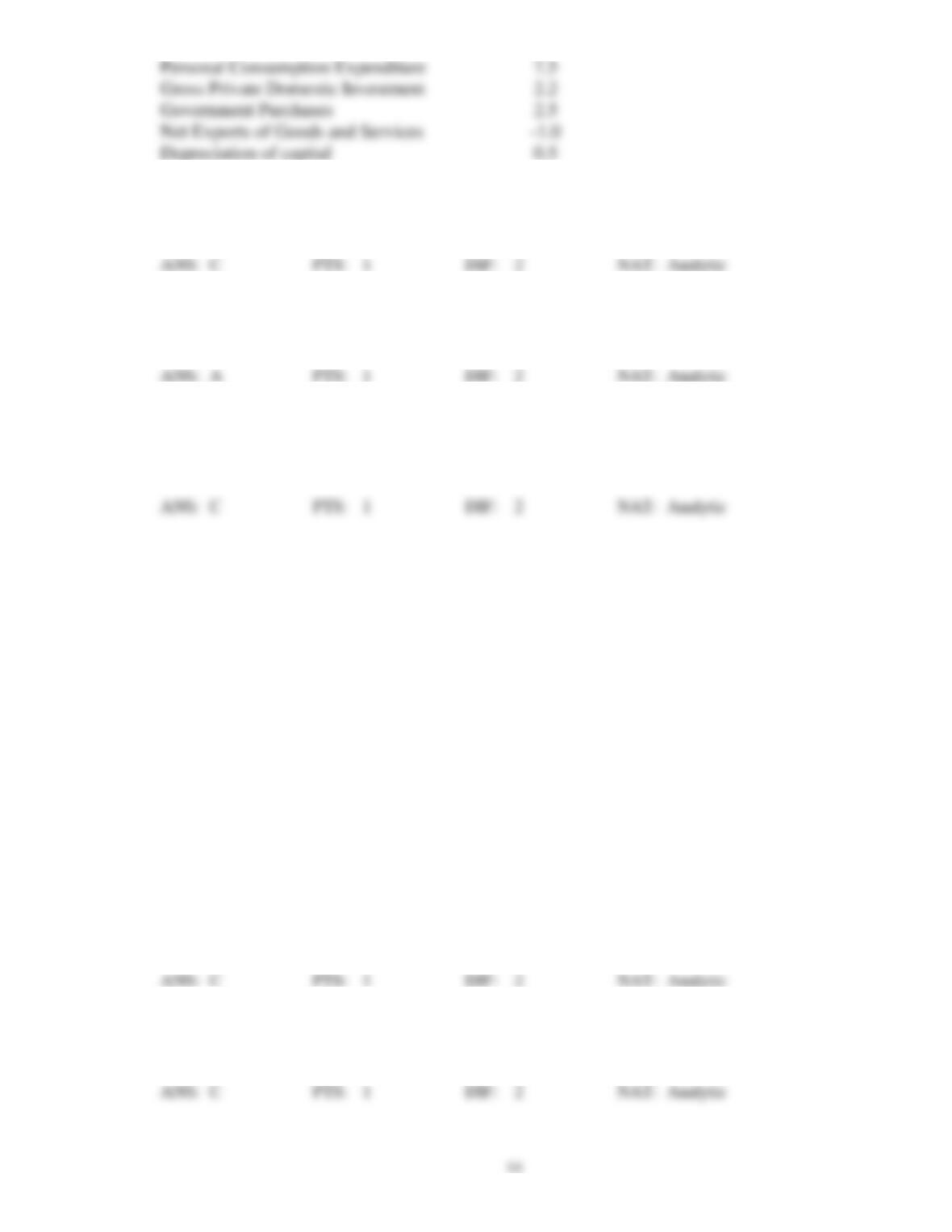
17. Based on the data in Table 2.1, Gross Domestic Product is:
a.
$11.7 trillion.
c.
$11.2 trillion.
b.
$10.7 trillion.
d.
none of the above.
18. Based on the data in Table 2.1, net domestic private investment is:
a.
$1.7 trillion.
c.
$11.0 trillion.
b.
$2.7 trillion.
d.
none of the above.
19. Depreciation is:
a.
when the price level falls.
c.
the capital used up producing this period’s
output.
b.
the economy goes into recession.
d.
all of the above.
Table 2.2
Category of Expenditure Trillions of $
Durable Goods 1.1
Fixed Investment 1.0
Federal Government Purchases 0.9
Exports 1.3
Nondurable Goods 2.6
Nonresidential Structures 1.3
State and Local Government 1.5
Imports 2.0
Services 5.2
Residential Structures 0.8
Changes in Business Inventories 2.0
20. Based on the data in Table 2.2, personal consumption expenditure is:
a.
$3.7 trillion.
c.
$8.9 trillion.
b.
$9.7 trillion.
d.
none of the above.
21. Based on the data in Table 2.2, gross private investment is:
a.
$1.0 trillion.
c.
$5.1 trillion.
b.
$4.3 trillion.
d.
none of the above.

15
22. Based on the data in Table 2.2, government purchases are:
a.
$0.9 trillion.
c.
$0.6 trillion.
b.
$2.4 trillion.
d.
none of the above.
23. Based on the data in Table 2.2, net exports of goods and services are:
a.
$0.7 trillion.
c.
-$0.7 trillion.
b.
$3.3 trillion.
d.
none of the above.
24. Based on the data in Table 2.2, gross domestic product is:
a.
$17.7 trillion.
c.
$19.7 trillion.
b.
$15.7 trillion.
d.
none of the above.
25. Based on the data in Table 2.2, net domestic product is:
a.
$15.7 trillion.
c.
$19.7 trillion.
b.
$17.7 trillion.
d.
none of the above.
26. Economists sometimes use a closed economy model despite the fact of trade with the rest of the world
because:
a.
the world as a whole is a closed economy.
c.
it simplifies the analysis.
b.
at least for large countries like the US
exports and imports have been small
compared to GDP.
d.
all of the above.
27. Economists sometimes use a closed economy model because:
a.
few countries actually trade with others.
c.
exports and imports have no effect on the
economy.
b.
it simplifies the analysis.
d.
all of the above.
Table 2.3
Type of Income Trillions of $
Compensation of employees 7.1
Proprietor’s income 0.9
Rental income of persons 0.1
Corporate profits 1.4
Net interest 0.5
Taxes on production 0.9
Subsidies 0.1
Business transfers 0.1
Surplus of government enterprises -0.1
16
28. Based on the data in Table 2.3, national income is:
a.
$7.1 trillion.
c.
$11.0 trillion.
b.
$10.8 trillion.
d.
none of the above.
29. Taxes on production include:
a.
excise taxes.
c.
estate taxes.
b.
income taxes.
d.
all of the above.
30. National income includes:
a.
corporate taxes
c.
corporate profits.
b.
corporate assets
d.
all of the above.
31. National income and GDP diverge in practice because of:
a.
receipts and payments involving the rest
of the world.
c.
taxes
b.
subsidies.
d.
all of the above.
32. National income includes:
a.
rental income of persons.
c.
corporate profits.
b.
net interest.
d.
all of the above.
33. National income and GDP diverge in practice because of:
a.
subsidies.
c.
taxes.
b.
depreciation of capital.
d.
all of the above.
Table 2.4
Type of Product or Income Trillions of $
Gross domestic product (GDP) 12.5
Income receipts from the rest of the world 0.5
Depreciation of the capital stock 1.6
Corporate profits, taxes on production, contributions for social
insurance, net interest, business transfers, surplus of government
enterprises 3.6
Personal taxes 1.2
Income payments to the rest of the world 0.4
Personal income receipts on assets and personal transfer payments 3.0
34. Base on the data in Table 2.4, gross national product (GNP) is:
a.
$11.4 trillion.
c.
$12.5 trillion.
b.
$12.6. trillion.
d.
none of the above.

17
35. Based on the data in Table 2.4, net national product is:
a.
$11.0 trillion.
c.
$12.6 trillion.
b.
$11.4 trillion.
d.
none of the above.
36. Based on the data in Table 2.4, national income is:
a.
$7.4 trillion.
c.
$8.9 trillion.
b.
$11.0 trillion.
d.
none of the above.
37. Based on the data in Table 2.4, personal income is:
a.
$10.2 trillion.
c.
$11.8 trillion.
b.
$10.4 trillion.
d.
none of the above.
38. Based on the data in Table 2.4, disposable personal income is:
a.
$10 trillion.
c.
$9.2 trillion.
b.
$7.4 trillion.
d.
none of the above.
39. Gross national product (GNP) is gross domestic product (GDP):
a.
less income receipts from the rest of the
world less income payments to the rest of
the world.
c.
plus income receipts from the rest of the
world less income payments to the rest of
the world.
b.
less income receipts from the rest of the
world plus income payments to the rest of
the world.
d.
less income receipts from the rest of the
world less income payments to the rest of
the world.
40. Net national product (NNP) is gross national product (GNP):
a.
plus depreciation of capital.
c.
plus personal taxes.
b.
less depreciation of capital.
d.
less personal taxes.
41. Personal income is national income:
a.
less corporate profits, taxes on production,
contributions for social insurance, net
interest, business transfers and surplus of
government enterprises plus personal
income receipts on assets and personal
transfer payments.
c.
plus corporate profits, taxes on
production, contributions for social
insurance, net interest, business transfers
and surplus of government enterprises less
personal income receipts on assets and
personal transfer payments.
b.
less corporate profits, taxes on production,
contributions for social insurance, net
interest, business transfers, surplus of
government enterprises, personal income
receipts on assets and personal transfer
payments.
d.
plus corporate profits, taxes on
production, contributions for social
insurance, net interest, business transfers,
surplus of government enterprises,
personal income receipts on assets and
personal transfer payments.

18
42. Disposable personal income is personal income:
a.
plus personal taxes.
c.
less personal taxes.
b.
less corporate profits, taxes on production,
contributions for social insurance, net
interest, business transfers and surplus of
government enterprises plus personal
income receipts on assets and personal
transfer payments.
d.
plus corporate profits, taxes on
production, contributions for social
insurance, net interest, business transfers
and surplus of government enterprises less
personal income receipts on assets and
personal transfer payments.
43. Subtracted from national income to get personal income is:
a.
depreciation of capital.
c.
personal transfer payments.
b.
corporate profits.
d.
all of the above.
44. Added to national income to get personal income is:
a.
personal income receipts on assets.
c.
contributions for social insurance.
b.
net interest.
d.
all of that above.
45. Subtracted from national income to get personal income is:
a.
net interest.
c.
taxes on production.
b.
business transfers.
d.
all of the above.
46. Subtracted from personal income to get disposable personal income is:
a.
personal taxes.
c.
personal income receipts on assets.
b.
contributions for social insurance.
d.
all of the above.
47. The consumer price index (CPI):
a.
can not be constructed as a chained index.
c.
is updated whenever new goods are
introduced.
b.
does not adjust for quality changes in
goods.
d.
fully accounts for substitution to cheaper
goods.
48. The consumer price index is biased because it can not account for:
a.
quality changes in goods.
c.
people substituting to cheaper goods.
b.
new goods.
d.
all of the above.
49. The consumer price index does not account for:
a.
the introduction of new goods.
c.
goods whose prices fall.
b.
goods whose prices rise.
d.
all of the above.

19
50. The consumer price index is constructed from:
a.
tax data.
c.
data from wholesale producers.
b.
survey data.
d.
all of the above.
51. Nominal GDP can be misleading primarily because it
a.
does not include imputed rental income.
c.
is adjusted for inflation.
b.
depends on the overall level of prices.
d.
does not include personal consumption
expenditures.
52. Which of the following would NOT be included in this year’s GDP?
a.
the sale of a new 4-door sedan car to a
consumer.
c.
the sale of an antique automobile to a
antique-car collector.
b.
the sale of a new computer to a student.
d.
the sale of a new SUV to a consumer.
53. Which of the following would be included in this year’s GDP?
a.
the sale of a new car.
c.
the sale of an existing home.
b.
the sale of a used car.
d.
the sale of an antique table.
54. In the calculation of real GDP, a base year is used for measuring
a.
rental income.
c.
production quantities.
b.
wages.
d.
prices.
55. The chain-weighted measure of GDP
a.
uses average prices of goods for two
adjacent years.
c.
uses the current prices of goods.
b.
uses the price of goods in a base year,
such as the year 2000.
d.
gives more weight to goods which are
more expensive.
56. A chain-weighted measure of GDP addresses the issue of changes in
a.
product quality.
c.
the chain of supply for goods.
b.
the average weight of goods.
d.
the quantity of exports and imports.
57. When the quality of a product changes over time, real GDP
a.
cannot be adjusted for this problem.
c.
can be adjusted by using a chain-weighted
measure of GDP.
b.
can be adjusted by choosing a new base
year each decade.
d.
can be adjusted by subtracting
depreciation from nominal GDP.
58. If nominal GDP is 200 and the implicit price level is 1.25, then real GDP

20
a.
equals 250.
c.
equals 160.
b.
equals 201.25
d.
cannot be calculated.
59. If nominal GDP is 300 and the implicit price level is 0.75, then real GDP
a.
equals 400.
c.
equals 225.
b.
equals 300.
d.
cannot be calculated.
60. If real GDP equals 400 and the implicit price level is 0.75, then nominal GDP
a.
equals 400.
c.
equals 225.
b.
equals 300.
d.
cannot be calculated.
61. If real GDP equals 400 and the implicit price level is 1.25, then nominal GDP
a.
equals 320.
c.
equals 500.
b.
equals 400.
d.
cannot be calculated.
62. One shortcoming of real GDP is that it
a.
excludes most nonmarket activity.
c.
does not consider price changes.
b.
does not consider income distribution.
d.
(a) and (b).
63. Which of the following is NOT classified as a consumer durable?
a.
automobiles.
c.
refrigerators.
b.
furniture.
d.
none of the above.
64. Seasonal adjustment to macroeconomic data corrects mostly for
a.
price level changes.
c.
the weather and holidays.
b.
product quality changes.
d.
the housing industry cycle.
65. The sum of value added from all sectors in an economy is equal to
a.
national income.
c.
net national product.
b.
GDP.
d.
(a) and (b).
66. A pottery shop buys clay and other materials for $20. Workers use the materials to make 5 bowls that
are sold for $250 total. The value added by the pottery shop equals
a.
$0.
c.
$30.
b.
$20.
d.
$230.
SHORT ANSWER
1. What is nominal gross domestic product (GDP)?
2. What is real GDP and what makes it “real?”
3. What is the relationship between nominal and real GDP?
4. What parts of welfare does real GDP not measure?
5. Why might the consumer price index (CPI) overstate inflation?
6. Why should GDP measured by expenditures and by income each equal the same amount? Why, in
practice, are they often not equal?