Macroeconomics 2017 (Hubbard)
Chapter 2 Trade-offs, Comparative Advantage, and the Market System
2.1 Production Possibilities Frontiers and Opportunity Costs
1) ________ exists because unlimited wants exceed the limited resources available to fulfill those wants.
A) Scarcity
B) Productive efficiency
C) The command economy
D) Economic growth
2) To compete in the automobile market, Tesla must make many strategic decisions such as whether to
introduce a new car model, how to sell and service its cars, and where to advertise. At Tesla’s Fremont,
California plant, managers must decide on the monthly production quantities of their S and X models.
In making this decision, the managers
A) face no trade-off because the Fremont plant only produces these two models of the many Tesla
models produced worldwide.
B) face a trade-off, because producing more of one model means producing less of the other.
C) will choose to only produce the quantity of S and X models where marginal cost equals zero.
D) will always decide on production quantities in which revenues are maximized.
3) The principle of ________ is that the economic cost of using a factor of production is the alternative
use of that factor that is given up.
A) marginal cost
B) opportunity cost
C) normative economics
D) entrepreneurship
4) The production possibilities frontier shows
A) the various products that can be produced now and in the future.
B) the maximum attainable combinations of two products that may be produced in a particular time
period with available resources.
C) what an equitable distribution of products among citizens would be.
D) what people want firms to produce in a particular time period.
5) ________ shows that if all resources are fully and efficiently utilized, more of one good can be
produced only by producing less of another good.
A) Comparative advantage
B) Absolute advantage
C) The mixed market system
D) The production possibilities frontier model
6) The production possibilities frontier model assumes all of the following except
A) labor, capital, land and natural resources are fixed in quantity.
B) the economy produces only two products.
C) any level of the two products that the economy produces is currently possible.
D) the level of technology is fixed and unchanging.
7) The ________ production points on a production possibilities frontier are the points along and inside
the production possibilities frontier.
A) attainable
B) unattainable
C) productively efficient
D) allocatively efficient
8) The unattainable points in a production possibilities diagram are
A) the points within the production possibilities frontier.
B) the points along the production possibilities frontier.
C) the points of the horizontal and vertical intercepts.
D) the points outside the production possibilities frontier.
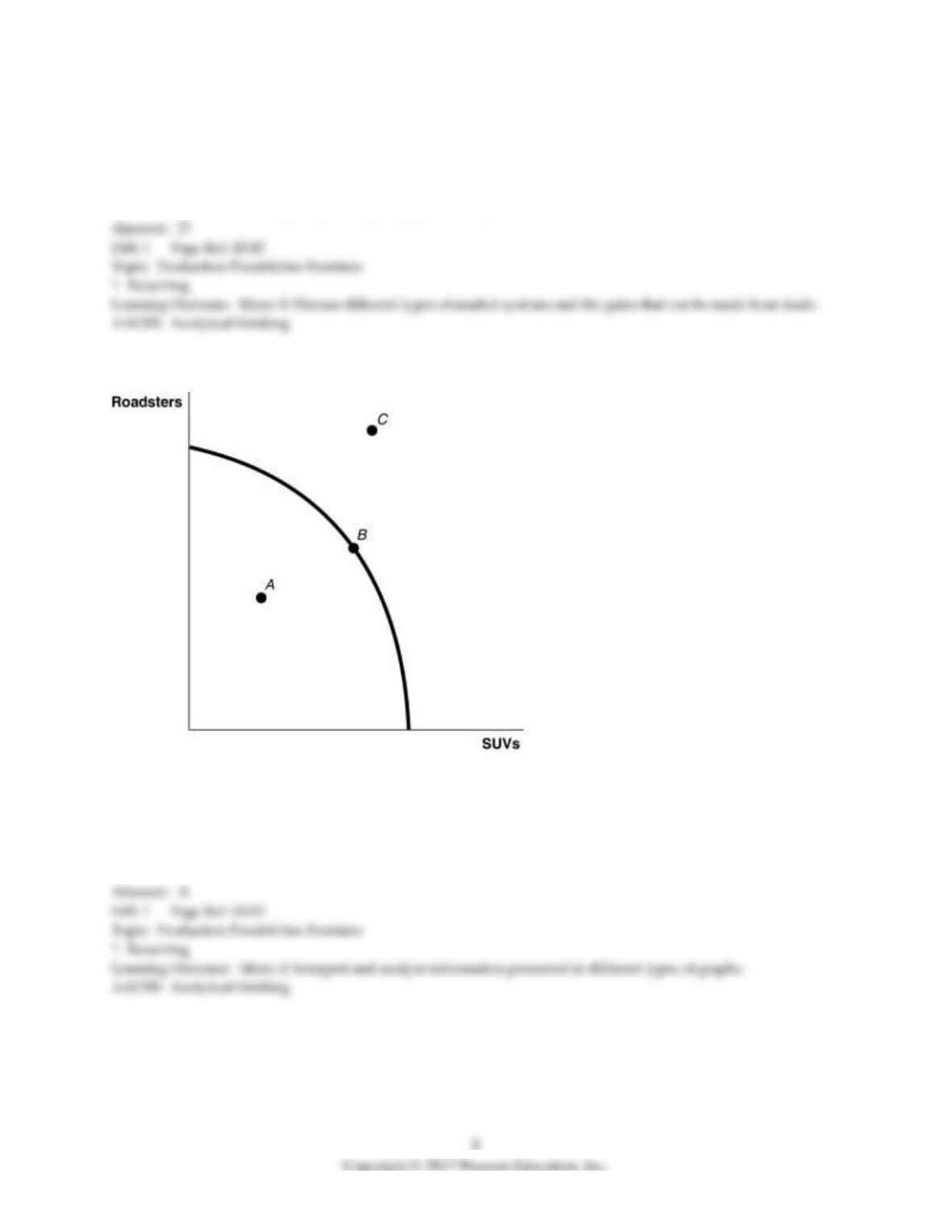
Figure 2-1
9) Refer to Figure 2-1. ________ is (are) inefficient in that not all resources are being used.
A) Point A
B) Point B
C) Point C
D) Points A and C
10) Refer to Figure 2-1. ________ is (are) technically efficient.
A) Point A
B) Point B
C) Point C
D) Points B and C
11) Refer to Figure 2-1. ________ is (are) unattainable with current resources.
A) Point A
B) Point B
C) Point C
D) Points A and C
12) In a production possibilities frontier model, a point inside the frontier is
A) allocatively efficient.
B) productively efficient.
C) productively and allocatively inefficient.
D) productively inefficient.
13) Carmelita can perform either a combination of 35 manicures and 70 pedicures or a combination of 50
manicures and 45 pedicures. If she now performs 35 manicures and 70 pedicures, what is the
opportunity cost of performing an additional 15 manicures?
A) 5 pedicures
B) 20 pedicures
C) 25 pedicures
D) 45 pedicures
14) If the production possibilities frontier is linear, then
A) opportunity costs are decreasing as more of one good is produced.
B) it is easy to efficiently produce output.
C) opportunity costs are increasing as more of one good is produced.
D) opportunity costs are constant as more of one good is produced.
Figure 2-2
Figure 2-2 above shows the production possibilities frontier for Vidalia, a nation that produces two
goods, roses and orchids.
15) Refer to Figure 2-2. What is the opportunity cost of one dozen orchids?
A) 0.4 dozen roses
B) 2.5 dozen roses
C) 7.25 dozen roses
D) 16 dozen roses
16) Refer to Figure 2-2. What is the opportunity cost of one dozen roses?
A) 0.4 dozen orchids
B) 2.5 dozen orchids
C) 7.25 dozen orchids
D) 16 dozen orchids
17) Refer to Figure 2-2. Suppose Vidalia is currently producing 20 dozen orchids per period. How many
roses is it also producing, assuming that resources are fully utilized?
A) 30 dozen roses
B) 50 dozen roses
C) 100 dozen roses
D) 150 dozen roses
18) Refer to Figure 2-2. If Vidalia chooses to produce 40 dozen orchids, how many roses can it produce
to maximize production?
A) 30 dozen roses
B) 50 dozen roses
C) 100 dozen roses
D) 150 dozen roses
19) Refer to Figure 2-2. If Vidalia chooses to produce 60 dozen orchids, how many roses can it produce
to maximize production?
A) 30 dozen roses
B) 50 dozen roses
C) 100 dozen roses
D) 150 dozen roses
20) Refer to Figure 2-2. If Vidalia chooses to produce 50 dozen roses, how many orchids can it produce
to maximize production?
A) 20 dozen orchids
B) 40 dozen orchids
C) 60 dozen orchids
D) 80 dozen orchids
21) Refer to Figure 2-2. If Vidalia chooses to produce 80 dozen roses, how many orchids can it produce
to maximize production?
A) 24 dozen orchids
B) 48 dozen orchids
C) 60 dozen orchids
D) 74 dozen orchids
22) Refer to Figure 2-2. The linear production possibilities frontier in the figure indicates that
A) Vidalia has a comparative advantage in the production of orchids.
B) Vidalia has a comparative disadvantage in the production of roses.
C) the tradeoff between roses and orchids is constant.
D) it is progressively more expensive to produce orchids.
23) A production possibilities frontier with a ________ shape indicates increasing opportunity costs as
more and more of one good is produced.
A) linear
B) bowed inward
C) bowed outward
D) perfectly horizontal
24) Increasing opportunity cost along a bowed-out production possibilities frontier occurs because
A) of inefficient production.
B) of ineffective management by entrepreneurs.
C) some factors of production are not equally suited to producing both goods or services.
D) of the scarcity of factors of production.
25) The slope of a production possibilities frontier measures the ________ of producing one more unit of
a good.
A) marginal revenue
B) total revenue
C) marginal cost
D) opportunity cost
26) Increasing marginal opportunity cost implies that
A) the more resources already devoted to any activity, the payoff from allocating yet more resources to
that activity increases by progressively smaller amounts.
B) the more resources already devoted to any activity, the benefits from allocating yet more resources to
that activity decreases by progressively larger amounts.
C) that rising opportunity costs makes it inefficient to produce beyond a certain quantity.
D) the law of scarcity.
27) If opportunity costs are ________, the production possibilities frontier would be graphed as a
negatively sloped straight line.
A) decreasing
B) increasing
C) negative
D) constant
Figure 2-3
28) Refer to Figure 2-3. Carlos Vanya grows tomatoes and strawberries on his land. His land is equally
suited for growing either fruit. Which of the graphs in Figure 2-3 represents his production possibilities
frontier?
A) Graph A
B) Graph B
C) Graph C
D) either Graph A or Graph B
E) either Graph B or Graph C
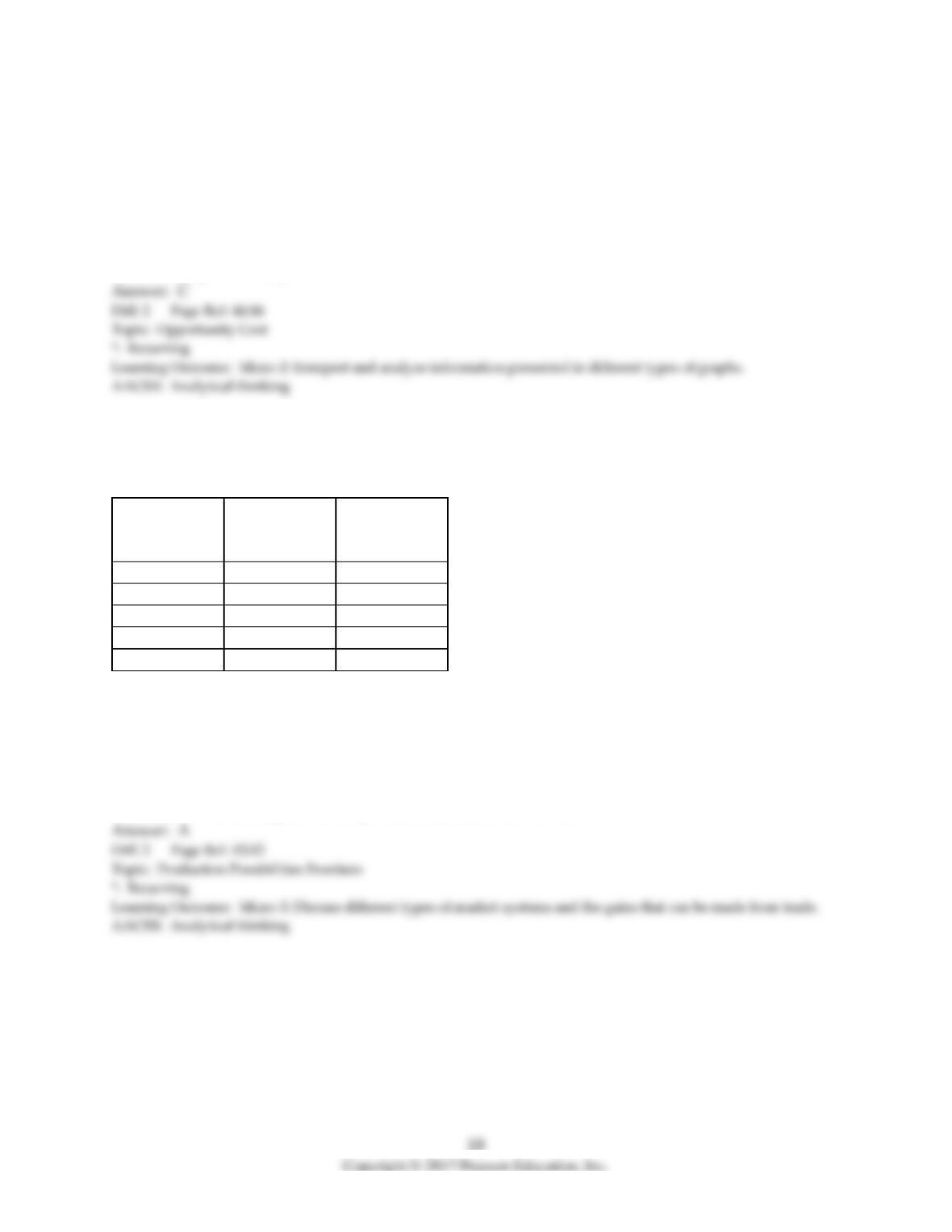
29) Refer to Figure 2-3. Carlos Vanya grows tomatoes and strawberries on his land. A portion of his
land is more suitable for growing tomatoes and the other portion is better suited for strawberry
cultivation. Which of the graphs in Figure 2-3 represent his production possibilities frontier?
A) Graph A
B) Graph B
C) Graph C
D) either Graph A or Graph B
E) either Graph B or Graph C
Table 2-1
Production Choices for Dina’s Diner
Choice
Quantity of
Sliders
Produced
Quantity of
Hot Wings
Produced
A
80
0
B
60
25
C
40
50
D
20
75
E
0
100
30) Refer to Table 2-1. Assume Dina’s Diner only produces sliders and hot wings. A combination of 40
sliders and 50 hot wings would appear
A) along Dina’s production possibilities frontier.
B) inside Dina’s production possibilities frontier.
C) outside Dina’s production possibilities frontier.
D) at the vertical intercept of Dina’s production possibilities frontier.
31) Refer to Table 2-1. Assume Dina’s Diner only produces sliders and hot wings. A combination of 60
sliders and 25 hot wings would appear
A) along Dina’s production possibilities frontier.
B) inside Dina’s production possibilities frontier.
C) outside Dina’s production possibilities frontier.
D) at the vertical intercept of Dina’s production possibilities frontier.
32) Refer to Table 2-1. Assume Dina’s Diner only produces sliders and hot wings. A combination of 40
sliders and 25 hot wings would appear
A) along Dina’s production possibilities frontier.
B) inside Dina’s production possibilities frontier.
C) outside Dina’s production possibilities frontier.
D) at the vertical intercept of Dina’s production possibilities frontier.
33) Refer to Table 2-1. Assume Dina’s Diner only produces sliders and hot wings. A combination of 20
sliders and 60 hot wings would appear
A) along Dina’s production possibilities frontier.
B) inside Dina’s production possibilities frontier.
C) outside Dina’s production possibilities frontier.
D) at the vertical intercept of Dina’s production possibilities frontier.
34) Refer to Table 2-1. Assume Dina’s Diner only produces sliders and hot wings. A combination of 60
sliders and 50 hot wings would appear
A) along Dina’s production possibilities frontier.
B) inside Dina’s production possibilities frontier.
C) outside Dina’s production possibilities frontier.
D) at the vertical intercept of Dina’s production possibilities frontier.
35) Refer to Table 2-1. Assume Dina’s Diner only produces sliders and hot wings. A combination of 50
sliders and 50 hot wings would appear
A) along Dina’s production possibilities frontier.
B) inside Dina’s production possibilities frontier.
C) outside Dina’s production possibilities frontier.
D) at the vertical intercept of Dina’s production possibilities frontier.
36) Refer to Table 2-1. Dina faces ________ opportunity costs in the production of sliders and hot wings.
A) increasing
B) decreasing
C) constant
D) negative
37) An outward shift of a nation’s production possibilities frontier can occur due to
A) a reduction in unemployment.
B) a natural disaster like a hurricane or bad earthquake.
C) a change in the amounts of one good desired.
D) an increase in the labor force.
38) ________ a nation’s production possibilities frontier represents economic growth.
A) An outward shift of
B) An inward shift of
C) Moving up along
D) Moving down along
39) Economic growth is represented on a production possibilities frontier model by the production
possibilities frontier
A) shifting outward.
B) shifting inward.
C) becoming steeper.
D) becoming flatter.
40) Without technological advancement, how can a nation achieve economic growth?
A) by producing more high-value goods and fewer low-value goods
B) through an increase in supplies of factors of production
C) by producing more low-value goods and fewer high-value goods
D) by decreasing the size of the labor force
41) Which of the following would shift a nation’s production possibilities frontier inward?
A) discovering a cheap way to convert sunshine into electricity
B) producing more capital equipment
C) an increase in the unemployment rate
D) a law requiring workers to retire at age 50
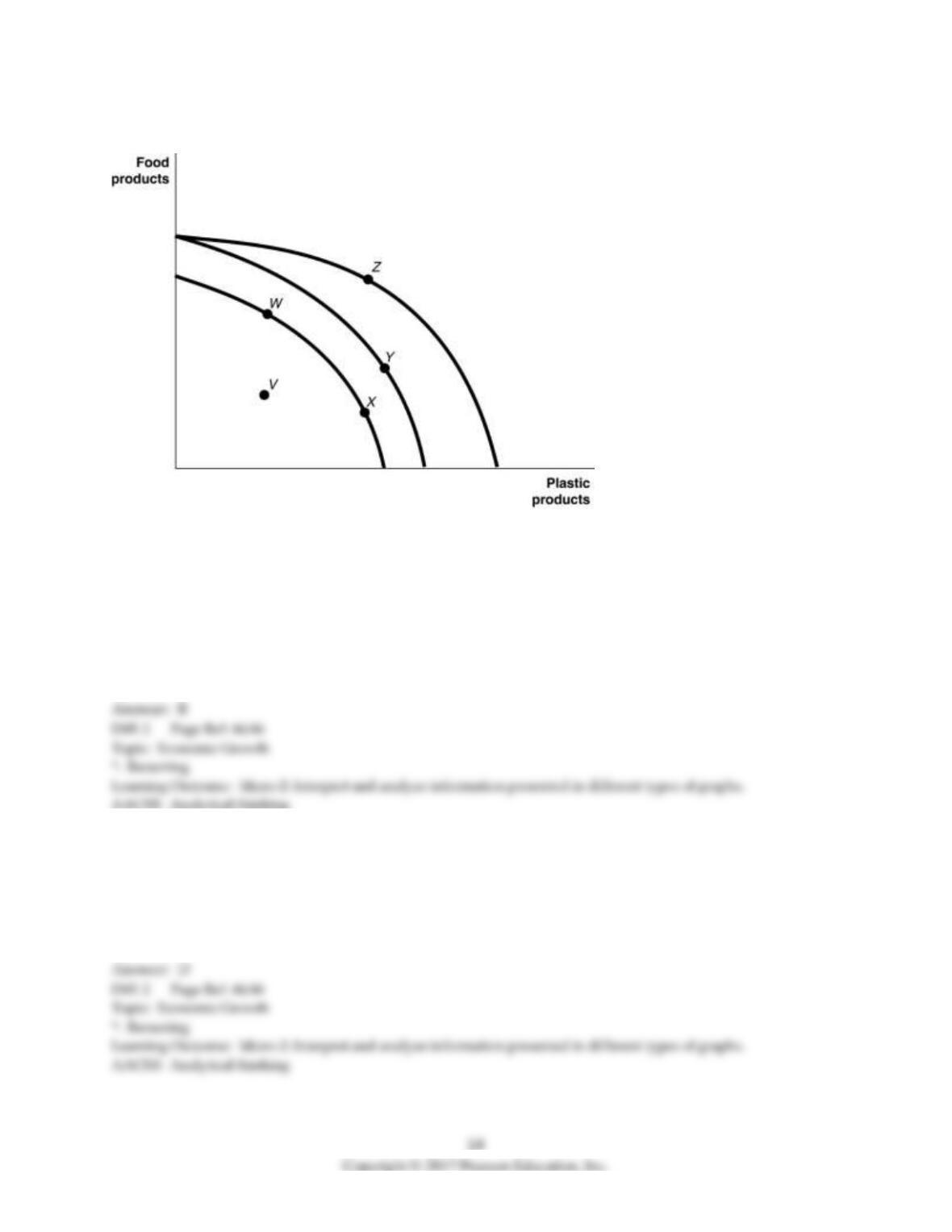
Figure 2-4
Figure 2-4 shows various points on three different production possibilities frontiers for a nation.
42) Refer to Figure 2-4. A movement from ________ could occur because of an influx of immigrant
labor.
A) X to W
B) X to Y
C) W to V
D) W to X
43) Refer to Figure 2-4. A movement from ________ is the result of advancements in plastic production
technology.
A) V to X
B) W to X
C) Z to W
D) Y to Z
44) Refer to Figure 2-4. Consider the following events:
a. an increase in the unemployment rate
b. a decrease in a nation’s money supply
c. a war that kills a significant portion of a nation’s population
Which of the events listed above could cause a movement from Z to X?
A) a, b, and c
B) a and b only
C) a and c only
D) a only
E) c only
45) Refer to Figure 2-4. Consider the following movements:
a. from point V to point W
b. from point W to point Y
c. from point Y to point Z
Which of the movements listed above represents advancements in technology with respect to both
plastic production and food production?
A) a, b, and c
B) b and c only
C) b only
D) c only
46) Refer to Figure 2-4. Consider the following events:
a. a decrease in the unemployment rate
b. general technological advancement
c. an increase in consumer wealth
Which of the events listed above could cause a movement from V to X?
A) a only
B) a and b only
C) b and c only
D) a, b, and c
47) Refer to Figure 2-4. Consider the following events:
a. a reduction in the patent protection period to no more than 2 years
b. a war that destroys a substantial portion of a nation’s capital stock
c. the lack of secure and enforceable property rights system
Which of the events listed above could cause a movement from W to V?
A) a only
B) a and b only
C) a and c only
D) b and c only
E) a, b, and c
48) Refer to Figure 2-4. A movement from ________ could occur because of additional government
restrictions toward allowing immigrant labor.
A) X to W
B) Y to X
C) V to W
D) W to X
49) Refer to Figure 2-4. A movement from ________ is the result of additional government restrictions
on the pollution that results from plastic production.
A) X to V
B) X to W
C) Z to W
D) Z to Y
50) Refer to Figure 2-4. Consider the following events:
a. a decrease in the unemployment rate
b. an increase in technology with respect to both food and plastic production
c. a war that kills a significant portion of a nation’s population
Which of the events listed above could cause a movement from W to Y?
A) a, b, and c
B) a and b only
C) a and c only
D) b only
E) c only
51) Refer to Figure 2-4. Consider the following movements:
a. from point V to point W
b. from point W to point Y
c. from point Y to point Z
Which of the movements listed above represents advancements in technology with respect to only
plastic production?
A) a, b, and c
B) b and c only
C) b only
D) c only
52) Refer to Figure 2-4. Consider the following events:
a. an increase in the unemployment rate
b. general technological advancement
c. an increase in consumer wealth
Which of the events listed above could cause a movement from Z to V?
A) a only
B) a and b only
C) b and c only
D) a, b, and c
53) Refer to Figure 2-4. Consider the following events:
a. an increase in the patent protection period to 75 years
b. a hurricane that destroys a substantial portion of a nation’s capital stock
c. the implementation of a secure and enforceable property rights system
Which of the events listed above could cause a movement from W to Z?
A) a only
B) a and b only
C) a and c only
D) b and c only
E) a, b, and c
54) The recession of 2007-2009 would most likely be represented in a production possibilities frontier
graph by
A) a point inside the frontier.
B) a point outside the frontier.
C) a point on the frontier.
D) an intercept on either the vertical or the horizontal axis.
55) Suppose there is some unemployment in the economy and society decides that it wants more of one
good. Which of the following statements is true?
A) It is not possible to achieve this unless technology advances.
B) It can increase output without giving up another good by employing more resources.
C) It will have to increase resource supplies.
D) It will have to give up production and consumption of some other good.
56) If society decides it wants more of one good and ________, then it has to give up some of another
good and incur some opportunity costs.
A) technology advances
B) resources are underutilized
C) all resources are fully utilized
D) new resources are discovered
57) According to the production possibilities model, if more resources are allocated to the production of
physical and human capital, then all of the following are likely to happen except
A) fewer goods will be produced for consumption today.
B) the production possibilities frontier will be shift outward in the future.
C) future economic growth is enhanced.
D) the country’s total production will fall.
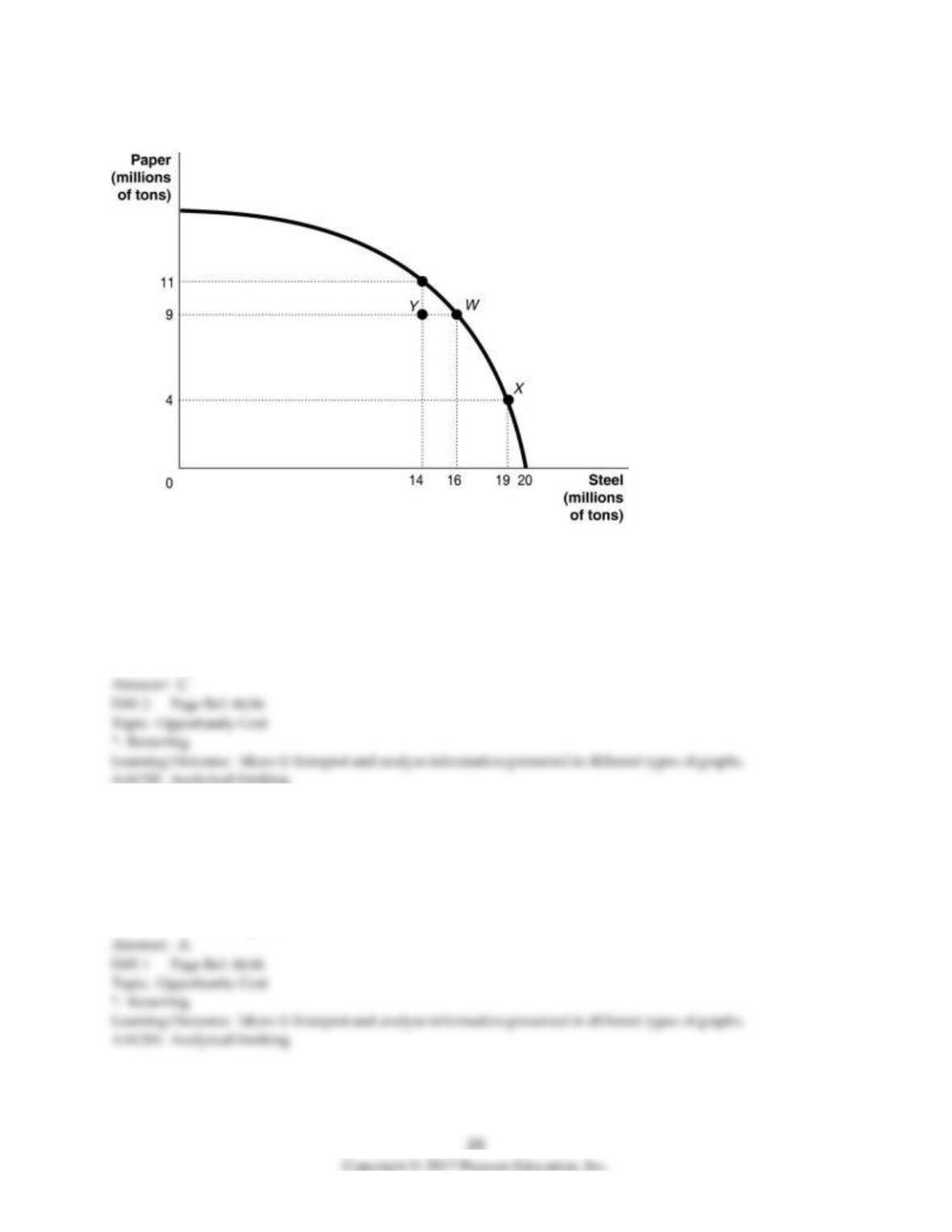
Figure 2-5
58) Refer to Figure 2-5. If the economy is currently producing at point Y, what is the opportunity cost of
moving to point X?
A) 5 million tons of steel
B) 9 million tons of paper
C) 5 million tons of paper
D) 19 million tons of steel
59) Refer to Figure 2-5. If the economy is currently producing at point X, what is the opportunity cost of
moving to point W?
A) 3 million tons of steel
B) 19 million tons of steel
C) 5 million tons of paper
D) 9 million tons of paper