
1. Shirley can choose between peanut butter pretzels and caramel coated popcorn for her evening snack. According to
economists, her _____ cost of consuming caramel coated popcorn would be the forgone peanut butter pretzels.
a.
internal
b.
opportunity
c.
average
d.
transaction
e.
social
2. In economics, the concept of opportunity cost is:
a.
negated by ensuring that the government has a role in a capitalist society.
b.
defined to be the highest-valued alternative that must be forgone when a choice is made.
c.
best illustrated by knowing why consumers choose one good over another.
d.
quantifiable only if you know the real dollar price of the goods and services you are giving up to consume
something.
e.
the methodology that government economists use to determine the total amount of the national debt.
3. Jane wins $100,000 in a lottery and immediately uses her winnings to open up a donuts shop. Her direct cost is
$50,000, and she puts the remaining money in a savings account earning 10 percent annual interest. Alternatively, Jane
could have placed all her lottery winnings in the 10 percent savings account. Jane’s total cost of opening up a donuts shop
is:
a.
$60,000.
b.
$50,000.
c.
$160,000.
d.
$45,000.
e.
$55,000.
4. If you have a choice of consuming either two apples, three oranges, or one candy bar, the opportunity cost of the candy
bar is:
a.
two apples.
b.
three oranges.
c.
two apples and three oranges.
d.
two apples or three oranges, whichever you value more.
e.
the difference in the prices of the three options.
5. Which economic concept is the closest to the saying “There’s no free lunch”?
a.
Specialization
b.
Unlimited wants
c.
Underutilization of resources
d.
Opportunity costs
e.
Overutilization of resources
6. Opportunity cost is best defined as:

a.
the sum of all alternatives given up when a choice is made.
b.
the money spent once a choice is made.
c.
the highest-valued alternative given up when a choice is made.
d.
the difference between the cost price and the selling price of a good.
e.
the cost of capital resources used in the production of additional capital.
7. Which of the following is an example of opportunity cost?
a.
The Chinese food that you give up when you choose to eat Italian food.
b.
The tuition that you pay to attend college.
c.
For a professor of economics, the pleasure that he or she derives from teaching economics.
d.
Sweets given up by a person who would never eat them even if he or she could.
e.
The price paid for a ticket when you go for a movie.
8. Nicky makes $25,000 a year as a sales clerk. He then decides to quit his job to enter a MBA program full-time (assume
Nicky doesn’t work in the summer or hold any part-time jobs). His tuition, books, living expenses, and fees total $15,000
a year. Given this information, the annual total cost of Nicky’s MBA studies is:
a.
$10,000.
b.
$30,000.
c.
$40,000.
d.
$15,000.
e.
$25,000.
9. Which of the following is related to the concept of trade-off used in economics?
a.
Paying tuition to attend college
b.
Paying a high price for a movie ticket on the first day of screening
c.
Not having enough information available to make a rational decision
d.
Giving up one good or activity in order to obtain some other good or activity
e.
Having your cake and eating it too
10. The giving up of a good or activity in order to obtain some other good or activity is called:
a.
a tradeoff.
b.
a cost analysis.
c.
a random choice.
d.
an opportunity cost.
e.
a sunk cost.
11. Which of the following best describes a tradeoff?
a.
An office executive enrolling into a management course to develop her skills.
b.
An investor buying stocks of a start-up company.
c.
A businessman investing a portion of company’s profit in research and development.
d.
A college student sacrificing a few hours of study time to work at the town cafeteria.

e.
A worker purchasing a new car with her bonus earnings.
12. The city of Austin can buy roads or light rail. If 10 miles of roads cost $1 million and 2 miles of light rail cost $10
million, what is the city’s opportunity cost of 1000 miles of roads?
a.
$100 million
b.
2 miles of light rail
c.
200 miles of light rail
d.
$50 million
e.
$1,000 million
13. The tradeoffs faced by a society can be illustrated in a graph known as the:
a.
production operations curve.
b.
production cost curve.
c.
production cost model.
d.
production cost forecast curve.
e.
production possibilities curve.
14. When constructing a production possibility curve for an economy, which of the following is assumed to be constant?
a.
The quantity of resources
b.
The government budget
c.
The quantity of goods produced
d.
The price level
e.
The money supply
Following is the production possibilities schedule for an economy producing two goods, Good A and Good B.
Table 2.1
Production Possibilities Schedule
Good A
Good B
Choice 1
100
0
Choice 2
90
20
Choice 3
70
40
Choice 4
40
60
Choice 5
0
80
15. Refer to Table 2.1. Identify the correct statement.
a.
This economy can produce 100 units of A and 20 units of B.
b.
The opportunity cost of producing more of A decreases as A increases.
c.
The opportunity cost of producing more of B decreases as B increases.
d.
This economy can produce 70 units of A and 40 units of B.
e.
If this economy fully and efficiently employs all its resources, it can produce 100 units of A and 80 units of B.
16. Refer to Table 2.1. According to the production possibilities schedule, in the table above, which of the following
statements is true?

a.
Moving from choice 2 to choice 3, the opportunity cost of producing 20 more units of good B is 20 units of
good A.
b.
There are increasing opportunity costs associated with producing more units of good B.
c.
Moving from choice 3 to choice 4, the opportunity cost of producing 20 more units of good B is 30 units of
good A.
d.
Moving from choice 1 to choice 2, the opportunity cost of producing 20 more units of good B is 10 units of
good A.
e.
All of these statements are true.
17. Which of the following is an assumption made while constructing a production possibilities frontier [PPF]?
a.
Dynamic technological know-how
b.
Flexible resource quality
c.
Fixed resource quantity
d.
Full and efficient use of resources
e.
Flexible money supply
18. Which of the following conditions is true for a nation operating at a point lying inside its production possibilities
curve?
a.
The nation is experiencing a technological breakthrough in one of its key industries.
b.
The nation is clearly utilizing its resources efficiently.
c.
The nation is producing the maximum output that can be produced with a limited quantity of resources.
d.
The nation is not utilizing its resources efficiently.
e.
The nation is producing the maximum output that can be produced with its unlimited quantity of resources.
19. Consider a nation with an endowment of iron ore and petroleum. If the nation specializes in the production of
aluminum and gasoline instead of steel we can say that it is operating:
a.
on its production possibilities curve.
b.
outside its production possibilities curve.
c.
inside its production possibilities curve.
d.
on the highest achievable production possibilities curve.
e.
on the lowest production possibilities curve.
20. A point inside a nation’s production possibilities curve can represent:
a.
a recession.
b.
an increase in population size.
c.
an economic growth.
d.
a technological advancement.
e.
an improvement in living standards.
21. If the resources within a nation are not being fully or efficiently utilized, it means:
a.
that the nation is operating at a point inside its production possibilities curve.
b.
that the nation is operating at a point outside its production possibilities curve.
c.
that the nation is operating at a point along its production possibilities curve.
d.
that the nation is probably technologically advanced.
e.
the government of that nation should seize ownership of the resources in order to attain the necessary
efficiencies.
22. Suppose a society begins by producing 3 units of X and 4 units of Y and then alters production to 4 units of X and 4
units of Y. If the quantity and quality of resources and the technology being used remain unchanged, then:
a.
3 units of X and 4 units of Y are a combination best represented by a point inside the production possibilities
curve [PPC].
b.
we can conclude that the society has moved along the PPC.
c.
we can conclude that resources were being fully utilized at 3 units of X and 4 units of Y.
d.
we can conclude that resources were being efficiently utilized at 3 units of X and 4 units of Y.
e.
3 units of X and 4 units of Y are a combination best represented by a point outside the PPC.
23. Given a production possibilities curve for defense goods and non-defense goods, which of the following is not true?
a.
A production point outside the curve may be attained if new resources are discovered.
b.
A production point outside the curve may be attained by acquiring a new technology.
c.
A production point outside the curve may be attained by shifting resources to defense goods.
d.
A production point outside the curve may be attained by acquiring both a new technology and greater
resources.
e.
A production point outside the curve cannot be attained with the current level of resources and technology.
24. A point outside the production possibilities curve [PPC]:
a.
represents inefficient use of resources.
b.
represents the prevalence of unemployment.
c.
is attainable if all resources are used efficiently.
d.
represents more resources than are currently available.
e.
will never be attainable, even if the quantity of resources increases.
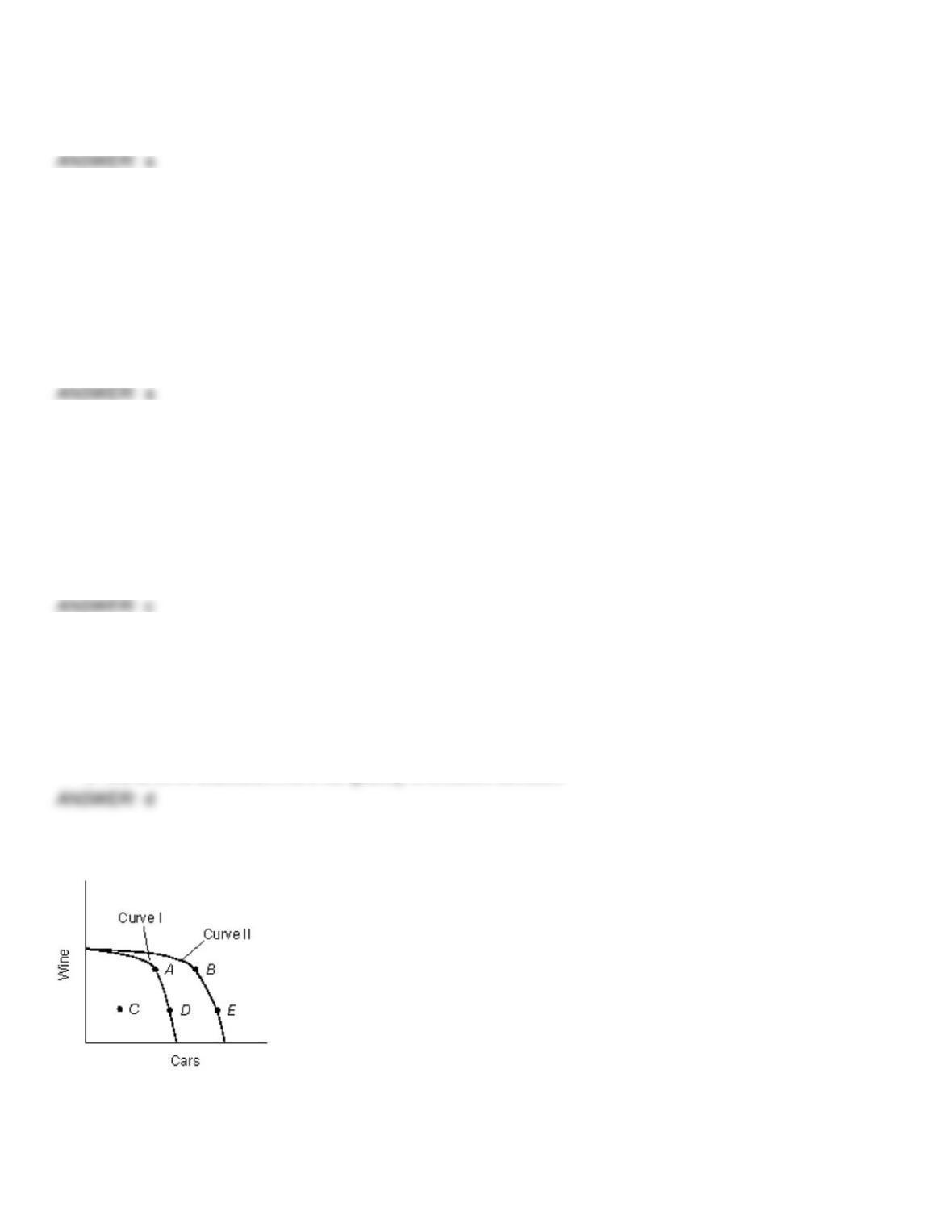
The figure given below represents the production possibilities curves [PPC] of a country producing wine and cars.
Figure 2.1
25. Refer to Figure 2.1. Identify the correct statement.
a.
If the country is at point A and is using all of its resources, point D is unattainable.
b.
If the country is at point A and is using all of its resources, Point C is unattainable.

c.
If the country is at point B and is using all of its resources, there will be an underutilization of resources at
point C.
d.
If the country is at point C, point B is unattainable.
e.
If the country is at point B, it will not move.
26. Refer to Figure 2.1. If the country has curve I as its PPC, then _____ would most likely cause the curve to shift to
curve II.
a.
an additional unit of farmland
b.
an increase in the work force
c.
the discovery of new metal resources
d.
a labor movement
e.
a consumer boycott
27. Refer to Figure 2.1. If the country’s PPC curve is curve II, then:
a.
points D and E use all of the resources.
b.
point A is unattainable.
c.
point D represents an under-utilization of resources.
d.
point E represents a state of unemployment.
e.
it is not possible to produce at curve I because wine is cheaper than cars.
28. If the general education level within a country rises significantly over time, it is likely that:
a.
the country will move to a different point along its current production possibilities curve.
b.
the country’s production possibilities curve will not change in any way.
c.
the country’s production possibilities curve will shift in.
d.
the country’s production possibilities curve will shift out.
e.
the country’s production possibilities curve will become convex to the origin.
29. Which of the following will result in an outward shift of the production possibilities curve [PPC]?
a.
A decrease in the quantity of resources
b.
An improvement in the quality of resources
c.
A fall in education standards
d.
An unsustainable growth in population
e.
An increase in unemployment rate
The figure given below represents an economy producing corn and planes under different economic situations.
Figure 2.2

30. Refer to Figure 2.2. Assume that the economy experiences a 20% drop in the work force. Which of the following
graph(s) in the figure describe(s) the change in the economy’s production possibilities curve [PPC]?
a.
Graph A
b.
Graph B
c.
Graph C
d.
Graph B and C
e.
Graph A and C
31. Refer to Figure 2.2. If there is an increase in the effectiveness of pesticides, which of the following graph(s) will
represent(s) the resulting shift in the production possibilities curve [PPC]?
a.
Graph A
b.
Graph B
c.
Graph C
d.
Graph A and B
e.
Graph B and C
32. Refer to Figure 2.2. If there is an increase in the education level of the population, graph(s) _____ best illustrate(s)
what will happen to the production possibilities curve [PPC].
a.
A
b.
B
c.
C
d.
A and C
e.
A and B
33. Which of the following would not cause any kind of an outward shift of a nation’s production possibilities curve
[PPC]?
a.
An improvement in the general level of education
b.
Technological innovation
c.
Discovery of a new source of energy
d.
An increase in the size of the labor force
e.
A flood that renders thousands of acres of farmland unusable
34. Consider a PPC with automobiles on the vertical axis and cotton on the horizontal axis. The discovery of a new
fertilizer that improves crop yield will shift:
a.
the vertical intercept up but will not shift the horizontal intercept.
b.
the horizontal intercept to the right but will not shift the vertical intercept.
c.
the horizontal intercept to the left and the vertical intercept upward.
d.
the vertical intercept downward and the horizontal intercept to the right.
e.
neither the horizontal intercept nor the vertical intercept.
35. Which of the following will bring about an inward shift of a production possibilities curve [PPC]?
a.
A decrease in the amount of resource employment
b.
An increase in the working-age population
c.
An increase in unemployment
d.
A decrease in the availability of natural resources
e.
An increase in the amount of capital available
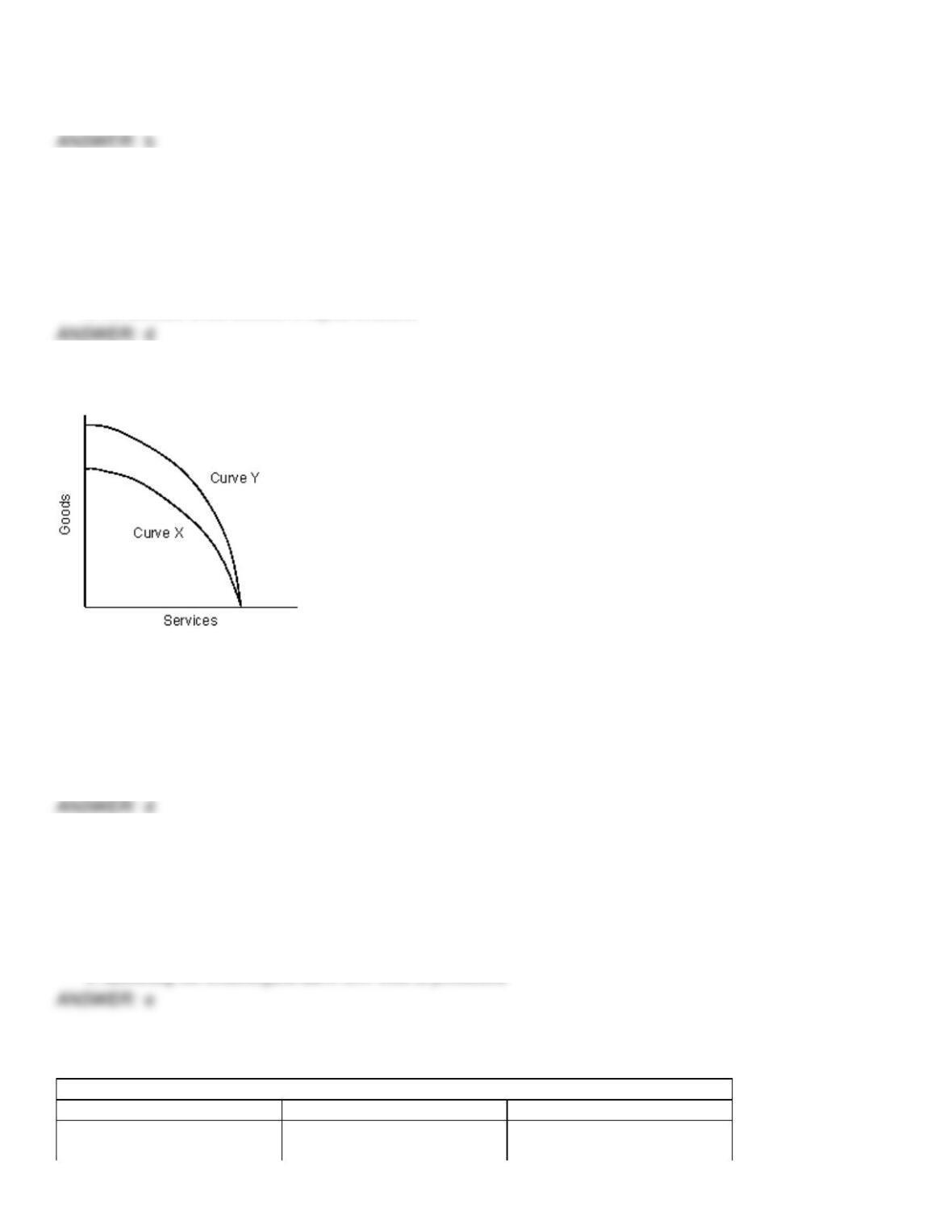
The figure given below represents the production possibilities curve for goods and services in an economy.
Figure 2.3
36. Refer to Figure 2.3. The movement from Curve X to Curve Y indicates a(n):
a.
contraction in the production of goods.
b.
contraction in the production of services.
c.
expansion in the ability to produce both goods and services.
d.
expansion in the ability to produce goods.
e.
expansion in the ability to produce services.
37. Which of the following actions is most likely to cause a rightward shift in a production possibilities curve [PPC]?
a.
Shifting from the production of one product to the production of another product
b.
Shifting all resources to the production of one product
c.
Employing idle resources
d.
Using fewer resources in production
e.
Increasing the technological know-how used in production
Given below is the production possibilities schedule for capital goods and consumer goods.
Table 2.2
Production Possibilities Schedule
Combination
Capital Goods
Consumer Goods
A
4
0
B
3
4

C
2
7
D
1
9
E
0
10
38. If the nation depicted in Figure 2.3 is producing at combination E, the opportunity cost of producing the tenth unit of
consumer good is:
a.
10 units of capital goods.
b.
6 units of capital goods.
c.
1 unit of capital good.
d.
4 units of capital goods.
e.
zero unit of capital good.
39. Consider Table 2.2. The production possibilities curve [PPC] representing this schedule would be:
a.
bowed in.
b.
bowed out.
c.
a negatively sloped straight line.
d.
a positively sloped straight line.
e.
bowed in if consumer goods are plotted on the horizontal axis and bowed out if capital goods are plotted on
the horizontal axis.
40. A decrease in the quantity of available resources would be represented by:
a.
a steeper PPC.
b.
a point inside the PPC.
c.
an inward shift of the PPC.
d.
an upward movement along the PPC.
e.
a downward movement along the PPC.
Given below is the production possibilities schedule for a small island nation in South Pacific that produces capital and
consumer goods.
Table 2.3
Production Possibilities Schedule
Capital Goods
Consumer Goods
10
0
9
1
7
2
4
3
0
4
41. Refer to Table 2.3. Identify the correct statement.
a.
The best the economy can do is to produce 10 units of capital goods and 4 units of consumer goods.
b.
The best the economy can do is to produce no capital goods and produce 2 units of consumer goods.
c.
If the economy produces 10 units of capital goods and no units of consumer goods, there is unemployment.
d.
If the economy produces 4 units of capital goods, it can manage to produce only 3 units of consumer goods.
e.
In order to produce the 10th unit of capital goods, 4 units of consumer goods must be forgone.
42. Which of the following ideas is illustrated by the production possibilities curve [PPC]?

a.
There are no limits on the total production feasible in an economy.
b.
An economy need not decrease the production of one commodity to increase the production of another.
c.
It is possible to satisfy unlimited wants in an economy through proper investment in research and
development.
d.
When an economy chooses to produce a combination of goods and services, other combinations of goods and
services are sacrificed.
e.
An economy can specialize in the production of only one good.
43. Consider the production possibilities curve for an economy producing only two commodities wheat (represented on
the X axis) and wine (represented on the Y axis). A movement up along the production possibilities curve [PPC] will
imply:
a.
an increase in wheat production.
b.
an increase in both wheat and wine production.
c.
a decline in both wheat and wine production.
d.
an increase in wine production.
e.
no change in either wheat or wine production.
44. Consider the production possibilities curve [PPC] for a country producing only cheese and wine. The first few
resources transferred from cheese to wine production are:
a.
those that are most specialized in cheese production.
b.
those that are most specialized in wine production.
c.
those that are least specialized in cheese production.
d.
those that are neither specialized in cheese nor wine production.
e.
those that are highly specialized in both cheese and wine production.
45. People (and all resources):
a.
tend to specialize in those activities in which their opportunity costs are minimized.
b.
tend to specialize in those activities in which their opportunity costs are maximized.
c.
never consider opportunity costs before specializing in a particular activity.
d.
consider only direct costs while choosing to specialize in a particular activity.
e.
do not act in their own self-interest but specialize in those activities which benefit others.
46. If a nation specializes in activities in which opportunity costs are the lowest and then trades with other nations, it is
most likely to:
a.
have a higher standard of living for its citizens than it would if it did not specialize and then trade.
b.
have a lower standard of living for its citizens than it would if it did not specialize and then trade.
c.
create as much wealth for its citizens as it could if it did not specialize and then trade.
d.
benefit in the short run but incur heavy loss in the long run.
e.
incur heavy loss in the short run and eventually cease production in the long run.
The table given below represents the output per hour of cookies and chilies in Ohio and Iowa.
Table 2.4

Output per Hour
Cookies
Chilies
Ohio
6
24
Iowa
12
96
47. Refer to Table 2.4. The opportunity cost of a cookie in Iowa is:
a.
8 chilies.
b.
4 chilies.
c.
96 chilies.
d.
less than in Ohio.
e.
the same as in Ohio.
48. Refer to Table 2.4. The opportunity cost of a chili in Ohio is:
a.
the same as in Iowa.
b.
1/4 unit of a cookie.
c.
4 units of cookies.
d.
1/8 unit of a cookie.
e.
8 units of cookies.
49. Refer to Table 2.4. Identify the correct statement.
a.
Ohio should specialize in the production of cookies and trade with Iowa.
b.
Iowa should specialize in the production of cookies and trade with Ohio.
c.
Ohio should specialize in the production of chilies and trade with Iowa.
d.
Both should specialize in the production of chilies.
e.
Each of the nations should continue to produce both the commodities and not specialize in any one
commodity.
50. Refer to Table 2.4. If the countries were to engage in trade, what would be the least amount Ohio would accept for 1
cookie?
a.
8 chilies
b.
of a chili
c.
of a chili
d.
4 chilies
e.
12 chilies
51. Refer to Table 2.4. If the countries were to engage in trade, what would be the most Ohio would be willing to pay for 1
chili?
a.
4 cookies
b.
8 cookies
c.
of a cookie
d.
of a cookie
e.
6 cookies

52. Assume that a doctor makes $200 per hour, a lawyer $250 per hour, an architect $140 per hour, a professor $50 per
hour, and a waiter $35 per hour. Which of these professionals is most likely to spend time to negotiate with a car dealer?
a.
The doctor
b.
The lawyer
c.
The architect
d.
The professor
e.
The waiter
53. The difference between what can be produced and consumed without specialization and trade and with specialization
and trade is called:
a.
comparative advantage.
b.
a tradeoff.
c.
marginal cost.
d.
opportunity cost.
e.
gains from trade.
54. Archie can paint 5 backyard fences or repair 2 cars in 8 hours, while Austin can paint 4 backyard fences or repair 2
cars in 8 hours. Identify the correct statement.
a.
Archie is relatively better in repairing cars.
b.
Archie is relatively better in painting fences.
c.
Austin is relatively better in painting fences.
d.
Archie and Austin are equally good in painting fences.
e.
Neither Archie not Austin are good in repairing cars.
55. Bob and Bill can make 16 toys each if they devote 8 working hours in a day. Further, Bob can repair 4 cars and Bill
can repair 2 cars, if they devote 8 working hours in a day. What is the opportunity cost of repairing one car to Bill?
a.
10 toys
b.
8 toys
c.
16 toys
d.
12 toys
e.
4 toys
56. Bob and Bill can make 16 toys each if they devote 8 working hours in a day. Further, Bob can repair 4 cars and Bill
can repair 2 cars, if they devote 8 working hours in a day. What is the opportunity cost of repairing one car to Bob?
a.
10 toys
b.
8 toys
c.
16 toys
d.
12 toys
e.
4 toys
57. Bob and Bill can make 16 toys each if they devote 8 working hours in a day. Further, Bob can repair 4 cars and Bill

can repair 2 cars, if they devote 8 working hours in a day. When these two individuals engage in trade, it would be
advantageous for both if:
a.
Bob specializes in the production of toys and Bill specializes in car repairing.
b.
Bob specializes in car repairing and Bill specializes in the production of toys.
c.
they specialize only in car repairing.
d.
they specialize only in the production of toys.
e.
they distribute their working hours evenly between the production of two goods.
58. Voluntary free trade results in:
a.
population growth.
b.
inflation.
c.
higher living standards.
d.
income disparity.
e.
unemployment.
The table given below represents butter and ham production by two countries Norway and Sweden.
Table 2.5
Time Spent
Making Butter
Norway
Sweden
100%
Butter
5
100
0%
Ham
10
100
59. According to Table 2.5, Norway has a comparative advantage in the production of _____ and an absolute advantage in
the production of _____.
a.
butter and ham; butter
b.
ham; butter
c.
none of the goods; butter
d.
ham; none of the goods
e.
butter; ham
60. Refer to Table 2.5 and identify the correct statement.
a.
Norway has an absolute advantage in butter production.
b.
Sweden has a comparative advantage in ham production.
c.
Norway has an absolute advantage in ham production.
d.
Trade is not possible between these two nations.
e.
It would be advantageous for Sweden to trade with Norway.
61. Economists refer to the ability of one person or nation to do something with a lower opportunity cost than another as
_____.
a.
voluntary trade
b.
specialization
c.
gains from trade
d.
absolute advantage
e.
comparative advantage

62. A person has a comparative advantage in producing a good if:
a.
that person can produce the good at a lower absolute cost than anyone else.
b.
that person can produce the good at a lower opportunity cost than anyone else.
c.
that person has a perfectly elastic demand curve for her good.
d.
that person spends less on advertizements.
e.
that person can produce the good at a higher opportunity cost than anyone else.
63. A world-renowned brain surgeon can type twice as fast as her secretarial assistant. Which of the following statements
is true in this situation?
a.
The secretary has an absolute advantage in typing.
b.
The surgeon should do her own typing to save money.
c.
The surgeon should fire the assistant and work weekends and evenings to stay up on her typing.
d.
The surgeon should spend her time doing brain surgery and allow her secretary to do the typing because the
secretary has a comparative advantage in typing.
e.
The surgeon should spend her time doing brain surgery and allow her secretary to do the typing because the
surgeon has a comparative advantage in typing.
64. Which of the following statements is true about comparative advantage?
a.
Comparative advantage exists whenever one person, firm, or nation can do something at higher opportunity
costs than some other individual, firm, or nation.
b.
Comparative advantage is interesting theoretically, but it is not relevant when evaluating real-world economic
conditions.
c.
Low income countries cannot possibly have a comparative advantage in the production of any good or service
because of the relatively low literacy rate.
d.
Comparative advantage exists whenever one person, firm, or nation can do something at lower opportunity
costs than some other individual, firm, or nation.
e.
Only technologically advanced economies can have a comparative advantage in the production of a good or
service.
65. The concept of comparative advantage applies:
a.
only to people with at least a high school diploma.
b.
only to people who are currently employed.
c.
to situations in which you have information about the salary levels of those with whom you are competing for
a job.
d.
to every case of trade or exchange.
e.
only to goods that are sold in the domestic market.
66. Assume that the United States uses 20 worker-hours to produce 1 computer and 5 worker-hours to produce 1 unit of
food; assume also that Japan uses 10 worker-hours to produce 1 computer and 30 worker-hours to produce 1 unit of food.
Which of the following statements is true?
a.
Japan has the comparative advantage in food production.
b.
The United States has the comparative advantage in food production.
c.
The United States has the absolute advantage in food production.
d.
The United States has a lower opportunity cost for making computers.
e.
Japan has a lower opportunity cost for making food.
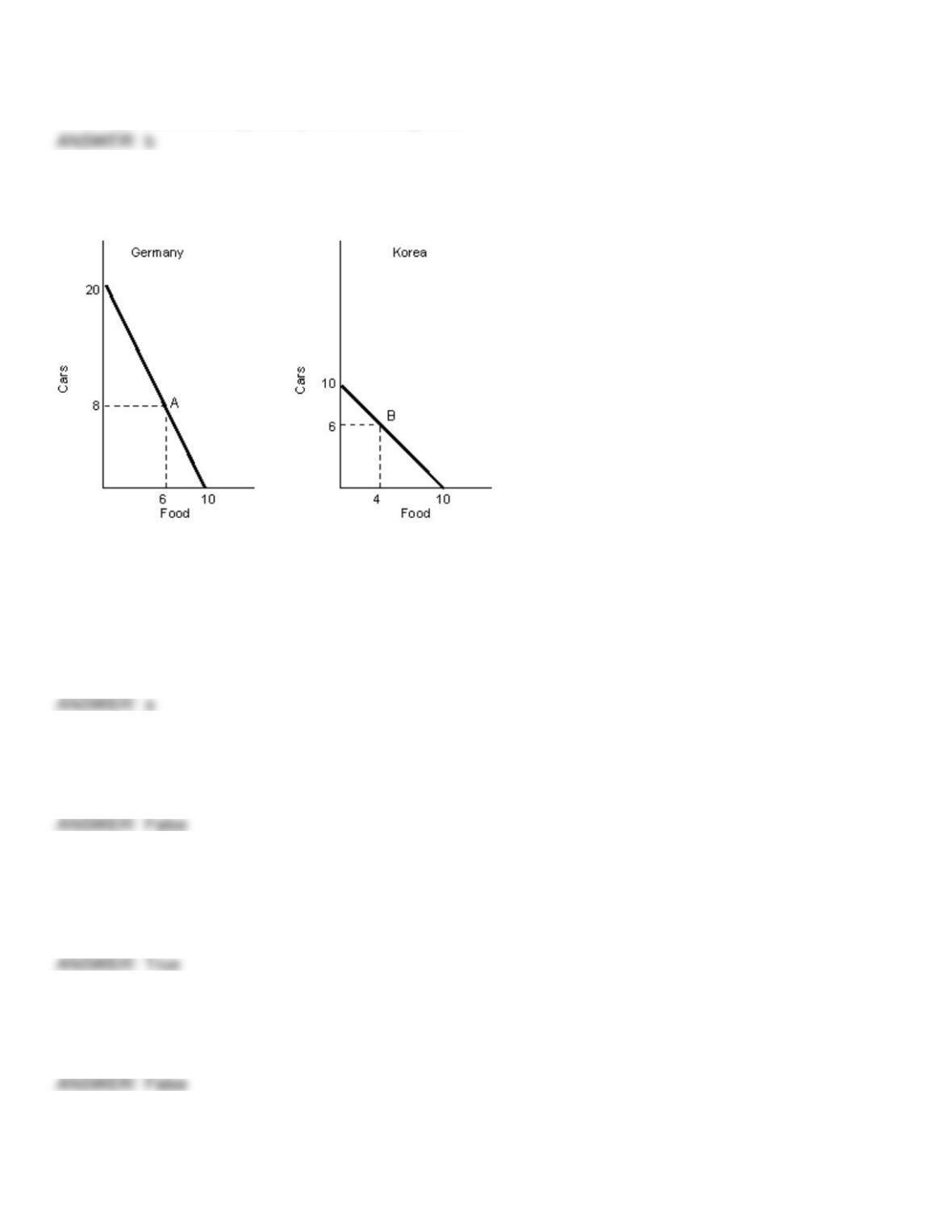
The figure given below represents the PPC in two nations – Germany and Korea, producing only two goods, cars and
food.
Figure 2.4
67. Refer to Figure 2.4 and identify the correct statement.
a.
Germany has comparative advantage in the production of cars.
b.
Korea has comparative advantage in the production of cars.
c.
Germany has comparative advantage in the production of food.
d.
Korea has a lower opportunity cost for making cars.
e.
Germany has a lower opportunity cost for making food.
68. According to economists, human activity is unresponsive to changes in costs.
a.
True
b.
False
69. When there is a choice between the consumption of bundle X and bundle Y, the opportunity cost of consuming bundle
X is bundle Y.
a.
True
b.
False
70. There is no cost of using your own savings in your business.
a.
True
b.
False
71. Betty goes out to enjoy a bouffe with her friend instead of practicing calculus problems for her maths examination that
is due the following day. This implies that the opportunity cost of the bouffe to Betty is zero.

a.
True
b.
False
72. If you have a choice between studying and doing another activity, you will devote your time to studying as long as the
additional benefit of studying is greater than the additional cost of studying.
a.
True
b.
False
73. A point lying inside the production possibilities curve [PPC] is not an attainable combination.
a.
True
b.
False
74. If an economy is operating at a point outside the PPC, either the society has resources that are not being fully used or
production is not efficient.
a.
True
b.
False
75. A nation’s production possibilities curve [PPC] will shift outward if its workers receive better training.
a.
True
b.
False
76. An economy’s PPC illustrates the extent to which the economy consumes what it produces.
a.
True
b.
False
77. Economic growth can be illustrated by an outward shift of the PPC.
a.
True
b.
False
78. Julio makes wine and beer. Last year he made 20 bottles of wine and 20 cases of beer. If the price of grapes goes
down (making wine cheaper to make), Julio will be able to make the same amount of wine and more beer.
a.
True
b.
False
79. Individuals, firms, and nations should specialize in those activities which have the highest marginal cost.
a.
True
b.
False

80. If using the same resources, the U.S. workers can produce more of any good than Mexican workers, then the United
States should produce every good.
a.
True
b.
False
81. Specialization and trade do not allow individuals, firms, or even nations to acquire goods that lie beyond their
production capabilities.
a.
True
b.
False
82. Free trade leads to an overall improvement in the standard of living in a country because everything is produced at the
lowest possible cost.
a.
True
b.
False
83. If an individual can produce a good or service with a lower opportunity cost than another individual, then he or she is
said to have the comparative advantage.
a.
True
b.
False
84. Specialization and trade can take place only if a country is endowed with more of something compared to other
countries.
a.
True
b.
False
85. It has been generally observed that most trade in the world occurs between a developed and a less-developed nation
rather than between industrial or developed nations.
a.
True
b.
False
86. Gains from trade can be realized if each country specializes in the production of a good in which it has a comparative
advantage.
a.
True
b.
False
87. Specialization according to comparative advantage followed by free trade makes every economy better off.
a.
True
b.
False