20) Refer to Table 2-5. What is Estonia’s opportunity cost of producing one cell phone?
A) 0.2 board feet of lumber
B) 5 board feet of lumber
C) 8 board feet of lumber
D) 32 board feet of lumber
21) Refer to Table 2-5. What is Finland‘s opportunity cost of producing one cell phone?
A) 0.25 board feet of lumber
B) 4 board feet of lumber
C) 12 board feet of lumber
D) 16 board feet of lumber
22) Refer to Table 2-5. What is Estonia’s opportunity cost of producing one board foot of lumber?
A) 0.2 cell phones
B) 5 cell phones
C) 8 cell phones
D) 32 cell phones
23) Refer to Table 2-5. What is Finland‘s opportunity cost of producing one board foot of lumber?
A) 0.25 cell phones
B) 4 cell phones
C) 12 cell phones
D) 16 cell phones
24) Refer to Table 2-5. Estonia has a comparative advantage in the production of
A) both products.
B) lumber.
C) cell phones.
D) neither product.
25) Refer to Table 2-5. Finland has a comparative advantage in the production of
A) both products.
B) lumber.
C) cell phones.
D) neither product.
26) Refer to Table 2-5. If the two countries specialize and trade, who should export lumber?
A) There is no basis for trade between the two countries.
B) Estonia
C) Finland
D) They should both be exporting lumber.
27) Refer to Table 2-5. If the two countries specialize and trade, who should export cell phones?
A) There is no basis for trade between the two countries.
B) Estonia
C) Finland
D) They should both be importing cell phones.
28) If the best lawyer in town is also the best at operating a word processor, then according to economic
reasoning, this person should
A) split her time evenly between being a lawyer and a word processor.
B) specialize in being a lawyer because its opportunity cost is lower.
C) should pursue the activity she enjoys more.
D) specialize in being a word processor because it is more capital-intensive.
29) Izzy Amador is a highly talented tattoo artist. She has chosen to specialize in tattoo art because of all
of the following except
A) her tattoos are highly esteemed by tattoo lovers who are willing to pay very high prices.
B) for her, this is the most lucrative way to purchase the products that she wants to consume.
C) her opportunity cost of pursuing another career is very low.
D) she obviously has a comparative advantage in tattoo art.
30) As job opportunities for women and the wages those jobs pay have increased, the opportunity cost
of doing housework has ________, so many families have chosen to hire specialists in households
chores, such as cleaning services and lawn care services, because the cost of these specialists is ________
than the cost of the wife (or husband) performing those chores.
A) increased; higher
B) increased; lower
C) decreased; higher
D) decreased; lower
Table 2-6
James
Lucy
Wagons
16
18
Tricycles
32
24
Table 2-6 shows the output per week of two people, James and Lucy. They can either devote their time
to making wagons or making tricycles.
31) Refer to Table 2-6. Which of the following statements is true?
A) Lucy has an absolute advantage in making both products.
B) James has an absolute advantage in making both products.
C) Lucy has an absolute advantage in making wagons and James in making tricycles.
D) James has an absolute advantage in making wagons and Lucy in making tricycles.
32) Refer to Table 2-6. What is Lucy’s opportunity cost of making a wagon?
A) 3/4 of a wagon
B) 3 wagons
C) 1 1/3 tricycles
D) 2 tricycles
33) Refer to Table 2-6. What is Lucy’s opportunity cost of making a tricycle?
A) 3/4 of a wagon
B) 3 wagons
C) 1 1/3 tricycles
D) 2 tricycles
34) Refer to Table 2-6. What is James’s opportunity cost of making a wagon?
A) 2 tricycles
B) 1/2 of a wagon
C) 1/2 of a tricycle
D) 3/4 of a wagon
35) Refer to Table 2-6. What is James’s opportunity cost of making a tricycle?
A) 2 tricycles
B) 1/2 of a wagon
C) 1/2 of a tricycle
D) 3/4 of a wagon
36) Refer to Table 2-6. Which of the following statements is true?
A) Lucy has a comparative advantage in making both products.
B) James has a comparative advantage in making both products.
C) Lucy has a comparative advantage in making wagons and James in making tricycles.
D) Lucy has a comparative advantage in making tricycles and James in making wagons.
Table 2-7
Minnie
Mickey
Hats
40
50
Umbrellas
10
5
Table 2-7 shows the output per week of two people, Minnie and Mickey. They can either devote their
time to making hats or making umbrellas.
37) Refer to Table 2-7. Which of the following statements is true?
A) Mickey has an absolute advantage in making both products.
B) Minnie has an absolute advantage in making both products.
C) Minnie has an absolute advantage in making hats and Mickey in making umbrellas.
D) Minnie has an absolute advantage in making umbrellas and Mickey in making hats.
38) Refer to Table 2-7. What is Minnie’s opportunity cost of making a hat?
A) 1/5 of an umbrella
B) 1/4 of an umbrella
C) 4 umbrellas
D) 10 umbrellas
39) Refer to Table 2-7. What is Mickey’s opportunity cost of making a hat?
A) 1/10 of an umbrella
B) 1/5 of an umbrella
C) 5 umbrellas
D) 10 umbrellas
40) Refer to Table 2-7. What is Minnie’s opportunity cost of making an umbrella?
A) 1/10 of a hat
B) 1/4 of a hat
C) 4 hats
D) 40 hats
41) Refer to Table 2-7. What is Mickey’s opportunity cost of making an umbrella?
A) 1/5 of a hat
B) 5 hats
C) 10 hats
D) 50 hats
42) Refer to Table 2-7. Which of the following statements is true?
A) Minnie has a comparative advantage in making both products.
B) Mickey has a comparative advantage in making both products.
C) Minnie has a comparative advantage in making hats and Mickey in making umbrellas.
D) Mickey has a comparative advantage in making hats and Minnie in making umbrellas.
Table 2-8
Wilma
Betty
Statues
12
14
Benches
4
7
Table 2-8 shows the output per month of two people, Wilma and Betty. They can either devote their
time to making marble statues or making marble benches.
43) Refer to Table 2-8. Which of the following statements is true?
A) Wilma has an absolute advantage in making both products.
B) Betty has an absolute advantage in making both products.
C) Betty has an absolute advantage in making statues and Wilma in making benches.
D) Betty has an absolute advantage in making benches and Wilma in making statues.
44) Refer to Table 2-8. What is Wilma’s opportunity cost of making a statue?
A) 1/3 of a bench
B) 3 benches
C) 6/7 of a statue
D) 1/2 of a bench
45) Refer to Table 2-8. What is Wilma’s opportunity cost of making a bench?
A) 1/3 of a statue
B) 3 statues
C) 1/2 of a bench
D) 1.3 statues
46) Refer to Table 2-8. What is Betty’s opportunity cost of making a statue?
A) 1/2 of a bench
B) 2 benches
C) 1/3 of a bench
D) 1.4 statues
47) Refer to Table 2-8. What is Betty’s opportunity cost of making a bench?
A) 1/2 of a statue
B) 2 statues
C) 1.75 benches
D) 2.8 statues
48) Refer to Table 2-8. Which of the following statements is true?
A) Wilma has a comparative advantage in making both products.
B) Betty has a comparative advantage in making both products.
C) Betty has a comparative advantage in making statues and Wilma in making benches.
D) Betty has a comparative advantage in making benches and Wilma in making statues.
49) For each pound of salami that Hungary produces, it gives up the opportunity to make 10 bottles of
beer. Slovakia can produce 1 pound of salami for every 8 bottles of beer it produces. Which of the
following is true about the comparative advantage between the two countries?
A) Hungary has the comparative advantage in salami.
B) Hungary has the comparative advantage in beer.
C) Slovakia has the comparative advantage in salami and beer.
D) Slovakia has the comparative advantage in beer.
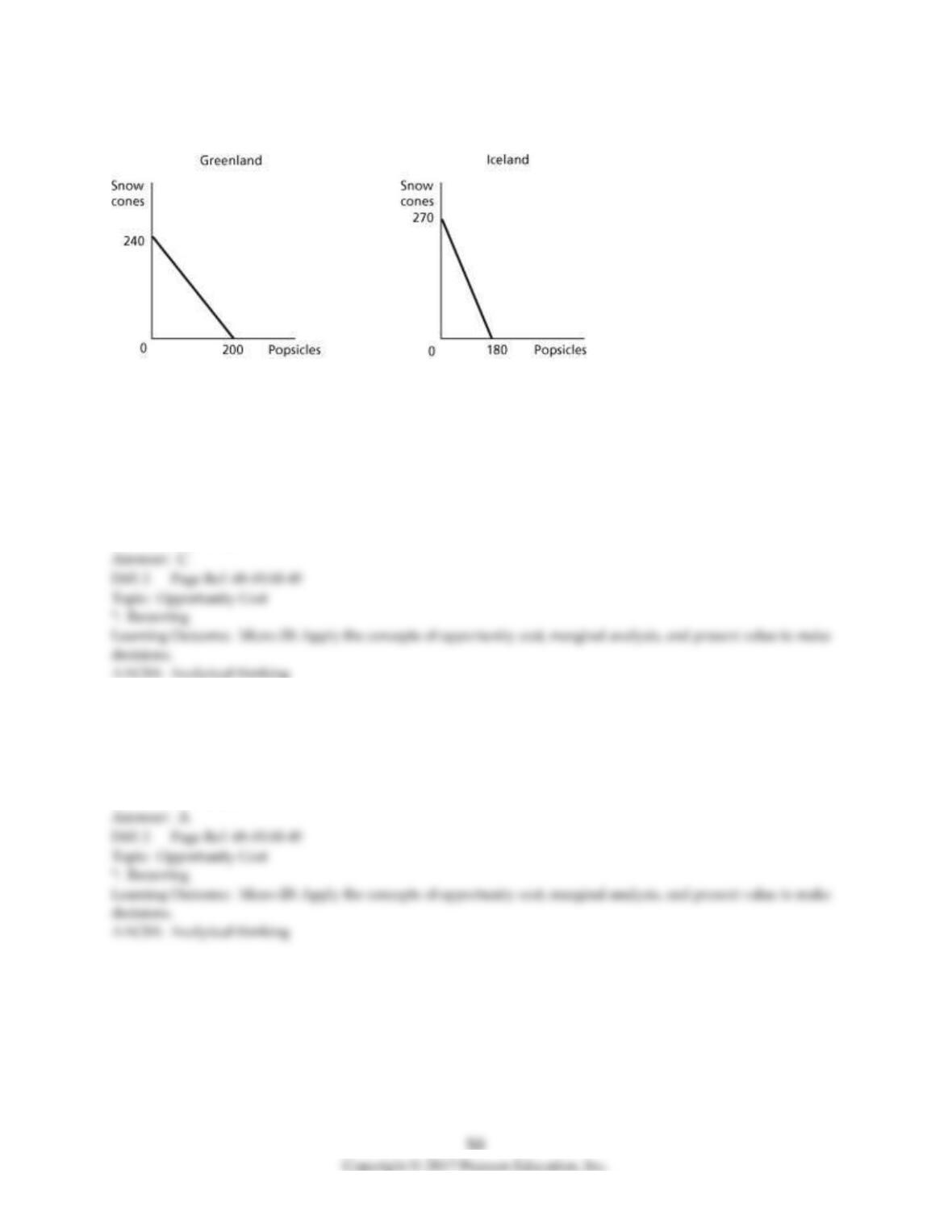
Figure 2-9
Figure 2-9 shows the production possibilities frontiers for Greenland and Iceland. Each country
produces two goods, snow cones and popsicles.
50) Refer to Figure 2-9. What is the opportunity cost of producing 1 popsicle in Greenland?
A) 2/3 of a snow cone
B) 5/6 of a snow cone
C) 1 1/5 snow cones
D) 240 snow cones
51) Refer to Figure 2-9. What is the opportunity cost of producing 1 popsicle in Iceland?
A) 1 1/2 snow cones
B) 3/4 of a snow cone
C) 2/3 of a snow cone
D) 270 snow cones
52) Refer to Figure 2-9. What is the opportunity cost of producing 1 snow cone in Greenland?
A) 2/3 of a popsicle
B) 5/6 of a popsicle
C) 1 1/5 popsicles
D) 200 popsicles
53) Refer to Figure 2-9. What is the opportunity cost of producing 1 snow cone in Iceland?
A) 2/3 of a popsicle
B) 3/4 of a popsicle
C) 1 1/2 popsicles
D) 180 popsicles
54) Refer to Figure 2-9. Which country has a comparative advantage in the production of popsicles?
A) Greenland
B) They have equal productive abilities.
C) Iceland
D) neither country
55) Refer to Figure 2-9. Which country has a comparative advantage in the production of snow cones?
A) Greenland
B) They have equal productive abilities.
C) Iceland
D) neither country
56) Refer to Figure 2-9. If the two countries have the same amount of resources and the same
technological knowledge, which country has an absolute advantage in the production of popsicles?
A) Greenland
B) They have the same advantage.
C) Iceland
D) cannot be determined
Table 2-9
One Wristwatch
Rice (per pound)
Japan
50 hours
2 hours
Thailand
30 hours
1.5 hours
Table 2-9 shows the number of labor hours required to produce a wristwatch and a pound of rice in
Japan and Thailand.
57) Refer to Table 2-9. Does either Japan or Thailand have an absolute advantage and if so, in what
product?
A) Thailand has an absolute advantage in rice.
B) Japan has an absolute advantage in rice.
C) Thailand has an absolute advantage in both products.
D) Japan has an absolute advantage in wristwatches.
58) Refer to Table 2-9. What is Japan’s opportunity cost of producing one wristwatch?
A) 0.04 pounds of rice
B) 4 pounds of rice
C) 25 pounds of rice
D) 40 pounds of rice
59) Refer to Table 2-9. What is Thailand’s opportunity cost of producing one wristwatch?
A) 0.05 pounds of rice
B) 20 pounds of rice
C) 25 pounds of rice
D) 60 pounds of rice
60) Refer to Table 2-9. What is Japan’s opportunity cost of producing one pound of rice?
A) 0.04 units of a wristwatch
B) 4 wristwatches
C) 25 wristwatches
D) 40 wristwatches
61) Refer to Table 2-9. What is Thailand’s opportunity cost of producing one pound of rice?
A) 60 wristwatches
B) 20 wristwatches
C) 5 wristwatches
D) 0.05 units of a wristwatch
62) Refer to Table 2-9. Japan has a comparative advantage in the production of
A) rice.
B) wristwatches.
C) both products.
D) neither product.
63) Refer to Table 2-9. Thailand has a comparative advantage in the production of
A) rice.
B) wristwatches.
C) both products.
D) neither product.
64) Refer to Table 2-9. If the two countries specialize and trade, who should export rice?
A) There is no basis for trade between the two countries.
B) Japan
C) Thailand
D) They should both be exporting rice.
65) Refer to Table 2-9. If the two countries specialize and trade, who should export wristwatches?
A) There is no basis for trade between the two countries.
B) Japan
C) Thailand
D) They should both be importing wristwatches.
66) If Blake can pick more cherries in one hour than Cody, then Blake has a comparative advantage in
cherry picking.
67) The basis for trade is absolute advantage, not comparative advantage.
68) If a country produces only two goods, then it is not possible to have a comparative advantage in the
production of both those goods.
69) In a two-good, two country world, if one country has an absolute advantage in the production of
both goods, it can still benefit by trading with the other country.
70) If the opportunity cost of producing more of one good increases as more of that good is produced,
then the production method is inefficient.
71) It is not possible to have a comparative advantage in producing a good or service without having an
absolute advantage.
72) If Abigail can make more candles in one day than Pierre, then Abigail has an absolute advantage in
making candles.
73) If a country produces only two goods, it is possible to have an absolute advantage in the production
of both goods.
74) In a two-good, two country world, if one country has a comparative advantage in the production of
one good, it can benefit by trading with the other country.
75) For a person to have a comparative advantage in producing a product, he must be able to produce
that product at a higher opportunity cost than his competitors.
76) It is not possible to have an absolute advantage in producing a good or service without having a
comparative advantage.
77) Is it possible for a firm to have a comparative advantage in producing something without having an
absolute advantage? Why or why not?
78) Should countries specialize in producing goods and services based on having a comparative
advantage or an absolute advantage? Why?
Table 2-10
Wristwatch
Rice (bushels)
Japan
200 hours
10 hours
Thailand
180 hours
6 hours
79) Refer to Table 2-10. This table shows the number of labor hours required to produce a wristwatch
and a bushel of rice in Japan and Thailand.
a. Which country has an absolute advantage in the production of wristwatches?
b. Which country has an absolute advantage in the production of rice?
c. What is Japan’s opportunity cost of producing one wristwatch?
d. What is Thailand’s opportunity cost of producing one wristwatch?
e. What is Japan’s opportunity cost of producing one bushel of rice?
f. What is Thailand’s opportunity cost of producing one bushel of rice?
g. If each country specializes in the production of the product in which it has a comparative
advantage, who should produce wristwatches?
h. If each country specializes in the production of the product in which it has a comparative
advantage, who should produce rice?
58
80) Suppose in Belgium, the opportunity cost of producing a trombone is 8 clarinets. In Denmark, the
opportunity cost of producing a trombone is 6 clarinets.
a. What is the opportunity cost of producing a clarinet for Belgium?
b. What is the opportunity cost of producing a clarinet for Denmark?
c. Which country has a comparative advantage in the production of clarinets?
d. Which country has a comparative advantage in the production of trombones?
Table 2-11
Cell Phone
Lumber (board
feet)
Estonia
20 hours
5 hours
Finland
18 hours
4 hours
81) Refer to Table 2-11. This table shows the number of labor hours required to produce a cell phone
and a board foot of lumber in Estonia and Finland.
a. Which country has an absolute advantage in the production of cell phones?
b. Which country has an absolute advantage in the production of lumber?
c. What is Estonia’s opportunity cost of producing one cell phone?
d. What is Finland’s opportunity cost of producing one cell phone?
e. What is Estonia’s opportunity cost of producing one board foot of lumber?
f. What is Finland’s opportunity cost of producing one board foot of lumber?
g. If each country specializes in the production of the product in which it has a comparative
advantage, who should produce cell phones?
h. If each country specializes in the production of the product in which it has a comparative
advantage, who should produce lumber?

60
Table 2-12
Cell Phone
Lumber (board foot )
Estonia
20 hours
5 hours
Finland
18 hours
4 hours
82) Refer to Table 2-12. This table shows the number of labor hours required to produce a cell phone
and a board foot of lumber in Estonia and Finland.
a. If each country has a total of 3,600 labor hours to devote to the production of the two goods, draw
the production possibilities frontier for each country. Put “Cell Phone” on the horizontal axis and
“Lumber” on the vertical axis. Be sure to identify the intercept values on your graphs.
b. Suppose each country allocates 55% its labor hours to lumber production and 45% to the production
of cell phones. Complete Table 2-13 below to show each country’s output of the two products.
Table 2-13: Production and Consumption with no Trade
Cell Phone
Output
Lumber
Output
(board
feet)
Estonia
Finland
Total
c. If the two countries do not trade and consume whatever they produce, identify the current
production and consumption point for each country on their respective production possibilities
frontiers. Label Estonia’s consumption point “E” and Finland’s consumption point, “F.”
d. Suppose the two countries specialize and trade. Who should produce cell phones and who should
produce lumber? Explain your answer.
e. Complete Table 2-14 below to show each country’s output with specialization.
Table 2-14: Output with Specialization
Cell Phone
Output
Lumber
Output
(board
feet)
Estonia
Finland
Total
f. Did specialization increase the combined output for the two countries without any increase in
resources? If so, by how much?
g. Suppose Estonia and Finland agree to trade so that in exchange for 400 board feet of lumber, the
exporter of lumber receives 90 cell phones. Complete Table 2-15 below to show each country’s
consumption bundle after trade.