105) Explain: “The law of increasing additional cost is an inevitable phenomenon in economics.”
106) Explain the concept of the law of increasing additional cost.
107) Explain what is meant by economic efficiency. Does efficiency imply that the fastest
production processes or the most powerful equipment must always be used? Explain.
108) Why is a point below the production possibilities curve less efficient than a point on that
curve?
2.4 Economic Growth, Production Possibilities, and the Trade-Off between Present and Future
1) In order for an economy to increase its production possibilities, the economy must
A) be very efficient.
B) increase inputs.
C) increase its wants.
D) reduce output.
2) The discovery of new natural resources will cause
A) the economy to move closer to the production possibilities curve.
B) the production possibilities curve to shift up and to the right.
C) an upward movement along the curve.
D) the curve to shift back and to the left.
3) The production possibilities curve can shift inward when
A) production increases.
B) employment increases.
C) the stock of productive capital rises.
D) a country experiences a natural disaster.
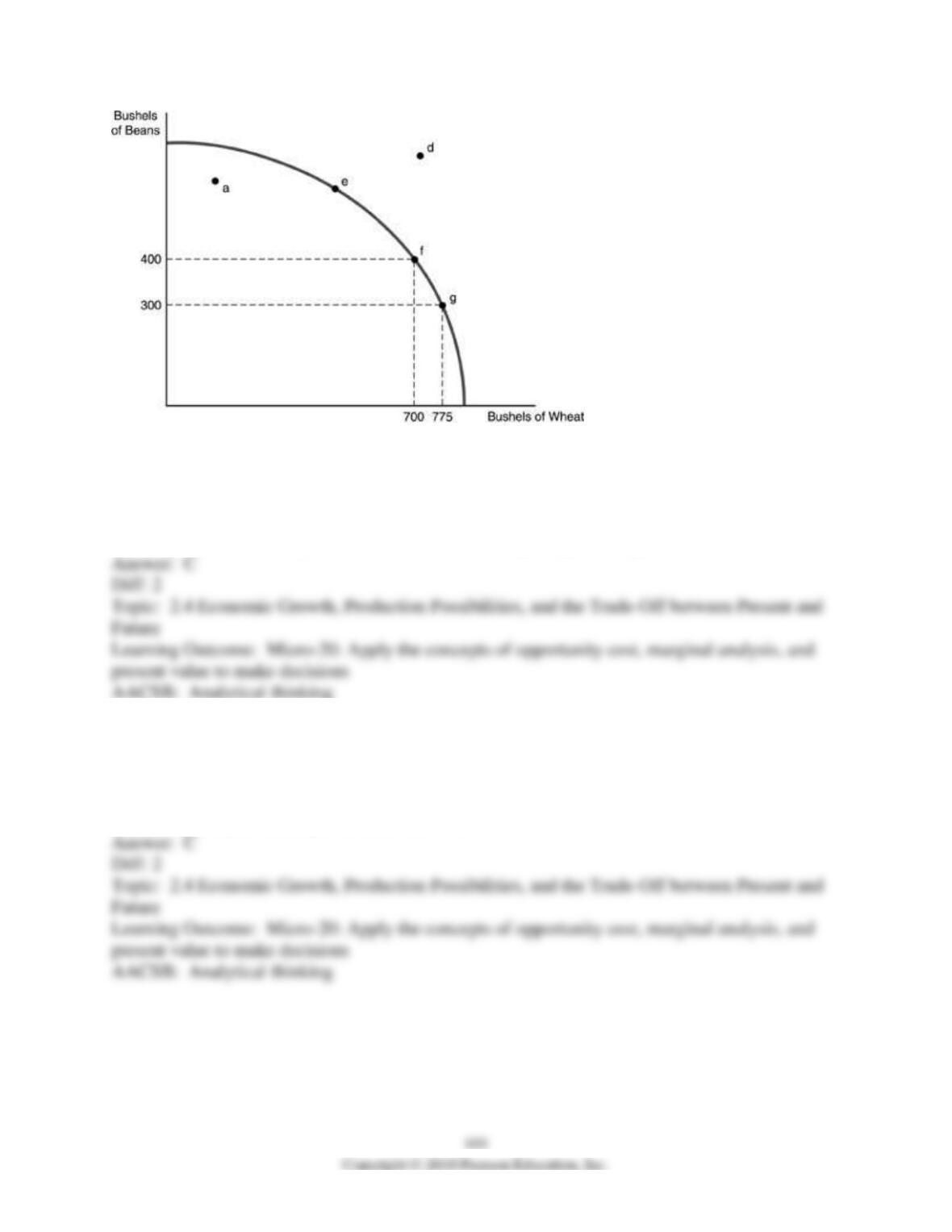
4) Refer to the above figure. Which of the following would allow society to move to point d?
A) producing efficiently
B) concentrating production in wheat
C) increasing the quantity of labor
D) using the best land to produce wheat and the lower quality land to produce beans
5) Economic growth can be drawn in a diagram by
A) making the production possibilities curve more bowed out.
B) making the production possibilities curve less bowed out.
C) shifting the production possibilities curve out.
D) shifting the production possibilities curve in.
6) All of the following would cause the production possibilities curve to shift outward EXCEPT
A) an improvement in technology.
B) an increase in the amount of labor available.
C) a decline in the unemployment rate.
D) an increase in the level of capital stock.
7) How is economic growth shown by the production possibilities curve?
A) by shifting the curve to the right
B) by moving the curve to the left
C) by moving up the existing curve
D) by changing the shape of the curve from a straight line to one that is bowed
8) The production possibilities curve shifts outward when
A) the law of increasing additional cost takes hold.
B) the economy is producing efficiently.
C) we produce more consumption goods over productive investment in equipment.
D) there is an increase in resources or technology.
9) Economic growth can be pictured in a production possibilities curve diagram by
A) shifting the production possibilities curve in.
B) shifting the production possibilities curve out.
C) making the production possibilities curve straighter.
D) moving from a point inside the production possibilities curve to a point on the curve.
10) The only way that a society can produce outside the production possibilities curve is
A) through economic growth.
B) by producing efficiently.
C) by obeying the Law of Increasing Additional Cost.
D) to use the concept of opportunity cost.
11) If a country is currently producing inside its production possibilities curve
A) it can increase the production of both goods by putting unemployed resources to work.
B) it can increase the production of one of the goods only if it reduces the production of the other
good.
C) it is experiencing efficient production of one good but not the other.
D) None of the above are correct.
12) If an economy produces only steel and wheat, a new fertilizer will
A) cause the production of wheat to increase at every point on a production possibilities curve
but not affect the production of steel, that is the curve moves outward on the wheat axis only.
B) cause the production of both wheat and steel to increase at every point along the production
possibilities curve, that is the curve moves outward on both the wheat axis and the steel axis.
C) not affect the production of either wheat or steel.
D) cause the production of steel to increase at every point along the production possibilities
curve but not affect the production of wheat, that is the curve moves outward on the steel axis
only.
13) In order for a production possibilities curve to shift to the right, which of the following must
occur?
A) government involvement
B) increasing consumer wants
C) economic growth
D) reductions in the supply of resources
14) Regarding the production possibilities curve, an improvement in technology will
A) shift the curve o the left.
B) cause a movement downward along the curve.
C) cause a movement downward along the curve
D) shift the curve to the right.
15) The production possibilities curve (PPC) illustrates economic growth by a(n)
A) bowed-out shape of the PPC.
B) outward shift of the PPC.
C) inward shift of the PPC.
D) movement along the PPC.
16) Economic growth appears on a production possibilities curve as
A) the curve shifting out away from the origin.
B) the curve shifting in toward the origin.
C) a change in the slope of the curve.
D) the points outside the production possibilities curve.
17) A production possibilities curve will shift inward
A) when the unemployment rate increases.
B) when production is inefficient.
C) when resources are expanding.
D) when a war destroys the capital goods of a country.
18) Generally, if a nation produces more consumer goods than capital goods
A) more of all goods may be produced in the future.
B) less of all goods may be produced in the future.
C) about the same amount of capital goods may be produced in the future as are being produced
today.
D) society will have to forego future consumption of capital goods.
19) The use of goods and services for personal satisfaction is known as
A) the formation of capital goods.
B) production.
C) personal investment.
D) consumption.
20) A country that must reduce current consumption to increase future consumption possibilities
A) must be allocating resources inefficiently.
B) must be producing along the production possibilities curve.
C) must be producing outside the production possibilities curve.
D) must not have private ownership of property.
21) Whenever a society forgoes current consumption to invest in capital goods
A) it will have less to consume next year.
B) it will be easier for that society to consume less in the future because people will become
accustomed to less.
C) that society can consume more in the future.
D) it will be forced to produce fewer capital goods in the future.
22) At a point on a production possibilities curve, opportunity cost of more capital goods today is
A) fewer capital goods in the future.
B) fewer consumer goods in the future.
C) fewer consumer goods today.
D) more unemployed resources in the future.
23) When an economy sacrifices production of consumption goods to produce more capital
goods, we would expect that the production possibilities curve will
A) shift outward.
B) shift inward.
C) become a straight line.
D) shift about in random fashion.
24) Capital goods
A) are a special type of consumption goods.
B) are consumed because they enhance the enjoyment consumers obtain from other goods and
services.
C) are goods used to make consumer goods and services.
D) refer to the expenses that a company incur for producing other types of goods.
25) If a country increased the production of its capital goods, then
A) the more consumption of goods we can have today.
B) the less consumption we can have today, but we will have more in the future.
C) the more unemployed resources there will be in the future.
D) the more unemployed resources there are today.
26) The opportunity cost of more consumption of goods today is
A) lower consumption of goods in the future.
B) fewer capital goods in the future.
C) more capital goods today.
D) more unemployment both today and in the future.
27) Whenever productive resources are used to make capital goods
A) society is not producing efficiently.
B) society is giving up current consumption.
C) the production possibilities curve becomes flatter.
D) absolute advantage occurs.
28) The more society consumes today
A) the more it consumes next year.
B) the less it can produce today.
C) the less society can consume in the future.
D) the more capital goods society can produce in the future.
29) The trade-off between current consumption and the production of capital goods is also a
trade-off between
A) the future cost for capital goods and future cost of consumption goods.
B) having fewer needs and more wants in the future.
C) satisfying the needs of the poor and the wants of the wealthy.
D) current consumption and future consumption.
30) To have more consumer goods in the future, we must
A) produce more capital goods today.
B) lower current income.
C) get government involved in the production process.
D) stop producing all goods today.
31) The trade-off between the present and future consumption is measured by
A) the money cost of both the present and future consumption.
B) the foregone present consumption.
C) the difference between the money price of future goods and the money cost of producing
them.
D) the difference between the money price of present goods and the money cost of producing
them.
32) Using productive resources to make capital goods requires that we
A) get everyone to agree on the best use of those resources.
B) get government approval of our plan to make capital goods.
C) forgo some level of current consumption.
D) prove that the existence of the capital goods will not cause any environmental damage.
33) Trading off capital goods for increasing amounts of consumer goods today will most likely
result in
A) increased long-term growth.
B) decreased long-term growth.
C) decreased prices in consumer goods.
D) increases in the quantity of consumer goods.
34) A production possibilities curve will shift outward or to the right for all of the following
reasons EXCEPT
A) an increase in the unemployment rate.
B) an increase in the quality of the labor force.
C) an improvement in production technology.
D) a discovery of a new source of renewable energy.
35) Economic growth is shown by
A) a point near the top of the production possibilities curve.
B) a point outside the production possibilities curve.
C) an inward shift of the production possibilities curve.
D) an outward shift of the production possibilities curve.
36) If the production of capital goods is shown along the horizontal axis of a production
possibilities curve, and the production of consumer goods is shown along the vertical axis of a
production possibilities curve, and the economy desires to have a rapid rate of economic growth,
then the economy should produce at a point
A) near the middle of the curve dividing resources equally between the production of consumer
and capital goods.
B) at a point near the vertical axis concentrating on the production of consumer goods.
C) at a point near the horizontal axis concentrating on the production of capital goods.
D) at a point inside the curve allowing the economy to adjust rapidly to changes in economic
activity.
37) If a country wants to promote future growth, it should
A) produce more capital goods today.
B) produce more consumer goods today.
C) produce only economic goods.
D) produce only needed goods.
38) “Because resources are scarce, the production of more capital goods means that fewer
resources are available to produce consumption goods, so there is less current consumption.” Do
you agree or disagree? Explain.
39) Explain briefly what will likely happen to society if it chooses to produce more capital goods
and fewer consumption goods.
40) Explain what will happen to the production possibilities curve over time if society gives up
some consumption goods in favor of more capital goods.
41) Why does the trade-off between consumption goods and capital goods represent a trade-off
between the present and the future?
2.5 Specialization, Comparative Advantage, and Trade
1) Comparative advantage is
A) when a country can produce a good at a lower opportunity cost compared to other countries.
B) when a country can produce all goods more quickly than any other country.
C) when the production possibilities curve shifts outward to the right.
D) only for individuals and not countries.
2) If Maggie can make $80,000 as an accountant, $50,000 as a cashier, $20,000 as a cook, and
nothing as an opera singer, she has a comparative advantage in
A) accounting.
B) being a cashier.
C) being a cook.
D) opera singing.
3) Carlos is an executive of a major corporation. Boris is a baker. Carlos earns a salary ten times
as large as the salary Boris earns, and Carlos has a much larger oven for baking break. Carlos can
make a loaf of bread that tastes better than Boris’s bread but Boris can bake faster.
A) Carlos has an absolute and comparative advantage over Boris in making bread.
B) Carlos has an absolute but not comparative advantage over Boris in making bread.
C) Carlos had a comparative but not absolute advantage over Boris in making bread.
D) Carlos does not have an absolute or comparative advantage over Boris in making bread.
4) Which is the best example of specialization?
A) a high school math teacher who teaches only calculus
B) a firm that produces both luggage and cooking oil
C) a person whose job includes accounting, personnel, and maintenance tasks
D) a high school math teacher who teaches algebra and calculus
5) Why do people specialize?
A) Specialization allows people to do a variety of job tasks.
B) Specialization usually increases productivity.
C) Specialization decreases people’s dependence on each other.
D) Specialization occurs when people do not want to learn new tasks.
6) Specialization can occur because
A) governments pass laws that require it.
B) varying skills differentiate workers.
C) absolute advantage creates specialization among laborers.
D) managers and laborers share job tasks.
7) If a country’s production possibilities curve gets more bowed out over time, it is an indication
that
A) technological change has taken place.
B) society is learning to use its resources more efficiently.
C) the quantity of labor and capital have increased.
D) resources have become more highly specialized.
8) Generally, specialization leads to
A) constant opportunity costs.
B) greater productivity.
C) reductions in people’s skill levels.
D) greater self-reliance.
9) Specialization and the division of labor typically result in
A) cost overruns.
B) increased output.
C) decreased output.
D) a greater reliance upon imports.
10) Absolute advantage is
A) producing at a lower opportunity cost.
B) producing a good using the fewest inputs.
C) producing a good only when demand is high.
D) producing a good that requires imported components.
11) A person has a comparative advantage in an activity whenever she
A) has an absolute advantage in the activity.
B) can perform the activity at a lower opportunity cost than another person can.
C) can do the activity in less time than anyone else.
D) can do everything better than anyone else.
12) Comparative advantage is always a(n) ________ concept.
A) absolute
B) efficiency
C) relative
D) monetary
13) If you can make $25,000 a year teaching, $20,000 a year writing computer programs,
$30,000 a year driving a cab, and $40,000 a year as an actor or actress. You have a comparative
advantage in
A) teaching.
B) writing computer programs
C) being an actor or actress.
D) one of them but we need more information to know which.
14) Comparative advantage implies choosing the activity that
A) has a high opportunity cost.
B) is inside the production possibilities frontier.
C) has the lowest opportunity cost.
D) does not demand any specialization.
15) If individual X has comparative advantage in painting and individual Y has comparative
advantage in carpentry, then
A) individual X must use fewer hours to paint a fence than individual Y.
B) individual Y will specialize in painting.
C) there is a lower opportunity cost (expressed in units of carpentry) for individual X to paint
than for individual Y to paint.
D) specialization will not occur, since each does not have a clear absolute advantage.