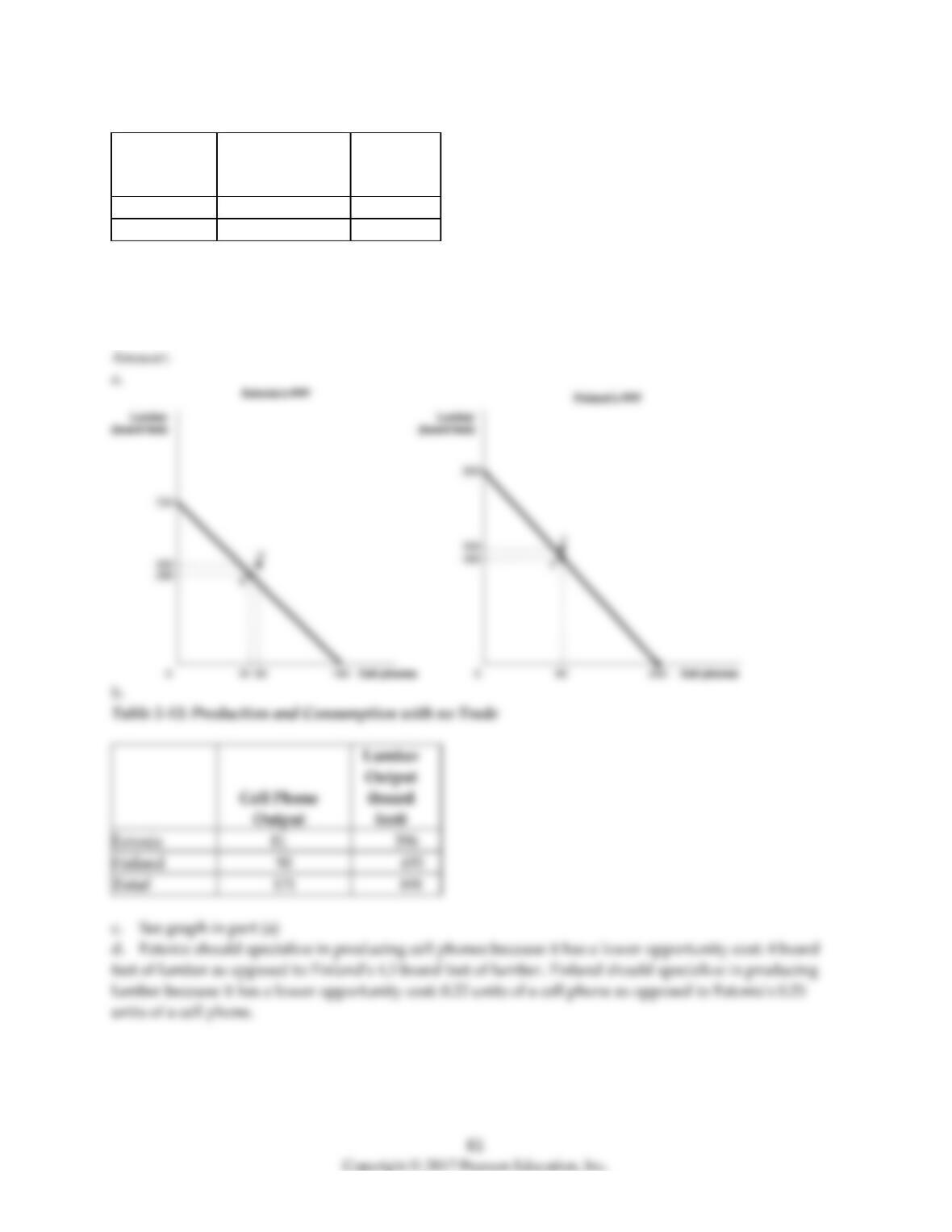
Table 2-15: Consumption with Trade
Cell Phone
Lumber
(board
feet)
Estonia
Finland
h. Show the consumption points after trade on each country’s production possibilities frontier. Label
these points “X” for Estonia and “Y” for Finland.
i. Has trade made the two countries better off? Explain your answer.
feet)
Estonia
Finland
83) Suppose in the United States, the opportunity cost of producing a motor engine is 4 auto bodies. In
Canada, the opportunity cost of producing a motor engine is 2 auto bodies.
a. What is the opportunity cost of producing an auto body for the United States?
b. What is the opportunity cost of producing an auto body for Canada?
c. Which country has a comparative advantage in the production of auto bodies?
d. Which country has a comparative advantage in the production of motor engines?
2.3 The Market System
1) Which of the following is a factor of production?
A) a sofa produced by a furniture manufacturer
B) 20 shares of Microsoft stock
C) the janitor at the local elementary school
D) $500 in cash
2) An example of a factor of production is
A) a car produced by an auto manufacturer.
B) a worker hired by an auto manufacturer.
C) a loan granted to an auto manufacturer.
D) the automobiles exported by an auto manufacturer.
3) If a vineyard wants to raise funds to purchase a new bottling machine, it does so in the
A) factor market.
B) output market.
C) product market.
D) alcoholic beverages market.
4) A worker is hired in a
A) goods and services market.
B) product market.
C) government market.
D) factor market.
5) When you purchase a new surfboard you do so in the
A) resource market.
B) product market.
C) input market.
D) factor market.
6) The resource income earned by those who supply labor services is called
A) wages and salaries.
B) stock options.
C) profit.
D) bonus.
7) Which of the following statements about an entrepreneur is true?
A) purchases other factors of production in the output market
B) develops the vision for the firm and funds the producing unit
C) sells his entrepreneurial services in the output market
D) does not face personal risk
8) The circular flow model demonstrates
A) the role of the government in overseeing the market system.
B) the roles played by households and firms in the market system.
C) how shortages and surpluses are eliminated in a market.
D) how demand and supply for goods and services are brought into equilibrium.
9) Firms
A) have no influence on the circular flow in a market economy.
B) purchase resources in the product market.
C) sell goods in the product market.
D) sell resources in the factor market.
10) Households
A) purchase final goods and services in the factor market.
B) purchase final goods and services in the product market.
C) purchase resources in the product market.
D) purchase resources in the factor market.
11) In the circular flow model, households
A) sell goods and services in the input market.
B) and firms spend earnings from resource sales on goods and services in the factor market.
C) hire resources sold by firms in the factor market.
D) spend earnings from resource sales on goods and services in the product market.
12) Which of the following is not a flow in the circular flow model?
A) the flow of goods and services and the flow of resources to produce goods and services
B) the flow of profit and the flow of revenue
C) the flow of income earned by households and the flow of expenditures incurred by households
D) the flow of revenue received by producers and the flow of payments to resource owners
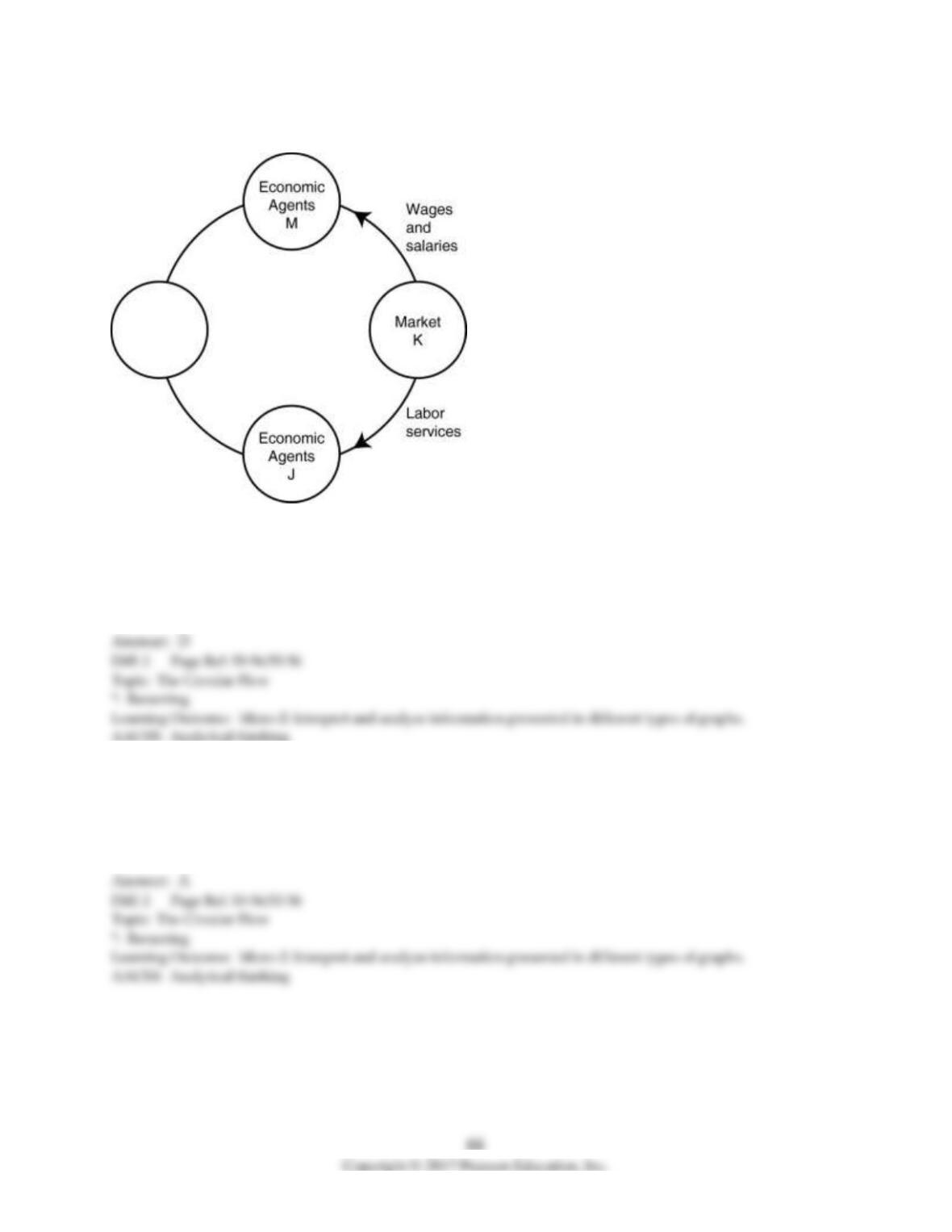
Figure 2-10
13) Refer to Figure 2-10. In the circular flow diagram, market K represents
A) households.
B) product markets.
C) firms.
D) factor markets.
14) Refer to Figure 2-10. In the circular flow diagram, economic agents M represent
A) households.
B) product markets.
C) firms.
D) factor markets.
67
15) Which of the following are represented by the same flow in the circular flow model?
A) the flow of goods and the flow of factors of production
B) the flow of costs and the flow of revenue
C) the flow of income earned from the sale of resources and the flow of expenditures on goods and
services
D) the flow of income received by households and the flow of tax revenues paid by firms
16) Which of the following statements is true about a simple circular flow model?
A) Producers are neither buyers nor sellers in the product market.
B) Households are neither buyers nor sellers in the input market.
C) Producers are buyers in the factors market.
D) Households are sellers in the product market.
68
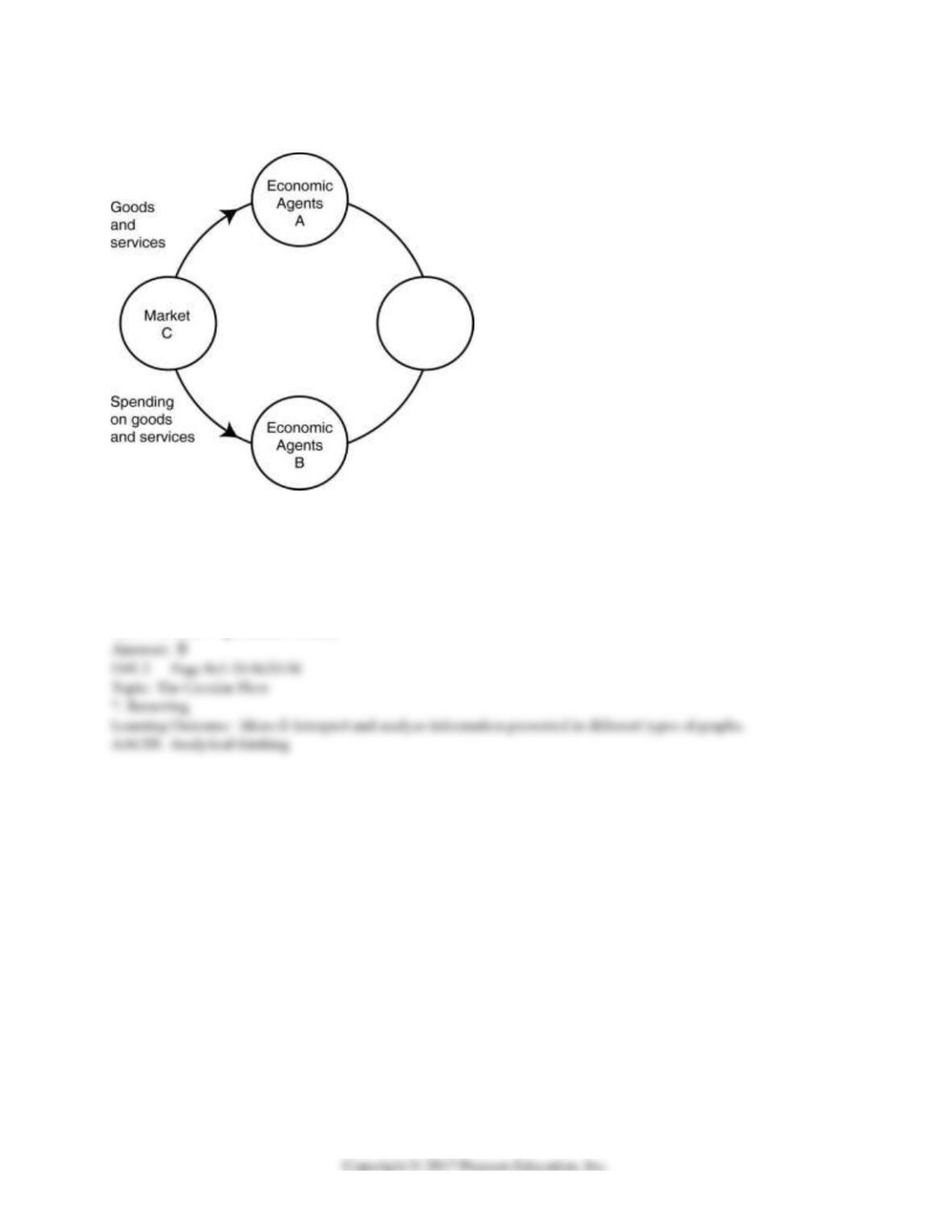
Figure 2-11
17) Refer to Figure 2-11. In the circular flow diagram, who are economic agents A and who are
economic agents B?
A) A = firms; B = households
B) A = households; B = firms
C) A = households; B = factor markets
D) A= firms; B = product markets
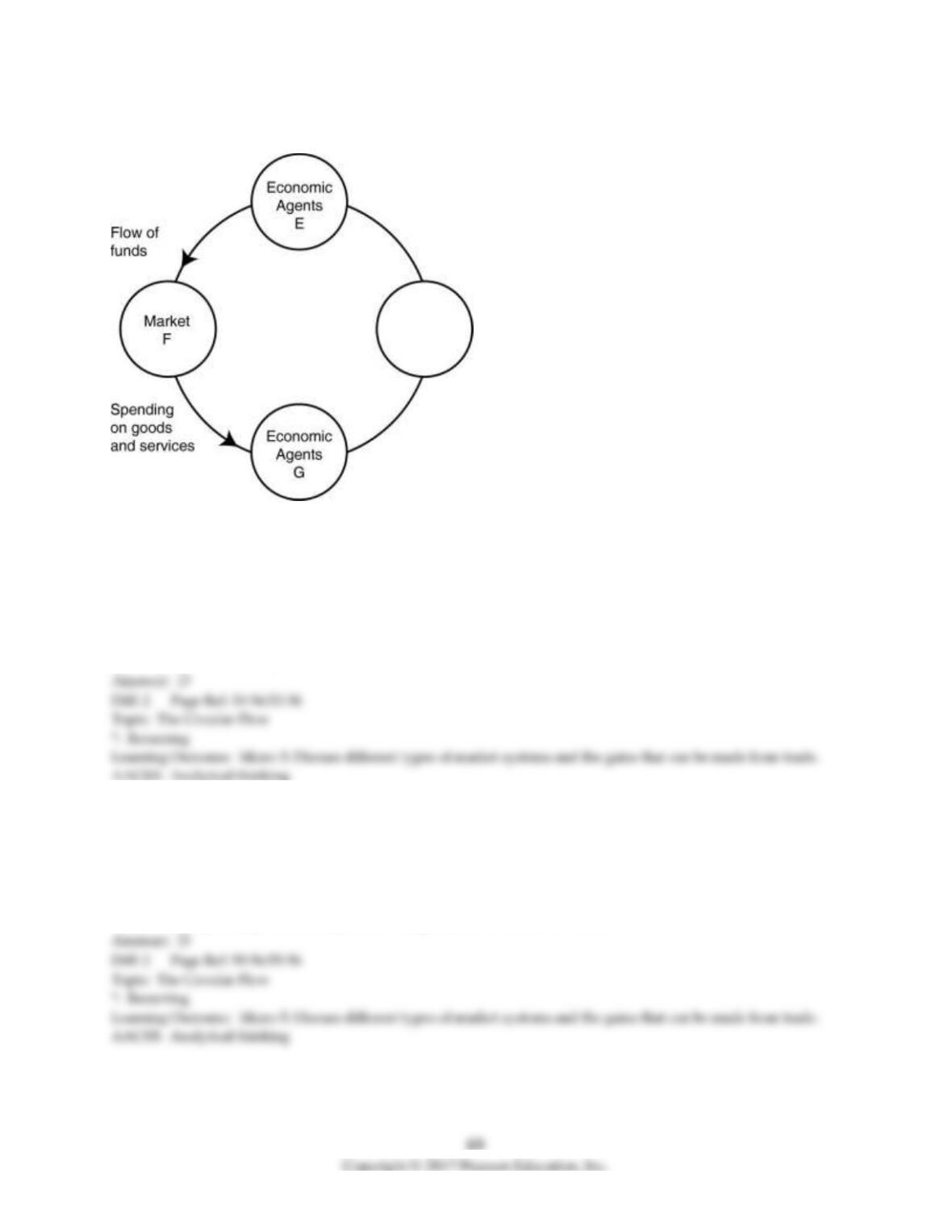
Figure 2-12
18) Refer to Figure 2-12. One segment of the circular flow diagram in the Figure shows the flow of
funds from market F to economic agents G. The funds represent spending on goods and services. What
is market F and who are economic agents G?
A) F = factor markets; G = households
B) F = product markets; G = households
C) F = factor markets; G = firms
D) F = product markets; G = firms
19) Which of the following is an example of spending on factors of production in the circular flow
model?
A) Tuan purchases a cappuccino at the student union.
B) Laurence rents a car to drive to a wedding in San Diego.
C) Yvette pays $50 to join a softball league.
D) The “Lucky Ducky” casino buys a new craps table for the casino floor.
70
20) All of the following are examples of spending on goods and services in the circular flow model
except
A) Amanda purchases a new electric guitar to pursue her hobby seriously.
B) Chaitanya buys a new spa pedicure chair for her expanding nail salon business.
C) Hernan buys a pizza at Papa C’s.
D) Lenny buys a new digital camera to take pictures at his son’s graduation.
21) Published in 1776, ________ was written by Adam Smith.
A) “The General Theory of Employment, Interest, and Money”
B) “The Communist Manifesto”
C) “The Declaration of Economics”
D) “An Inquiry into the Nature and Causes of the Wealth of Nations”
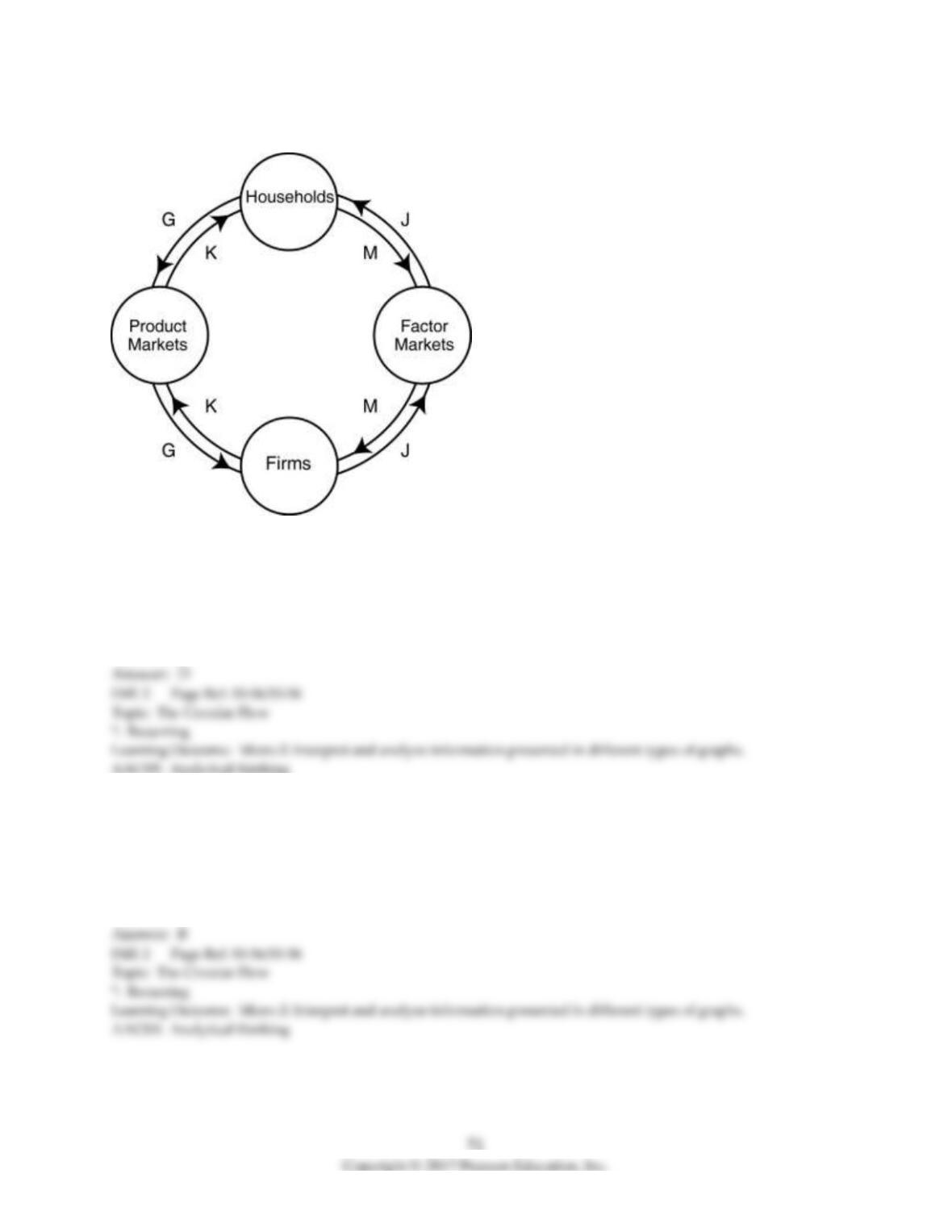
Figure 2-13
22) Refer to Figure 2-13. Which two arrows in the diagram depict the following transaction: Stanley
purchases the novel, “Night of Sorrows” for his summer reading pleasure.
A) J and M
B) J and G
C) K and M
D) K and G
23) Refer to Figure 2-13. Which two arrows in the diagram depict the following transaction: Lizzie
Haxem hires “The Paint Pros,” a professional painting company, to paint her home.
A) J and M
B) K and G
C) K and M
D) J and G
24) Refer to Figure 2-13. Which two arrows in the diagram depict the following transaction: Carter
earns a $400 commission for selling men’s designer shoes at Brooks Brothers.
A) J and M
B) K and G
C) K and M
D) J and G
25) ________ behavioral assumption about humans was that people usually act in a rational, self-
interested way.
A) Thomas Malthus’s
B) Adam Smith’s
C) Karl Marx’s
D) Janet Yellen’s
26) Which of the following countries does not come close to the free market benchmark?
A) the United States
B) Japan
C) Cuba
D) France
27) Adam Smith’s ________ refers to the process by which individuals acting in their own self-interest
bring about a market outcome that benefits society as a whole.
A) Utopian society
B) comparative advantage model
C) invisible hand
D) survival of the fittest theory
28) A critical function of the government in facilitating the operation of a market economy is
A) producing goods and services for low-income households.
B) setting up and enforcing private property rights.
C) ensuring an equal distribution of income to all citizens.
D) controlling the market prices of food items.
29) The ability to exercise control over one’s own resources within the confines of the law refers to
A) the free market.
B) one’s property rights.
C) entrepreneurship.
D) having an absolute advantage.
30) The primary purpose of patents and copyrights is to
A) provide owners with large profit forever.
B) protect firms from being taken advantage of by competing firms.
C) protect domestic firms from foreign competition.
D) encourage the expenditure of funds on research and development to create new products.
31) If property rights are not well enforced, all of the following are likely to occur except
A) fewer goods and services will be produced.
B) economic efficiency will be reduced.
C) an economy will produce inside its production possibilities frontier.
D) a significant number of people will be willing to risk their funds by investing them in local
businesses.
32) A successful market economy requires well defined property rights and
A) balanced supplies of all factors of production.
B) an independent court system to adjudicate disputes based on the law.
C) detailed government regulations.
D) a safety net to ensure that those who cannot participate in the market economy can earn an income.
33) All of the following are considered intellectual property except
A) books.
B) films.
C) software.
D) shares of stock.
34) A guild is
A) a group of independent producers competing with each other.
B) an organization of producers that limits the amount of a good produced.
C) a group of nations who agree not to compete with each other.
D) a nation that is a free-market benchmark.
35) In 18th century Europe, governments gave guilds legal authority to limit production of goods. This
authority obstructed the market mechanism because the guild’s actions prevented the forces of ________
from coordinating the self-interested decisions of producers and consumers.
A) absolute advantage
B) demand and supply
C) opportunity cost
D) nature
36) When a celebrity has the desire to have his image protected following his death, this is best
described as an example of the protection of
A) an invention.
B) a patent.
C) a trademark.
D) intellectual property.
37) In the desire to have a celebrity’s image protected to prevent it from being used in ways he would
not approve, a celebrity’s estate
A) will probably not be successful, since there are no laws regulating this kind of use in the United
States.
B) will have to be granted a patent declaring the celebrity’s image a new product, and this will give the
estate protection for 7 years.
C) can rely on U.S. laws that protect intellectual property rights to prevent the unauthorized use of his
image.
D) will most likely be more successful in developing countries than in high-income countries, since
property regulations are better enforced in developing countries.
38) Which of the following is a factor of production?
A) an acre of forested land
B) a U.S. Treasury bond
C) 20 shares of Ford stock
D) $25,000 in cash
39) Which of the following is an example of spending on goods and services in the circular flow model?
A) Micah purchases a new wrench for his auto repair business.
B) Chester buys a first-class ticket from Atlanta to London for his long-awaited vacation.
C) Toby buys a new lawn mower to use in his lawn care business.
D) Lily purchases a new massage table for use in her therapy center.
Article Summary
On October 5, 2015, 12 nations, including the United States, reached an agreement on the Trans-
Pacific Partnership (TPP) treaty, a free-trade agreement that has been negotiated in total secrecy for
more than five years. One of the more controversial parts of the agreement deals with intellectual
property rights, with details of this provision released to the public by the Website Wikileaks.
According to Wikileaks, the intellectual property rights section of the TPP contains regulations that
would potentially have “wide-ranging effects on internet services, medicines, publishers, civil
liberties, and biological patents.” Included in these regulations is the potential to extend patents on
pharmaceuticals which could delay the development of less expensive, generic versions of the
patented drugs.
Source: Doug Bolton, “TPP leaked: Wikileaks releases intellectual property chapter of controversial
internet and medicine-regulating trade agreement,” independent.co.uk, October 9, 2015.
40) Refer to the Article Summary. If the 12 nations that are a part of the TPP do not agree to these stricter
pharmaceutical patent laws as a way to increase intellectual property rights and ignore any
international agreements which do protect these intellectual property rights, which of the following
would most likely occur?
A) Pharmaceutical companies would decrease investment in the development of more experimental
drugs.
B) Pharmaceutical companies would consider expanding operations to these TPP nations.
C) More patents would be issued to pharmaceutical companies.
D) More dollars would be spent on the development of new medicines.
41) Once the copyright on a book expires,
A) any publisher can now claim copyright of that author’s words.
B) only the first publisher to reissue the book can claim copyright of that author’s words.
C) no publisher can claim copyright of that author’s words, but the book can be reissued by any
publisher.
D) no publisher can claim copyright of that author’s words because the book can never be reissued.
42) The payment received by suppliers of entrepreneurial skills is called profit.
43) In the circular flow model, households demand resources such as labor services in the product
market.
44) In economics, the term “free market” refers to a market where no sales tax is imposed on products
sold.
45) In a free market there are virtually no restrictions, or at best few restrictions, on how a good or
service can be produced or sold.
46) A stand of redwood trees is not an example of a factor of production but the harvested and
processed redwood is a factor of production.
47) The idea underlying Adam Smith’s “invisible hand” is that people tend to behave in ways that go
unnoticed in society.
48) The payment received by suppliers of entrepreneurial skills is called rent.
49) In the circular flow model, households supply resources such as labor services in the product
market.
50) A welding machine is an example of a factor of production if it is being used to produce
automobiles.
51) In a simple circular flow diagram, who supplies factors of production in markets and who buys
these factors of production? Who supplies goods and services in markets and who buys these goods
and services?
52) List the four broad categories of factors of production.
53) Define the term “property rights.” Explain why the lack of well-defined and enforceable property
rights is detrimental to the smooth functioning of a market system.
54) Why are music, television, and movie companies concerned about their products being posted to
Internet Web sites such as YouTube?
80
55) Adam Smith, the father of modern economics wrote in his book, An Inquiry into the Nature and Causes
of the Wealth of Nations, “It is not from the benevolence of the butcher, the brewer, or the baker, that we
expect our dinner but from their regard to their own interest.” Explain what he meant by that statement
and how such behavior promotes the wealth of a nation.
56) Identify whether each of the following transactions will take place in the factor market or in the
product market:
a. Shondra buys a Harley-Davidson Softail motorcycle.
b. Aimee works 20 hours a week at a grocery store.
c. Gustavo sells a warehouse to a produce delivery company.
d. Ocean Spray increases employment at its Middleboro, Massachusetts plant.