22) The saying that “You cannot have your cake and eat it too” illustrates the economic concept
of
A) a positive statement.
B) a normative statement.
C) physical capital.
D) opportunity cost.
23) On an afternoon that a class meets, you could alternatively study for an exam that will take
place in another class the next morning, go to a movie with a friend, or, most desirable to you at
present, take a nap. The opportunity cost of attending the afternoon class is
A) forgoing the nap.
B) missing seeing the movie with your friend.
C) giving up the time to study for the next morning’s exam.
D) being unable to engage in all three of the above activities.
24) Opportunity cost is best defined as
A) the sum of the dollar values of all alternatives given up when choices are made.
B) the cost of producing the purchased goods.
C) the next highest valued alternative when a choice is made.
D) the dollar price of the purchased item.
25) You have the option of consuming one can of soda or two cookies or three oranges. You
picked the can of soda. Therefore the opportunity cost of this can of soda is
A) the price of the can of soda.
B) the difference in the prices of these three products.
C) the price of the cookies as they are not usually consumed with soda.
D) either the cookies or the oranges, whichever you like more.
26) The opportunity cost of going to college full time away from home includes
A) the income you could have earned from a full-time job.
B) the funds you would have saved if you had not paid the tuition.
C) the time you could have spent with parents back home.
D) All of the above are correct.
27) A student has a job that pays a wage rate of $10 per hour. The night before an economics
exam, the student has set aside four hours to study for the exam, estimating that for each hour
spent studying, her grade will rise by 5 points. That night, she gets a call from her employer to
come to work for a wage rate of $15 per hour for that night. She decides to work for three hours
and earn an extra $45.00. The next day she takes the test and gets a grade of 75. The opportunity
cost for her work is
A) the $45.00 she earned.
B) the 15 extra points she estimates that she could have earned on the exam if she had studied the
extra three hours.
C) the three hours she did not study.
D) the entire four hours she set aside for studying.
28) Opportunity cost can best be defined as
A) the interest cost of financing a business loan at the bank.
B) the value of all of the alternatives sacrificed.
C) the value of the next-highest-ranked alternative.
D) There is no real definition for opportunity cost.
29) If Hillary goes surfing for two hours instead of earning $10 per hour for those two hours, her
opportunity cost is
A) the good time spent surfing.
B) the minimum wage that some other people would earn.
C) the travel time to the beach.
D) $20.
30) Opportunity cost exists because of
A) poverty.
B) scarcity.
C) greed.
D) self-interest.
31) You like to sleep until 11:00 am during the semester. What is the opportunity cost of
attending an 8:00 am class?
A) nothing, since you can go back to bed later
B) sleep
C) obtaining the notes from the 8:00 am class
D) the credit hours earned from the 8:00 am class
32) Opportunity costs arise from
A) choices.
B) poverty.
C) mistakes.
D) income inequality.
33) Even though mass transit systems such as buses are available in most cities in the United
States, many residents decide to drive to work in their own vehicles because
A) the opportunity cost of riding a bus is too high for them.
B) there is no opportunity cost of them to drive.
C) they are not rational.
D) they do not behave according to the economic way of thinking.
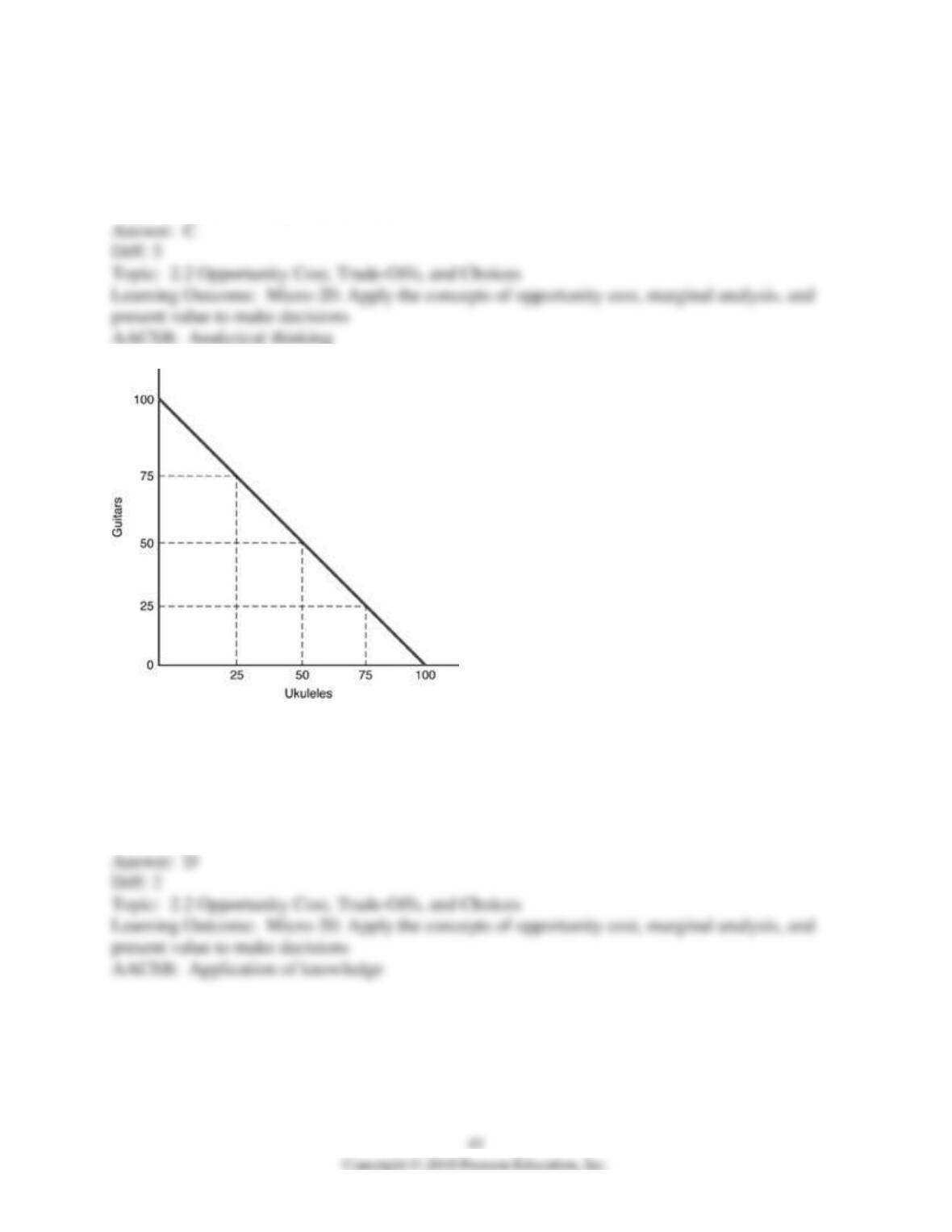
34) Which of the following sets of terms describes the problem of scarcity in economics?
A) goods, land, and needs
B) labor, needs, and opportunity costs
C) choices, opportunity costs, and trade-offs
D) production, consumption, and wants
35) In the above figure, the opportunity cost of moving from producing 75 guitars and 25
ukuleles to producing 50 guitars and 50 ukuleles is
A) 25 ukuleles.
B) 50 guitars.
C) 100 guitars.
D) 25 guitars.
36) In the above figure, the opportunity cost of moving from producing 50 guitars and 50
ukuleles to producing 25 guitars and 75 ukuleles is
A) 25 guitars.
B) 75 ukuleles.
C) 25 ukuleles.
D) 50 guitars.
37) In the above figure, as more ukuleles are produced, the opportunity cost in terms of guitars is
A) decreasing.
B) increasing.
C) constant.
D) zero.
38) In the above figure, moving from producing 50 guitars and 50 ukuleles to producing 25
guitars and 75 ukuleles, the opportunity cost of one ukulele is
A) 25 guitars.
B) 75 ukuleles.
C) 25 ukuleles.
D) 1 guitar.
47
39) In the above figure, the opportunity cost of moving from producing 75 guitars and 25
ukuleles to producing 25 guitars and 75 ukuleles is
A) 25 guitars.
B) 75 ukuleles.
C) 25 ukuleles.
D) 50 guitars.
40) Opportunity cost is illustrated on the production possibilities curve by a
A) bowed-out shape of the curve.
B) shift to the right of the curve.
C) shift to the left of the curve.
D) movement along the curve.
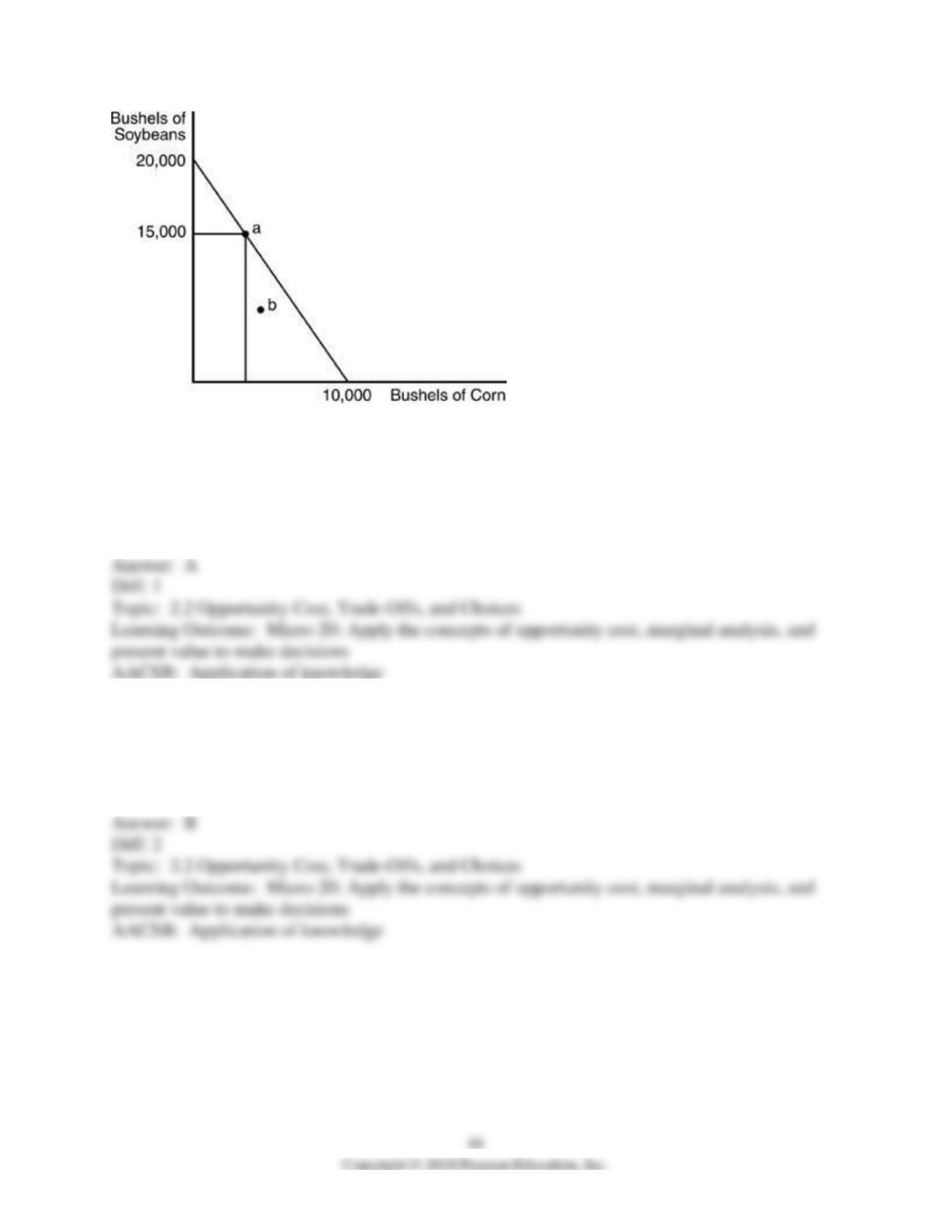
41) A farmer has 100 acres of land on which he can grow soybeans or corn. An acre of land
yields 200 bushels of soybeans or 100 bushels of corn. The above figure refers to the farmer’s
A) production possibilities curve.
B) substitution options curve.
C) demand curve.
D) opportunity cost curve.
42) In the above figure, how many bushels of corn are produced at point “a”?
A) 10,000
B) 2,500
C) 1,000
D) 0
43) In the above figure, what is the opportunity cost of one bushel of soybeans?
A) 1 bushel of corn
B) 0.5 bushels of corn
C) 2 bushels of corn
D) unable to determine
44) In the above figure, what is the opportunity cost of one bushel of corn?
A) 1 bushel of soybeans
B) 0.5 bushel of soybeans
C) 2 bushels of soybeans
D) unable to determine
45) If opportunity costs are constant, then
A) the production possibilities curve does not exist.
B) the production possibilities curve bows outward.
C) the production possibilities curve is a negatively sloped straight line.
D) factors of production must not be fully employed.
46) The production possibilities curve represents the maximum feasible production combinations
resulting from
A) the mix of current resources that utilizes all available inputs using current technology.
B) a fixed amount of demand by consumers.
C) the lack of trade-offs in production.
D) the lack of technology used in production.
47) The production possibilities curve represents
A) the maximum amount of labor and capital available to society.
B) the combinations of goods and services among which consumers are indifferent.
C) the maximum combination of goods and services that can be produced with fixed resources
and technology, given efficient use of the resources.
D) the maximum rate of growth of capital and labor in a country.
48) If all resources were perfectly adaptable for alternative uses, the production possibilities
curve would
A) be bowed out.
B) be a loop.
C) be a straight line.
D) not exist.
49) A straight-line production possibilities curve takes this shape because
A) the opportunity cost of producing a good is constant.
B) the opportunity cost of producing more of a good is decreasing.
C) resources are better suited for producing one output than another.
D) resources are fixed.
The above table shows the daily production possibilities for a bakery.
Currently the bakery bakes 60 pizzas and 180 loaves of bread, that is at alternative C.
50) Using the above table, what is the opportunity cost of moving from alternative C to
alternative D?
A) 60 loaves of bread
B) 2 loaves of bread
C) 30 loaves of bread
D) 1/2 loaf of bread
51) Using the above table, what is the opportunity cost of moving from alternative C to
alternative B?
A) 1/2 a pizza pie
B) 60 pizza pies
C) 90 pizza pies
D) 30 pizza pies
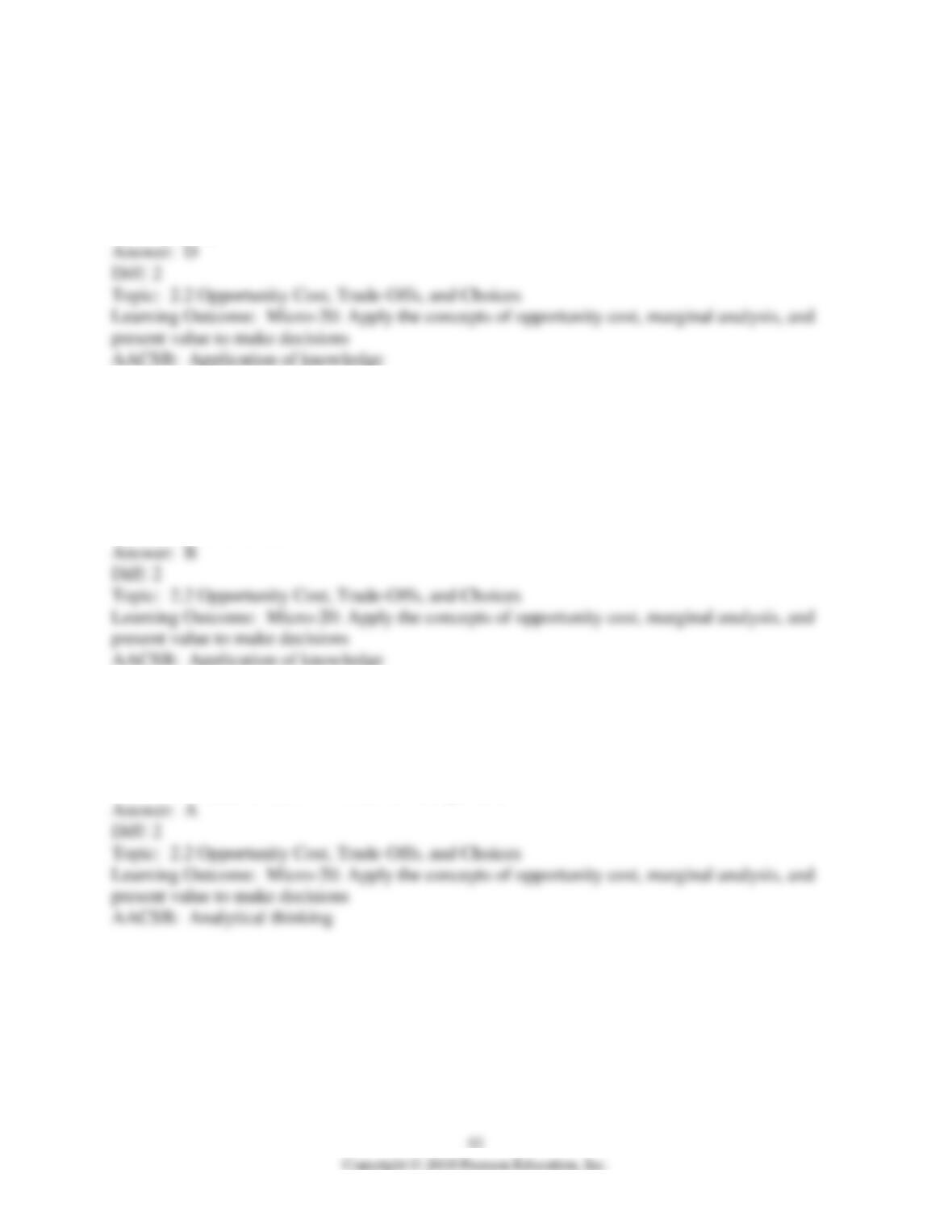
52) Using the above table, moving from alternative C to alternative B, what is the opportunity
cost of one loaf of bread?
A) 1 pizza pie
B) 30 pizza pies
C) 2 pizza pies
D) 0.5 pizza pie
53) Using the above table but now the bakery bakes 30 pizzas and 240 loaves of bread
(alternative B), moving from alternative B to alternative D, what is the opportunity cost of one
pizza pie?
A) 2.5 loaves of bread
B) 2 loaves of bread
C) 0.5 loaf of bread
D) 150 loaves of bread
54) People always face trade-offs because
A) they always have more than one use for their time and money.
B) they can always afford to buy different goods and services.
C) trading takes place in a market economy.
D) they can make themselves better off through trade.
55) Which of the following statements indicates the idea of trade-offs?
A) “There is no such thing as a free lunch.”
B) “The devil made me do it.”
C) “You’ve got me under your spell.”
D) “Always give it the best that you can.”
56) The production possibilities curve represents
A) the total amount of stocks and bonds that exist in the economy.
B) the trade-off between human capital and physical capital that exists.
C) all possible combinations of total output that can be produced.
D) society’s needs.
57) The curve that represents all possible combinations of goods that can be produced is called
A) the production possibilities curve.
B) the resource allocation curve.
C) the efficiency curve.
D) the supply curve.
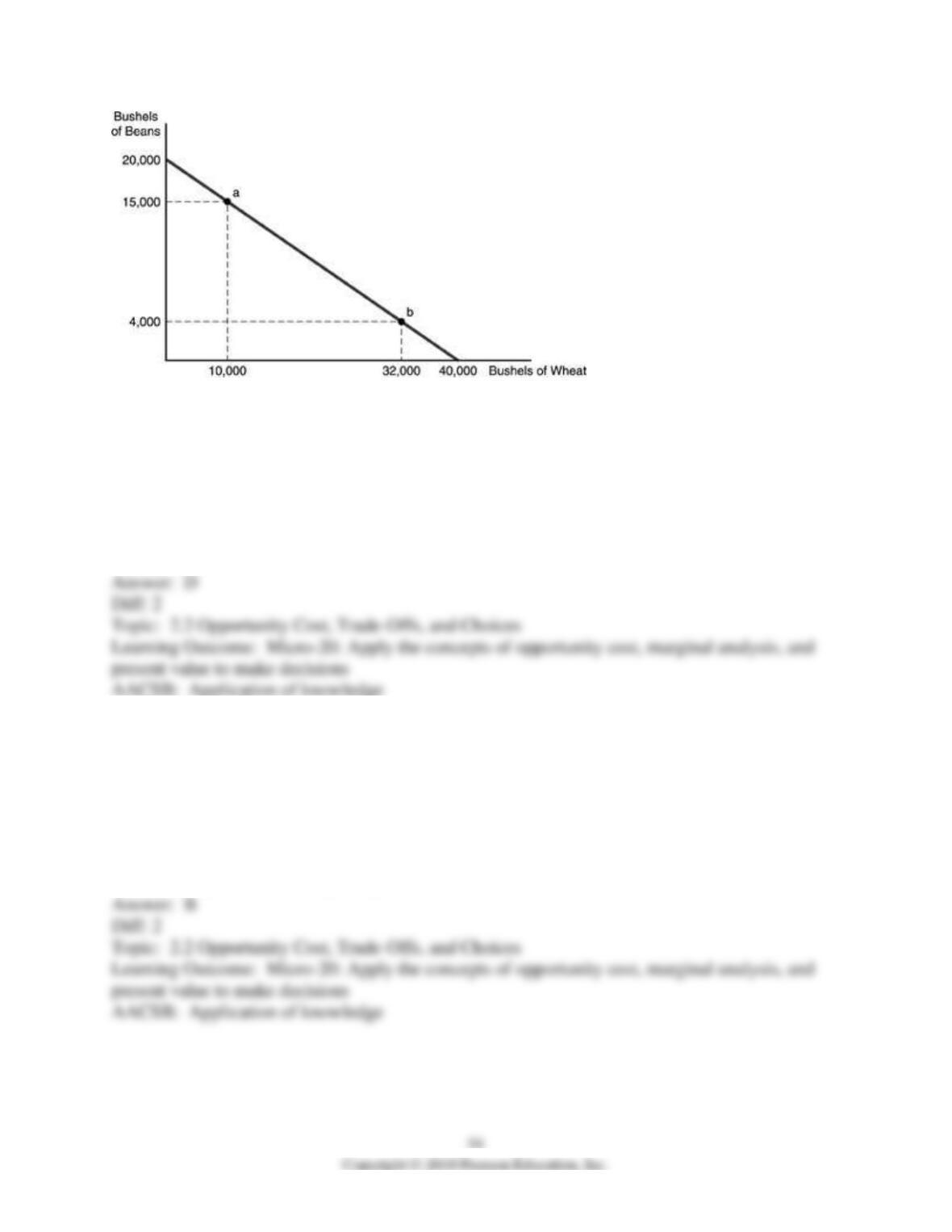
58) Refer to the above figure. A farmer has 50 acres of land on which to grow wheat or beans.
An acre of land yields 400 bushels of beans or 800 bushels of wheat. Which of the following is a
possible combination of beans and wheat that can be grown, assuming the land is farmed
efficiently?
A) 30,000 bushels of each
B) 20,000 bushels of beans and 40,000 bushels of wheat
C) 5,000 bushels of beans and 5,000 bushels of wheat
D) 16,000 bushels of beans and 8,000 bushels of wheat
59) Refer to the above figure. A farmer has 50 acres of land on which to grow wheat or beans.
An acre of land yields 400 bushels of beans or 800 bushels of wheat. Which of the following is a
possible combination of beans and wheat that can be grown, assuming the land is farmed
efficiently?
A) 30,000 bushels of each
B) 15,000 bushels of beans and 10,000 bushels of wheat
C) 25,000 bushels of beans and 25,000 bushels of wheat
D) 20,000 bushels of beans and 40,000 bushels of wheat
60) In the above figure, the farmer faces a trade-off between beans and wheat equal to
A) one-to-one.
B) three-to-one.
C) one-to-two.
D) one-to-four.
61) The above figure is referred to as a(n)
A) supply-demand curve.
B) consumption curve.
C) production possibilities curve.
D) scarcity-shortage curve.
62) Refer to the above figure. If the farmer has 50 acres of land, the farmer is producing at point
a, and an acre of land yields 400 bushels of beans or 800 bushels of wheat, how much land is
devoted to the production of wheat?
A) 8.5 acres
B) 10 acres
C) 12.5 acres
D) 15 acres
63) The production possibilities curve demonstrate which of the following concepts?
A) scarcity
B) choice
C) trade-offs
D) all of the above
64) The production possibilities curve shows all possible combinations of
A) two goods that are desired by society.
B) two goods that can be efficiently produced with a given set of resources.
C) two goods that can be purchased given the prices of the goods.
D) two goods that two countries can trade with each other.
65) A straight-line production possibilities curve has
A) an increasing opportunity cost between the two goods.
B) a decreasing opportunity cost between the two goods.
C) a constant opportunity cost between the two goods.
D) no opportunity cost between the two goods.
66) Which of the following would result in a movement along the production possibilities curve?
A) a fall in the unemployment rate
B) growth in the capital stock
C) population growth
D) a change in the outputs of two goods that a society chooses to produce
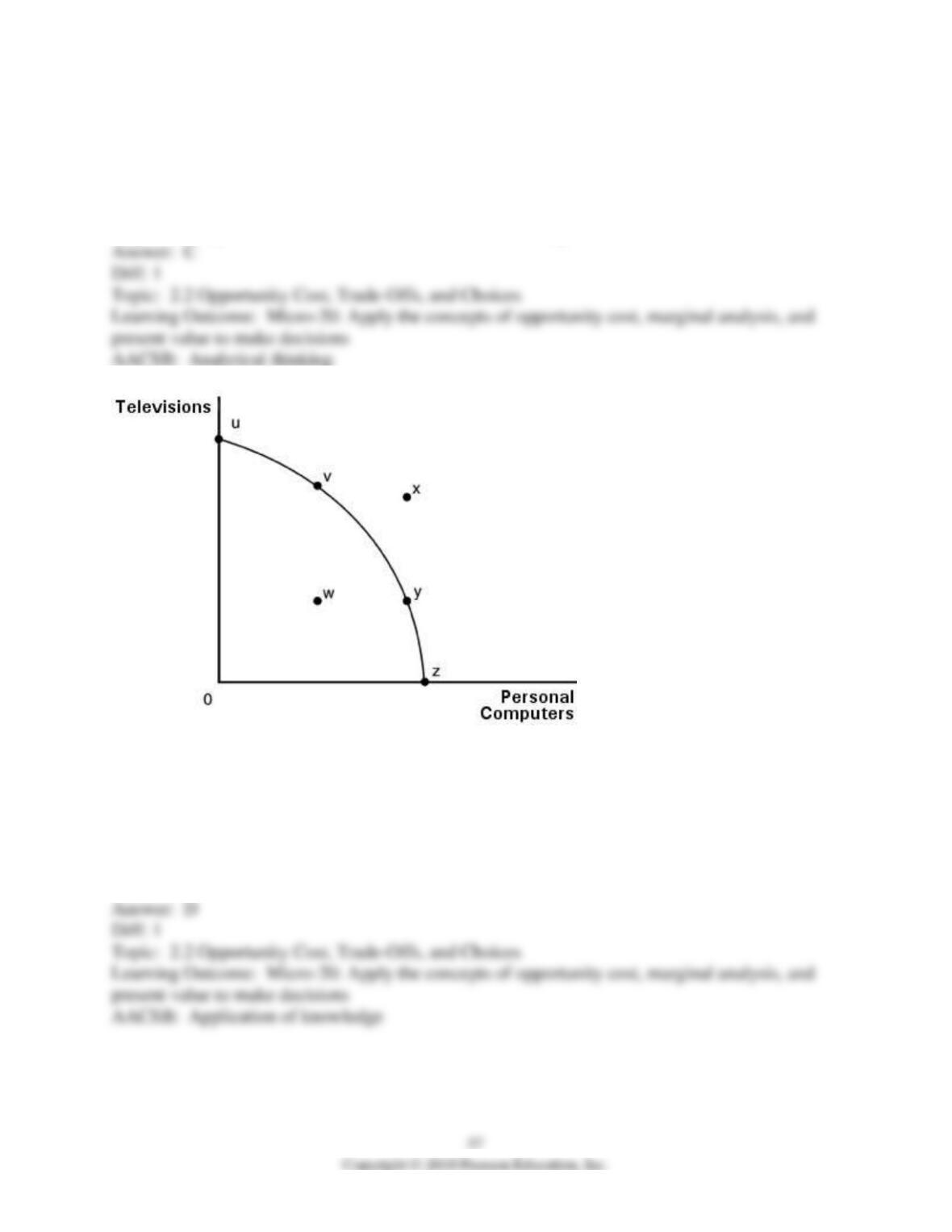
67) A movement along the production possibilities curve would imply that
A) the labor force has grown.
B) productivity has increased.
C) society has chosen a different set of outputs.
D) productivity has declined because workers are demanding more leisure.
68) Which of the following statements about a movement along the production possibilities
curve in the above figure is FALSE?
A) An additional computer can be produced only if fewer televisions are produced.
B) The trade-off between computers and televisions is not constant.
C) Society cannot have more of both goods at the same time.
D) There are no opportunity costs involved in choosing one point on the curve over all other
points.
69) If the production possibilities curve is a downward sloping straight line, then
A) resources are highly specialized, making it difficult to use them for alternative uses.
B) technological change has increased.
C) production is efficient only when producing at the mid-point.
D) all resources must be perfectly adaptable for alternative uses.
70) A graphical representation which shows the trade-off that occurs when more of one output is
obtained at the expense of another is called
A) a scarcity curve.
B) a production possibilities curve.
C) a growth curve.
D) a supply curve.
71) Suppose an acre of land yields 100 bushels of corn and that one bushel of corn provides
enough seed for one-quarter of an acre of land. The opportunity cost of consuming another 100
bushels of corn today is
A) 100 bushels of corn next year.
B) 25 bushels of corn next year.
C) 10 bushels of corn next year.
D) 2.5 bushels of corn next year.
72) Briefly explain why people make choices.
73) Briefly explain the concept of opportunity cost. What is the opportunity cost of attending
college?
74) How are scarcity, choice, and opportunity cost related?
75) Suppose that nuclear power plants are banned. What are examples of the opportunity costs of
this decision?
76) Suppose you order a slice of pepperoni pizza and a soda at a shopping mall food court. What
are examples of the opportunity costs of this decision?
77) It is not uncommon for people to say something like, “If we can put someone on the moon
we should be able to . . . ,” followed by the person’s favorite project. What response can an
economist make to this person?
78) Both an NBA basketball player and a fast-food cook are going to graduate school. Who has a
higher opportunity cost? Explain.