60) Refer to Figure 2-5. If the economy is currently producing at point W, what is the opportunity cost
of moving to point Y?
A) 2 million tons of steel
B) 14 million tons of steel
C) 2 million tons of paper
D) 9 million tons of paper
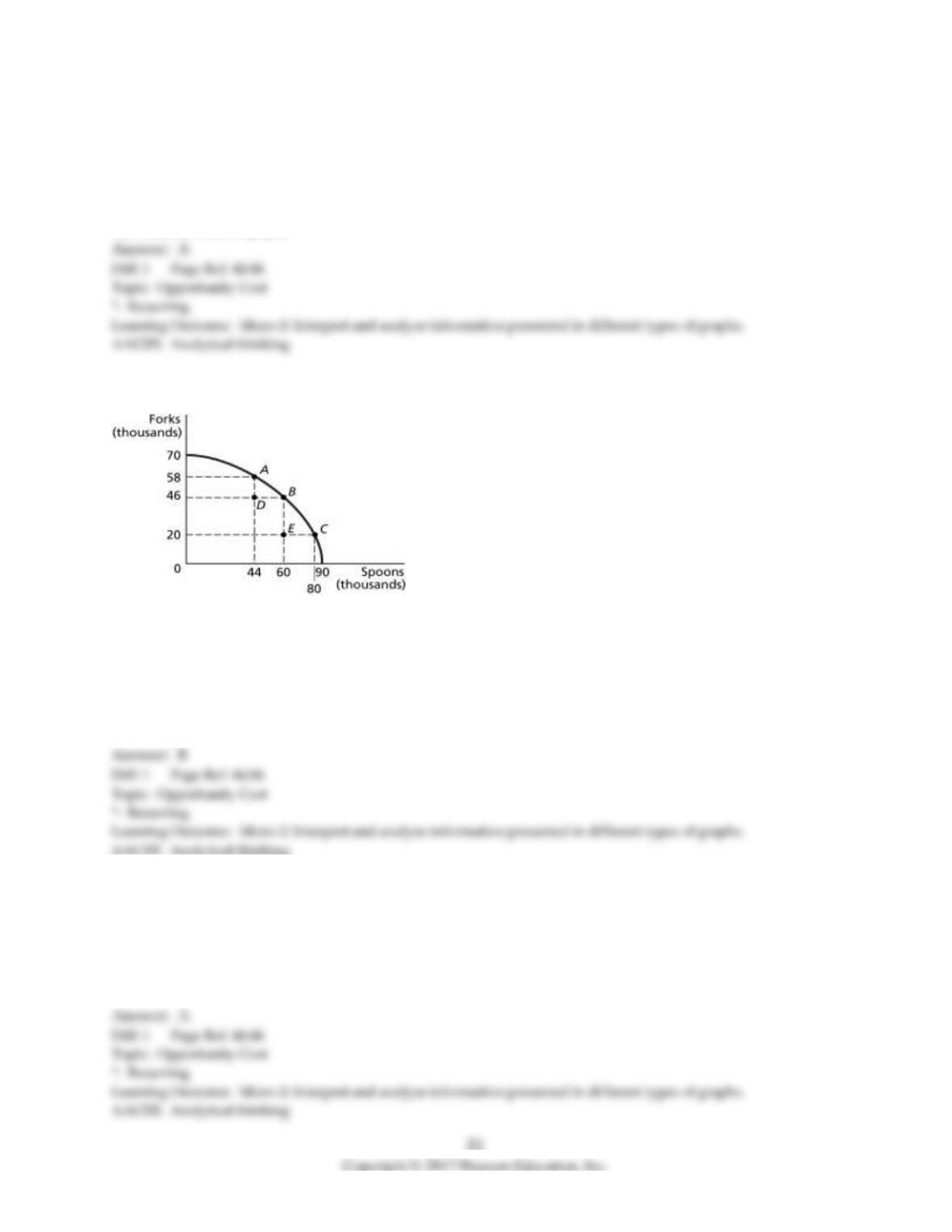
Figure 2-6
61) Refer to Figure 2-6. If the economy is currently producing at point A, what is the opportunity cost of
moving to point B?
A) 16 thousand spoons
B) 12 thousand forks
C) 60 thousand spoons
D) 46 thousand forks
62) Refer to Figure 2-6. If the economy is currently producing at point C, what is the opportunity cost of
moving to point B?
A) 20 thousand spoons
B) 26 thousand forks
C) 40 thousand spoons
D) 46 thousand forks
22
63) Refer to Figure 2-6. If the economy is currently producing at point D, what is the opportunity cost of
moving to point B?
A) 16 thousand spoons
B) 46 thousand forks
C) 60 thousand spoons
D) 0 forks
64) Refer to Figure 2-6. If the economy is currently producing at point E, what is the opportunity cost of
moving to point B?
A) 26 thousand forks
B) 20 thousand forks
C) 60 thousand spoons
D) 0 spoons
65) Refer to Figure 2-6. If the economy is currently producing at point E, what is the opportunity cost of
moving to point D?
A) 26 thousand forks
B) 20 thousand forks
C) 16 thousand spoons
D) 0 spoons
66) A student comments to his roommate that the only way he will be able to pass his final exams is to
not sleep for the next three days. This statement suggests that
A) students are more concerned about good grades than good health.
B) society should value sleep more highly than good grades.
C) there is a trade-off between studying and sleep.
D) society should value good grades more highly than sleep because students can catch up on their
sleep once final exams are over.
67) Suppose your expenses for this term are as follows: tuition: $5,000, room and board: $3,000, books
and other educational supplies: $500. Further, during the term, you can only work part-time and earn
$4,000 instead of your full-time salary of $10,000. What is the opportunity cost of going to college this
term, assuming that your room and board expenses would be the same even if you did not go to
college?
A) $5,500
B) $8,500
C) $11,500
D) $14,500
68) The opportunity cost of taking an on-line history class is
A) the knowledge and enjoyment you receive from taking the class.
B) the value of the time spent on line.
C) equal to the highest value of an alternative use of the time and money spent on the class.
D) zero because there is no classroom time involved if you are enrolled in the course.
E) the cost of tuition and fees only.
69) Horatio can produce either a combination of 15 bird houses and 25 wind chimes or a combination of
30 bird houses and 15 wind chimes. If he now produces 30 bird houses and 15 wind chimes, what is the
opportunity cost of producing an additional 10 wind chimes?
A) 2 bird houses
B) 15 bird houses
C) 30 bird houses
D) 45 bird houses
Table 2-2
Production choices for Nadia’s Neckware
Choice
Quantity of
Ascots
Produced
Quantity of
Bowties
Produced
A
32
0
B
24
6
C
16
12
D
8
18
E
0
24
70) Refer to Table 2-2. Assume Nadia’s Neckware only produces ascots and bowties. A combination of 8
ascots and 18 bowties would appear
A) along Nadia’s production possibilities frontier.
B) inside Nadia’s production possibilities frontier.
C) outside Nadia’s production possibilities frontier.
D) at the horizontal intercept of Nadia’s production possibilities frontier.
71) Refer to Table 2-2. Assume Nadia’s Neckware only produces ascots and bowties. A combination of
16 ascots and 6 bowties would appear
A) along Nadia’s production possibilities frontier.
B) inside Nadia’s production possibilities frontier.
C) outside Nadia’s production possibilities frontier.
D) at the horizontal intercept of Nadia’s production possibilities frontier.
72) Refer to Table 2-2. Assume Nadia’s Neckware only produces ascots and bowties. A combination of
24 ascots and 12 bowties would appear
A) along Nadia’s production possibilities frontier.
B) inside Nadia’s production possibilities frontier.
C) outside Nadia’s production possibilities frontier.
D) at the horizontal intercept of Nadia’s production possibilities frontier.
73) Refer to Table 2-2. Assume Nadia’s Neckties only produces ascots and bowties. Nadia faces
________ opportunity costs in the production of ascots and bowties.
A) increasing
B) decreasing
C) constant
D) negative
74) An inward shift of the production possibilities frontier represents
A) positive economic growth.
B) negative economic growth.
C) a rise in the unemployment rate.
D) technological improvement.
26
75) Which of the following would shift a nation’s production possibilities frontier outward?
A) discovering a more efficient process to desalinate water
B) an increase in the minimum wage
C) a decrease in the unemployment rate
D) more restrictive immigration policies
76) Suppose your expenses for this term are as follows: tuition: $9,000, room and board: $1,500, books
and other educational supplies: $1,000. Further, during the term, you can only work part-time and earn
$3,000 instead of your full-time salary of $8,000. What is the opportunity cost of going to college this
term, assuming that your room and board expenses would be the same even if you did not go to
college?
A) $10,000
B) $13,000
C) $15,000
D) $18,000
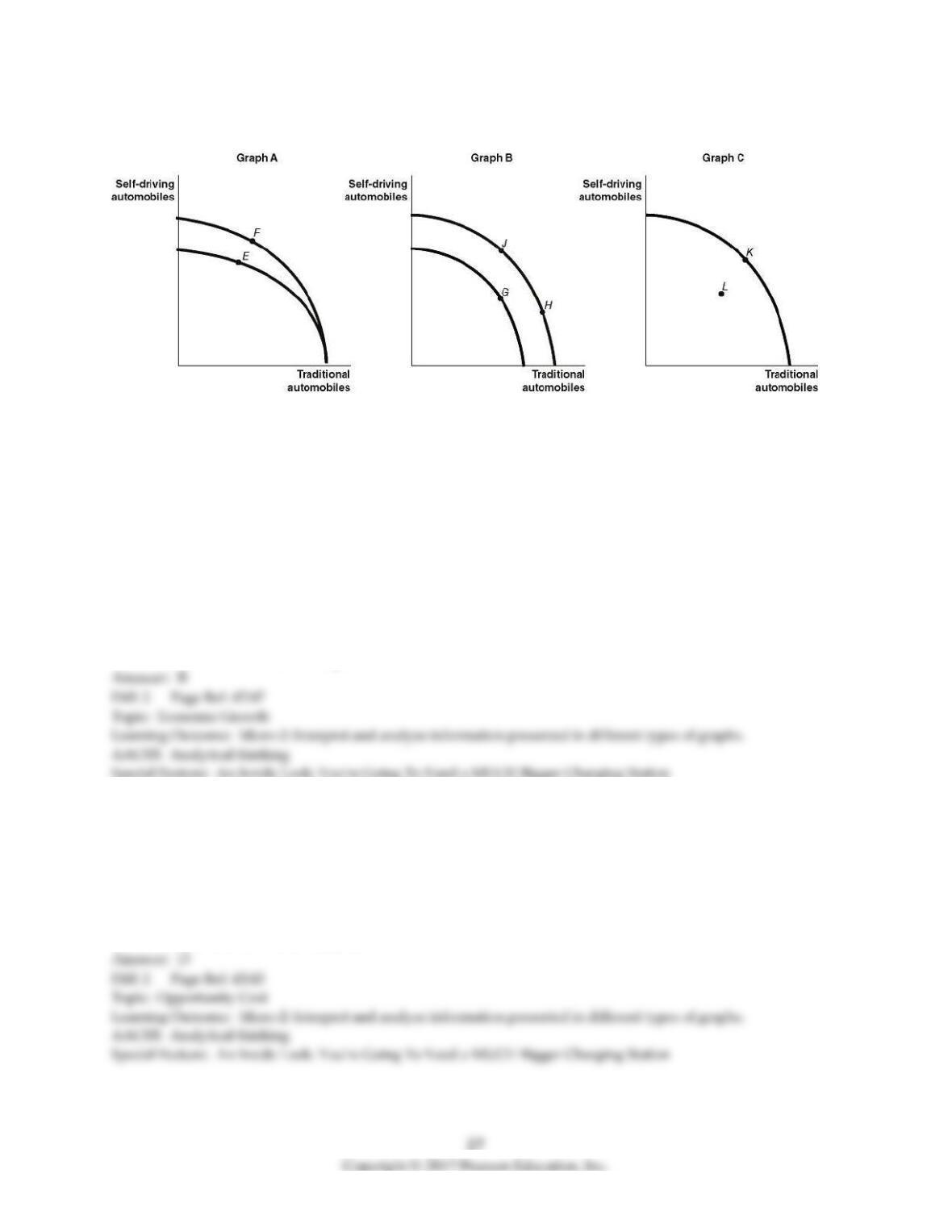
Figure 2-7
Apple recently announced that the company is exploring the electric vehicle market, and is looking to
produce vehicles as early as 2020. Assume Apple chooses to produce both traditional electric-engine
vehicles and self-driving electric-engine vehicles. Figure 2-7 shows changes to its production
possibilities frontier in response to new developments and different strategic production decisions.
77) Refer to Figure 2-7. Suppose worker productivity increases so that the total number of vehicles
produced increases as the company adds more machinery, workers, and changes the layout of the
factory. This is best represented by the
A) movement from E to F in Graph A.
B) movement from G to H in Graph B.
C) movement from K to L in Graph C.
D) movement from H to J in Graph B.
78) Refer to Figure 2-7. Assume that in response to changing consumer demands, Apple cuts back on
the production of self-driving automobiles and increases its production of traditional automobiles. This
strategy is best represented by the
A) movement from F to E in Graph A.
B) movement from G to J in Graph B.
C) movement from K to L in Graph C.
D) movement from J to H in Graph B.
79) An increase in the unemployment rate may be represented as a movement from a point on the
production possibilities frontier to a point inside the frontier.
80) If a country is producing efficiently and is on the production possibilities frontier, the only way to
produce more of one good is with an advance in technology.
81) Consider a country that produces only two goods: pineapples and tractors. Suppose it is possible for
this country to increase its production of pineapples without producing fewer tractors. In this case, its
current output combination is inefficient.
82) Any output combination inside a production possibilities frontier is associated with unused or
underutilized resources.
83) An increase in population shifts the production possibilities frontier inwards over time.
84) If additional units of a good could be produced at a constant opportunity cost, the production
possibilities frontier would be linear.
85) On a diagram of a production possibilities frontier, opportunity cost is represented by the slope of
the production possibilities frontier.
86) To increase gas mileage, automobile manufacturers make cars small and light. Large cars absorb
more of the impact of an accident than small cars but yield lower gas mileage. These facts suggest that a
positive relationship exists between safety and gas mileage.
87) A decrease in the unemployment rate may be represented as a movement from a point inside the
production possibilities frontier to a point on the frontier.
88) If a country is producing efficiently and is on the production possibilities frontier, producing more
of one good would result in a movement along the frontier.
89) Consider a country that produces only two goods: bird feeders and binoculars. Suppose it is
possible for this country to increase its production of bird feeders without producing fewer binoculars.
In this case, its current output combination is inefficient.
90) Any output combination along a production possibility frontier is associated with overused or
unattainable resources.
91) A decrease in the labor force shifts the production possibilities frontier inwards over time.
92) If additional units of a good are produced at an increasing opportunity cost, the production
possibilities frontier would be bowed outward (concave).
93) On a diagram of a production possibilities frontier, economic decline (negative growth) is
represented by the production possibilities frontier shifting inward.
94) What causes a production possibilities frontier to shift outward?
95) What causes a production possibilities frontier to shift inward?
96) How are efficiency and inefficiency represented on a production possibilities frontier?
97) What does the term “increasing marginal opportunity cost” mean? How are increasing marginal
opportunity costs represented on a bowed out production possibilities frontier?
32
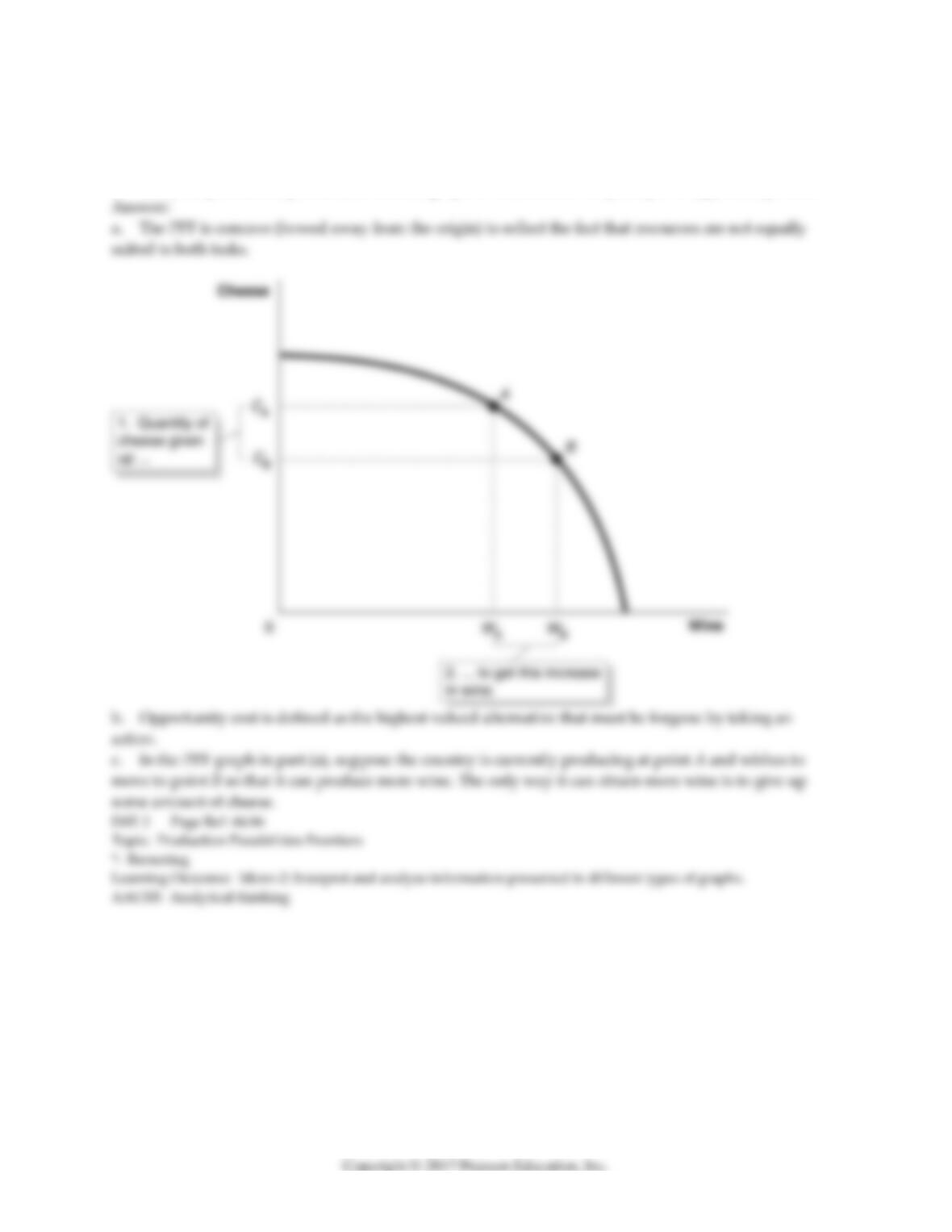
98) a. Draw a production possibilities frontier for a country that produces two goods, wine and
cheese. Assume that resources are not equally suited to both tasks.
b. Define opportunity costs.
c. Use your production possibilities frontier graph to demonstrate the principle of opportunity costs.

33
Table 2-3
Possible Output
Combinations
Cashews
(thousands of
pounds)
Almonds
(thousands of
pounds)
A
35
0
B
30
20
C
25
35
D
20
47
E
15
57
F
10
64
G
5
68
H
0
70
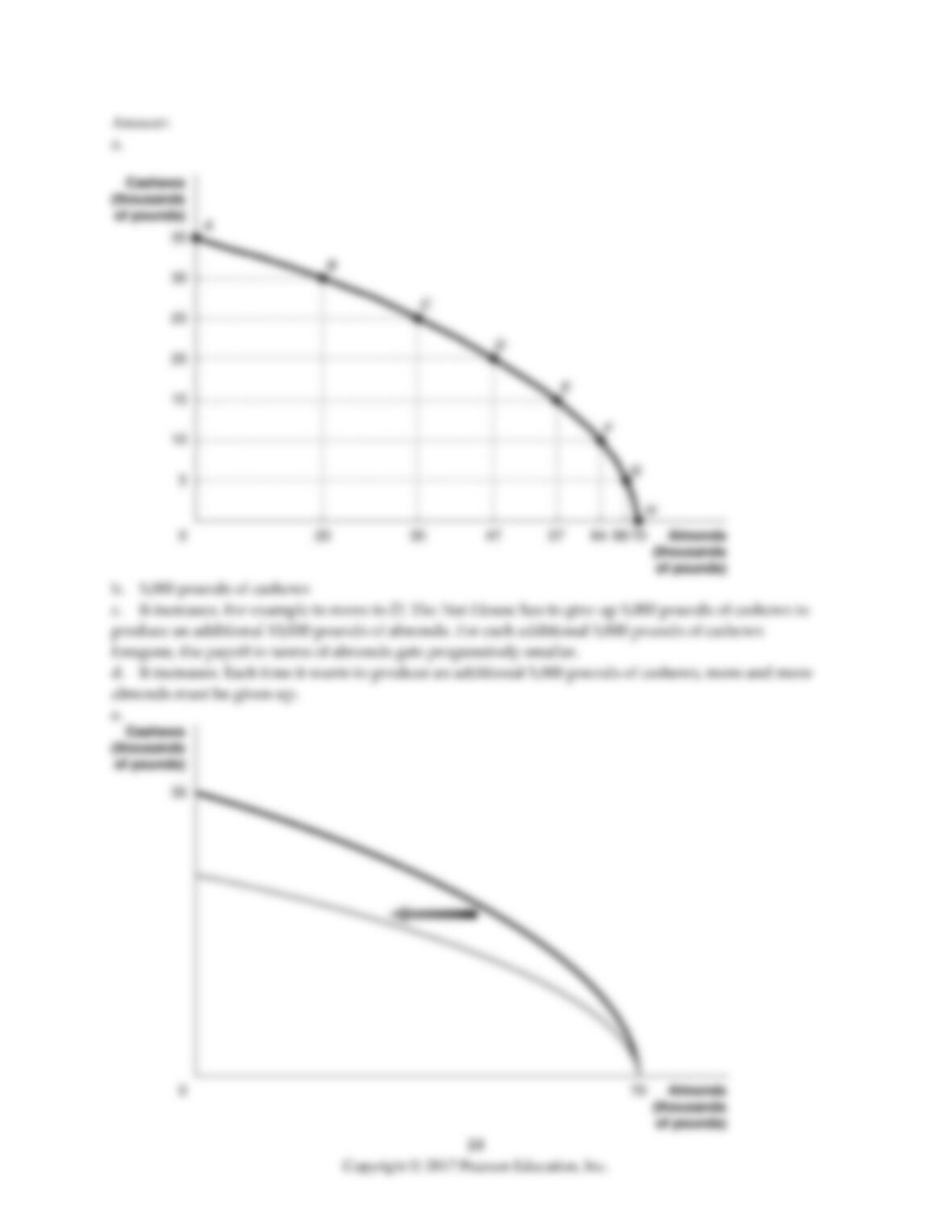
99) Refer to Table 2-3. The Nut House produces only cashews and almonds. The table above shows the
maximum possible output combinations of the two nuts using all resources and currently available
technology.
a. Graph The Nut House’s production possibilities frontier. Put almonds on the horizontal axis and
cashews on the vertical axis. Be sure to identify the output combination points on your diagram.
b. Suppose The Nut House is currently producing at point C. What is the opportunity cost of
producing an additional 12,000 pounds of almonds?
c. Suppose The Nut House is currently producing at point C. What happens to the opportunity cost of
producing more and more almonds? Does it increase, decrease or remain constant? Explain your
answer.
d. Suppose The Nut House is currently producing at point F. What happens to the opportunity cost of
producing more and more cashews? Does it increase, decrease or remain constant? Explain your
answer.
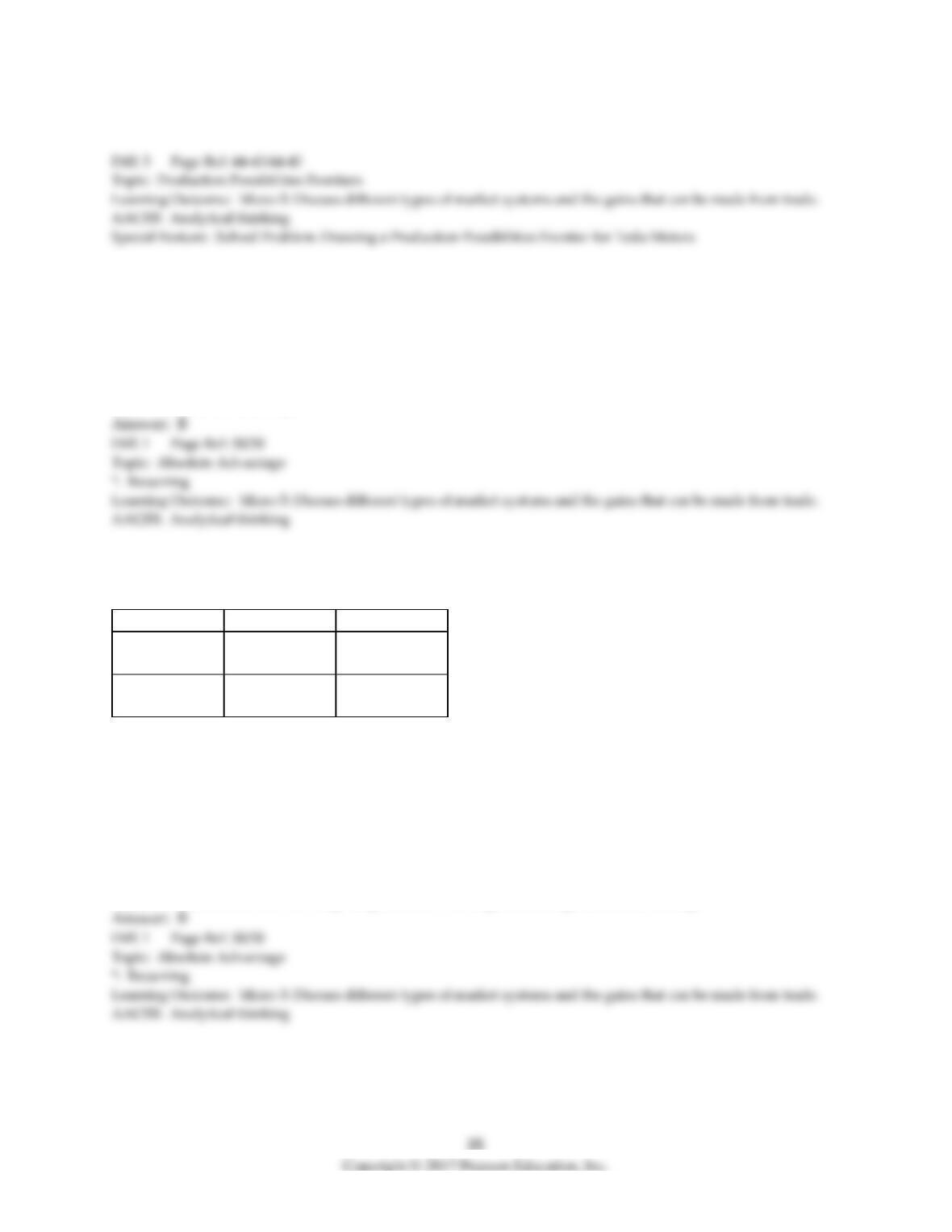
e. Suppose The Nut House is plagued by a variety of white root-rot disease, which destroys cashew
trees but not almond trees. Show in a graph what happens to its PPF.
2.2 Comparative Advantage and Trade
1) If you can produce more of something than others with the same resources, you have
A) a comparative advantage.
B) an absolute advantage.
C) an efficient production system.
D) a free-market economy.
Table 2-4
George
Jack
Lawns
Mowed
10
6
Gardens
Cultivated
5
4
Table 2-4 shows the output per day of two gardeners, George and Jack. They can either devote their
time to mowing lawns or cultivating gardens.
2) Refer to Table 2-4. Which of the following statements is true?
A) Jack has an absolute advantage in both tasks.
B) George has an absolute advantage in both tasks.
C) Jack has an absolute advantage in lawn mowing and George in garden cultivating.
D) Jack has an absolute advantage in garden cultivating and George in lawn mowing.
3) Refer to Table 2-4. What is Jack’s opportunity cost of mowing a lawn?
A) one-half of a garden cultivated
B) two lawns mowed
C) two-thirds of a garden cultivated
D) one and a half lawns mowed
4) Refer to Table 2-4. What is Jack’s opportunity cost of cultivating a garden?
A) one-half of a garden cultivated
B) two lawns mowed
C) two-thirds of a garden cultivated.
D) one and a half lawns mowed
5) Refer to Table 2-4. What is George’s opportunity cost of mowing a lawn?
A) one-half of a garden cultivated
B) two lawns mowed
C) two-thirds of a garden cultivated.
D) one and a half lawns mowed
6) Refer to Table 2-4. What is George’s opportunity cost of cultivating a garden?
A) one-half of a garden cultivated
B) two lawns mowed
C) two-thirds of a garden cultivated
D) one and a half lawns mowed
7) Refer to Table 2-4. Which of the following statements is true?
A) Jack has a comparative advantage in both tasks.
B) George has a comparative advantage in both tasks.
C) Jack has a comparative advantage in lawn mowing and George in garden cultivating.
D) Jack has a comparative advantage in garden cultivating and George in lawn mowing.
8) Comparative advantage means
A) the ability to produce more of a product with the same amount of resources than any other producer.
B) the ability to produce a good or service at a lower opportunity cost than any other producer.
C) the ability to produce a good or service at a higher opportunity cost than any other producer.
D) compared to others you are better at producing a product.
9) Specializing in the production of a good or service in which one has a comparative advantage enables
a country to do which of the following?
A) never have to engage in trade with other nations
B) increase the variety of products that it can produce with a decrease in resources
C) consume a combination of goods that lies outside its own production possibilities frontier
D) produce a combination of goods that lies outside its own production possibilities frontier
10) For each watch that Switzerland produces, it gives up the opportunity to make 50 pounds of
chocolate. Germany can produce 1 watch for every 100 pounds of chocolate it produces. Which of the
following is true about the comparative advantage between the two countries?
A) Switzerland has the comparative advantage in chocolate.
B) Switzerland has the comparative advantage in watches.
C) Germany has the comparative advantage in watches and chocolate.
D) Germany has the comparative advantage in watches.
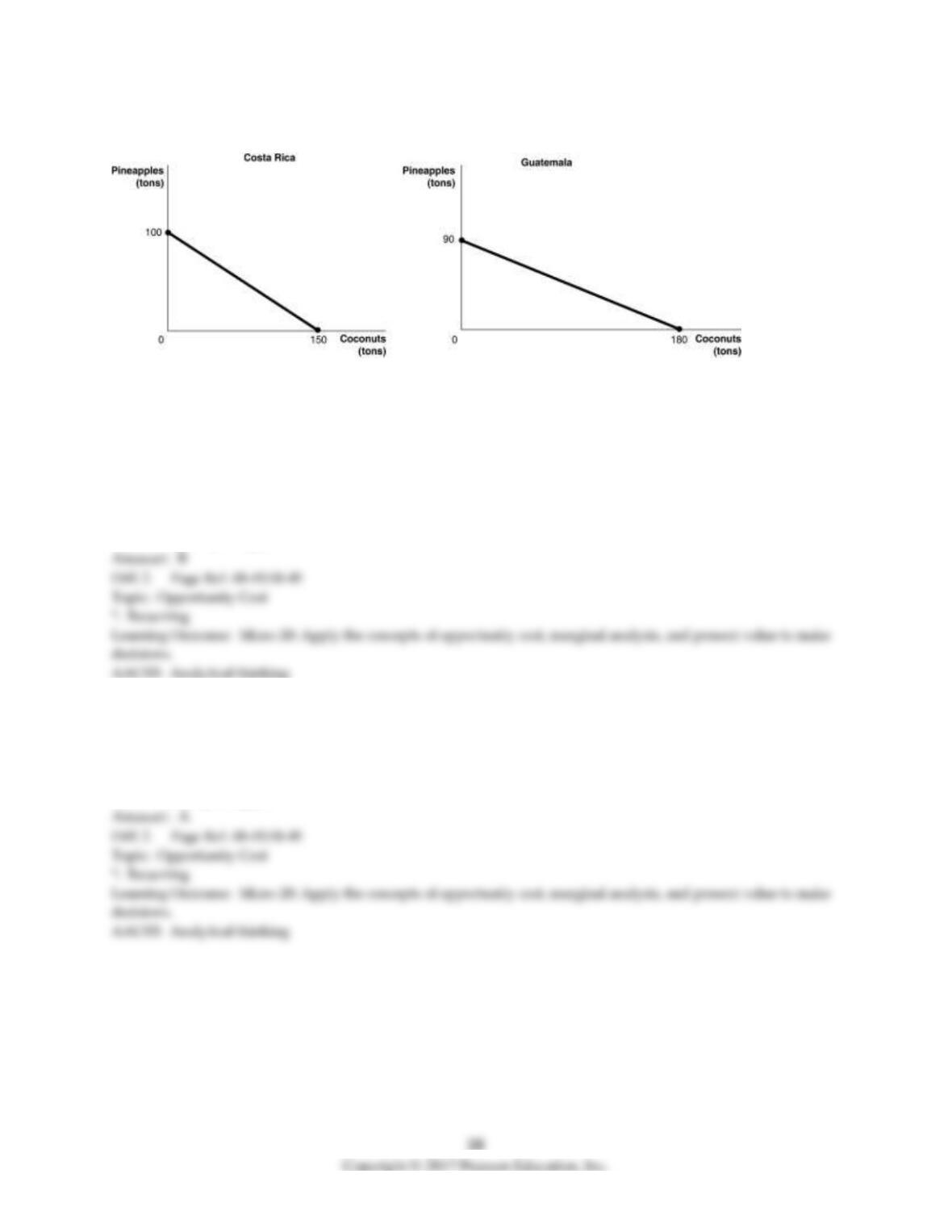
Figure 2-8
Figure 2-8 shows the production possibilities frontiers for Costa Rica and Guatemala. Each country
produces two goods, pineapples and coconuts.
11) Refer to Figure 2-8. What is the opportunity cost of producing 1 ton of coconuts in Costa Rica?
A) 3/8 of a ton of pineapples
B) 2/3 of a ton of pineapples
C) 1 1/2 tons of pineapples
D) 100 tons of pineapples
12) Refer to Figure 2-8. What is the opportunity cost of producing 1 ton of coconuts in Guatemala?
A) 1/2 of a ton of pineapples
B) 1 1/3 tons of pineapples
C) 2 tons of pineapples
D) 90 tons of pineapples
13) Refer to Figure 2-8. What is the opportunity cost of producing 1 ton of pineapples in Costa Rica?
A) 3/8 of a ton of coconuts
B) 2/3 of a ton of coconuts
C) 1 1/2 tons of coconuts
D) 100 tons of coconuts
14) Refer to Figure 2-8. What is the opportunity cost of producing 1 ton of pineapples in Guatemala?
A) 1/2 of a ton of coconuts
B) 1 1/3 tons of coconuts
C) 2 tons of coconuts
D) 180 tons of coconuts
15) Refer to Figure 2-8. Which country has a comparative advantage in the production of coconuts?
A) Guatemala
B) They have equal productive abilities.
C) Costa Rica
D) neither country
16) Refer to Figure 2-8. Which country has a comparative advantage in the production of pineapples?
A) Guatemala
B) They have equal productive abilities.
C) Costa Rica
D) neither country
17) Refer to Figure 2-8. If the two countries have the same amount of resources and the same
technological knowledge, which country has an absolute advantage in the production of both
pineapples and coconuts?
A) Guatemala
B) neither country
C) Costa Rica
D) cannot be determined
18) Individuals who have never been the best at doing anything
A) cannot have a comparative advantage in producing any product.
B) can still have a comparative advantage in producing some product.
C) perform all tasks at a higher opportunity cost than others.
D) must have an absolute advantage in at least ones task.
Table 2-5
One Cell Phone
Lumber (per board
foot)
Estonia
40 hours
8 hours
Finland
16 hours
4 hours
Table 2-5 shows the number of labor hours required to produce a cell phone and a board foot of lumber
in Estonia and Finland.
19) Refer to Table 2-5. Does either Estonia or Finland have an absolute advantage and if so, in what
product?
A) Finland has an absolute advantage in lumber.
B) Estonia has an absolute advantage in lumber.
C) Finland has an absolute advantage in both products.
D) Estonia has an absolute advantage in cell phones.