6) Based on the table “Real and Nominal GDP,” if year three is the base year, then the real GDP
in year two is ________.
A) 8250
B) 5900
C) 7500
D) 6775
E) none of the above
7) Variables measured at current market prices are nominal, rather than real. In what sense are
nominal variables unreal?
2.6 Measuring Inflation
1) The most frequently reported price index is ________.
A) the consumer price index (CPI)
B) the gross domestic product (GDP) deflator
C) the personal consumption expenditure (PCE) deflator
D) chain weighted GDP
E) the interest income deflator
2) Nominal GDP =________ where the price level is the ________.
A) Price level ÷ Real GDP; GDP deflator
B) Price level × Real GDP; CPI
C) Price level ÷ Real GDP; CPI
D) Price level × Real GDP; GDP deflator
E) none of the above
3) Real GDP =________ where the price level is the ________.
A) Nominal GDP × Price level; GDP deflator
B) Nominal GDP ÷ Price level; GDP deflator
C) Nominal GDP ÷ Price level; CPI
D) Nominal GDP × Price level; CPI
E) none of the above
4) Examples of deflators are the ________ and ________ deflator
A) real; nominal
B) private disposable income; gross national product
C) personal consumption expenditure; gross domestic product
D) gross domestic product; rental income
E) private disposable income; personal consumption expenditure
5) Examples of deflators are the ________ and ________ deflator
A) real; nominal
B) private disposable income; gross national product
C) personal consumption expenditure; rental income
D) gross domestic product; private disposable income
E) none of the above
6) The Bureau of Labor Statistics (BLS) reports the CPI ________.
A) every month
B) every two months
C) every three months
D) every year
E) twice each month
7) The Bureau of Economic Analysis calculates the PCE deflator ________.
A) every month
B) every two months
C) every three months
D) every year
E) twice each month
8) To compute the CPI, the Bureau of Labor Statistics (BLS) compiles a “basket of goods” that
________; each price in the index is weighted by ________.
A) are produced in the United States; an expenditure survey
B) the average farmer produces; how long it takes for the particular good to reach the market
C) the average urban consumer buys; the quantity of the good that goes into the basket
D) only members of congress purchase; a “luxury” score
E) is typical of consumers below the poverty line; the perceived quality of the good
9) Computing the CPI is important because it provides ________.
A) a rough measure of the cost of living
B) it is used as a benchmark in labor negotiations
C) government uses it to index entitlements, such as social security benefits, so that beneficiaries
do not lose purchasing power in periods of inflation
D) all of the above
E) none of the above
10) Computing the CPI is important because ________.
A) it is a very accurate and error-free measure of the cost of living
B) it helps predict spending patterns for particular goods and services
C) government uses it to index entitlements, such as social security benefits, so that beneficiaries
do not lose purchasing power in periods of inflation
D) all of the above
E) none of the above
11) In 1995, the Boskin commission identified which of the following problems with the
computation of the CPI?
A) it does not account for the fact that consumers can substitute away from products as they get
more expensive
B) an increase in price could be the result of quality improvements rather than an increase in the
cost of living
C) it often does not reflect decreases in the cost of living that occur when new goods are
introduced
D) all of the above
E) none of the above
12) The inflation rate = ________.
A) nominal GDP – real GDP
B) growth rate in real GDP – growth rate in nominal GDP
C) growth rate in real GDP + growth rate in nominal GDP
D) nominal GDP ÷ real GDP
E) none of the above
13) The inflation rate can be obtained by ________.
A) dividing the nominal GDP by the GDP deflator
B) subtracting the real GDP from the nominal GDP
C) multiplying the CPI by GDP
D) subtracting the growth in real GDP from the growth in nominal GDP
E) none of the above
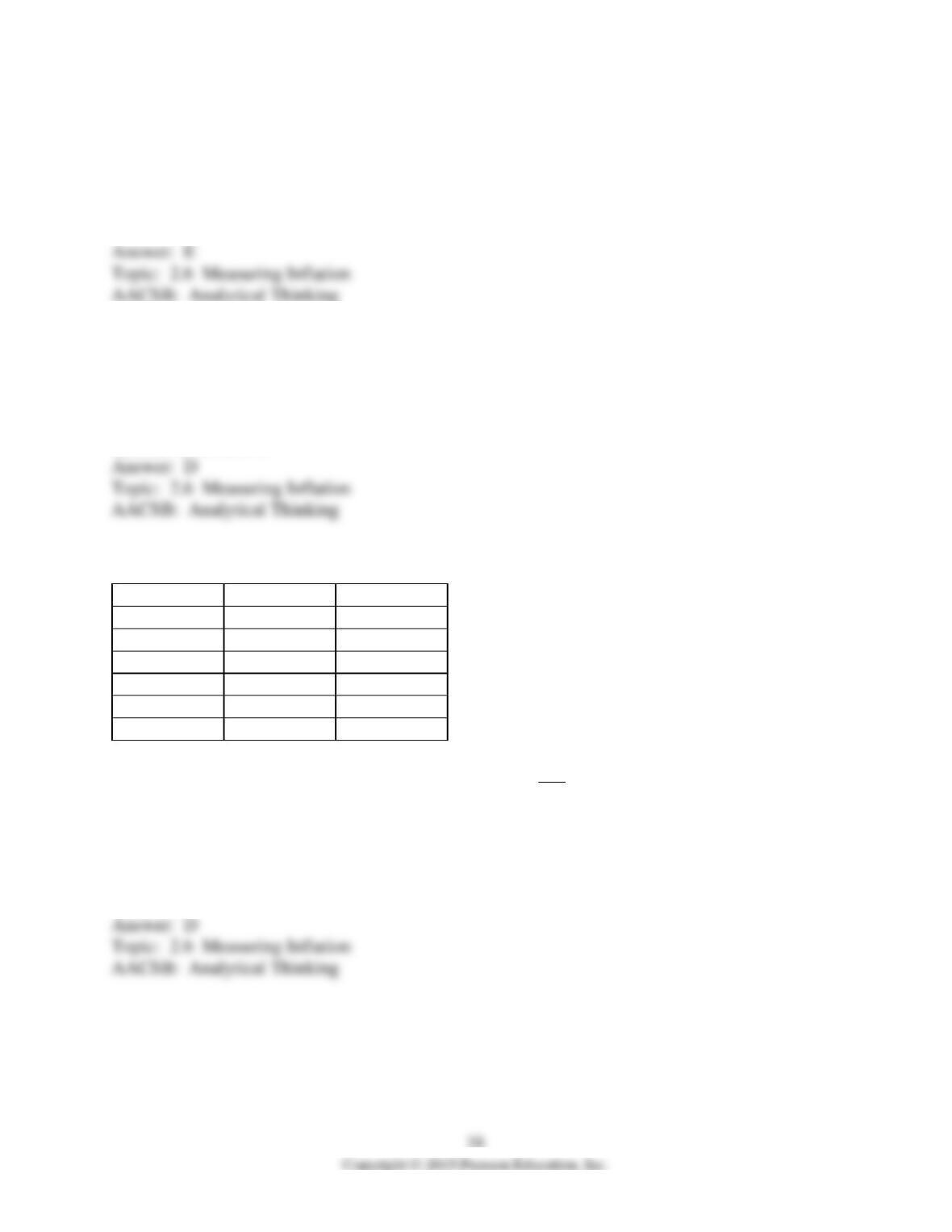
Real and Nominal GDP
video games
energy drinks
year 1 price
40
2
year 1 output
100
500
year 2 price
40
2.5
year 2 output
120
550
year 3 price
45
2.5
year 3 output
150
600
14) Based on the table “Real and Nominal GDP,” if year one is the base year, then the GDP
deflator for year two is ________.
A) 95.5
B) 123.5
C) 118
D) 104.7
E) 116.6
15) Based on the table “Real and Nominal GDP,” if year one is the base year, then the GDP
deflator for year three is ________.
A) 165
B) 139.8
C) 85.8
D) 133.6
E) 114.6
16) Based on the table “Real and Nominal GDP,” if year one is the base year, then the inflation
rate in year three is ________.
A) 14.6%
B) 9.5%
C) 9.9%
D) 11.5%
E) 16.5%
17) In relatively poor economies, modest expenditures on public health (immunization of
children) can produce large improvements. What does this imply about the accuracy of the
growth rate of real GDP as a measure of national well-being? How is the situation different in
rich economies?
2.7 Measuring Unemployment
1) Which of these represents an example of citizens who would not typically be counted as
unemployed?
A) when your economics professor loses his job and gets a new one at McDonald’s
B) when your fourteen-year-old cousin loses her summer job in September
C) when your neighbor has been out of work for so long that he decides to stay at home and
write a novel
D) all of the above
E) none of the above
Figure 2.5 Unemployment in the adult civilian population, 2013
2) According to Figure 2.5, the United States civilian labor force in June 2013 was ________.
A) 157.1 million
B) 144.8 million
C) 245.6 million
D) 100.8 million
E) none of the above
3) According to Figure 2.5, the United States civilian unemployment rate in June 2013 was
________.
A) 5.0%
B) 22.1%
C) 7.8%
D) 8.5%
E) none of the above
4) According to Figure 2.5, the United States civilian labor force participation rate in June 2013
was ________.
A) 59%
B) 43.8%
C) 66.7%
D) 64.0%
E) none of the above
5) According to Figure 2.5, the United States civilian employment ratio in June 2013 was
________.
A) 66.7%
B) 43.8%
C) 59%
D) 64.0%
E) none of the above
6) A discouraged worker might ________.
A) be counted as unemployed
B) have tried to find a job during the month prior to the household survey, but without success
C) have been prevented from working during the week prior to the household survey, due to
illness or other temporary circumstances
D) be waiting to return to a job from which he or she has been laid off
E) none of the above
7) If a large number of people were to leave their civilian jobs and join the military, which of the
following would increase?
A) the civilian labor force
B) the civilian employment ratio
C) the civilian unemployment rate
D) the civilian labor-force participation rate
E) none of the above
8) The unemployment rate is computed by ________.
A) dividing labor force by the adult population
B) dividing the number of unemployed by the adult population
C) multiplying the employment ratio by the adult population
D) dividing the labor force by the number of unemployed
E) none of the above
9) The unemployment rate that is typically reported in the media is ________.
A) based on a survey from 150,000 business establishments on weekly earnings, number of
workers and hours worked
B) computed every three months
C) based on a survey of 60,000 households
D) reported by the Treasury Department
E) none of the above
10) The unemployment rate that is typically reported in the media is ________.
A) based on a survey from 150,000 business establishments on weekly earnings, number of
workers and hours worked
B) reported on a monthly basis by the Bureau of Labor Statistics (BLS)
C) based on a survey of 150,000 households
D) reported by the Federal Reserve
E) none of the above
11) The household and establishment surveys sometimes differ on the labor market conditions.
This is probably because ________.
A) the establishment survey counts a worker who holds two jobs twice and the household survey
does not
B) the establishment survey only counts employees of a company and the household survey also
counts the self employed
C) the establishment survey covers more workers than the household survey
D) all of the above
E) none of the above
12) The household and establishment surveys sometimes differ on the labor market conditions.
This is probably because ________.
A) the household survey counts a worker who holds two jobs twice and the establishment survey
does not
B) the household survey only counts employees of a company and the establishment survey also
counts the self employed
C) the household survey covers more workers than the establishment survey
D) all of the above
E) none of the above
13) Assume that a high proportion of recent college graduates decides to stay in school seeking
advanced degrees, rather than confront the challenge of landing a good job in the midst of
generally high unemployment. What is the direct impact of this behavior on (a) the labor force
participation rate, (b) the employment ratio, and (c) the unemployment rate?
2.8 Measuring Interest Rates
1) There are different interest rates associated with many types of securities. Which of the
following statements is correct?
A) they vary depending on the liquidity of the security
B) they vary depending on the risk associated with the security
C) except in very unusual times, most interest rates move together
D) all of the above
E) none of the above
2) The Federal Funds Rate is ________.
A) the rate charged on overnight loans between banks
B) the rate charged on corporate bank loans to healthy “prime” borrowers
C) the rate charged on U.S. Treasury bonds by the Federal Reserve
D) the rate charged on U.S securities with maturities of less than a year
E) none of the above
22
3) The nominal interest rate ________.
A) makes no allowance for inflation
B) is a percentage of the amount borrowed
C) is the rate that most banks advertise
D) all of the above
E) none of the above
4) Which of the following is a good indicator of short-term interest rates in international
markets?
A) prime rate
B) Treasury bill rate
C) LIBOR
D) Federal funds rate
E) none of the above
5) The real interest rate differs from the nominal rate in that ________.
A) it more accurately represents the true cost of borrowing
B) it varies negatively with changes in the rate of inflation
C) it is the better indicator of credit market conditions
D) all of the above
E) none of the above
6) The Fisher equation implies ________.
A) the nominal interest rate equals the real rate of inflation plus expected inflation
B) the real interest rate equals expected inflation
C) expected inflation equals current inflation
D) the rate of inflation equals the real minus the nominal rates of interest
E) none of the above
7) The Fisher equation implies that an increase in the nominal rate of interest relative to the real
rate indicates that ________.
A) inflation is expected to rise
B) inflation is expected to decrease
C) the real cost of borrowing has increased
D) the real cost of borrowing has decreased
E) none of the above
8) An increase in the expected rate of inflation is most likely to cause an increase in ________.
A) the ex post real interest rate
B) the ex ante real interest rate
C) the nominal interest rate
D) the expected real interest rate
E) none of the above
9) An increase in the actual rate of inflation is most likely to cause a decrease in ________.
A) the ex post real interest rate
B) the ex ante real interest rate
C) the nominal interest rate
D) the expected real interest rate
E) none of the above
10) In the 1970s, nominal interest rates in the United States were quite high, while real rates
were extremely low. Which group “wins” in this circumstance, lenders or borrowers? What
might explain the willingness of the “losers” to accept disadvantageous loan terms?
24
11) A small business owner has a line of credit from a bank with a nominal interest rate of seven
percent. For several years, the price level has been rising at an annual rate of two percent, but the
owner has just read in the newspaper that economists expect next year’s inflation rate to be four
percent or more. Assume that this owner may either continue the line of credit at seven percent,
or renegotiate to alter both the size of the credit and the interest rate. What reason might there be
for the owner to keep the credit terms as is? What argument might justify changing the credit
agreement?