2) If a country operates on its PPF, it achieves production efficiency.
3) Moving downward along a PPF, the opportunity cost of another unit of the good measured
along the horizontal axis decreases.
4) We have achieved production efficiency if we can produce more of one good without
producing less of some other good.
5) Each point on the production possibilities frontier achieves allocative efficiency.
6) We are using resources efficiently if we can produce more of one good without producing less
of some other good that we value more highly.
7) The more we have of a good or service, the smaller is its marginal benefit and the less we are
willing to pay for an additional unit of it.
8) As long as the marginal benefit from a good is greater than its marginal cost, an economy is
operating efficiently.

9) If marginal benefit is greater than marginal cost for the production of cars, to reach the
allocative efficient quantity of cars, the production of cars must be increased.
10) When a nation is producing the allocatively efficient quantity of a product, the marginal
benefit of producing the good equals the marginal cost of producing that good.
11) As long as technology increases, economic growth is free.
12) Over the past several decades, the United States has devoted a greater fraction of its
resources to consumption than Hong Kong, which is why the U.S. economy grew faster than
Hong Kong’s economy.
13) If Hong Kong continues to devote more resources to accumulating capital than the United
States, Hong Kong will continue to grow more rapidly than the United States.
14) A country has a comparative advantage in the production of a good if its opportunity cost is
lower compared to another country.
15) Specialization and trade allow countries to consume beyond their PPFs.

16) If two countries specialize in the production of goods in which they have a comparative
advantage, they can experience gains from trade.
17) Property rights facilitate the development of trade.
18) A circular flow diagram shows the flows from the goods and resources markets.
19) Households are buyers in factor markets and sellers in goods markets.
20) In the United States, the government coordinates most of the economic activity.
155
10 Extended Problems
Extra study time
(hours per
week)
Quidditch
(hours per
week)
Harry’s grade
(points)
10
0
90
8
2
87
6
4
82
4
6
75
2
8
66
0
10
55
Quidditch
(hours per
week)
Marginal benefit
of an extra hour
(points)
1
3.0
3
2.5
5
2.0
7
1.5
9
1.0
1) Harry usually spends 10 hours a week playing Quidditch. However, his Defense Against the
Dark Arts exam is coming and he needs more time to study for the exam. If he does not study at
all, the lowest grade he will receive is 55. But Harry realizes that this grade is unacceptable and
so he has to give up some of his Quidditch time. But how much? He asks his friend Hermione,
who is very good at Magical Economics, to help him figure this out. Together, they come up
with the schedules of Harry’s possibilities and values in the tables above. Then Hermione quickly
finds the solution. But Harry still looks puzzled. Help Hermione to explain her solution to Harry.
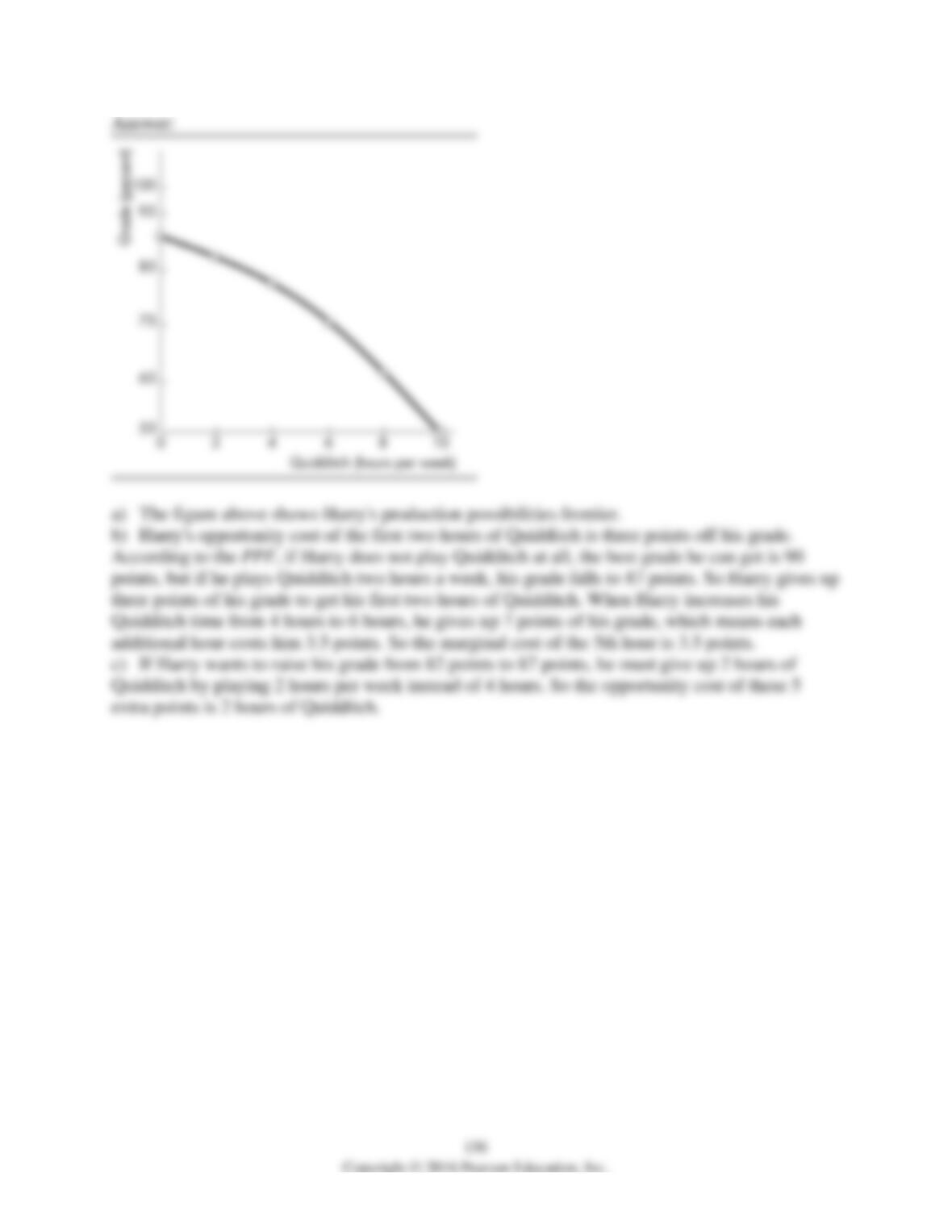
a) Draw Harry’s production possibilities frontier with the Quidditch hours on the horizontal axis
and Harry’s grade, starting at 55, on the vertical axis.
b) What is the opportunity cost of the first two hours of Quidditch? What is the marginal cost of
the 5th hour?
c) What is Harry’s opportunity cost of raising his grade from 82 points to 87 points?
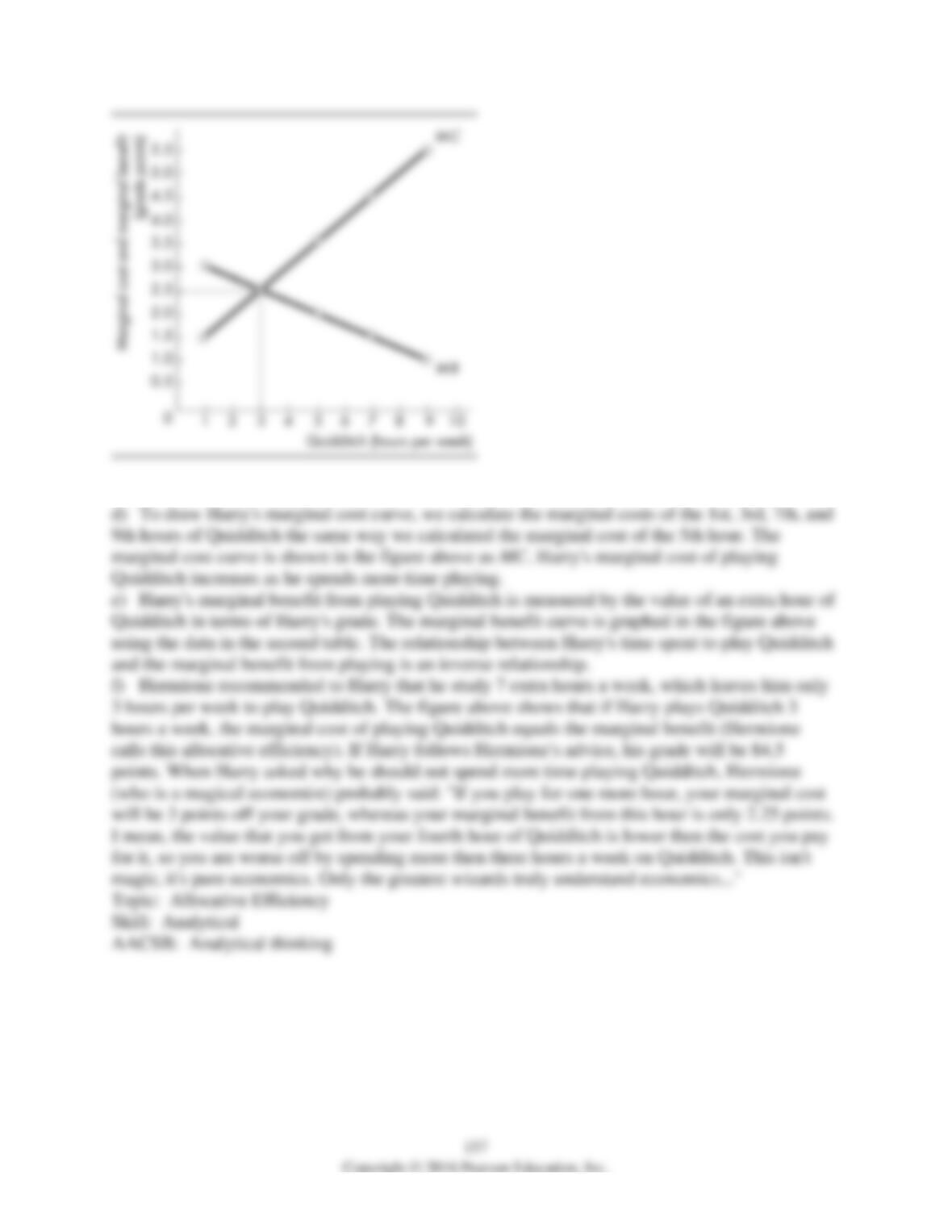
d) Draw Harry’s marginal cost of playing Quidditch curve. What happens to the marginal cost if
Harry spends more time playing Quidditch?
e) Draw Harry’s marginal benefit from playing Quidditch curve. Describe the relationship
between Harry’s time spent playing Quidditch and the marginal benefit from playing Quidditch.
f) For how many extra hours did Hermione recommend Harry to study? Why? If Harry follows
her advice, what grade will he expect? What do you think Hermione said when Harry asked why
he should not spend more time playing Quidditch?
158
Combination
Wine
(thousands of
bottles per year)
Bread
(thousands of
loaves per year)
A
0
21
B
2
20
C
4
18
D
6
15
E
8
11
F
10
6
G
12
0
Wine
(thousands of
bottles per year)
Willingness to
pay
(loaves of bread
per bottle of wine)
1
2.5
3
2.0
5
1.5
7
1.0
9
0.5
2) The Hobbits of the Shire are trying to decide how much bread and how much wine to produce.
They ask you to be their economic consultant and give you the information in the first table
above about different combinations of wine and bread that they can produce if they are fully
employed and doing their best. The Hobbits also give you the information in the second table
above about their willingness to pay for wine depending on how much wine they already have.
To help the Hobbits solve their problem:
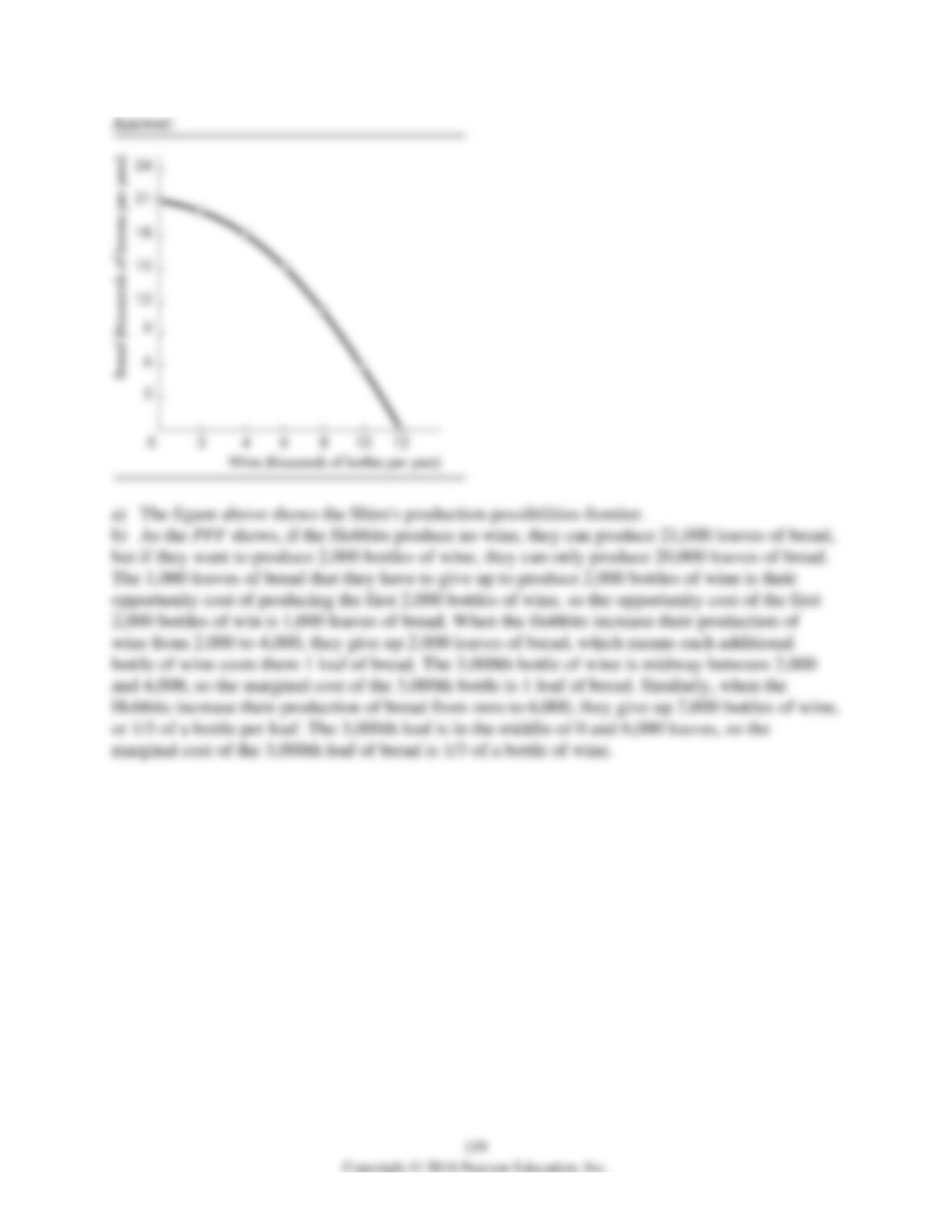
a) Draw the Shire’s production possibilities frontier. Put wine on the horizontal axis.
b) What is the opportunity cost of the first two thousand bottles of wine? What is the marginal
cost of the 3000th bottle of wine? What is the marginal cost of the 3,000th loaf of bread?
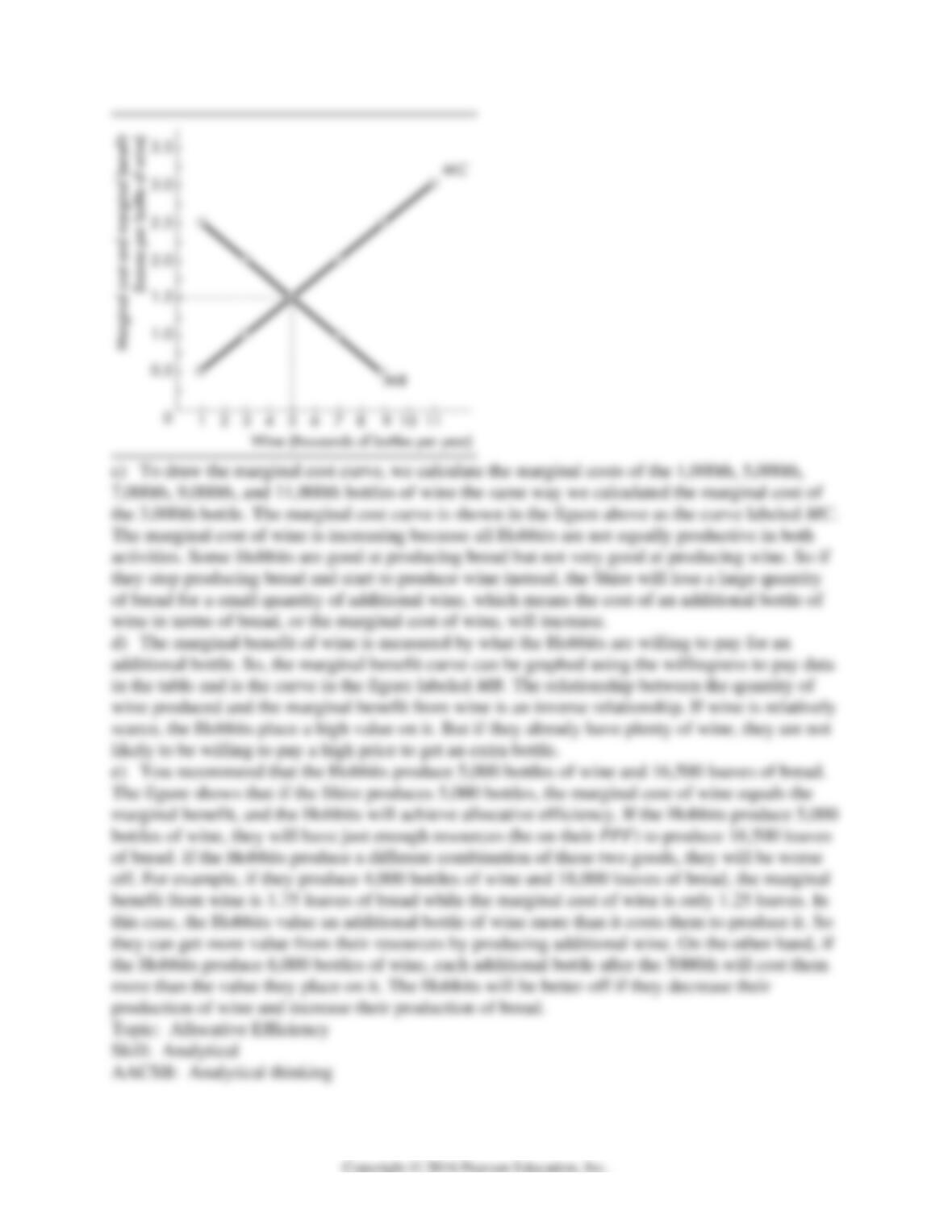
c) Draw the marginal cost of wine curve. What happens to the marginal cost if production of
wine increases? Why?
d) Draw the marginal benefit from wine curve on the same figure on which you put the
marginal cost curve. Describe the relationship between the quantity of wine produced and the
marginal benefit from wine.
e) What combination of bread and wine will you recommend the Hobbits to produce? Why?
Explain to the Hobbits why they would be worse off by producing a different combination of
bread and wine.
160
3) Sarah and her boyfriend Mike want to save some money to pay for their wedding. So they
decided to help people in the neighborhood by cleaning their garages and mowing lawns. Sarah
takes 60 minutes to clean a garage and 80 minutes to mow a lawn. Mike takes 80 minutes to
clean a garage and 80 minutes to mow a lawn. Sarah and Mike devote 10 hours per week each to
these activities and get paid $25 for each garage they clean and $25 for each lawn they mow.
Sarah says to Mike: “I have an absolute advantage in cleaning and we are equally productive in
mowing. Therefore I should do both cleaning and mowing but you should only mow lawns.”
Mike disagrees. He thinks Sarah should specialize in cleaning garages and he should specialize
in mowing lawns. Help Sarah and Mike to resolve their dispute.
a) Who has an absolute advantage in cleaning garages? In mowing lawns? Explain.
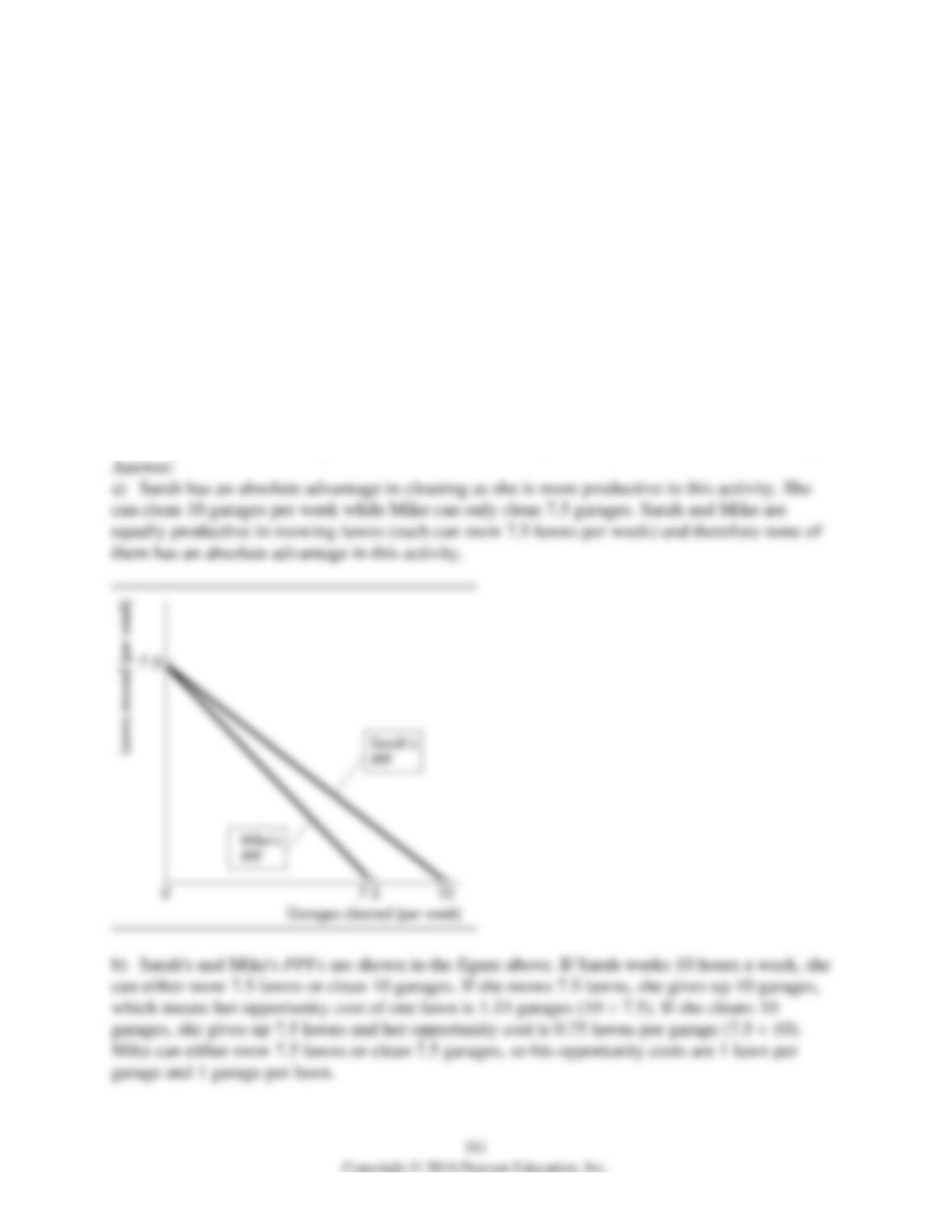
b) Draw Sarah’s and Mike’s production possibilities frontiers. What are each individual’s
opportunity costs?
c) Who has a comparative advantage in cleaning garages? In mowing lawns? Explain.
d) Is Sarah right when she says that she should do both cleaning and mowing while Mike should
only mow lawns? Or may be Mike is right when he suggests that Sarah specializes in cleaning
and he specializes in mowing? Illustrate and substantiate your answer with a numerical example.