Production
point
Wheat
(bushels)
Soybeans
(bushels)
A
1,500
and
0
B
1,000
and
2,250
C
500
and
3,500
D
0
and
4,000
7) The table above gives the production possibilities frontier for a nation that produces wheat and
soybeans. Use the information in that table to complete the table below, which has in it the
opportunity costs of moving from one production point to another. Do not forget to note the units
of the opportunity costs.
Movement
from
Opportunity
cost
Movement
from
Opportunity
cost
A to B
D to C
B to C
C to B
C to D
B to A
from
from
A to B
B to C
C to B
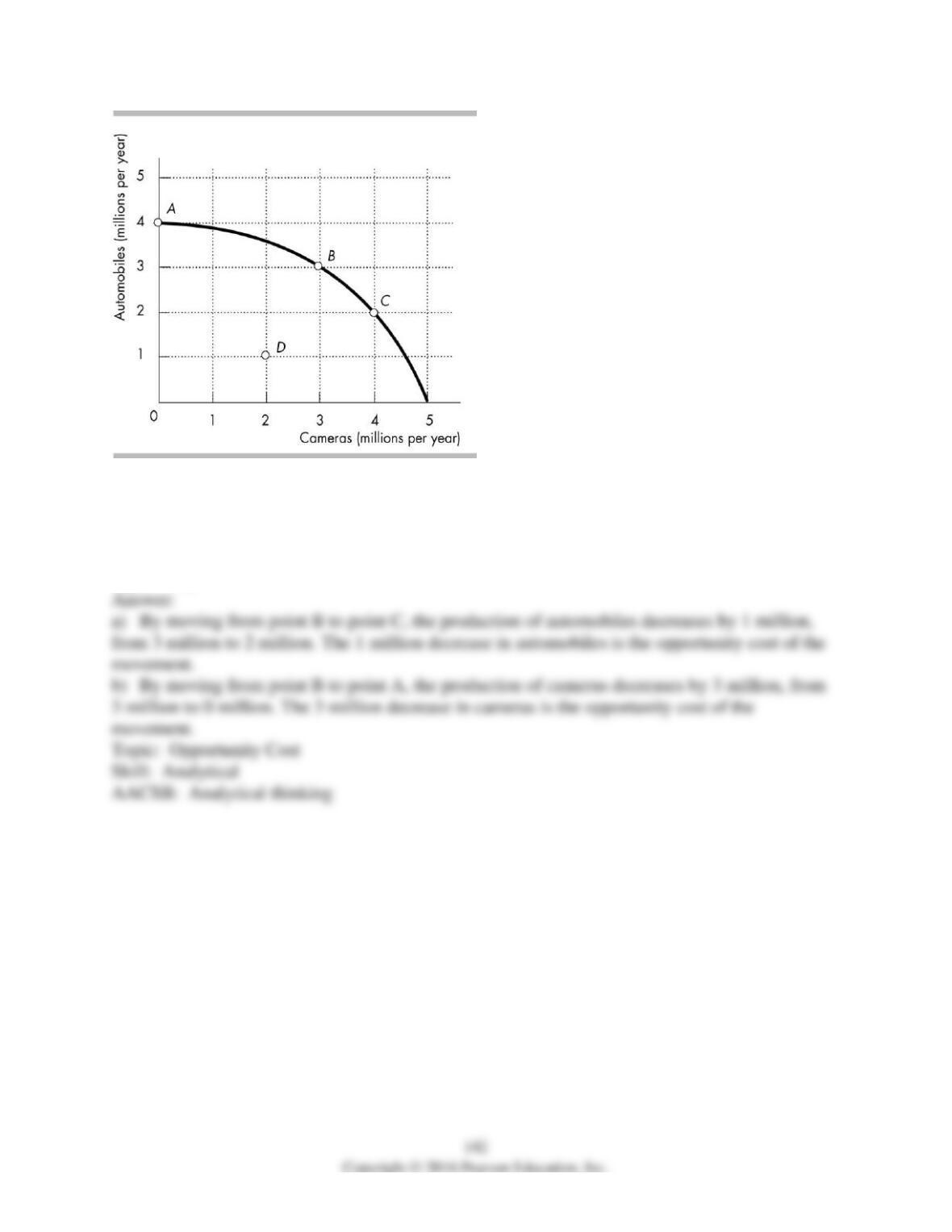
8) The figure above represents the production possibilities frontier for a country.
a) The nation is currently producing at point B and wants to move to point C. What is the
opportunity cost of the move?
b) The nation is currently producing at point B and wants to move to point A. What is the
opportunity cost of the move?

Production
point
Beef
(pounds)
Wheat
(bushels)
A
0
and
9
B
2
and
7
C
4
and
4
D
6
and
0
9) The table above presents the production possibilities of Farmer Brown. Use these data to
calculate Farmer Brown’s opportunity cost of additional beef as Farmer Brown moves from point
A to B to C to D. Also use the data to calculate Farmer Brown’s opportunity cost of additional
wheat as Farmer Brown moves from point D to C to B to A. Based on these costs, does Farmer
Brown use resources that are more productive in one activity than the other? Explain your
answer.
Production
point
Fish
(pounds)
Berries
(pounds)
A
0
and
50
B
1
and
45
C
2
and
35
D
3
and
20
E
4
and
0
10) The table above shows the production possibilities frontier for the nation of Isolanda.
a) Find the marginal cost of a pound of fish using the above PPF.
b) How does the marginal cost of a pound of fish change as more fish are caught?
(pounds of
11) At the current point of production on a nation’s production possibilities frontier, the marginal
benefit of a slice of pizza is 500 tacos per slice of pizza while the marginal cost of producing a
slice of pizza is 750 tacos per slice of pizza. To be allocatively efficient, what should be done?

Quantity
(millions of
bushes of apples)
Marginal benefit
(oranges per
bushel)
Marginal Cost
(oranges per
bushel)
5
10
1
10
8
3
15
6
6
20
4
9
25
2
12
12) Using the values for the marginal benefit and the marginal cost of a bushel of apples given in
the table above, what is the allocatively efficient quantity of apples? Suppose 10 million bushels
of apples are produced. Should the quantity be increased or deceased? What if 20 million bushels
are produced; should the quantity be increased or decreased?
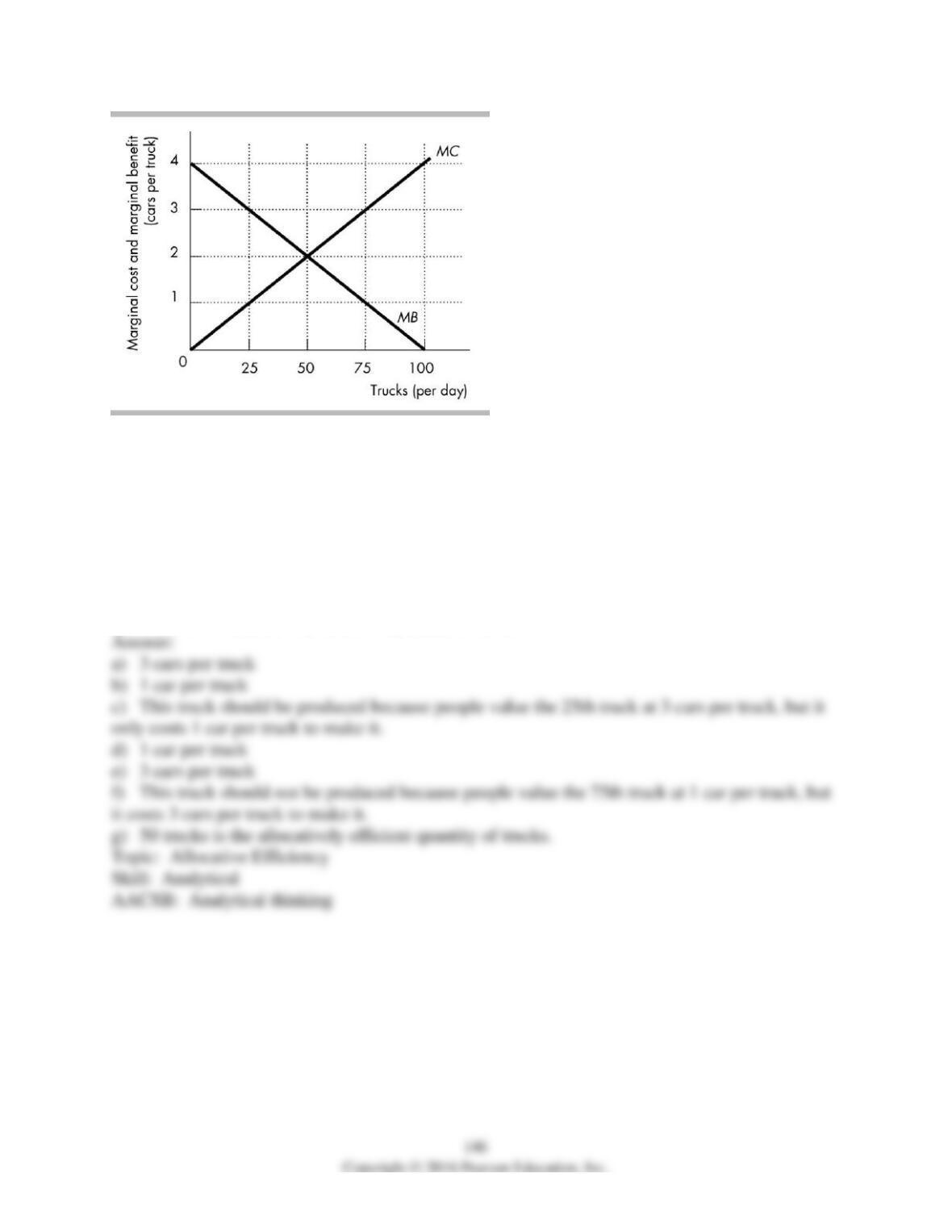
13) Suppose a factory can be designed to produce either trucks or cars. The figure above shows
the marginal cost and marginal benefit of producing trucks in terms of the forgone cars.
a) What is the marginal benefit of the 25th truck?
b) What is the marginal cost of the 25th truck?
c) Should the 25th truck be produced? Why or why not.
d) What is the marginal benefit of the 75th truck?
e) What is the marginal cost of the 75th truck?
f) Should the 75th truck be produced? Why or why not?
g) What is the allocatively efficient quantity of trucks?

China’s production
in 1 day
Pakistan’s production
in 1 day
Cloth 8
Cheese 16
Cloth 4
Cheese 12
14) The table above shows the amounts of cloth and cheese that China and Pakistan can produce
in an hour. Which country has the comparative advantage in cloth and which country has the
comparative advantage in cheese?
Omar’s production
in 1 day
John’s production
in 1 day
Computers fixed 12
Lines of code 800
Computers fixed 4
Lines of code 200
15) Omar and John can fix computers or write computer programs. The table above shows the
number of computers they can fix and the lines of code they can write in a day.
a) Who, if anyone, has the absolute advantage?
b) Who has the comparative advantage in fixing computers? Why?
c) Who has the comparative advantage in writing programs? Why?
16) Jake takes 40 minutes to fry a chicken and 10 minutes to toast a slice of bread. His brother
Elwood takes 60 minutes to fry a chicken and 4 minutes to toast a slice of bread. Calculate each
brother’s opportunity cost. Who has a comparative advantage in which activity? Explain. Will the
brothers gain if they specialize?
17) Mary takes 4 minutes to make a sandwich and 6 minutes to mix a cocktail. Her sister Ash
takes 4 minutes to make a sandwich and 4 minutes to mix a cocktail. Calculate each sister’s
opportunity cost. Which of the two sisters has an absolute advantage in making sandwiches? In
mixing cocktails? Which of the two has a comparative advantage in making sandwiches? In
mixing cocktails?
Nation A’s
production in 1 day
Nation B’s
production in 1 day
Computers 100
Software 140
Computers 120
Software 150
18) Two nations can produce computers and software in the amounts given in the table above.
Does either nation have an absolute advantage in producing the products? Which nation has a
comparative advantage in computers? Which nation has a comparative advantage in software?
Explain your answers.
19) Japan can use all of its resources to produce 100 videos or 400 shoes. China can use all of its
resources to produce 25 videos or 200 shoes. Which nation has the comparative advantage in
shoes and which nation has the comparative advantage in videos?
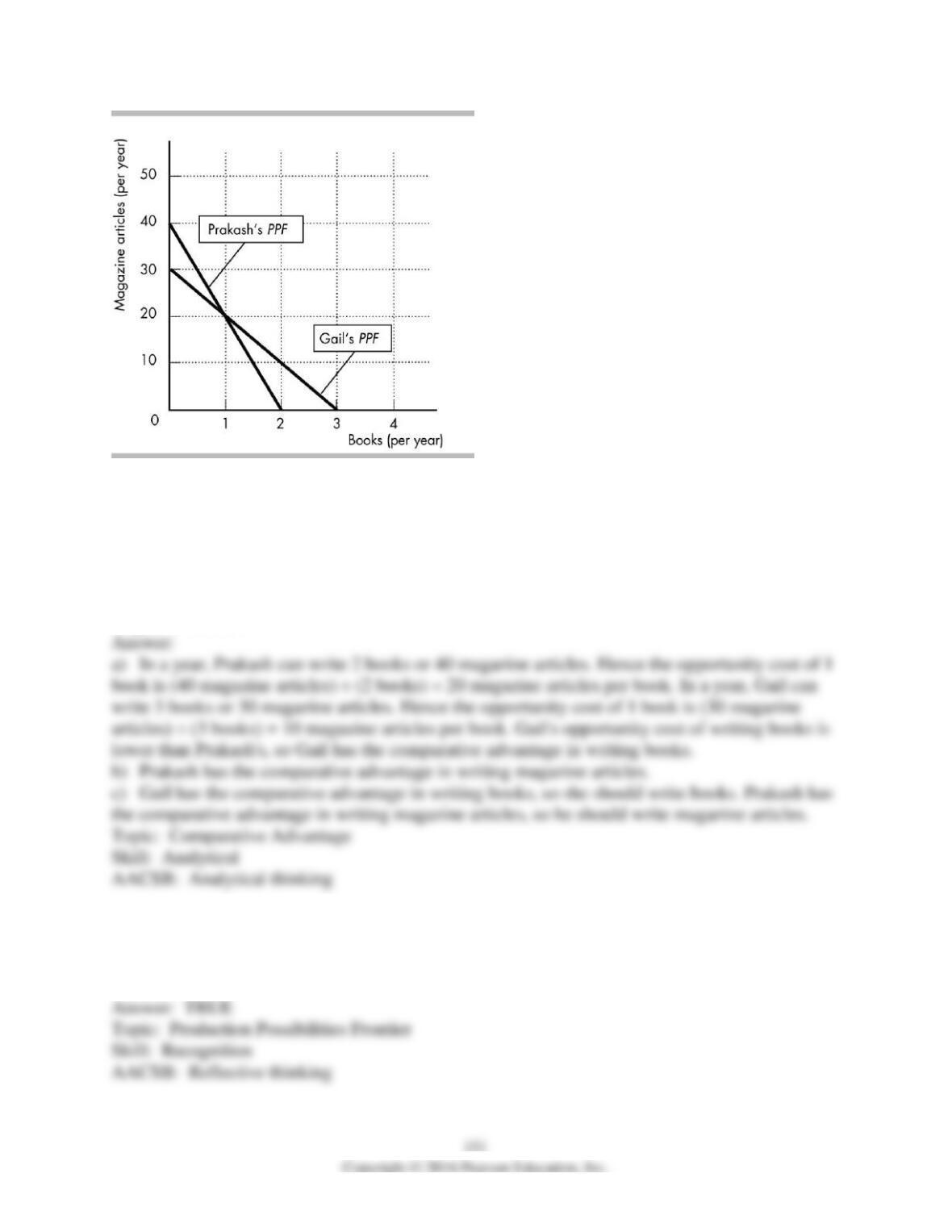
20) The figure above shows Prakash’s and Gail’s production possibilities frontiers for writing
books and magazine articles.
a) What is Prakash’s opportunity cost of a book? What is Gail’s opportunity cost? Who has the
comparative advantage in writing books?
b) Who has the comparative advantage in writing magazine articles?
c) According to their comparative advantages, who should write books and who should write
magazine articles?
9 True or False
1) Points outside the production possibilities frontier illustrate production points that cannot be
attained.