
36) Homer and Teddy are stranded on a desert island. To feed themselves each day they can
either catch fish or pick fruit. In a day, Teddy could pick 60 pieces of fruit or catch 20 fish.
Homer could pick 100 pieces of fruit or catch 150 fish. Which of the following statements is
CORRECT?
A) Homer has an absolute advantage in catching fish and Teddy has an absolute advantage in
picking fruit.
B) Homer has an absolute advantage in picking fruit and Teddy has an absolute advantage in
catching fish.
C) Homer has an absolute advantage in both catching fish and picking fruit.
D) Teddy has an absolute advantage in both catching fish and picking fruit.
Don’s production
possibilities
Bob’s production
possibilities
Pens
10
5
Pencils
20
15
37) The above table shows the number of pencils or pens that could be produced by Don and
Bob in an hour. This schedule shows that
A) Don has an absolute advantage in the production of pencils, and Bob has an absolute
advantage in the production of pens.
B) Bob has an absolute advantage in the production of pencils, and Don has an absolute
advantage in the production of pens.
C) Don has a comparative advantage in the production of both pencils and pens.
D) Bob has a comparative advantage in the production of pencils.
U.S. production
possibilities
France’s production
possibilities
Steel
100
25
Concrete
200
100
38) The above table shows the tons of steel and concrete that can be produced by the United
States and France in an hour. From the data in the table
A) France has a comparative advantage in the production of concrete.
B) the United States has a comparative advantage in the production of concrete.
C) France has an absolute advantage in the production of concrete.
D) the United States has a comparative advantage in the production of both goods.
39) Agnes can produce either 1 unit of X or 1 unit of Y in an hour, while Brenda can produce
either 2 units of X or 4 units of Y in an hour. The opportunity cost of producing a unit of X is
A) 1 unit of Y per unit of X for Agnes and 2 units of Y per unit of X for Brenda.
B) 1 unit of Y per unit of X for Agnes and 1/2 unit of Y per unit of X for Brenda.
C) 1 hour for Agnes and 1/2 hour for Brenda.
D) 1 hour for Agnes and 2 hours for Brenda.
40) Agnes can produce either 1 unit of X or 1 unit of Y in an hour, while Brenda can produce
either 2 units of X or 4 units of Y in an hour. The opportunity cost of producing a unit of Y is
A) 1 unit of X per unit of Y for Agnes and 2 units of X per unit of Y for Brenda.
B) 1 unit of X per unit of Y for Agnes and 1/2 unit of X per unit of Y for Brenda.
C) 1 hour for Agnes and 1/2 hour for Brenda.
D) 1 hour for Agnes and 2 hours for Brenda.
41) Agnes can produce either 1 unit of X or 1 unit of Y in an hour, while Brenda can produce
either 2 units of X or 4 units of Y in an hour. There can be gains from exchange
A) if Agnes specializes in the production of X and Brenda specializes in the production of Y.
B) if Agnes specializes in the production of Y and Brenda specializes in the production of X.
C) only if Agnes becomes faster at producing X.
D) only if Brenda becomes faster at producing X or Y.
42) Agnes can produce either 1 unit of X or 1 unit of Y in an hour, while Brenda can produce
either 2 units of X or 4 units of Y in an hour.
A) Brenda has an absolute advantage in the production of X and Y.
B) Agnes has a comparative advantage in the production of Y.
C) Brenda has a comparative advantage in the production of X.
D) Brenda cannot gain from trade.
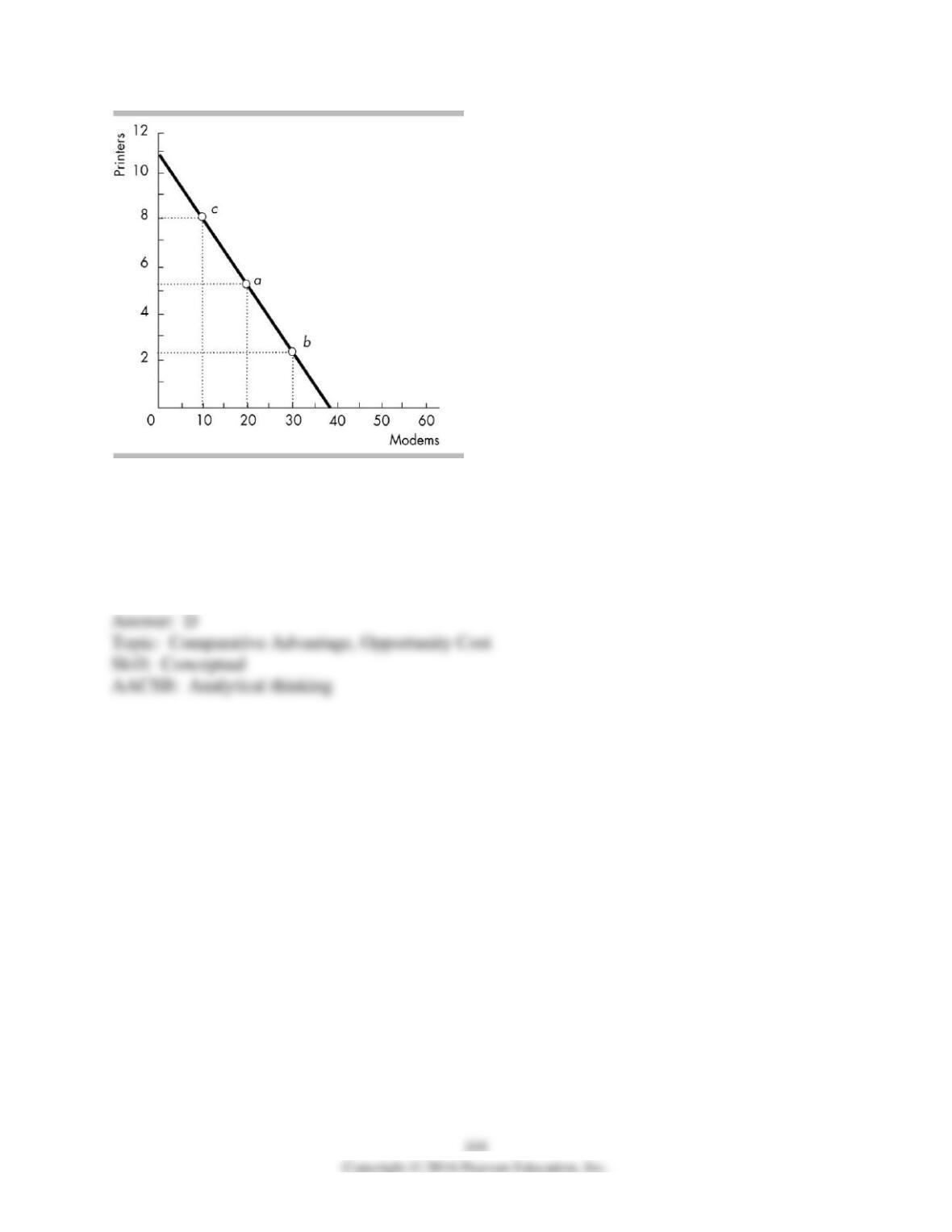
43) Vicky currently produces at point a in the figure above. If Vicky moves from point a to point
b to point c, her opportunity cost of a modem ________.
A) decreases
B) increases
C) is zero
D) remains the same
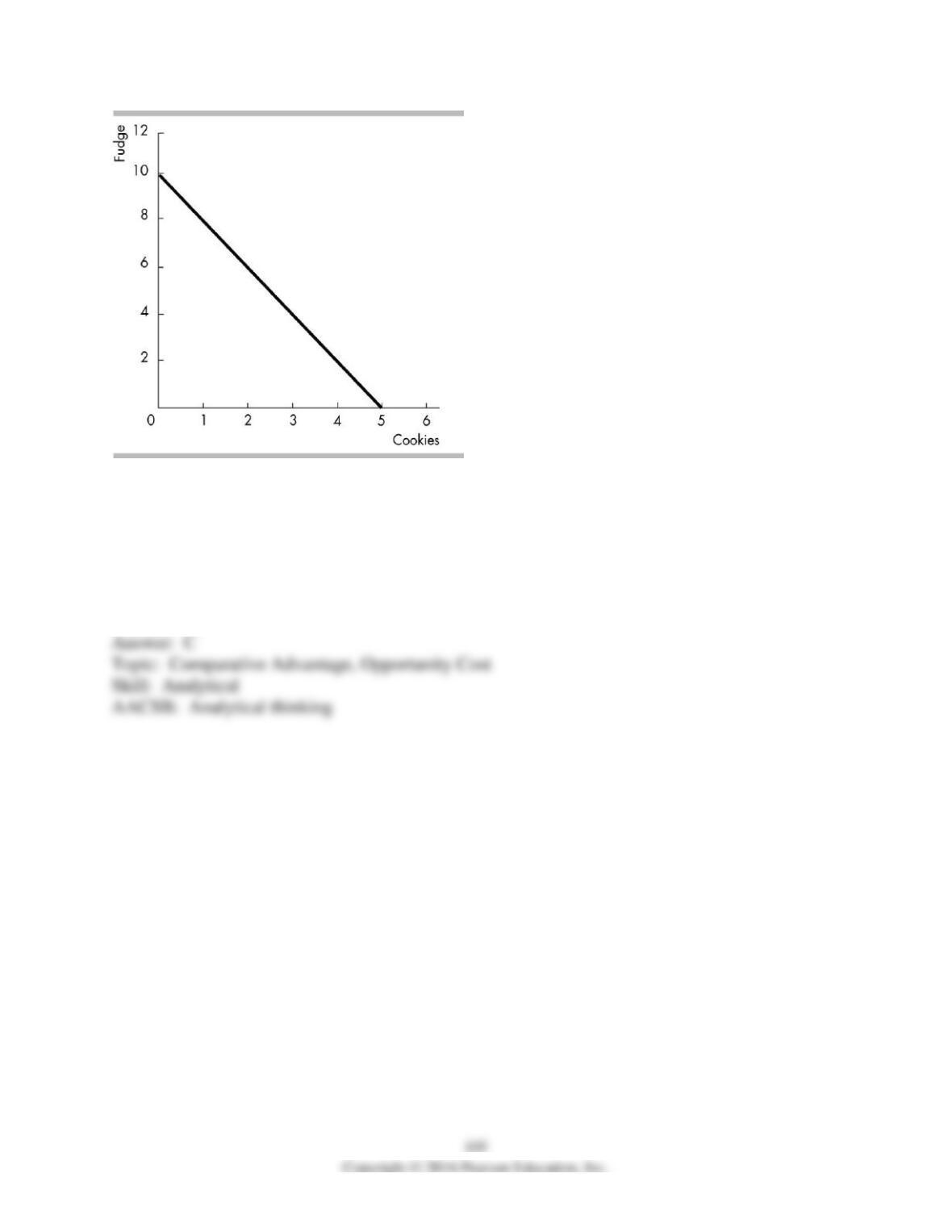
44) The figure above shows Freda’s PPF. Freda currently produces 10 packets of fudge and no
cookies. If Freda decides to produce 1 packet of cookies, her opportunity cost of the packet of
cookies is ________ of fudge.
A) 1 packet
B) 1/2 packet
C) 2 packets
D) 0 packets
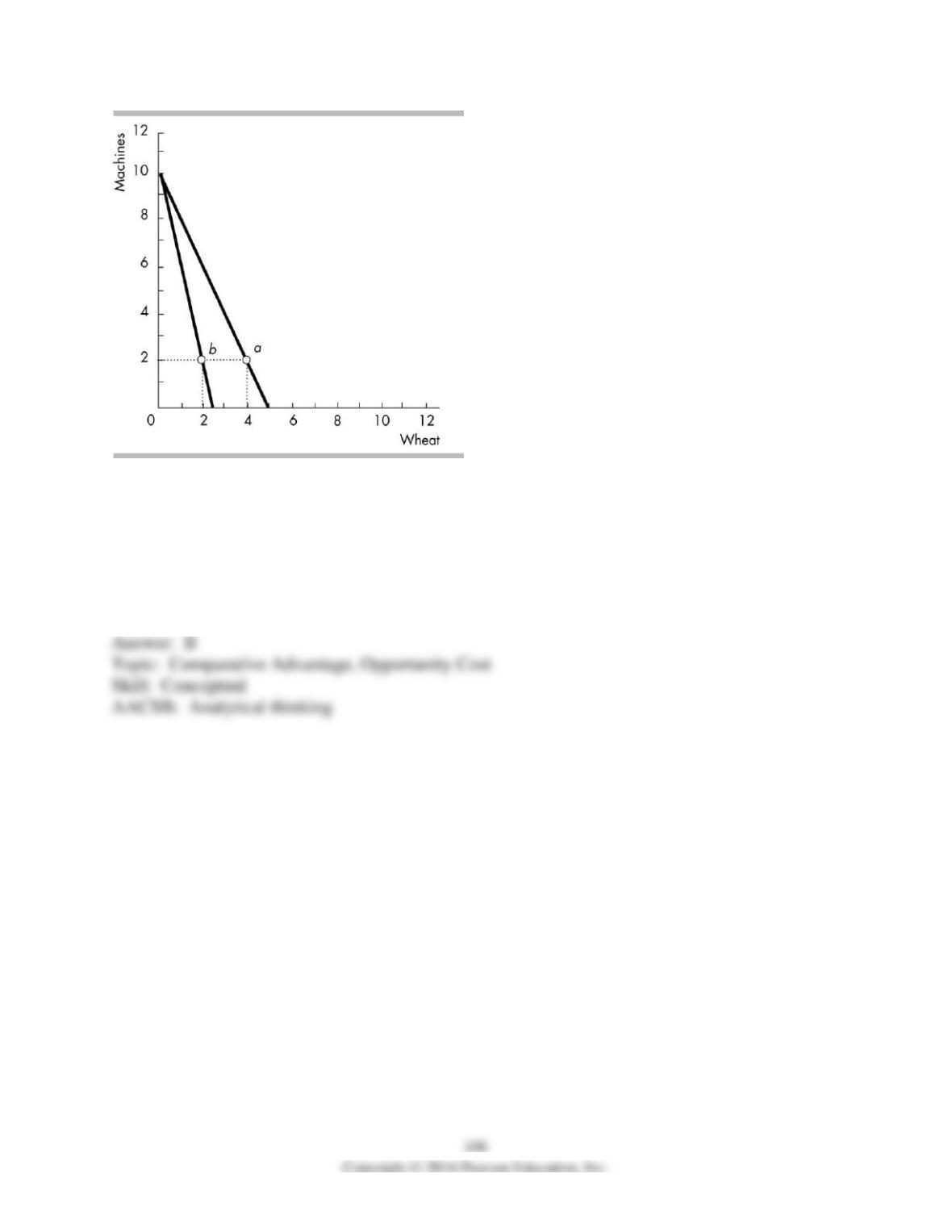
45) An economy produces at point a on the PPF shown in the above figure. A drought reduces
the amount of wheat produced and the economy produces at point b. The opportunity cost of a
unit of wheat ________.
A) remains the same
B) increases
C) is impossible to calculate without numbers on the axes
D) decreases
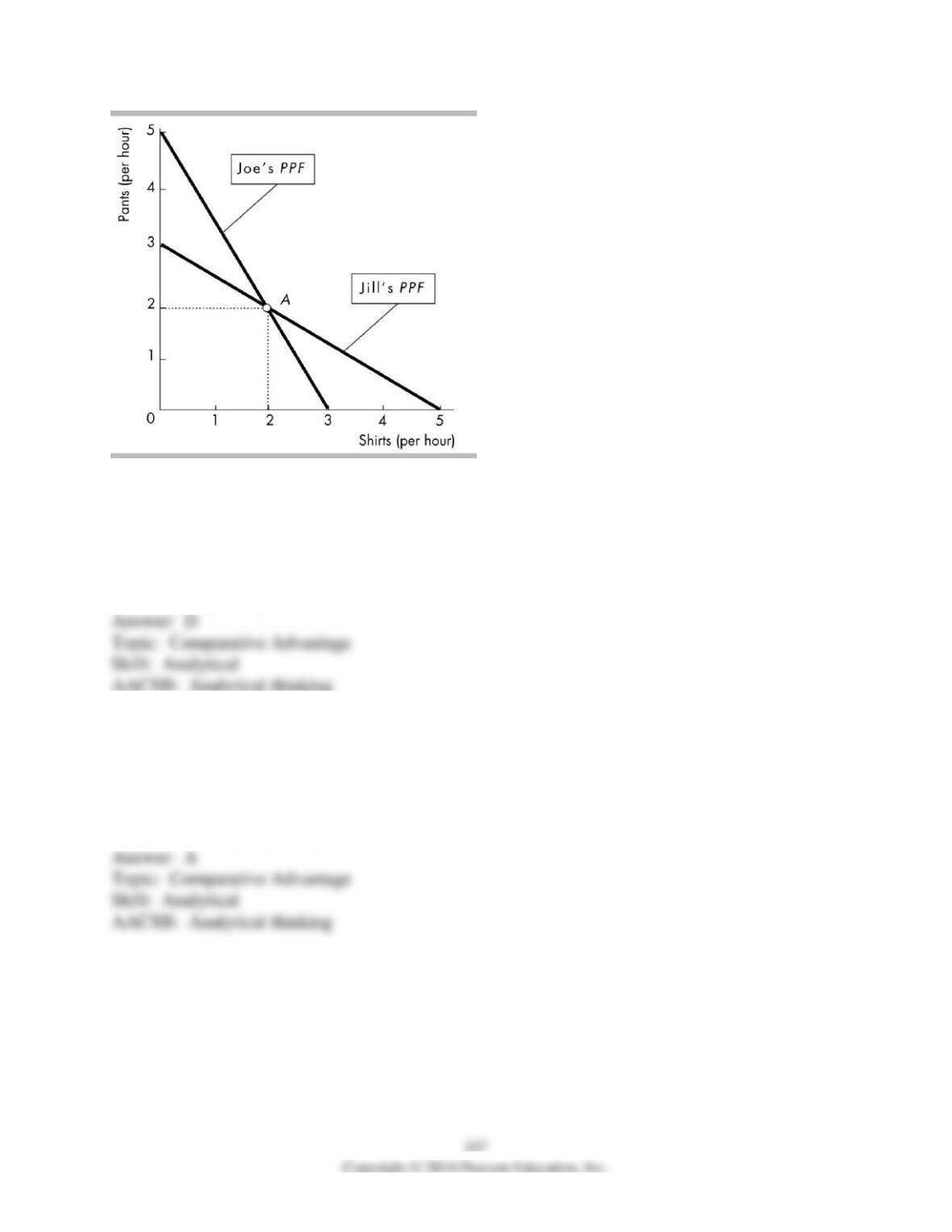
46) In the figure above, Joe is producing at point A. Joe’s opportunity cost of producing one shirt
is
A) 5/3 of a pair of pants per shirt.
B) 3/5 of a pair of pants per shirt.
C) 5 pairs of pants per shirt.
D) 2 pairs of pants per shirt.
47) In the figure above, Jill is producing at point A. Jill’s opportunity cost producing one pair of
pants is
A) 2 shirts per pair of pants.
B) 3 shirts per pair of pants.
C) 3/5 of a shirt per pair of pants.
D) 5/3 of a shirt per pair of pants.
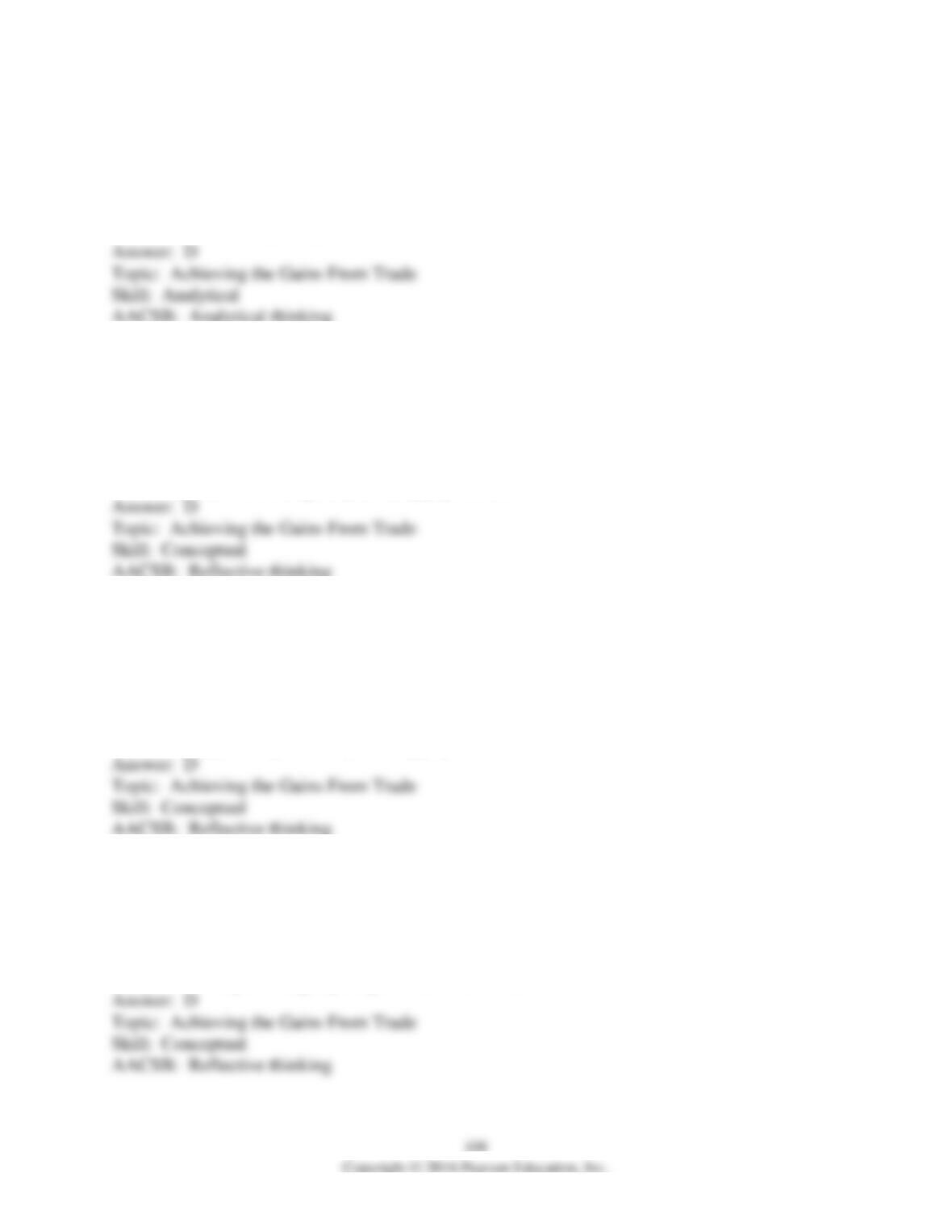
48) In the figure above, both Joe and Jill initially produce at point A. If Joe and Jill realize that
they each possess a comparative advantage, which outcome can we expect?
A) Joe will specialize in shirts and Jill will specialize in pants.
B) Joe will specialize in pants and Jill will specialize in shirts.
C) Joe and Jill each will be able to consume more than 2 shirts and 2 pairs of pants.
D) Both answers B and C are correct.
49) One of the largest categories of exports from the United States is now pop culture: movies,
music, TV programming, and videos. A direct conclusion from this information is that,
compared to other countries, the United States has
A) lower wages for producers of pop culture.
B) higher wages for producers of pop culture.
C) an absolute advantage in producing pop culture.
D) a comparative advantage in producing pop culture.
50) One of the largest categories of exports from the United States is now pop culture: movies,
music, TV programming, and videos. A direct conclusion from this information is that,
compared to other countries, the United States has
A) lower wages for producers of pop culture.
B) higher wages for producers of pop culture.
C) a higher opportunity cost of producing pop culture.
D) a lower opportunity cost of producing pop culture.
51) A country that has a comparative advantage in producing capital goods will ________ a
country that has a comparative advantage in consumption goods.
A) reap all of the gains from trade when it trades with
B) grow slower than
C) reap fewer of the gains from trade when it trades with
D) specialize in producing capital goods and trade with
52) George and Michael can gain from exchange
A) unless one has an absolute advantage in all goods.
B) if each specializes in the production of the good for which he has the higher opportunity cost.
C) if each specializes in the production of the good for which he has the lower opportunity cost.
D) unless they have different opportunity costs.
53) Tom and Di grow tomatoes and turnips. Tom has a comparative advantage in growing
tomatoes if ________.
A) Tom can grow more tomatoes than Di can
B) his opportunity cost of tomatoes is less than Di’s opportunity cost of tomatoes
C) his opportunity cost of tomatoes is less than his opportunity cost of turnips
D) his marginal benefit from tomatoes is greater than Di’s
54) If Tom and Di specialize in producing the goods in which he and she have a comparative
advantage and they exchange goods, then ________.
A) each will produce a combination of goods that is within her/his production possibility frontier
B) they will lose because they are no longer able to produce and consume both goods
C) each will gain because each can consume a combination of goods that is outside her/his
production possibility frontier
D) one of them will gain and the other will lose
55) When a nation has a comparative advantage in the production of a particular good
A) the nation tends to avoid specialization.
B) the comparative advantage encourages self-sufficiency.
C) the opportunity cost of producing that good is higher than that of other goods.
D) the nation can gain from trade.
56) To obtain the gains available from comparative advantage, individuals or countries must do
more than specialize; they must also
A) save.
B) invest.
C) engage in research and development.
D) trade.
57) According to the principle of comparative advantage, if a rich country trades with a poor
country, then
A) the rich country will benefit and the poor country will lose.
B) the rich country will lose and the poor country will benefit.
C) both countries will benefit.
D) neither of the countries will benefit.
58) The idea of comparative advantage implies that people or countries
A) should specialize in the production of goods.
B) can gain from trading.
C) can consume at a point outside their production possibilities frontier.
D) all of the above.
59) By specialization and trade, two individuals can
A) consume at a point beyond their individual production possibilities frontiers.
B) increase their comparative advantage.
C) increase their absolute advantage.
D) shift their individual production possibilities frontiers outward.
60) Suppose that the United States and Cuba decide to open up trade. If each country specializes
in the good in which it has a comparative advantage, ________ will gain from that trade because
________.
A) both countries; consumption possibilities in both Cuba and the United States will lie outside
their PPFs.
B) neither country; their consumption possibilities will not change.
C) only the United States; consumption possibilities in Cuba will lie outside its PPF and U.S.
consumption possibilities will not change.
D) only Cuba; consumption possibilities in Cuba will lie outside its PPF and U.S. consumption
possibilities will not change.
61) In one day, Sue can change the oil on 20 cars or change the tires on 20 cars. In one day, Fred
can change the oil on 20 cars or change the tires on 10 cars. Sue and Fred can gain from trade if
Sue changes the ________ and Fred changes the ________.
A) tires; oil
B) oil; oil
C) oil; tires
D) tires; tires
62) Missouri can produce 10,000 tons of pecans per year or 5,000 tons of pears per year.
Washington can produce 12,000 tons of pecans per year or 48,000 tons of pears per year. Which
of the following statements about opportunity cost is CORRECT?
A) The opportunity cost of a ton of pecans is 2 tons of pears per ton of pecans for Missouri and
1/4 ton of pears per ton of pecans for Washington.
B) The opportunity cost of a ton of pears is 2 tons of pecans per ton of pears for Missouri and 1/4
ton of pecans per ton of pears for Washington.
C) The opportunity cost of a ton of pecans is 1/2 ton of pears per ton of pecans for Missouri and
4 tons of pears per ton of pecans for Washington.
D) Both answers B and C are correct.
63) Missouri can produce 10,000 tons of pecans per year or 5,000 tons of pears per year.
Washington can produce 12,000 tons of pecans per year or 48,000 tons of pears per year. Which
of the following statements is TRUE?
A) Washington has an absolute advantage in the production of both pecans and pears.
B) Washington has a comparative advantage in the production of both pecans and pears.
C) Washington has a comparative advantage in producing pecans and Missouri has a
comparative advantage in producing pears.
D) Both answers A and C are correct.
64) Missouri can produce 10,000 tons of pecans per year or 5,000 tons of pears per year.
Washington can produce 12,000 tons of pecans per year or 48,000 tons of pears per year. If these
two states were to engage in trade, which of the following is TRUE?
A) Missouri would specialize in pear production and trade pears to Washington pecans.
B) Missouri would specialize in pecan production and trade pecans to Washington for pears.
C) Washington would produce both pears and pecans and Missouri would produce neither.
D) Half of both Washington’s and Missouri’s resources would be devoted to pears and the other
half to pecans because that is the comparative advantage.
65) Suppose that a typical German factory can produce 20 cameras or 1 computer in an hour, and
that a typical American factory can produce 10 cameras or 1 computer in an hour. The
opportunity cost of 20 cameras in terms of computers in Germany is
A) 10 computers per camera.
B) 2 computers per camera.
C) 1 computer per camera.
D) 1/20 of a computer per camera.
66) Suppose that a typical German factory can produce 20 cameras or 1 computer in an hour, and
that a typical American factory can produce 10 cameras or one computer in an hour. The
opportunity cost of 20 cameras in terms of computers in the United States is
A) 10 computers per camera.
B) 2 computers per camera.
C) 1 computer per camera.
D) 1/20 of a computer per camera.
67) Suppose that a typical German factory can produce 20 cameras or 1 computer in an hour, and
that a typical American factory can produce 10 cameras or one computer in an hour. If Germany
produces one less computer and switches resources to cameras, and the United States produces
one more computer and takes resources out of cameras, then the net change in camera production
in both countries taken together is
A) 0.
B) minus 10 cameras.
C) plus 10 cameras.
D) plus 20 cameras.
68) Suppose that a typical German factory can produce 20 cameras or 1 computer in an hour, and
that a typical American factory can produce 10 cameras or one computer in an hour. Germany
wishes to purchase computers from the United States in exchange for cameras. What is the
maximum number of cameras per computer that Germany would be willing to pay the United
States?
A) 10 cameras per computer
B) 20 cameras per computer
C) 1 camera per computer
D) 2 cameras per computer
U.S. production
possibilities
France’s production
possibilities
Steel
100
25
Concrete
200
100
69) The data in the above table demonstrates that gains from trade can be captured if
A) the United States produced both goods.
B) the United States produced steel in exchange for concrete produced in France.
C) the United States produced concrete in exchange for steel produced in France.
D) each country became self-sufficient, produced both goods for itself, and did not engage in
trade.
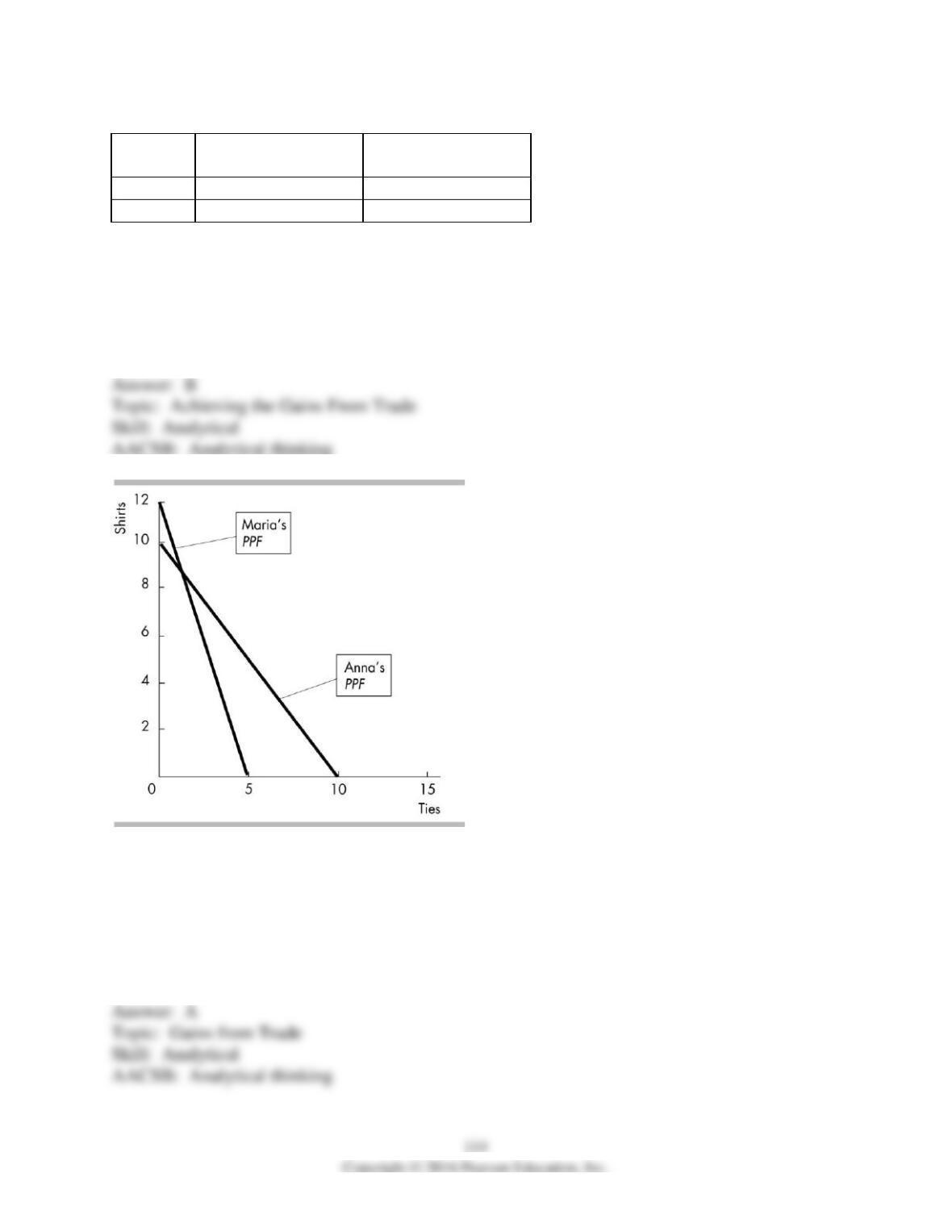
70) Anna and Maria produce shirts and ties. The figure above shows Anna’s PPF and Maria’s
PPF. Anna and Maria can achieve the gains from trade if Anna produces ________ and Maria
produces ________.
A) ties; shirts
B) shirts and ties; only ties
C) only ties; shirts and ties
D) shirts; ties
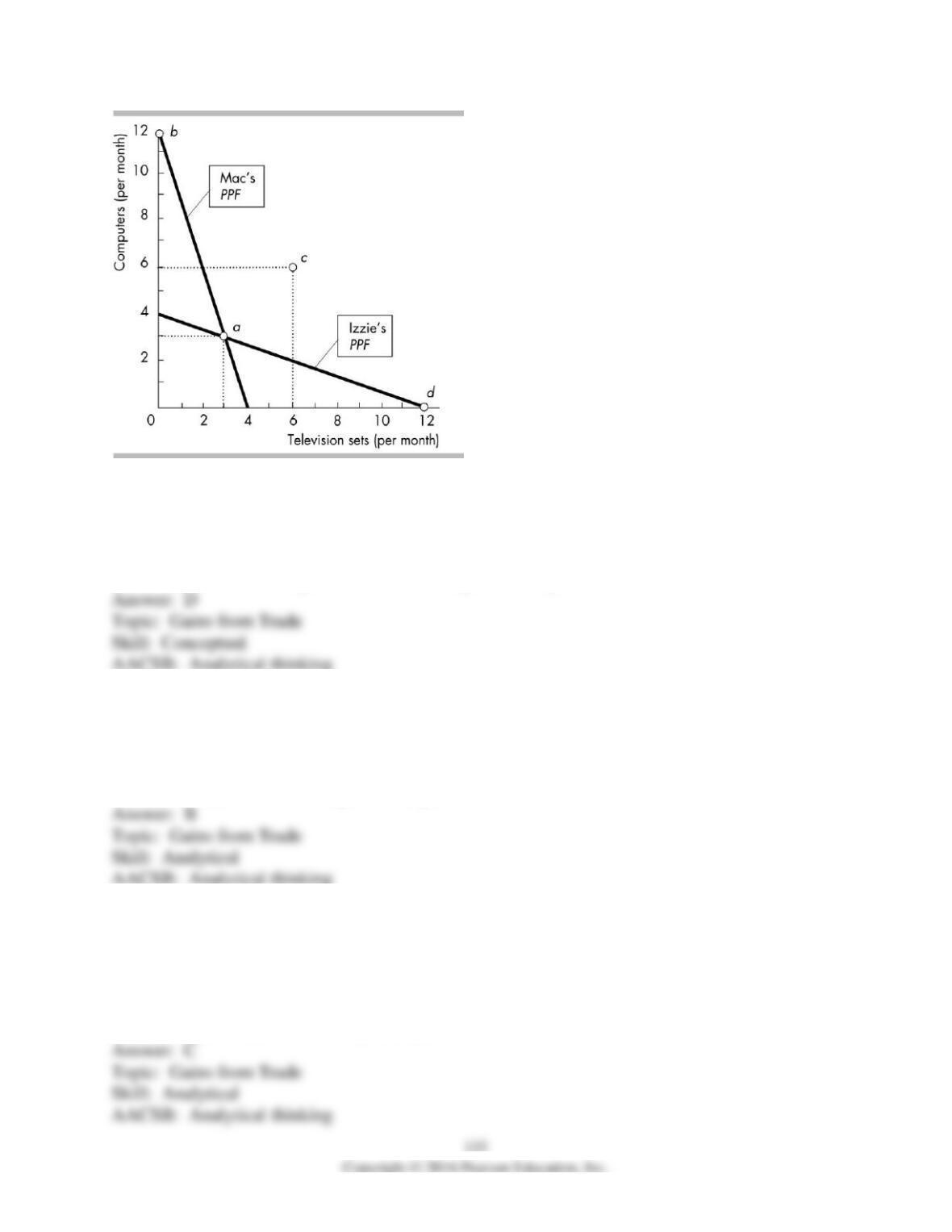
71) In the figure above, suppose that Mac and Izzie trade and reach point c. Then
A) Mac produces outside his production possibilities frontier.
B) Izzie produces outside her production possibilities frontier.
C) Mac and Izzie both produce outside their production possibilities frontiers.
D) neither Mac nor Izzie produce outside their production possibilities frontiers.
72) In the figure above, suppose that Mac and Izzie trade and reach point c. Then
A) Mac and Izzie should both produce at point a.
B) Mac should produce at point b and Izzie should produce at point d.
C) Mac should produce at point d and Izzie should produce at point b.
D) Mac and Izzie should both produce at point c.
73) In the figure above, if Mac and Izzie both completely specialized and traded with one
another, their joint output would be
A) 3 computers and 3 TV sets per month.
B) 6 computers and 6 TV sets per month.
C) 12 computers and 12 TV sets per month.
D) 24 computers and 24 TV sets per month.
74) In the figure above, suppose that Mac and Izzie specialize and trade to reach point c. Mac
sends Izzie
A) 12 computers in exchange for 12 TVs.
B) 12 computers in exchange for 6 TVs.
C) 6 computers in exchange for 12 TVs.
D) 6 computers in exchange for 6 TVs.
75) In order to achieve the maximum gains from trade, people should specialize according to
A) property rights.
B) PPF.
C) absolute advantage.
D) comparative advantage.
76) In one day, Brandon can either plow 10 acres or plant 20 acres. In one day, Christopher can
either plow 14 acres or plant 14 acres. Which of the following statements about comparative
advantage is CORRECT?
A) Brandon has a comparative advantage in both plowing and planting.
B) Brandon has a comparative advantage only in plowing.
C) Brandon has a comparative advantage only in planting.
D) Christopher has a comparative advantage in both plowing and planting.
77) In one day, Brandon can either plow 10 acres or plant 20 acres. In one day, Christopher can
either plow 14 acres or plant 14 acres. Brandon and Christopher can
A) gain from exchange if Brandon specializes in planting and Christopher specializes in plowing.
B) gain from exchange if Brandon specializes in plowing and Christopher specializes in planting.
C) exchange, but only Brandon will gain from the exchange.
D) exchange, but only Christopher will gain from the exchange.
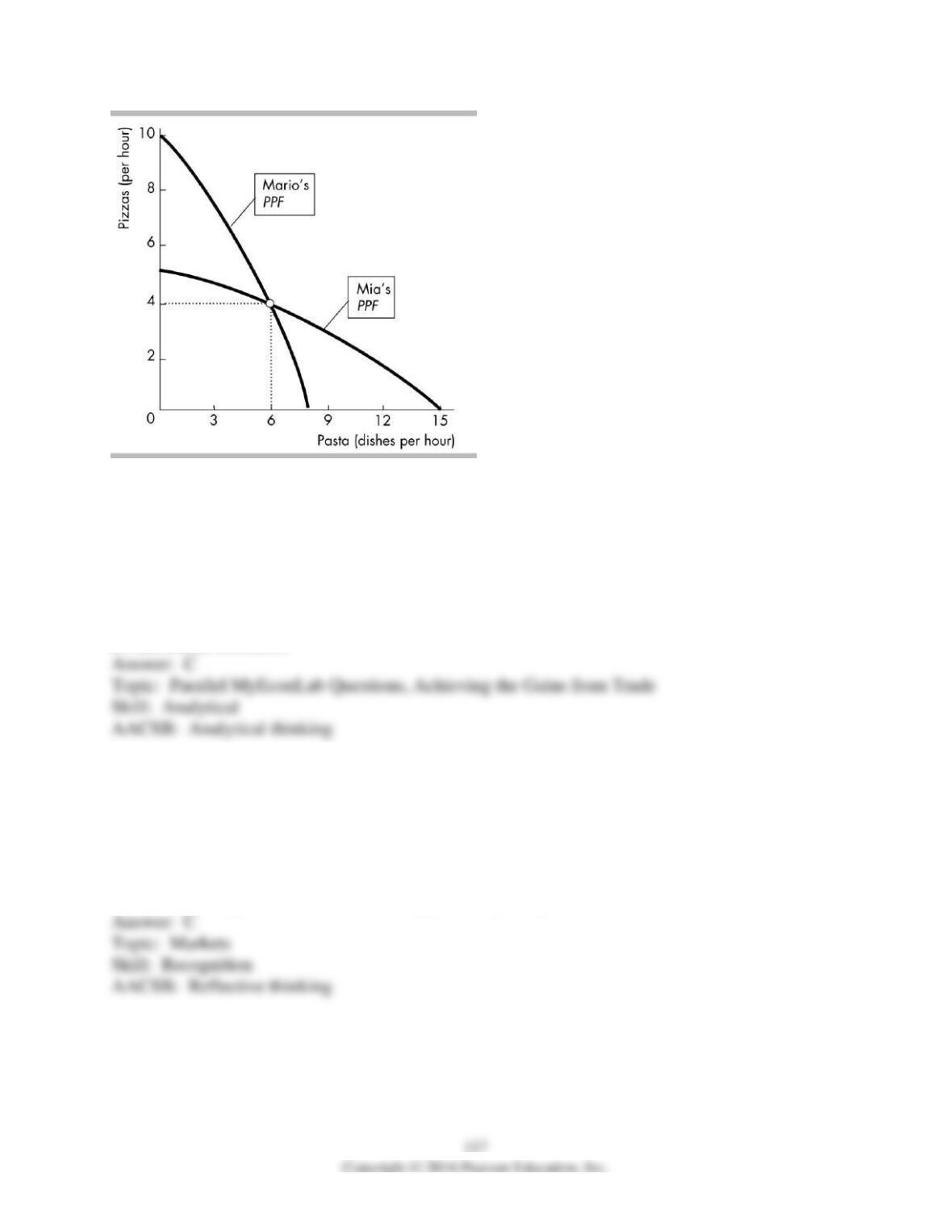
78) Refer to the above figure. Mario is self-sufficient and so is Mia. Each produces 6 dishes of
pasta and 4 pizzas. Mario and Mia decide to specialize and trade. After they have specialized and
traded, compared to the initial situation, Mia’s opportunity cost of pasta has ________ and
Mario’s opportunity cost of a pizza has ________.
A) decreased, decreased
B) decreased, increased
C) increased, increased
D) increased, decreased
5 Economic Coordination
1) The term “market” refers to
A) physical structures only.
B) locations where buyers and sellers physically meet.
C) any arrangement that enables buyers and sellers to get information and trade with one another.
D) trading arrangements that have been approved by the government.
2) Markets are best defined as
A) arrangements where buyers and sellers get together to buy and sell.
B) specific geographic locations where people get together to buy and sell.
C) hypothetical constructs used to analyze how people form their tastes and preferences.
D) places where people can inspect goods and services carefully.
3) Markets
A) facilitate trade.
B) allow traders to enjoy gains from trade.
C) coordinate price information between buyers and sellers.
D) All of the above answers are correct.
4) Which of the following is TRUE regarding markets?
I) Economists define a market as a geographic location where trade occurs.
II) A market enables buyers and sellers to get information about each other and to buy and sell
from each other.
III) Markets coordinate decisions through prices.
A) I only
B) I and III
C) II and III
D) I, II and III
5) Two social institutions that are essential for trade to be organized are ________.
A) property rights and laws
B) markets and banks
C) businesses and banks
D) markets and property rights
6) The social arrangements that govern the ownership, use, and disposal of property are referred
to as
A) the double coincidence of wants.
B) capitalism.
C) private enterprise.
D) property rights.
7) In order to societies to reap the gains from trade, it is necessary to
A) define and enforce property rights.
B) foster economic growth.
C) distribute resources equally.
D) achieve productive efficiency.
8) In a world lacking property rights, it would be ________ to realize the gains from trade and
there would be ________ specialization.
A) easier; less
B) easier; more
C) harder; less
D) harder; more
9) The rights of an owner to use and exchange property are
A) capitalist rights.
B) socialist rights.
C) property rights.
D) money rights.
120
10) The social arrangement that gives John Grisham, the writer of best-selling novels, the
ownership of his novels is
A) a market.
B) property rights.
C) absolute advantage.
D) dynamic comparative advantage.
11) If property rights are not clearly defined and enforced, then
A) incentives for specialization based on comparative advantage are weakened.
B) some potential gains from specialization and trade are lost.
C) resources are devoted to protecting possessions rather than to production.
D) All of the above answers are correct.
12) A system of property rights
A) encourages economic growth by creating incentives to invest in capital and to be innovative.
B) discourages economic growth by discouraging the development of new ideas and ways of
doing things.
C) reduces the efficiency of government, which reduces the growth rate of the economy over
time.
D) encourages investment but discourages entrepreneurial activity, so the effect on economic
growth is uncertain.
13) Intellectual property
A) is protected by common law rather than by written laws.
B) is protected by people’s sense of decency rather than by written laws.
C) belongs to everyone with the necessary human capital to use it.
D) is often protected by copyrights and patents.