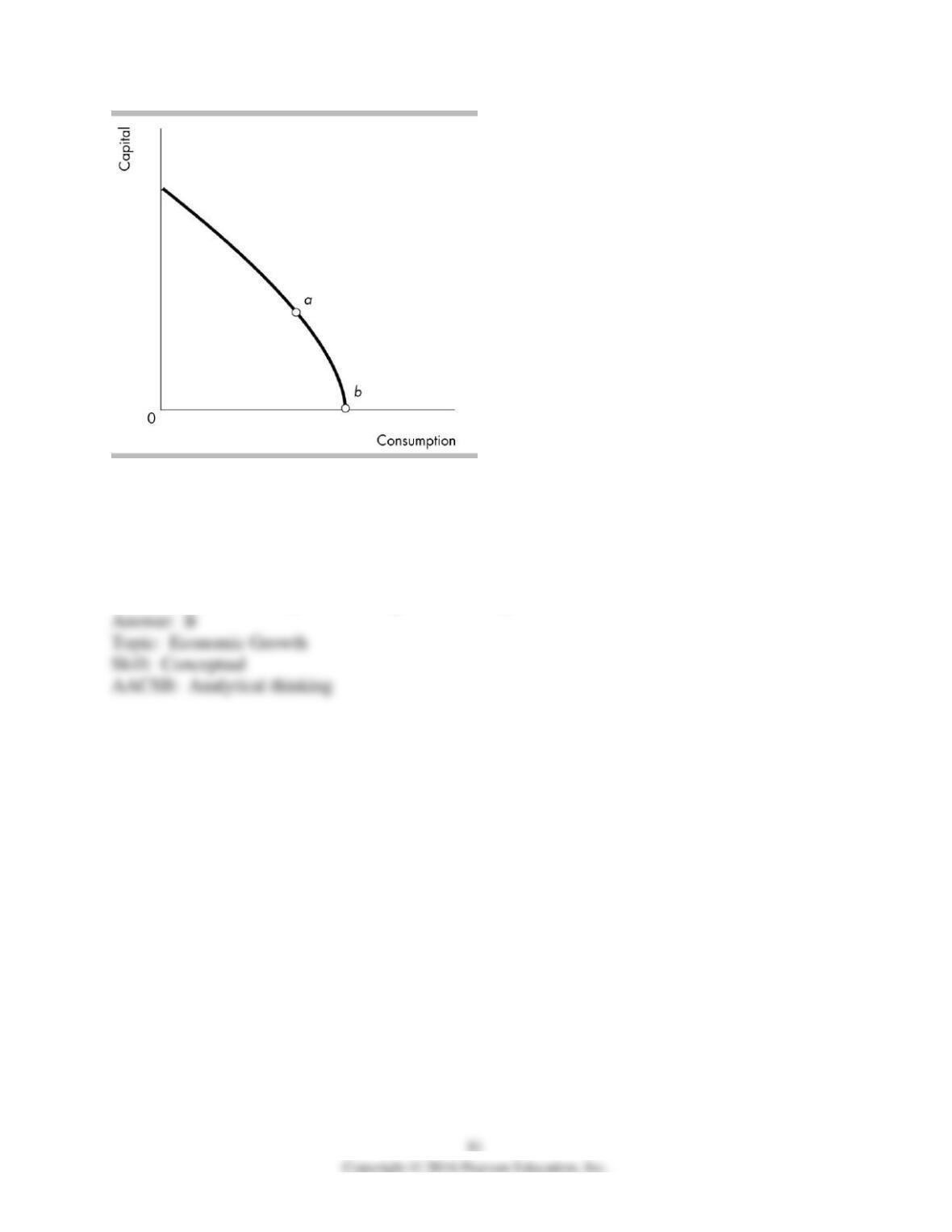
29) Two countries, Alpha and Beta, have identical production possibilities frontiers illustrated
above. If Alpha produces at point a and Beta produces at point b, then ________.
A) Beta’s economic growth rate will exceed Alpha’s
B) Alpha consumes less than Beta today, but it will grow faster than Beta
C) Alpha’s and Beta’s economic growth rates will be the same
D) Beta’s future consumption will be greater than Alpha’s
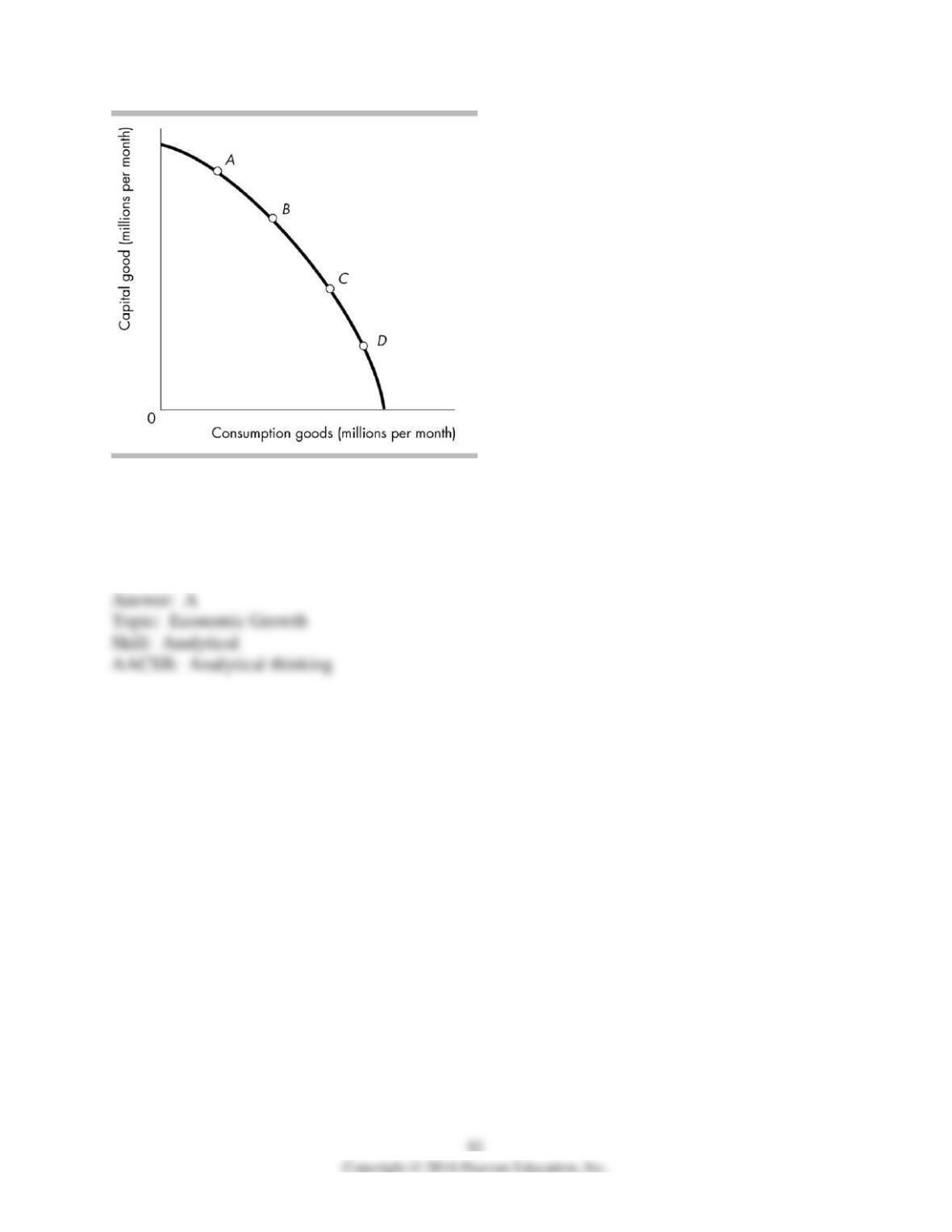
30) In the figure above, an economy would grow fastest if it produces at point
A) A.
B) B.
C) C.
D) D.
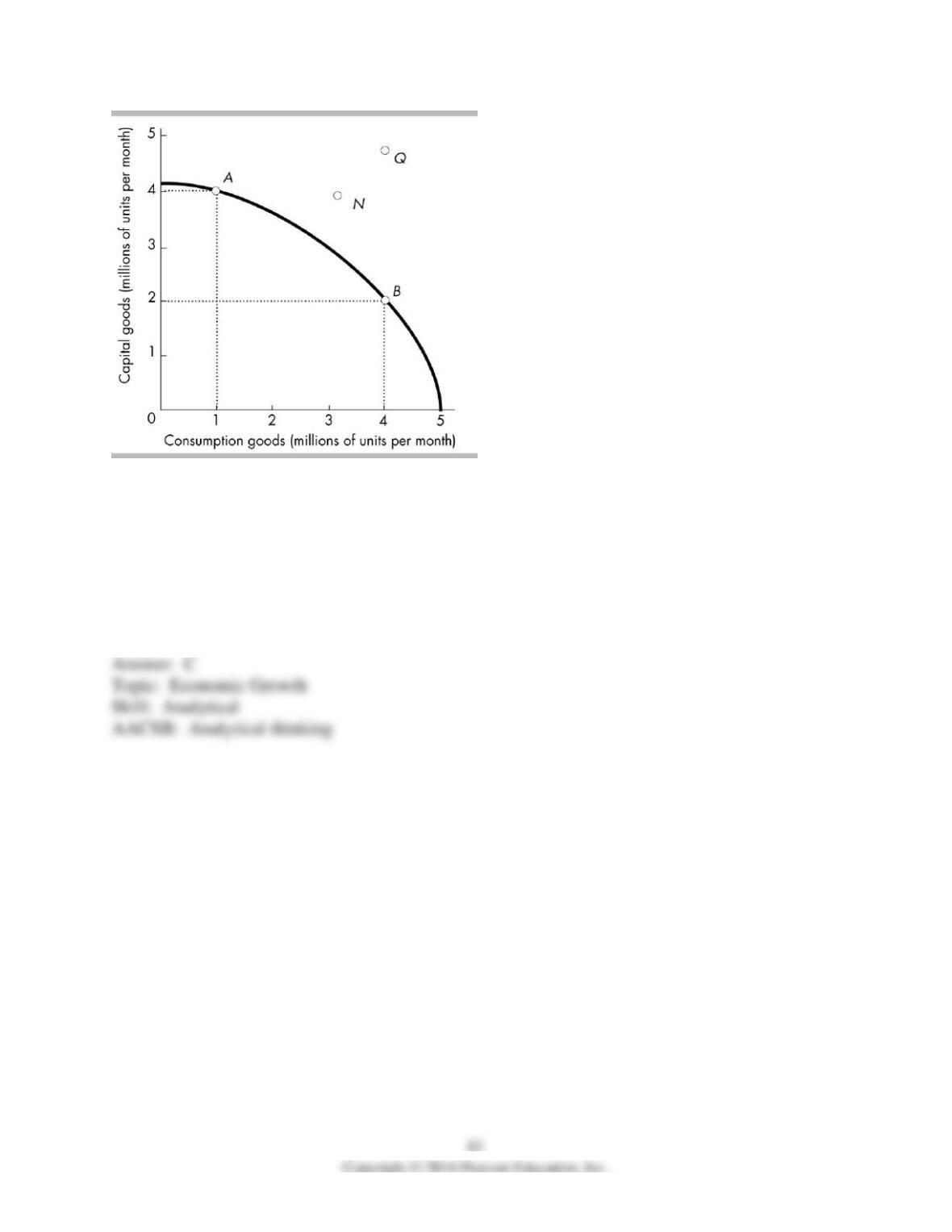
31) In 2012, Country X and Country Y had the same production possibilities, illustrated in the
figure above. Country X chose to produce at point A, while country Y chose to produce at point
B. In 2018, most likely, Country X will be at point such as ________ while Country Y will be at
point such as ________.
A) A; B
B) B; A
C) N; Q
D) Q; N
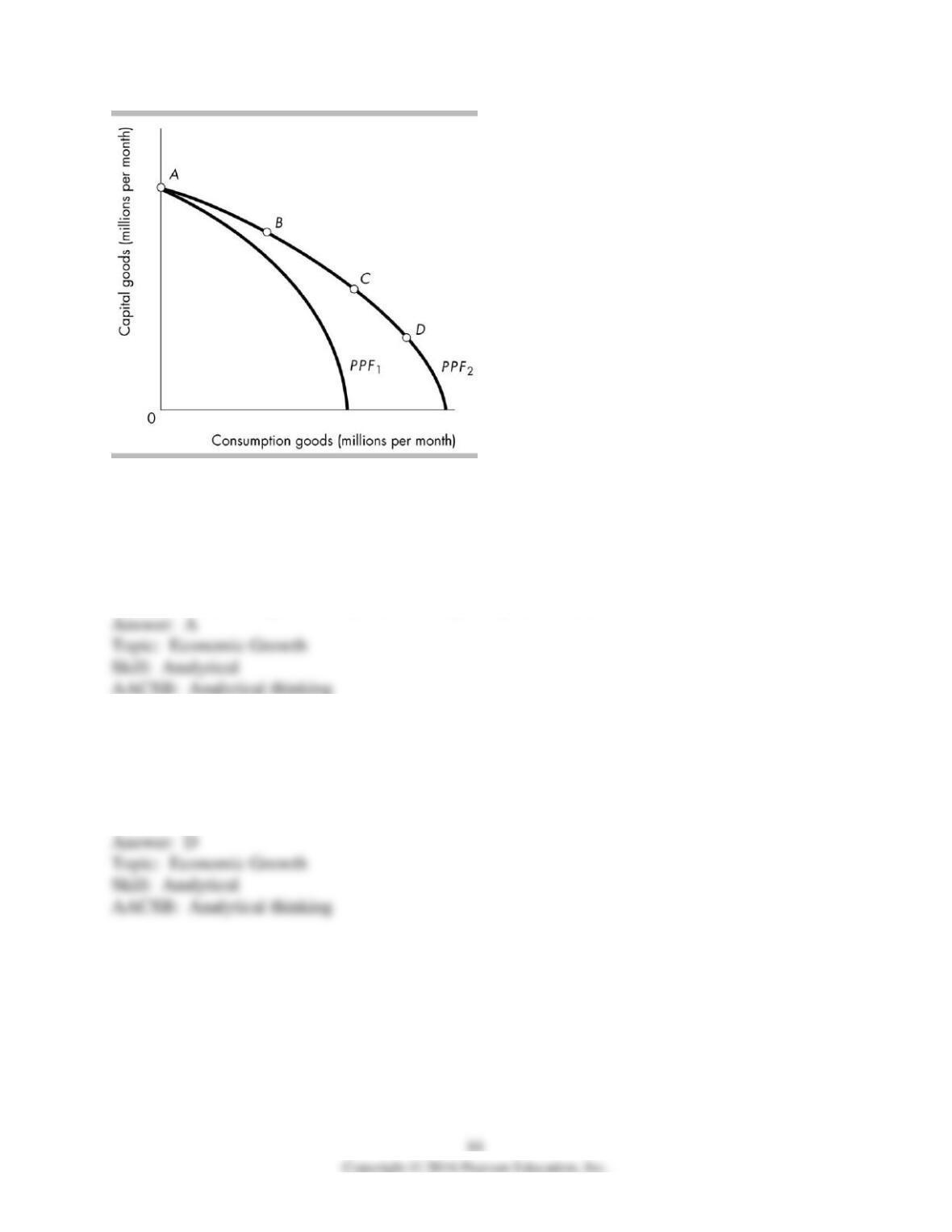
32) In the above figure, in order for this country to move from production possibilities frontier
PPF1 to PPF2, it might
A) increase the skills and productivity of its work force.
B) put all unemployed resources to work producing desired output.
C) engage in exchange with other nations.
D) increase the average level of prices for all goods produced and consumed.
33) In the above figure, once on PPF2, a country would grow slowest by producing at point
A) A.
B) B.
C) C.
D) D.
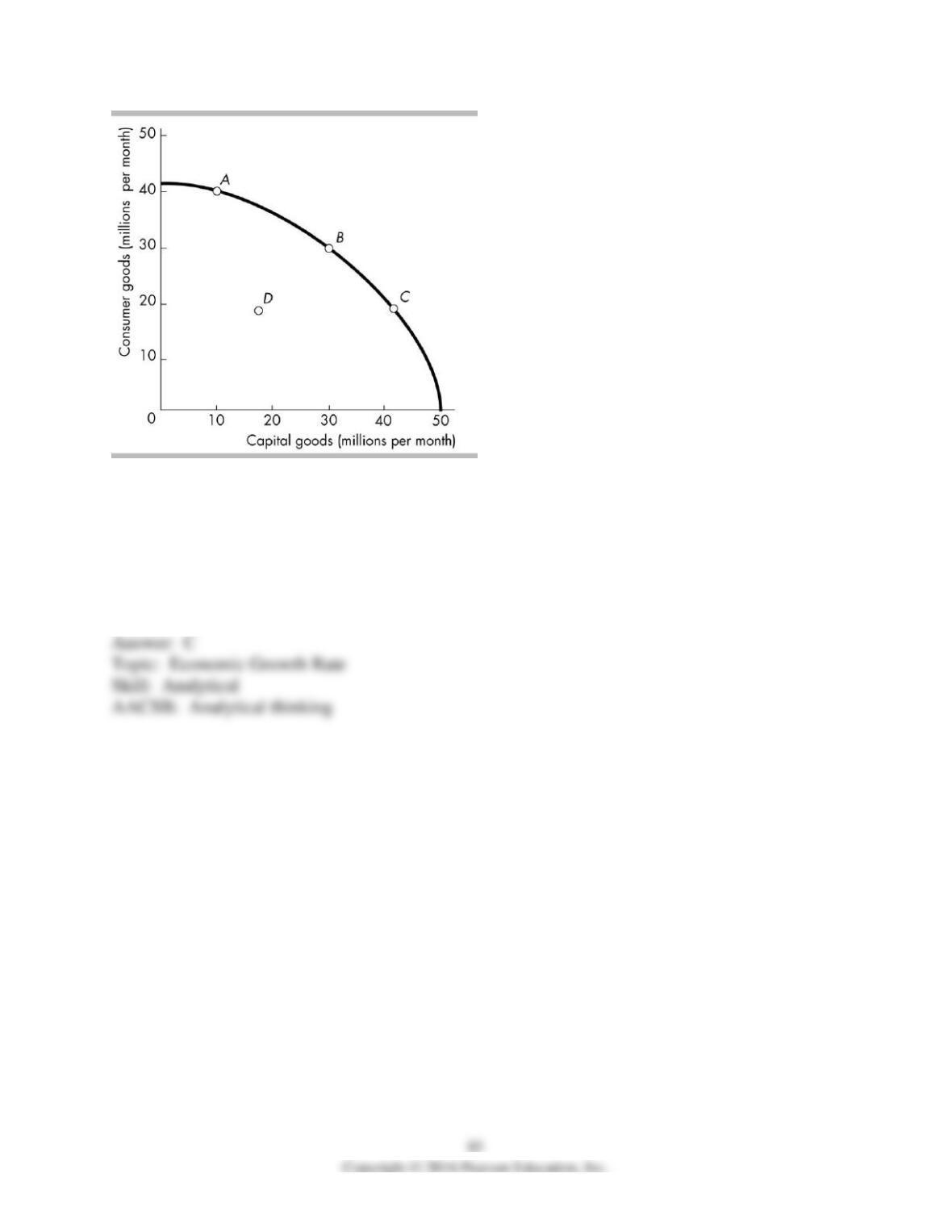
34) The figure above shows the production possibilities frontiers for four nations that have
identical production possibilities frontiers in the present. The one that will grow most rapidly in
the future is most likely to be producing at point
A) A.
B) B.
C) C.
D) D.
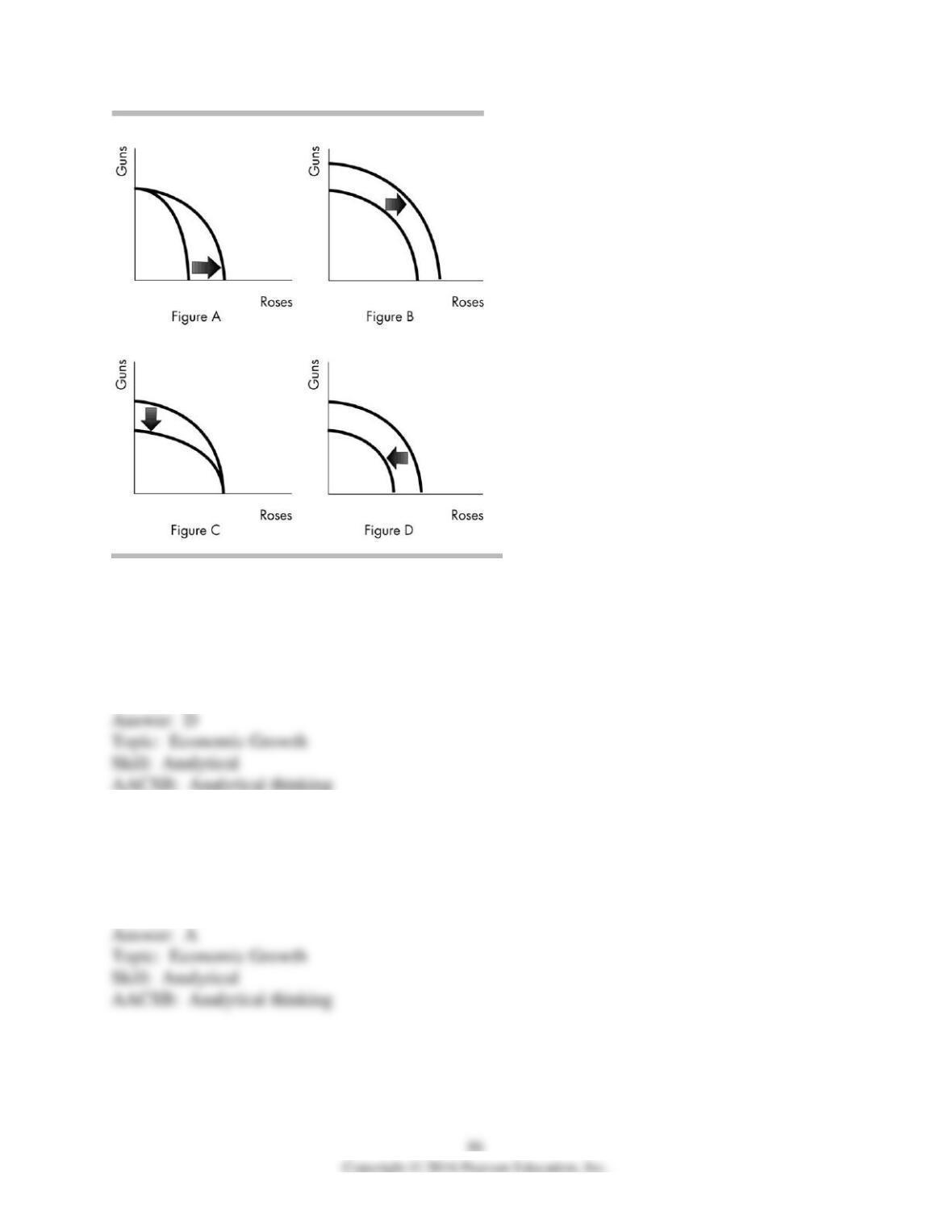
35) Based on the above, which figure shows the impact of a decrease in the population available
to work?
A) Figure A
B) Figure B
C) Figure C
D) Figure D
36) Which graph shows the impact of scientists developing a more powerful fertilizer?
A) Figure A
B) Figure B
C) Figure C
D) Figure D
37) Economic growth
A) leads to less consumption in the present and increased consumption in the future.
B) is free.
C) is the major reason we face scarcity.
D) allows us to increase our consumption in the present and in the future.
38) The opportunity cost of more capital goods today is
A) fewer capital goods in the future.
B) fewer consumer goods in the future.
C) fewer consumer goods today.
D) more unemployed resources in the future.
39) The opportunity cost of economic growth is
A) future consumption that a nation gets if it gives up some present consumption.
B) future consumption that a nation gives up to consume more today.
C) present consumption that a nation gives up to accumulate capital.
D) present investment that a nation gives up to increase its economic growth.
40) An opportunity cost of economic growth is
A) essentially zero because economic growth leads to such large gains in the long run.
B) the decrease in production of consumption goods in the present time period.
C) decreased by the creation of capital goods rather than consumption goods.
D) so high that places such as Hong Kong have had to do without it.
41) The tradeoff between current consumption and the production of capital goods also reflects a
tradeoff between
A) the future production of capital goods and future consumption of goods.
B) economic growth and technological change.
C) satisfying today the needs of the poor and the wants of the wealthy.
D) current consumption and future consumption.
42) President Obama has proposed a goal that everyone complete at least one year of formal
education or training beyond high school. This policy would ________ the production of current
consumption goods and services and ________ the future production of consumption goods and
services.
A) decrease; increase
B) increase; decrease
C) not change; increase
D) increase; increase
43) Economic growth
A) creates unemployment.
B) has no opportunity cost.
C) shifts the PPF outward.
D) makes it more difficult for a nation to produce on its PPF.
44) The PPF shifts if
A) the unemployment rate falls.
B) people decide they want more of one good and less of another.
C) the prices of the goods and services produced rise.
D) the resources available to the nation change.
45) An increase in the nation’s capital stock will
A) shift the PPF outward.
B) cause a movement along the PPF upward and leftward.
C) cause a movement along the PPF downward and rightward.
D) move the nation from producing within the PPF to producing at a point closer to the PPF.
46) One of the opportunity costs of economic growth is
A) capital accumulation.
B) technological change.
C) reduced current consumption.
D) the gain in future consumption.
47) In general, the more resources that are devoted to technological research, the
A) greater is current consumption.
B) higher is the unemployment rate.
C) faster the PPF shifts outward.
D) more the PPF will bow outward.
48) An increase in the nation’s capital stock will
A) shift the PPF outward.
B) cause a movement along the PPF up and to the left.
C) cause a movement along the PPF down and to the right.
D) move the nation from producing within the PPF to producing at a point closer to the PPF.
4 Gains from Trade
1) Because of the existence of comparative advantage, the total output of goods is higher when
each producer
A) produces many different goods.
B) produces at the midpoint of its PPF.
C) specializes in the production of one good or a few goods.
D) makes both intermediate and final goods.
2) A person has a comparative advantage in producing a particular good if that person
A) has higher productivity in producing it than anyone else has.
B) can produce it at lower opportunity cost than anyone else can.
C) has less desire to consume that good than anyone else has.
D) has more human capital related to that good than anyone else has.
3) Comparative advantage is
A) the ability to perform an activity at a lower opportunity cost than anyone else.
B) the ability to perform an activity at a higher opportunity cost than anyone else.
C) the ability to perform an activity at a zero opportunity cost.
D) another name for absolute advantage.
4) A person has a comparative advantage in an activity if that person can
A) produce more goods in a given amount of time than another person.
B) produce fewer goods in a given amount of time than another person.
C) perform the activity at a lower opportunity cost than anyone else.
D) perform that activity at a higher opportunity cost than anyone else.
5) A person has a comparative advantage in an activity whenever he or she
A) has an absolute advantage in the activity.
B) can perform the activity at a lower opportunity cost than can anyone else.
C) can do the activity in less time than anyone else.
D) can do everything better than anyone else.
6) A country possesses a comparative advantage in the production of a good if
A) the opportunity cost in terms of forgone output of alternative goods is lower for this country
than it is for its trading partners.
B) it possesses an absolute advantage in the production of this good.
C) it is able to produce more of this good per hour than can any other country.
D) all of the above.
7) Individuals A and B both produce good X. A has a comparative advantage in the production of
good X if A
A) has a lower opportunity cost of producing good X than has B.
B) has a lower opportunity cost of producing good X than of producing good Y.
C) can produce more units of X in a given time period than can B.
D) can produce X using newer technology than can B.
8) Which of the following describes comparative advantage?
A) To produce a bushel of wheat Farmer John must give up 2 bushels of corn whereas Farmer
Ben must give up 3 bushels of corn.
B) Company A can produce 4 boxes of cereal in a day whereas Company B can produce 5 boxes
of cereal in a day.
C) Firm A can produce a good at a cost of $3 and Firm B can produce the good at a cost of $4.
D) Jane can type 50 words per minute and Joe can type 60 words per minute.
9) In an eight-hour day, Andy can produce either 24 loaves of bread or 8 pounds of butter. In an
eight-hour day, Bob can produce either 8 loaves of bread or 8 pounds of butter. Andy has a
comparative advantage in the production of
A) bread, while Bob has a comparative advantage in the production of butter.
B) butter, while Bob has a comparative advantage in the production of bread.
C) bread and neither has a comparative advantage in the production of butter.
D) both bread and butter.
10) The kitchen manager at an Italian restaurant is deciding what assignments he should give to
his two cooks, John and David. John can make 25 pizzas or 40 servings of pasta per hour and
David can make 20 pizzas or 30 servings of pasta. Which of the following should be the
manager’s choice?
A) Fire David because he is not as productive as John. John will do both jobs.
B) John will make pizza because he has comparative advantage in making pizza.
C) David will make pizza because he has comparative advantage in making pizza.
D) John and David both will spend half their time making pizza and half their time making pasta
because each has a comparative advantage in making pizza.
11) An economy produces only food and shelter. There are two individuals in the economy: Bill
and Mary. Mary’s opportunity cost of producing 1 unit of shelter is 2 units of food. Bill’s
opportunity cost of producing 1 unit of shelter is 4 units of food.
A) Bill has a comparative advantage over Mary in the production of shelter.
B) Mary has a comparative advantage over Bill in the production of food.
C) Mary has a comparative advantage over Bill in the production of shelter.
D) Bill has an absolute advantage over Mary in the production of shelter.
12) Country A can produce 1 cello by giving up the production of 5 guitars. Country B can
produce 1 guitar by giving up the production of 4 cellos. In which good does country A have a
comparative advantage?
A) guitars
B) cellos
C) both goods
D) neither good
13) The opportunity cost of producing one ton of wheat for Country Gamma is 4 tons of corn.
The opportunity cost of producing one ton of wheat for Country Beta is 8 tons of corn. Which
country has the comparative advantage in the production of wheat?
A) Gamma
B) Beta
C) Neither country has a comparative advantage.
D) Both countries have the comparative advantage.
14) Suppose that in an hour Joe can prepare 10 sandwiches or 5 pizzas. The opportunity cost of
Joe producing one sandwich is
A) 2 pizzas.
B) 1/2 pizza.
C) 5 pizzas.
D) 1 pizza.
15) Suppose Joe can prepare 10 sandwiches or 5 pizzas in an hour and Beth can produce 12
sandwiches or 9 pizzas. Which of the following is TRUE?
A) Beth should produce pizza because she has a higher opportunity cost of producing pizza than
does Joe.
B) Beth should produce pizza because she has a lower opportunity cost of producing pizza than
does Joe.
C) Joe should produce pizza because he has a higher opportunity cost of producing pizza than
does Beth.
D) Joe should produce pizza because he has a lower opportunity cost of producing pizza than
does Beth.
16) Suppose Joe can prepare 20 sandwiches or 10 pizzas in an hour and Beth can produce 36
sandwiches or 27 pizzas. The concept of comparative advantage concludes that
A) Beth should produce both goods because she can produce more of both goods in an hour than
can Joe.
B) Beth should produce sandwiches and Joe should produce pizza.
C) Beth should produce pizza and Joe should produce sandwiches.
D) Beth should produce both goods and Joe should produce sandwiches.
17) Tom takes 20 minutes to cook an egg and 5 minutes to make a sandwich. Jerry takes 15
minutes to cook an egg and 3 minutes to make a sandwich. Tom has a comparative advantage in
________ and Jerry has a comparative advantage in ________.
A) cooking eggs; making sandwiches
B) making sandwiches; cooking eggs
C) neither of these activities; both activities
D) both activities; neither of these activities
18) Tom takes 20 minutes to cook an egg and 5 minutes to make a sandwich. Jerry takes 15
minutes to cook an egg and 3 minutes to make a sandwich. If Tom and Jerry trade
A) Tom will benefit and Jerry will not.
B) Jerry will benefit and Tom will not.
C) both will benefit.
D) none of them will benefit.
19) Tom takes 20 minutes to cook an egg and 5 minutes to make a sandwich. Jerry takes 15
minutes to cook an egg and 3 minutes to make a sandwich. Both individuals will be better off if
A) Tom trades sandwiches in exchange for eggs.
B) Jerry trades sandwiches in exchange for eggs.
C) they trade, no matter who trades sandwiches and who eggs.
D) they don’t trade.
20) In one week Alice can produce 5 pairs of shoes or 4 bookshelves while Roger can produce
10 pairs of shoes or 6 bookshelves. Alice has ________ advantage in producing ________.
A) an absolute; shoes
B) a comparative; shoes
C) an absolute; bookshelves
D) a comparative; bookshelves
21) In one week Alice can produce 5 pairs of shoes or 4 bookshelves while Roger can produce
10 pairs of shoes or 6 bookshelves. Alice should specialize in the production of
A) shoes.
B) bookshelves.
C) either shoes or bookshelves.
D) neither shoes nor bookshelves.
22) In an hour, Andy can make either 5 pizzas or 12 pies and Chris can make either 6 pizzas or
18 pies. ________ advantage in making pizzas.
A) Andy has an absolute
B) Andy has a comparative
C) Chris has a comparative
D) None of the above answers is correct.
23) Betty and Ann live on a desert island. With a day’s labor, Ann can produce 8 fish or 4
coconuts; Betty can produce 6 fish or 2 coconuts. Ann’s opportunity cost of producing 1 coconut
is ________ and she should specialize in the production of ________.
A) 8 fish per coconut; fish
B) 2 fish per coconut; coconuts
C) 6 fish per coconut; coconuts
D) 0 fish per coconut; coconuts
24) Betty and Ann live on a desert island. With a day’s labor, Ann can produce 6 fish or 4
coconuts; Betty can produce 3 fish or 1 coconut. Betty’s opportunity cost of producing 1 fish is
________, and she should specialize in the production of ________.
A) 1/3 coconut per fish; fish
B) 2/3 coconut per fish; coconuts
C) 1 coconut per fish; fish
D) 4 coconuts per fish; fish

25) Homer and Teddy are stranded on a desert island. To feed themselves each day they can
either catch fish or pick fruit. In a day, Teddy could pick 60 pieces of fruit or catch 20 fish.
Homer could pick 100 pieces of fruit or catch 150 fish. Which of the following is CORRECT?
A) Homer has a comparative advantage in catching fish and Teddy has a comparative advantage
in picking fruit.
B) Homer has a comparative advantage in picking fruit and Teddy has a comparative advantage
in catching fish.
C) Homer has a comparative advantage in both catching fish and picking fruit.
D) Teddy has a comparative advantage in both catching fish and picking fruit.
Blue Violet’s Orange Rose’s
production possibilities production possibilities
Teapots
(number
per week)
Coffeepots
(number
per week)
Teapots
(number
per week)
Coffeepots
(number
per week)
150
&
0
75
&
0
100
&
25
50
&
50
50
&
50
25
&
100
0
&
75
0
&
150
26) Two countries, Blue Violet and Orange Rose, produce only two goods: teapots and
coffeepots. The table above gives their production possibilities. ________ has a comparative
advantage in teapots and ________ has a comparative advantage in coffeepots.
A) Orange Rose; Blue Violet
B) Blue Violet; Orange Rose
C) Blue Violet; Blue Violet
D) Orange Rose; Orange Rose

Blue Violet’s Sweet Pansy’s
production possibilities production possibilities
Teapots
(number
per week)
Coffeepots
(number
per week)
Teapots
(number
per week)
Coffeepots
(number
per week)
150
&
0
150
&
0
100
&
25
100
&
50
50
&
50
50
&
100
0
&
75
0
&
150
27) Two countries, Blue Violet and Sweet Pansy, produce only two goods: teapots and
coffeepots. The table above gives their production possibilities.
A) Blue Violet has a comparative advantage in teapots.
B) Sweet Pansy has a comparative advantage in teapots.
C) Both have a comparative advantage in teapots.
D) Sweet Pansy has an absolute advantage in teapots.
28) Two countries, Blue Violet and Sweet Pansy, produce only two goods: teapots and
coffeepots. The table above gives their production possibilities. With specialization and trade,
Sweet Pansy produces ________ and Blue Violet produces ________.
A) 150 coffeepots, 150 teapots
B) 150 teapots, 75 coffeepots
C) 150 teapots and 150 coffeepots, nothing
D) 100 teapots and 25 coffeepots, 100 teapots and 50 coffeepots
Country A Country B
Good X
(units of X)
Good Y
(units of Y)
Good X
(units of X)
Good Y
(units of Y)
0
16
0
12
2
12
2
9
4
8
4
6
6
4
6
3
8
0
8
0
29) In the table above, country A is producing 4 units of X and 8 units of Y and country B is
producing 4 units of X and 6 units of Y. The opportunity cost of producing more of
A) good X is the same for both countries.
B) good Y is the same for both countries.
C) good X is lower in country A.
D) good Y is lower in country A.
30) In the table above, country A is producing 4 units of X and 8 units of Y and country B is
producing 4 units of X and 6 units of Y. Regarding the production of good X
A) country A has an absolute advantage.
B) country B has an absolute advantage.
C) country A has a comparative advantage.
D) country B has a comparative advantage.
31) In the table above, country B is producing 4 units of X and 6 units of Y. For country B, the
opportunity cost of producing an additional unit of X is
A) 4 units of Y per unit of X.
B) 2 units of Y per unit of X.
C) 3/2 units of Y per unit of X.
D) 1 unit of Y per unit of X.
32) In the table above, country B is producing 4 units of X and 6 units of Y. For country B, the
opportunity cost of producing an additional unit of Y is
A) 1/2 unit of X per unit of Y.
B) 2/3 unit of X per unit of Y.
C) 2 units of X per unit of Y.
D) 3 units of X per unit of Y.
33) Both Mergatroid and the Geebocks produce only gizmos and widgets. It is possible for
Mergatroid to have
A) an absolute and a comparative advantage in both products.
B) an absolute but not a comparative advantage in both products.
C) a comparative but not an absolute advantage in both products.
D) neither a comparative nor an absolute advantage in both products.
34) A person who has an absolute advantage in the production of all goods will
A) also have a comparative advantage in the production of all goods.
B) not be able to gain from specialization and exchange.
C) have a production possibilities frontier with a constant slope.
D) have a comparative advantage in the production of some goods but not in the production of
others.
35) A country that has an absolute advantage in producing all goods will ________.
A) have a comparative advantage in some goods but not all
B) produce all goods at lowest opportunity cost
C) have a comparative advantage in all goods
D) not gain from specialization and trade