2) For a given positively sloped supply curve, the price increase to consumers resulting from a specific tax
imposed on sellers will be
A) greater the more price elastic demand is.
B) greater the less price elastic demand is.
C) equal to the entire tax when demand is perfectly elastic.
D) equal to half of the tax whenever demand is unit elastic.
3) A specific tax on sellers will
A) shift the demand curve to the right.
B) shift the demand curve to the left.
C) shift the supply curve to the right.
D) shift the supply curve to the left.
4) Consumers will always pay the entire amount of a specific tax whenever
A) demand is perfectly inelastic.
B) supply is perfectly elastic.
C) Both A and B above.
D) Either A or B above but not at the same time.
5) If a government wants to maximize revenues from a tax, it should
A) impose it on sellers.
B) impose it on consumers.
C) choose a good with a relatively elastic demand.
D) choose a good with a relatively inelastic demand.
6) If the demand curve for a good is unit price elastic and the supply curve is perfectly price elastic, a $1
specific tax imposed on the sellers of this good will
A) shift the supply curve up vertically by $1.
B) shift the demand curve down vertically by $1.
C) not raise price at all.
D) cause price to increase but by less than $1.
7) Suppose the demand curve for a good is downward sloping and the supply curve is upward sloping.
At the market equilibrium, if demand is more elastic than supply in absolute value, a $1 specific tax will
A) raise the price to consumers by 50 cents.
B) raise the price to consumers by less than 50 cents.
C) raise the price to consumers by more than 50 cents.
D) raise the price to consumers by $1.
8) Suppose the demand curve is perfectly inelastic and the supply curve is upward sloping. The price
sellers receive after a specific tax is imposed on sellers
A) is less than before the tax.
B) is higher than before the tax.
C) is unchanged.
D) depends on the supply elasticity.
9) The vertical distance of the shift in supply from a specific tax of t amount on producers will
A) equal t.
B) be less than t.
C) depend on the elasticity of supply.
D) depend on the incidence of the tax.
10) Suppose the demand curve for movie tickets has unitary price elasticity and the supply curve is
perfectly price elastic. If 3 million tickets are currently sold at a price of $5, approximately how much tax
revenue could the government generate from a $1 specific tax?
A) $18 million
B) $3 million
C) $2.5 million
D) $1.5 million
11) In the case of a specific tax, tax incidence is independent of who pays
A) only when supply and demand elasticities are not constant.
B) only when the tax is collected from consumers.
C) in most but not all cases.
D) in all cases.
12) If the government decides to levy an ad valorem tax on product with a perfectly inelastic supply. The
consumers tax incidence will be
A) 0.
B) 1.
C) .5.
D) Cannot be determined.
13) In the case of a specific tax the resulting price received by producers depends on
A) the tax rate.
B) the price elasticity of supply.
C) the price elasticity of demand.
D) All of the above.
14) The tax incidence of a specific tax or ad valorem tax is influenced by
A) who pays the tax.
B) the amount of the tax.
C) the price elasticities of supply and demand.
D) All of the above.
15) The benefit of a subsidy paid on each unit sold will go entirely to the sellers in the market if
A) the supply curve is perfectly inelastic.
B) if the subsidy is paid to producers.
C) the demand curve is perfectly elastic.
D) the supply is perfectly elastic.
16) If the government levies a specific tax on tobacco producers, the spending of consumers will probably
A) increase.
B) decrease.
C) unchanged.
D) depend on supply elasticity.
For the following, please answer “True” or “False” and explain why.
17) Only in the case of perfectly inelastic demand will consumers pay the full amount of a specific tax or
ad valorem tax.
18) Government revenue from an excise tax of a given amount is greater when demand is relatively
inelastic than when it is relatively elastic.
19) Explain why a tax increase on cigarettes in one state might not lead to a substantial price increase for
all consumers in that state.
20) Suppose the market for grass seed can be expressed as:
Demand: QD = 100 – 2p
Supply: QS = 3p
At the market equilibrium, calculate the price elasticities of supply and demand. Use these numbers to
predict the change in price resulting from a specific tax.
21) Suppose the market for grass seed can be expressed as:
Demand: QD = 100 – 2p
Supply: QS = 3p
If government imposes a $5 specific tax to be collected from sellers, what is the price consumers will pay?
How much tax revenue is collected? What fraction is paid by sellers?
22) Suppose the market for grass seed can be expressed as:
Demand: QD = 100 – 2p
Supply: QS = 3p
If government imposes a 10% ad valorem tax to be collected from sellers, what is the price consumers will
pay? How much tax revenue is collected?
23) Suppose the market for grass seed is expressed as:
Demand: QD = 100 – 2p
Supply: QS = 3p
Price elasticity of supply is constant at 1. If the supply curve is changed to Q = 8p, price elasticity of
supply is still constant at one. Yet with the new supply curve, consumers pay a larger share of a specific
tax. Why?
24) Suppose the market for grass seed can be expressed as:
Demand: QD = 100 – 2p
Supply: QS = 3p
Price elasticity of supply is constant at one. If the demand curve is changed to Q = 10 – .2p, price elasticity
of demand at any given price is the same as before. Yet the incidence of a tax falling on consumers will be
higher. Why?
25) Suppose the market for grass seed can be expressed as:
Demand: QD = 200 – 5p
Supply: QS = 40 + 5p
If the government collects a $5 specific tax from sellers, how much will the quantity demanded change
from the amount demanded before the tax? What price will consumers pay after the tax? What price will
sellers receive after the tax? What is the tax revenue?
26) Suppose that a market has the following supply and demand equations:
Demand: QD = 380 – 10p
Supply: QS = 80 + 5p
If the government imposes a specific tax of τ on suppliers, what will be the price buyers pay and sellers
receive, quantity, and government revenue from the tax (as functions of τ). What tax level maximizes the
revenue the government collects from the tax?
27) The California cigarette market consists of the following supply and demand curves:
QD = 150 – 20p
QS = 40p
where Q is the number of packs of cigarettes per year (in millions!), and p is the price per pack.
a. Compute the market equilibrium price and quantity.
b. Calculate the price elasticities of each curve at the equilibrium price/quantity.
c. California imposes a tax on cigarettes of $0.90 per pack. Suppliers pay this tax to the government.
Compute the after-tax price and quantity. How much do suppliers receive net of tax (per pack)?
d. Demand for cigarettes is generally more elastic over longer periods of time as consumers have more
time to kick the habit. What does this imply about the tax incidence in the long run as compared to the
short run?
2.7 Quantity Supplied Need Not Equal Quantity Demanded
1) Municipalities that have adopted the policy of “rent control” typically set the rentals on certain
apartments well below equilibrium. As a result,
A) landlords have a difficult time finding tenants.
B) prospective tenants have a difficult time finding available apartments.
C) there is a surplus of apartments.
D) All of the above.
2) When “rent controls” result in a shortage of housing, landlords
A) use criteria other than price to allocate housing.
B) lower the price to allocate the housing.
C) attempt to attract renters.
D) None of the above.
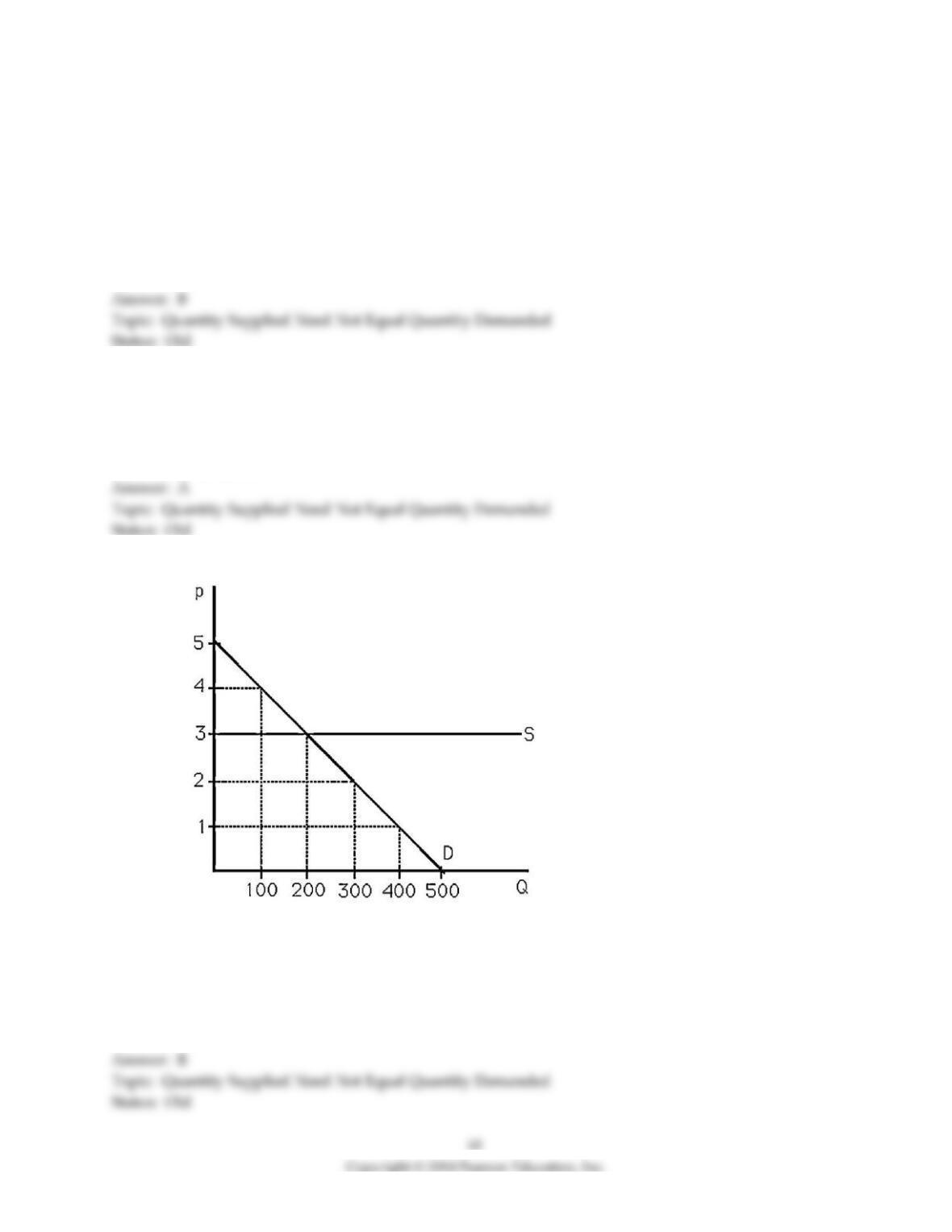
3) The above figure shows the market for crude oil. If a consumer group convinces the government to set
a maximum price of $2 per barrel, then
A) 300 barrels of crude oil will be sold at $2.
B) zero barrels of crude oil will be sold.
C) zero barrels of crude oil will be demanded.
D) None of the above.
4) The above figure shows the market for crude oil. If the oil exploration firms convince the government
to set a minimum price of $4 per barrel, then
A) 100 barrels of crude oil will be sold at $4.
B) zero barrels of crude oil will be sold.
C) zero barrels of crude oil will be demanded.
D) None of the above.
5) If a government-imposed price ceiling causes the observed price in a market to be below the
equilibrium price,
A) there will be excess demand.
B) there will be excess supply.
C) the curves will shift to make a new equilibrium at the regulated price.
D) None of the above.
6) In the labor market, if the government imposes a minimum wage that is below the equilibrium wage,
then
A) workers who wish to work at the minimum wage will have a difficult time finding jobs.
B) firms will hire fewer workers than without the minimum wage law.
C) some workers may lose their jobs as a result.
D) nothing will happen to the wage rate or employment.
7) Suppose the market for potatoes can be expressed as follows:
Supply: QS = -20 + 10p
Demand: QD = 400 – 20p
If the government sets a maximum price of $10 per unit, what will be the quantity demanded and
quantity supplied?
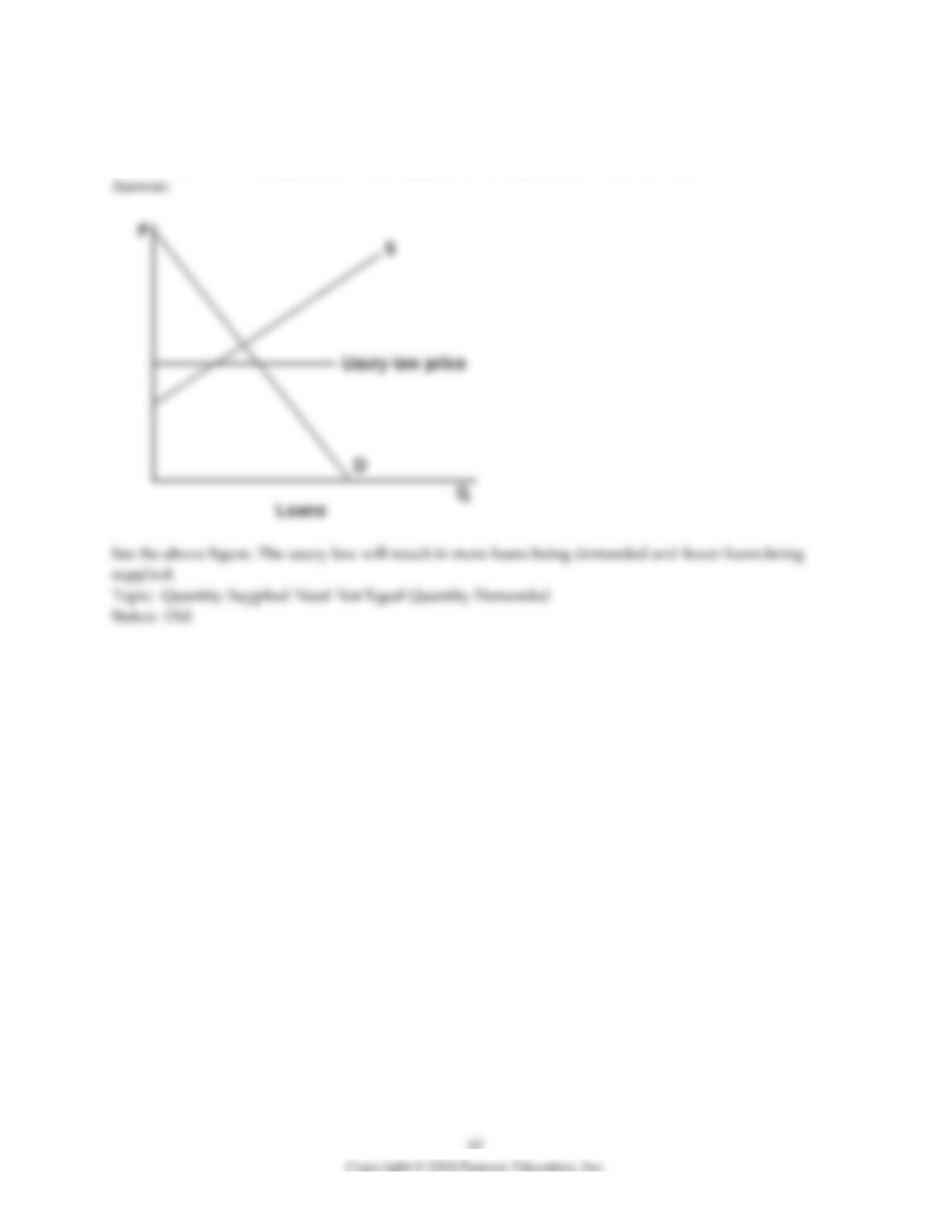
8) Usury laws place a ceiling on interest rates that lenders such as banks can charge borrowers. The
interest rate is the price of a loan. Graph a binding usury law on the market for loans, and describe the
effects of the law on the quantity of loans supplied and the quantity of loans demanded.
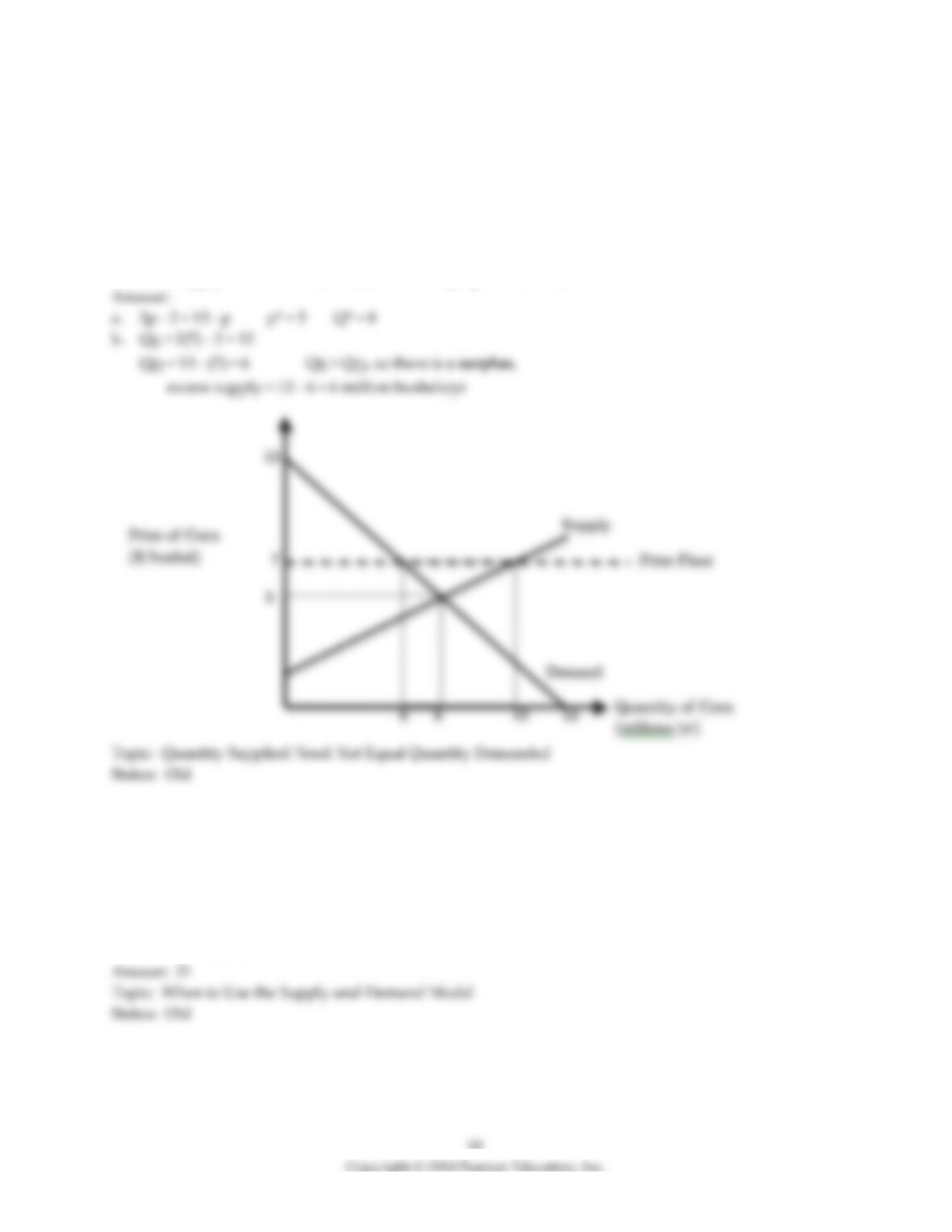
9) Suppose the market for corn is given by the following equations for supply and demand:
QS = 2p − 2
QD = 13 − p
where Q is the quantity in millions of bushels per year and p is the price.
a. Calculate the equilibrium price and quantity. Sketch the supply and demand curves on a graph
indicating the equilibrium.
b. If a price floor is imposed at $7 per bushel, will there be a surplus or a shortage? What is the quantity
of excess supply or demand that results? Draw a graph to show this.
2.8 When to Use the Supply-and-Demand Model
1) It is appropriate to use the supply-and demand-model if, in a market,
A) everyone is a price taker with full information about the price and quality of the good.
B) firms sell identical products.
C) costs of trading are low.
D) All of the above.
2) Consumers and firms are known as price takers only if
A) no market exists to determine the equilibrium price.
B) they can set the market price.
C) they cannot affect the market price.
D) excess demand exists.
3) Costs that pertain to finding a trading partner and making a trade are called
A) transaction costs.
B) transgression costs.
C) consumption costs.
D) transaction taxes.
4) It is appropriate to use the supply-and-demand model in which of the following markets?
A) beer market
B) car market
C) wheat market
D) market for breakfast cereal
For the following, please answer “True” or “False” and explain why.
5) The supply-and-demand model may not be appropriate in markets with large transaction costs.
6) Explain why the supply-and-demand model should not be used to analyze the market for jeans.