142. Which point represents an efficient level of output both before and after the shift?
a. point A d. point D
b. point B e. point E
c. point C
143. Which point represents an output that was efficient before the shift but is inefficient afterward?
a. point A d. point D
b. point B e. point E
c. point C
144. Ollie proposes that Kukla give Zola 1 table in exchange for 2 rugs. What are Kukla’s and Zola’s
reactions?
a. Kukla likes the proposal, but Zola does not.
b. Zola likes the proposal, but Kukla does not.
c. Kukla and Zola both like the proposal.
d. Neither Kukla nor Zola likes the proposal.
e. Ollie’s proposal is not feasible.
145. Ollie proposes that Kukla give Zola 2 tables in exchange for 1 rug. What are Kukla’s and Zola’s
reactions?
a. Kukla likes the proposal, but Zola does not.
b. Zola likes the proposal, but Kukla does not.
c. Kukla and Zola both like the proposal.
d. Neither Kukla nor Zola likes the proposal.
e. Ollie’s proposal is not feasible.
146. Ollie proposes that Kukla give Zola 2 tables in exchange for 2 rugs. What are Kukla’s and Zola’s
reactions?
a. Kukla likes the proposal, but Zola does not.
b. Zola likes the proposal, but Kukla does not.
c. Kukla and Zola both like the proposal.
d. Neither Kukla nor Zola likes the proposal.
e. Ollie’s proposal is not feasible.

147. When an economy shifts away from production of consumer goods and toward production of
capital goods, for the average worker this trade-off means
a. a higher standard of living.
b. longer work hours.
c. a lower savings rate (as a percentage of income).
d. more leisure time.
e. more disposable income.
148. For what kind of society does a shift away from the production of capital goods and toward the
production of consumer goods make sense?
a. a society with a scarcity of natural resources
b. a society with a high unemployment rate
c. a society with a low per-capita income
d. a society with a large per-capita stock of capital goods
e. a society with a large population
149. A poker player wins some cash. Which use of the money would most naturally be considered an
investment?
a. buying a round of drinks for everyone at a bar
b. using the money to play more poker
c. paying off debts owed to bookies
d. shopping for groceries
e. buying a book of tips for poker players
150. Why has India’s economy grown faster than the United States’ in recent years?
a. India production has focused more on consumer goods.
b. India has lowered its population growth rate.
c. India has attained a higher standard of living than the United States.
d. India’s production has focused more on capital goods.
e. India has placed more focus on its citizens’ immediate needs.
SHORT ANSWER
1. Comment on the role of models in economics. What are the strengths and weaknesses of using
them to explore the world around us?
2. How will a reduction in the national unemployment rate affect a nation’s production possibilities
frontier (PPF)?
3. What assumptions do economists make when developing a production possibilities frontier (PPF)?
4. What does it mean when society is operating inside the production possibilities frontier (PPF)?
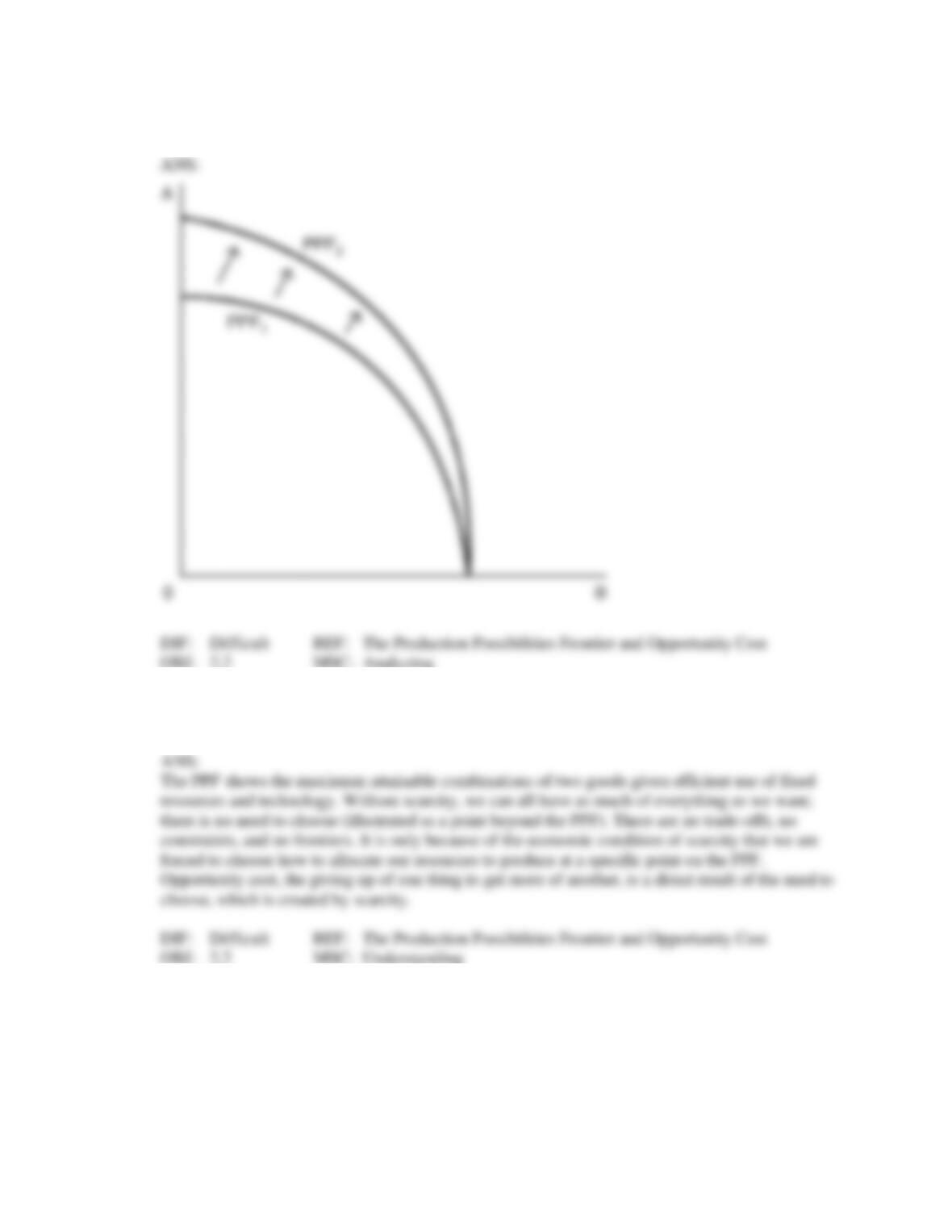
5. Draw a production possibilities frontier (PPF) for good A and good B. Suppose that these goods
are subject to increasing relative costs in production, and be sure that your graph reflects this fact.
Now suppose that a new and innovative technology enhances the production of good A but not
good B. Illustrate how this new innovation changes the production possibilities frontier (PPF).
6. Explain how scarcity is the root cause of the trade-offs and opportunity cost illustrated in the
production possibilities frontier (PPF).
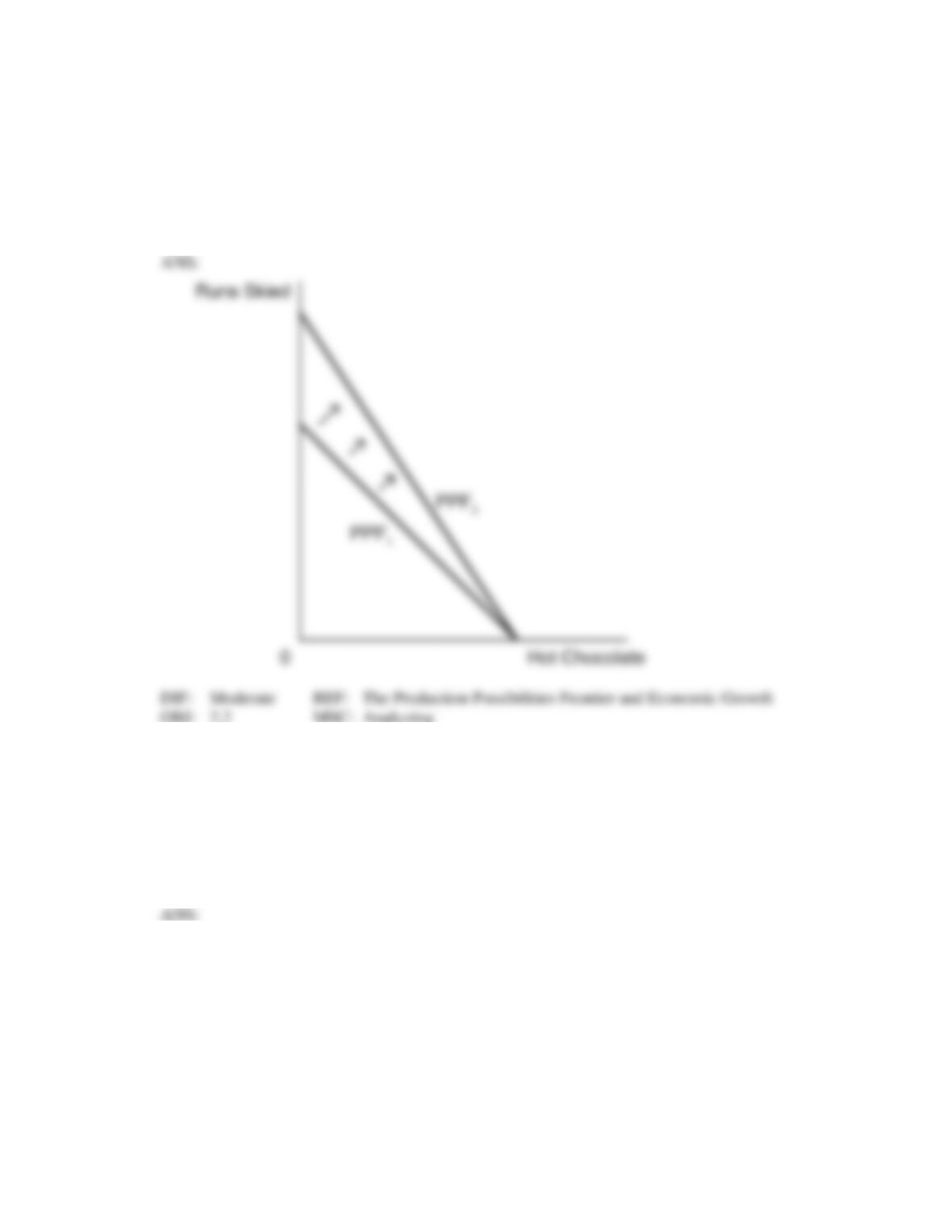
7. Suppose that, during an afternoon at Hambre’s favorite ski resort, Hambre could either make
additional runs down the slopes or produce and sip hot chocolate by the fire in the lodge. Draw a
production possibilities frontier (PPF) that describes his production trade-offs between runs skied
(by riding the chairlift to the top and skiing down the slope) versus cups of hot chocolate produced
and sipped. Hambre’s production of each of these goods is subject to constant marginal
opportunity costs in production, so be sure that, in the graph, the opportunity cost of one activity in
terms of the other is the same at any point on the PPF.
Now suppose that a new superfast ski lift reduces the time it takes to get to the top of the mountain.
Show, on the same graph, how this changes the PPF.
8. Suppose that during Coco’s afternoon shift working at the library, she could either reshelve books
or process interlibrary loan (ILL) requests. Draw a production possibilities frontier (PPF) that
describes Coco’s production trade-offs. Her production of each of these goods is subject to
increasing relative costs in production, so be sure that the graph reflects this fact.
Now suppose that a new online request system increases Coco’s efficiency at processing ILL
requests but does not affect her reshelving ability. Show, on the same graph, how this new
innovation changes the PPF.
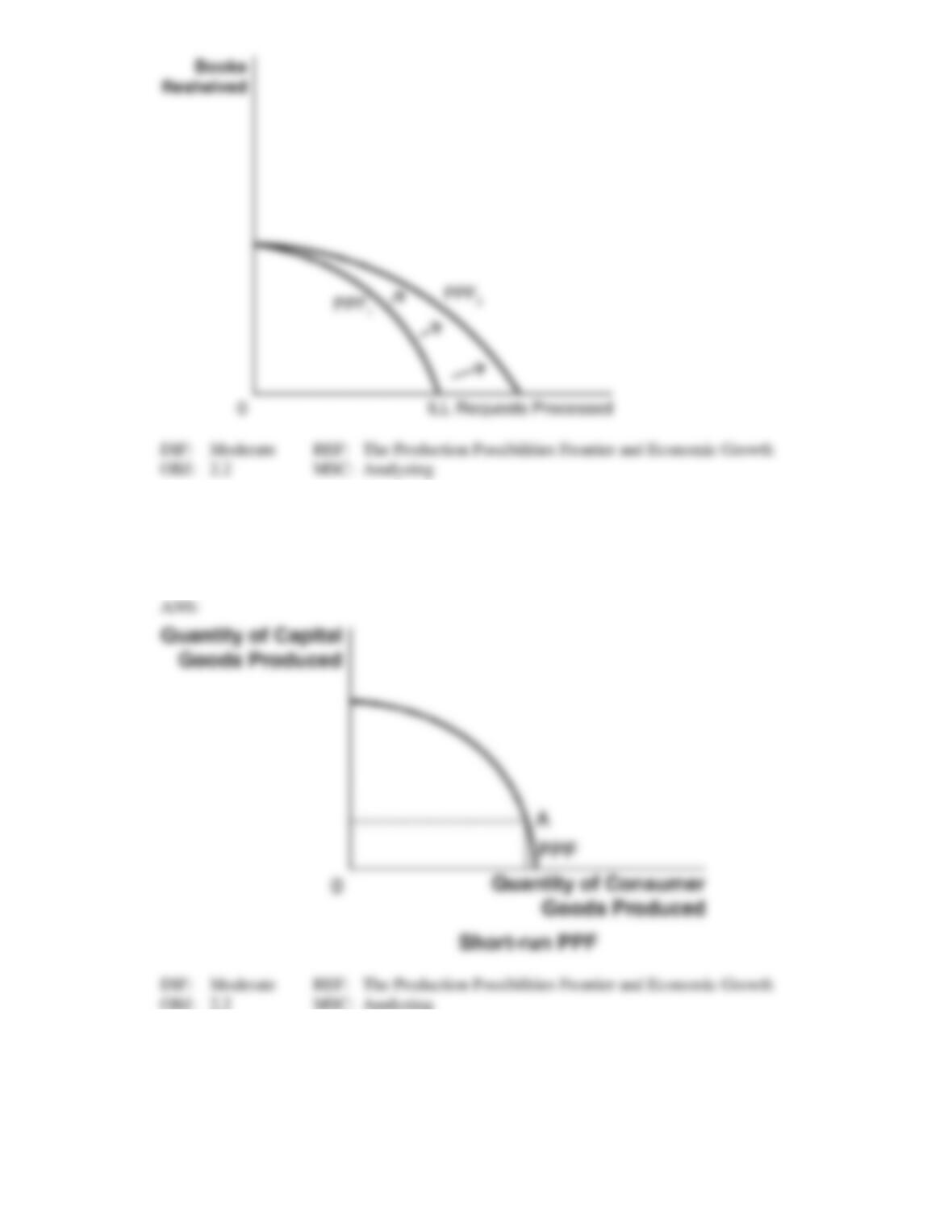
9. Draw a production possibilities frontier (PPF) that shows a pizza shop’s production trade-offs
between producing pizzas and stromboli. Suppose the pizza shop upgrades to a larger, more
automated oven. On the same graph, show how the PPF changes. (The oven is used to bake both
pizzas and stromboli.)
10. Kristen is planning to add new mulch to all the landscaping beds around her house. She has
determined the quantity of mulch she will need and identified these two options for getting the
mulch to her house:
1. Kristen can have all the mulch delivered to her yard in one dump truck for $450.
2. Kristen can make four trips to the garden center with her pickup truck and haul it herself. It
will cost her $75 per load for the mulch, plus $25 in fuel and truck wear per load. She estimates
it will take about five hours to haul and unload all four loads.
What is the full cost of each method? Which method is cheaper? How is opportunity cost relevant?
11. How can a person who is “better” or more efficient (in that he or she has an absolute advantage in
the production of various goods on the PPF) at producing several things be made even better off by
specialization and trade?
12. The existing entries in the following table show the maximum quantities of milk shakes or fruit
smoothies the college president and dining hall staffer could make during an afternoon shift, given
a fixed amount of resources.
a. Fill in the remaining part of the table (be sure to label the units) and answer the questions
below.
Number of Milk Shakes per Shift Number of Smoothies
per Shift Opportunity
Cost of 1
Smoothie Opportunity
Cost of 1
Milk Shake
President 50 25
Dining Hall Staffer 90 30
b. Who has a comparative advantage in producing smoothies?
c. Who has an absolute advantage in producing milk shakes?
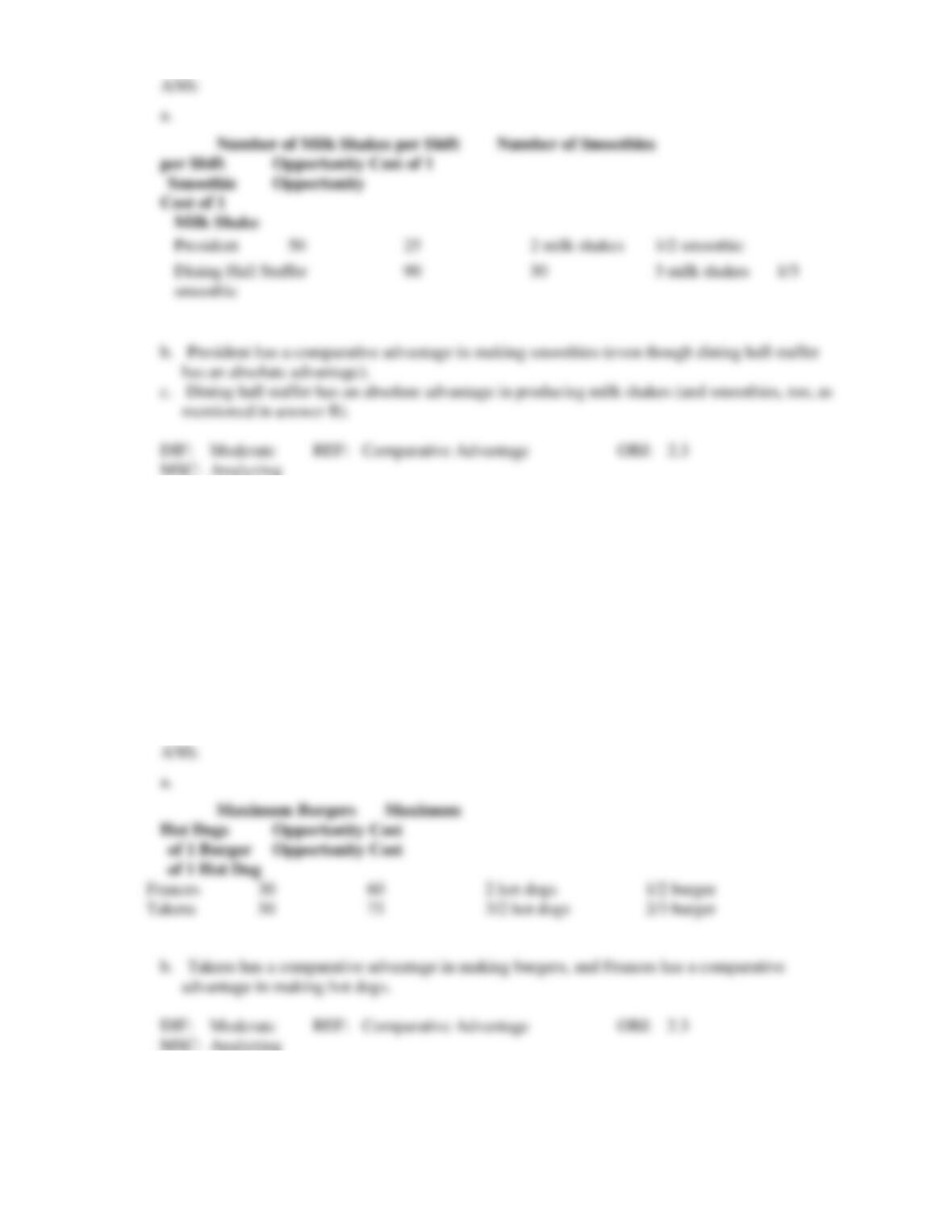
13. The table below shows the maximum number of burgers or hot dogs that Frances and Takeru can
cook in one hour.
a. Fill in the rest of the table with the opportunity cost of burgers and hot dogs for each person.
Be sure to include the units.
b. Identify who has a comparative advantage in producing each good.
Maximum Burgers Maximum Hot Dogs Opportunity Cost
of 1 Burger Opportunity Cost
of 1 Hot Dog
Frances 30 60
Takeru 50 75
14. Why might Shaquille O’Neal, a 7「1イ former National Basketball Association (NBA) player, hire
professional movers to help him move, even though his size and strength likely make him more
proficient (better) at furniture moving than the professionals he may hire?
15. Why doesn’t our society invest more resources into the production of capital goods to enhance the
level of growth in our future production possibilities frontier (PPF)?
16. In the movie A Knight’s Tale, three peasants win a jousting tournament and must decide whether
they should enjoy most of their winnings now or use most of it for training to improve their future
jousting performances. Use appropriate production possibilities frontiers (PPFs) and words to
describe the investment trade-off they face.
17. Is it always better to forgo current consumption in order to invest more in capital goods that will
provide more growth in society’s production possibilities frontier (PPF) and make us better off in
the future?
18. Physicists can conduct experiments to study subatomic particles, even though no one has ever seen
or photographed a subatomic particle. Experimental psychologists can study emotions, even
though no one has ever seen or photographed an emotion. How can there be experiments in these
areas of study? What are the implications for the science of economics?
19. Explain why, ultimately, the opportunity cost of producing consumer goods instead of capital
goods must be defined in terms of consumer goods.
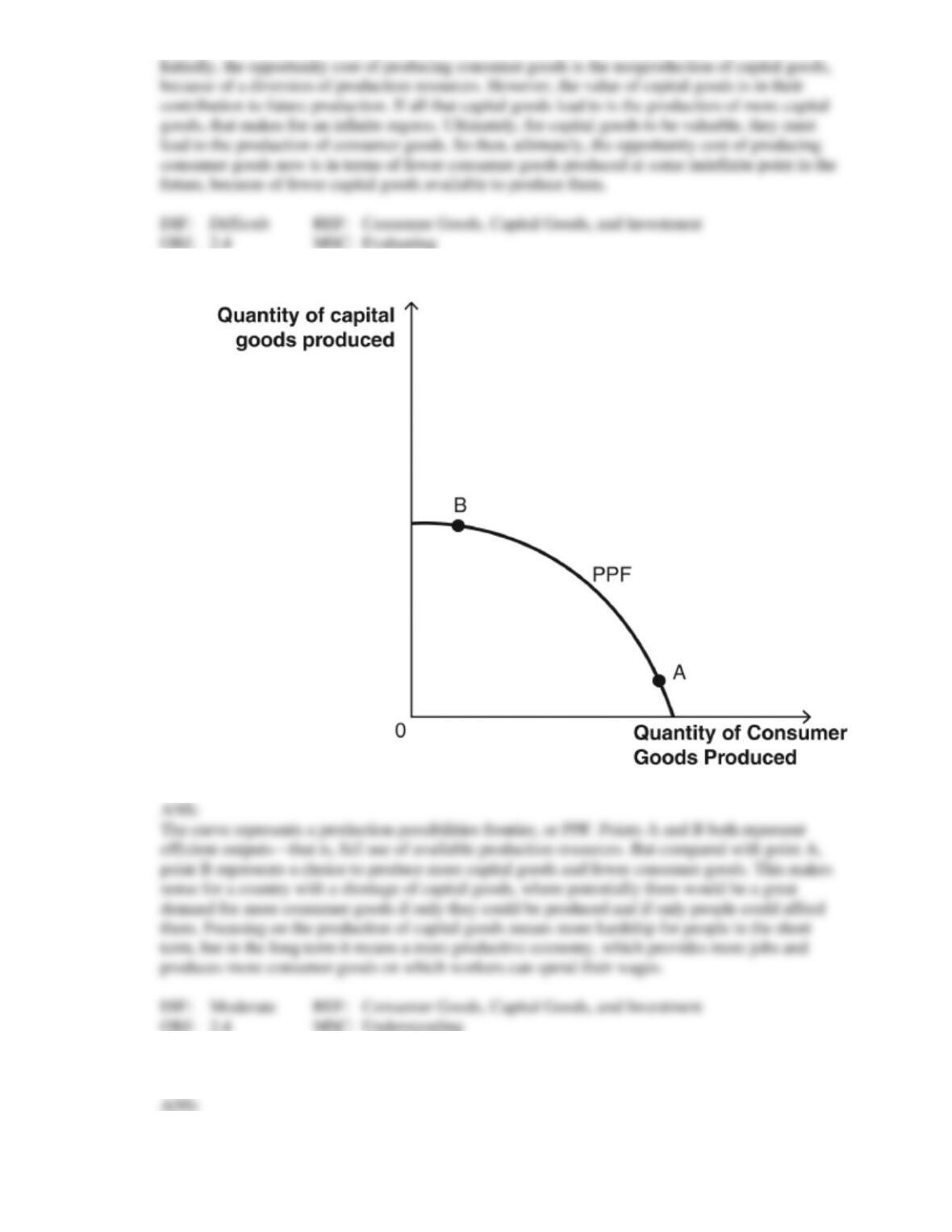
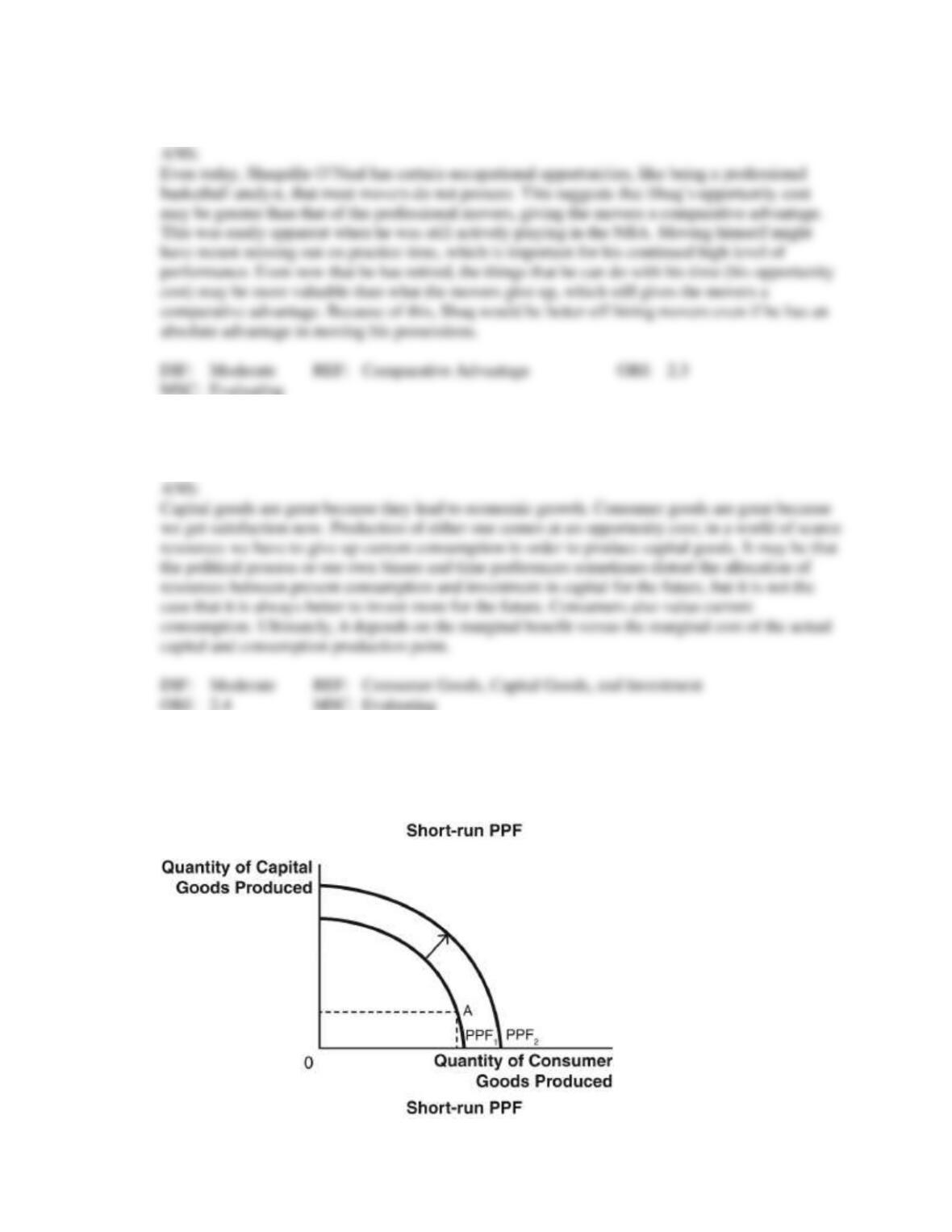
20. Explain why, in the figure, a country might rather be at point B than at point A.
21. Explain how trading of goods creates value without creating any new goods.
22. Why is the concept of ceteris paribus important for model building?
23. When economists use models to make predictions, faulty assumptions can have disastrous
consequences. Why is “avoid making assumptions” not the solution to this problem? Use the
concepts of endogenous and exogenous factors to explain.
24. When it comes to making ceramic plates and cups, Reza has a comparative advantage over Greta.
When it comes to making knives, forks, and spoons, Greta has a comparative advantage over Reza.
If Reza and Greta plan to engage in trade for mutual gain, does the concept of opportunity cost
enable them to determine exactly what trading ratio of place settings to silverware sets they should
use? Why or why not?

25. Even though person A has an absolute advantage over person B both at producing good X and at
producing good Y, it can still make sense for persons A and B to engage in trade involving goods
X and Y. Explain why this is so.