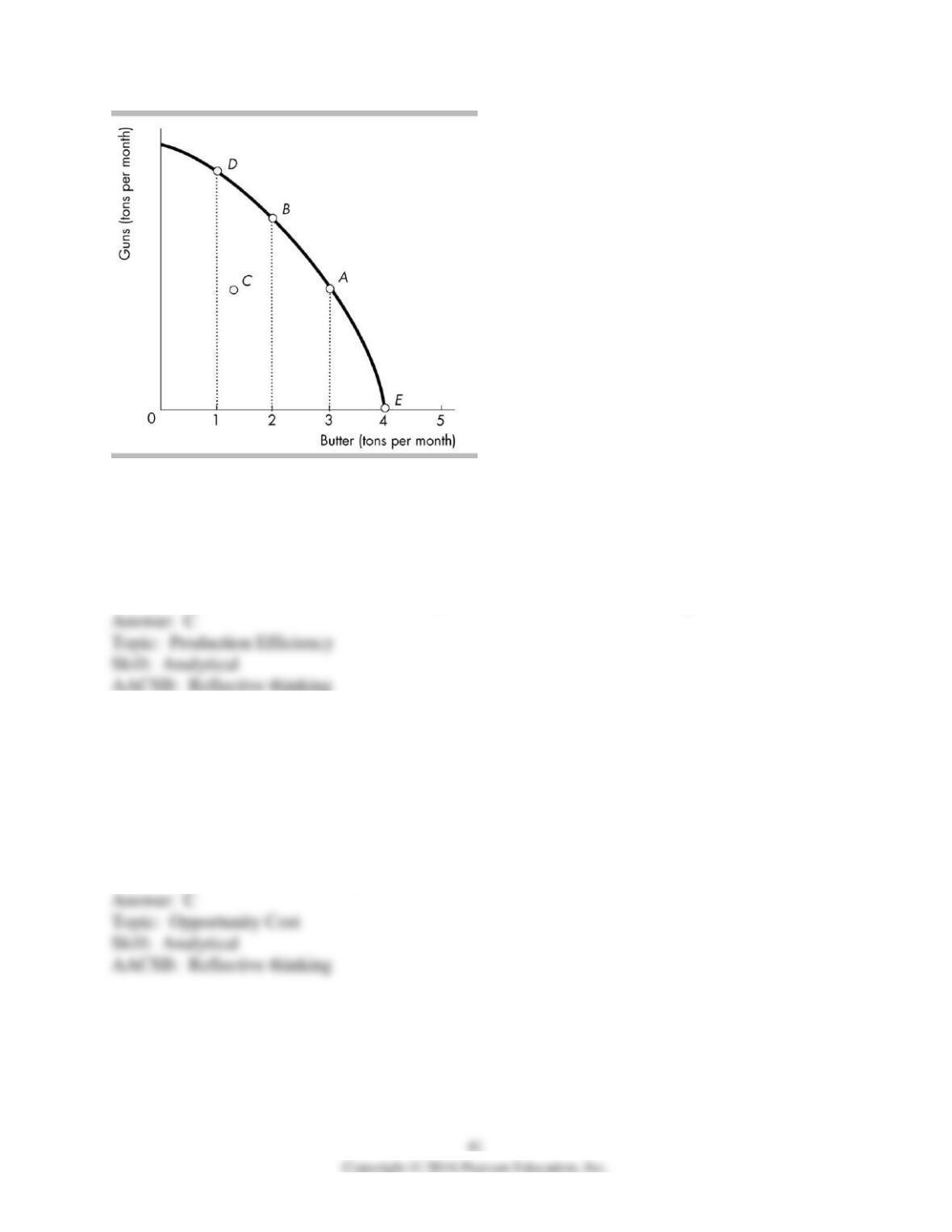
123) In the figure above, the point labeled C in the production possibilities frontier
A) is unattainable; it is beyond the productive capability of this country.
B) represents a highly desirable output level in the long run, because it conserves scarce
resources.
C) represents either unemployed or inefficiently utilized resources.
D) represents the maximum sustainable output level for this nation in the long run.
124) The country whose production possibilities frontier is illustrated above is currently at
position A on the production possibilities frontier. If it wishes to move to position B, it will
A) find this change impossible to achieve given the resources it currently possesses.
B) have to employ all currently unemployed resources to accomplish this.
C) incur an opportunity cost of having to give up some butter in order to make the additional
amount of guns desired.
D) be able to make the desired switch only if there is a significant improvement in the
technology available to the nation.
125) In the figure above, moving from point B to point D
A) has an opportunity cost of one ton of butter per month.
B) has an opportunity cost of one ton of guns per month.
C) requires an increase in technology.
D) is impossible.
126) In the figure above, which of the following movements has the largest opportunity cost?
A) from point C to point B
B) from point C to point A
C) from point B to point A
D) from point A to point E
127) A PPF, such as the one above, that bows outward illustrates
A) decreasing opportunity cost.
B) increasing opportunity cost.
C) that technology is improving.
D) that productivity is falling.
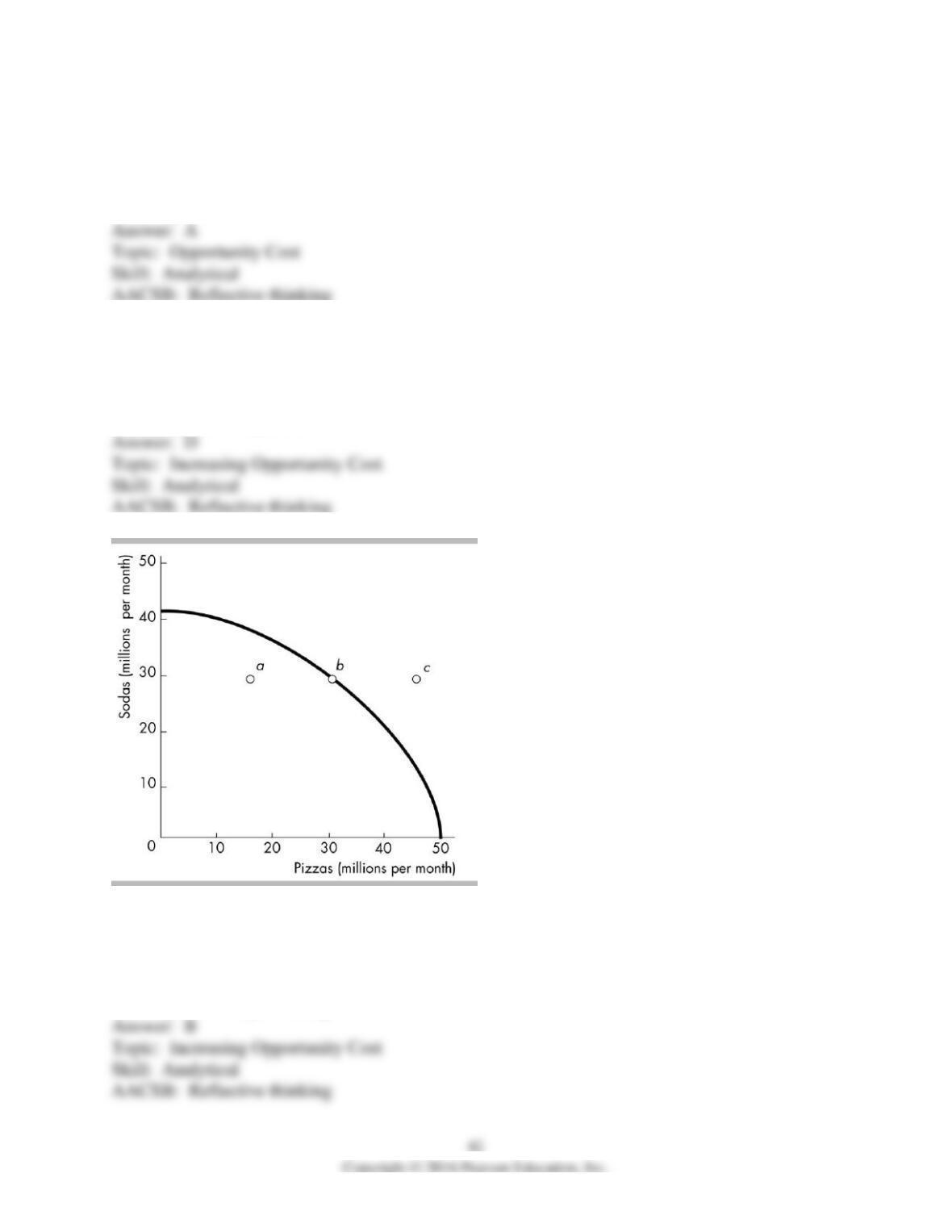
128) In the figure above
A) moving from point a to point b would require new technology.
B) production at point b is efficient whereas production at point a is not efficient.
C) some resources must be unemployed at point c.
D) opportunity costs are decreasing.
129) As we increase the production of computers, we find that we must give up larger and larger
amounts of DVD players per computer.
A) This situation illustrates increasing opportunity cost.
B) As a result, we should specialize in the production of DVD players.
C) The production possibilities frontier for computers and DVD players is a straight line.
D) DVD players will be more highly regarded by consumers than computers.
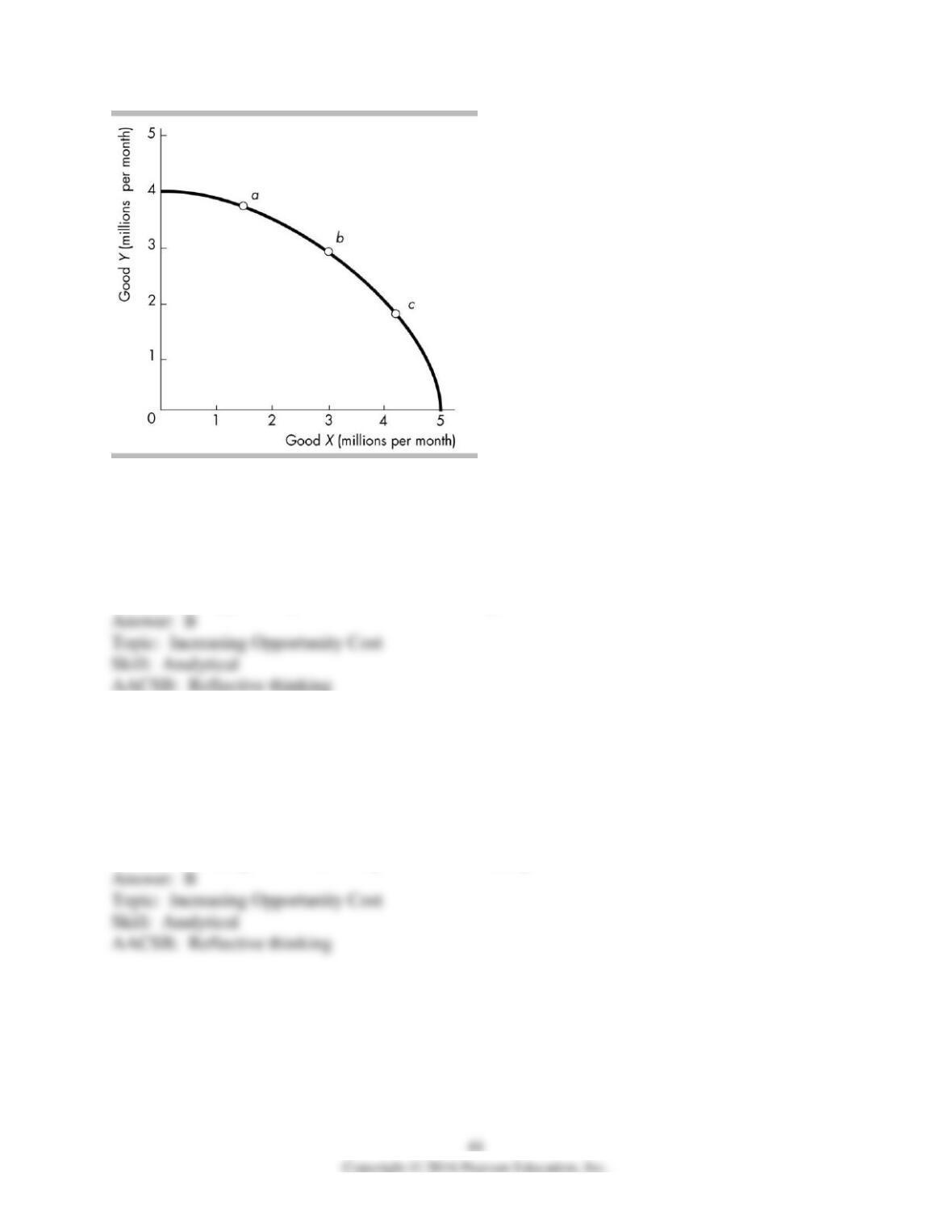
130) As output moves from point a to point b to point c along the PPF in the above figure, the
opportunity cost of one more unit of good X
A) rises. The opportunity cost of one more unit of good Y also rises.
B) rises. The opportunity cost of one more unit of good Y falls.
C) falls. The opportunity cost of one more unit of good Y rises.
D) falls. The opportunity cost of one more unit of good Y also falls.
131) Refer to the production possibilities frontier in the figure above. More of good X must be
given up per unit of good Y gained when moving from point b to point a than when moving from
point c to point b. This fact
A) illustrates decreasing opportunity cost.
B) illustrates increasing opportunity cost.
C) indicates that good X is more capital intensive than good Y.
D) indicates that good Y is more capital intensive than good X.
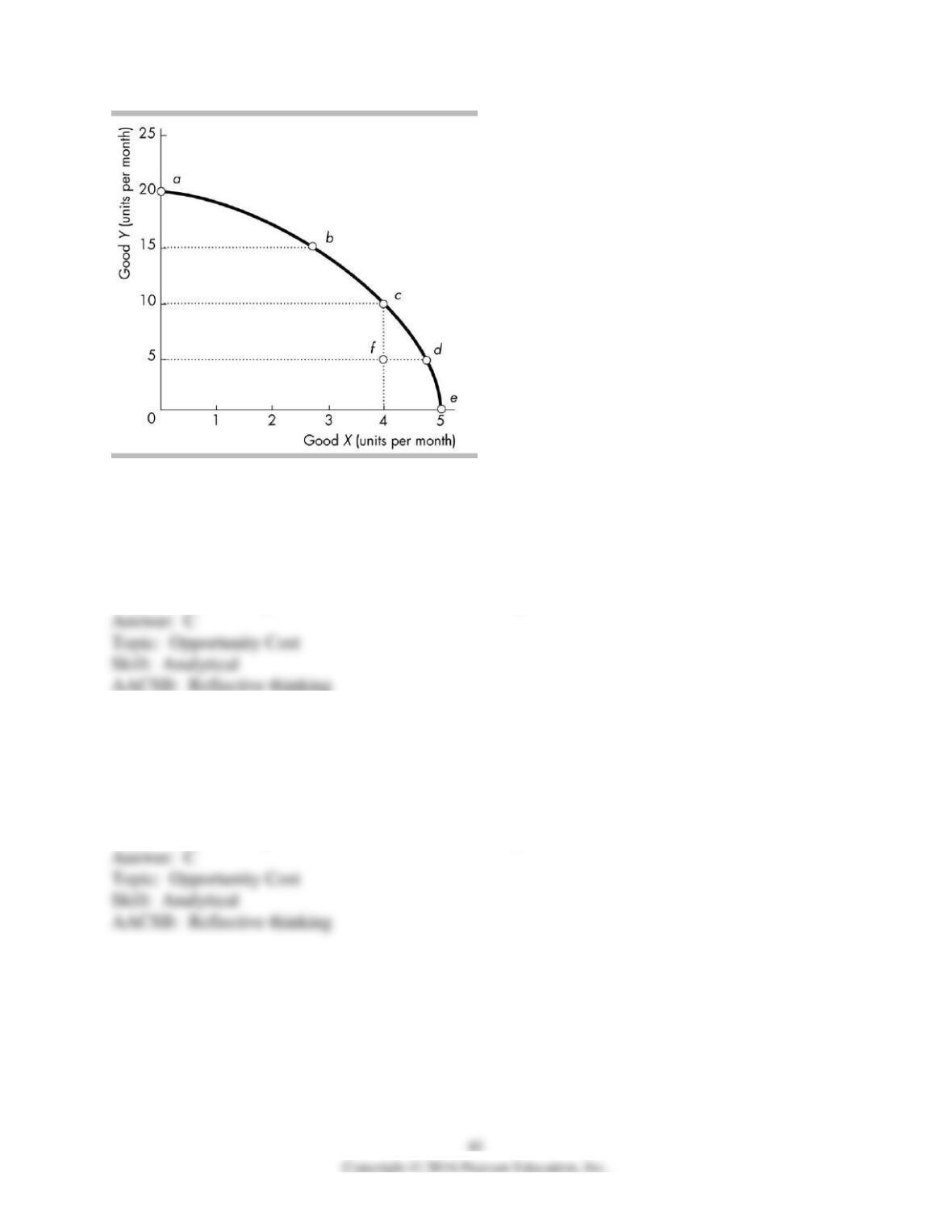
132) The figure above illustrates Mary’s production possibilities frontier. If Mary wants to move
from point b to point c, she must
A) improve technology.
B) increase the accumulation of capital.
C) give up some of good Y in order to obtain more of good X.
D) give up some of good X in order to obtain more of good Y.
133) The above figure illustrates Mary’s production possibilities frontier. If Mary wants to move
from point d to point c, she must
A) improve technology.
B) increase her accumulation of capital.
C) give up some of good X in order to obtain more of good Y.
D) give up some of good Y in order to obtain more of good X.
134) The above figure illustrates Mary’s production possibilities frontier. Which of the following
movements show opportunity costs increasing?
A) point a to point b to point c
B) point a to point f
C) point f to point a
D) point c to point f to point d
135) Refer to the production possibilities frontier figure above. Which of the following
movements requires the largest opportunity cost, in terms of good X forgone, per extra unit of
good Y?
A) from point e to point d
B) from point d to point c
C) from point c to point b
D) from point b to point a
136) Refer to the production possibilities frontier in the figure above. Which of the following
movements requires the largest opportunity cost, in terms of good Y forgone, per extra unit of
good X?
A) from point a to point b
B) from point b to point c
C) from point c to point d
D) from point d to point e
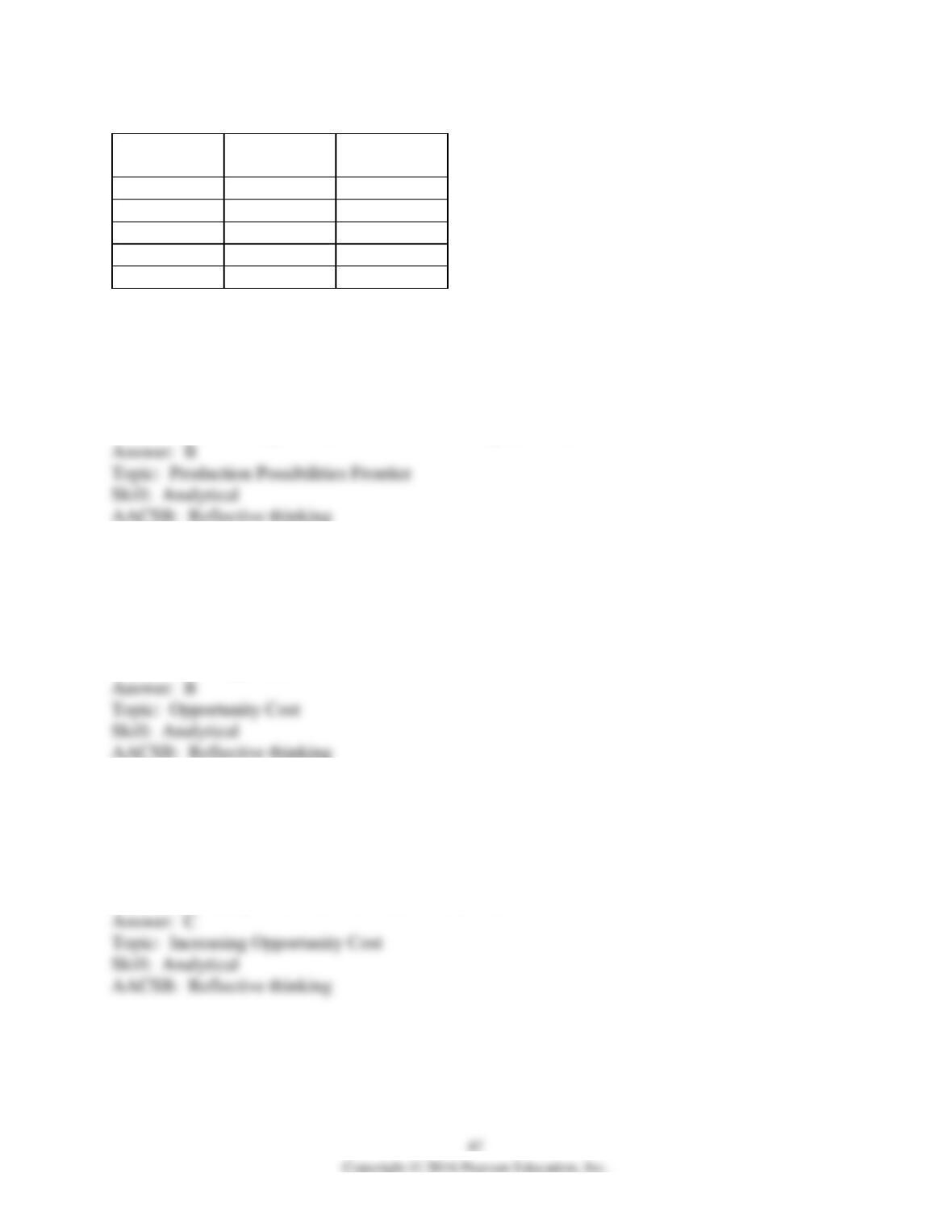
Point
Production
of X
Production
of Y
a
0
40
b
4
36
c
8
28
d
12
16
e
16
0
137) Refer to the table above, which gives five points on a nation’s PPF. The production of 7
units of X and 28 units of Y is
A) impossible given the available resources.
B) possible but leaves some resources less than fully used or misallocated.
C) on the production possibilities frontier between points c and d.
D) on the production possibilities frontier between points b and c.
138) Refer to the table above, which gives five points on a nation’s PPF. The opportunity cost of
increasing the production of Y from 16 to 36 units is a total of
A) 1/5 unit of X per unit of Y.
B) 2/5 unit of X per unit of Y.
C) 1/2 unit of X per unit of Y.
D) 3/5 unit of X per unit of Y.
139) Refer to the table above, which gives five points on a nation’s PPF. As we increase the
production of X,
A) the output of Y increases.
B) unemployment increases.
C) the opportunity cost of each new unit of X increases.
D) the opportunity cost of each new unit of X decreases.
140) If the United States can increase its production of automobiles without decreasing its
production of any other good, the United States must have been producing at a point
A) within its PPF.
B) on its PPF.
C) beyond its PPF.
D) None of the above is correct because increasing the production of one good without
decreasing the production of another good is impossible.
141) Production points inside the PPF are
A) efficient but not attainable.
B) efficient and attainable.
C) inefficient and not attainable.
D) inefficient and attainable.
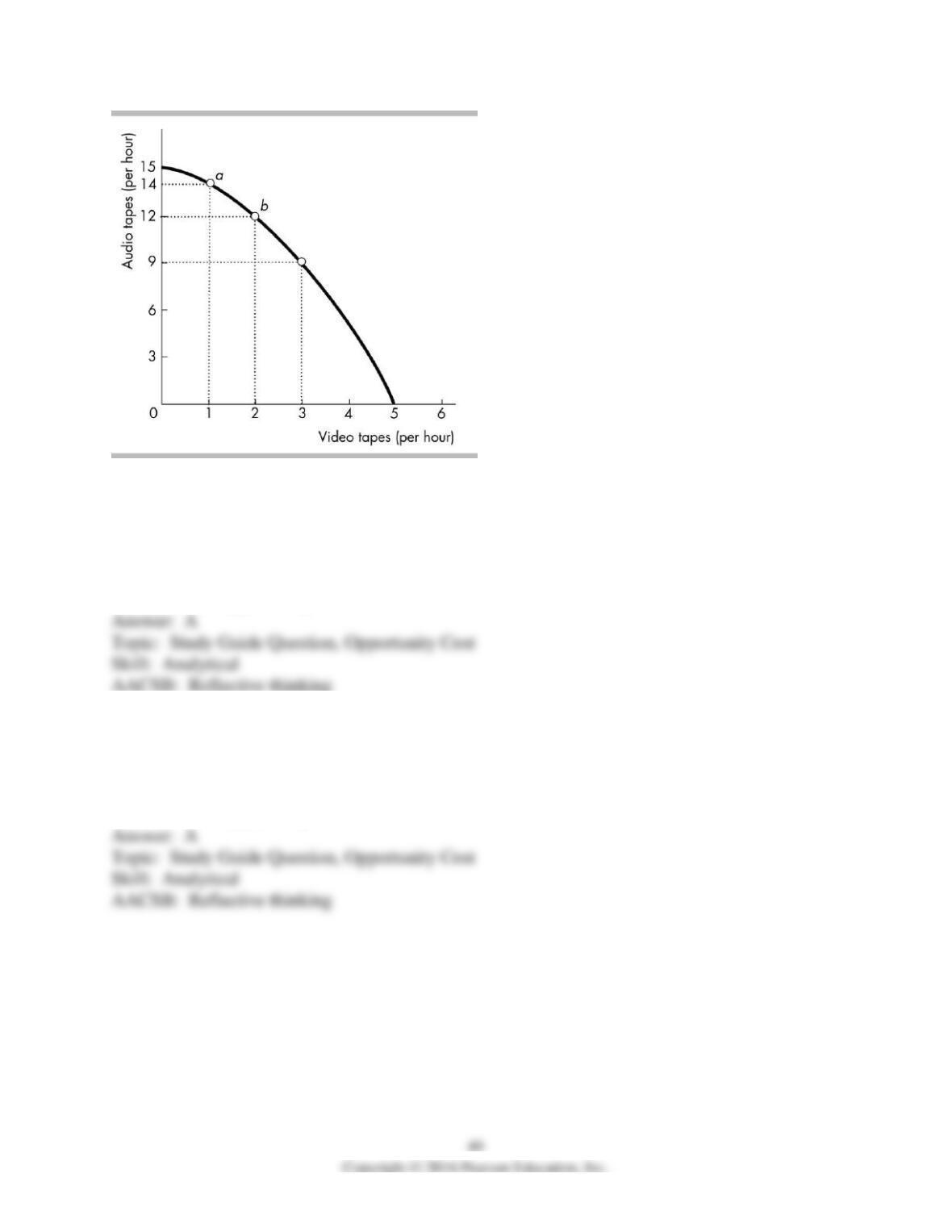
142) In the above figure, at point a what is the opportunity cost of producing one more audio
tape?
A) 1 video tape per audio tape
B) 2 video tapes per audio tape
C) 14 video tapes per audio tape
D) There is no opportunity cost.
143) In the above figure, at point b what is the opportunity cost of producing 2 more audio tapes?
A) 1/2 video tape per audio tape
B) 1 video tape per audio tape
C) 6 video tapes per audio tape
D) There is no opportunity cost.
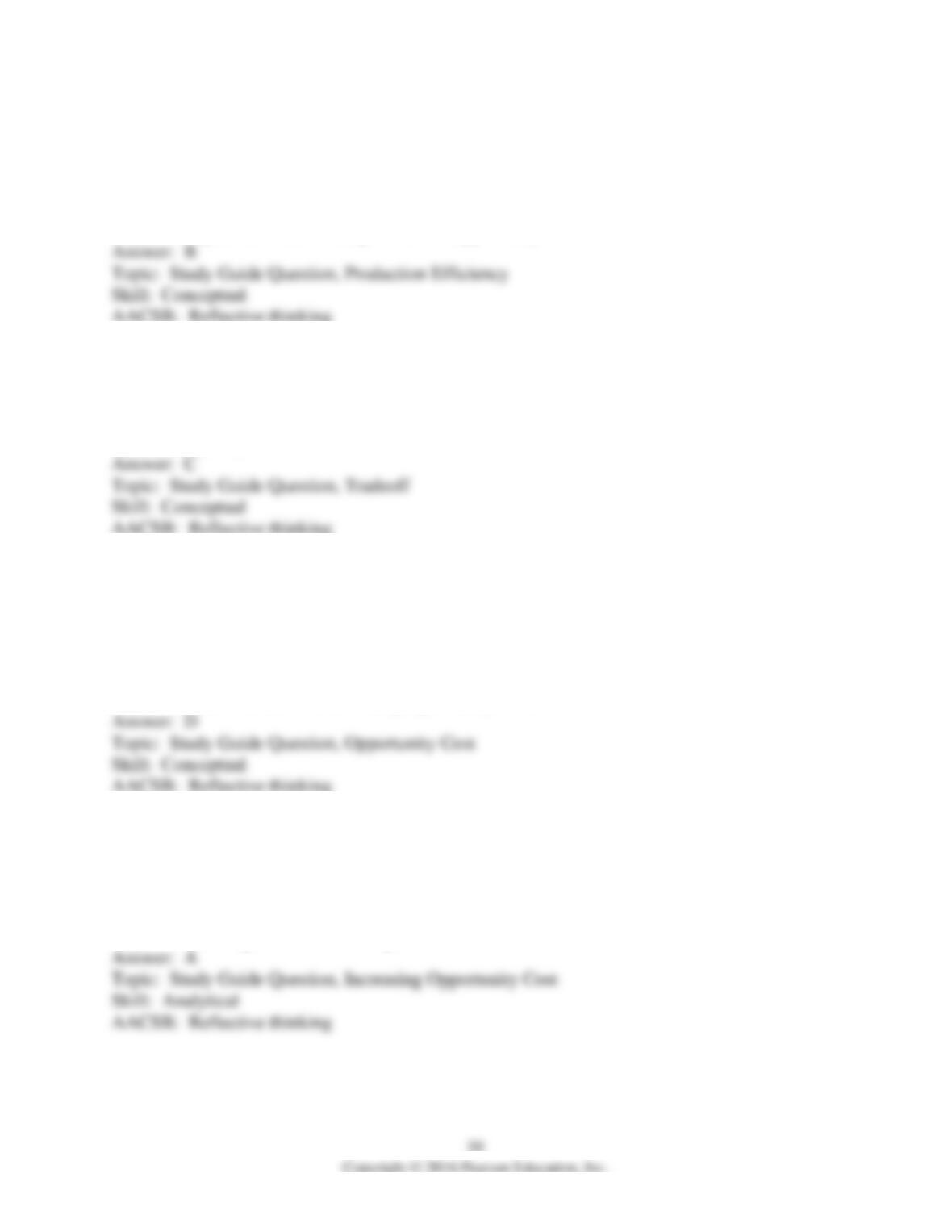
144) Production efficiency means that
A) scarcity is no longer a problem.
B) producing more of one good is possible only if the production of some other good is
decreased.
C) as few resources as possible are being used in production.
D) producing another unit of the good has no opportunity cost.
145) The existence of the tradeoff along the PPF means that the PPF is
A) bowed outward.
B) linear.
C) negatively sloped.
D) positively sloped.
146) The bowed-outward shape of a PPF
A) is due to capital accumulation.
B) reflects the unequal application of technology in production.
C) illustrates the fact that no opportunity cost is incurred for increasing the production of the
good measured on the horizontal axis but it is incurred to increase production of the good
measured along the vertical axis.
D) is due to the existence of increasing opportunity cost.
147) Moving along a bowed-out PPF between milk and cotton, as more milk is produced the
marginal cost of an additional gallon of milk
A) rises.
B) does not change.
C) falls.
D) probably changes, but in an ambiguous direction.
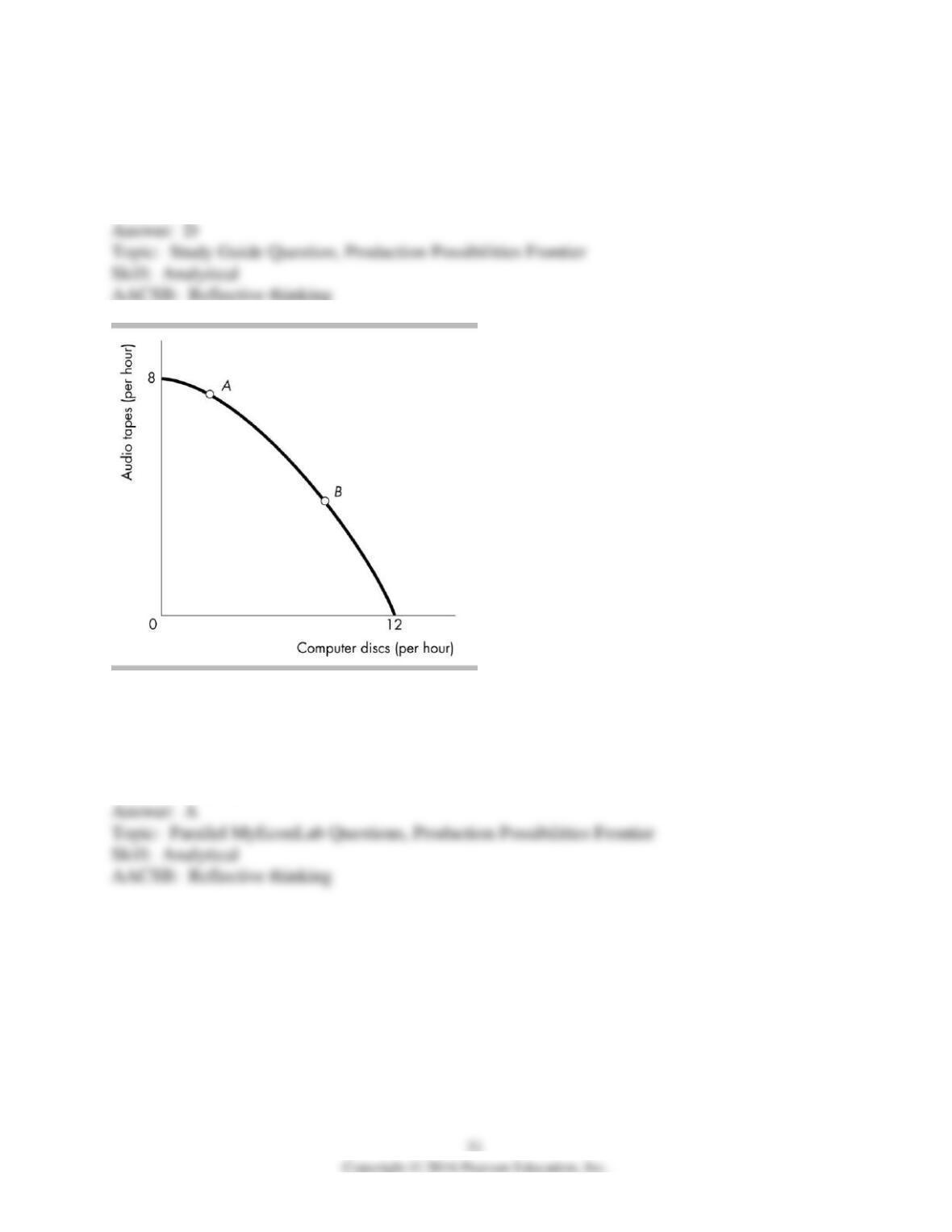
148) A nation can produce at a point outside its PPF
A) when it trades with other nations.
B) when it produces inefficiently.
C) when its PPF is bowed out.
D) never.
149) In the above figure, point A is ________, and point B is ________.
A) attainable, attainable
B) attainable, unattainable
C) unattainable, attainable
D) unattainable, unattainable
150) Abe can catch 15 pounds of fish an hour or pick 30 pounds of fruit an hour. He works an 8-
hour day, spending 5 hours picking fruit and 3 hours catching fish. Calculate Abe’s opportunity
cost of a pound of fruit.
A) 6 minutes
B) 3 hours a day
C) 2 pounds of fish
D) 0.5 pounds of fish
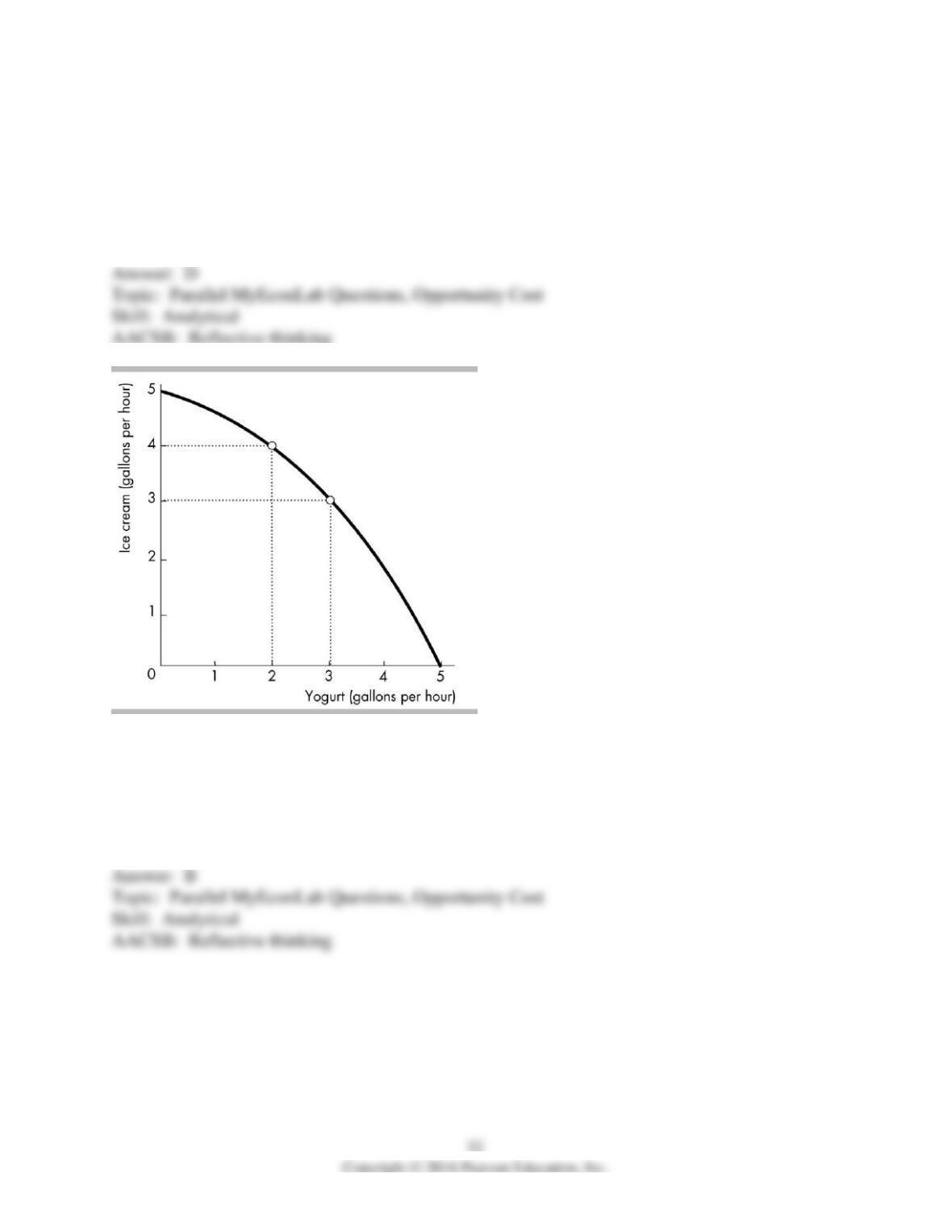
151) In the figure above, if the quantity of yogurt produced increases from 2 gallons an hour to 3
gallons an hour, the opportunity cost of a gallon of yogurt in terms of ice cream is
A) half a gallon.
B) 1 gallon.
C) 3 gallons.
D) 4 gallons.
152) Claire and Dag are farmers who produce beef and corn. In a year, Claire can produce 16
tons of beef or 40 bushels of corn, while Dag can produce 5 tons of beef or 25 bushels of corn.
The opportunity cost of producing a ton of beef is
A) 10 bushels of corn for Dag and 8 bushels of corn for Claire.
B) 5 bushels of corn for Dag and 2.5 bushels of corn for Claire.
C) 20 bushels of corn for Dag and 50 bushels of corn for Claire.
D) 36.5 days for Dag and 45.6 days for Claire.
153) Abe can catch 10 pounds of fish an hour or pick 10 pounds of fruit. Zeb can catch 30
pounds of fish an hour or pick 20 pounds of fruit. The opportunity cost of fish is ________ for
Abe than for Zeb, and the opportunity cost of fruit is ________ for Abe than for Zeb.
A) higher, lower
B) lower, higher
C) higher, higher
D) lower, lower
2 Using Resources Efficiently
1) Marginal cost is the opportunity cost
A) that your activity imposes on someone else.
B) that arises from producing one more unit of a good or service.
C) of a good or service that exceeds its benefit.
D) of a good or service divided by the number of units produced.
2) Marginal cost is the ________ one more unit of a good and ________ of the good increases.
A) opportunity cost of producing; increases as production
B) opportunity cost of producing; decreases as production
C) price that must be paid to consume; increases as consumption
D) price that must be paid to consume; decreases as consumption
3) Moving along a PPF, marginal cost is
A) the cost of producing the first unit of a good or service.
B) the total cost, less the production of the other good or service.
C) greater than the opportunity cost.
D) equal to the opportunity cost of producing one more unit of a good or service.
4) The quantity of shoes produced is measured along the horizontal axis of a PPF and the
quantity of shirts is measured along the vertical axis. As you move down toward the right along
the PPF, the marginal cost of
A) shoes decreases.
B) shoes increases.
C) shirts increases.
D) shoes and shirts is equal at the midpoint between the vertical and horizontal axis.
5) Marginal cost
A) increases as more is produced.
B) remains constant as more is produced.
C) decreases as more is produced.
D) decreases as marginal benefits decrease.
6) When the opportunity cost of producing more of a good is increasing, the marginal cost of
producing more of the good is
A) decreasing.
B) constant.
C) increasing.
D) More information is needed to answer the question.
7) A marginal cost curve
A) is upward sloping.
B) shows that as more of a good is produced, opportunity costs of producing another unit
increase.
C) is bowed inward so that its slope can become negative.
D) Both answers A and B are correct.
Quantity of beans
(bushels)
Quantity of
carrots
(bushels)
5
0
4
5
8
9
2
12
1
14
0
15
8) The table above represents different points along a production possibilities curve. What is the
marginal cost of moving from 2 bushels to 3 bushels of beans?
A) 9 bushels of carrots per bushel of beans
B) 12 bushels of carrots per bushel of beans
C) 3 bushels of carrots per bushel of beans
D) 21 bushels of carrots per bushel of beans
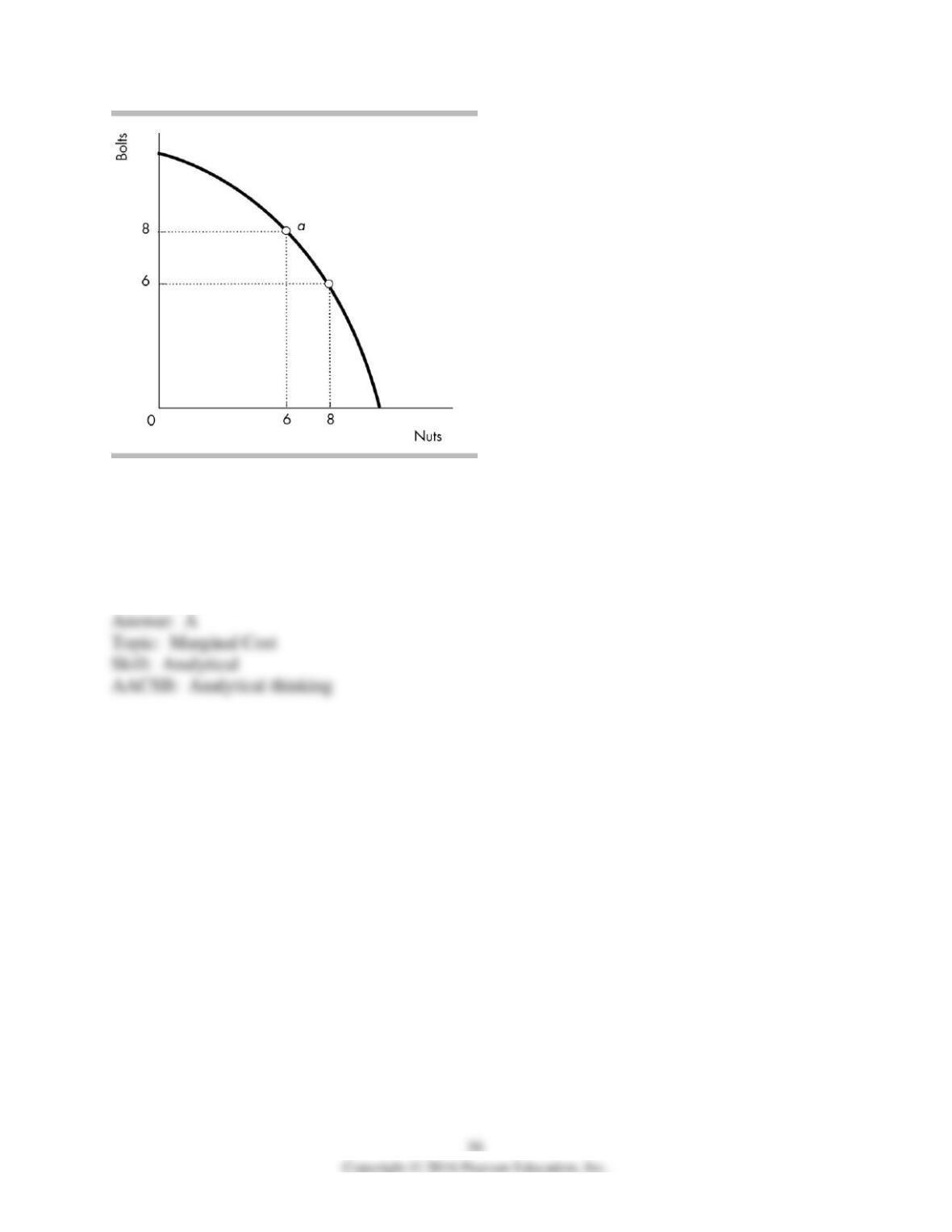
9) Victor currently produces nuts and bolts at point a in the figure. Victor’s marginal cost of
producing an additional nut is ________.
A) 1 bolt per nut
B) 1/2 bolt per nut
C) 8/6 bolts per nut
D) 8 bolts per nut
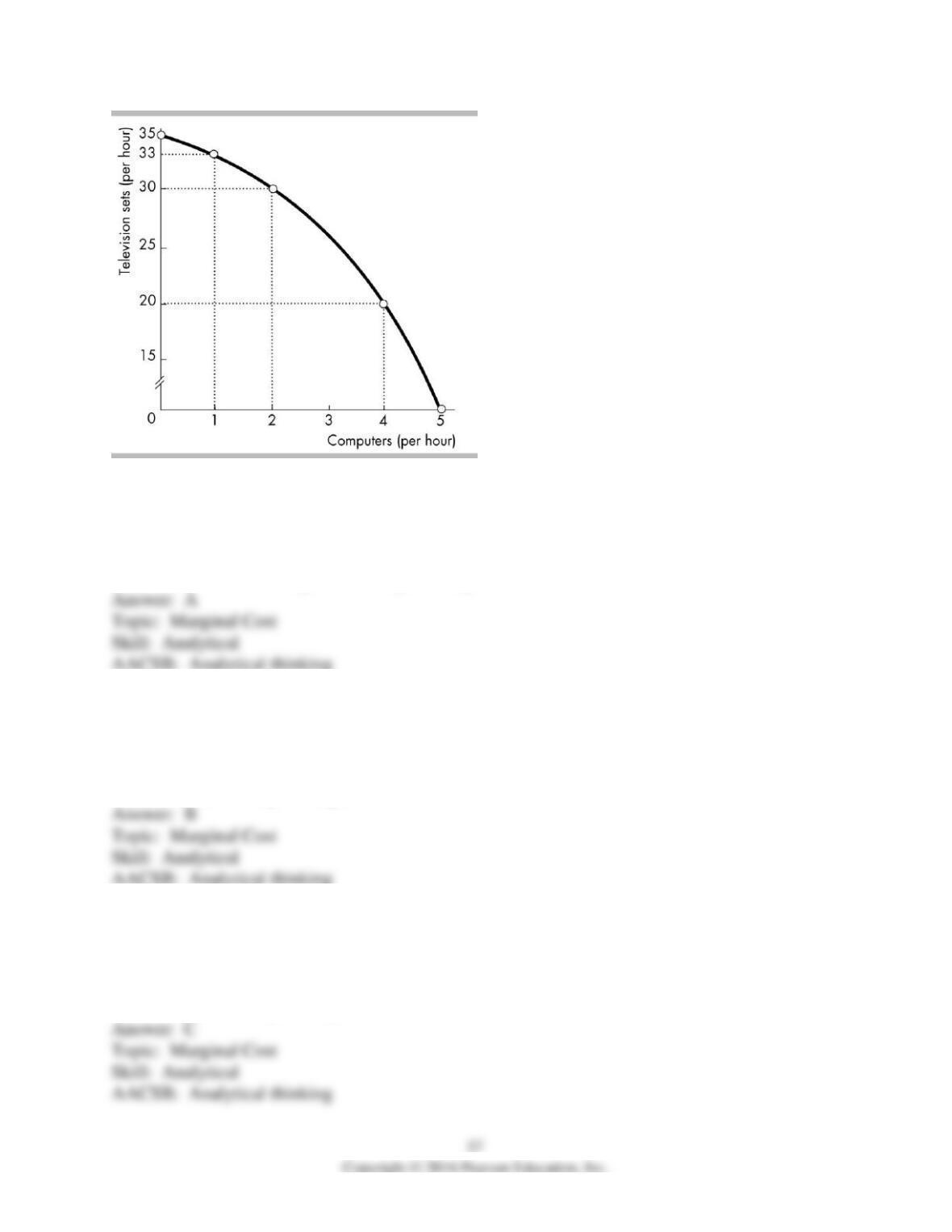
10) In the figure above, the marginal cost of producing a computer
A) increases as more computers are produced.
B) stays the same as more computers are produced.
C) decreases as more computers are produced.
D) is the same as the marginal cost of producing a television set.
11) In the figure above, the marginal cost of the second computer is
A) 2 television sets per computer.
B) 3 television sets per computer.
C) 5 television sets per computer.
D) 30 television sets per computer.
12) In the figure above, the marginal cost of the fifth computer is
A) 0 television sets per computer.
B) 4 television sets per computer.
C) 20 television sets per computer.
D) 35 television sets per computer.
13) Marginal cost curves slope
A) upward because of increasing opportunity cost.
B) upward because of decreasing opportunity cost.
C) downward because of increasing opportunity cost.
D) downward because of decreasing opportunity cost.
14) Marginal benefit is the benefit
A) that your activity provides to someone else.
B) of producing a good or service when the total benefit from the good or service exceeds its
total cost.
C) that is received from consuming one more unit of a good or service.
D) of consuming another good or service divided by the total number of goods or services
produced.
15) Marginal benefit is the
A) benefit that a person receives from consuming one more unit of a good or service.
B) amount of one good or service that a person gains when another good or service is consumed.
C) minimum amount a person is willing to pay for one more unit of a good or service.
D) dollars sacrificed to purchase a good or service.
16) The marginal benefit from a good is the amount a person is willing to pay for
A) all of the good the person consumes.
B) one more unit of the good.
C) all of the units of the good the person consumes divided by the number of units he or she
purchases.
D) one more unit of the good divided by the number of units purchased.
17) We measure the marginal ________ of a good by what a ________ for another unit of the
good.
A) benefit; person must pay
B) cost; person is willing to pay
C) benefit; person is willing to pay
D) cost; person’s preferences are
18) The marginal benefit of a good or service
A) increases as more is consumed.
B) decreases as more is consumed
C) remains constant as more is consumed.
D) decreases as less is consumed
19) The principle of decreasing marginal benefit means that as the quantity of a good consumed
A) decreases, its marginal benefit decreases.
B) increases, its marginal benefit decreases.
C) increases, its total benefit decreases.
D) None of the above answers is correct.
20) As a person consumes more of a good, the
A) marginal benefit increases.
B) marginal benefit decreases.
C) marginal benefit increases or decreases depending whether or not the economy is on the PPF.
D) price of the good falls.
21) The principle of decreasing marginal benefit implies that the
A) additional benefit from obtaining one more of a good or service decreases as more is
consumed.
B) additional benefit from obtaining one more of a good or service increases as more is
consumed.
C) total benefit from obtaining more of a good or service decreases as more is consumed.
D) total benefit from obtaining more of a good or service remains the same as more is consumed.
22) Which of the following is TRUE regarding marginal benefit?
I) The marginal benefit curve shows the benefit firms receive by producing another unit of a
good.
II) Marginal benefit increases as more of a good is consumed.
A) I and II
B) I only
C) II only
D) neither I nor II
23) Susan likes to drink sodas. The ________ soda Susan drinks, the ________ of the last soda.
A) more; higher the marginal benefit
B) less; higher the opportunity cost
C) less; lower the marginal benefit
D) more; lower the marginal benefit
24) Marginal benefit is the benefit ________ one more unit of the good and ________ of the
good increases.
A) of producing; increases as production
B) of producing; decreases as production
C) from consuming; increases as consumption
D) from consuming; decreases as consumption