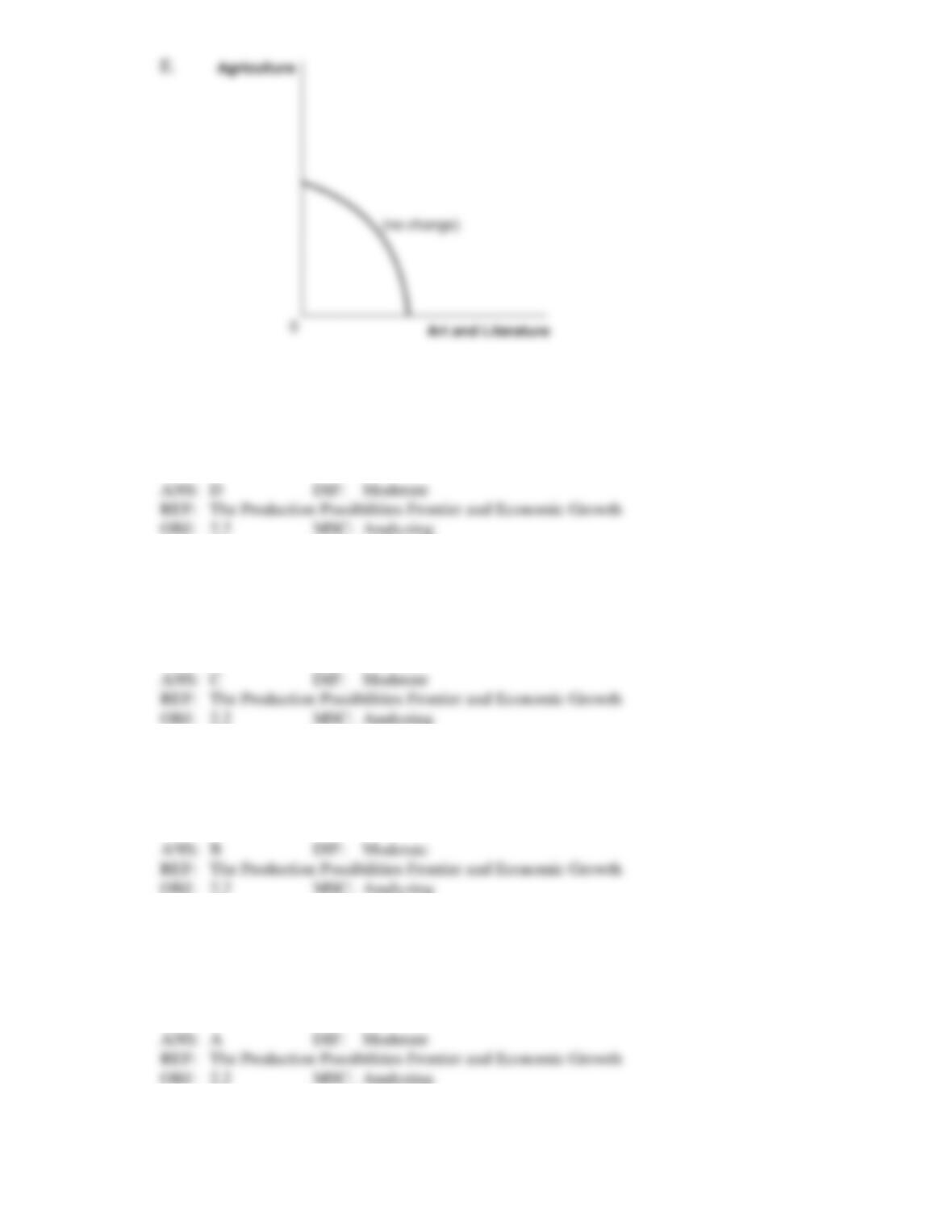
83. Suppose a great plague wipes out half of the society’s population. Which of the following graphs
best depicts how this would affect the PPF?
a. Graph A d. Graph D
b. Graph B e. Graph E
c. Graph C
84. Suppose the plow is invented and agricultural productivity greatly increases. Which of the
following graphs best depicts how this would affect the PPF?
a. Graph A d. Graph D
b. Graph B e. Graph E
c. Graph C
85. Suppose the printing press is invented. Which graph best depicts how this would affect the PPF?
a. Graph A d. Graph D
b. Graph B e. Graph E
c. Graph C
86. Suppose a new generation of baby boomers is entering the workforce. Which graph best depicts
how this would affect the PPF?
a. Graph A d. Graph D
b. Graph B e. Graph E
c. Graph C
87. What is Chandler’s opportunity cost of baking 1 loaf of bread?
a. 4 pies d. 1 loaf of bread
b. 2 pies e. 1/2 loaf of bread
c. 1 pie
88. What is Monica’s opportunity cost of baking 1 loaf of bread?
a. 4 pies d. 1 loaf of bread
b. 2 pies e. 1/2 loaf of bread
c. 1 pie
89. What is Chandler’s opportunity cost of baking 1 pie?
a. 4 pies d. 1 loaf of bread
b. 2 pies e. 1/2 loaf of bread
c. 1 pie
90. What is Monica’s opportunity cost of baking 1 pie?
a. 2 pies d. 1/2 loaf of bread
b. 1 pie e. 2 loaves of bread
c. 1 loaf of bread
91. If Monica and Chandler decide to specialize in order to maximize their combined output, who
should produce what?
a. Chandler should specialize in making pies because he has an absolute advantage.
b. Monica should specialize in making pies and Chandler should specialize in making bread.
c. Chandler should specialize in making pies and Monica should specialize in making bread.
d. Monica should specialize in making bread and pies because she has a comparative advantage
in both.
e. Monica should not specialize because she is better at producing both.
92. Specialization and trade allow individuals to
a. consume outside their own production possibilities frontiers (PPFs).
b. shift their PPFs outward.
c. produce more goods with less technology.
d. eliminate scarcity.
e. produce fewer goods with less technology.
93. One has an absolute advantage in producing something whenever
a. one enjoys producing that good.
b. one can produce more of it than someone else using the same quantity of resources.
c. one’s opportunity cost is constant.
d. one’s opportunity cost is lower than that of other producers.
e. one has specific training in the production of that good.
94. When one producer can create more of a good than another producer using the same quantity of
resources, the first producer has
a. a zero-sum game. d. a comparative advantage.
b. gains from trade. e. increasing relative costs.
c. an absolute advantage.
95. The ability of one producer to create more of a good than another producer using the same quantity
of resources is called
a. comparative advantage. d. gains from trade.
b. absolute advantage. e. the law of increasing relative cost.
c. a positive-sum game.
96. Given the same quantity of resources, what is Solange’s opportunity cost of producing a New York
pizza?
a. 5/2 Philly cheesesteaks d. 1/3 New York pizza
b. 2/5 Philly cheesesteak e. 4/5 New York pizza
c. 3 Philly cheesesteaks
97. Given the same quantity of resources, what is Jay-Z’s opportunity cost of producing a New York
pizza?
a. 5/2 Philly cheesesteaks d. 120/125 New York pizza
b. 1/3 Philly cheesesteak e. 4/5 New York pizza
c. 3 Philly cheesesteaks
98. Given an eight-hour workday, which statement best describes the absolute advantage evident in the
table?
a. Jay-Z has an absolute advantage in making pizzas, and Solange has an absolute advantage in
making cheesesteaks.
b. Solange has an absolute advantage in making pizzas, and Jay-Z has an absolute advantage in
making cheesesteaks.
c. Jay-Z has an absolute advantage in the production of both foods.
d. Solange has an absolute advantage in the production of both foods.
e. Neither party has an absolute advantage.
99. Given an eight-hour workday, to experience gains from trade,
a. Solange should make pizzas and Jay-Z should make cheesesteaks.
b. Solange should make cheesesteaks and Jay-Z should make pizzas.
c. each should make his or her own cheesesteaks and pizzas.
d. Solange should produce both pizzas and cheesesteaks.
e. Jay-Z should produce both pizzas and cheesesteaks.
100. Suppose that Solange and Jay-Z could each make either New York–style pizza or Philly
cheesesteaks. Given an eight-hour workday, which of the following would permit them to consume
outside their respective production possibilities frontiers (PPFs)?
a. a decrease in technology
b. a decrease in resources
c. specialization and trade
d. efficient use of all their productive resources
e. an “Empire State” of mind
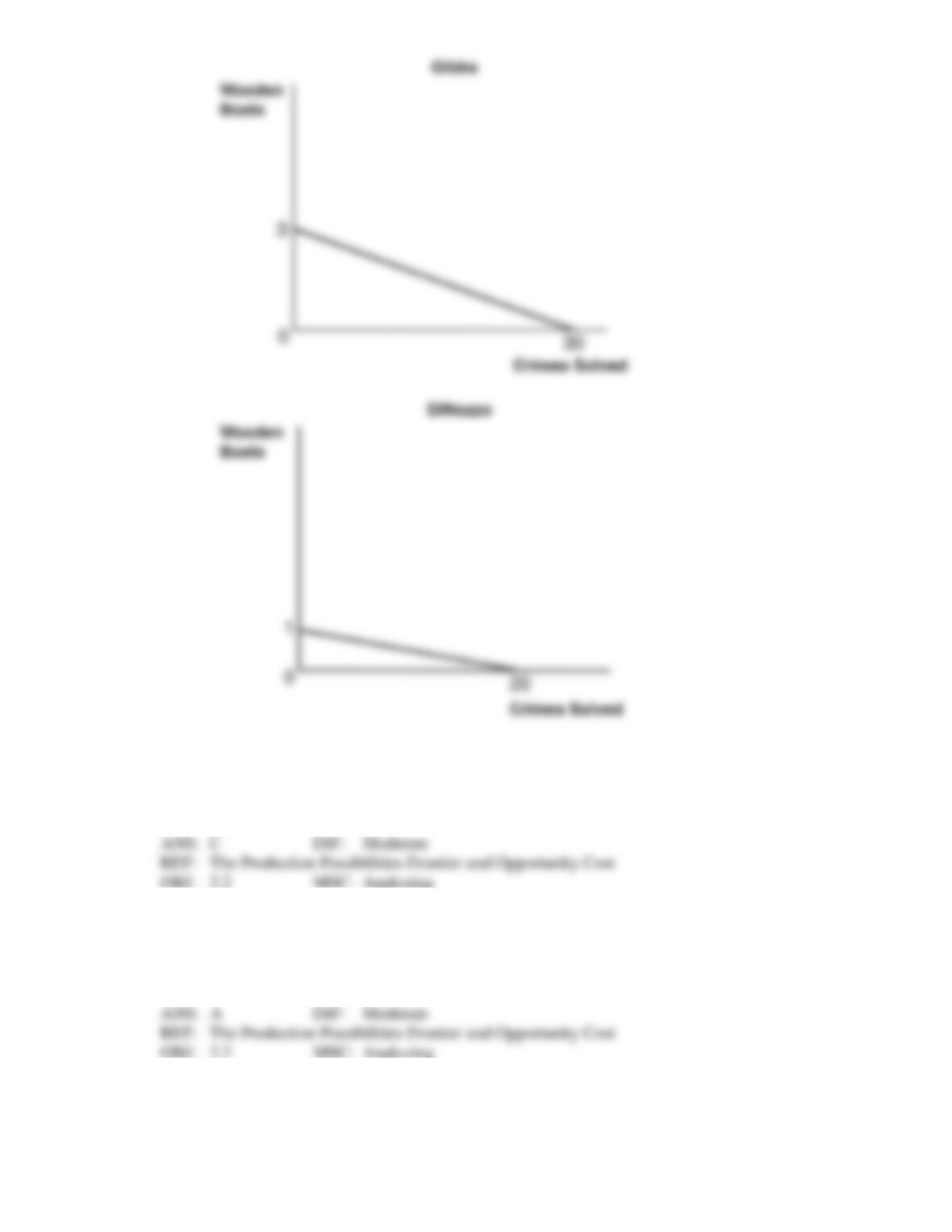
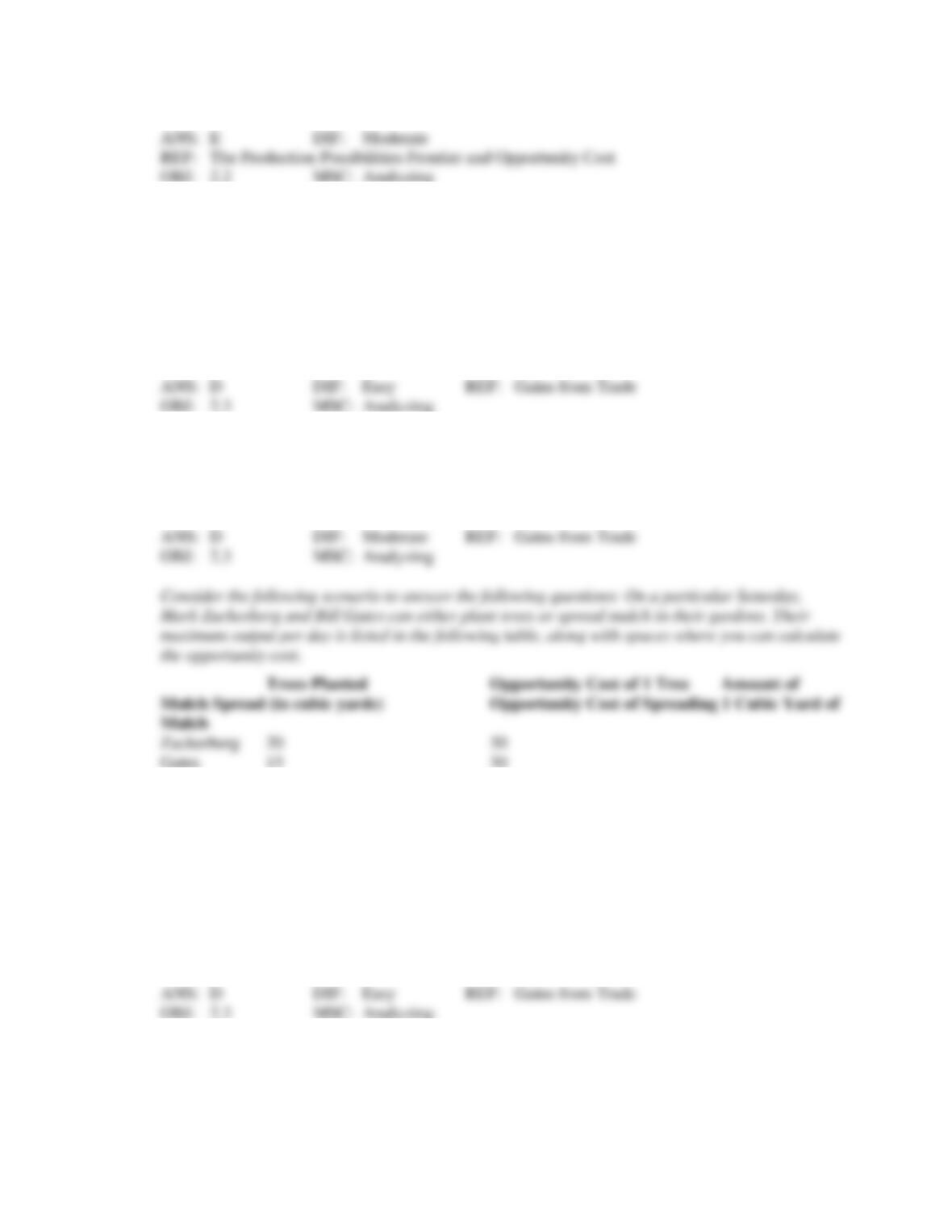
101. What is Gibbs’s opportunity cost of making a wooden boat?
a. 20 solved crimes d. 1/20 of a boat
b. 30 solved crimes e. 1/10 of a boat
c. 10 solved crimes
102. What is DiNozzo’s opportunity cost of making a wooden boat?
a. 20 solved crimes d. 1/20 of a boat
b. 30 solved crimes e. 1/10 of a boat
c. 10 solved crimes
103. What is Gibbs’s opportunity cost of solving a crime?
a. 20 solved crimes d. 1/20 of a boat
b. 30 solved crimes e. 1/10 of a boat
c. 5 solved crimes
104. Which statement best describes absolute advantage?
a. DiNozzo has an absolute advantage in the production of wooden boats.
b. DiNozzo has an absolute advantage in both.
c. Gibbs has an absolute advantage in solving crimes, whereas DiNozzo has an absolute
advantage in making wooden boats.
d. Gibbs has an absolute advantage in both.
e. Gibbs has an absolute advantage in making wooden boats, whereas DiNozzo has an absolute
advantage in solving crimes.
105. What is DiNozzo’s opportunity cost for solving a crime?
a. 20 solved crimes d. 1/20 of a boat
b. 30 solved crimes e. 1/10 of a boat
c. 5 solved crimes
106. Based on this scenario, who has an absolute advantage in spreading mulch?
a. Zuckerberg has the advantage because he gives up fewer trees each time he spreads 1 cubic
yard of mulch.
b. Gates has the advantage because he gives up fewer trees each time he spreads 1 cubic yard of
mulch.
c. Zuckerberg has the advantage because he gives up more trees each time he spreads 1 cubic
yard of mulch.
d. Neither has an absolute advantage in spreading mulch.
e. Both parties have an absolute advantage in planting trees.
107. At what terms of trade (relative price ratio) could they specialize and trade with one another so that
both have more trees planted and mulch spread than they could accomplish on their own?
a. 12 trees planted per 12 cubic yards of mulch spread
b. 10 trees planted per 12 cubic yards of mulch spread
c. 9 trees planted per 12 cubic yards of mulch spread
d. 7 trees planted per 12 cubic yards of mulch spread
e. 5 trees planted per 12 cubic yards of mulch spread
108. If Lola can produce more output from a set amount of resources than Kevin, ________ has a(n)
________ advantage.
a. Lola; comparative d. Kevin; absolute
b. Kevin; comparative e. Lola; normative
c. Lola; absolute
109. When one producer has a comparative advantage in production, he or she
a. can produce more output than someone else using the same quantity of resources.
b. can produce a good at a lower opportunity cost than someone else.
c. does not benefit from trade with other producers.
d. is unable to reach his or her production possibilities frontier (PPF).
e. trades only with others who have the same comparative advantage.
110. The ability of one producer to produce a good at a lower opportunity cost than another producer is
called
a. a normative statement. d. comparative advantage.
b. a zero-sum game. e. the law of increasing relative cost.
c. absolute advantage.
111. To determine which of two producers has a comparative advantage, one would need to know their
a. increasing relative costs.
b. opportunity costs of production for both goods.
c. normative beliefs.
d. zero-sum games.
e. levels of investment.
112. Someone has a comparative advantage in producing a good whenever
a. one enjoys producing that good.
b. one can produce more of the good than someone else using the same resources.
c. one’s opportunity cost is constant.
d. one’s opportunity cost of producing that good is lower than that of other producers.
e. one has specific training in the production of that good.
113. Mrs. Abel has a comparative advantage in producing cabbage if, in comparison to Mr. Lace, Mrs.
Abel can grow cabbage
a. with less labor. d. at a lower opportunity cost.
b. with fewer inputs. e. with less technology.
c. at a lower equilibrium.
114. If Kingsley can sell paper at a lower opportunity cost than Todrick, then ________ has a(n)
________ advantage in paper sales.
a. Kingsley; absolute d. Kingsley; comparative
b. Todrick; absolute e. Todrick; comparative
c. Kingsley; positive
115. Suppose Hoda is a brilliant attorney who can draft especially persuasive legal briefs. She also
happens to possess some excellent administrative skills such as typing, filing, assembling binders
and notes, and making reservations. Which best describes whether Hoda should hire an
administrative assistant to help her?
a. Hoda should not hire an administrative assistant because she has an absolute advantage in
performing administrative functions.
b. Hoda should not hire an administrative assistant because she likely has a comparative
advantage in performing administrative functions.
c. Hoda should hire an administrative assistant because the assistant would likely have an
absolute advantage in writing legal briefs.
d. Hoda should hire an administrative assistant because the assistant would likely have a
comparative advantage in performing administrative functions.
e. Hoda should hire an administrative assistant because the assistant would likely have a
comparative advantage in writing legal briefs.
116. For both parties to benefit from specialization and trade, the trading parties must agree on
a. a price somewhere between their opportunity costs of production.
b. a plan not to trade with other parties.
c. who has the absolute advantage in production.
d. the appropriate level of investment for the future.
e. the source of comparative advantage.
117. Suppose that Lo and Manuel can either run errands or wash dishes. Their maximum outputs per
hour are listed in the following table. Given the same quantity of resources, at what terms of trade
(relative price ratio) could they specialize and trade so that both consume outside their own
production possibilities frontiers (PPFs)?
Errands Run Opportunity Cost
of 1 Errand Dishes Washed Opportunity Cost
of 1 Dish Washed
Lo 1 60 dishes 60 1/60 errand

Manuel 3 15 dishes 45 1/15 errand
a. 1 errand run per 75 dishes washed d. 1 errand run per 10 dishes washed
b. 1 errand run per 30 dishes washed e. 1 errand run per 6 dishes washed
c. 1 errand run per 12 dishes washed
118. Suppose that Leslie and Hussein can either make salads or grill steaks. Their maximum outputs per
hour are listed in the following table. Given the same quantity of resources, at what terms of trade
(relative price ratio) could they specialize and trade so that both consume outside their own
production possibilities frontiers (PPFs)?
Maximum
Number of Salads Opportunity
Cost of 1 Salad Maximum
Number of Steaks Opportunity Cost
of 1 Steak
Leslie 9 1/3 steak 3 3 salads
Hussein 12 1/2 steak 6 2 salads
a. 1 salad per 1 steak d. 3 salads per 1 steak
b. 2 salads per 1 steak e. 3.5 salads per 1 steak
c. 2.5 salads per 1 steak
119. Consumer goods
a. are produced today to be used to produce more goods in the future.
b. are produced today to be consumed at some point in the future.
c. are invested today in order to consume more today.
d. are produced today to be consumed today.
e. generate economic growth.
120. Goods that are produced now so that they can be used to produce other goods in the future are
called ________ goods.
a. capital d. normal
b. consumer e. opportunity
c. investment
121. Goods that are produced for current consumption are called ________ goods.
a. capital d. normal
b. consumer e. opportunity
c. investment
122. Goods that are produced today in order to make other valuable goods and services in the future are
called ________ goods.
a. normal d. capital
b. inferior e. personal
c. consumer
123. Forgoing current consumption so that those resources can be used to produce new capital is called
a. absolute advantage. d. scarcity.
b. comparative advantage. e. saving.
c. investment.
124. The process of using current resources to create or buy new capital is called
a. absolute advantage. d. the law of increasing relative cost.
b. comparative advantage. e. economic growth.
c. investment.
125. The process of using current resources to create new capital is
a. absolute advantage. d. investment.
b. comparative advantage. e. free.
c. specialization.
126. The opportunity cost of every investment in capital goods is
a. current consumption (consumer goods).
b. future consumption (capital goods today).
c. absolute advantage.
d. comparative advantage.
e. scarcity.
127. Over the last 20 years, countries such as India and China have
a. consumed heavily with little regard for the future.
b. invested heavily and enjoyed significant economic growth.

c. eliminated the problem of scarcity.
d. produced outside their production possibilities frontiers (PPFs).
e. produced wholly for current consumption.
128. Is there an opportunity cost to increased investment in capital goods today?
a. Yes, increased production of capital goods means fewer consumer goods today.
b. Yes, increased production of capital goods today means less economic growth in the future.
c. No, increased production of capital goods today does not mean fewer consumer goods today.
d. No, increased production of capital goods today guarantees more consumption today.
e. No, if society is producing at an efficient point on the production possibilities frontier (PPF),
then there is no opportunity cost to investment in capital goods.
129. Greater investment in capital goods today leads to
a. greater growth in the production possibilities frontier (PPF) in the future.
b. greater consumption today.
c. the end of scarcity.
d. less opportunity cost.
e. scarcity.
130. Which of the following would NOT lead to an outward shift of a future production possibilities
frontier (PPF)?
a. population growth d. the discovery of new resources
b. increased investment today e. a decline in life expectancy
c. an increase in technology
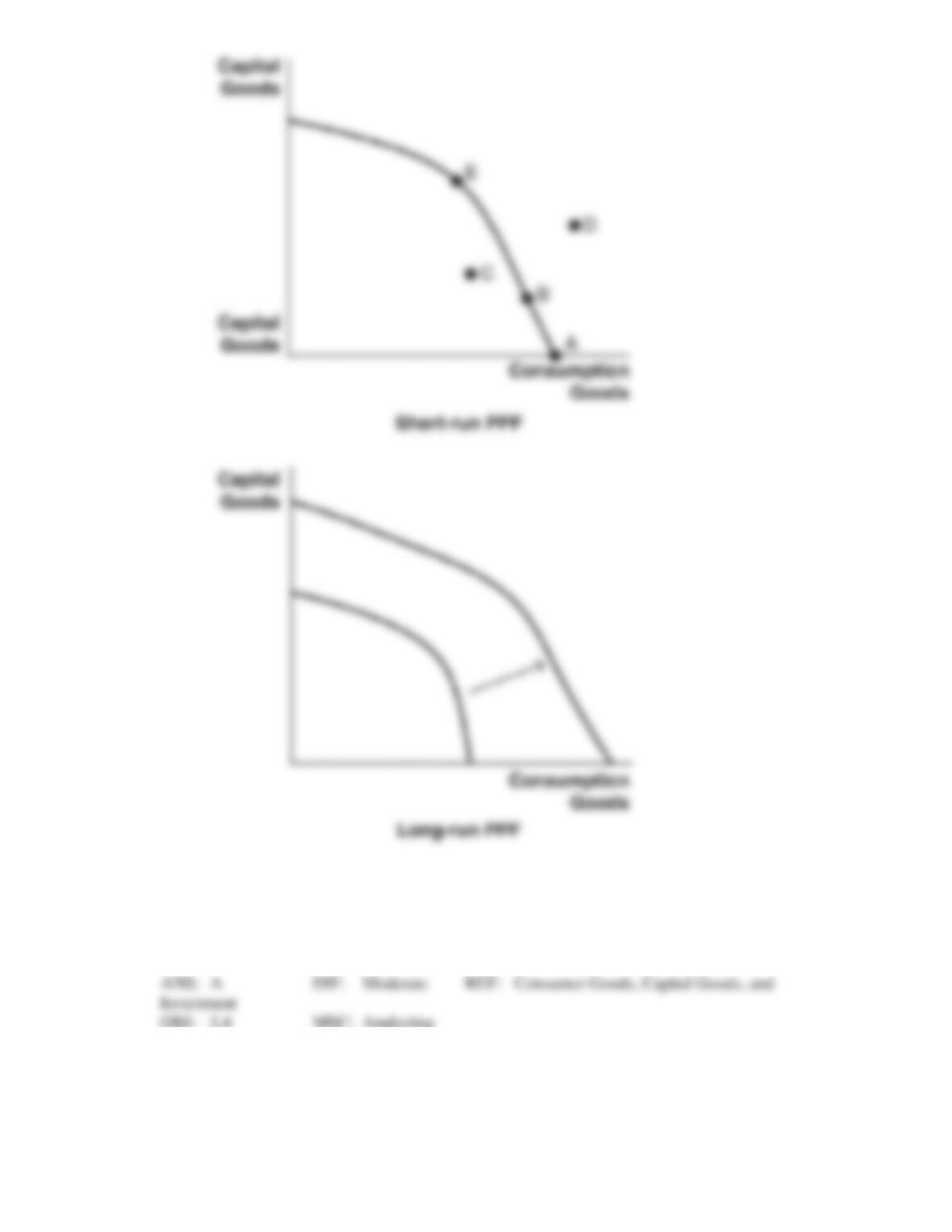
131. Which allocation point in the short-run production possibilities frontier (PPF) will lead to no
growth in the long-run PPF?
a. point A d. point D
b. point B e. point E
c. point C
132. Which allocation point in the short-run production possibilities frontier (PPF) will lead to the most
significant growth in the long-run PPF?
a. point A d. point D
b. point B e. point E
c. point C
133. The usual purpose of an experiment is to
a. test a model that is based on a hypothesis.
b. turn a hypothesis into a theory.
c. observe an interesting phenomenon.
d. construct a model based on a hypothesis.
e. formulate a hypothesis that explains a phenomenon.
134. For a phenomenon to be investigated by means of experiments, the phenomenon must
a. involve human beings. d. be well understood.
b. have observable effects. e. be quantitatively measurable.
c. have occurred in the past.
135. Which of the following is an important characteristic of good economic models?
a. They deal with the economy as a whole.
b. They use the language of mathematics.
c. They are flexible in their designs.
d. They avoid making predictions.
e. They are as complex as the realities they represent.
136. Wilbur and Orville Wright’s testing of wing designs in a wind tunnel is an example of using
a. observations to construct models. d. models to collect data.
b. hypotheses to test observations. e. data to make predictions.
c. a theory to formulate hypotheses.
137. Which faulty assumption by banks led to the Great Recession that began in 2007?
a. that inflation would always remain low
b. that the U.S. government would always pay its debts
c. that stock prices would never drop
d. that the dollar would always be strong against other currencies
e. that real estate prices would always rise
138. Economic growth is, by definition, an increase in the
a. ability to produce goods.
b. number of participants in the workforce.
c. demand for goods.
d. average citizen’s standard of living.
e. average worker’s salary.
139. Which scenario represents economic contraction?
a. an outward shift of the PPF
b. an inward shift of the PPF
c. upward movement along the PPF
d. downward movement along the PPF
e. straightening of the curve of the PPF
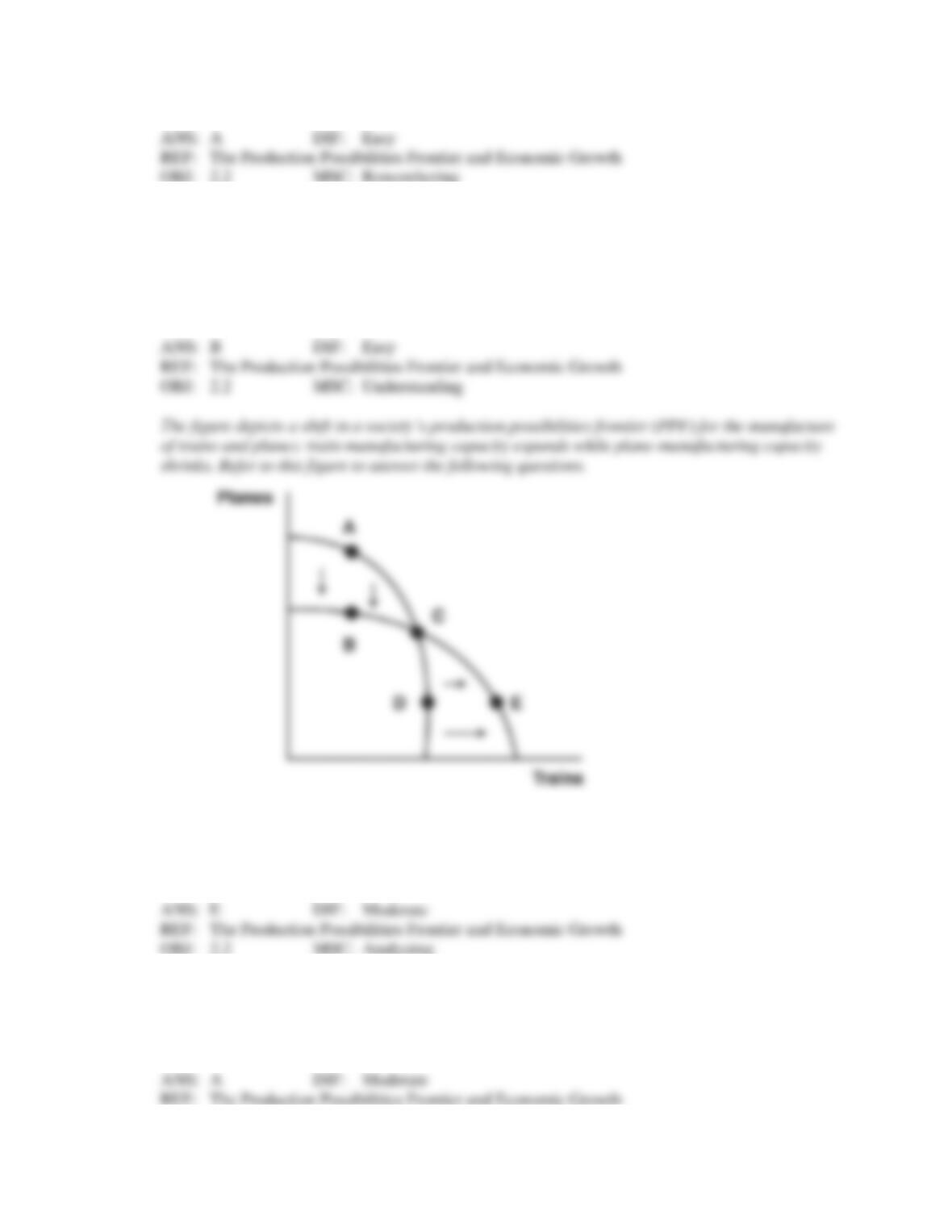
140. Which point represents a new production possibility?
a. point A d. point D
b. point B e. point E
c. point C
141. Which point ceases to represent a production possibility?
a. point A d. point D
b. point B e. point E
c. point C