CHAPTER 2: Model Building and Gains from Trade
MULTIPLE CHOICE
1. An economist’s use of experiments and real-world data to test a theory is an example of
a. the scientific method in economics. d. normative analysis.
b. macroeconomics. e. comparative advantage.
c. economic growth.
2. On the television show MythBusters, the hosts design experiments, collect data, and test theories
based on popular myths. This is an example of
a. the scientific method. d. production possibilities.
b. economic growth. e. absolute advantage.
c. gains from trade.
3. Economists use the scientific method and the tools of economics to study
a. only the decisions of individuals.
b. only the decisions of business firms.
c. only economic growth and gross domestic product (GDP).
d. only the production possibilities curve.
e. anything around them; the world is the economist’s laboratory.
4. The scientific method and the tools of economics are useful in examining
a. only how individuals make decisions.
b. only how business firms make decisions.
c. only how government policies affect macroeconomic outcomes.
d. only the trade-offs evident in the production possibilities frontier (PPF).
e. anything; economists will use their tools to study anything in the world around them.
5. A positive statement
a. is a claim that can be tested.
b. is a statement about what ought to be.
c. is a declaration of opinion.
d. is a claim that cannot be tested.
e. cannot be evaluated using the scientific method.
6. Which of the following is a positive statement?
a. An economist should test every theory at least twice.
b. Increases in the minimum wage cause unemployment.
c. We ought to deregulate the mortgage market.
d. The government must provide unlimited health care to citizens.
e. We should forgo some current consumption in order to invest in the future.
7. Which of the following is a normative statement?
a. The sky is blue.
b. The sky is green with pink polka dots.
c. Points on the production possibilities frontier (PPF) are efficient.
d. Points outside the production possibilities frontier (PPF) are unattainable with current
resources.
e. We should strive to push the production possibilities frontier (PPF) outward.
8. Which of the following is a positive statement?
a. Nelly’s dog should lose some weight.
b. Legally requiring dogs to have rabies shots will reduce the number of rabid dogs.
c. Nelly should take her dog to the veterinarian once a year for a checkup.
d. Chihuahuas are cuter than bulldogs.
e. All dogs should be required to wear leashes at all times.
9. Which of the following is a normative statement?
a. One should wear a helmet when cycling.
b. The sky is blue.
c. A bicycle has two wheels.
d. A unicycle has five wheels.
e. Electricity follows the path of least resistance.
10. Which of the following is a positive statement?
a. Individuals should make good long-term decisions.
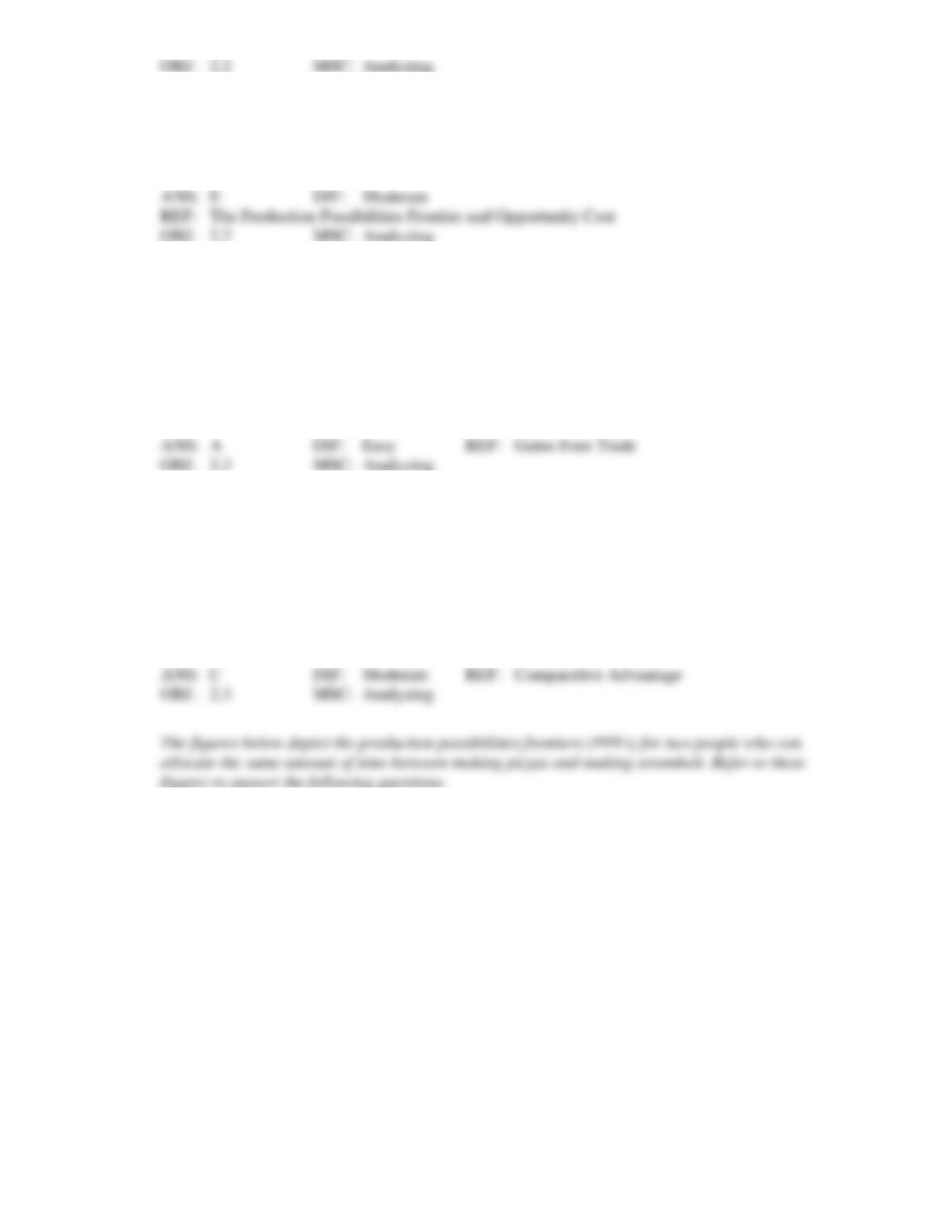
b. Corporations should maximize shareholder value.
c. The government should reduce the level of unemployment.
d. The most important effects of policy happen in the short term.
e. The unemployment rate is 8 percent.
11. Which of the following is a positive statement?
a. Winters in Arkansas are too cold.
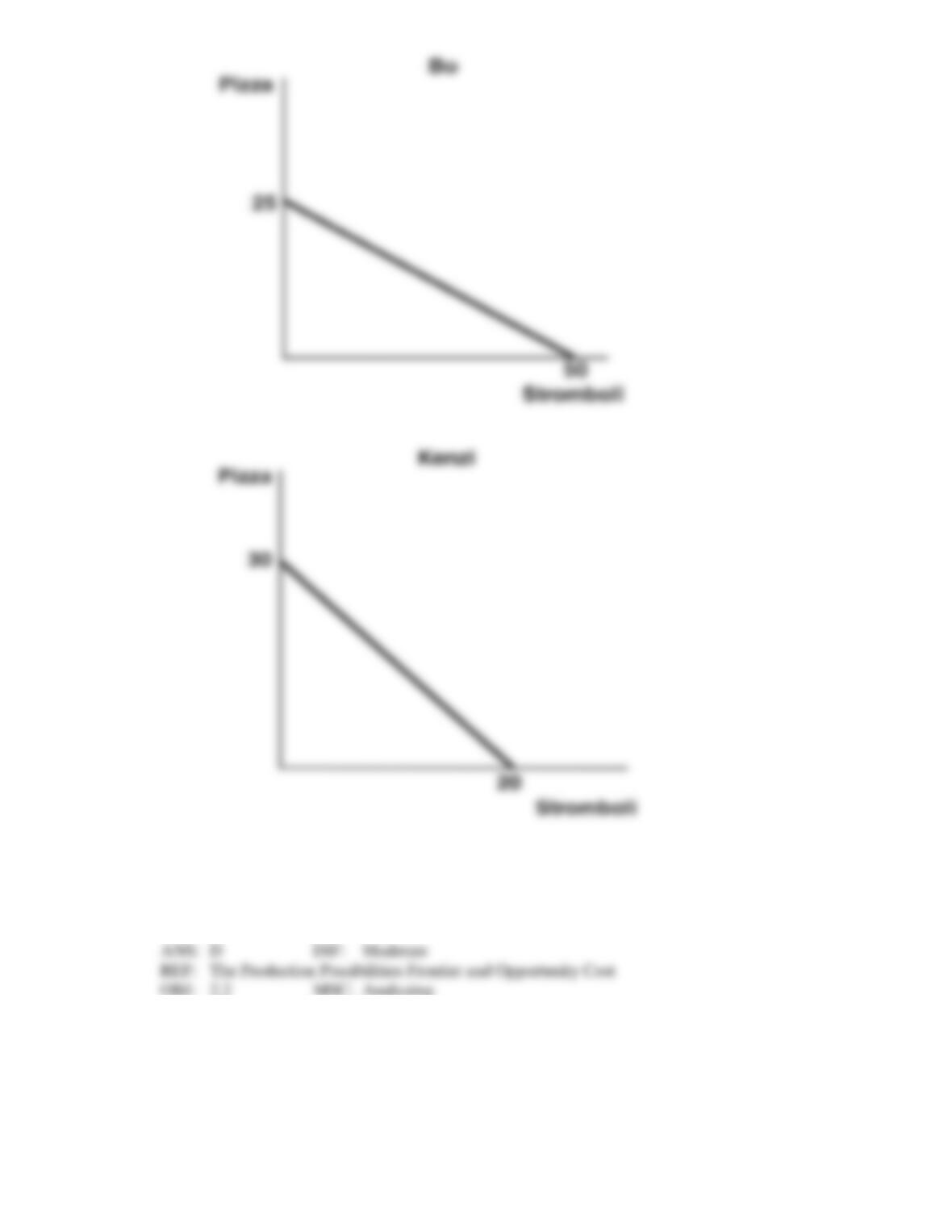
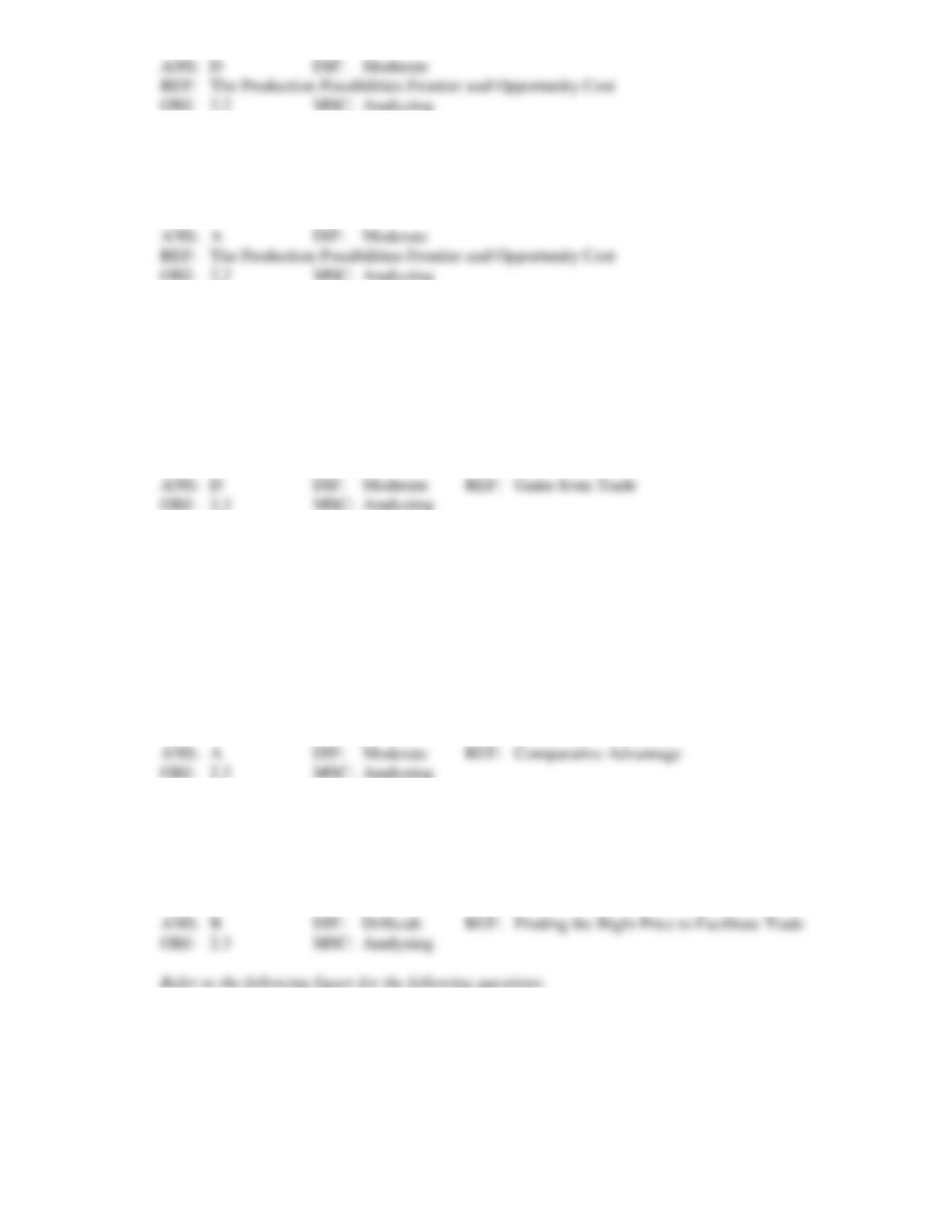
b. Everyone should work in a bank to understand the true value of money.
c. Harvard University is the top education institution in the country.
d. On average, people save 15 percent when they switch to GEICO.
e. Everyone ought to have a life insurance policy.
12. Which of the following is a normative statement?
a. The current exchange rate is 0.7 British pounds per U.S. dollar.
b. In January, the average temperature in Fargo, North Dakota, is 56 degrees.
c. Winters in Arkansas are too cold.
d. On average, people save 15 percent when they switch to GEICO.
e. University of Virginia graduates earn more than Duke University graduates.
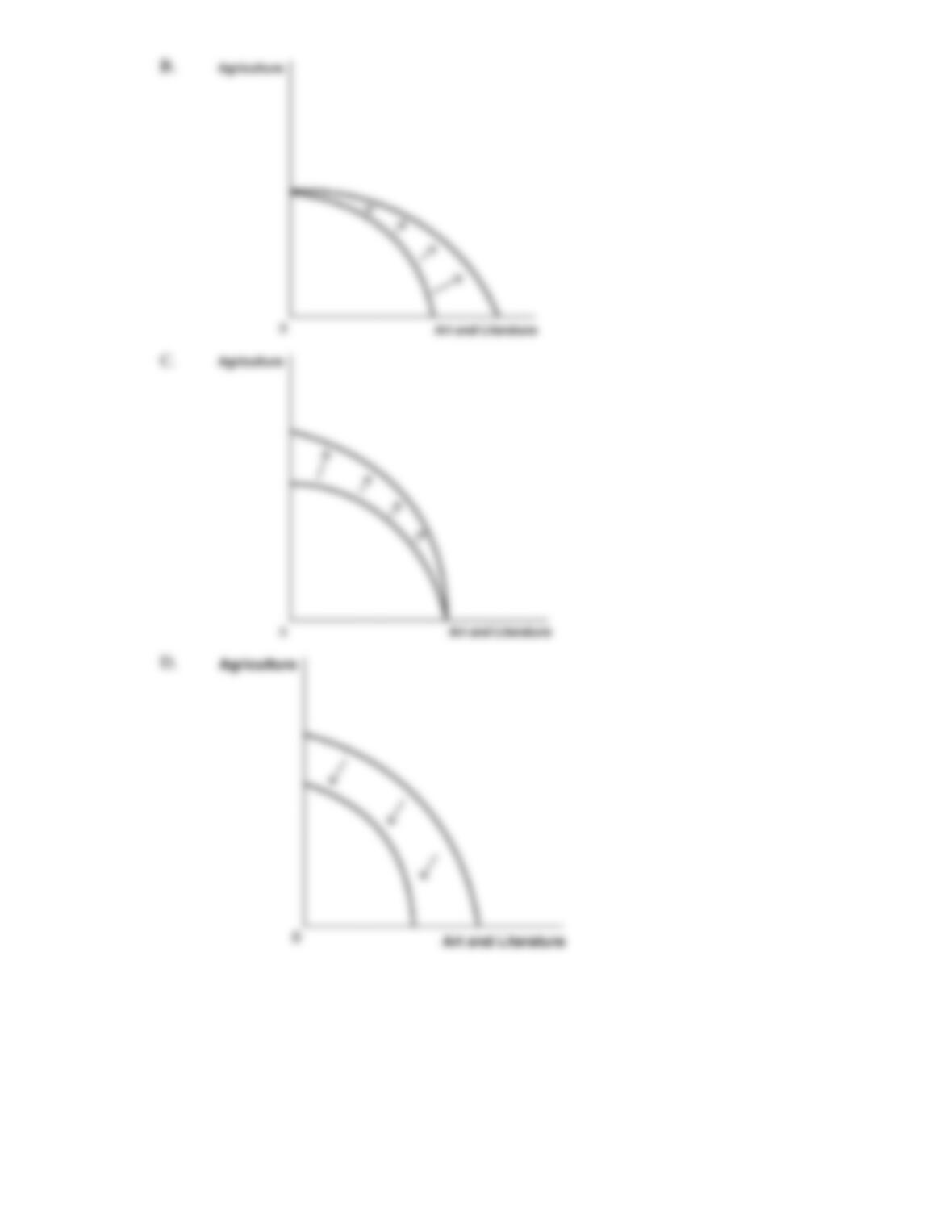
13. The important act of holding all other variables constant while examining a particular variable is
known as
a. endogeneity. d. macroeconomics.
b. a normative statement. e. ceteris paribus.
c. a positive statement.
14. Ceteris paribus means
a. in sets of two.
b. constant opportunity cost.
c. other things being equal.
d. buyer beware.
e. there is no reason to argue about people’s tastes.
15. Which of the following is necessary to build a good economic model?
a. normative statements d. complex math
b. assumptions e. realism
c. opinions
16. The process of examining a change in one variable in a model while assuming that all the other
variables remain constant is called
a. exogenous factors. d. positive analysis.
b. ceteris paribus. e. faulty assumptions.
c. normative analysis.
17. Why do economists use models?
a. Models are used to add complexity to a simple world.
b. Models allow us to study a simplified version of a complex world.
c. Models allow us to control exogenous factors.
d. Models make the world harder to understand.
e. Models allow us to examine more factors than what actually exists in our world.
18. Variables that are NOT accounted for in a model are called
a. endogenous factors. d. positive statements.
b. exogenous factors. e. the scientific method.
c. normative statements.
19. Variables that are controlled for in a model are called
a. normative statements. d. exogenous factors.
b. positive statements. e. the scientific method.
c. endogenous factors.
20. Nadine is considering the “dress well, test well” theory, which argues that one performs better on
exams when one dresses nicer than one does when wearing sweatpants. If Nadine wants to test this
theory over the course of the semester, which of the following would be an endogenous factor in
her experiment?
a. her innate ability in the subject
b. the difficulty of the exam
c. the relative mix of multiple-choice and short-answer questions
d. her clothing choice for the exam
e. the amount of time Nadine spends studying for the exam
21. When testing a paper airplane on a campus quad, which of the following would be an exogenous
factor?
a. the weight of the paper used in making the plane
b. the ratio of wingspan to plane length
c. the height of the body of the plane
d. the level of wind encountered
e. the number of folds in the wings
22. When testing a model rocket on a campus quad, which of the following would be an endogenous
factor?
a. the current wind speed across the quad
b. the quad’s elevation and air pressure
c. the extent of precipitation
d. the gravitational pull of Earth
e. the size of the rocket engine
23. Car companies build wind tunnels to test the aerodynamics and the handling capabilities of their
car designs. The many variables that can be precisely controlled inside the wind tunnel are
considered ________ factors.
a. normative d. endogenous
b. positive e. exogenous
c. comparative
24. One reason that economists make assumptions when designing models is to
a. exclude variables that do not add predictive power to the model.
b. make models more like the real world.
c. make models more complex.
d. increase endogenous factors.
e. ensure that all possible factors are included.
25. A model without any simplifying assumptions
a. is highly complex and likely unworkable.
b. excludes important predictive variables.
c. is very helpful for solving tough, real-world problems.
d. does not look like the real-world problem it is meant to address.
e. provides simplified solutions to complex problems.
26. The production possibilities frontier (PPF) shows
a. the trade-off between the efficient production of two different goods.
b. the difference between microanalysis and macroanalysis.
c. the difference between normative and positive analysis.
d. how a firm should price a new product.
e. how price and quantity are related for a single good.
27. A graph that shows the maximum attainable combinations of two goods when society efficiently
uses its productive resources is called
a. a production possibilities frontier (PPF).
b. a supply curve.
c. opportunity cost.
d. a consumer demand curve.
e. absolute advantage.
28. At full employment, a society produces
a. somewhere within its production possibilities frontier (PPF).
b. somewhere outside its PPF.
c. at the origin on its PPF graph.
d. on its PPF.
e. only one good.
29. The ________ illustrates the various combinations of output that a society can produce if all of its
resources are being used efficiently.
a. concept of absolute advantage
b. law of positive statements
c. law of demand
d. production possibilities frontier (PPF)
e. principle of comparative advantage
30. The area inside (within) the production possibilities frontier (PPF) contains ________ points.
a. normative d. inefficient
b. positive e. high opportunity cost
c. efficient
31. Ceteris paribus, if a society is producing at a point on the production possibilities frontier (PPF), it
can only increase the production of one good by
a. also increasing the production of the second good.
b. decreasing the production of the second good.
c. increasing the price of the second good.
d. decreasing the price of the second good.
e. reducing the resources available for production.
32. A society that is producing its maximum combination of goods and using all available resources
for production
a. has minimized its opportunity cost.
b. has maximized its opportunity cost.
c. is operating on its production possibilities frontier (PPF).
d. is operating outside its PPF.
e. has eliminated scarcity.
33. On a production possibilities frontier (PPF) that shows the trade-off between consumer goods and
capital goods given a fixed amount of labor, unemployment is illustrated by
a. movement from a point within the frontier to a point on the frontier.
b. a point outside the frontier.
c. a point within the frontier.
d. movement from a point on the frontier to another point on the frontier.
e. a point on the frontier.
34. How will a reduction in the national unemployment rate affect a nation’s production possibilities
frontier (PPF)?
a. It will cause the PPF to shift inward.
b. It will cause the PPF to shift outward.
c. It will move society to a point inward, to a point farther away from the PPF.
d. It will move society outward, to a point closer to or on the PPF.
e. It will push society to a point outside its PPF.
35. Think of the production possibilities frontier (PPF) model. When society is producing the largest
possible output from its resources, it is operating
a. inefficiently. d. inside (within) the PPF.
b. efficiently. e. beyond its opportunity cost.
c. with no opportunity cost.
36. Which of the following is NOT an assumption that economists make when developing a
production possibilities frontier (PPF)?
a. We live in a world with only two goods.
b. There are no increases in technology.
c. There is no change in available resources.
d. Society will always be producing somewhere on the PPF.
e. There are no decreases in technology.
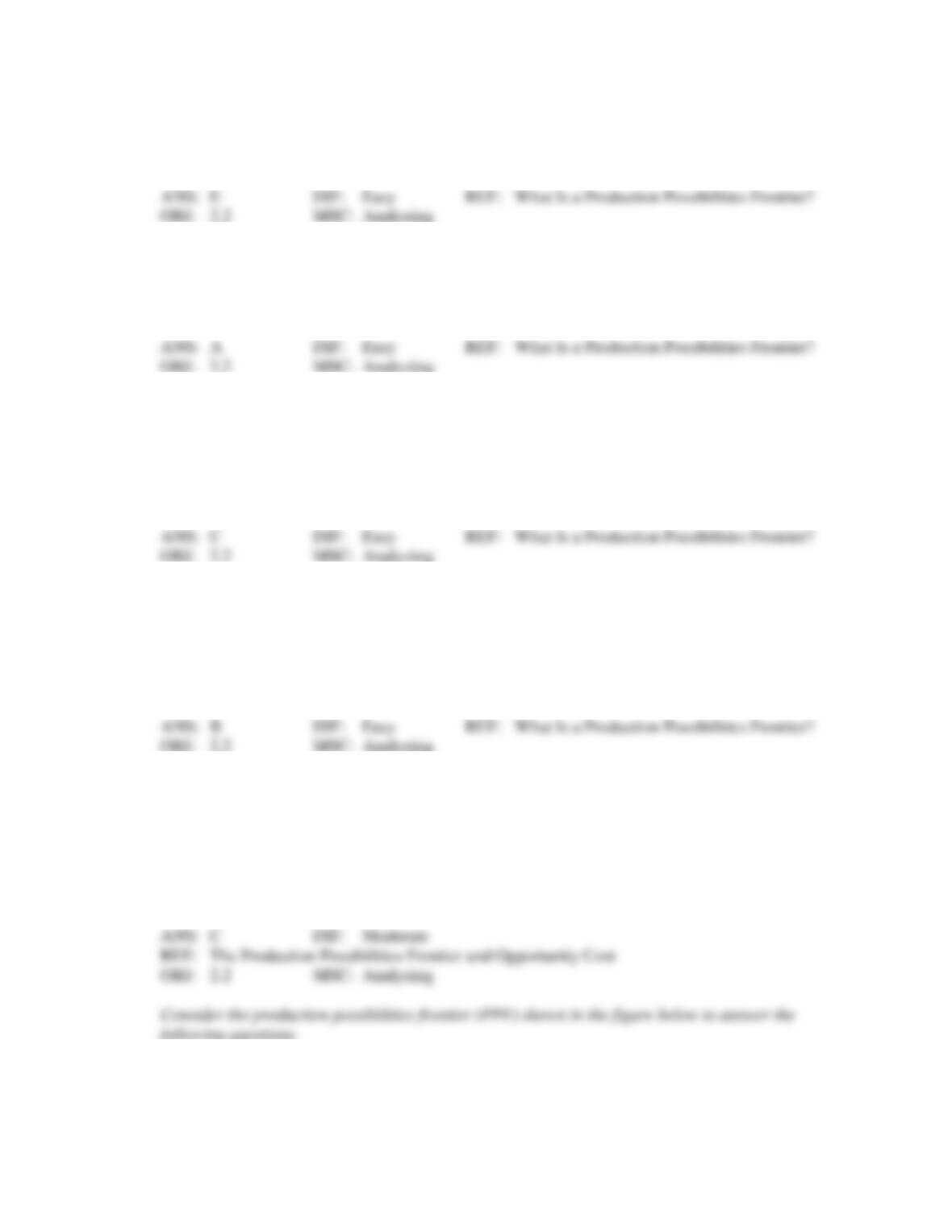
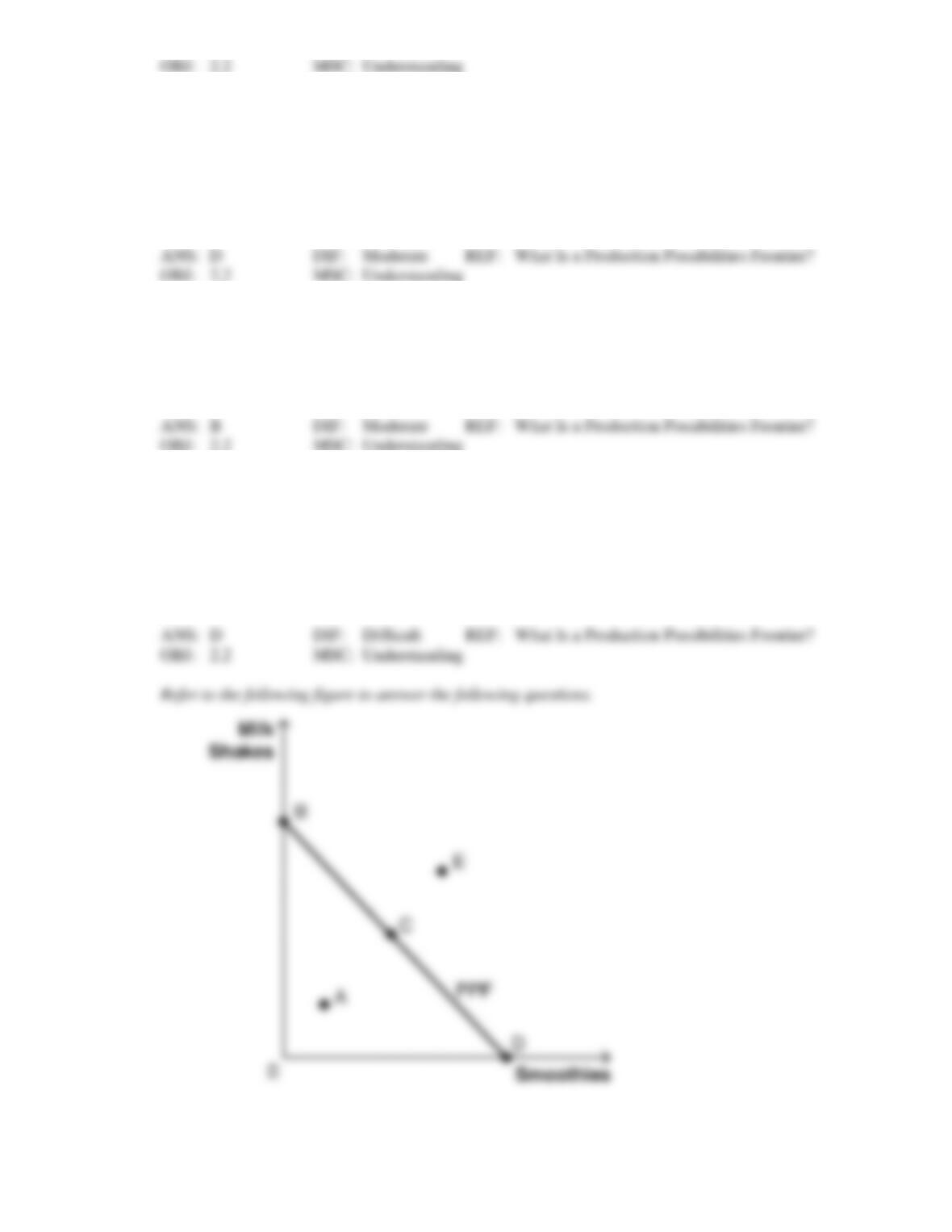
37. Which point in the corresponding figure represents a combination of smoothies and milk shakes
that society CANNOT currently produce?
a. point A d. point D
b. point B e. point E
c. point C
38. Which point in the corresponding figure shows that productive resources are NOT fully employed?
a. point A d. point D
b. point B e. point E
c. point C
39. In the figure, point A is
a. an efficient point.
b. unattainable with current resources.
c. an inefficient point.
d. the equilibrium.
e. the point where society would prefer to consume.
40. In the figure, point E is
a. an efficient point.
b. unattainable with current resources.
c. an inefficient point.
d. the equilibrium.
e. evidence that trade does not enrich society.
41. Which statement best describes the opportunity cost evident in the production possibilities frontier
(PPF) for the accompanying figure?
a. The law of increasing relative cost applies because the PPF is a straight line.
b. The law of increasing relative cost applies because the PPF is bowed outward.
c. The opportunity cost is constant because the PPF is a straight line.
d. The opportunity cost is constant because the PPF is bowed outward.
e. The opportunity cost decreases because the line has negative slope.
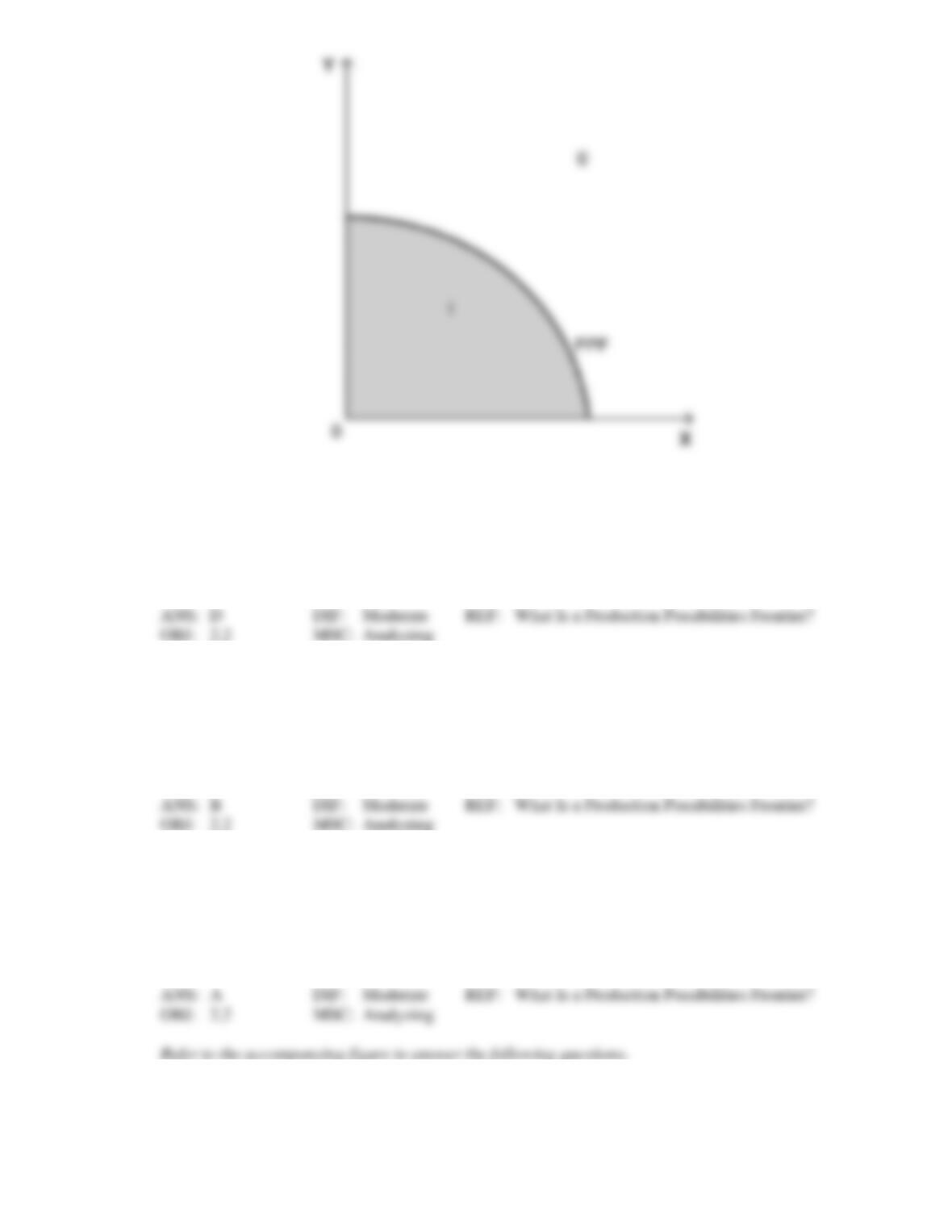
42. Given current resources and technology, the attainable range is best described as
a. only area O: points outside the PPF.
b. points on the PPF only.
c. only area I: points inside the PPF.
d. area I: points inside the PPF and points on the PPF.
e. area O: points outside the PPF and points on the PPF.
43. The set of efficient points is best described as
a. only area O: points outside the PPF.
b. points on the PPF only.
c. only area I: points inside the PPF.
d. area I: inside the PPF and points on the PPF.
e. area O: outside the PPF and points on the PPF.
44. Given current resources and technology, the unattainable range is best described as
a. only area O: points outside the PPF.
b. points on the PPF only.
c. only area I: points inside the PPF.
d. area I: inside the PPF and points on the PPF.
e. area O: outside the PPF and points on the PPF.
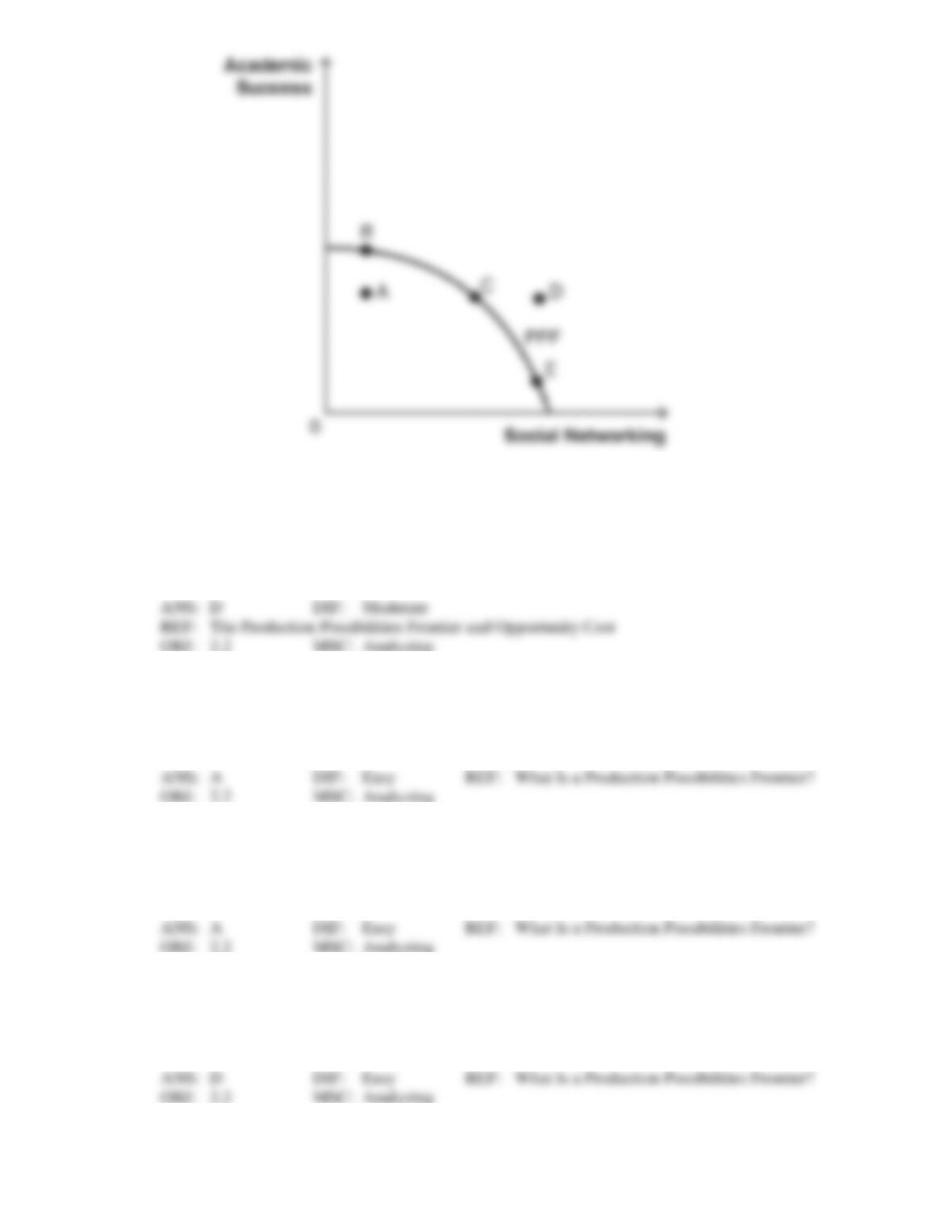
45. How is opportunity cost illustrated?
a. a move from point A to point B
b. a move from point A to point C
c. a move from point C to point D
d. a move from point B to point C
e. a move from point D to point E
46. The inefficient point(s) is/are
a. point A. d. point D.
b. points C and D. e. points B, C, and E.
c. point C.
47. Unemployed resources are evident at
a. point A. d. point D.
b. point B. e. points B, C, and E.
c. point C.
48. Given the current resources, one would need even more hours in each day in order to attain
a. point A. d. point D.
b. point B. e. point E.
c. point C.
49. The ________ states that the opportunity cost of producing a good always rises as one produces
more of it.
a. law of increasing relative cost
b. law of positive economics
c. law of demand
d. production possibilities frontier (PPF) model
e. zero-sum game
50. When the opportunity cost of producing a good rises as someone produces more of it, one
experiences
a. normative economics. d. inferior goods.
b. increasing relative costs. e. increasing marginal utility.
c. downward-sloping demand.
51. As we move from one efficient point on the production possibilities frontier (PPF) to another
efficient point on the PPF, we experience
a. decreasing relative cost. d. unlimited resources.
b. opportunity cost. e. unattainable combinations.
c. macroeconomics.
52. Suppose someone is studying a production possibilities frontier (PPF) that has a bowed-out shape
relative to the origin. What causes this shape?
a. economic growth d. normative economics
b. the law of increasing relative cost e. more resources
c. absolute advantage
53. Opportunity cost is evident on the production possibilities frontier (PPF) graph
a. as we move from one point on the frontier to another point on the frontier.
b. as we move from the origin to any inefficient point.
c. as we move from one unattainable point to an efficient point on the frontier.
d. as we move from an inefficient point to the origin.
e. at any one single point on the graph.
54. Suppose someone finds a production possibilities frontier (PPF) that is shaped like a straight line.
What can one determine about the production of the two goods?
a. Production of the two goods is subject to decreasing relative cost.
b. Production of the two goods is subject to increasing relative cost.
c. Production of the two goods is subject to constant opportunity cost anywhere along the PPF.
d. One producer must have an absolute advantage in production.
e. More resources will not cause the PPF to shift.
55. The movie Saving Private Ryan is about a military mission to find and recover a particular
soldier—Private Ryan. The movie is predominantly about how much was given up in an effort to
save this one particular soldier. The main economic theme of the movie is
a. absolute advantage. d. comparative advantage.
b. opportunity cost. e. positive advantage.
c. normative analysis.
56. What is Mikhail’s opportunity cost of a sculpture?
a. 2 paintings d. 1/3 sculpture
b. 1/2 painting e. 1/2 sculpture
c. 3 paintings
57. What is Stefan’s opportunity cost of a sculpture?
a. 1/2 painting d. 1/3 sculpture
b. 1/3 painting e. 3/5 sculpture
c. 3 paintings
58. What is Mikhail’s opportunity cost of a painting?
a. 1/2 painting d. 2 sculptures
b. 1/2 sculpture e. 2 paintings
c. 3 paintings
59. What is Stefan’s opportunity cost of a painting?
a. 1/3 painting d. 3 paintings
b. 1/3 sculpture e. 3 sculptures
c. 2/5 sculpture
60. Based on the table, does Mikhail or Stefan have an absolute advantage?
a. Yes, Mikhail has an absolute advantage in both sculptures and paintings.
b. Yes, Stefan has an absolute advantage in both sculptures and paintings.
c. Yes, Mikhail has an absolute advantage in paintings, and Stefan has an absolute advantage in
sculptures.
d. Yes, Mikhail has an absolute advantage in sculptures, and Stefan has an absolute advantage in
paintings.
e. No, neither has an absolute advantage.
61. Based on the table, does Mikhail or Stefan have a comparative advantage?
a. Yes, Mikhail has a comparative advantage in both sculptures and paintings.
b. Yes, Stefan has a comparative advantage in both sculptures and paintings.
c. Yes, Mikhail has a comparative advantage in paintings, and Stefan has a comparative
advantage in sculptures.
d. Yes, Mikhail has a comparative advantage in sculptures, and Stefan has a comparative
advantage in paintings.
e. No, neither has a comparative advantage.
62. What is Bo’s opportunity cost of making 1 pizza?
a. 50 stromboli d. 2 stromboli
b. 20 stromboli e. 1.5 stromboli
c. 2.5 stromboli
63. What is Kenzi’s opportunity cost of making 1 stromboli?
a. 30 pizzas d. 1.5 pizzas
b. 20 stromboli e. 2/3 pizza
c. 2 pizzas
64. What is Bo’s opportunity cost of making 1 stromboli?
a. 1/2 pizza d. 2 stromboli
b. 2/3 pizza e. 25 pizzas
c. 2 pizzas
65. Which statement best describes the absolute advantage as shown in the graphs?
a. Kenzi has an absolute advantage in the production of both.
b. Bo has an absolute advantage in the production of both.
c. Bo has an absolute advantage in the production of pizzas, and Kenzi has an absolute advantage
in the production of stromboli.
d. Kenzi has an absolute advantage in the production of pizzas, and Bo has an absolute advantage
in the production of stromboli.
e. They both have an absolute advantage in the production of stromboli.
66. Based on the figure, which statement about comparative advantage is true?
a. Bo has a comparative advantage in the production of stromboli because her opportunity cost is
lower.
b. Bo has a comparative advantage in the production of stromboli because her opportunity cost is
higher.
c. Bo has a comparative advantage in the production of pizzas because her opportunity cost is
lower.
d. Bo has a comparative advantage in the production of pizzas because her opportunity cost is
higher.
e. Bo has a comparative advantage in the production of both pizzas and stromboli.
67. If Bo and Kenzi were to specialize and trade, at what exchange rate would they find some quantity
of trade to be mutually beneficial?
a. 3 pizzas for 1 stromboli d. 1 pizza for 1/2 stromboli
b. 1 pizza for 1 stromboli e. 1 pizza for 1/4 stromboli
c. 10 pizzas for 2 stromboli
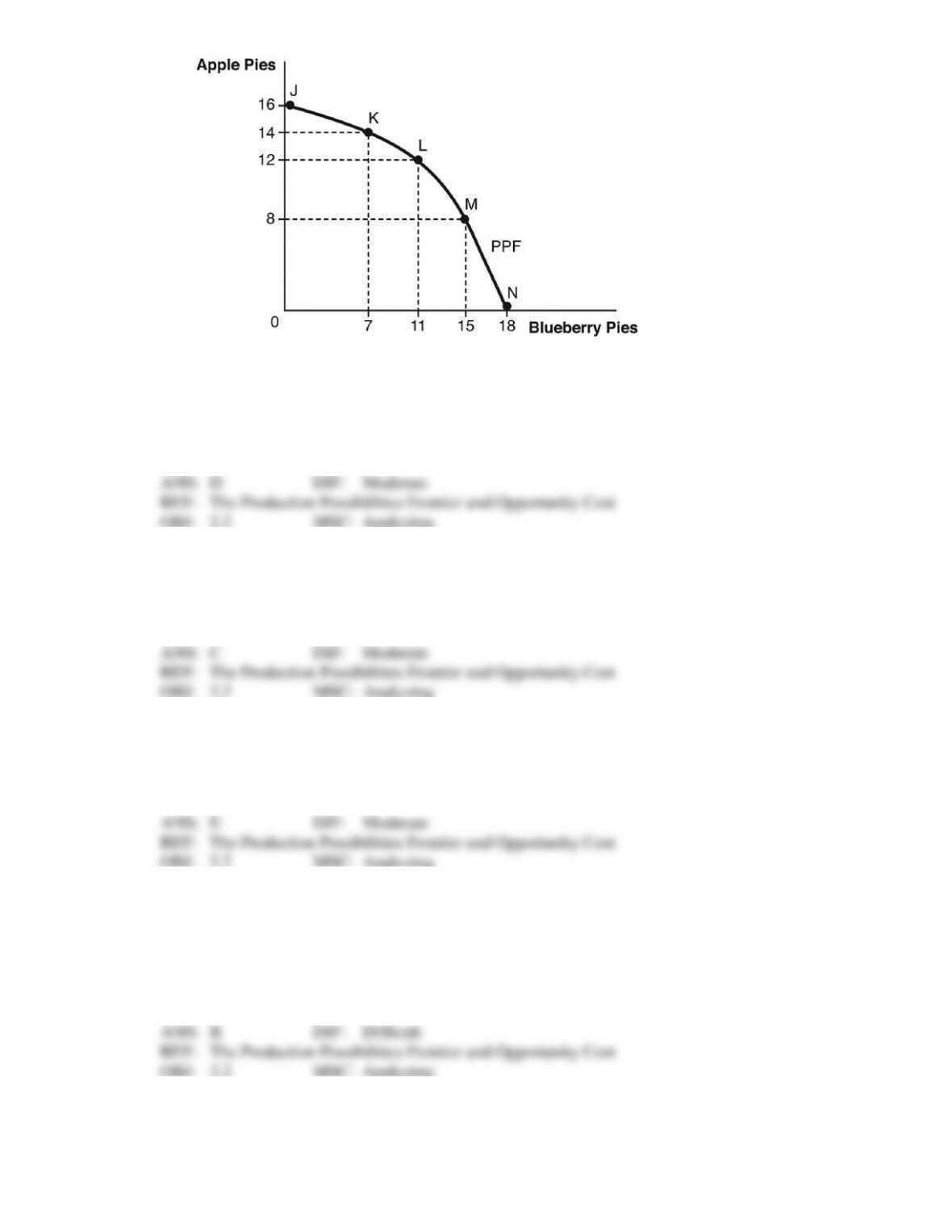
68. The opportunity cost of increasing the production of apple pies from 12 to 14 pies is ________
pies.
a. 2 blueberry d. 4 blueberry
b. 14 apple e. 2 apple
c. 7 blueberry
69. The opportunity cost of increasing production of apple pies from 14 to 16 pies is ________ pies.
a. 2 blueberry d. 4 blueberry
b. 14 apple e. 16 blueberry
c. 7 blueberry
70. The opportunity cost of increasing production of blueberry pies from 7 to 11 pies is ________ pies.
a. 2 blueberry d. 4 apple
b. 14 apple e. 2 apple
c. 7 blueberry
71. As we move from points N to M to L, the opportunity cost of additional apple pie
a. decreases due to the law of increasing relative cost.
b. increases due to the law of increasing relative cost.
c. decreases due to the law of normative economics.
d. increases due to the law of marginal analysis.
e. decreases due to enhancements in technology.
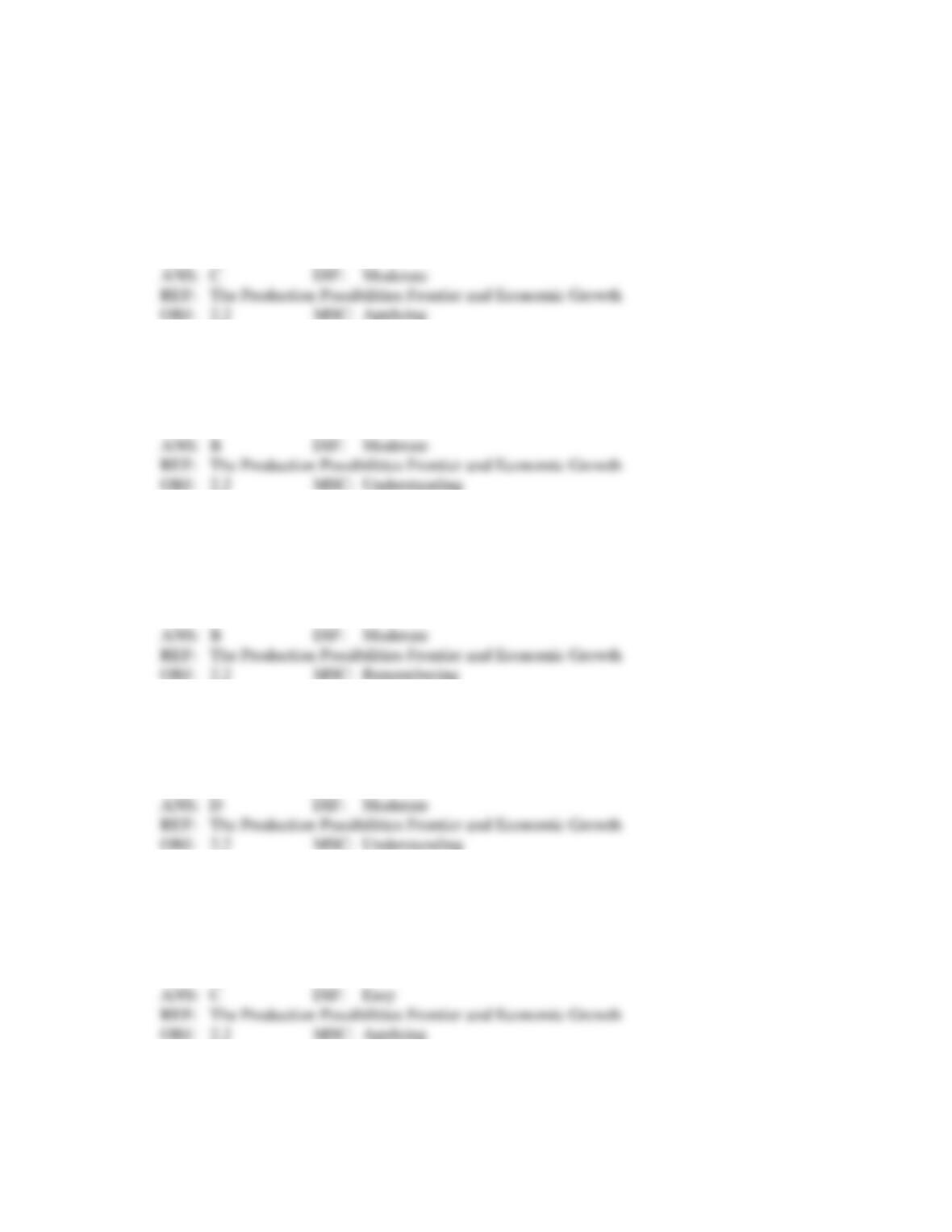
72. According to the figure, a new technology that makes it easier to peel, core, and prepare apples
will cause
a. the entire production possibilities frontier (PPF) to shift outward.
b. the entire production possibilities frontier (PPF) to shift inward.
c. the production possibilities frontier (PPF) to rotate outward to a larger maximum quantity of
apple pies with no change in maximum blueberry pies.
d. the production possibilities frontier (PPF) to rotate outward to a larger maximum quantity of
blueberry pies with no change in maximum apple pies.
e. the production possibilities frontier (PPF) to stay exactly the same because there is no change
in resources.
73. Economic growth can be depicted on a production possibilities frontier (PPF) as an
a. inward shift of the PPF. d. inward rotation along the y axis.
b. outward shift of the PPF. e. increase in opportunity cost.
c. inward rotation along the x axis.
74. An increase in general resources that affects the production of both goods on a production
possibilities frontier (PPF) would cause an
a. inward shift of the PPF. d. outward rotation along the y axis.
b. outward shift of the PPF. e. increase in opportunity cost.
c. outward rotation along the x axis.
75. Economic growth is represented on a production possibilities frontier (PPF) by the PPF
a. getting steeper. d. shifting outward.
b. getting flatter. e. rotating downward.
c. shifting inward.
76. An increase in the labor force would be reflected in a society’s production possibilities frontier
(PPF) by an
a. increase in opportunity cost. d. outward rotation along the x axis.
b. inward shift of the PPF. e. outward rotation along the y axis.
c. outward shift of the PPF.
77. A town on the Gulf Coast is battered by a massive hurricane that destroys most of its productive
resources. The community’s production possibilities frontier (PPF) would show an
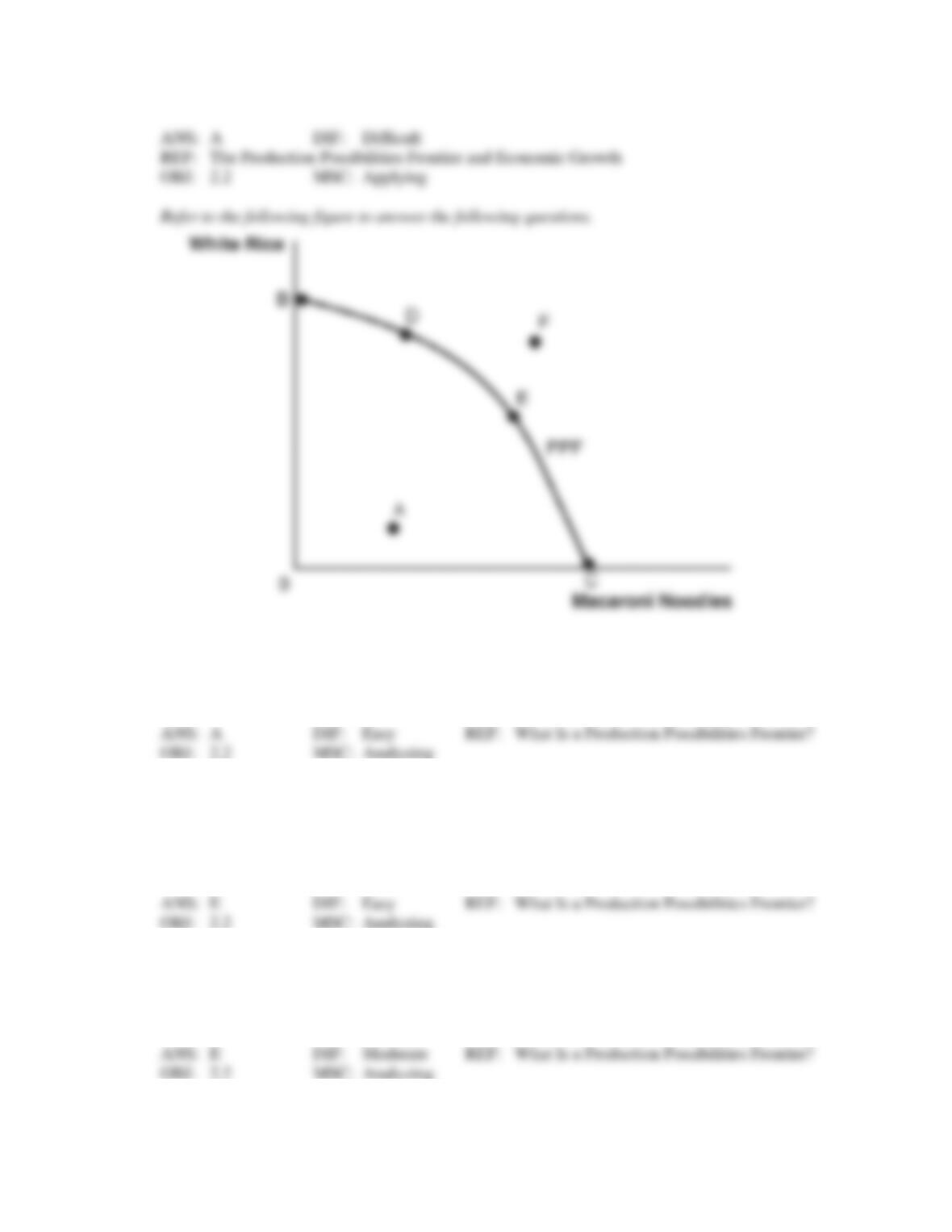
a. inward shift of the PPF. d. outward rotation along the y axis.
b. outward shift of the PPF. e. increase in opportunity cost.
c. outward rotation along the x axis.
78. Which of the following represents an inefficient point?
a. point A d. point D
b. point B e. point F
c. point C
79. Which of the following represents a point that is unattainable with current resources and
technology?
a. point B d. point E
b. point C e. point F
c. point D
80. What is the most preferred consumption point for a carbohydrate-loving society?
a. point B d. point E
b. point C e. point F
c. point D
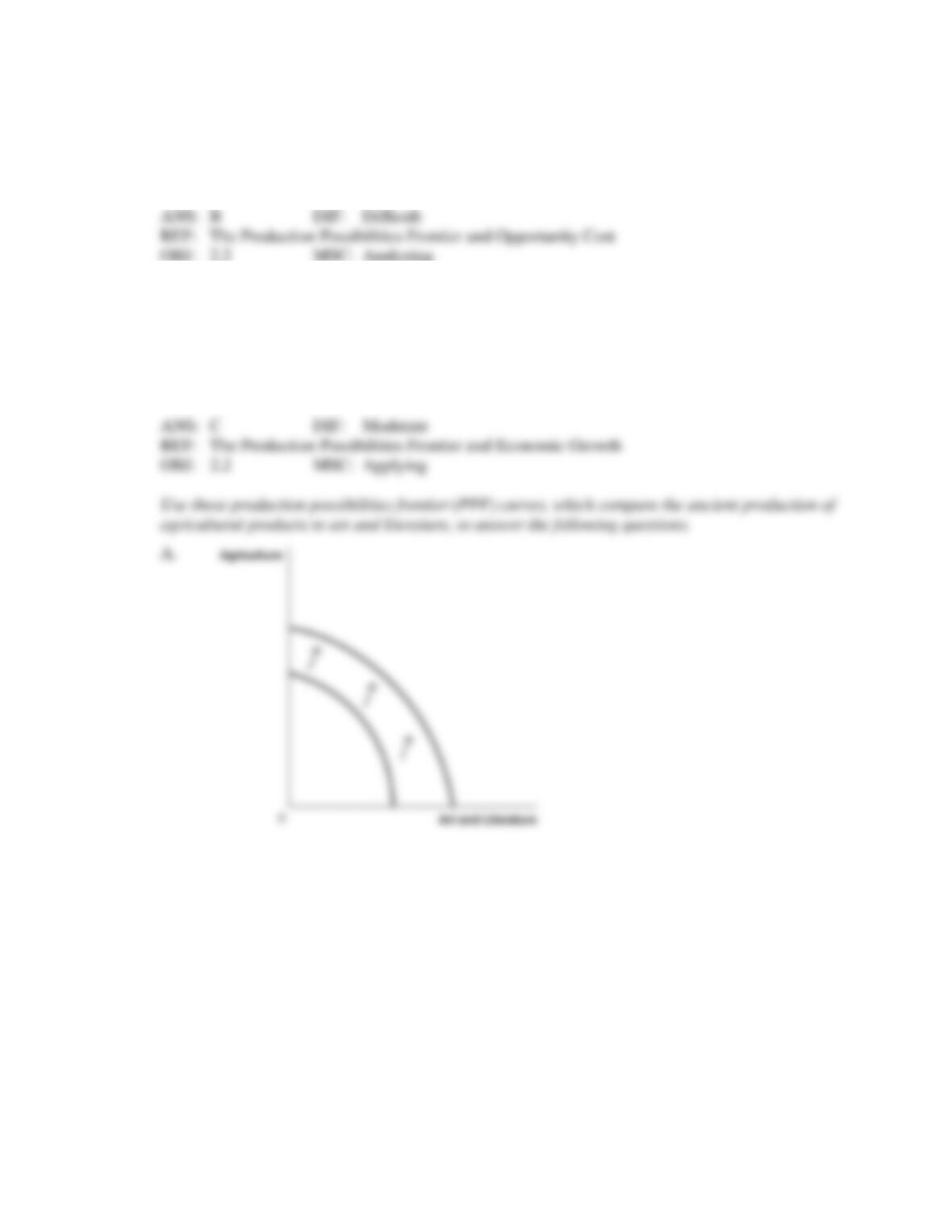
81. We can see that the opportunity cost of moving from point D to point E is different from the
opportunity cost of moving from point D to point C because
a. growing rice requires more water than growing wheat for pasta does.
b. the slope of the production possibilities frontier (PPF) is different in each of the two segments.
c. they are all efficient points.
d. they are all attainable points.
e. the opportunity cost is constant along the PPF.
82. This society could reach point F when there is a(n)
a. increase in the monetary price of white rice.
b. credible new study that shows eating pasta reduces the risk of heart attacks.
c. new technology that makes the storage and transport of both rice and pasta more efficient.
d. new tax on the sale of both rice and pasta.
e. increase in the monetary price of macaroni.