Microeconomics, 12e (Parkin)
Chapter 2 The Economic Problem
1 Production Possibilities and Opportunity Cost
1) The production possibilities frontier is the boundary between
A) those combinations of goods and services that can be produced and those that can be
consumed.
B) those resources that are limited and those that are unlimited.
C) those combinations of goods and services that can be produced and those that cannot.
D) those wants that are limited and those that are unlimited.
2) The production possibilities frontier is
A) upward sloping and reflects unlimited choices.
B) upward sloping and reflects tradeoffs in choices.
C) downward sloping and reflects unlimited choices.
D) downward sloping and reflects tradeoffs in choices.
3) The production possibilities frontier
A) depicts the boundary between those combinations of goods and services that can be produced
and those that cannot given resources and the current state of technology.
B) shows how many goods and services are consumed by each person in a country.
C) is a model that assumes there is no scarcity and no opportunity cost.
D) is a graph with price on the vertical axis and income on the horizontal axis.
4) The production possibilities frontier itself illustrates
A) all goods that can be produced by an economy.
B) the combination of goods and services that can be produced efficiently.
C) all goods and services that are desired but cannot be produced due to scarce resources.
D) all possible production of capital goods.
5) The production possibilities frontier is the boundary between those combination of goods and
services that can be
A) produced and those that can be consumed.
B) consumed domestically and those that can be consumed by foreigners.
C) produced and those that cannot be produced.
D) consumed and those that cannot be produced.
6) The production possibilities frontier itself shows
A) the maximum amount of resources available at any given time.
B) combinations of goods and services that do not fully use available resources.
C) the maximum rate of growth of output possible for an economy.
D) the maximum levels of production that can be attained.
7) The production possibilities frontier represents
A) the maximum amount of labor and capital available to society.
B) combinations of goods and services among which consumers are indifferent.
C) the maximum levels of production that can be attained.
D) the maximum rate of growth of capital and labor in a country.
8) Which of the following is NOT true concerning a society’s production possibilities frontier
(PPF)?
A) It reveals the maximum amount of any two goods that can be produced from a given quantity
of resources.
B) Tradeoffs occur when moving along a PPF.
C) Production efficiency occurs when production is on the frontier itself.
D) Consumers will receive equal benefits from the two goods illustrated in the PPF.
9) The production possibilities frontier separates ________.
A) the goods and services that people want from those that they do not want
B) the types of goods that can be attained from those that can’t be attained
C) the quantities of goods and services that can be produced from those that cannot be produced
D) the combinations of goods that people value and those that they don’t
10) When producing at a production efficient point, ________.
A) our choice of the goods can be either on or within the production possibilities frontier
B) we can satisfy our all wants
C) the opportunity cost of another good is zero
D) we face a tradeoff and incur an opportunity cost
11) Harry produces 2 balloon rides and 4 boat rides an hour. Harry could produce more balloon
rides but to do so he must produce fewer boat rides. Harry is ________ his production
possibilities frontier.
A) producing inside
B) producing on
C) producing outside
D) producing either inside or on
12) Production efficiency occurs when production ________.
A) is at a point beyond the production possibilities frontier
B) is on the production possibilities frontier or inside it
C) is at any attainable point
D) is on the production possibilities frontier
13) A point outside a production possibilities frontier indicates
A) that resources are not being used efficiently.
B) an output combination that society cannot attain given its current level of resources and
technology.
C) that resources are being used very efficiently.
D) that both goods are characterized by increasing costs.
14) Which of the following is NOT illustrated by a production possibilities frontier?
A) scarcity
B) opportunity cost
C) necessity for choice
D) who gets the goods
15) A production possibilities frontier figure does NOT illustrate
A) the limits on production imposed by our limited resources and technology.
B) the exchange of one good or service for another.
C) opportunity cost.
D) attainable and unattainable points.
16) Any production point outside the production possibilities frontier is
A) unattainable.
B) associated with unused resources.
C) attainable only if prices fall.
D) attainable only if prices rise.
17) Which of the following statements regarding the production possibilities frontier is TRUE?
A) Points outside the frontier are attainable.
B) Points inside the frontier are attainable.
C) Points on the frontier are less efficient than points inside the frontier.
D) None of the above because all of the above statements are false.
18) Jane produces only corn and cloth. Taking account of her preferences for corn and cloth
A) makes her production possibilities frontier straighter.
B) makes her production possibilities frontier steeper.
C) makes her production possibilities frontier flatter.
D) does not affect her production possibilities frontier.
19) On the vertical axis, the production possibilities frontier shows ________; on the horizontal
axis, the production possibilities frontier shows ________.
A) the quantity of a good; the number of workers employed to produce the good
B) the quantity of a good; the price of the good
C) the quantity of a good; a weighted average of resources used to produce the good
D) the quantity of one good; the quantity of another good
20) Scarcity is represented on a production possibilities frontier figure by
A) the amount of the good on the horizontal axis forgone.
B) the fact that there are only two goods in the diagram.
C) technological progress.
D) the fact there are attainable and unattainable points.
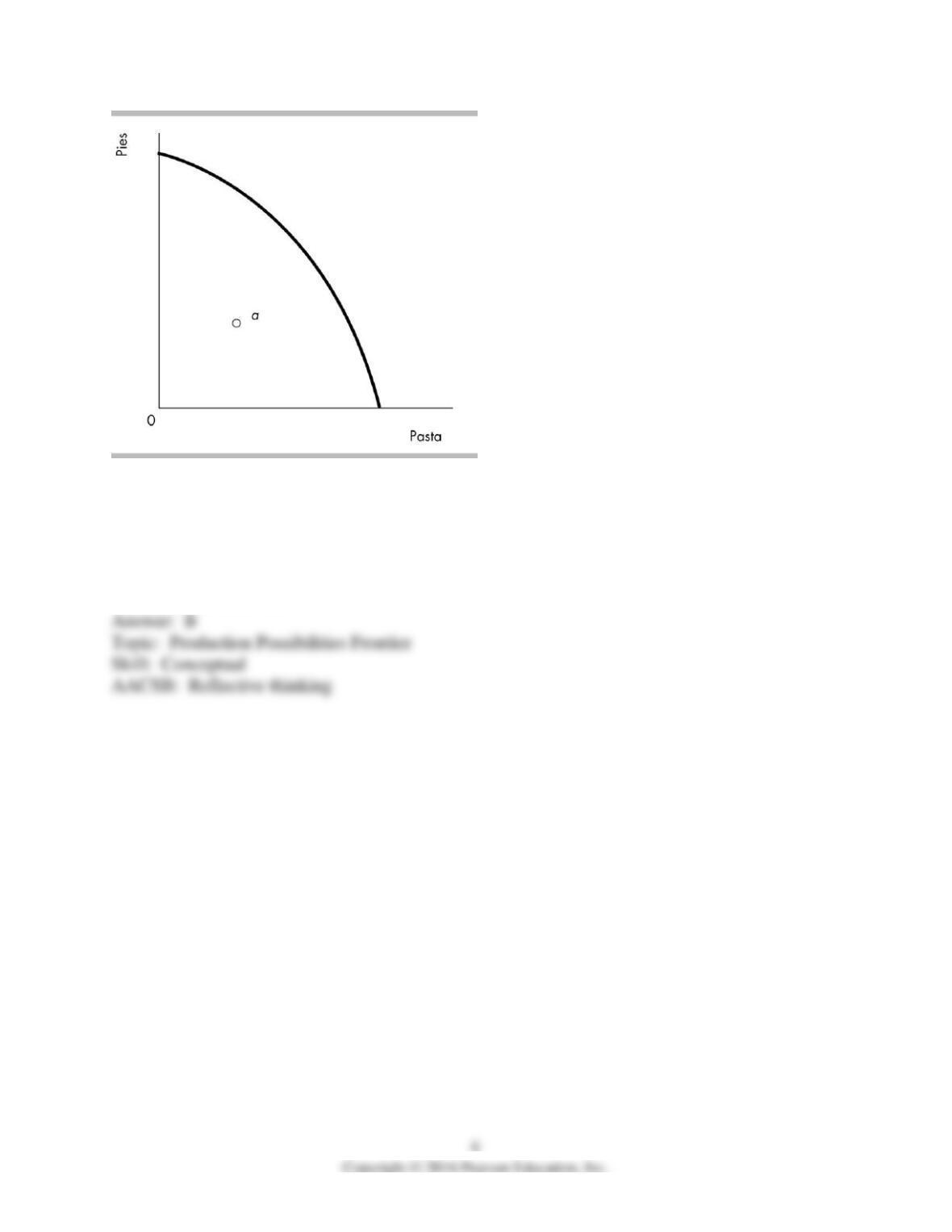
21) The figure above shows Roger’s production possibilities frontier. Point a is an ________
point and at that point production is ________.
A) attainable; efficient
B) attainable; inefficient
C) unattainable; inefficient
D) unattainable; efficient
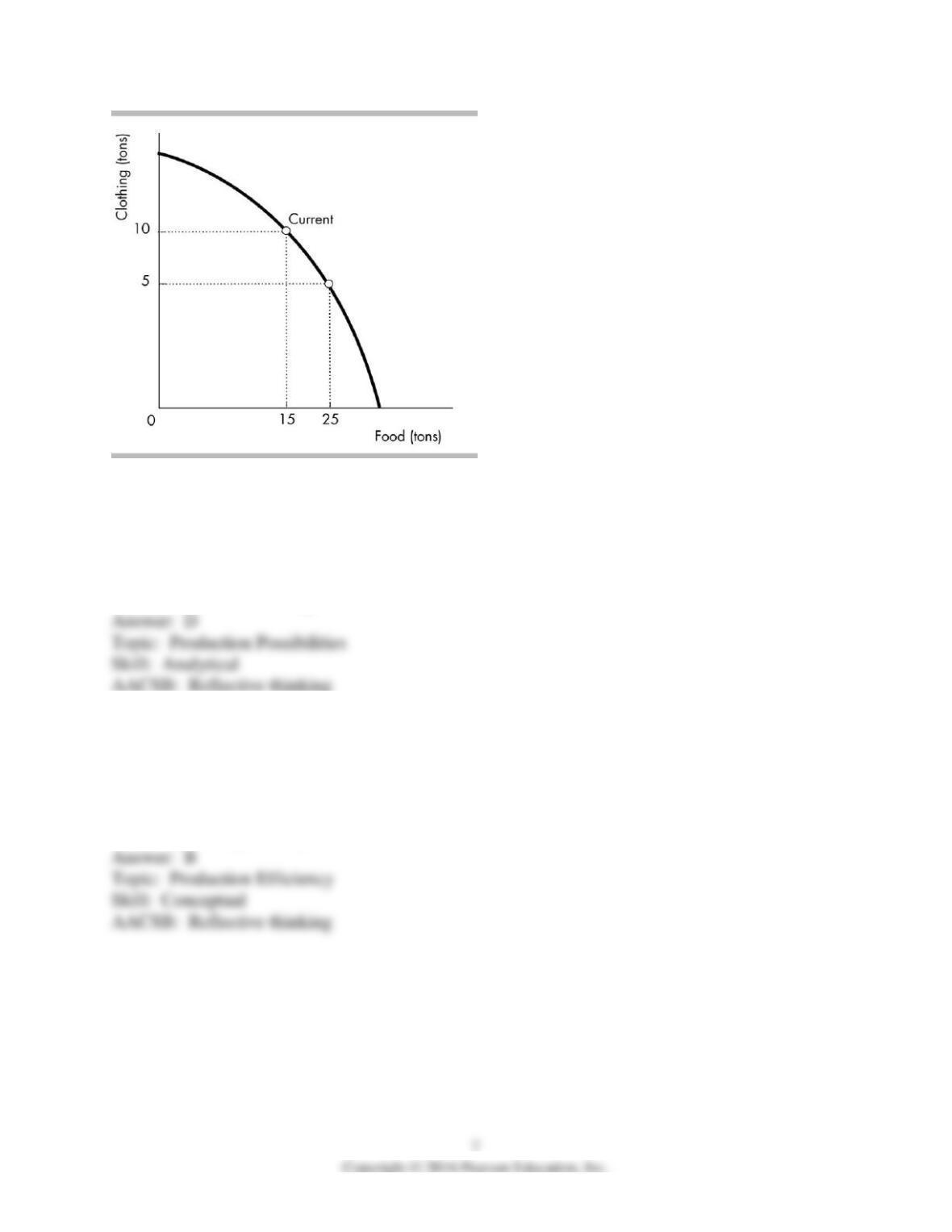
22) The above figure illustrates that if this country wishes to move from its current production
point (labeled “Current”) and have 10 more tons of food, it can do this by producing
A) 10 more tons of clothing.
B) 10 fewer tons of clothing.
C) 5 more tons of clothing.
D) 5 fewer tons of clothing.
23) Suppose the country of Popcorn produces only jets and corn. If Popcorn cannot produce any
more jets without giving up corn, we say that Popcorn has achieved
A) the highest marginal benefit.
B) production efficiency.
C) the lowest marginal cost.
D) the highest opportunity cost.
24) A society that is producing on its production possibilities frontier is
A) not utilizing all of its resources.
B) not being technologically efficient.
C) producing too much output.
D) fully utilizing all of its productive resources.
25) If a country must decrease current consumption to increase the amount of capital goods it
produces today, then it must
A) be using resources inefficiently today, but will be more efficient in the future.
B) be producing along the production possibilities frontier today and its production possibilities
frontier will shift outward if it produces more capital goods.
C) must be producing outside the production possibilities frontier and will continue to do so in
the future.
D) must not have private ownership of property and will have to follow planning authorities’
decisions today and in the future.
26) A country that must decrease production of one good in order to increase the production of
another
A) must be using resources inefficiently.
B) must be producing on its production possibilities frontier.
C) must be producing beyond its production possibilities frontier.
D) must have private ownership of property.
27) If an economy is operating at a point inside the production possibilities frontier, then
A) society’s resources are being inefficiently utilized.
B) the PPF curve will shift inward.
C) society’s resources are being used to produce too many consumer goods.
D) economic policy must retard further growth of the economy.
28) Any point on a production possibilities frontier (PPF) itself is
A) production efficient.
B) unattainable.
C) inefficient.
D) equitable.
29) If production point is inside the production possibilities frontier
A) it is not possible to produce more of both goods.
B) production is inefficient.
C) in order to produce more of one good, less of the other must be produced.
D) production is in the “unattainable” region.
30) If a society is operating at a point inside its production possibilities frontier, then this
society’s
A) resources are being inefficiently utilized.
B) production possibilities frontier will shift rightward.
C) resources are being used in the most efficient manner.
D) economy will grow too fast.
31) A president of the United States promises to produce more defense goods without any
decreases in the production of other goods. This promise can be valid
A) if the United States is producing at a point on its production possibilities frontier.
B) if the United States is producing at a point inside its production possibilities frontier.
C) if the United States is producing at a point beyond its production possibilities frontier.
D) only if the production possibilities frontier shifts rightward.
32) Using the production possibilities frontier model, unemployment is described as producing at
a point
A) on the exact middle of the PPF curve.
B) on either end of the PPF curve.
C) inside the PPF curve.
D) outside the PPF curve.
33) A reduction in the amount of unemployment
A) shifts the production possibilities frontier outward.
B) moves the economy’s point of production closer to the production possibilities frontier.
C) moves the economy’s point of production along the production possibilities frontier.
D) moves the economy’s point of production further away from the production possibilities
frontier.
34) A point inside a production possibilities frontier
A) could indicate that some resources are unemployed.
B) is unattainable.
C) is more efficient than points on the production possibilities frontier.
D) implies that too much capital and not enough labor are being used.
35) A point inside a production possibilities frontier
A) could indicate that resources are misallocated.
B) is more efficient than a point on the production possibilities frontier.
C) reflects the fact that more technology needs to be developed to fully employ all resources.
D) implies that too much labor and not enough capital is being used.
36) Production points inside the production possibilities frontier
A) are unattainable.
B) are attainable only with the full utilization of all resources.
C) are associated with unused or misallocated resources.
D) result in more rapid growth.
37) When resources are assigned to inappropriate tasks, that is, tasks for which they are not the
best match, the result will be producing at a point
A) where the slope of the PPF is positive.
B) where the slope of the PPF is zero.
C) inside the PPF.
D) outside the PPF.
38) Some time ago the government of China required many highly skilled technicians and
scientists to engage in unskilled agricultural labor in order to develop “proper social attitudes.”
This policy probably caused China to produce
A) at an inappropriate point along its production possibilities frontier.
B) outside its production possibilities frontier with respect to food, but inside with respect to
high-technology goods.
C) inside its production possibilities frontier with respect to food, but outside with respect to
high-technology goods.
D) inside its production possibilities frontier.
39) Sam’s production possibilities frontier has good A on the horizontal axis and good B on the
vertical axis. If Sam is producing at a point inside his frontier, then he
A) can increase production of both goods with no increase in resources.
B) is fully using all his resources.
C) values good A more than good B.
D) values good B more than good A.
40) A situation in which some resources are NOT fully utilized is represented in a production
possibilities frontier diagram by
A) any point on either the horizontal or the vertical axis.
B) the midpoint of the production possibilities frontier.
C) a point outside the production possibilities frontier.
D) a point inside the production possibilities frontier.
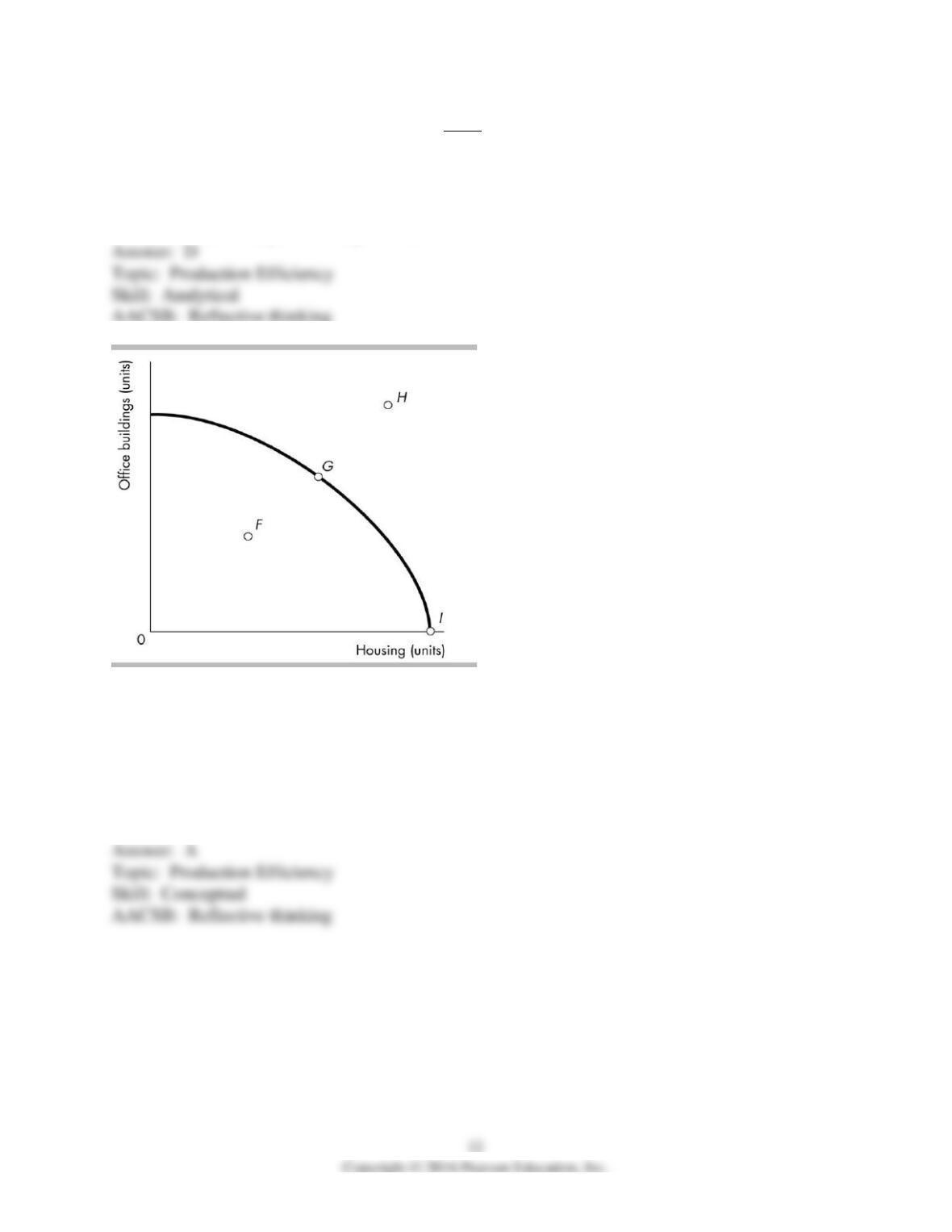
41) Consider the PPF for office buildings and housing shown in the figure above. Which point in
the diagram shows that resources to produce office buildings and housing are being misallocated,
unused, or both?
A) point F
B) point G
C) point H
D) point I
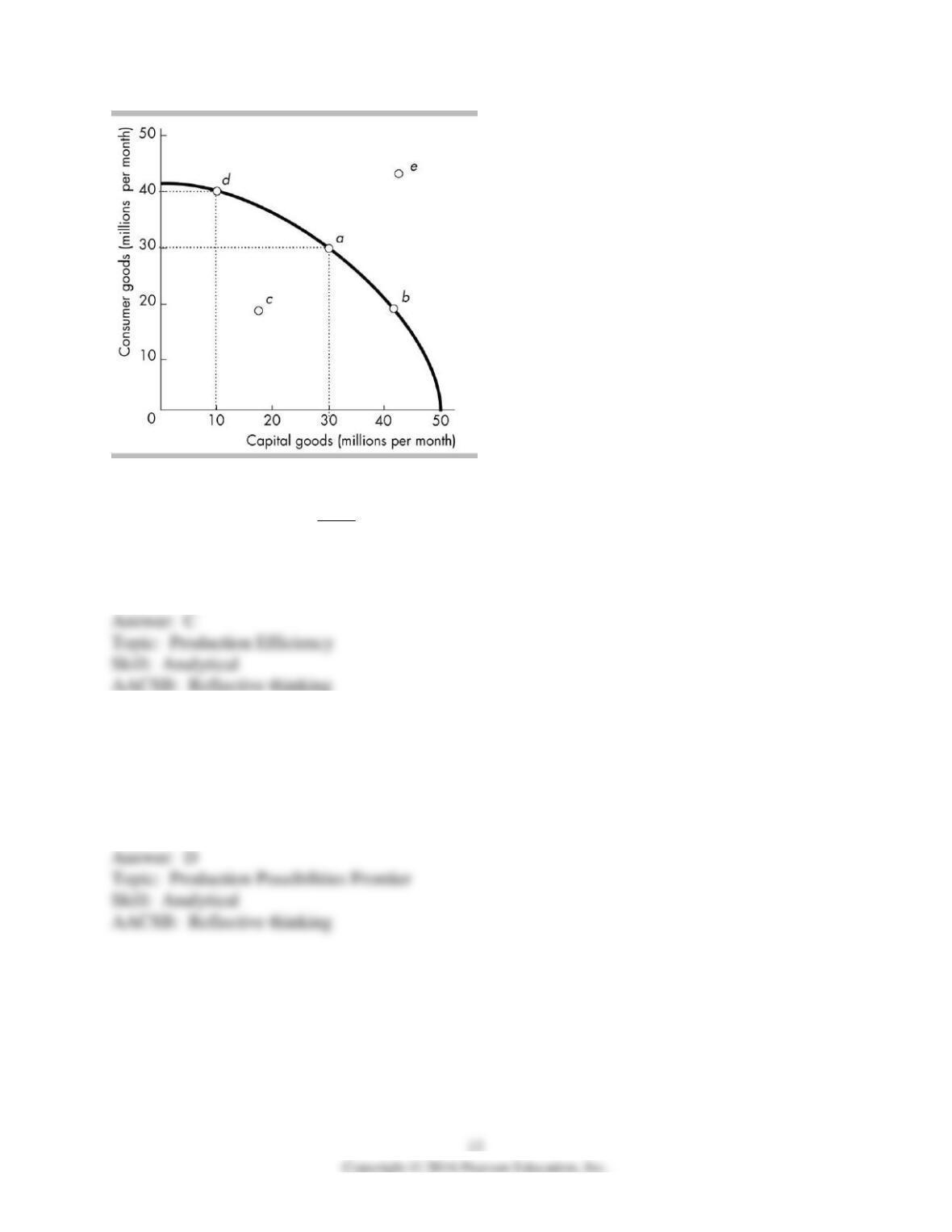
42) Refer to the production possibilities frontier in the figure above. Which production point
indicates that resources are NOT fully utilized or are misallocated?
A) point a
B) point b
C) point c
D) point e
43) Refer to the production possibilities frontier in the figure above. Which production point is
unattainable?
A) point a
B) point b
C) point c
D) point e
44) Refer to the production possibilities frontier in the figure above. Production point ________
represents an ________ production point.
A) b; unattainable
B) c; unattainable
C) e; inefficient
D) c; inefficient
45) In the figure above, moving from production at point d to production at point a requires
A) technological change.
B) a decrease in unemployment.
C) decreasing the output of consumer goods in order to boost the output of capital goods.
D) both capital accumulation and a decrease in unemployment.
46) Refer to the production possibilities frontier in the figure above. Suppose a country is
producing at point a. A movement to point ________ means that the country ________.
A) d; must give up 20 million capital goods
B) e; is not operating efficiently
C) d; gives up 10 million consumer goods
D) b; is producing at an inefficient point
47) Refer to the production possibilities frontier in the figure above. If the country moves from
point a to point c, the opportunity cost of the move is
A) 30 million capital goods.
B) 20 million capital goods.
C) 10 million capital goods.
D) 10 million consumption goods.
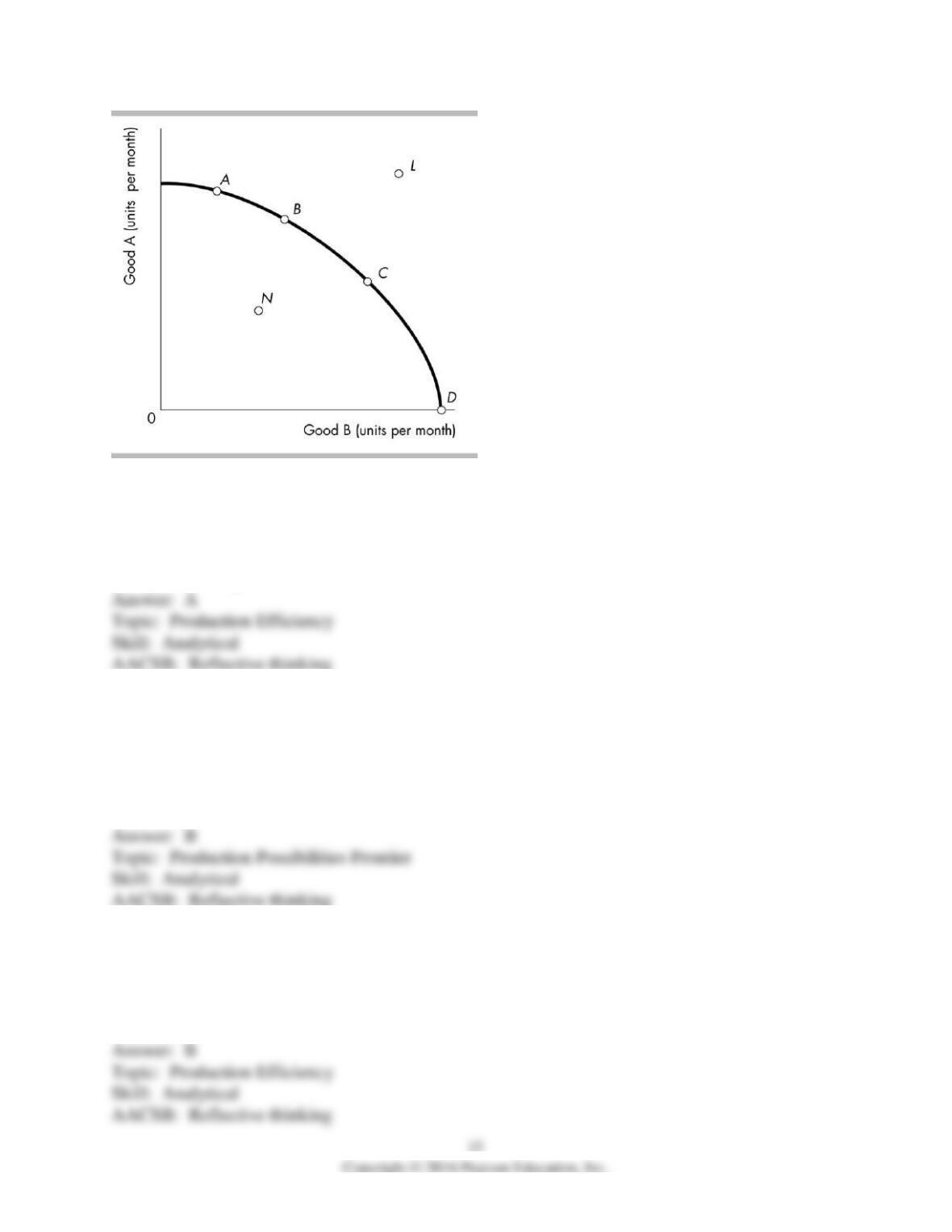
48) Point C on the production possibilities frontier in the above diagram illustrates
A) a point that achieves production efficiency.
B) a combination of goods and services that cannot be produced efficiently
C) all goods and services that are desired but cannot be produced due to scarce resources.
D) a production point that has underutilization of resources
49) In the above figure, which point represents an unattainable production combination of the
two goods?
A) point C
B) point L
C) point D
D) point N
50) In the above figure, which point represents an attainable but inefficient production point?
A) point C
B) point N
C) point L
D) point D
51) A tradeoff is
A) represented by a point inside a PPF.
B) represented by a point outside a PPF.
C) a constraint that requires giving up one thing to get another.
D) a transaction at a price either above or below the equilibrium price.
52) When producing goods and services along a PPF, tradeoffs exist because
A) not all production is efficient.
B) society has only a limited amount of productive resources.
C) buyers and sellers often must negotiate prices.
D) human wants and needs are limited at a particular point in time.
53) Considering a PPF with health care services on the vertical axis and other goods and services
on the horizontal axis, the increasing production of health care services in the United States as a
result of the aging population represents
A) a movement upward along the PPF.
B) an outward shift of the PPF from the vertical axis.
C) an outward shift of the PPF from the horizontal axis.
D) a movement downward along the PPF.
54) A tradeoff is illustrated by
A) a point inside the PPF.
B) a point outside the PPF.
C) a change in the slope of the PPF.
D) the negative slope of the PPF.
55) Moving from one point on the production possibilities frontier to another ________.
A) involves a tradeoff but does not incur an opportunity cost
B) involves an opportunity cost but no tradeoff
C) involves a tradeoff and incurs an opportunity cost
D) involves no tradeoff but it does incur an opportunity cost
56) When we choose a particular option, we must give up alternative options. The highest-valued
alternative forgone is the ________ of the option chosen.
A) opportunity cost
B) comparative advantage
C) nonmonetary cost
D) absolute advantage
57) Ted can study for his economics exam or go to a concert. He decides to study for his
economics exam instead of going to the concert. The concert he will miss is Ted’s ________ of
studying for the exam.
A) opportunity cost
B) explicit cost
C) implicit cost
D) discretionary cost
58) Opportunity cost is best defined as
A) the amount of money that an individual is willing to pay to purchase a good that means a
great deal to that person.
B) the amount of money lost by one individual in an exchange process so that another individual
might gain.
C) the highest-valued alternative that is forgone when choosing among various alternatives.
D) a situation in which one individual cannot have an absolute advantage over another individual
in the production of all goods.
59) Most students attending college pay tuition and are unable to hold a full-time job. For these
students, tuition is
A) part of the opportunity cost of going to college. So are their forgone earnings from not
holding a full-time job.
B) part of the opportunity cost of going to college. Their forgone earnings from not holding a
full-time job are not part of the opportunity cost of attending college.
C) not part of the opportunity cost of going to college, but their forgone earnings from not
holding a full-time job are part of the opportunity cost of attending college.
D) not part of the opportunity cost of going to college. Neither are their forgone earnings from
not holding a full-time job.
60) If Sam is producing at a point on his production possibilities frontier, then he
A) cannot produce any more of either good.
B) can produce more of one good only by producing less of the other.
C) will be unable to gain from trade.
D) is not subject to scarcity.
61) Opportunity cost is illustrated in a production possibilities frontier (PPF) by a movement
A) from the region within the PPF to a point on the PPF.
B) from the region within the PPF to the region outside of the PPF.
C) from the region outside of the PPF to a point on the PPF.
D) along the PPF where to gain more of one good it is necessary to give some of another good.
62) When moving along the production possibilities frontier, opportunity cost is measured as the
A) increase in the quantity produced of one good divided by the decrease in the quantity
produced of another good.
B) decrease in the quantity produced of one good divided by the increase in the quantity
produced of another good.
C) quantity produced of one good divided by the quantity produced of another good.
D) quantity produced of one good multiplied by the quantity produced of another good.
63) While producing on the production possibilities frontier, if additional units of a good could
be produced at a constant opportunity cost, the production possibilities frontier would be
A) bowed outward.
B) bowed inward.
C) positively sloped.
D) a straight line.
64) Opportunity cost is represented on the production possibilities frontier by
A) attainable and unattainable points.
B) efficient and inefficient points.
C) the amount of good Y forgone when more of good X is produced.
D) technological progress.
65) As residents of developing countries increase their chocolate consumption, the increased
production of cocoa results in
A) increased opportunity cost of cocoa production.
B) decreased opportunity cost of cocoa production.
C) no change in production of other goods and services.
D) increased production of other goods and services.
66) At one point along a PPF, 50 tons of coffee and 100 tons of bananas are produced. At
another point along the same PPF, 30 tons of coffee and 140 tons of bananas are produced. The
opportunity cost of a ton of coffee between these points is
A) 7/5 of a ton of bananas per ton of coffee.
B) 1/2 of a ton of bananas per ton of coffee.
C) 5/7 of a ton of bananas per ton of coffee.
D) 2 tons of bananas per ton of coffee.
67) When operating on its PPF, a country can produce 2 tons of butter and 200 cars OR 3 tons of
butter and 150 cars. The opportunity cost of 1 ton of butter is ________ cars per ton of butter.
A) 300
B) 200
C) 50
D) 0.75
68) In one day, Sue can change the oil on 20 cars or change the tires on 20 cars. In one day, Fred
can change the oil on 20 cars or change the tires on 10 cars. Sue’s opportunity cost of changing
oil is ________ than Fred’s and her opportunity cost for changing tires is ________ than Fred’s.
A) greater; less
B) less; greater
C) less; less
D) greater; greater
69) At one point along a PPF, 10 pizzas and 7 sandwiches can be produced. At another point
along the same PPF, 9 pizzas and 10 sandwiches can be produced. The opportunity cost of a
pizza between these points is ________ per pizza.
A) 7/10 of a sandwich
B) 10/7 of a sandwich
C) 1/3 of a sandwich
D) 3 sandwiches
70) At one point along a PPF 40 tons of wheat are produced while 80 tons of rice are produced.
At another point along the same PPF, 41 tons of wheat are produced while 70 tons of rice are
produced. The opportunity cost of producing a ton of wheat between these points is ________
per ton of wheat.
A) 1/2 ton of rice
B) 10 tons of rice
C) 1/10 ton of rice
D) 4/7 ton of rice