Chapter 02 Test Bank – Static Key
1. The income statement is the major device for measuring the profitability of a firm over a period of time.
2. The income statement shows the amount of profits earned based on any one given day.
3. Sales minus cost of goods sold is equal to earnings before taxes.
4. Sales minus cost of goods sold is equal to gross profit.
5. It is not possible for a company with a high gross profit margin to have a low operating profit.
6. Gross profit margin is a measurement of how much gross profit a company generated from the amount
of sales it earned.
7. Operating profit is essentially a measure of how efficient management is in generating revenues and
controlling expenses.
8. Another way of writing net income after tax is earnings after taxes (EAT).
9. Dividing earnings after taxes (which includes all profits distributed to both preferred stockholders and
common stockholders) by common shares outstanding produces earnings per share.
10. The price-earnings (P/E) ratio is strongly related to the past performance of the firm.
11. Accounting income is based on verifiably completed transactions.
12. When a firm has a sharp drop off in earnings, its P/E ratio may be artificially high.
13. The P/E ratio provides no indication of investors’ expectations about the future of a company.
14. The real value of a firm is the same from an economic and accounting perspective.
15. A balance sheet represents the assets, liabilities, and owner’s equity of a company at a given point in
time.
16. A balance sheet represents what the firm owns, owes, and ownership of a company at a given date.
17. Liquidity means that the items that can convert to cash show up as cash on the balance sheet.
18. The investments account includes marketable securities.
19. The long-term investments account represents a commitment of funds of at least one year or more.
20. Asset accounts are listed in order of their liquidity.
21. Accumulated depreciation shows up in the income statement, while depreciation expense shows up on
the balance sheet.
22. Accumulated depreciation should always be equal to the depreciation expense charged in the income
statement.
23. Total assets of a firm are paid for with liabilities and stockholders’ equity.
24. Marketable securities are short term investments and are valued on the balance sheet at their original
purchase price.
25. Book value per share of stock and market value per share of stock are usually the same dollar amount.
26. Book value per share of stock is of greater concern to the financial manager than market value per
share of stock.
27. Book value of a company is equal to net worth of a company, which is not always equal to the market
value of the company.
28. Equity is a measure of the monetary contributions that have been made directly or indirectly on behalf
of the owners of the company.
29. Stockholders equity is equal to liabilities plus assets.
30. Stockholders equity is equal to assets minus liabilities.
31. Retained earnings shown on the balance sheet represents profits generated from prior year’s earnings
less any prior dividends.
32. Balance sheet items should be adjusted for inflation when valuing a company.
33. Balance sheet items consider inflation and market value when assigning the amount to assets,
liabilities, and equity accounts.
34. Cash and cash equivalents are considered anything that can convert to cash within one year.
35. The Statement of Cash Flows has three parts: operating, investing, and financing under both the
indirect and direct method.
36. The statement of cash flows helps measure how the changes in a balance sheet accounts were
financed between two time periods, the beginning and the ending balance.
37. Cash flow from operations is equal to earnings before taxes minus depreciation.
38. The indirect method of preparing the Cash Flow Statement basically adjusts the net income to reflect
what the financials would have looked like if cash basis was used instead of accrual basis.
39. Assume that two companies both have a net income of $100,000. The firm with the highest
depreciation expense will have the highest cash flow, assuming all other adjustments are equal.
40. An increase in assets represents a positive source of funds.
41. An increase in a liability account represents a source of positive funds on the cash flow statement.
42. The purchase of a new factory building would reduce the cash flows from investing activities on the
statement of cash flows.
43. Paying cash dividends to common shareholders will not affect the Cash Flow Statement.
44. The sale of a firm’s securities is a source of positive funds, whereas the purchase of securities is a use
of funds.
45. Depreciation is an accrual accounting entry that does not affect the cash account so it needs to be
adjusted for when using the indirect method of the Cash Flow Statement.
46. Free cash flow is equal to cash flow from operating activities plus depreciation.
47. Free cash flow is equal to cash flow from operating activities minus necessary capital expenditures and
normal dividend payments.
48. For corporations with low taxable income (less than $50,000), the effective tax rate can be as much as
40%.
49. Interest expense is deductible before taxes and therefore has an after-tax cost equal to the interest paid
times (1 – tax rate).
50. Federal corporate tax rates have changed several times since 1980.
51. A $125,000 credit sale could be a part of a firm’s cash flow from operations if money is received within
the firm’s same fiscal year.
52. Preferred stock dividends are tax deductible.
53. Book value per share is the most important measure of value of a firm for a stockholder.
54. An increase in accounts receivable results in a cash inflow on the statement of cash flows.
55. A decrease in bonds payable results in a cash outflow on the statement of cash flows.
56. An increase in accrued expenses results in a cash outflow on the statement of cash flows.
57. A cash flow statement is considered correct if the change in cash flow plus the beginning balance ties
to the ending cash balance.
58. Although depreciation does not provide cash to the firm directly, the fact that it is tax-deductible can
provide cash inflow to the company.
59. Gross profit is equal to
60. Which of the following is not subtracted in arriving at operating income?
61. Increasing interest expense will have what effect on Earnings Before Interest and Taxes (EBIT)?
62. Allen Lumber Company had earnings after taxes of $750,000 in the year 2015 with 300,000 shares
outstanding on December 31, 2015. On January 1, 2016, the firm issued 50,000 new shares. The company
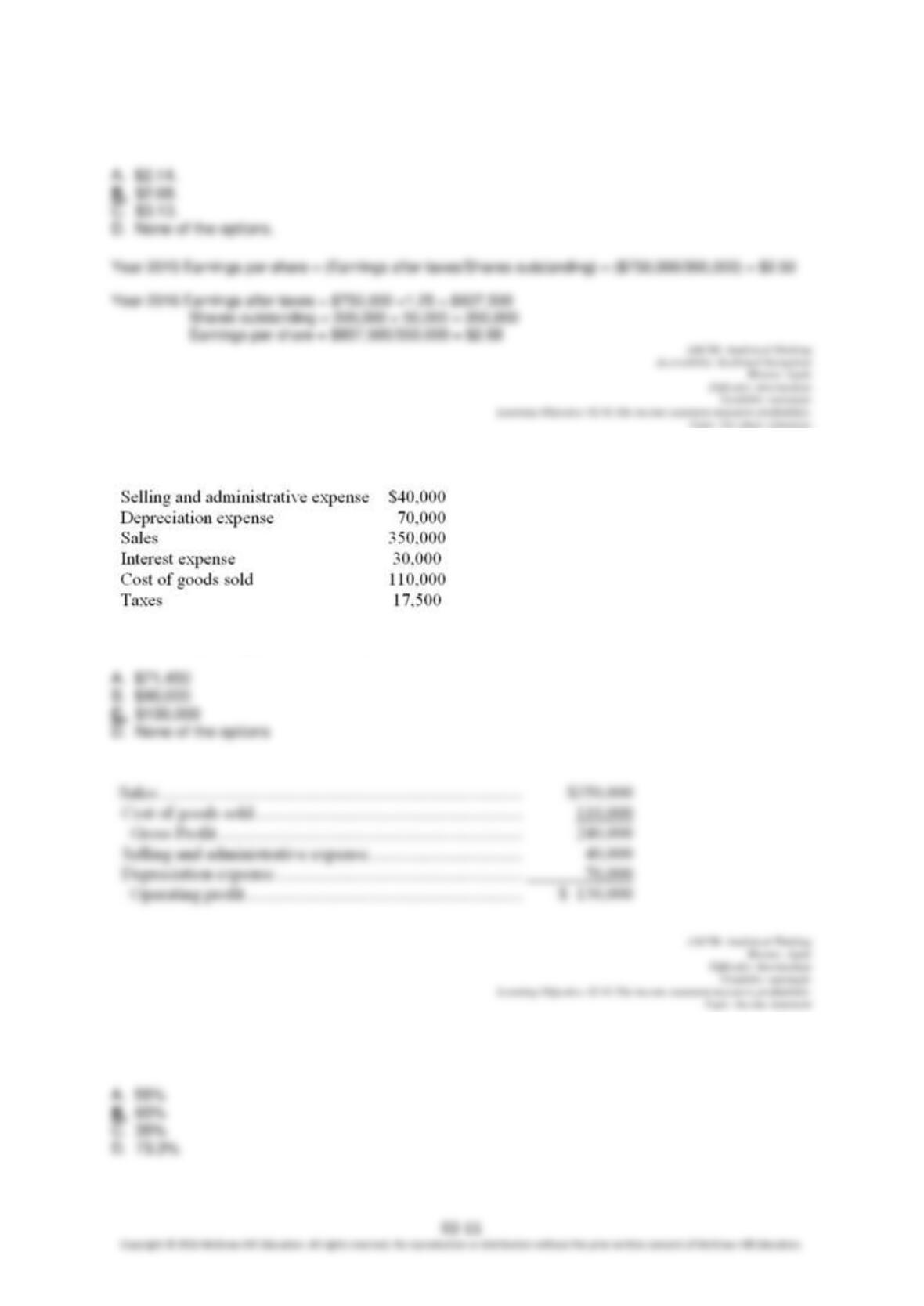
took the proceeds from these new shares as well as other operating improvements and earned $937,500
earnings after taxes in 2016. Earnings per share for the year 2016 were
Topic: Per-share valuations
63. Consider the following information for Ball Corp.
What is the operating profit for Ball Corp.?
64. Candy Company had sales of $320,000 and cost of goods sold of $112,000. What is the gross profit
margin (ratio of gross profit to sales)?
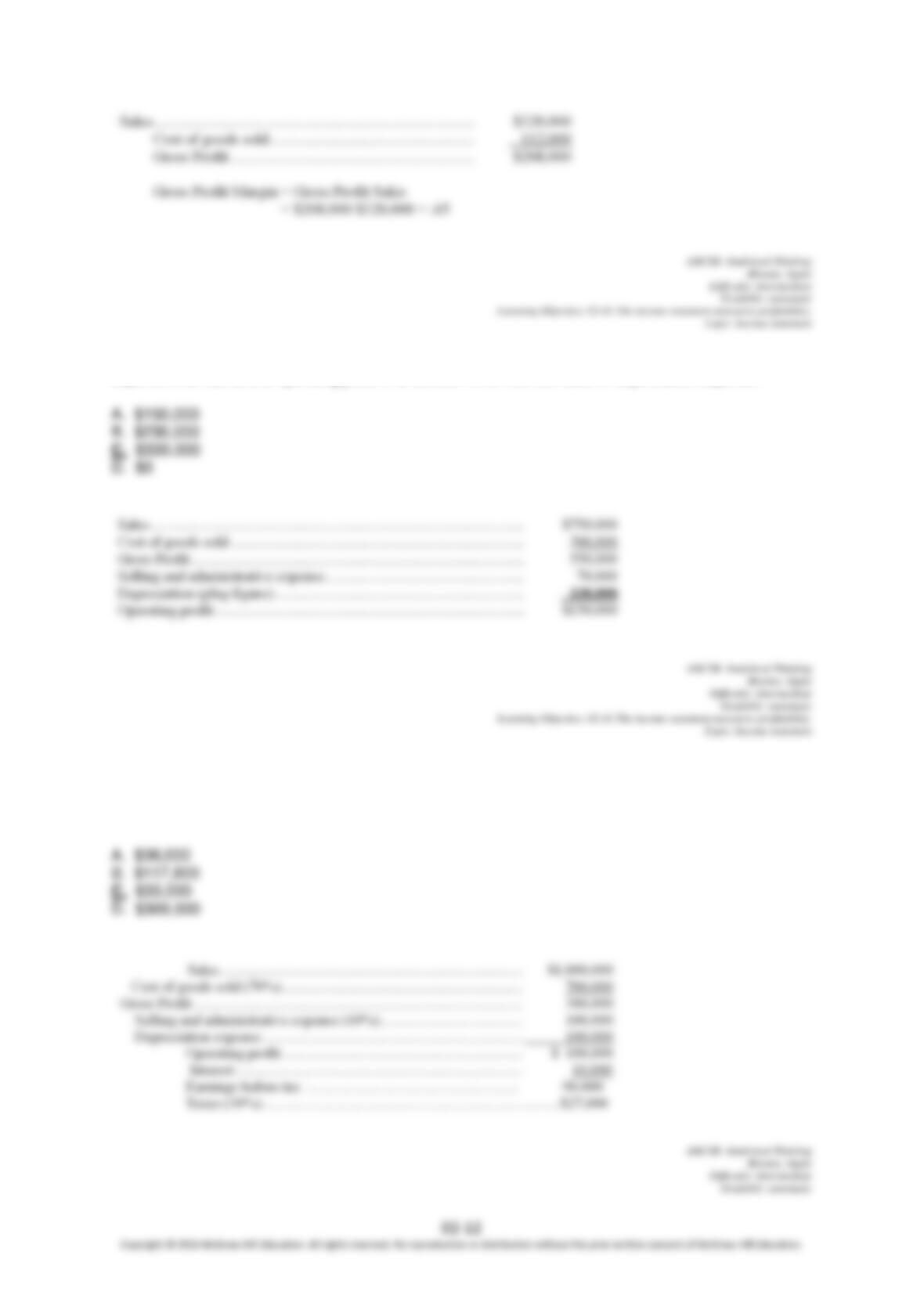
65. Density Farms Inc. had sales of $750,000, cost of goods sold of $200,000, selling and administrative
expense of $70,000, and operating profit of $150,000. What was the value of depreciation expense?
66. Elgin Battery Manufacturers had sales of $1,000,000 in 2015 and their cost of goods sold is $700,000.
Selling and administrative expenses were $100,000. Depreciation expense was $80,000 and interest
expense for the year was $10,000. The firm’s tax rate is 30 percent. What is the dollar amount of taxes paid
in 2015?
Learning Objective: 02-01 The income statement measures profitability.
Topic: Income statement
67. A firm has $1,500,000 in its common stock account and $1,000,000 in its capital paid in excess of par
account. The firm issued 100,000 shares of common stock. What was the issue price (market value) if only
one stock has ever been sold?
68. A firm has $4,000 in its common stock account and $10,000 in its paid-in capital account. The firm
issued 1,000 shares of common stock. What is the par value of the common stock?
69. A firm with earnings per share of $3 and a price-earnings (P/E) ratio of 24 will have a stock market price
of
70. Earnings per share is