a.
there will be an excess demand of 10 pounds in Columbia’s domestic market.
b.
Columbia’s domestic market for coffee will be in equilibrium.
c.
there will be an excess demand for Columbian coffee in the international market.
d.
the international market for coffee will be in equilibrium.
e.
Columbia will export 4 pounds of coffee.
55. Refer to Figure 20.1. If the price of Columbian coffee falls to $6 in the international market:
a.
there will be an excess supply of 8 pounds of Columbian coffee in the international market.
b.
the Columbian domestic market for coffee will be in equilibrium.
c.
the international market for coffee will be in equilibrium.
d.
there will be an excess demand of 4 pounds for coffee in Columbia’s domestic market.
e.
there will be an excess supply of coffee in Columbia’s domestic market.
MACR.BOYE.16.97 – ch. 19, 2
56. If the world price of steel is greater than the U.S. “no–trade” domestic equilibrium price of steel, the United States:
a.
will not produce steel.
b.
will demand steel from the rest of the world.
c.
will supply steel to the rest of the world.
d.
will not trade steel.
e.
will have a shortage of steel in the domestic market.
MACR.BOYE.16.97 – ch. 19, 2
United States – Reflective Thinking
57. If the world price is below the domestic “no–trade” equilibrium price, then with international trade:
a.
the domestic shortage can be eliminated by rationing.
b.
the domestic surplus can be consumed at home.
MACR.BOYE.16.97 – ch. 19, 2
c.
the domestic surplus can be exported to the rest of the world.
d.
the domestic quantity demanded is equal to that supplied by the world.
e.
the domestic shortage can be met by foreign imports.
58. The import demand curve shows the amount of the home country’s:
a.
surplus at various prices below the “no–trade” equilibrium.
b.
shortage at various prices below the “no–trade” equilibrium.
c.
equilibrium “no–trade” quantity demanded.
d.
surplus at various prices above the “no–trade” equilibrium.
e.
shortage at various prices above the “no–trade” equilibrium.
MACR.BOYE.16.97 – ch. 19, 2
59. The export supply curve shows a country’s:
a.
domestic surplus at various prices below the “no–trade” equilibrium price.
b.
domestic shortage at various prices below the “no–trade” equilibrium price.
c.
domestic supply at the “no–trade” equilibrium price.
d.
domestic surplus at various prices above the “no–trade” equilibrium price.
e.
domestic shortage at various prices above the “no–trade” equilibrium price.
MACR.BOYE.16.97 – ch. 19, 2
60. The international equilibrium price is the point at which:
a.
the domestic supply curve of one country intersects the domestic demand curve of another.
b.
the domestic demand and supply curves of a country intersects each other.
c.
the export supply curve of one country intersects the import demand curve of another.
d.
the domestic demand of the trading partners become identical.
MACR.BOYE.16.97 – ch. 19, 2
e.
the domestic supply of the trading partners become identical.
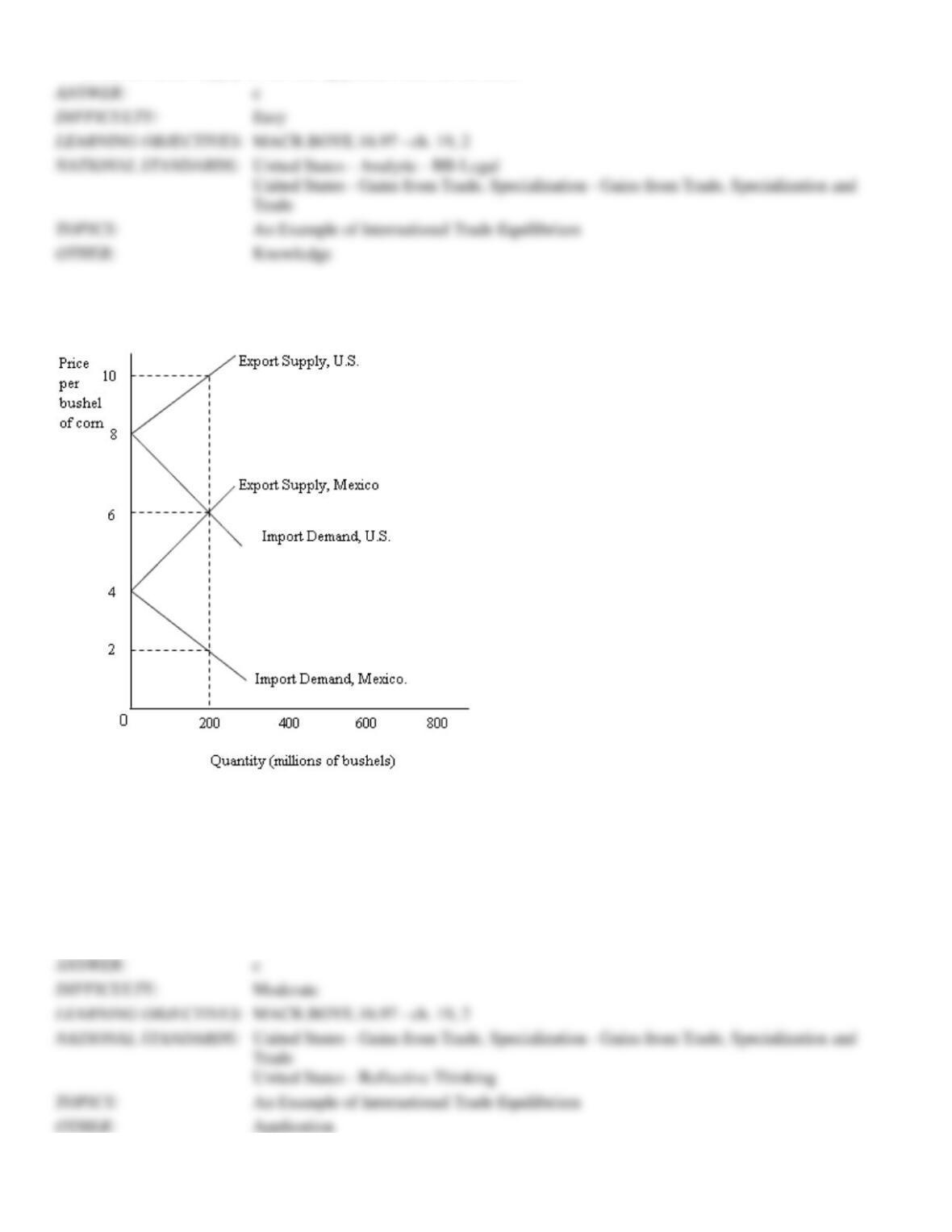
The figure given below shows the import demand and export supply curves of corn of the U.S. and Mexico.
Figure 20.2
61. According to Figure 20.2, the international equilibrium price of corn is:
a.
$2.
b.
$4.
c.
$6.
d.
$8.
e.
$10.
Moderate
MACR.BOYE.16.97 – ch. 19, 2
Application
Easy
MACR.BOYE.16.97 – ch. 19, 2
Knowledge
62. Refer to Figure 20.2. The no-trade equilibrium price of corn in the U.S. is:
a.
$2.
b.
$4.
c.
$6.
d.
$8.
e.
$10.
63. Refer to Figure 20.2. The no-trade equilibrium price of a bushel of corn in Mexico is:
a.
$2.
b.
$4.
c.
$6.
d.
$8.
e.
$10.
b
Moderate
Application
The table below shows the quantity demanded (in thousands) and quantity supplied (in thousands) of computers in the
U.S. and Canada at different prices.
Table 20.5
U.S.
Canada
Price
Quantity Demanded
Quantity Supplied
Quantity Demanded
Quantity Supplied
$1,200
50
10
60
10
$1,400
45
30
50
20
$1,600
40
50
40
30
$1,800
35
70
30
40
$2,000
30
90
20
50
64. According to Table 20.5, the international equilibrium price of computers is:
a.
$2,000.
b.
$1,600.
c.
$1,800.
d.
$1,400.
e.
$1,200.
b
d
Moderate
Application
65. According to Table 20.5, the equilibrium quantity of computers traded in the world market is:
a.
20,000 computers.
b.
30,000 computers.
c.
10,000 computers.
d.
15,000 computers.
e.
40,000 computers.
Challenging
MACR.BOYE.16.98 – ch. 19, 3
66. The oldest theory of comparative advantage is based on:
a.
factor abundance.
b.
productivity differences.
c.
product life cycles.
d.
preferences.
e.
human skills.
b
Moderate
MACR.BOYE.16.99 – ch. 19, 4
Sources of Comparative Advantage
67. Differences in the productivity of labor account for comparative advantage if:
a.
the minimum wage varies across the countries.
b.
the size of the domestic market varies across the countries.
c.
different countries have differences in labor hours required to produce each good.
d.
the strength of workforce varies across countries.
e.
the laborers are paid different wages in different countries.
Easy
MACR.BOYE.16.98 – ch. 19, 3
Application
68. According to the Ricardian model, the source of comparative advantage is:
a.
differences in labor productivity in the different countries.
b.
differences in foreign trade policies followed by the governments of the various countries.
c.
differences in resource endowments of the economies.
d.
differences in the fields of research and development in the countries.
e.
differences in the taste and preferences of the consumers in the different countries.
MACR.BOYE.16.99 – ch. 19, 4
Sources of Comparative Advantage
69. According to the Heckscher-Ohlin model:
a.
a relatively labor scarce country produces labor intensive goods.
b.
the labor productivity varies across different countries.
c.
the technological advancement varies across countries.
d.
the taste and preference patterns of the consumers are not similar across the countries.
e.
a capital abundant country exports sophisticated, manufactured products.
MACR.BOYE.16.99 – ch. 19, 4
Sources of Comparative Advantage
70. According to the Heckscher-Ohlin theory, comparative advantage is based on:
a.
labor productivity differences.
b.
product life cycles.
c.
the availability of skilled resources.
d.
consumer tastes and preferences.
e.
the relative abundance of the factors of production.
MACR.BOYE.16.99 – ch. 19, 4
71. The original comparative advantage model that used the relative abundance of factors of production to explain
comparative advantage assumed that countries:
a.
employed all four factors of production; land, labor, capital, and entrepreneurship.
b.
employed only two factors of production; labor and capital.
c.
employed only two factors of production; land and entrepreneurial ability.
d.
worked with a fixed capital stock.
e.
were free to vary their employment of only one factor of production; labor.
MACR.BOYE.16.99 – ch. 19, 4
Sources of Comparative Advantage
72. Workers in industrial countries earn much higher wages than workers in developing countries because:
a.
the industrial countries are labor rich and capital poor economies.
b.
the industrial countries lack a steady supply of unskilled laborers.
c.
the industrial countries produce labor intensive goods.
d.
the marginal productivity of labor is low in the industrial economies.
e.
the marginal productivity of labor is high in the industrial economies.
MACR.BOYE.16.99 – ch. 19, 4
Sources of Comparative Advantage
73. Which of the following statements in the context of U.S. exports is true?
a.
The U.S. exports products produced in the low wage industries.
b.
Primary products account for the largest share of U.S. exports to developed nations.
c.
The U.S. mainly exports labor intensive goods.
d.
Most U.S. exports are produced in high-wage industries.
e.
A bulk of U.S. exports to developing nations comprise of perishable commodities.
MACR.BOYE.16.99 – ch. 19, 4
Sources of Comparative Advantage
Sources of Comparative Advantage
74. The product life cycle theory of comparative advantage predicts that a new product will be first produced and exported
by:
a.
the nation that first demanded the new product.
b.
the first firm to successfully copy the technology.
c.
the nation in which it was invented.
d.
the countries with the most stable economies and the fewest restrictions on foreign trade.
e.
the company with the most extensive network of international distributors for the product.
Easy
MACR.BOYE.16.99 – ch. 19, 4
Sources of Comparative Advantage
75. The product life cycle theory predicts that comparative advantage shifts away from the country of origin if:
a.
the product is introduced in many countries simultaneously.
b.
the product is highly demanded in international markets.
c.
the demand for the product drastically declines in the domestic market of the country where it was invented.
d.
other countries have lower manufacturing costs using the now-standardized technology.
e.
other countries develop highly skilled labor forces to improve product quality.
Easy
MACR.BOYE.16.99 – ch. 19, 4
Sources of Comparative Advantage
76. The theory that explains the shift of color TV sets production from the United States to Japan and Taiwan is called the
_____ theory.
a.
productivity difference
b.
factor abundance
c.
product life cycle
d.
preference
e.
human skills
MACR.BOYE.16.99 – ch. 19, 4
Sources of Comparative Advantage
77. Which of the following looks at the demand side of the market to explain some of the observed international trade
patterns?
a.
The theory of consumer preferences
b.
The factor abundance theory
c.
The product life cycle theory
d.
The Ricardian model
e.
The human skills approach
MACR.BOYE.16.99 – ch. 19, 4
Sources of Comparative Advantage
78. The fact that the United States exports Budweiser beer and imports Heineken beer can be explained by:
a.
the differences in labor productivity in the U.S. and other countries.
b.
the differences in factor endowments in the U.S. and its trading partners.
c.
the world price of Budweiser beer is lower than Heineken beer.
d.
the fact that production of Budweiser beer in the U.S. is inadequate compared to its demand.
e.
the preference for foreign brands of beer by a part of the U.S. population.
MACR.BOYE.16.99 – ch. 19, 4
Sources of Comparative Advantage
79. Firms in industrial countries find a larger market for their goods in other industrial countries than in developing
countries because:
a.
the consumption patterns in the industrial countries are highly heterogeneous.
b.
the trade policies of the industrial nations are more favorable than the developing countries.
c.
the industrial countries tend to have a higher population than the developing countries.
d.
the industrial countries are capital intensive countries.
e.
the consumption patterns in the industrial countries are more or less similar.
MACR.BOYE.16.99 – ch. 19, 4
Sources of Comparative Advantage
80. We know that industrial countries tend to trade with other industrial countries. This pattern counters the:
a.
preference theory of comparative advantage.
b.
factor abundance theory of comparative advantage.
c.
concept of intraindustry trade.
d.
product life cycle theory of comparative advantage.
e.
human skills theory of comparative advantage.
b
Easy
MACR.BOYE.16.99 – ch. 19, 4
Sources of Comparative Advantage
Knowledge
81. The principle of comparative advantage states that a country should specialize in the production of those goods that
have the highest opportunity costs.
a.
True
b.
False
False
Easy
MACR.BOYE.16.96 – ch. 19, 1
Introduction
Knowledge
82. Trade between industrial countries account for the majority of international trade.
a.
True
b.
False
True
Easy
MACR.BOYE.16.96 – ch. 19, 1
Trade
Knowledge
83. Absolute advantage is determined by comparing the opportunity costs of producing each good in different countries.
a.
True
b.
False
Easy
Knowledge
84. If a laborer in Mexico can produce 2 bushels of wheat or 4 bushels of corn in a day, the opportunity cost of producing
wheat is 4 bushels of corn.
a.
True
b.
False
False
Easy
Application
85. International trade permits greater consumption than would be possible from the domestic production alone.
a.
True
b.
False
True
Easy
Knowledge
86. Countries should specialize and import goods in which they have a comparative disadvantage.
a.
True
b.
False
True
Easy
Knowledge
87. If Brazil can produce 5 shirts or 4 pounds of beef in a day, and Uruguay can produce 10 shirts or 2 pounds of beef in a
day, then Brazil has a comparative advantage in the production of beef.
a.
True
b.
False
Knowledge
88. No country can have an absolute advantage in the production of more than one good.
a.
True
b.
False
False
Knowledge
89. Absolute advantage is irrelevant, because knowing the absolute number of labor hours required to produce a good
does not tell us if we can benefit from trade.
a.
True
b.
False
True
Easy
Trade
Knowledge
90. We benefit from trade if we are able to obtain a good from a foreign country by giving up more of other goods than
we would have to give up to obtain the good at home.
a.
True
b.
False
False
Easy
91. Any terms of trade within the limits set by domestic opportunity costs will be mutually harmful, because each country
True
Moderate
Application
tries to push the other as close to the limits of the terms of trade as possible.
a.
True
b.
False
92. If Bolivia can produce 6 calculators or 3 televisions in a day, and Argentina can produce 4 calculators or 12 televisions
in a day, then Bolivia would be willing to trade 1 calculator for 1 television with Argentina.
a.
True
b.
False
True
Challenging
Application
93. A country with a strong bargaining power is likely to direct the terms of trade in its favor.
a.
True
b.
False
True
Easy
Knowledge
94. Dutch Disease is associated with a dramatic decline in the demand for a primary commodity produced by a country.
a.
True
b.
False
False
Easy
False
Easy
Knowledge
95. A sudden appreciation in the exchange rate of a country deteriorates the terms of trade of the country.
a.
True
b.
False
96. Though the countries can benefit by completely specializing in the production of the good in which they have
comparative advantage, in real world however, they do not completely specialize.
a.
True
b.
False
True
Easy
Knowledge
97. If the world price of a good is equal to its no-trade equilibrium price, the country will import more of the good from
other nations.
a.
True
b.
False
False
Easy
Knowledge
98. The higher the world price above the domestic no-trade equilibrium, the lesser the quantity of a good exported by a
country.
a.
True
b.
False
False
Easy
United States – Gains from Trade, Specialization – Gains from Trade, Specialization and
True
Moderate
Comprehension
99. The export supply and import demand curves measure the domestic shortage and surplus, respectively, at different
world prices.
a.
True
b.
False
False
Easy
Knowledge
100. If the export supply curve of tomatoes and the import demand curve of tomatoes of Luxembourg intersect at the
international price level of tomatoes, then Luxembourg will suspend trading tomatoes in the international market.
a.
True
b.
False
False
Moderate
Application
101. If the world price is above the domestic “no–trade” equilibrium price, then with international trade, the shortage
caused in the domestic market can be met by foreign imports.
a.
True
b.
False
False
Easy
Knowledge
102. If the international price of oranges is less than the domestic price of oranges in Spain, then Spain will export oranges
to other countries.
a.
True
b.
False
False
Trade
Knowledge
103. The export supply curve is the portion of the domestic supply curve below the no-trade equilibrium price.
a.
True
b.
False
False
Easy
Application
104. International equilibrium occurs if the quantity of imports demanded by one country is equal to the quantity of
exports supplied by the other country.
a.
True
b.
False
True
Easy
Knowledge
105. The standard interpretation of the Ricardian model is that differences in factor endowments between countries
account for differences in labor productivity.
a.
True
b.
False
False
Easy
Knowledge
106. It seems self evident that countries would have an advantage in producing those goods that use relatively large
amounts of their most abundant factor of production.
Easy
Application
a.
True
b.
False
107. The Heckscher-Olin model uses differences in factor abundance to determine whether any nation has a comparative
advantage in any good.
a.
True
b.
False
True
Easy
Trade
Knowledge
108. Countries with a relatively high stock of skilled labor will have a comparative advantage in producing goods that
require relatively larger quantities of skilled labor.
a.
True
b.
False
True
Easy
Knowledge
109. Developing countries can be expected to have a comparative advantage in industries requiring a relatively large
amount of skilled labor.
a.
True
b.
False
False
Easy
Trade
True
Easy
Trade
Knowledge
110. The human skills theory is similar to the factor abundance theory of explaining the source of comparative advantage,
except that the former concentrates only on different aspects of labor.
a.
True
b.
False
True
Easy
Knowledge
111. The comparative advantage in a specific good can shift over time from one country to another, as the other countries
can produce it at a cheaper cost after imitating the technology.
a.
True
b.
False
True
Easy
Knowledge
112. The simultaneous import and export of goods in the same industry by a particular country is known as interindustry
trade.
a.
True
b.
False
False
Moderate
Trade
Knowledge
Knowledge