c.
both the income and substitution effect.
d.
neither the income effect nor the substitution effect.
c
Moderate
DISC: Labor markets
United States – BPROG: Analytic
Labor markets
The Supply of Labor
209. If wages decrease and workers choose to work more hours or more shifts, their behavior is evidence of
a.
the substitution effect.
b.
the income effect.
c.
rational expectations.
d.
rational ignorance.
Easy
DISC: Labor markets
United States – BPROG: Analytic
Labor markets
The Supply of Labor
210. Unions can be thought of as constituting
a.
a monopoly element in the supply of labor.
b.
a monopoly element in the demand for labor.
c.
an oligopoly element in the supply of labor.
d.
a competitive element in the demand for labor.
a
Moderate
DISC: Labor markets
United States – BPROG: Analytic
Labor markets
Unions and Collective Bargaining
211. The American Bar Association administers the bar examinations that prospective lawyers must pass before being
allowed to practice law. The exam system thus allows the ABA to act like a
a.
monopsony.
b.
union that can restrict the supply of lawyers.
c.
union that can increase the number of lawyers.
d.
None of the above is correct.
Difficult
DISC: Labor markets
United States – BPRPOG: Analysis
Labor markets
Unions and Collective Bargaining
212. The goal of a union may be to maximize the
a.
number of union members.
b.
income received by workers in the relevant industry.
c.
number of workers employed in the relevant industry.
d.
All of the above are correct.
Easy
DISC: Labor markets
United States – BPROG: Analytic
Labor markets
Unions and Collective Bargaining
213. In a famous series of commercials, the International Ladies’ Garment Workers Union (ILGWU) urged buyers to
“look for the union label” and to avoid buying clothes not made by ILGWU members. Through the commercials, the
ILGWU tried to attain its goals by
a.
restricting the number of ILGWU members.
b.
featherbedding.
c.
raising the marginal revenue products of ILGWU members.
d.
creating lower prices for goods made by ILGWU members.
c
Moderate
DISC: Labor markets
United States – BPROG: Reflective Thinking – BPROG: Analysis
Labor markets
Unions and Collective Bargaining
214. Which of the following might be a goal of a union?
a.
increasing the size of the union
b.
increasing the income while holding the size of the union constant
c.
increasing both the size and income of the union
d.
all of the above
Easy
DISC: Labor markets
United States – BPROG: Analytic
Labor markets
Unions and Collective Bargaining
215. Suppose the goal of a union is to maximize the total income of all workers it represents. In this case it will probably
aim for a wage at which the elasticity of demand for workers is
a.
0.
b.
infinite.
c.
1.
d.
ranging from 2 to 5.
c
Difficult
DISC: Elasticity
United States – BPRPOG: Analysis
Elasticity
Unions and Collective Bargaining
216. Unions have the power to
a.
set all working rules.
b.
increase the firm’s total taxes.
c.
push wages above competitive levels at times.
d.
make a firm nationalized.
c
Easy
DISC: Labor markets
United States – BPROG: Analytic
Labor markets
Unions and Collective Bargaining
217. Among possible union strategies, the one that can both raise wages and add to employment is
a.
restricting the supply of workers.
b.
raising the demand curve for the product or for labor.
c.
fixing the wage.
d.
striking frequently.
Moderate
DISC: Labor markets
United States – BPROG: Reflective Thinking – BPROG: Analysis
Labor markets
Unions and Collective Bargaining
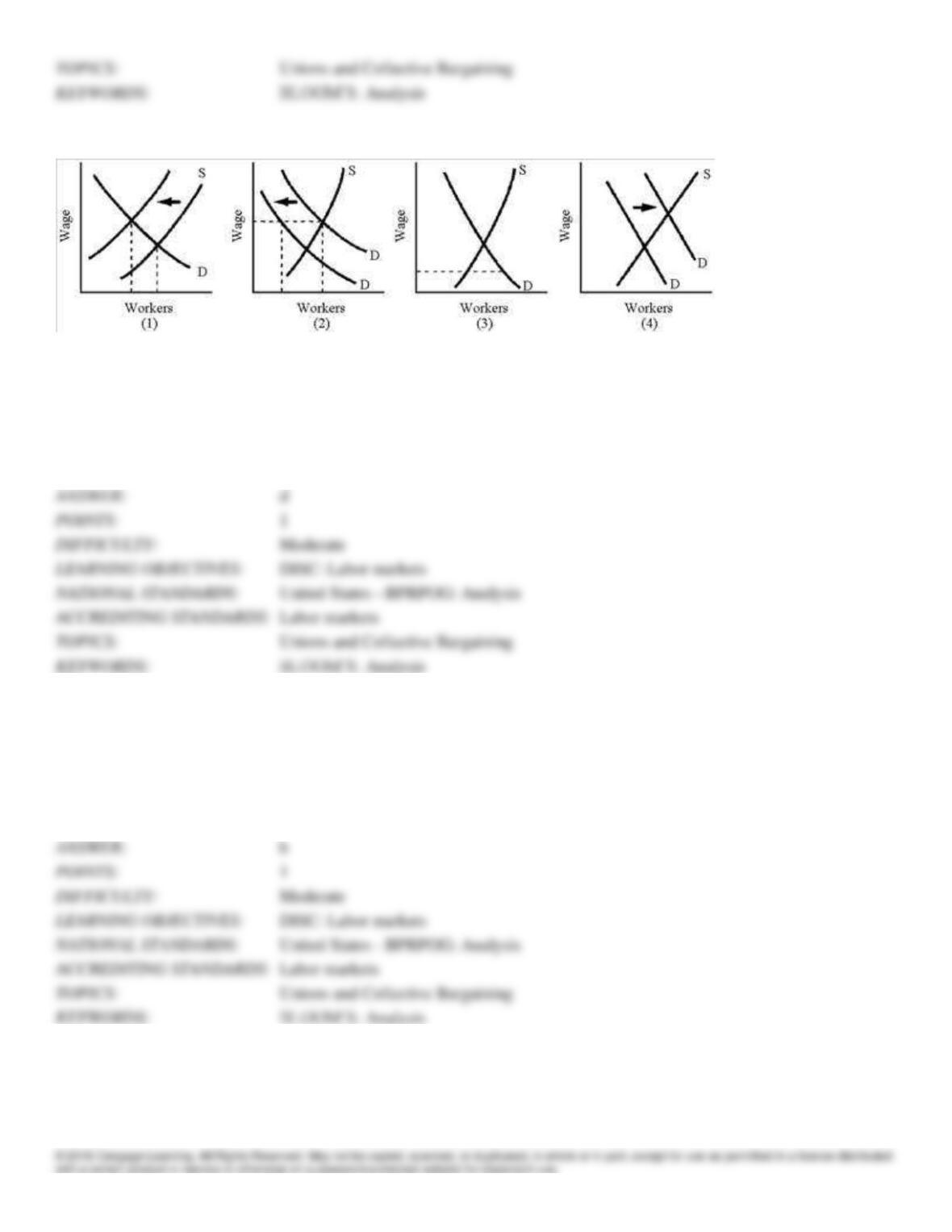
Figure 20-4
218. In Figure 20–4, which panel shows the impact of union efforts to have goods produced in Asia excluded from the
U.S. market?
a.
1
b.
2
c.
3
d.
4
d
1
DISC: Labor markets
United States – BPRPOG: Analysis
Labor markets
219. In Figure 20–4, which panel depicts a union suffering unemployment during a recession rather than allowing the
wage to fall?
a.
1
b.
2
c.
3
d.
4
b
1
DISC: Labor markets
United States – BPRPOG: Analysis
Labor markets
Unions and Collective Bargaining
220. The consensus among researchers is that union workers earn 15 percent more than otherwise identical nonunion
workers. This means unions have probably raised wages
a.
exactly 15 percent.
b.
less than 15 percent.
c.
at least 15 percent.
d.
more or less than 15 percent, but one cannot tell exactly.
c
Difficult
DISC: Labor markets
United States – BPROG: Reflective Thinking – BPROG: Analysis
Labor markets
Unions and Collective Bargaining
221. A union wants to increase its members’ wages without reducing employment. Which of the following strategies
might achieve that goal?
a.
setting a high minimum wage rate for its members
b.
increasing the number of members in the union
c.
pushing employers not to allow featherbedding of workers
d.
training its members to work more productively
Moderate
DISC: Labor markets
United States – BPROG: Reflective Thinking – BPROG: Analysis
Labor markets
Unions and Collective Bargaining
222. For which of the following workers would the income effect be more likely to outweigh the substitution effect of an
increase in wage?
a.
gardener
b.
teacher
c.
professional athlete
d.
plumber
c
Moderate
DISC: Labor markets
United States – BPROG: Analytic
Labor markets
The Supply of Labor
223. A minimum wage law might increase wages without reducing employment if the hiring firm is
a.
in perfect competition.
b.
a monopolist.
c.
a monopolistic competitor.
d.
a monopsonist.
DISC: Labor markets
United States – BPROG: Analytic
Labor markets
Unions and Collective Bargaining
224. The term “bilateral monopoly” refers to market situations in which
a.
there are two participants on the selling side.
b.
there are two participants on the buying side.
c.
there is a monopoly on the selling side and a monopsony on the buying side.
d.
a monopoly has evaded antitrust laws.
DISC: Labor markets
United States – BPROG: Analytic
Labor markets
Unions and Collective Bargaining
225. A monopsonist hires labor in a market with perfectly competitive supply. Whenever she hires an additional worker,
a.
she must reduce the wage paid to all workers already hired.
b.
she will not change the wage paid to all workers already hired.
c.
she must raise the wage paid to all workers already hired.
d.
she may or may not choose to change the wage paid to all workers already hired.
DISC: Labor markets
United States – BPROG: Analytic
Labor markets
Unions and Collective Bargaining
226. When large oligopolistic firms negotiate with the unions of their employees, the resulting bargaining process closely
resembles
a.
perfect competition.
b.
a dual labor market.
c.
monopolistic competition.
d.
bilateral monopoly.
DISC: Labor markets
United States – BPROG: Analytic
Labor markets
Unions and Collective Bargaining
227. The initial stage of the procedure in which a union and an employer negotiate over a contract is known as
a.
featherbedding.
b.
collective bargaining.
c.
mediation.
d.
arbitration.
Easy
DISC: Labor markets
United States – BPROG: Analytic
Labor markets
Unions and Collective Bargaining
228. In the collective bargaining process
a.
supply and demand analysis is used to determine the wage.
b.
the contract can legally cover only the wage or salary determined.
c.
there is often heated discussion with threats of strikes and counterthreats of lockout.
d.
the negotiation period is limited to thirty days.
c
Moderate
DISC: Labor markets
United States – BPROG: Analytic
Labor markets
Unions and Collective Bargaining
229. For which of the following workers would the substitution effect be more likely to outweigh the income effect of an
increase in wage?
a.
air traffic controller
b.
marketing manager
c.
waitress
d.
dentist
c
Moderate
DISC: Labor markets
United States – BPRPOG: Analysis
Labor markets
The Supply of Labor
230. Which of the following workers would be most likely to work fewer hours as a result of a wage increase?
a.
farm worker
b.
surgeon
c.
lifeguard
d.
bartender
Moderate
DISC: Labor markets
United States – BPRPOG: Analysis
Labor markets
The Supply of Labor
231. The United States has had a long history of work time lost due to worker strikes. This trend has
a.
increased over time.
b.
decreased over time.
c.
stayed relatively constant during the past century.
d.
been less of a problem compared to other countries such as Japan.
Moderate
DISC: Labor markets
United States – BPROG: Analytic
Labor markets
Unions and Collective Bargaining
232. Creative destruction by innovation means
a.
destruction of an innovative product once it fails in the market.
b.
introduction of an innovative product makes older substitute goods obsolete.
c.
substitute goods make innovative goods less competitive in the market.
d.
introduction of innovative goods increase the competition in the market
Easy
DISC: Labor markets
United States – BPROG: Analytic
Labor markets
Entrepreneurship and Growth
233. In many high-tech industries in the economy, such as computers, medical equipment, and automobiles
a.
price competition is utilized by firms more than innovation to compete with rivals.
b.
firms compete on the basis of innovation only; never engaging in price competition.
c.
innovation is utilized by firms to compete with rivals more than price competition.
d.
firms use price competition only; never engaging in innovation to compete with rivals.
e.
firms utilize innovation and price competition equally to compete with rivals.
DISC: Markets, market failure, a – DISC: Markets, market failure, and externalities
United States – BPROG: Analytic
Markets, market failure, and ext – Markets, market failure, and externalities
Sources of Free-Market Innovation: The Role of the Entrepreneur
234. Most innovations in the economy come from
a.
many different industries in a few countries.
b.
a few industries in many different countries.
c.
many different industries in many different countries.
d.
a few industries in a few countries.
e.
a few industries in the United States.
DISC: Productivity and growth
Productivity and growth
Sources of Free-Market Innovation: The Role of the Entrepreneur
235. Firms share technology with rivals,
a.
in order to better compete with their rivals.
b.
in order to help out when their rivals are in trouble.
c.
to share the substantial risks of innovation.
d.
because they are required to by law.
e.
in order to pass false information to their rivals in order to drive them out of business.
DISC: Markets, market failure, a – DISC: Markets, market failure, and externalities
United States – BPROG: Analytic
Markets, market failure, and ext – Markets, market failure, and externalities
Sources of Free-Market Innovation: The Role of the Entrepreneur
236. Why do firms spend money on costly innovation?
a.
Competitive markets leave firms no choice but to innovate.
b.
Innovation is a low-risk activity.
c.
Innovation always results in higher profits for firms.
d.
Innovation is usually profitable because the majority of innovations reach the market place.
e.
Because innovation is beneficial for society and firms are motivated to act in ways that are beneficial for
society.
a
Moderate
DISC: Markets, market failure, a – DISC: Markets, market failure, and externalities
United States – BPROG: Reflective Thinking – BPROG: Analysis
Markets, market failure, and ext – Markets, market failure, and externalities
Sources of Free-Market Innovation: The Role of the Entrepreneur
237. Regarding new inventions, which of the following statements is not true?
a.
a new invention typically has little competition
b.
this effective monopoly on the market earns the inventor abundant profit
c.
that profit gets the attention of other potential inventors, who create competing products
d.
reduced to zero economic profits, the inventor goes out of business
Difficult
DISC: Productivity and growth
United States – BPROG: Reflective Thinking – BPROG: Analysis
Productivity and growth
Entrepreneurship and Growth
238. There is strong evidence that entrepreneurs are characteristically:
a.
driven by greed
b.
overoptimistic
c.
not good business people
d.
satisfied with the status quo
Moderate
DISC: Productivity and growth
United States – BPROG: Reflective Thinking – BPROG: Analysis
Productivity and growth
Entrepreneurship and Growth
Essay
239. Define the following terms and explain their importance to the study of economics.
a.
minimum wage law
b.
income and substitution effects
c.
backward-bending labor supply curve
d.
human capital theory
e.
dual labor markets
backward bending.
types of jobs and career paths.
DISC: Labor markets
United States – BPROG: Analytic
Labor markets
Wage Determination in Competitive Markets
240. Briefly and concisely define the following terms and explain their relevance to the study of economics.
a.
industrial and craft unions
b.
closed shop
c.
union shop
d.
bilateral monopoly
e.
collective-bargaining agreement