
Tests, Surveys, and Pools Tests
Test Canvas : TestBanks Chapter 19: Factor Markets and the Distribution of
Income
Microeconom ics, 3e
Test Canvas: TestBanks Chapter 19: Factor Markets and the
Distribution of Income
The Test Canvas allows you to add and edit questions, add Question Sets or Random Blocks, reorder questions,
and review the test. More Help
Delete Points Update Hide Question Details
Select: All None Select by Type:
– Question Type –
Description
Instructions
Total Questions 246
Total Points 0
1. True/False: An input differs from a factor of pro…
Question An input differs from a factor of production in that the former gets used up in the
production process, while the latter is an enduring source of income for its owner.
2. True/False: The factor of production capital incl...
Question The factor of production capital includes physical capital (such as buildings and
machines), human capital (improvement in labor by education and knowledge), and
financial capital (such as stock market investments).
3. True/False: The importance of human capital has b…
Question The importance of human capital has been increased by technological progress.
Edit Mode is:
ON
Question SettingsCreate Question Reuse Question Upload Questions
Points: 0
Points: 0
Points: 0
Success: 246 questions added as a copy.

4. True/False: Approximately 71% of all income gener…
Question Approximately 71% of all income generated in the United States goes to corporate
profit.
5. True/False: Suppose the factor market for compute…
Question Suppose the factor market for computer engineers is competitive in India and the
United States, but Indian engineers earn one–fifth of what American engineers earn.
This means that in India engineers are price-takers, but engineers in America are
not.
6. True/False: A profit-maximizing producer employs …
Question A profit-maximizing producer employs each factor of production up to the point at
which the value of the marginal product of the last unit of the factor employed is
equal to the price per unit of output.
7. True/False: Assume that perfect competition exist…
Question Assume that perfect competition exists in output and factor markets. The P = MC
rule for profit maximization implies the same level of labor use that would be implied
by using the VMPL = W rule.
8. True/False: Your boss is trying to decide whether…
Question Your boss is trying to decide whether to buy out a rival company and asks for your
advice. The boss says that the rival will be bought if there is evidence that the rival
is operating inefficiently. (Your company will then improve its efficiency and
increase profits.) The rival will not be bought if there is evidence that the rival is
already operating efficiently. Your boss gives you the following data on the rival’s
operations: The average product of labor equals 4, the marginal product of labor
equals 10, the wage equals $20, and the price of output equals $5. Based on this
information, you should tell your boss to buy the rival.
Points: 0
Points: 0
Points: 0
Points: 0
Points: 0

9. True/False: If a perfectly competitive firm choos…
Question If a perfectly competitive firm chooses the level of output so that price equals
marginal revenue, then it is also true that at that output level the value of the
marginal product of labor will equal the wage rate.
10. True/False: If the demand for orange juice increa...
Question If the demand for orange juice increases, the derived demand for orange grove
workers will decrease.
11. True/False: Although improved technology can eith...
Question Although improved technology can either increase or decrease the demand for a
factor of production, the usual effect of technological progress is to reduce demand
for labor, holding everything else constant.
12. True/False: The clearest sign of discrimination a…
Question The clearest sign of discrimination against an individual is that that individual is paid
less than the value of his or her marginal productivity.
13. True/False: According to the marginal productivit...
Question According to the marginal productivity theory of income distribution, in a competitive
economy each factor of production is paid its equilibrium value of the marginal
product.
14. True/False: The marginal productivity theory of i...
Question The marginal productivity theory of income distribution is based on the assumption
that factor markets are perfectly competitive.
15. True/False: Over the past 30 years the premium fo...
Question Over the past 30 years the premium for workers with advanced degrees has
decreased.
Points: 0
Points: 0
Points: 0
Points: 0
Points: 0
Points: 0
Points: 0

16. True/False: Wage differentials that arise because...
Question Wage differentials that arise because of innate differences in ability or talent are
consistent with the marginal productivity theory of income distribution.
17. True/False: An efficiency wage exists when an emp…
Question An efficiency wage exists when an employer pays an employee more than the
equilibrium wage to motivate the employee to work hard.
18. True/False: An example of the substitution effect...
Question An example of the substitution effect dominating the income effect occurs when
people take summer vacations rather than winter vacations, even though their pay
is the same year-round.
19. True/False: A backward-bending labor supply curve…
Question A backward-bending labor supply curve is possible only if leisure is an inferior good.
20. True/False: As stock prices rise and workers’ wea...
Question As stock prices rise and workers’ wealth increases, workers will increase the
quantity supplied of labor because they will want to buy more stock.
21. Multiple Choice: G. Reecy‘s Hamburger Joint is a fast-...
Question G. Reecy‘s Hamburger Joint is a fast-food restaurant that specializes in
hamburgers. It uses inputs and factors of production in the production process.
Which of the following is a factor of production?
Answer the raw meat used for the hamburgers
Points: 0
Points: 0
Points: 0
Points: 0
Points: 0
Points: 0

22. Multiple Choice: Human capital:
Question Human capital:
Answer consists of man-made resources such as buildings and machines.
23. Multiple Choice: Which of the following is not a facto...
Question Which of the following is not a factor of production at a college?
Answer the faculty
24. Multiple Choice: Which of the following is a factor of...
Question Which of the following is a factor of production at a college?
25. Multiple Choice: Which of the following is an input in...
Question Which of the following is an input in the production of croissants?
Points: 0
Points: 0
Points: 0
Points: 0

26. Multiple Choice: The key distinction between a factor ...
Question The key distinction between a factor of production and an input is that:
Answer an input is an enduring source of income, but a factor of production is used up
in the production process.
27. Multiple Choice: Human capital is the improvement in _…
Question Human capital is the improvement in ________ created by ________.
Answer physical capital; technology
28. Multiple Choice: Manufactured resources such as equipm...
Question Manufactured resources such as equipment, buildings, and tools are also known
as:
Answer human capital.
Points: 0
Points: 0
Points: 0

29. Multiple Choice: Now that Naila has completed her bach…
Question Now that Naila has completed her bachelor‘s degree, she has decided to pursue
her master‘s degree. Naila’s choice of additional education is called an investment
in:
Answer natural resources.
30. Multiple Choice: When the demand for automobiles is hi…
Question When the demand for automobiles is high, the demand for workers who build
automobiles is high. This relation between the market for automobiles and the
market for the labor that builds automobiles is why demand in a factor market is
called:
Answer the marginal productivity theory of income distribution.
31. Multiple Choice: The demand for factors of production …
Question The demand for factors of production is called a derived demand because it is:
Points: 0
Points: 0
Points: 0

32. Multiple Choice: The demand for a factor of production…
Question The demand for a factor of production is a(n):
33. Multiple Choice: Factor demand called derived demand b…
Question Factor demand called derived demand because it:
Answer requires the use of other factors.
34. Multiple Choice: The category “compensation of e…
Question The category “compensation of employees”:
Answer includes the earnings of proprietors.
35. Multiple Choice: The category “compensation of e…
Question The category “compensation of employees” doesn’t capture the full income of labor
because:
Points: 0
Points: 0
Points: 0
Points: 0

36. Multiple Choice: In the United States in the early yea...
Question In the United States in the early years of the twenty-first century, approximately
________ of total income in the economy took the form of compensation of
employees.
37. Multiple Choice: The largest component of the factor d...
Question The largest component of the factor distribution of income in the United States is:
Answer interest and rents.
38. Multiple Choice: In terms of contribution to total inc...
Question In terms of contribution to total income in the United States, the single most
important factor of production is:
Answer capital.
39. Multiple Choice: Which of the following is not true ab...
Question Which of the following is not true about the factor distribution of income?
Answer It is the division of total income among labor, land, and capital.
Points: 0
Points: 0
Points: 0
Points: 0

40. Multiple Choice: In the United States in the early twe…
Question In the United States in the early twenty-first century, 70% of total income, by far the
largest share, took the form of:
41. Multiple Choice: In terms of contribution to total U.S...
Question In terms of contribution to total U.S. income, the least important factor of production
is:
Answer capital.
42. Multiple Choice: When labor is hired in a competitive ...
Question When labor is hired in a competitive market, the value of the marginal product of
labor is computed by:
Points: 0
Points: 0
Points: 0
43. Multiple Choice: Liyun owns a small flower shop and th...
Question Liyun owns a small flower shop and the industry is perfectly competitive. She is
considering whether or not to hire an additional worker. The wage rate for the worker
is $500 per week; the marginal product of the additional worker would be 100 units
per week; and the price of the units produced is $10 per unit. What should Liyun
do?
44. Multiple Choice: As a general rule, a profit-maximizin...
Question As a general rule, a profit-maximizing restaurant owner employs each factor of
production up to the point at which the value of the marginal product of the
________ unit of the factor employed is ________ that factor’s price.
45. Multiple Choice: Using standard economic theory, Scien...
Question Using standard economic theory, Scientific Superconductors should continue hiring
workers until:
46. Multiple Choice: The value of the marginal product is ...
Question The value of the marginal product is equal to:
Answer marginal product times the wage rate.
Points: 0
Points: 0
Points: 0
Points: 0

47. Multiple Choice: Reference: Ref 19-1 (Table: Droids a…
Question
Reference: Ref 19-1
(Table: Droids and Moisture Output) Luke Skywalker operates a moisture farm on
the planet Tatooine. The moisture farm utilizes droids. Luke’s production function is
given in the table Droids and Moisture Output. A barrel of moisture sells for 50
republic credits. A droid costs 675 republic credits per month to rent. How many
droids should Luke rent?
48. Multiple Choice: Reference: Ref 19-2 (Table: Workers ...
Question
Points: 0
Points: 0
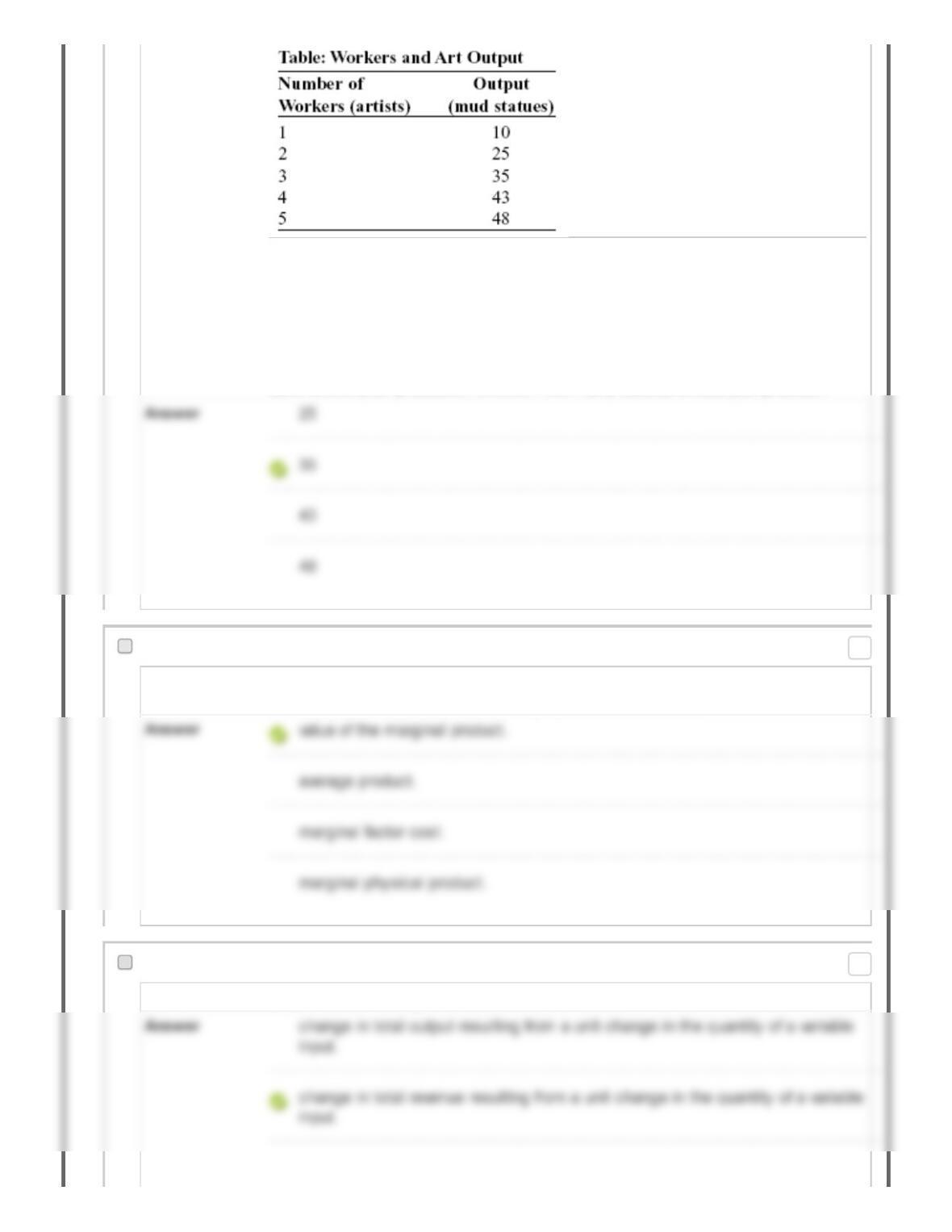
Reference: Ref 19-2
(Table: Workers and Art Output) Look at the table Workers and Art Output.
Suppose you achieve your dream of opening your own art studio, specializing in
selling mud statues. You pay $10 in fixed costs for equipment, and you pay $9 per
day to each of your workers who make the mud statues. You know the mud
statues industry is perfectly competitive, with a current market price of $1. The
table shows your production function. How many statues should you produce?
49. Multiple Choice: The amount by which the use of an add...
Question The amount by which the use of an additional unit of a factor of production
increases a firm’s total revenue during a period is called the:
50. Multiple Choice: The value of the marginal product is ...
Question The value of the marginal product is the:
Points: 0
Points: 0

51. Multiple Choice: If the extra output that is produced ...
Question If the extra output that is produced by hiring one more unit of labor adds more to
________ than to ________, the firm will increase its profit by increasing the use of
labor.
52. Multiple Choice: The Bountiful Bakery is considering h...
Question The Bountiful Bakery is considering hiring another pastry chef. The bakery knows
the average product of its chefs is 15 dozen croissants per day. It also believes that
the next chef hired will produce an extra 12 dozen croissants per day. A dozen
croissants sell for $30. The bakery should hire another worker:
53. Multiple Choice: The amount by which an additional uni...
Question The amount by which an additional unit of a factor increases a firm’s ________
during a period is the ________.
Points: 0
Points: 0
Points: 0

54. Multiple Choice: Which of the following best describes...
Question Which of the following best describes the value of the marginal product?
55. Multiple Choice: The value of the marginal product is ...
Question The value of the marginal product is calculated as:
56. Multiple Choice: The amount that an additional unit of...
Question The amount that an additional unit of a factor adds to a firm‘s total revenue is called
the:
57. Multiple Choice: The marginal product times product pr…
Question The marginal product times product price equals the:
Points: 0
Points: 0
Points: 0
Points: 0

58. Multiple Choice: Which of the following calculations i...
Question Which of the following calculations is correct?
59. Multiple Choice: Which of the following statements is ...
Question Which of the following statements is true?
60. Multiple Choice: Which of the following statements is ...
Question Which of the following statements is true?
61. Multiple Choice: A profit-maximizing firm will base it...
Points: 0
Points: 0
Points: 0
Points: 0

Question A profit-maximizing firm will base its decision to hire workers on the additional
costs and benefits of each worker. If the extra output that is produced by hiring one
more unit of labor adds more to ________ than to ________, the firm will increase
its profit by increasing the use of labor.
62. Multiple Choice: A firm is in equilibrium when the wag...
Question A firm is in equilibrium when the wage is:
Answer less than the price of the product.
63. Multiple Choice: Suppose Billy Bud’s Bucking Broncos e…
Question Suppose Billy Bud’s Bucking Broncos employs 20 workers at a daily wage rate of
$60 each. The average product of labor is 30 bucking broncos per day; the marginal
product of the last worker is 12 bucking broncos per day; and total fixed cost is
$3,600 for equipment. What is the marginal cost of the last bucking bronco
produced?
Answer $0.20
64. Multiple Choice: To maximize profits, a firm will empl...
Question To maximize profits, a firm will employ workers up to the point at which for the last
worker employed:
Answer marginal product is equal to the nominal wage rate.
Points: 0
Points: 0
Points: 0

65. Multiple Choice: Maria operates a persimmon orchard in…
Question Maria operates a persimmon orchard in southeastern Oklahoma. She pays her
workers $248 per week to pick and process persimmons, and she sells her
persimmons for $6 per bushel. If she adds one more worker and that worker can
pick and process 44 bushels per week, what will be the profit for Maria from hiring
that worker?
66. Multiple Choice: For the Tampa Bay Rays baseball team,...
Question For the Tampa Bay Rays baseball team, the value of the marginal product curve is
the team’s labor ________ curve. This means the marginal product curve has a
________ slope.
67. Multiple Choice: Jose, a corn farmer, pays his workers…
Question Jose, a corn farmer, pays his workers $8 an hour. At his current level of labor use,
the marginal product of an additional hour of labor is three bushels of corn. The
market price of corn is $2.75. In order to maximize his profits, Jose should:
Points: 0
Points: 0
Points: 0
68. Multiple Choice: Barry‘s Brewpub is considering hiring…
Question Barry‘s Brewpub is considering hiring more brew masters (it already employs
several). The current market wage for a brew master is $120. The average brew
master produces 40 pints of beer per day, but Barry expects the next brew master
hired to produce only 20 pints per day. Barry’s Brewpub will hire another brew
master only if:
69. Multiple Choice: Barry‘s Brewpub is considering hiring…
Question Barry‘s Brewpub is considering hiring more brew masters (it already employs
several). A pint of brew sells for $3. The market wage of a brew master is $150 per
day. Barry‘s Brewpub will hire another brew master only if Barry believes the new
brew master will:
70. Multiple Choice: Mary is considering hiring another wo...
Question Mary is considering hiring another worker in an assembly line for stereo speakers.
Mary knows the average product of labor is 15 speakers per day. She also believes
that the next worker hired will produce an extra 12 speakers per day. A speaker
sells for $10. Mary should hire another worker:
Points: 0
Points: 0
Points: 0
71. Multiple Choice: The individual producer‘s labor deman...
Question The individual producer‘s labor demand curve is the:
72. Multiple Choice: All perfectly competitive fast-food f…
Question All perfectly competitive fast–food firms are hiring the profit–maximizing quantity of
labor and are paying their workers $7 per hour. If the government raises the
minimum wage to $8 per hour:
73. Multiple Choice: As the ________ of labor used in prod...
Question As the ________ of labor used in production increases, ceteris paribus, eventually
the ________ will ________.
74. Multiple Choice: When a firm is a perfect competitor i…
Question
Points: 0
Points: 0
Points: 0
Points: 0