
CHAPTER 19—GOVERNMENT IN THE MARKET ECONOMY
Key
1. Water pollution is a familiar type of:
2. At the socially efficient price-output level:
3. Social marginal cost is the cost borne by:
4. If investment in a public project makes at least one individual better off and no one worse off, the result is
called:
5. Expenses that are not directly borne by producers or their customers are called:
6. A method used to determine how to best employ resources in a given social program or public-sector
investment project is called:
7. If use by certain individuals does not reduce availability for others, then a good or service is said to display:
8. When an anticipated program or project involves positive net benefits it is:
9. When government-run enterprise is sold to the private sector, this process is known as:
10. One important difference between private and public institutions is:
11. Adam Smith’s belief that the pursuit of self-interest by individuals leads to social betterment is called the:
12. It is not generally considered to be an appropriate function of government to:
13. Market failure refers to a situation where:
14. The stabilization function of government refers to attempts to control the problems of:
15. Air and water pollution are examples of:
16. Social costs refer to costs borne by:
17. Which of the following is the best example of a public good?
18. One of the characteristics of a public good is that the:
19. Market failure refers to:
20. The notion that individuals know what is in their own best interest is:
21. All of the following influence exports except:
22. Policies that are designed to reduce barriers to international trade are known as:
23. All public goods involve:
24. An example of a public good subject to nonrival consumption is given by:
25. An example of a public good subject to the nonexclusion concept that is provided by the private sector in
26. External Social Benefits. Publicly-funded primary and secondary education is common throughout the
world. This support is usually justified on the basis that there are significant external social benefits to having
an articulate and well-educated populace. Some of the external benefits associated with a more highly educated
populace include higher income tax revenues, reduced crime, higher voter participation, and so on.
A.
Describe the nonrival consumption concept as it pertains to publicly-funded primary and secondary education.
B.
Describe the nonexclusion consumption concept as it pertains to publicly-funded primary and secondary education.
C.
In terms of the external social benefits of education argument, is the public support basis for college education as strong as it is for
primary and secondary education?
concept.
suggest that the basic external social benefits to primary and secondary education may in fact be greater than those from college

27. External Social Benefits. During recent years, professional sports have enjoyed an unprecedented boom all
across the United States and Canada. Team revenues have skyrocketed with growing fan interest and
attendance, thriving broadcast revenues, and flourishing corporate sponsorship support. At the same time, major
and minor league teams in baseball, football, basketball, and hockey have come to increasingly rely upon public
funding to cover construction costs and maintenance expenses for sport facilities.
A.
Describe the nonrival consumption concept as it applies to publicly-funded sport facilities.
B.
Describe the nonexclusion consumption concept as it applies to publicly-funded sport facilities.
C.
In terms of the external social benefits concept, is the equity argument in favor of public support for sport facilities as strong as it is for
industrial development in general?
28. Public vs Private Goods. Use the nonrival concept to classify each of the following goods and services as
public goods or private goods. Also indicate whether or not the good or service in question can be characterized
by the nonexclusion concept. Explain.
A.
Police protection.
B.
Public libraries
C.
State and local lotteries.
D.
Long-distance phone service.
E.
Yellowstone National Park.
capacity exists, following a modest increase in the number of fans. Thus, publicly-funded professional sports facilities are not a good
example of a public good in the sense of the nonrival consumption concept.
concept.
29. Public vs Private Goods. Use the nonrival concept to classify each of the following goods and services as
public goods or private goods. Also indicate whether or not the good or service in question can be characterized
by the nonexclusion concept. Explain.
A.
Lighthouse signals.
B.
Small pox vaccinations.
C.
Criminal justice system.
D.
Local phone service.
E.
The Simpsons television program provided on “free” TV.
might be in the near future, made exclusive by restricting viewership to cable TV customers.
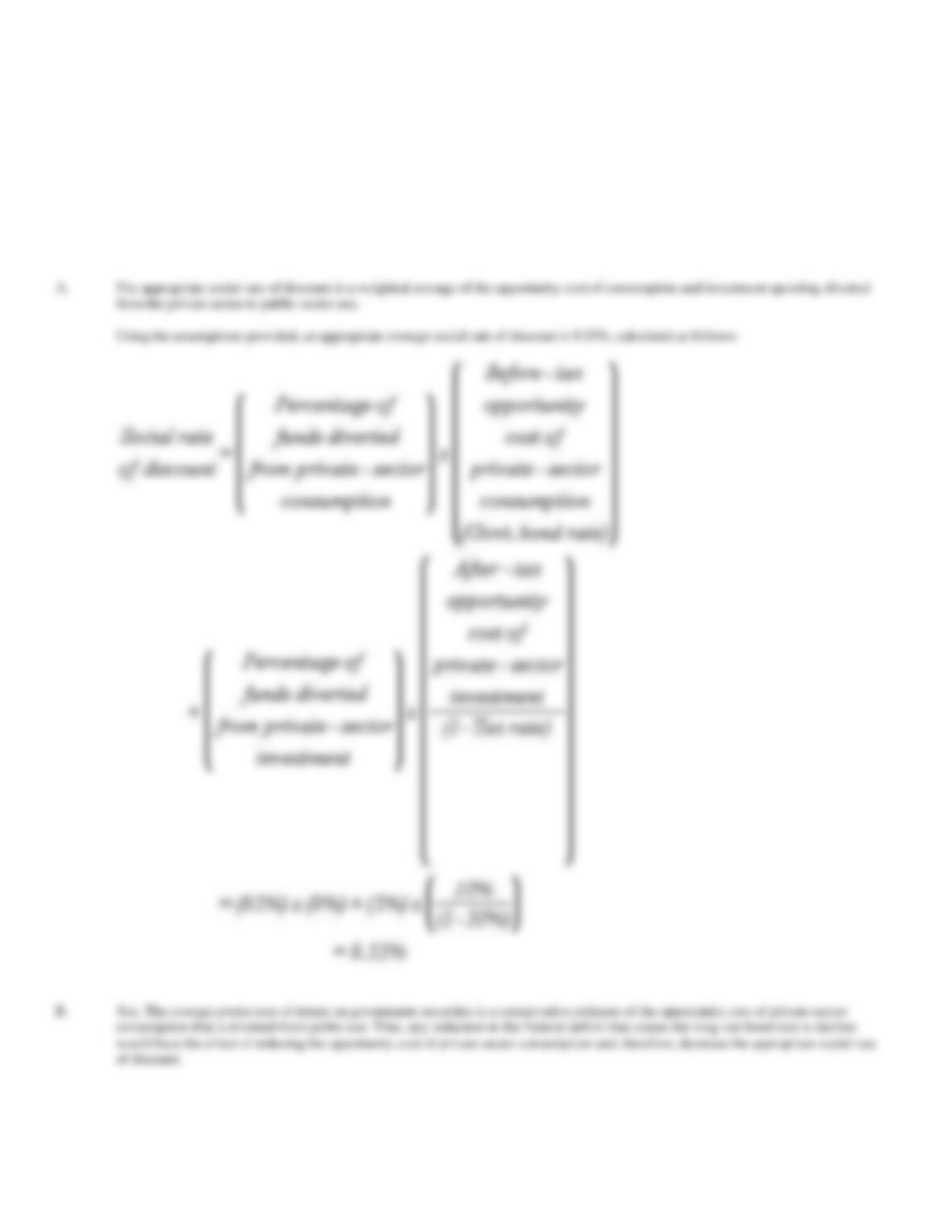
30. Social Rate of Discount. Assume that the rate of return on long-term government bonds is 10%, a typical
after-tax return on investment in the private sector is 12%, the marginal corporate and individual tax rate is
40%, and consumption averages 95% of total income.
A.
Based on the information provided, calculate an economically appropriate social rate of discount.
B.
Is a decrease in the marginal corporate tax rate likely to increase, decrease, or have no effect on the appropriate social rate of discount?
Using the assumptions provided, an appropriate average social rate of discount is 10.5%, calculated as follows:
31. Social Rate of Discount. Assume that the rate of return on long-term government bonds is 9%, a typical
after-tax return on investment in the private sector is 10%, the marginal corporate and individual tax rate is
50%, and consumption averages 95% of total income.
A.
Based on the information provided, calculate an economically appropriate social rate of discount.
B.
Would a reduction in the Federal deficit that led to a decline in the long-term government bond rate affect the appropriate social rate of
discount? If so, how? If not, why not?
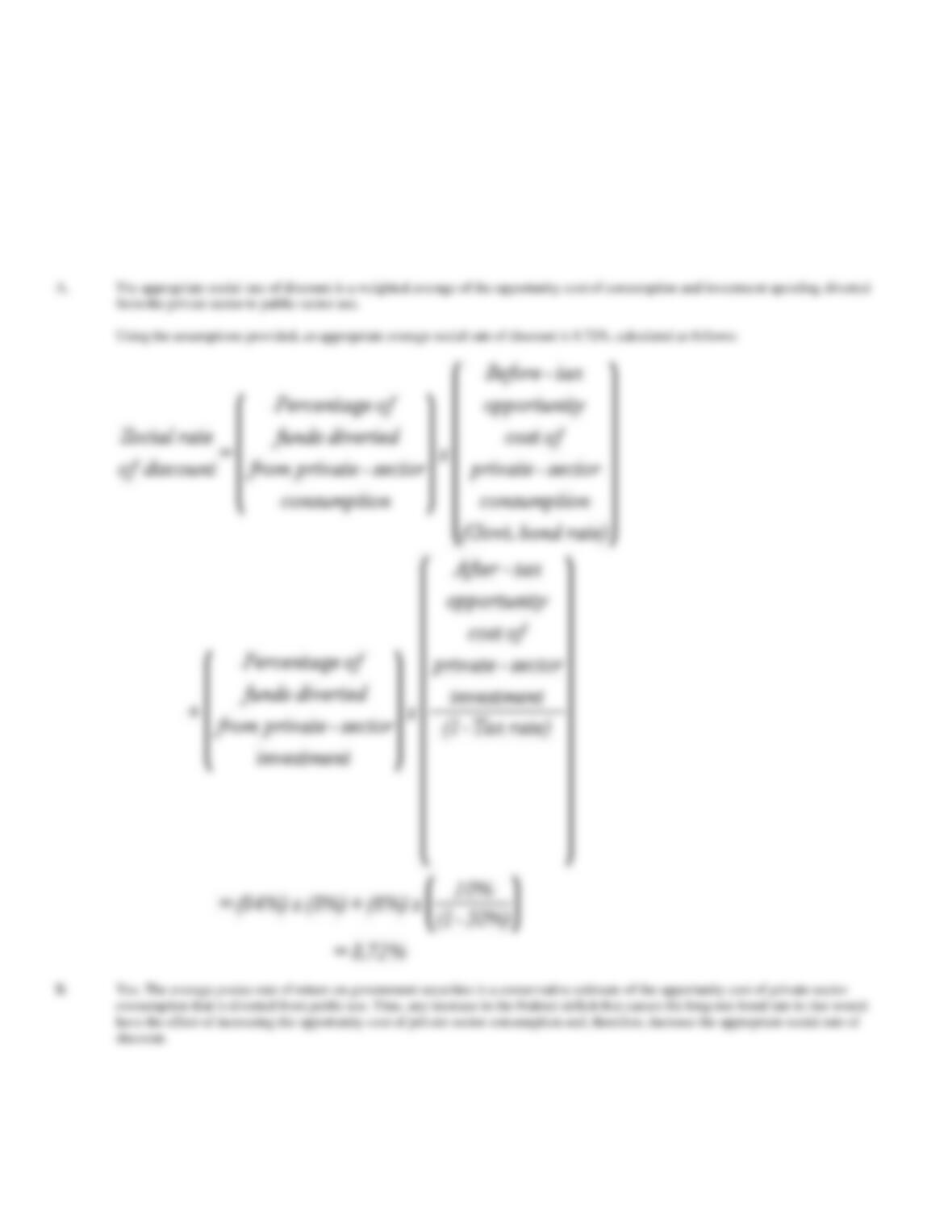
32. Social Rate of Discount. Assume that the rate of return on long-term government bonds is 8%, a typical
after-tax return on investment in the private sector is 10%, the marginal corporate and individual tax rate is
50%, and consumption averages 94% of total income.
A.
Based on the information provided, calculate an economically appropriate social rate of discount.
B.
Would an increase in the Federal deficit that led to an increase in the long-term government bond rate affect the appropriate social rate
of discount? If so, how? If not, why not?
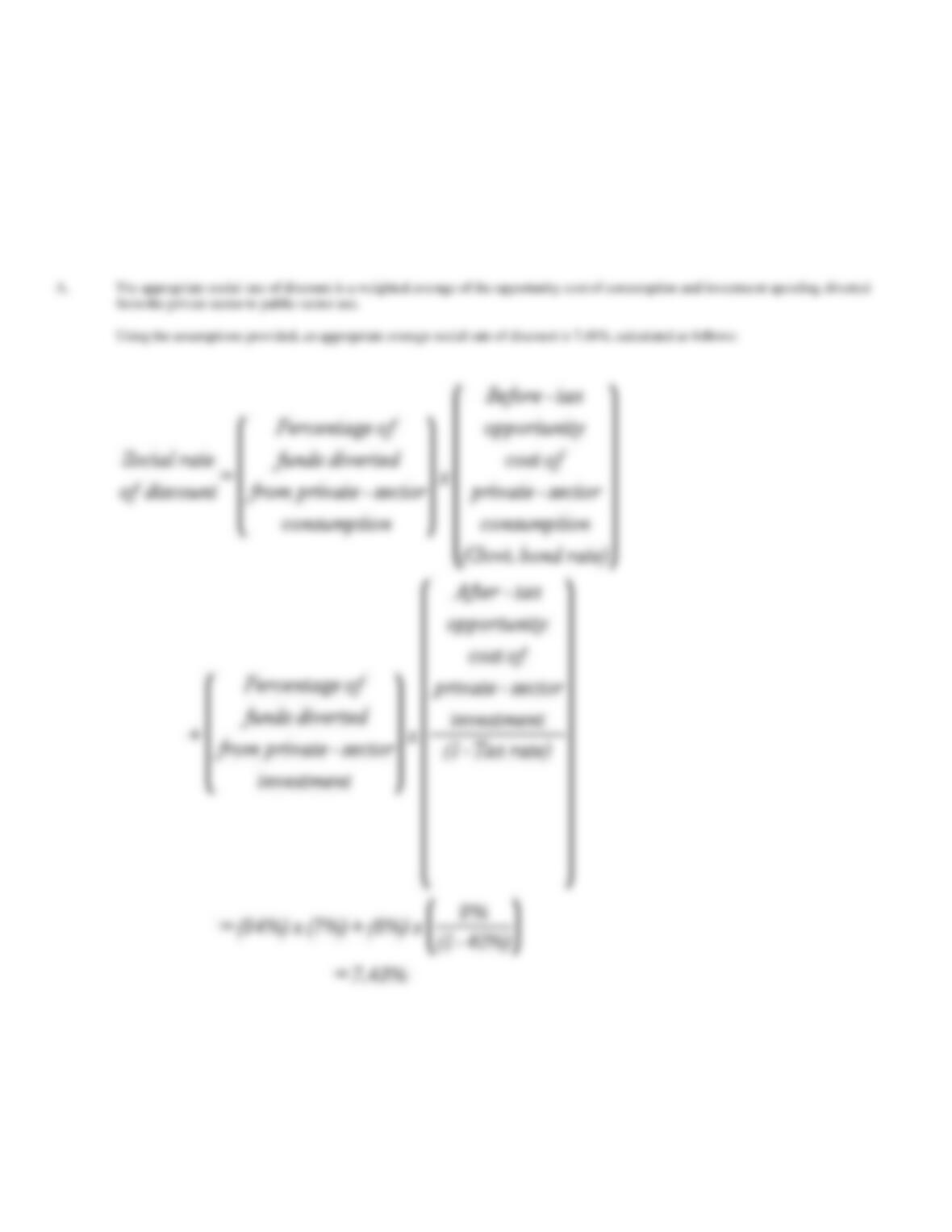
33. Social Rate of Discount. Assume that the rate of return on long-term government bonds is 7%, a typical
after-tax return on investment in the private sector is 9%, the marginal corporate and individual tax rate is 40%,
and consumption averages 94% of total income.
A.
Based on the information provided, calculate an economically appropriate social rate of discount.
B.
Would an increase in the private-sector savings rate due to a reduction in tax benefits for individual retirement accounts increase,
decrease, or have no effect on the appropriate social rate of discount?

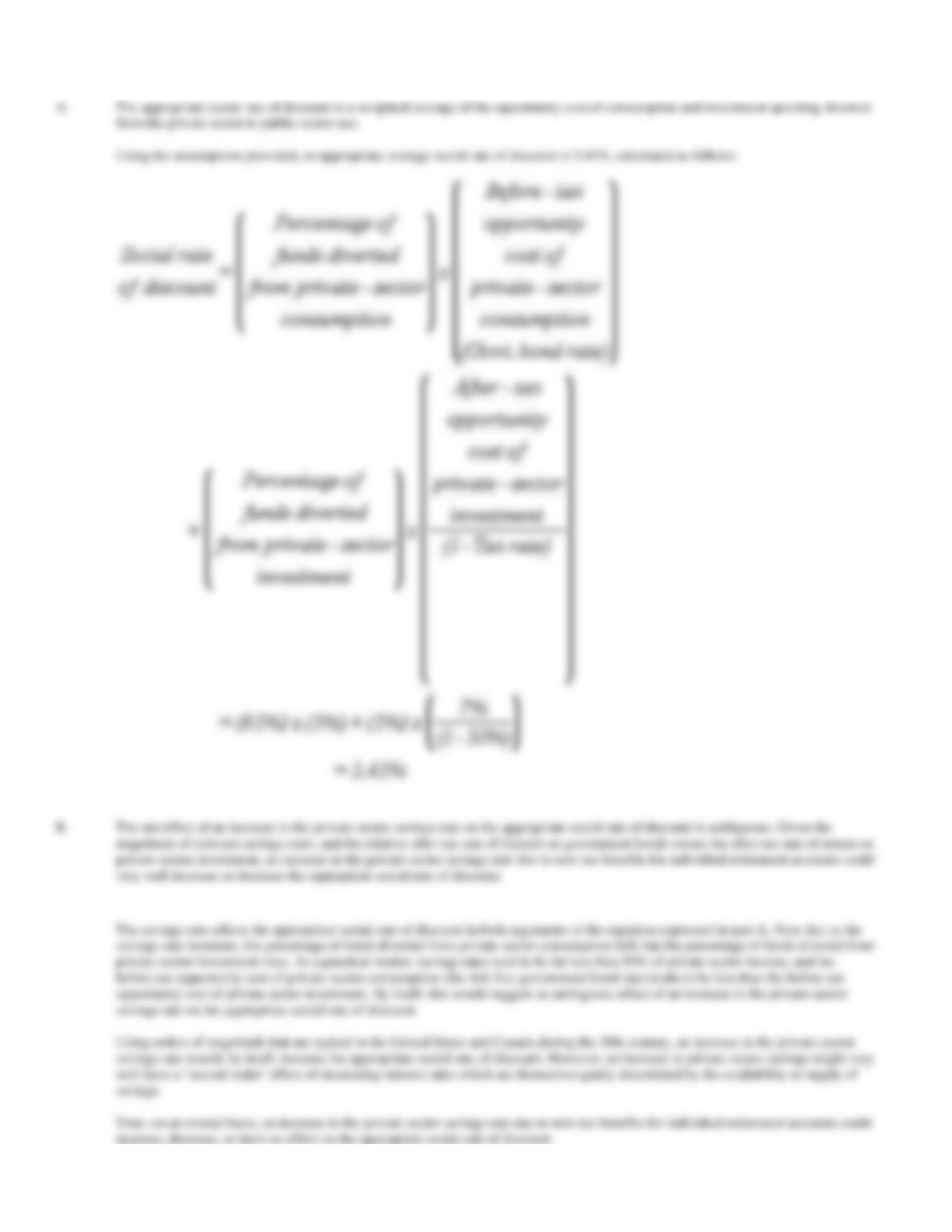
34. Social Rate of Discount. Assume that the rate of return on long-term government bonds is 5%, a typical
after-tax return on investment in the private sector is 7%, the marginal corporate and individual tax rate is 50%,
and consumption averages 95% of total income.
A.
Based on the information provided, calculate an economically appropriate social rate of discount.
B.
Would a decrease in the private-sector savings rate due to new tax benefits for individual retirement accounts increase, decrease, or
have no effect on the appropriate social rate of discount?
savings.
Thus, on an overall basis, an increase in the private-sector savings rate due to new tax benefits for individual retirement accounts could

35. Public Management Theory. A traditional rationale for public sector management of economic resources
is that there is a fundamental difference in the economic characteristics of two broad categories of goods and
services. These two categories are called public goods and private goods.
A.
Describe the essential characteristic of public goods and cite some examples.
B.
Describe the essential characteristic of private goods and cite some examples.
36. Nonrival Consumption Concept. The essential distinguishing characteristic of public goods is the concept
of nonrival consumption.
A.
Explain the nonrival consumption concept.
B.
Cite some examples of goods that display the nonrival consumption attribute.
37. Nonexclusion Concept. Many public goods display the attribute of being nonexclusionary in consumption.
A.
Explain the nonexclusion concept, and how it differs from the nonrival consumption concept.
B.
Does national defense display both the nonrival and nonexclusion attributes?
C.
Is an optimal amount of national defense likely to be provided by the private sector?