38) The price of A falls by 2 percent, and the quantity demanded of A increases by 2 percent.
Meanwhile, the quantity demanded of B increases by 2 percent too. We would conclude that
A) demand for A is elastic, and A and B are substitutes.
B) demand for A is elastic, and A and B are complements.
C) demand for A is unit-elastic, and A and B are complements.
D) demand for A is inelastic, and A and B are unrelated.
39) The cross price elasticity of demand between two goods is 2. We may conclude that
A) the two goods are very complementary and probably are sold together.
B) the two goods are poor substitutes for each other.
C) the demand for one of the goods is likely to be fairly elastic and the demand for the other
good is likely to be fairly inelastic.
D) the demand for each of the goods is likely to be very elastic.
40) The cross-price elasticity of demand of products “A” and “B” is zero. This implies that “A”
and “B” are
A) substitute products.
B) complementary products.
C) independent products.
D) unique goods, as the price elasticity of demand for one of them is zero.
41) If the price of one good increases, and as a result the demand for another related good falls,
the goods are
A) substitutes.
B) normal goods.
C) complements.
D) inferior goods.
42) Two items which have a positive cross price elasticity of demand are referred to as
A) luxury goods.
B) inferior goods.
C) substitutes.
D) complements.
43) Two items which have a negative cross price elasticity of demand are referred to as
A) luxury goods.
B) inferior goods.
C) substitutes.
D) complements.
44) If the value of the cross elasticity of demand is negative, the two goods are
A) complementary goods.
B) substitute goods.
C) normal goods.
D) inferior goods.
45) The cross price elasticity of demand is defined as
A) the percentage change in the supply for one good (a shift in the supply curve) divided by the
percentage change in price of a related good.
B) the percentage change in demand for two different commodities.
C) the percentage change in the demand for one good (a shift in the demand curve) divided by
the percentage change in price of a related good.
D) the percentage change in price for two different commodities.
46) If the price of one good increases, and as a result the demand for another good increases, the
goods are
A) substitutes.
B) normal goods.
C) complements.
D) inferior goods.
47) If the cross price elasticity of demand between two commodities is positive, then these
commodities are
A) are superior.
B) are complements.
C) are substitutes.
D) are inferior.
48) If the price of oranges went up by 20 percent, which of the following values of the cross
price elasticity for apples would be most reasonable to anticipate?
A) 0.0
B) 1.2
C) -2.0
D) -0.2
49) If the price of apples went down by 20 percent, which of the following values of the cross
price elasticity for boats would be most reasonable to anticipate?
A) 0.0
B) 2.0
C) -2.0
D) -20
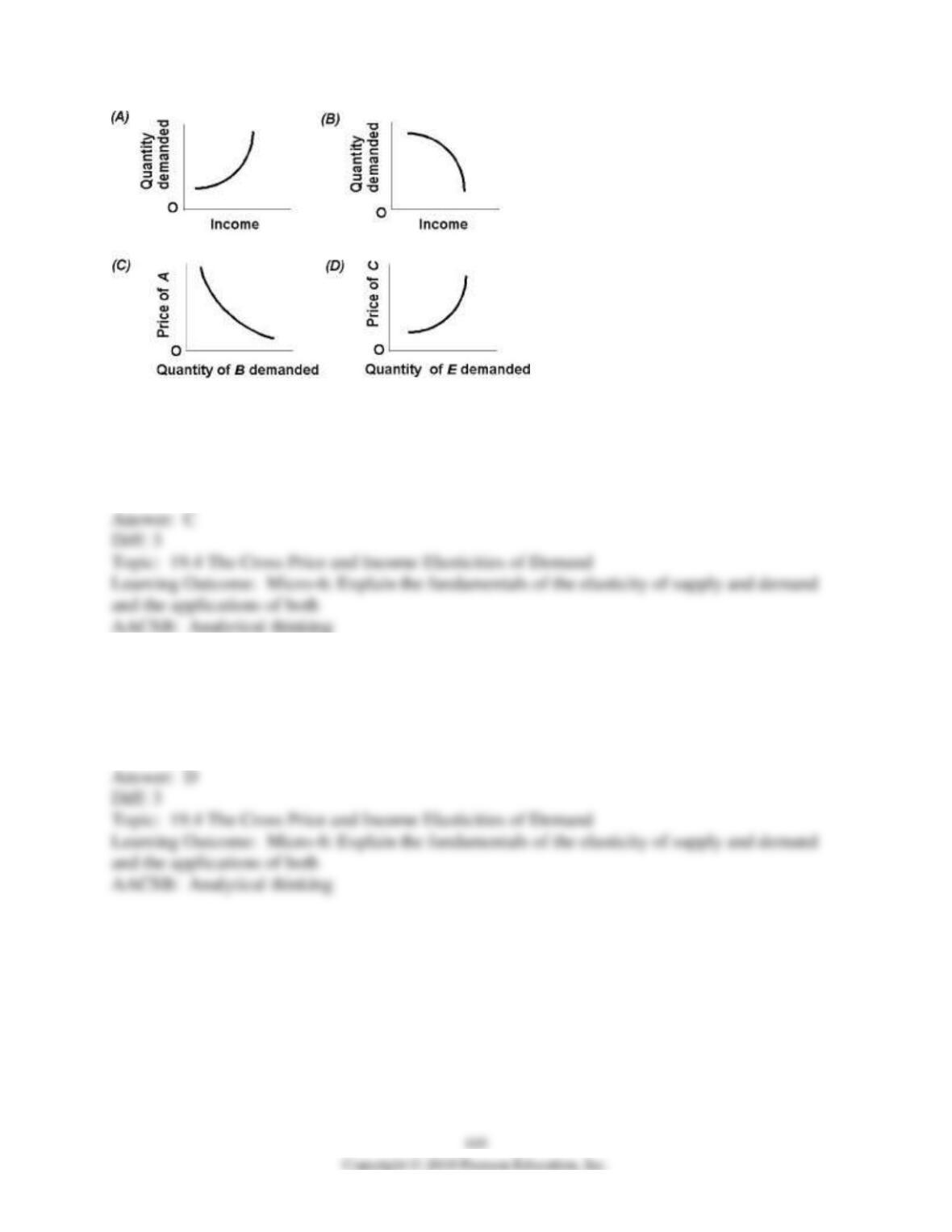
50) Use the above figure. Which graph depicts complementary goods?
A) A
B) B
C) C
D) D
51) Use the above figure. Which graph depicts substitute goods?
A) A
B) B
C) C
D) D
52) If the price of wireless phone service decreases and the demand for wired phone services
decreases, then wired and wireless phone services are
A) substitutes.
B) complements.
C) inferior goods.
D) elastic goods.
53) Income elasticity relates to
A) a movement down a demand curve.
B) a movement up a demand curve.
C) a horizontal shift in a demand curve.
D) the percentage change in quantity demanded divided by the percentage change in the price.
54) Suppose that the income elasticity of demand for peanut butter is 0.75. Which of the
following is TRUE?
A) Peanut butter is a normal good, because income elasticity is positive.
B) Peanut butter is an inferior good, because income elasticity is positive.
C) Peanut butter is a normal good, because income elasticity is less than 1.
D) Peanut butter is an inferior good, because income elasticity is less than 1.
55) Income elasticity of demand is defined as
A) the change in quantity demanded divided by the change in income.
B) the change in quantity demanded divided by the change in market price.
C) the percentage change in income divided by the percentage change in quantity demanded.
D) the percentage change in demand divided by the percentage change in income.
56) If one’s demand for good X decreases as income rises, the income elasticity of demand for
good X is
A) elastic.
B) inelastic.
C) unit elastic.
D) negative.
57) If an individual’s income rises 4 percent and his clothing purchases increase 5 percent in
response, the income elasticity for clothing by the individual is
A) -0.8.
B) 0.8.
C) 1.25.
D) -1.25.
58) Which of the following goods is likely to have the highest income elasticity?
A) a designer blouse
B) tomato soup
C) hamburger
D) can of tuna
59) Income elasticity of demand is defined as
A) the change in income divided by the change in quantity.
B) the change in price divided by the change in income.
C) the percentage change in demand divided by the percentage change in income.
D) the change in income multiplied by the change in quantity.
60) If demand for Tesla automobiles rises in an area where incomes have increased, this tells us
that a Tesla is
A) a normal good.
B) an inferior good.
C) a complementary good.
D) a substitute good.
61) When Frank’s income was $100 per week, 10 units of good A were demanded. Now his
income is $150 per week and 12 units of good A are demanded. Using the percentage change
formula, the income elasticity of demand for good A equals
A) 0.45.
B) 0.40.
C) 2.20.
D) 2.50.
62) Income elasticity of demand reflects
A) the change in total quantity demanded divided by the total change in income.
B) the responsiveness of the quantity demanded to changes in income, adjusting its relative price
so real income does not change.
C) the responsiveness of income of producers to a change in quantity sold of the good.
D) the responsiveness of demand to changes in income.
63) When Mary earned $3,200 per month, she bought 2 concert tickets each month. Now her
monthly income is $5,600, and the number of concert tickets she purchases has risen to 3 per
month. Mary’s income elasticity of demand for concert tickets equals ________ and the tickets
are a(n) ________ good for Mary.
A) -1.36; normal
B) -0.21; inferior
C) +0.21; complementary
D) +0.73; normal
64) The income elasticity of demand is
A) the percentage change in demand divided by the percentage change in income.
B) the change in income divided by the percentage change in price.
C) the change in quantity demanded divided by the change in price.
D) the percentage change in income divided by the percentage change in quantity demanded.
65) A measure of the responsiveness of demand to changes in income, all other things being
constant, is
A) income elasticity of demand.
B) price income elasticity of demand.
C) price elasticity of demand.
D) cross price elasticity of demand.
66) The responsiveness of demand to changes in income holding the good’s relative price
constant is
A) price elasticity of demand.
B) income elasticity of demand.
C) elasticity of supply.
D) cross price elasticity of demand.
67) The difference between price elasticity of demand and income elasticity of demand is that
A) income elasticity of demand examines how an individual’s income changes when prices
change and the price elasticity of demand examines how quantity demand changes when price
changes.
B) income elasticity refers to the movement along the demand curve while price elasticity refers
to a horizontal shift of the demand curve.
C) income elasticity measures the responsiveness of income to changes in supply while price
elasticity of demand measures the responsiveness of demand to a change in price.
D) income elasticity refers to a horizontal shift of the demand curve while price elasticity of
demand refers to a movement along the demand curve.
68) When Tim earned $65,000 he purchased 10 novels a year. His income has just increased to
$68,000 and he plans to purchase 15 novels this year. Tim’s income elasticity of demand for
novels equals
A) 0.
B) 0.11.
C) 1.67.
D) 8.87.
69) Jill earns an income of $2,000 a week and goes out to dinner 4 times a week. If her income
increased to $2,100 she would go out to dinner 5 times a week. Jill’s income elasticity of demand
is
A) 0.22
B) 4.56
C) 2.28
D) -0.22
70) The income elasticity of demand
A) is positive only.
B) is negative only.
C) must lie between -1 and +1.
D) can be positive, negative, or zero.
71) The income elasticity of demand for all goods taken together must be
A) zero.
B) -1.
C) +1.
D) between 0 and 1.
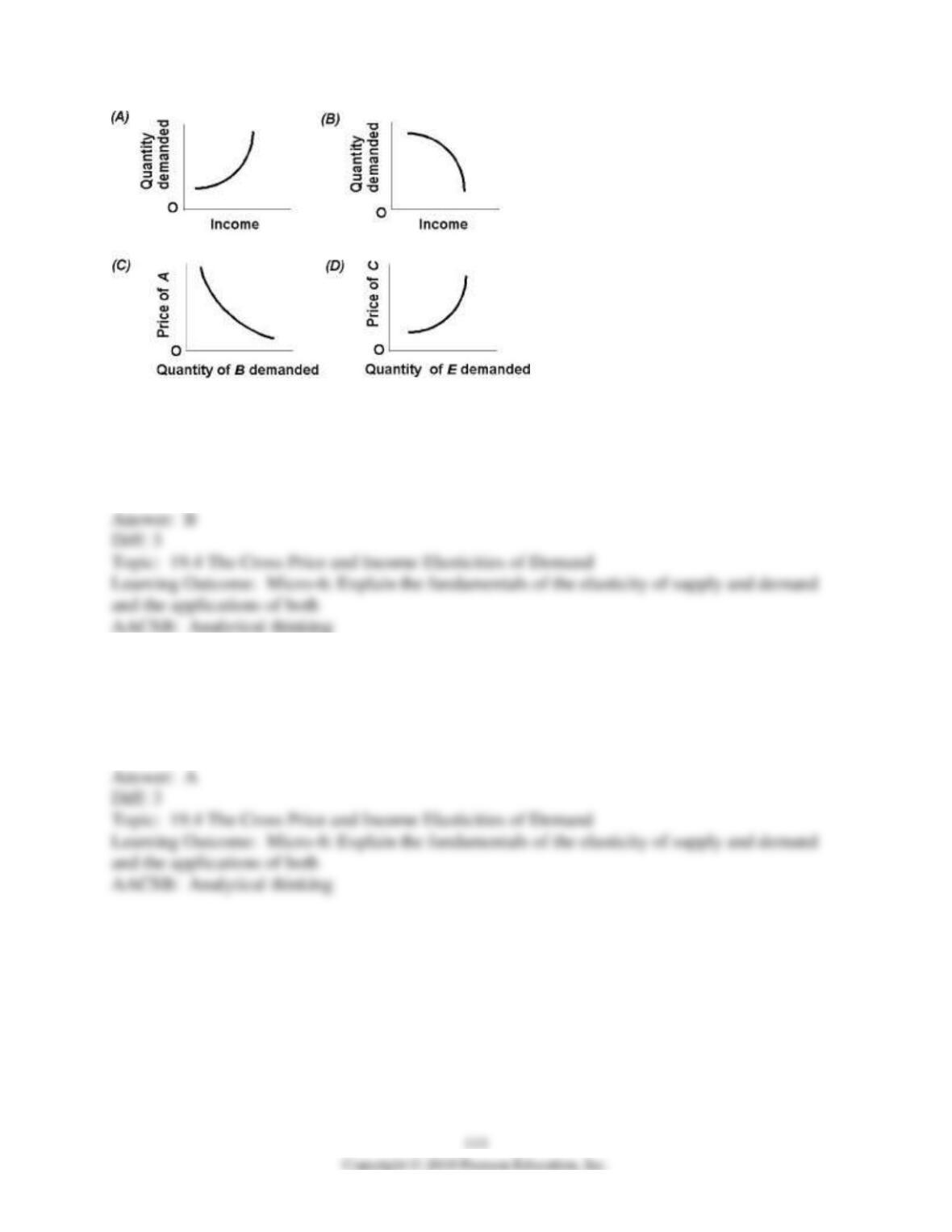
72) Use the above figure. Which graph depicts an inferior good?
A) A
B) B
C) C
D) D
73) Use the above figure. Which graph depicts a normal good?
A) A
B) B
C) C
D) D
74) An inferior good has an income elasticity of demand that is
A) positive.
B) negative.
C) positive but less than 1.
D) zero.
75) For most goods and services the income elasticity of demand is
A) negative.
B) positive.
C) invisible.
D) inverse.
76) Use the above table. The income elasticity of artisan bread is
A) 1.285.
B) 0.780.
C) 0.012.
D) 8.330.
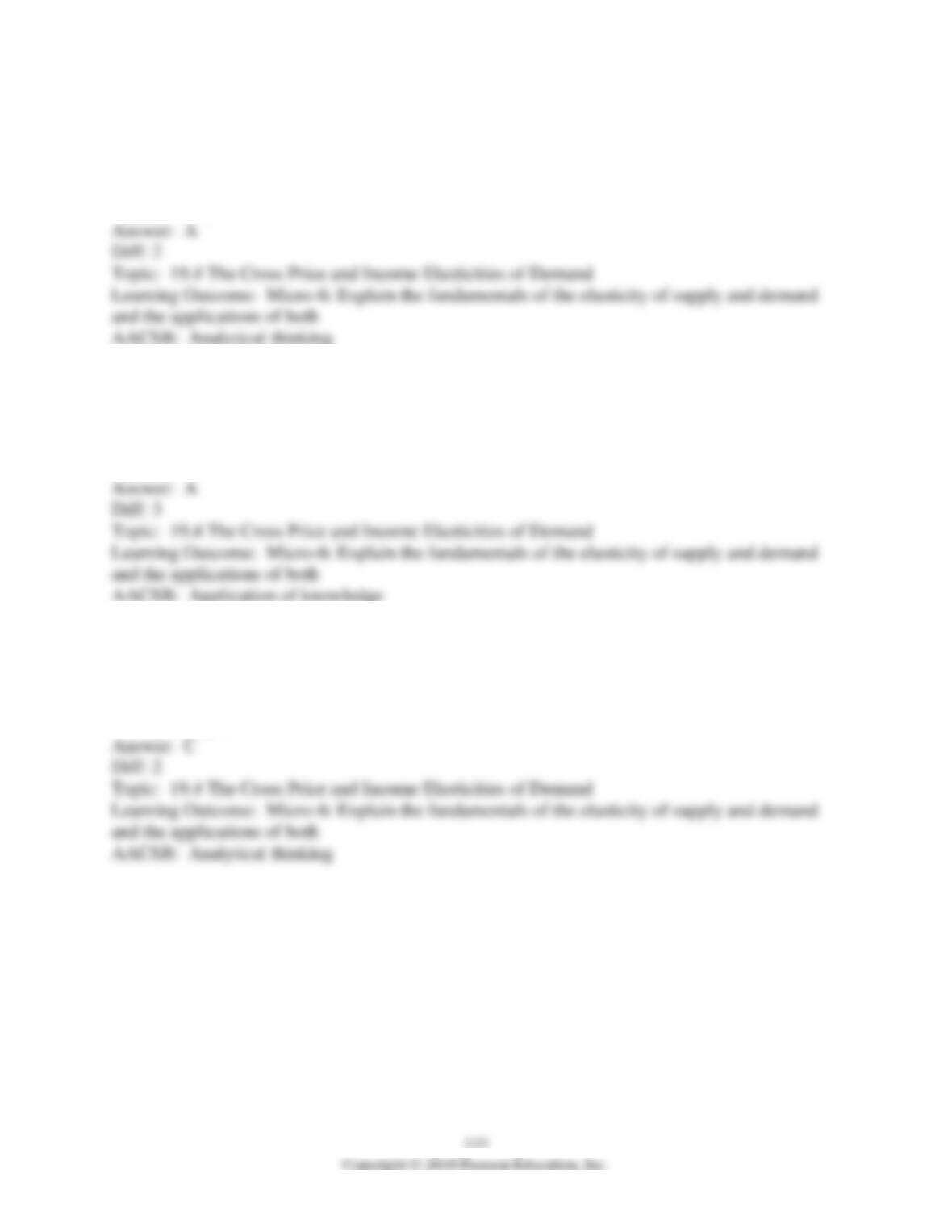
77) Use the above table. Based on the information in the table, artisan bread is a(n)
A) normal good.
B) necessary good.
C) inferior good.
D) negative good.
78) Use the above table. The income elasticity of jam is
A) -0.33.
B) 0.33.
C) 3.00.
D) -3.00.
79) Use the above table. Based on the information in the table, jam is a(n)
A) normal good.
B) necessary good.
C) inferior good.
D) negative good.
80) If your income rises and, as a result, you buy fewer packages of Ramen Noodles, then
Ramen Noodles are a(n)
A) substitute.
B) normal good.
C) complement.
D) inferior good.
81) If your income rises by one percent and, as a result, you buy more steak, then steak is a(n)
A) substitute.
B) normal good.
C) complement.
D) inferior good.
82) Charlie’s income went from $1000 per week to $1500 per week. As a result he increased his
consumption of beef from 1 pound a week to 3 pounds a week. Based on his consumption
patterns, the income elasticity of beef for Charlie is
A) 2.50.
B) -.50.
C) .50.
D) -1.50.
83) What would you expect the cross price elasticity of iPods and online music downloads?
Explain your answer.
84) How does the cross elasticity of demand differ from the price elasticity of demand? How are
they related?
85) Why can cross price elasticity of demand be positive or negative, unlike the price elasticity
of demand with respect to the item’s own price?
86) “Income elasticity of demand is always positive.” Do you agree or disagree? Explain.
87) “The income elasticity of a good is positive if a consumer increases the total spending on that
good as a result of an increase in its market price.” Do you agree or disagree? Why?
88) Graphically, what is the main difference between the measure of income elasticity of demand
as opposed to the measure of price elasticity of demand?
19.5 Price Elasticity of Supply
1) If the price elasticity of supply of tablets is constant and equal to 2.5, a 10 percent increase in
price will result in a change in quantity supplied equal to
A) 2.5 percent.
B) 25 percent.
C) 20 percent.
D) -20 percent.