35) If total revenues rise when the market price increases, then we know that
A) demand is inelastic.
B) demand is elastic.
C) demand is unit-elastic.
D) its demand has zero elasticity.
36) If the bus fare of a city increases from $1.00 to $1.10 per ride and as a result total revenue
increases, then we know that
A) percentage change in fare is less than percentage change in number of rides.
B) percentage change in fare is greater than percentage change in number of rides.
C) percentage change in fare is equal to the percentage change in number of rides.
D) it is impossible to tell.
37) Total revenues reach a maximum when
A) demand is elastic.
B) demand is inelastic.
C) demand is unit-elastic.
D) price elasticity is at a minimum.
38) If demand is unit-elastic throughout the demand curve, then total revenues are
A) greater the higher the price.
B) lower the higher the price.
C) maximized at the midpoint of the demand curve.
D) the same for any price the firm charges.
39) Within the range of prices around the midpoint on a straight-line demand curve, demand is
A) elastic.
B) inelastic.
C) unit-elastic.
D) zero.
40) If the slope of a demand curve is constant, then we know that
A) elasticity of demand is also elastic everywhere.
B) elasticity of demand is constant and elastic.
C) elasticity of demand is inelastic everywhere.
D) elasticity of demand varies along the demand curve.
41) If demand is perfectly elastic everywhere along the demand curve, then
A) people must be irrational.
B) the demand curve is vertical.
C) the demand curve is a rectangular hyperbola.
D) the demand curve is horizontal.
42) Suppose 1000 units of a good are sold at $10 a unit. If its price increases to $20 and total
revenue increases to $20,000 and increases by $1000 for every dollar increase in price after that,
we know that
A) demand is perfectly elastic.
B) the demand curve is vertical.
C) the demand curve is downward sloping and the firm is on the inelastic portion of the demand
curve.
D) the demand curve is a rectangular hyperbola.
43) A local transit authority charges $1 for a bus ride. An economics study suggests that in the
price range from $0.50 to $1.50, the elasticity of demand for bus trips is 1.2. To increase its
revenue, the transit authority should
A) leave the fare as it is.
B) raise the fare.
C) lower the fare.
D) charge $1.20.
44) Moving upward along a downward sloping straight-line demand curve, as the price of the
product goes up
A) the price elasticity of demand does not change.
B) the price elasticity of demand goes from being inelastic to being elastic.
C) the price elasticity of demand goes from being elastic to being inelastic.
D) the price elasticity of demand goes from negative to positive.
45) Moving downward on a downward sloping linear demand curve, the absolute value of the
price elasticity of demand
A) is constant.
B) increases continuously.
C) decreases continuously.
D) may either increase or decrease.
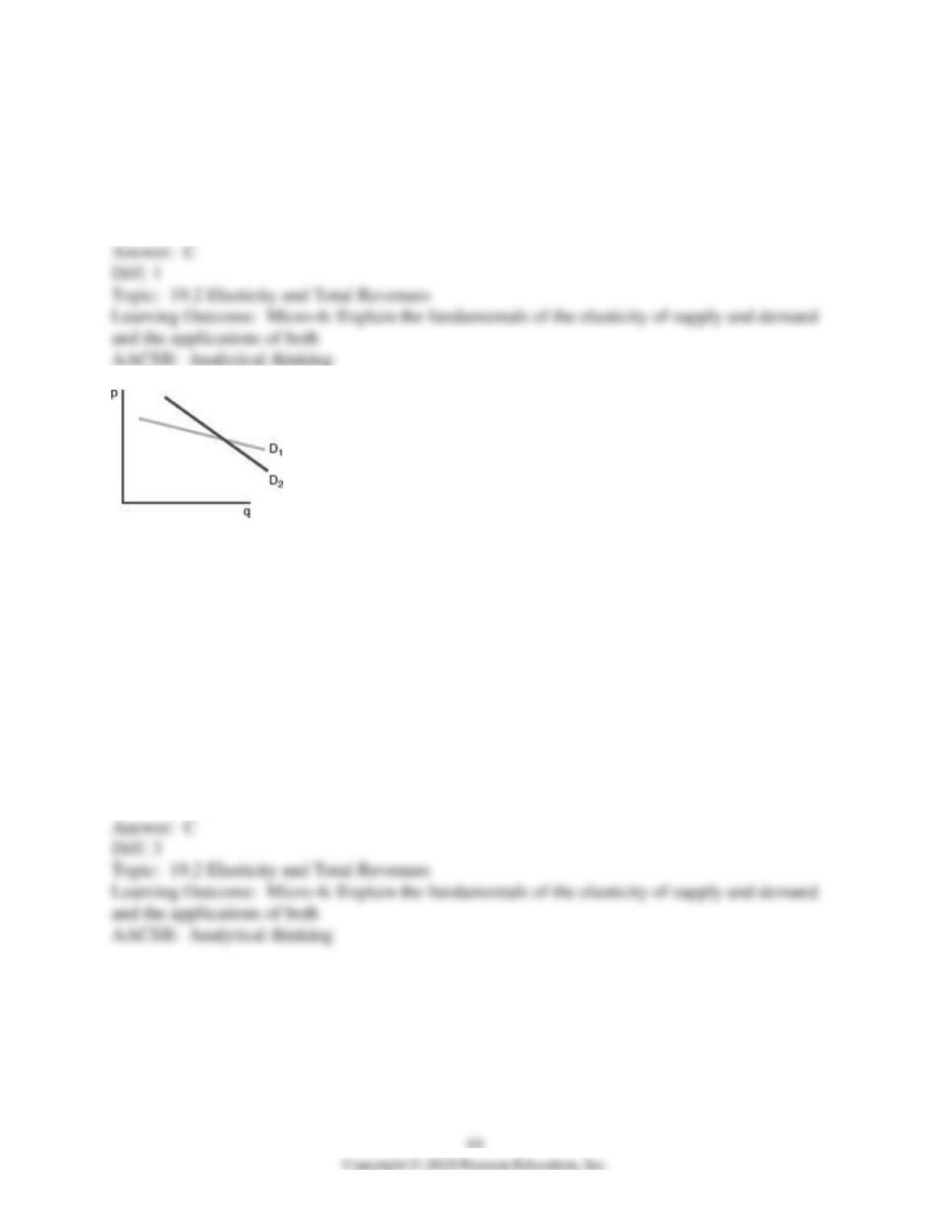
46) Consider the above figure. Which of the following statements is correct?
A) In any range of prices encompassing the crossing point of the two demand curves, the price
elasticity of demand associated with demand curve D1 is equal to the price elasticity of demand
associated with demand curve D2.
B) In any range of prices encompassing the crossing point of the two demand curves, the price
elasticity of demand associated with demand curve D1 is less than the price elasticity of demand
associated with demand curve D2.
C) In any range of prices encompassing the crossing point of the two demand curves, the price
elasticity of demand associated with demand curve D1 is greater than the price elasticity of
demand associated with demand curve D2.
D) In any range of prices encompassing the crossing point of the two demand curves, the price
elasticity of demand is infinite.
47) Suppose that the demand for movie tickets is price inelastic for the range of prices between
$10 and $12. If a movie theater raises the price of tickets from $10 to $12, what will happen to
total revenues?
A) Total revenues will decrease.
B) Total revenues will increase.
C) Total revenues will not change.
D) Total revenues will have no relationship to the quantity of ties demanded.
48) A university raises annual tuition by 2 percent. No other events have occurred, and the
university’s revenues have increased. It must be TRUE that
A) the associated change in quantity demanded was smaller than 2 percent.
B) the associated change in quantity demanded was equal to 2 percent.
C) the associated change in quantity demanded was greater than 2 percent.
D) there was no associated change in quantity demanded.
49) If the price of a good increases and the total revenue also increases, the good has a(n)
A) elastic demand.
B) inelastic demand.
C) unit elastic demand.
D) perfectly elastic demand.
50) A movie theater raises ticket prices from $8 to $10 in order to raise revenues. The theater’s
management is assuming the absolute value of the price elasticity of demand for tickets is
A) less than 1.
B) greater than 1.
C) equal to 1.
D) infinity.
51) Which of the following is FALSE regarding inelastic demand?
A) Price elasticity of demand is less than 1 (Ep < 1).
B) If a firm raises price, total revenues will go up.
C) Price elasticity of demand is greater than 1 (Ep > 1).
D) If a firm lowers price, total revenues will fall.
52) If the government places a $0.50 tax on an item for which demand is perfectly elastic
A) the entire tax will be paid by the consumer.
B) the tax will be split equally between the consumer and producer, with each paying exactly
$0.25.
C) most of the tax will be paid by the consumer.
D) the entire tax will be paid by the producer.
53) When demand is elastic
A) changes in price and changes in total revenue move in the same direction.
B) there is no relationship between changes in price and changes in total revenue.
C) changes in price and changes in total revenue move in opposite directions.
D) for any change in price, total revenue will not change.
54) Total revenue is
A) price × quantity.
B) change in price × change in quantity.
C) change in price × quantity.
D) price × change in quantity.
55) All of the following are true regarding the relationship between price elasticity of demand
and total revenues EXCEPT
A) when market demand is elastic, if the market price declines, then total revenues will rise.
B) when market demand is unit elastic, if the market price rises, then total revenues will not
change.
C) when market demand is inelastic, if the market price falls, then total revenues will decrease.
D) when market demand is inelastic, if the market price rises, then total revenues will decrease.
56) When demand is unit elastic, an increase in price will cause
A) an increase in total revenue.
B) a decrease in total revenue.
C) no change in total revenue.
D) a change in total revenue in either direction depending on whether the price is increasing or
decreasing.
57) If the price of a good increases and the total revenue remains the same, the demand for the
good is
A) elastic.
B) inelastic.
C) unit elastic.
D) perfectly elastic.
58) When the price of coffee is $2.2 per cup, 11 million cups are demanded, and when the price
of coffee goes up to $2.6 per cup, 10 billion cups are demanded. The coffee in this range has a(n)
A) elastic demand.
B) inelastic demand.
C) unit elastic demand.
D) perfectly elastic demand.
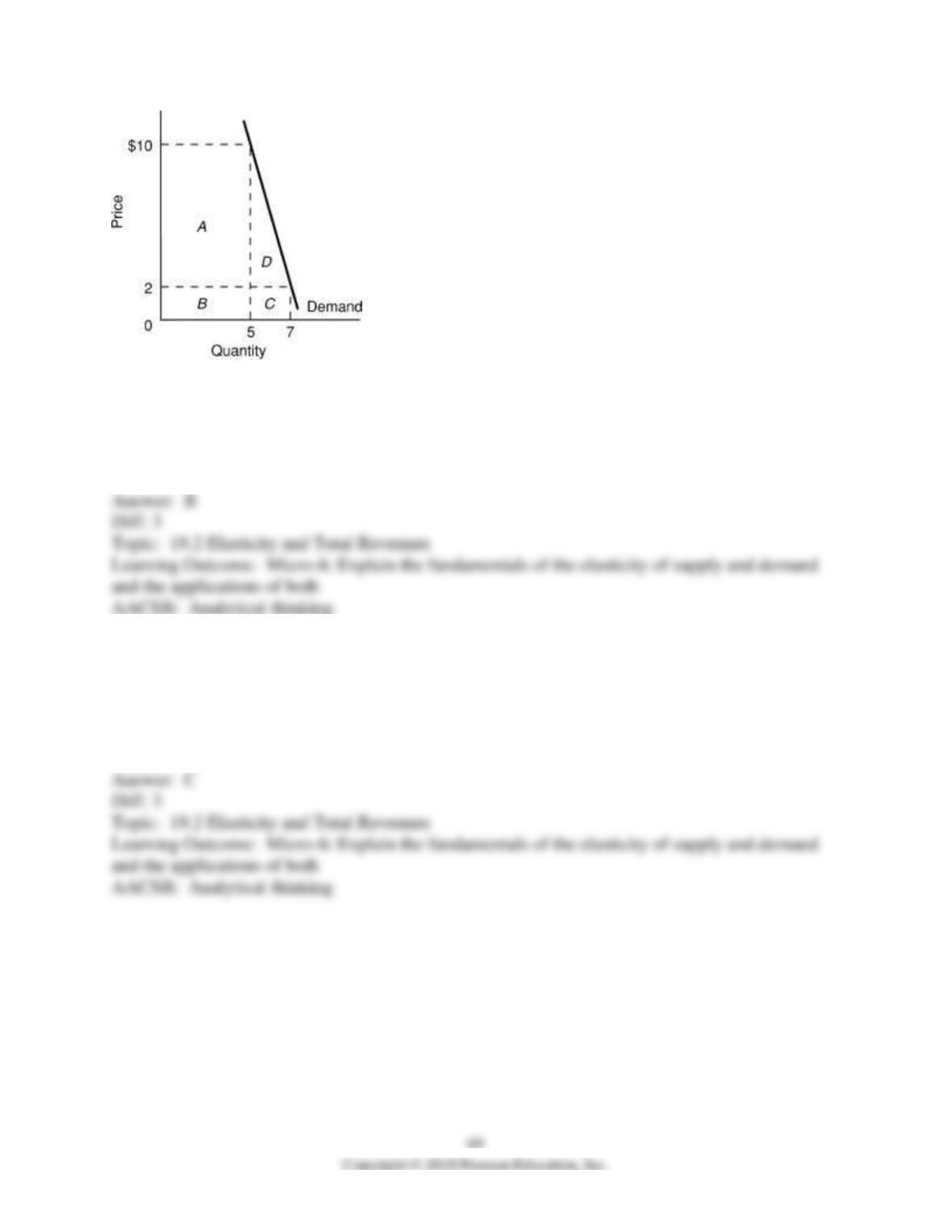
59) Use the above figure. When the price increases from $2 to $10, total revenue
A) increases from areas A + B to areas B + C and demand is inelastic.
B) increases from areas B + C to areas A + B and demand is inelastic.
C) increases from areas B + C to areas A + D and demand is elastic.
D) increases from areas C + D to areas B + A and demand is elastic.
60) Use the above figure. When the price increases from $2 to $10, the absolute price elasticity
of demand is
A) 0.67.
B) 1.50.
C) 0.25.
D) 1.00.
61) When the price of a pound of oranges is $1.00, 7500 pounds of oranges are demanded. When
the price of a pound of oranges decreases to $0.80, 10,000 pounds of oranges are demanded. In
this price range the demand for oranges is
A) elastic.
B) inelastic.
C) unit elastic.
D) perfectly elastic.
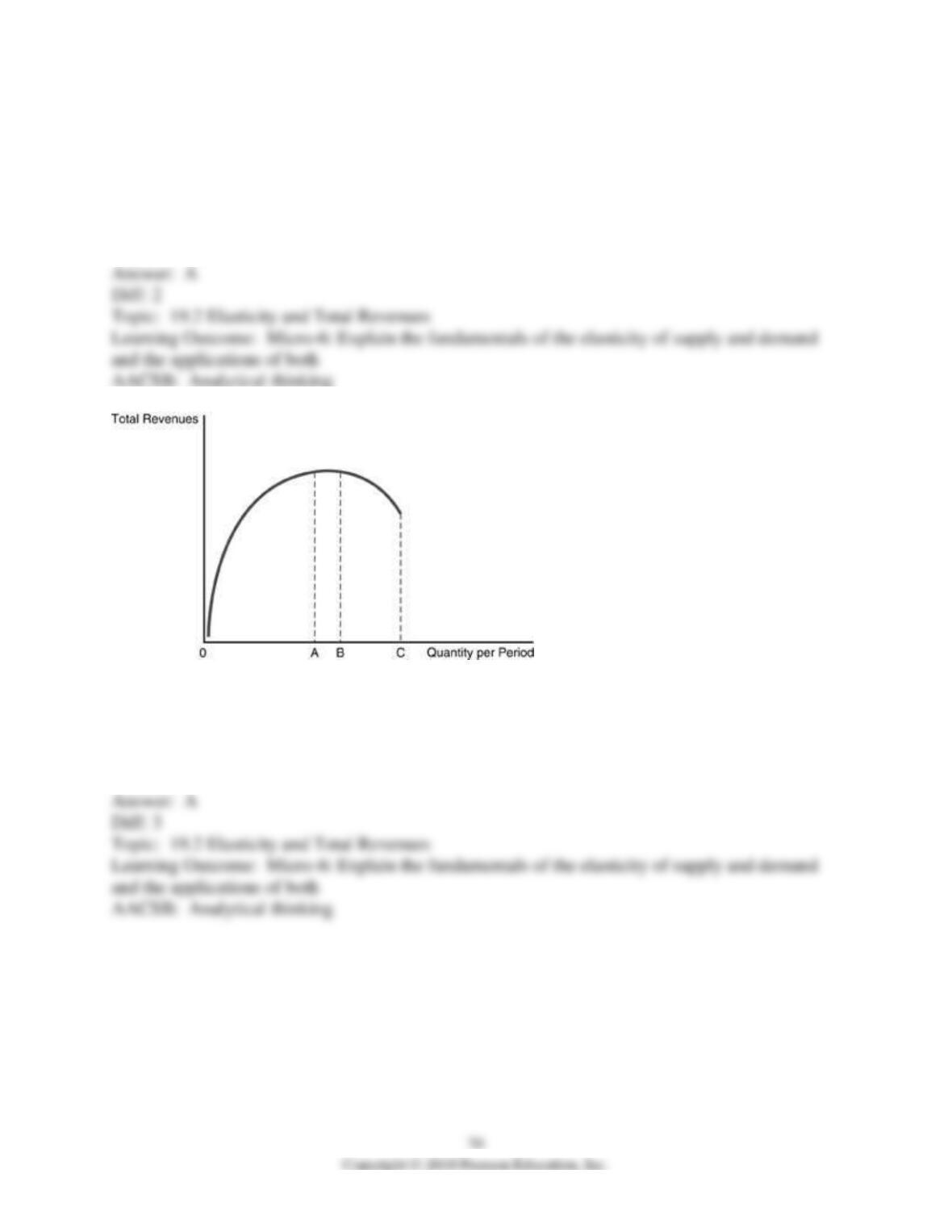
62) Refer to the above figure. Demand will be elastic when quantity is between
A) 0 and A.
B) 0 and B.
C) A and B.
D) B and C.
63) Refer to the above figure. Demand will be unit-elastic when quantity is between
A) 0 and A.
B) 0 and B.
C) A and B.
D) B and C.
64) Refer to the above figure. Demand will be inelastic when quantity is between
A) 0 and A.
B) 0 and B.
C) A and B.
D) B and C.
65) “Unit elasticity of demand can be found everywhere along a straight-line demand curve with
a slope of -1.” Do you agree or disagree? Explain.
66) For a linear demand curve, where is the amount of total expenditures on a good maximized?
67) “Higher prices always yield higher revenues.” Do you agree or disagree? Why?
19.3 Determinants of the Price Elasticity of Demand
1) An elastic response in the quantity of a good demanded would be caused by
A) the availability of many substitutes.
B) a lack of substitutes.
C) a lack of sensitivity to the good’s price.
D) the good representing a small portion of a person’s budget.
2) Which of the following is a determinant of the price elasticity of demand for an item?
A) the availability of a close substitute for the item
B) the percentage of a consumers budget allocated to expenditures on the item
C) the amount of time available to adjust to a change in the price of the item
D) All of the above are correct.
3) Which of the following is a determinant of the price elasticity of demand for a product?
I. The existence of substitute goods
II. The percentage of a consumer’s total budget devoted to purchases of that commodity
A) I only
B) II only
C) both I and II
D) neither I nor II
4) One of the most important determinants of a good’s price elasticity of demand is
A) the profits of suppliers.
B) the numbers of buyers in the market.
C) the ease with which consumers can substitute other goods for that product.
D) the cost of producing the good.
5) Which of the following would NOT affect a good’s price elasticity of demand?
A) the ease of substitution between goods
B) the cost of producing the good
C) the number of substitute goods available
D) the proportion of one’s budget spent on an item
6) The price elasticity of demand would most likely be the lowest for
A) a house.
B) salt.
C) a Toyota sport utility vehicle.
D) Shell gasoline.
7) Which of the following goods is most likely to have the lowest price elasticity?
A) movie tickets
B) DVD rentals
C) tap water
D) pasta
8) The demand for diet soft drinks (as a group) is relatively inelastic because
A) there are many of them on the market.
B) there are few substitutes.
C) the purchase of a soft drink represents a large portion of a person’s budget.
D) none of the above.
9) Which of the following would most likely exhibit the highest price elasticity of demand?
A) gasoline
B) Colgate toothpaste
C) motor oil
D) salt
10) Other things being equal, demand is less elastic
A) the more expensive the good is.
B) the smaller the percentage of a total budget that a family spends on a good.
C) the longer is the time period for adjustment.
D) the more substitutes a good has.
11) The demand curve for gasoline should be
A) more elastic in the long run than in the short run.
B) less elastic in the long run than in the short run.
C) as elastic in the long run as it is in the short run.
D) more or less elastic in the long run versus the short run depending upon supply conditions.
12) The longer the time frame involved, the more likely it is that the demand will be relatively
A) elastic.
B) inelastic.
C) steep.
D) flat.
13) Compared to the short-run price elasticity of demand, the long-run price elasticity of demand
is
A) smaller.
B) the same.
C) greater.
D) either greater than or less, depending on the number of substitutes the good has.
14) If the price elasticity of demand (Ep) equals one in the short run, then, other things being
equal, in the long run Ep will be
A) one.
B) less than one.
C) greater than one.
D) indeterminate without more information.
15) The longer any price change persists, the
A) more difficult it is to alter quantity demanded.
B) greater is the price elasticity of demand.
C) lower is the price elasticity of demand.
D) more likely price will return to its original level.
16) The government raises gasoline taxes as part of the price of gasoline and receives more tax
revenues. However, after five years, the government discovers that revenues from the gasoline
tax have declined. This situation would be most likely to occur if
A) the long-run elasticity of supply was much greater than the long-run elasticity of demand.
B) the demand for gasoline was inelastic in the short run, but elastic in the long run.
C) the long-run elasticity of demand was greater than the long-run elasticity of supply.
D) the demand for gasoline was perfectly inelastic in both the short run and the long run.
17) Which of the following is NOT a determinant of the price elasticity of demand?
A) existence of substitutes
B) expenditures on the good as a share of a consumer’s budget
C) the amount of time allowed for adjustment to changes in the price of the commodity
D) the price level in a country
18) When many substitutes exist for a good, demand will be
A) elastic.
B) unit-elastic.
C) inelastic.
D) perfectly unit-elastic.
19) When very few substitutes for a good exist, demand will be
A) elastic.
B) unit-elastic.
C) inelastic.
D) perfectly elastic.
20) Suppose two goods are perfect substitutes. The price elasticity of demand of one of the goods
is
A) 0.
B) 1.
C) 10.
D) infinity.
21) Which of the following is NOT a factor that determines the price elasticity of demand?
A) the amount that suppliers have made available
B) the percentage of a consumer’s total budget spent on the good
C) the existence of substitutes
D) the length of time allowed for adjustments to change in the price of the commodities
22) When a particular product has numerous but imperfect substitutes, the demand for that
product will tend to be
A) inelastic.
B) elastic.
C) unitary.
D) perfectly elastic.
23) When there are very few substitutes for a good, the demand for the good will tend to be
A) inelastic.
B) elastic.
C) unitary.
D) perfectly elastic.
24) For which of the following would the absolute price elasticity of demand be greatest?
A) salt
B) tickets to the Super Bowl
C) Dr. Pepper cola
D) gasoline
25) For which of the following purchases would the absolute price elasticity of demand be
greatest?
A) a luxury sedan
B) utilities
C) chewing gum
D) a smartphone
26) For which of the following purchases would the absolute price elasticity of demand be
smallest?
A) a luxury sport utility vehicle
B) utilities
C) chewing gum
D) a smartphone
27) Other things being equal, demand is more elastic if
A) the good is less expensive the good.
B) the time period for adjustment is shorter.
C) a family spends a larger percentage of its budget on the good.
D) the good is more unique.