22) If the GDP deflator in the United States is 114, and the GDP deflator in Ukraine is 142, which of the
following changes would the theory of purchasing power parity predict? (The Ukrainian currency is
the hryvnia.)
A) The demand for the dollar will rise since the dollar is undervalued.
B) The demand for the dollar will fall since the dollar is overvalued.
C) The supply of the dollar will fall since the dollar is undervalued.
D) No prediction regarding changes in the demand or supply of the dollar can be made without
information on the exchange rate between the United States and Ukraine.
23) Suppose the GDP deflator in the United States is 125 and the GDP deflator in Japan is 100. Also
assume the United States has trade barriers on Japanese goods in the form of quotas. What does this
imply about the exchange rate of yen per dollar under the theory of purchasing power parity in the long
run?
A) The exchange rate of yen per dollar will be equal to 1.25.
B) The exchange rate of yen per dollar will be greater than 0.8.
C) The exchange rate of yen per dollar will be equal to 0.8.
D) The exchange rate of yen per dollar will be less than 0.8.
24) If the purchasing power of the dollar is greater than the purchasing power of the euro, purchasing
power parity predicts that the exchange rate will
A) increase if the exchange rate is greater than 1 euro per dollar.
B) decrease if the exchange rate is less than 1 euro per dollar.
C) be equal to the relative purchasing power across the currencies in the long run.
D) not fluctuate and stay constant in the long run.
25) Countries that use the euro as their currency face similar concerns as countries did during the years
of the gold standard in that each are (were)
A) unable to conduct monetary policy.
B) unable to conduct fiscal policy.
C) using currency which is backed by gold.
D) using a floating currency.
26) Because the value of the euro is determined by factors that affect the entire euro zone, during the
recession of 2007-2009, individual countries using the euro
A) were unable to have their exchange rates depreciate.
B) were more insulated from unemployment increases than most countries.
C) experienced a greater increase in exports than did most countries.
D) were able to use expansionary monetary policy to lessen the impact of the recession.
27) The “Big Mac Theory of Exchange Rates” tests the accuracy of the purchasing power parity theory.
In July 2015, the Economist reported that the average price of a Big Mac in the U.S. was $4.79. In
Sweden, the average price of a Big Mac at that time was 43.7 kronor. What is the “implied exchange
rate” between Swedish kronor and U.S. dollars?
A) 0.11 kronor per dollar
B) 1.90 kronor per dollar
C) 9.12 kronor per dollar
D) 46.2 kronor per dollar
23
28) If, at the current exchange rate between the dollar and the Norwegian kroner of 5.78 kroner per
dollar, the dollar is “overvalued,” how do you expect demand and supply in the foreign exchange
markets to respond?
A) The demand for the dollar will rise, while the supply of the kroner will fall.
B) The demand for the dollar will fall, while the supply of the kroner will rise.
C) The supply of the dollar will rise, while the demand for the kroner will fall.
D) The supply of the dollar will rise, while the demand for the kroner will rise.
29) If the U.S. government places tariffs on imports from countries that have been accused of
deliberately undervaluing their currencies, the price of these imports will ________ and the demand for
the undervalued currency will ________.
A) rise; rise
B) rise; fall
C) fall; rise
D) fall; fall
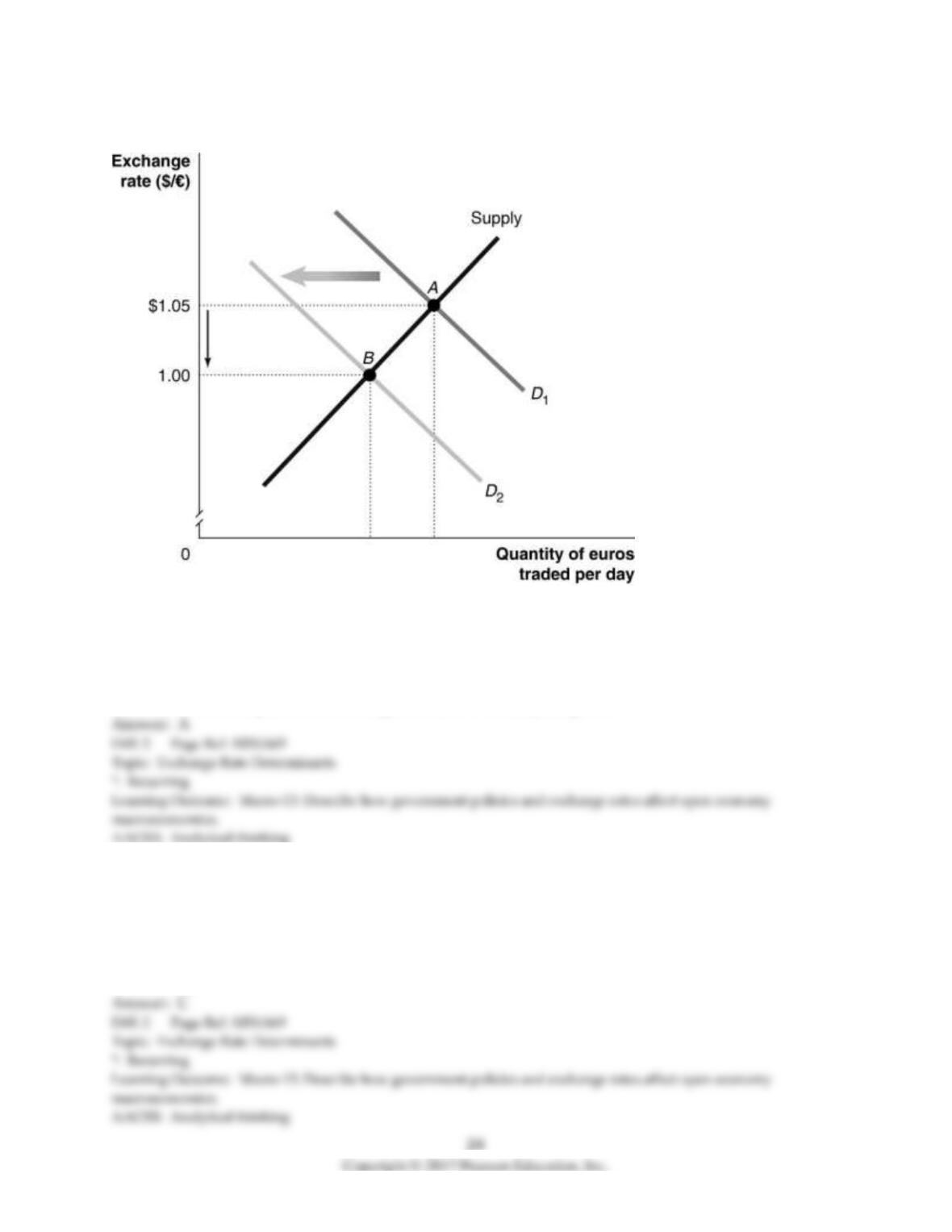
Figure 19-1
30) Refer to Figure 19-1. Which of the following would cause the change depicted in the figure above?
A) U.S. productivity rises relative to European productivity.
B) Europeans decrease their preferences for U.S. goods relative to European goods.
C) The European Union increases its quotas on U.S.-produced wine.
D) an increase in the price level of U.S. goods relative to European goods
31) Refer to Figure 19-1. Which of the following would cause the change depicted in the figure above?
A) U.S. productivity falls relative to European productivity.
B) Americans increase their preferences for goods produced in the EU relative to American goods.
C) The United States imposes a quota on wine from the European Union.
D) The price level of goods produced in the EU decreases relative to the price level of goods produced
in the United States.
25
32) Refer to Figure 19-1. Which of the following would cause the change depicted in the figure above?
A) European productivity rises relative to American productivity.
B) Americans increase their preferences for goods produced in the EU relative to American goods.
C) The U.S. removes a quota on wristwatches from the European Union.
D) The price level of goods produced in the EU increases relative to the price level of goods produced in
the United States.
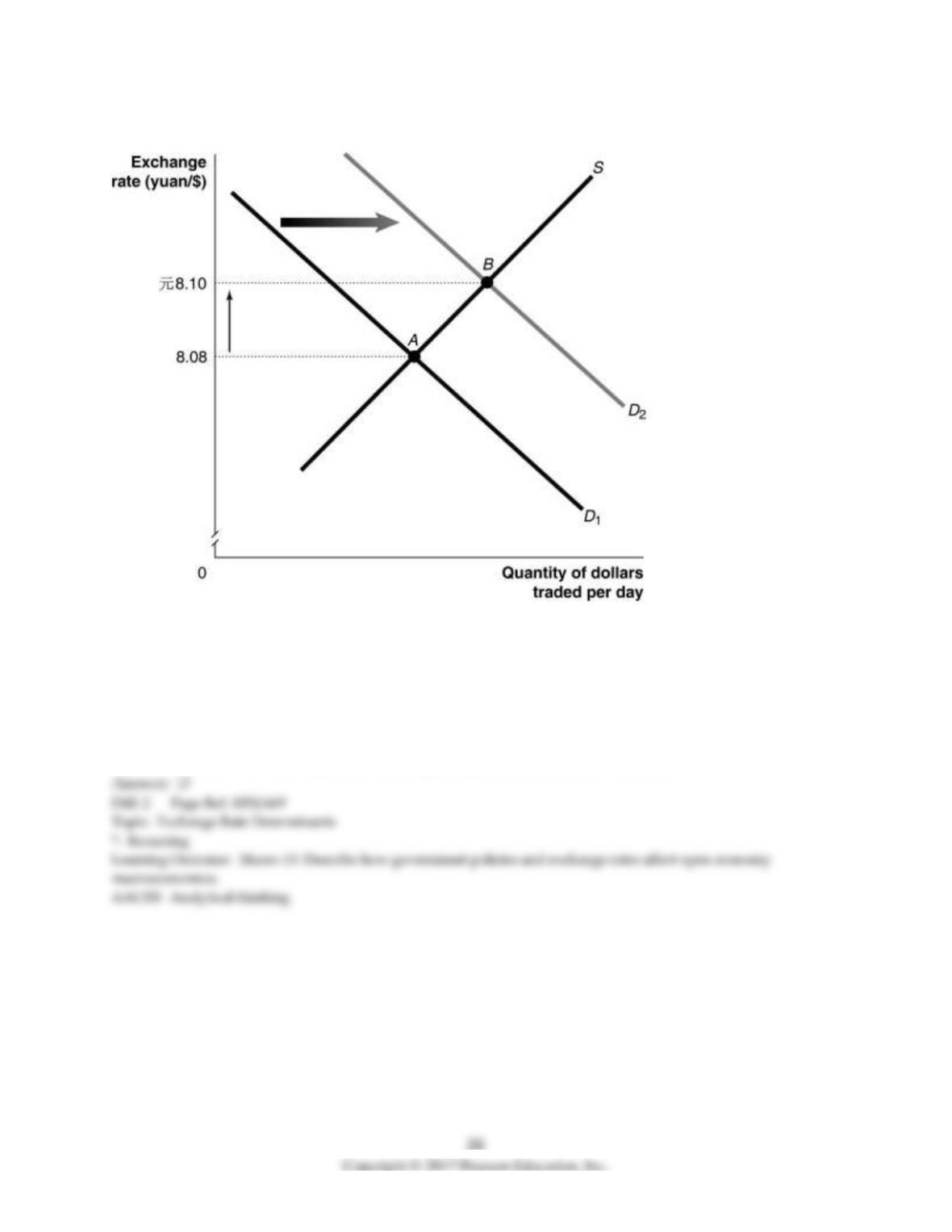
Figure 19-2
33) Refer to Figure 19-2. Which of the following would cause the change depicted in the figure above?
A) Lack of investment in infrastructure causes U.S. productivity to fall relative to Chinese productivity.
B) Tainted cat food from China causes U.S. consumers to decrease their preferences for Chinese goods
relative to U.S. goods.
C) A new trade agreement with China results in the United States removing all tariffs on clothing
imported from China.
D) The Chinese increase their preferences for goods produced in the United States.
34) If the average productivity of American firms is rising more quickly than the average productivity
of Indian firms, which of the following would you expect to see? (India’s currency is the rupee.)
A) an increase in the value of the rupee relative to the dollar
B) a decrease in the prices of Indian products
C) a decrease in the quantity demanded of Indian products relative to American products
D) an increase in the quantity demanded of Indian products relative to American products
35) How will the exchange rate (foreign currency per dollar) respond to an increase in the relative rate
of productivity growth in the United States in the long run?
A) Exchange rates will rise.
B) Exchange rates will fall.
C) Exchange rates will be unaffected by changes in the relative rate of productivity growth in the United
States, both in the short run and in the long run.
D) The exchange rate will be affected in the short run, but not in the long run.
36) If inflation in Russia is higher than it is in the United States,
A) the purchasing power of the ruble in buying Russian goods will rise relative to the dollar.
B) the value of the dollar will rise in the long run.
C) the value of the ruble will rise in the long run.
D) Both A and C are correct.
37) Which of the following would increase the value of the dollar in the long run?
A) an increase in inflation in the United States relative to other countries
B) an increase in the demand for American goods relative to goods from other countries
C) a decrease in U.S. tariffs on foreign goods
D) an increase in the supply of dollars on the foreign exchange market
38) What explains the appreciation of the Japanese yen relative to the U.S. dollar from 1970 to the early
1990s?
A) Japanese productivity rose faster than U.S. productivity.
B) Japanese inflation rose faster than U.S. inflation.
C) U.S. consumers reduced their preferences for Japanese goods.
D) High tariffs and restrictive quotas in the United States caused the value of the dollar to decline.
39) The central bank of the European Union is called the
A) Bundesbank.
B) Banco Europe.
C) Federal Reserve.
D) European Central Bank.
40) By 2015, how many European countries were members of the European Union?
A) 12
B) 17
C) 28
D) 57
41) Members of the European Union decided to adopt a single currency by what year?
A) 2008
B) 2005
C) 1999
D) 1992
42) Which of the following is a drawback to having a common currency across countries, as in the
European Union?
A) A common currency increases barriers to trade across countries, reducing opportunities for economic
growth.
B) With a common currency, individual countries are no longer able to run independent monetary
policies.
C) Having a common currency implies that the prices of goods across countries must always be the
same, regardless of consumer preferences for goods across countries.
D) None of the above is a drawback to a common currency.
43) The currencies of Poland and Iceland (the zloty and the krona, respectively) declined in value
relative to the euro following the financial crisis of 2008. This means that the
A) zloty and krona appreciated in value against the euro.
B) euro depreciated in value against the zloty and the krona.
C) zloty and krona depreciated in value against the euro.
D) zloty depreciated in value against the krona.
E) Both A and B are correct.
44) Should European nations which are not currently using the euro choose to adopt the euro as their
currency, these countries would risk giving up the ability to use ________ to stabilize their economies in
the event of a recession.
A) expansionary fiscal policy
B) contractionary fiscal policy
C) expansionary monetary policy
D) contractionary monetary policy
45) Pegging a country’s exchange rate to the dollar can be advantageous if
A) the country does not trade much with the United States.
B) investors believe the dollar to be more stable than the domestic country’s currency.
C) a country wishes to conduct independent monetary policy.
D) imports are not a significant fraction of the goods the country’s consumers buy.
46) Which of the following is not an advantage to a country of choosing to fix its exchange rate against a
major currency, rather than choosing a floating exchange rate?
A) Pegging allows the country more flexibility in conducting monetary policy.
B) Pegging helps avoid inflation in imported goods caused by currency depreciation for countries with
significant levels of imports.
C) Pegging insures that interest payments stemming from foreign loans do not fluctuate with the value
of the currency.
D) Pegging reduces the uncertainty caused by currency fluctuations and thereby simplifies business
planning.
47) You are made better off in which of the following situations?
A) you borrow 10,000 pesos, you earn income in dollars, the dollar depreciates against the peso, you
must pay back the loan in pesos
B) you borrow $10,000, you earn income in pesos, the dollar depreciates against the peso, you must pay
back the loan in dollars
C) you borrow $10,000, you earn income in pesos, the dollar appreciates against the peso, you must pay
back the loan in dollars
D) you borrow 10,000 pesos, you earn income in pesos, the dollar depreciates against the peso, you
must pay back the loan in pesos
48) If a country’s currency is “pegged” to the dollar, its exchange rate is
A) floating.
B) flexible.
C) fixed.
D) undervalued.
49) A currency pegged at a value below the market equilibrium exchange rate is
A) overvalued.
B) undervalued.
C) achieving purchasing power parity.
D) None of the above are correct.
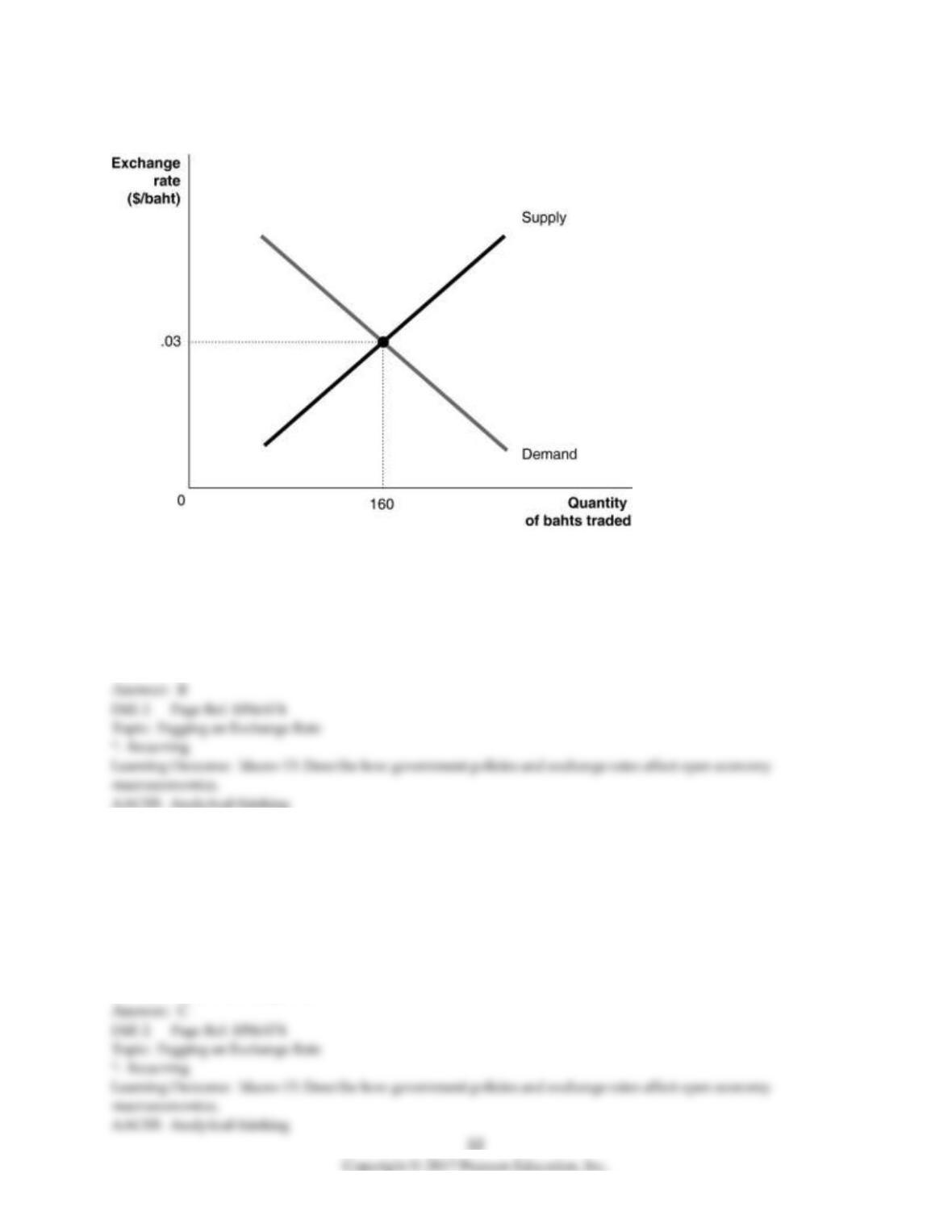
Figure 19-3
50) Refer to Figure 19-3. At what level should the Thai government peg its currency to the dollar to
make Thai exports cheaper to the United States?
A) greater than $.03/baht
B) less than $.03/baht
C) equal to $.03/baht
D) $1/baht
51) Refer to Figure 19-3. Which of the following is not true?
A) Thai imports from the United States are cheaper at exchange rates greater than $.03/baht than at the
equilibrium exchange rate.
B) The baht is overvalued at exchange rates greater than $.03/baht.
C) To achieve an exchange rate greater than $.03/baht, the Bank of Thailand must buy surplus dollars
with bahts.
D) Thai exports to the United States are more expensive at exchange rates greater than $.03/baht than at
the equilibrium exchange rate.
52) Refer to Figure 19-3. If the Thai government pegs its currency to the dollar at a value above
$.03/baht, we would say the currency is
A) undervalued.
B) overvalued.
C) parity valued.
D) equilibrium valued.
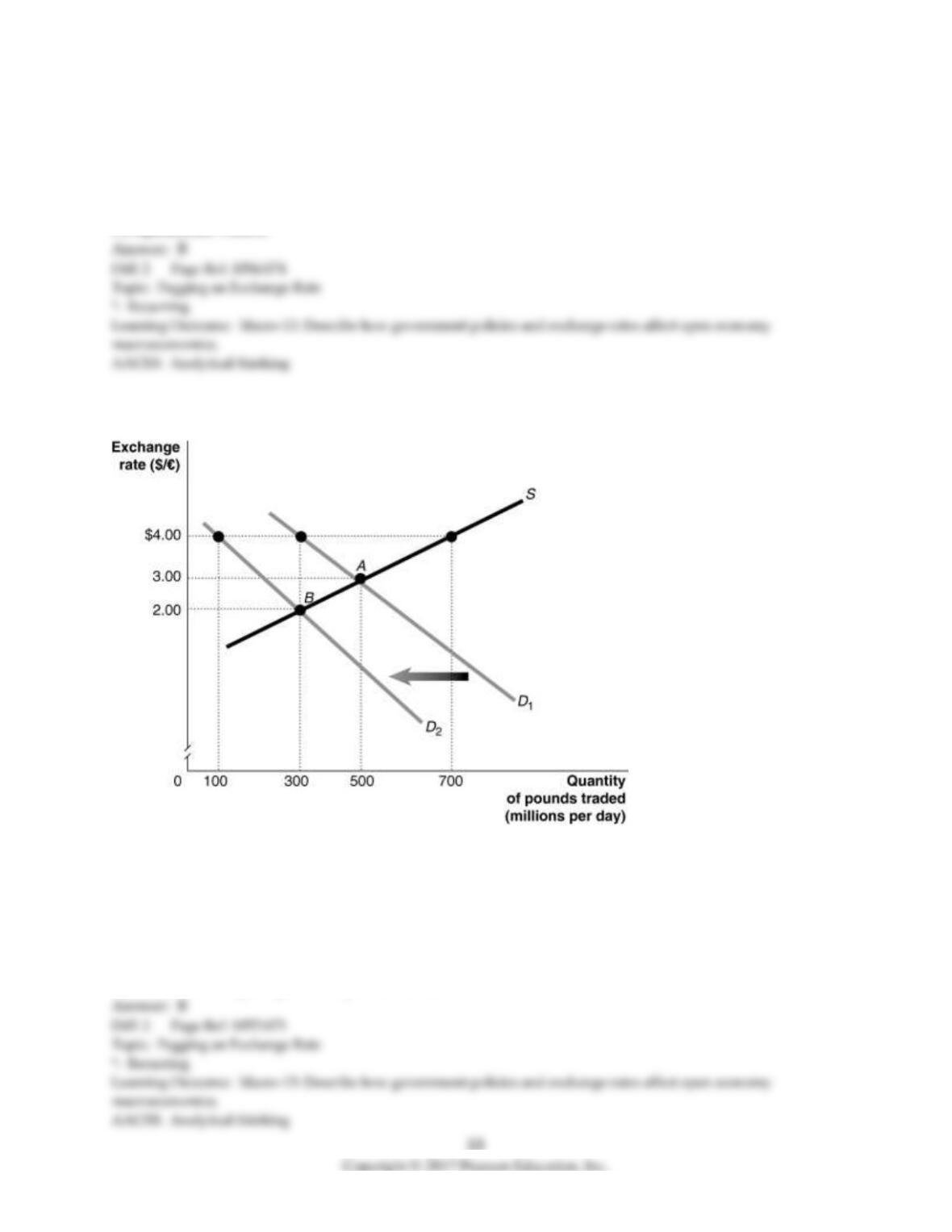
Figure 19-4
53) Refer to Figure 19-4. The equilibrium exchange rate is at A, $3/pound. Suppose the British
government pegs its currency at $4/pound. At the pegged exchange rate,
A) there is a shortage of pounds equal to 600 million.
B) there is a surplus of pounds equal to 400 million.
C) there is a shortage of pounds equal to 400 million.
D) there is a surplus of pounds equal to 600 million.
E) there is a shortage of pounds equal to 200 million.
54) Refer to Figure 19-4. The equilibrium exchange rate is at A, $3/pound. Suppose the British
government pegs its currency at $4/pound. Speculators expect that the value of the pound will drop and
this shifts the demand curve for pounds to D2. After the shift,
A) there is a shortage of pounds equal to 600 million.
B) there is a surplus of pounds equal to 400 million.
C) there is a shortage of pounds equal to 400 million.
D) there is a surplus of pounds equal to 600 million.
E) there is a shortage of pounds equal to 200 million.
55) Refer to Figure 19-4. The equilibrium exchange rate is originally at A, $3/pound. Suppose the British
government pegs its currency at $4/pound. Speculators expect that the value of the pound will drop and
this shifts the demand curve for pounds to D2. If the government abandons the peg, the equilibrium
exchange rate would be
A) $4/pound.
B) $3/pound.
C) $2/pound.
D) less than $2/pound.
35
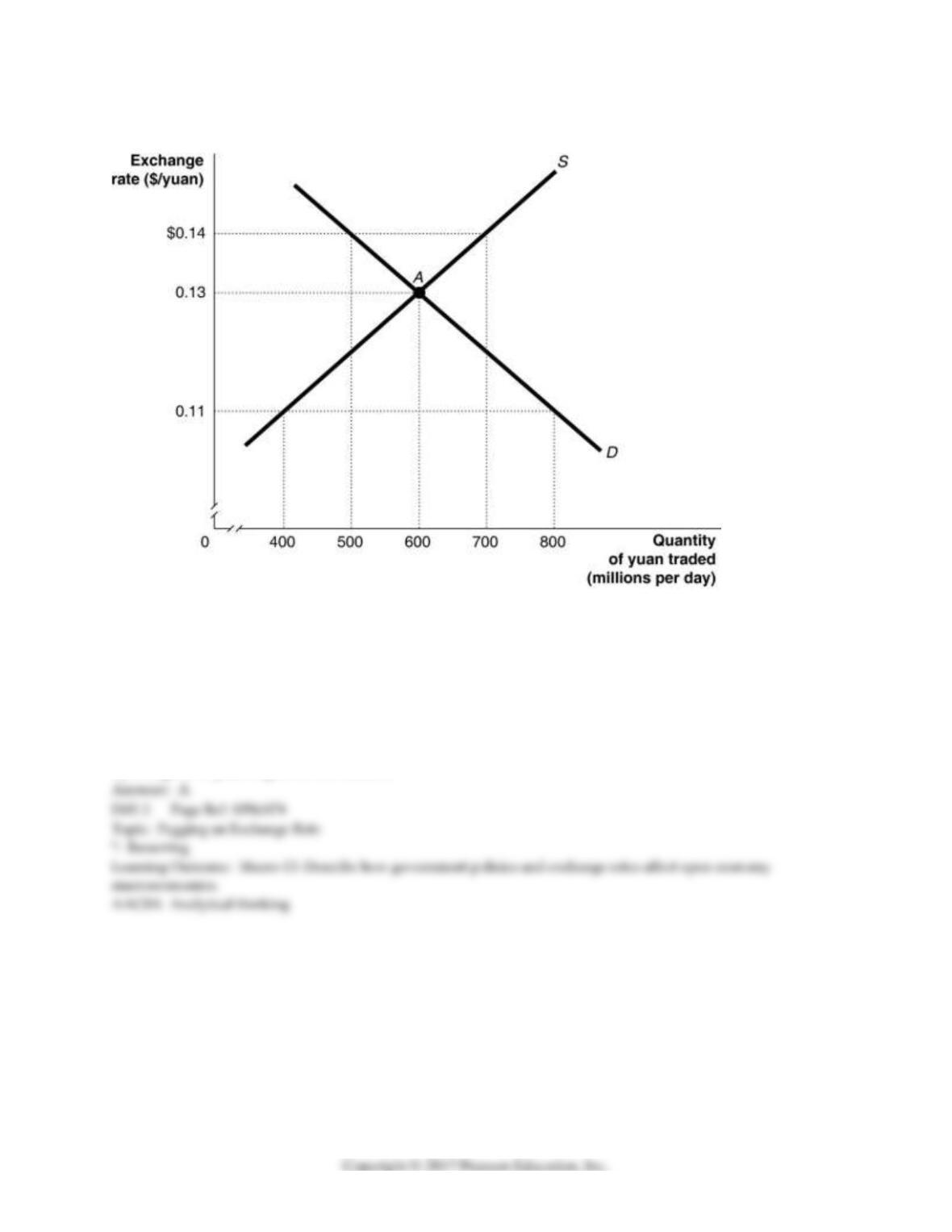
Figure 19-5
56) Refer to Figure 19-5. The Chinese government pegs the yuan to the dollar, at one of the specified
exchange rates on the graph, such that it undervalues its currency. Using the figure above, this would
generate
A) a shortage of yuan equal to 400 million.
B) a shortage of yuan equal to 200 million.
C) a surplus of yuan equal to 200 million.
D) a surplus of yuan equal to 400 million.
E) a surplus of yuan equal to 300 million.
57) Refer to Figure 19-5. Suppose the Chinese government decides to abandon pegging the yuan to the
dollar at a rate which undervalues the yuan. Using the figure above, the equilibrium exchange rate
would be ________ and Chinese exports to the United States would ________ in price.
A) $0.11/yuan; decrease
B) $0.11/yuan; increase
C) $0.14/yuan; increase
D) $0.13/yuan; increase
E) $0.13/yuan; decrease
58) Refer to Figure 19-5. Suppose the pegged exchange rate is $0.11/yuan. Because of safety concerns
and numerous product recalls, U.S. consumers lower their demand for Chinese products. Using the
figure above, this would
A) increase the surplus of Chinese yuan.
B) decrease the surplus of Chinese yuan.
C) decrease the shortage of Chinese yuan.
D) increase the shortage of Chinese yuan.
59) Refer to Figure 19-5. The Chinese government pegs the yuan to the dollar, at one of the specified
exchange rates on the graph, such that it overvalues its currency. Using the figure above, this would
generate
A) a shortage of yuan equal to 500 million.
B) a shortage of yuan equal to 100 million.
C) a surplus of yuan equal to 200 million.
D) a surplus of yuan equal to 700 million.
60) Refer to Figure 19-5. Suppose the pegged exchange rate is $0.14/yuan and U.S. consumers increase
their demand for Chinese products. Using the figure above, this would
A) increase the surplus of Chinese yuan.
B) decrease the surplus of Chinese yuan.
C) decrease the shortage of Chinese yuan.
D) increase the shortage of Chinese yuan.
61) If a country sets a pegged exchange rate that is above the equilibrium exchange rate, how can the
country maintain the peg?
A) by purchasing surplus domestic currency at the pegged rate
B) by selling surplus domestic currency at the pegged rate
C) by purchasing surplus domestic currency at the equilibrium exchange rate
D) by increasing the pegged exchange rate
62) During the Chinese experience with pegging the yuan to the dollar, the yuan was undervalued. As
a result,
A) there was a surplus of yuan on the market that the Chinese government had to purchase to maintain
the peg, depleting China’s reserves of dollars.
B) there was a surplus of dollars on the market that the Chinese government had to purchase to
maintain the peg.
C) the prices of Chinese exports were higher than they would have been without the peg.
D) the equilibrium value of the yuan was below the pegged value of the yuan.
63) When foreign investors in Thailand began to realize that Thailand could not maintain its peg to the
dollar indefinitely, they began to sell off their investments in Thailand and exchange the baht they
received for dollars. This reduction in investment by foreigners is termed
A) foreign direct investment.
B) capital flight.
C) capital inflow.
D) stabilizing capitalization.
64) Which of the following did not help Thailand maintain its peg against the dollar in the 1990s?
A) borrowing dollars from the International Monetary Fund in exchange for baht
B) buying baht on the foreign exchange market to support higher demand for the baht
C) increasing domestic interest rates to attract more foreign investors
D) foreigners selling off new investments in Thailand
65) Firms in Thailand that had borrowed dollars while the baht was pegged to the dollar faced interest
payments that were ________ than they had planned because the baht had been pegged ________ the
equilibrium exchange rate for the baht.
A) higher; above
B) higher; below
C) lower; above
D) lower; below
66) Destabilizing speculation refers to
A) actions taken by the International Monetary Fund that increase lending to countries who have
pegged their currencies against the dollar.
B) actions taken by currency traders to sell a currency that is undervalued.
C) actions taken by investors who sell a country’s currency in anticipation of buying it back later at a
lower price.
D) any depreciation of a country’s currency as a result of long-run adjustments to purchasing power
parity.
67) As foreign investors began to sell off investments they had made in Thailand, they traded in their
baht for dollars. The result of this was
A) pressure for the value of the baht to decline.
B) pressure for the value of the baht to rise.
C) an increase in the equilibrium value of the baht.
D) a decrease in the supply of the baht in foreign exchange markets.
68) China began pegging its currency, the yuan, to the dollar in 1994. Because the yuan has been
________ at the pegged exchange rate, the Chinese government ________ its reserves of dollars as the
government purchased more ________ to maintain the pegged exchange rate.
A) undervalued; increased; dollars
B) undervalued; decreased; yuan
C) overvalued; decreased; yuan
D) overvalued; increased; yuan
69) Although the pegged exchange rate between the yuan and the dollar has undervalued the yuan,
China had been reluctant to abandon the peg for fear that abandoning the peg would
A) increase exports and increase the current account deficit.
B) reduce capital inflows.
C) reduce exports and reduce economic growth.
D) increase Chinese holdings of dollars.
70) Under pressure from Japan, the United States, and Europe, China announced it switched from
pegging the yuan against the dollar to linking the value of the yuan to a ‘basket’ of currencies. The
result of this change was
A) the value of the yuan increased slightly relative to the dollar.
B) the value of the yuan has become very responsive to changes in demand and supply in the foreign
currency market.
C) the value of the yuan has increased dramatically and is beginning to remove the trade imbalance
between the United States and China.
D) the value of the yuan has decreased dramatically and has further spurred Chinese exports.
71) How were countries whose industries competed with Chinese industry affected by a yuan that was
pegged to the dollar?
A) Because the yuan was undervalued at the pegged exchange rate, the level of Chinese exports
remained higher than they would have been if the exchange rate was allowed to float freely.
B) Because the yuan was overvalued at the pegged exchange rate, competing firms from other countries
feared that abandoning the peg would lead to an increase in Chinese exports.
C) Competitors feared that the declining value of the dollar would continue to make Chinese goods
more expensive.
D) Because China’s population is so large relative to other countries, the pegged exchange rate made the
goods of foreign competing firms much less expensive than domestic Chinese goods.