28) When the consumer spends a large portion of her income on a good, demand will be
A) elastic.
B) unit-elastic.
C) inelastic.
D) elastic, unit-elastic or inelastic depending upon supply.
29) When a household spends over 70% of its monthly income on a good, demand will be
A) elastic.
B) unit-elastic.
C) inelastic.
D) elastic, unit-elastic or inelastic depending upon supply.
30) When the consumer spends a small portion of his income on a good, demand will be
A) elastic.
B) unit-elastic.
C) inelastic.
D) elastic, unit-elastic or inelastic depending upon supply.
31) When the consumer spends less than 1% of his income on a good, demand will be
A) elastic.
B) unit-elastic.
C) inelastic.
D) elastic, unit-elastic or inelastic depending upon supply.
32) The absolute price elasticity of demand would be the lowest for
A) automobiles.
B) Mr. Donut coffee.
C) sugar.
D) movie tickets.
33) Suppose that the value of the short-run absolute elasticity of demand for a good is 0.4. Then,
we know the long-run absolute price elasticity of demand will be
A) 0.
B) greater than 0.4.
C) elastic.
D) less than 0.4.
34) Suppose that the value of the long-run absolute elasticity of demand for a good is one. Then,
we know the short-run absolute price elasticity of demand will be
A) inelastic.
B) greater than one.
C) elastic.
D) less than one.
35) Compared to the long-run absolute elasticity of demand, the short-run absolute elasticity of
demand is
A) smaller.
B) the same.
C) larger.
D) either smaller or larger, depending on other factors.
36) Suppose that the absolute price elasticity of demand for hamburger is 1.5 and that the
absolute price elasticity of demand for steak is 2.5. Then the absolute price elasticity of demand
for beef will be
A) less than 1.5.
B) more than 2.5.
C) between 1.5 and 2.5.
D) equal to 1.5.
37) The longer any price change lasts over time, the
A) more difficult it is to alter quantity demanded.
B) the more quickly quantity demanded will return to its original level.
C) the longer the short-run equilibrium will continue to be the short-run equilibrium.
D) more quantity demanded will change.
38) For an addictive drug such as heroin, if the price of heroin increases, then
A) the quantity demanded never changes.
B) the quantity demanded will decrease by a relatively large amount.
C) the quantity demanded will actually increase.
D) the quantity demanded will decrease by a relatively small amount.
39) Which of the following is NOT a determinant of the price elasticity of demand?
A) the availability of potential substitutes
B) the share of the budget spent on the item
C) the time the consumer has to adjust to the price change
D) the cost to produce the product
40) Which of the following is NOT a determinant of the price elasticity of demand?
A) the number of producers of the good
B) the number of substitutes available to buyers
C) the time consumers have to adjust to a price change
D) expenditures on the item as a percentage of a consumer’s total budget
41) The absolute price elasticity of demand for a product for which annual expenditures make up
a very small share of a typical consumer’s budget is probably
A) less than 1.
B) equal to 1.
C) greater than 1.
D) infinity.
42) The absolute price elasticity of demand for a product that has many good substitutes is
probably
A) less than 1.
B) greater than 1.
C) equal to 1.
D) infinity.
43) Other things being equal, the longer a price change persists
A) the less is the elasticity of demand.
B) the less chance a consumer will be able to adjust.
C) the more the consumer will be willing to pay.
D) the greater is the elasticity of demand.
44) If the absolute price elasticity of demand is equal to 1 in the short run, then in the long run,
other things being equal, the absolute price elasticity of demand will be
A) less than one.
B) less than zero.
C) greater than one.
D) equal to zero.
45) In which of the following situations is the absolute price elasticity of demand for an item
most likely to exceed a value of 1?
A) when there are very few close substitutes for the item
B) when there are very few producers of the item
C) when the item’s share of expenses in consumers’ budgets is very small
D) when there is considerable time to adjust to a change in the price of the item
46) Generally, expenses on toothpaste are a small part of a consumer’s budget, so the demand for
toothpaste is more likely to be
A) elastic.
B) inelastic.
C) unit elastic.
D) perfectly elastic.
47) Which of the following is more likely to have perfectly elastic or nearly perfectly elastic
demand?
A) a textbook required for an economics course
B) the guitar produced by a master craftsman
C) cotton produced by a Texas farmer
D) the services offered by the only allergist in the community
48) After full adjustment to a price change has occurred, the absolute price elasticity of demand
for an item is equal to 1.5. In the short run, the absolute price elasticity of demand for the item
was probably
A) less than 0.
B) greater than 0.
C) less than 1.5.
D) greater than 1.5.
49) Generally, expenses on a truck are a large part of a consumer’s budget, so the demand for
trucks is more likely to be
A) elastic.
B) inelastic.
C) unit elastic.
D) perfectly elastic.
50) A product that has an elastic demand curve has all of the following characteristics EXCEPT
A) it has many substitutes.
B) a consumer can wait to buy the product.
C) it has few or no substitutes.
D) it is a large part of a consumer’s income.
51) Why is elasticity of demand greater for goods that are a large share of a consumer’s budget?
52) Which has a more elastic demand: hamburger or beef?
53) “The price elasticity of demand for a particular good is smaller in the long run because
consumers adapt to higher prices over time.” Do you agree or disagree? Explain.
19.4 The Cross Price and Income Elasticities of Demand
1) Suppose that the number of units of good A consumed falls 12 percent when the price of good
B falls 8 percent. The cross price elasticity of demand between goods A and B is
A) 0.66.
B) 1.75.
C) 2.0.
D) 1.5.
2) Suppose that the cross price elasticity of demand between goods Y and Z equals 1.5. Which of
the following is TRUE?
A) Goods Y and Z are complements because the cross price elasticity is greater than one.
B) Goods Y and Z are complements because the cross price elasticity is positive.
C) Goods Y and Z are substitutes because the cross price elasticity is greater than one.
D) Goods Y and Z are substitutes because the cross price elasticity is positive.
3) Suppose that when the price of root beer rises 1%, the quantity of hotdogs demanded falls
0.5%. This would mean that hotdogs and root beer are
A) substitutes, with a cross price elasticity of 0.5.
B) complements, with a cross price elasticity of -0.5.
C) substitutes, with a cross price elasticity of -2.0.
D) complements, with a cross price elasticity of -2.0.
4) Suppose that the amount of portable power banks demanded increases by 10 percent when the
price of personal computers falls by 5 percent. The cross price elasticity of demand between
portable power banks and personal computers is
A) 0.5.
B) -2.0.
C) -0.5.
D) 2.0.
5) If milk and cookies are complements, then their cross price elasticity of demand will be
A) elastic.
B) greater than zero but less than 1.
C) negative.
D) positive.
6) When two goods are substitutes for each other, the cross price elasticity of demand
A) will be negative.
B) will be zero.
C) may be either positive or negative.
D) will be positive.
7) If the cross price elasticity of demand between Los Angeles Lakers professional basketball
tickets and Los Angeles Dodgers professional baseball tickets is positive, then the two goods are
A) substitutes.
B) unrelated.
C) complements.
D) not related.
8) Suppose that the cross price elasticity of demand between good X and good Y is -1.55. This
indicates that the two goods are
A) substitutes.
B) complements.
C) both inferior.
D) completely unrelated in the minds of consumers.
9) Suppose that when the price of good A changes, the quantity of good B demanded remains the
same. The cross price elasticity of demand is
A) zero.
B) positive.
C) negative.
D) either positive or negative.
10) If the cross price elasticity of demand between two goods is negative, then the two goods are
A) substitutes.
B) complements.
C) unrelated.
D) independent.
11) If the cross price elasticity of demand between two goods is positive, then the two goods are
A) substitutes.
B) complements.
C) independent.
D) unrelated.
12) A positive cross price elasticity of demand between two goods suggests that the goods are
A) not related.
B) complements.
C) substitutes.
D) both of unitary elasticity.
13) If goods are completely unrelated, their cross price elasticity will
A) be greater than one.
B) be less than one.
C) be equal to zero.
D) be negative.
14) If the prices of computer tablets rise, we would expect the number of tablet covers purchased
to
A) increase.
B) decrease.
C) be equal to ten.
D) be equal to one.
15) When the price of sausages is $2.00 per pound, consumers buy 50 pounds of fish. When the
price of sausages rises to $3.00 per pound, 60 pounds of fish are purchased. The cross price
elasticity of demand between sausages and fish is approximately equal to
A) +0.04.
B) -0.45.
C) +2.20.
D) +0.45.
16) The cross price elasticity of demand is measured by the
A) percentage change in the quantity demanded of one good divided by the percentage change in
quantity demanded of another good.
B) percentage change in the price of one good divided by the percentage change in price of
another good.
C) percentage change in the demand for one good divided by the percentage change in price of
another good.
D) percentage change in the price of one good divided by the percentage change in the demand
for another good.
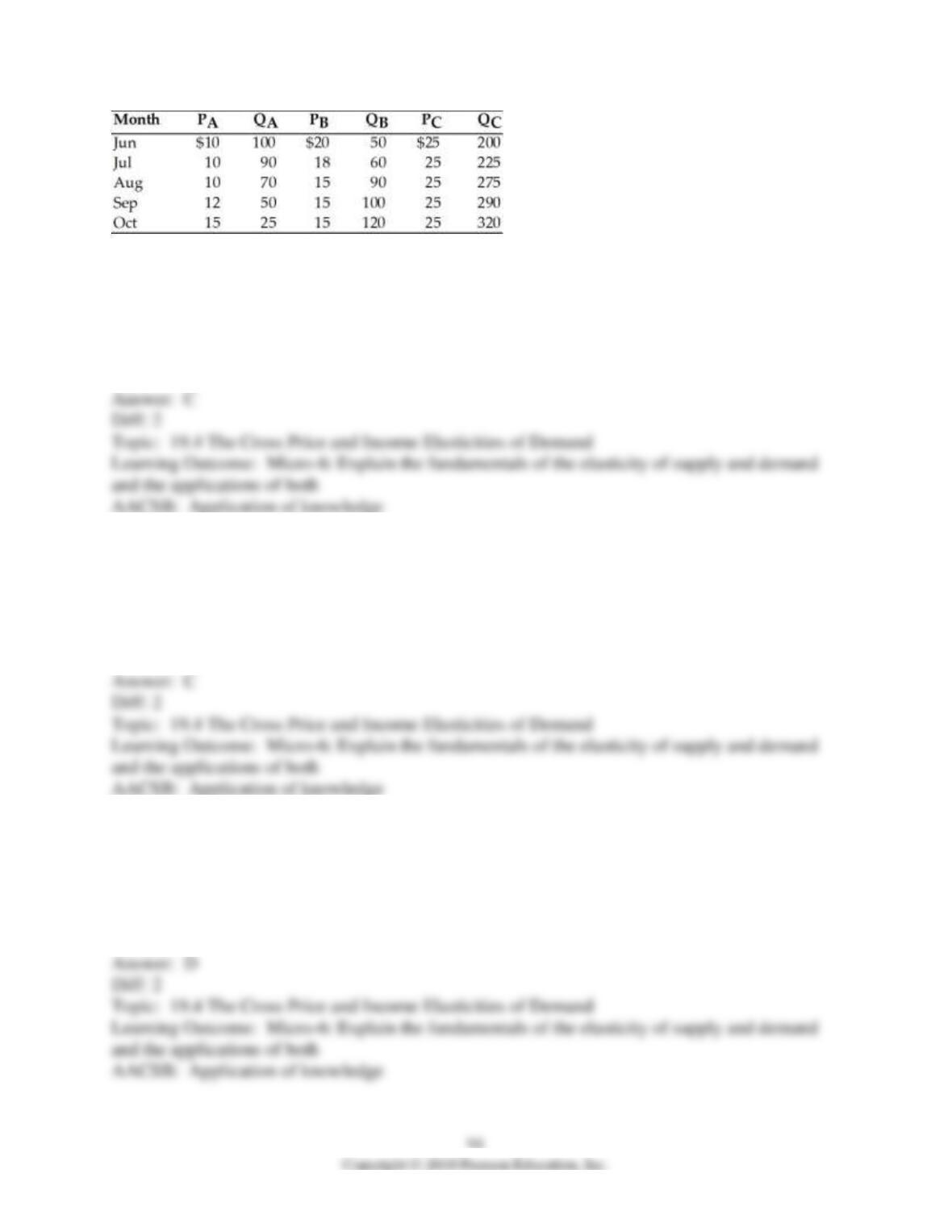
17) In the above table, the cross price elasticity of demand for good A with good B when PB
falls from $20 to $18 is
A) -2.
B) 0.
C) +1.
D) -1.
18) In the above table, the cross price elasticity of demand for good B with good A when PA
rises from $10 to $12 is
A) +0.29.
B) +1.83.
C) +0.58.
D) -0.58.
19) In the above table, the cross price elasticity of demand for good C with good B when PB
rises from $15 to $18 is
A) -2.20.
B) +2.20.
C) +1.10.
D) -1.10.
20) In the above table, the cross price elasticity of demand (using averages) for C with good A,
when PA increases from $12 to $15, is approximately equal to
A) +1.03
B) +2.26.
C) +0.44.
D) -0.44.
21) When the price of a video rental was $2.00, ticket sales at the local movie theatre averaged
180 admissions per night. Then the video store reduced the price of a video rental to $1, and the
theatre manager reported that ticket sales had fallen to 126 per night. What is the approximate
value of the cross price elasticity of demand between video rentals and theatre tickets?
A) -0.53
B) +0.30
C) +0.53
D) +1.67
22) The cross elasticity of demand is
A) the percentage change in the demand of one good divided by the percentage change in price
of another good.
B) the change in the price of one good divided by the change of quantity demanded of another
good.
C) the percentage change in the quantity demanded of one good divided by the percentage
change in the quantity demanded of another good.
D) the percentage change in the price of one good divided by the percentage change in the price
of another good.
23) The percentage change in the demand for one good divided by the percentage change in the
price of a related good is the
A) price elasticity of demand.
B) price elasticity of supply.
C) cross price elasticity of demand.
D) income elasticity.
24) When two goods are substitutes, their cross price elasticity of demand
A) infinity.
B) 0.
C) negative.
D) positive.
25) If two goods are complements,
A) the demands for both goods will be elastic.
B) cross price elasticity of demand will be 0.
C) cross price elasticity of demand will be negative.
D) cross price elasticity of demand will be positive.
26) When two goods are unrelated,
A) their cross price elasticity of demand will be infinity.
B) their cross price elasticity of demand will be 0.
C) their cross price elasticity of demand will be negative.
D) their cross price elasticity of demand will be positive.
27) Robert must always have sugar in his coffee. For Robert, the cross price elasticity of demand
for coffee and sugar is
A) equal to 0.
B) negative.
C) positive.
D) impossible to determine without more information.
28) George always purchases the soda with the lowest price. For George, the cross price
elasticity of demand for two brands of soda will be
A) equal to 0.
B) negative.
C) positive.
D) impossible to determine without more information.
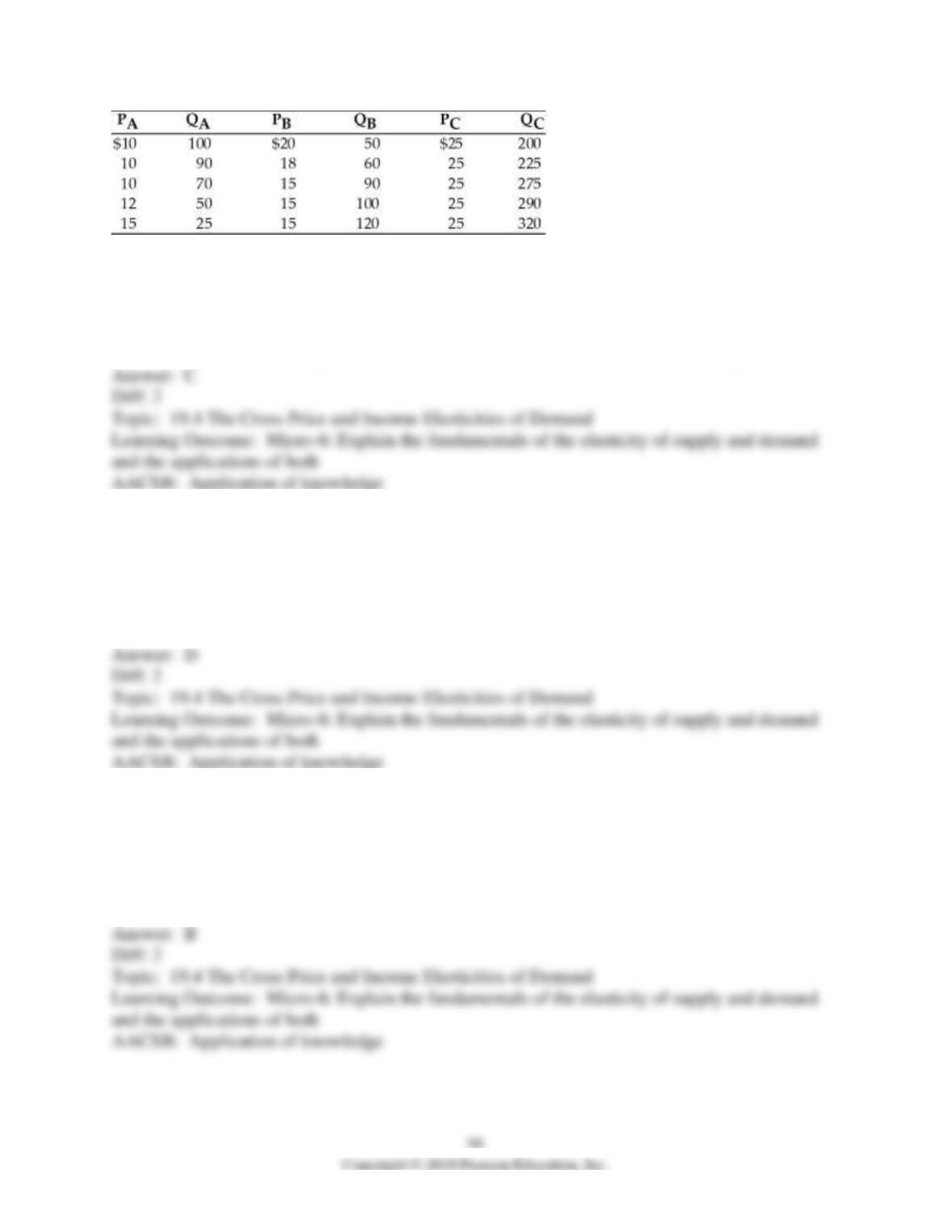
29) Refer to the above table. Based on the information in the table, we can say that
A) all three goods are substitutes for each other.
B) all three goods are complements.
C) Goods A and B are substitutes, B and C are complements, and A and C are substitutes.
D) Goods A and B are complements, B and C are substitutes, and A and C are complements.
30) Refer to the above table. Suppose the price of B rises from $18 to $20. What is the cross
price elasticity of demand between A and B?
A) -2
B) -1
C) 0
D) +1
31) Refer to the above table. Suppose the price of B rises from $18 to $20. What is the cross
price elasticity of demand between B and C?
A) -1.7273
B) -1.1176
C) -0.8947
D) +1.7273
32) Refer to the above table. Suppose the price of A increases from $10 to $12. What is the cross
price elasticity of demand between A and C?
A) +0.292
B) +7.06
C) -7.06
D) -0.292
33) Refer to the above table. Suppose the price of A increases from $10 to $12. What is the cross
price elasticity of demand between A and B?
A) -1.833
B) +0.545
C) +0.579
D) +1.833
34) Refer to the above table. The price of B decreases from $18 to $15. What is the cross price
elasticity of demand between B and A?
A) -0.73
B) -1.0
C) +1.38
D) +1.83
35) A measure of the responsiveness of the demand for one good to the percentage change in the
price of another good is
A) price elasticity of demand.
B) price elasticity of supply.
C) cross price elasticity of demand.
D) income elasticity.
36) Suppose the price of A increases by 10 percent while the quantity demanded of B does NOT
change. We would conclude that
A) the two goods are substitutes, but the cross elasticity of demand is not large.
B) the two goods are complements, but the cross elasticity of demand is not large.
C) the two goods are perfect substitutes.
D) the two goods are not related.
37) The cross price elasticity between A and B is 1.2. We can conclude that
A) goods A and B are substitutes.
B) goods A and B are complements.
C) goods A and B are unrelated.
D) goods A and B are perfect substitutes.