Macroeconomics: Policy and Practice, 2e (Mishkin)
Chapter 19 Investment
19.1 Data on Investment Spending
1) Investment spending in the U.S. ________.
A) comprises the majority of total spending
B) is equal to approximately 15 percent of total spending
C) is equal to approximately 81 percent of total spending
D) is the smallest component part of household consumption spending
2) Investment spending is a potent force in the macroeconomy, because ________.
A) it is subject to large fluctuations
B) it is larger than other spending categories
C) it is the focus of macroeconomic policies
D) it expresses entrepreneurial talent
3) The elements of investment spending are ________.
A) calculated only in real terms
B) equivalent to their corresponding international transactions
C) consumption, government, exports and imports
D) highly procyclical
4) Which of the following is not a component of investment spending?
A) spending by firms on equipment
B) the purchase of 1000 shares of corporate stock
C) residential construction
D) changes in inventories
5) Which of the following is a component part of investment spending?
A) the purchase of a new microwave by a fast food restaurant
B) the purchase of 500 shares of corporate stock
C) the sale of 500 shares of corporate stock
D) all of the above
6) The purchase and sale of financial instruments is not included in calculations of investment
spending because ________.
A) not all of these transactions are reported to the federal government
B) both foreign and domestic economic agents can engage in the described transactions, but only
U.S. economic agents can engage in investment
C) they do not necessarily lead to a change in the amount of output produced in the United States
D) they are already including in consumption spending
19.2 The Neoclassical Theory of Investment
1) Once the marginal product of capital is equal to the real rental cost of capital ________.
A) inventories will stabilize
B) depreciation will equal the marginal rate of substitution
C) the economy will reach full employment
D) a profit-seeking firm will stop acquiring capital
2) If the marginal product of capital is greater than the rental cost of capital in terms of goods
and services, then ________.
A) the firm should continue to produce using that same amount of capital
B) the firm should add additional capital
C) the firm should reduce the amount of capital is using
D) diminishing returns have been avoided
3) A firm possesses too much capital if ________.
A) the real rental cost of capital is equal to the marginal product of capital
B) the real rental cost of capital is less than the marginal product of capital
C) its investment spending exceeds its consumption outlays
D) the real rental cost of capital is more than the marginal product of capital

4) User cost is equal to ________.
A) interest cost plus the expected rate of change in the real price of capital plus depreciation
B) interest cost minus the rate of depreciation
C) interest cost minus the expected rate of change of the real price of capital plus depreciation
D) interest cost plus depreciation
5) Suppose that a machine costs $10,000 in constant dollars and the real rate of interest is 12
percent. If the machine is expected to increase in price by 2 percent and the rate of depreciation
is 5 percent, then the user cost of capital for that machine over one year is equal to ________.
A) $150
B) $1,500
C) $10,000
D) $102,500
6) A machine cost $15,000 to install, and has a resale value one year later of $12,000. If the real
interest rate is 10%, then the user cost of capital is ________.
A) $4,500
B) $1,500
C) $3,000
D) $1,200
7) The user cost of capital is negatively related to ________.
A) the real rate of interest
B) the depreciation rate
C) the expected rate of change of the real price of capital
D) the tertiary log of the nominal price of capital
8) The expected real cost of using a unit of capital over a given period of time is known as
________.
A) the real rate of interest
B) the nominal rate of interest
C) depreciation
D) the user cost of capital
9) Gross investment is equal to ________.
A) net investment plus depreciation
B) net investment divided by depreciation
C) net investment minus depreciation
D) net investment times depreciation
10) The fraction of capital that wears out every year is known as ________.
A) gross investment
B) depreciation
C) net investment
D) devaluation
11) Except during the Great Depression, net investment has always been ________.
A) equal to depreciation
B) equal to zero
C) positive
D) negative
12) An increase in the rate of depreciation is associated with ________.
A) a decrease in the rate of productivity
B) a decrease in gross investment
C) a decrease in net investment
D) an increase in net investment
13) A higher desired level of capital and investment will result from ________.
A) a decrease in productivity
B) a fall in expected future output
C) a depressed economy
D) a booming economy
5
14) A decline in the desired level of capital and investment will result from ________.
A) a rise in the real price of capital
B) a decrease in the rate of depreciation
C) a decrease in the real interest rate
D) a decrease in the real price of capital
15) A rise in the tax rate on businesses leads to ________.
A) a decline the desired level of capital and an increase in investment
B) a decline in the desired level of capital and a decrease in investment
C) an increase in the desired level of capital and a decrease in investment
D) an increase in the desired level of capital and an increase in investment
16) Based on the neoclassical theory of investment, which aspect of a booming economy helps to
explain the procyclicality of investment?
A) Tax revenues are likely to be rising.
B) The real interest rate is likely to be rising.
C) Capital goods are becoming more expensive.
D) Financing constraints are likely to be relaxed for many businesses.
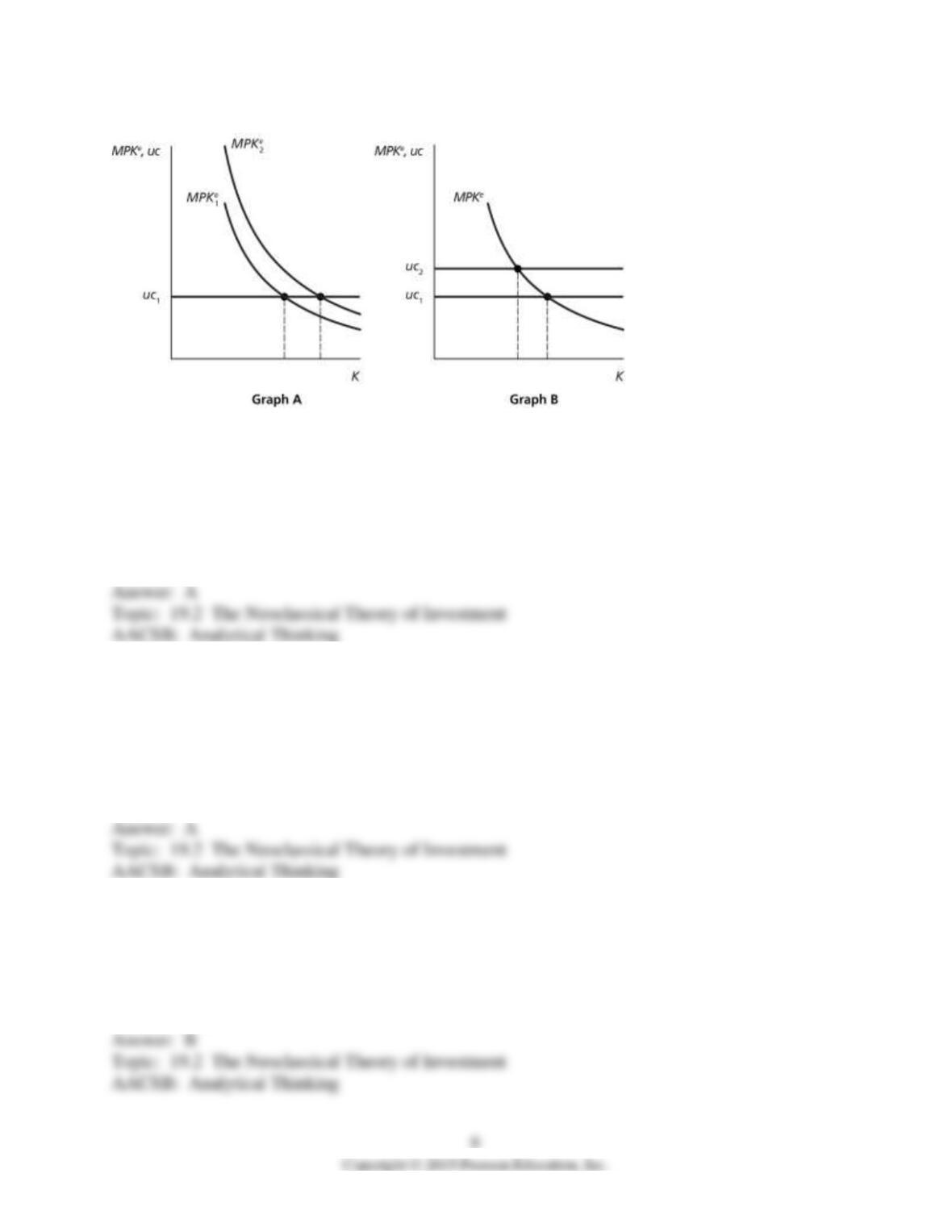
Desired Level of the Capital Stock
17) Consider the two graphs above. Suppose that allowable deductions from taxable business
income are increased. This would ________ the desired level of the capital stock, as depicted in
graph ________.
A) increase; B
B) increase; A
C) decrease; B
D) decrease; A
18) Consider the two graphs above. Suppose that financial liberalization enables more businesses
to access credit markets. This would ________ the desired level of the capital stock, as depicted
in graph ________.
A) increase; B
B) increase; A
C) decrease; B
D) decrease; A
19) Consider the two graphs above. Suppose that businesses expect to hire more workers. This
would ________ the desired level of the capital stock, as depicted in graph ________.
A) increase; B
B) increase; A
C) decrease; B
D) decrease; A
20) Consider the two graphs above. Suppose that the domestic currency is expected to
strengthen. This would ________ the desired level of the capital stock, as depicted in graph
________.
A) increase; B
B) increase; A
C) decrease; B
D) decrease; A
21) Consider the two graphs above. Suppose there is an increase in the real interest rate. This
would ________ the desired level of the capital stock, as depicted in graph ________.
A) increase; B
B) increase; A
C) decrease; B
D) decrease; A
22) Consider the two graphs above. Suppose that technological progress is expected to reduce
the future cost of capital goods. This would ________ the desired level of the capital stock, as
depicted in graph ________.
A) increase; B
B) increase; A
C) decrease; B
D) decrease; A
23) Use the neoclassical theory of investment to explain why technological progress that reduces
the price of computers (and related information technology) impacts investment differently than
technological progress that makes computers more productive.
8
24) Investment spending is procyclical. In the short run, are changes in investment affected more
by changes in the expected marginal product of capital, or by changes in the user cost of capital?
25) Should you stay in school beyond the current semester? Describe how you might use the
neoclassical theory of investment to help you decide.
19.3 Inventory Investment
1) The most volatile component of total investment spending is ________.
A) construction spending by firms
B) spending by firms on equipment
C) residential construction by households
D) inventory investment
2) The order of inventories for production as they are needed is known as ________.
A) just-in-time production
B) production smoothing
C) work in process
D) stock out avoidance
9
3) Retail stores that dedicate one or more aisles to “seasonal” items are engaging in ________.
A) just-in-time production
B) production smoothing
C) work in process
D) first degree price discrimination
4) Holdings of partially finished components involve inventories of ________.
A) Tobin’s q
B) work in process
C) production smoothing
D) stock-out components
5) A car dealer that maintains a large number of automobiles on their lot so that they avoid losing
a sale to another dealer who has the make and model a given customer wants is engaged in
________.
A) production smoothing
B) work in process
C) stock-out avoidance
D) first degree price discrimination
6) Firms that continue to produce when sales are temporarily low in an effort to avoid costly
fluctuations in production are engaging in ________.
A) second degree price discrimination
B) stock out avoidance
C) work in progress
D) production smoothing
7) One explanation for the sharp decline in inventory investment during the 2007-2009 financial
crisis was ________.
A) financing constraints
B) the rise in the level of income
C) the volatility of interest rates
D) the increase in total spending and therefore costs
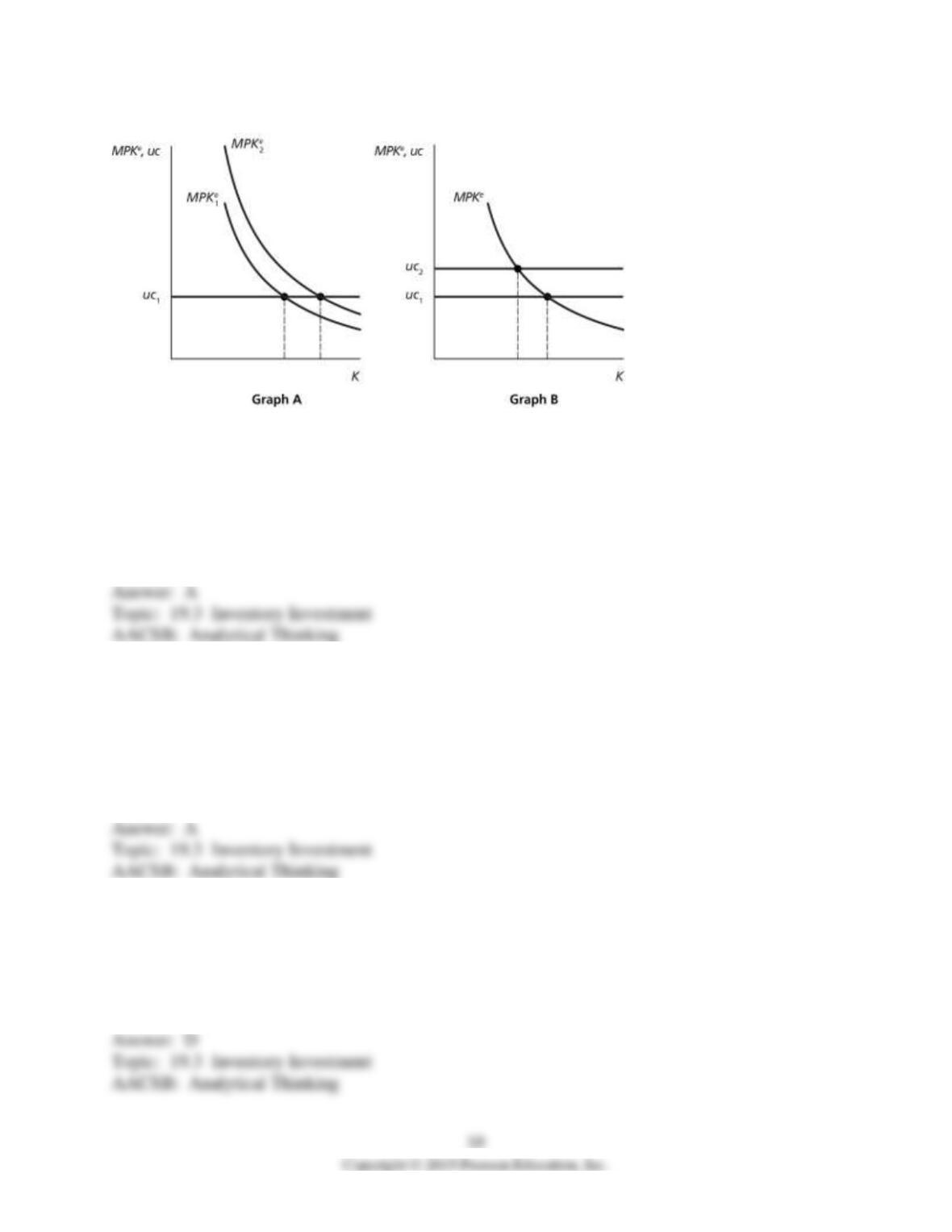
Desired Level of the Capital Stock
8) Consider the two graphs above. Suppose that firms are able to use inventories as collateral for
low-interest loans. This would ________ the desired level of inventories, as depicted in graph
________.
A) increase; B
B) increase; A
C) decrease; B
D) decrease; A
9) Consider the two graphs above. Suppose that improvements in storage technology reduce
inventory losses. This would ________ the desired level of inventories, as depicted in graph
________.
A) increase; B
B) increase; A
C) decrease; B
D) decrease; A
10) Consider the two graphs above. Suppose producers forecast a decrease in sales. This would
________ the desired level of inventories, as depicted in graph ________.
A) increase; B
B) increase; A
C) decrease; B
D) decrease; A

11
11) Consider the two graphs above. Suppose that improvements in technology enable farmers to
produce two or more harvests of the same crop each year. This would ________ the desired level
of inventories, as depicted in graph ________.
A) increase; B
B) increase; A
C) decrease; B
D) decrease; A
12) Consider the two graphs above. Suppose that final goods are assembled only when ordered
and to satisfy the precise preferences of each consumer. This would ________ the desired level
of inventories, as depicted in graph ________.
A) increase; B
B) increase; A
C) decrease; B
D) decrease; A
13) Consider the two graphs above. Suppose there is increased concentration in the retail sector
(that is, fewer, larger companies). This would ________ the desired level of inventories, as
depicted in graph ________.
A) increase; B
B) increase; A
C) decrease; B
D) decrease; A
14) Consider the two graphs above. Suppose rising fuel costs makes it more expensive to move
goods to and from warehouses. This would ________ the desired level of inventories, as
depicted in graph ________.
A) increase; B
B) increase; A
C) decrease; B
D) decrease; A
12
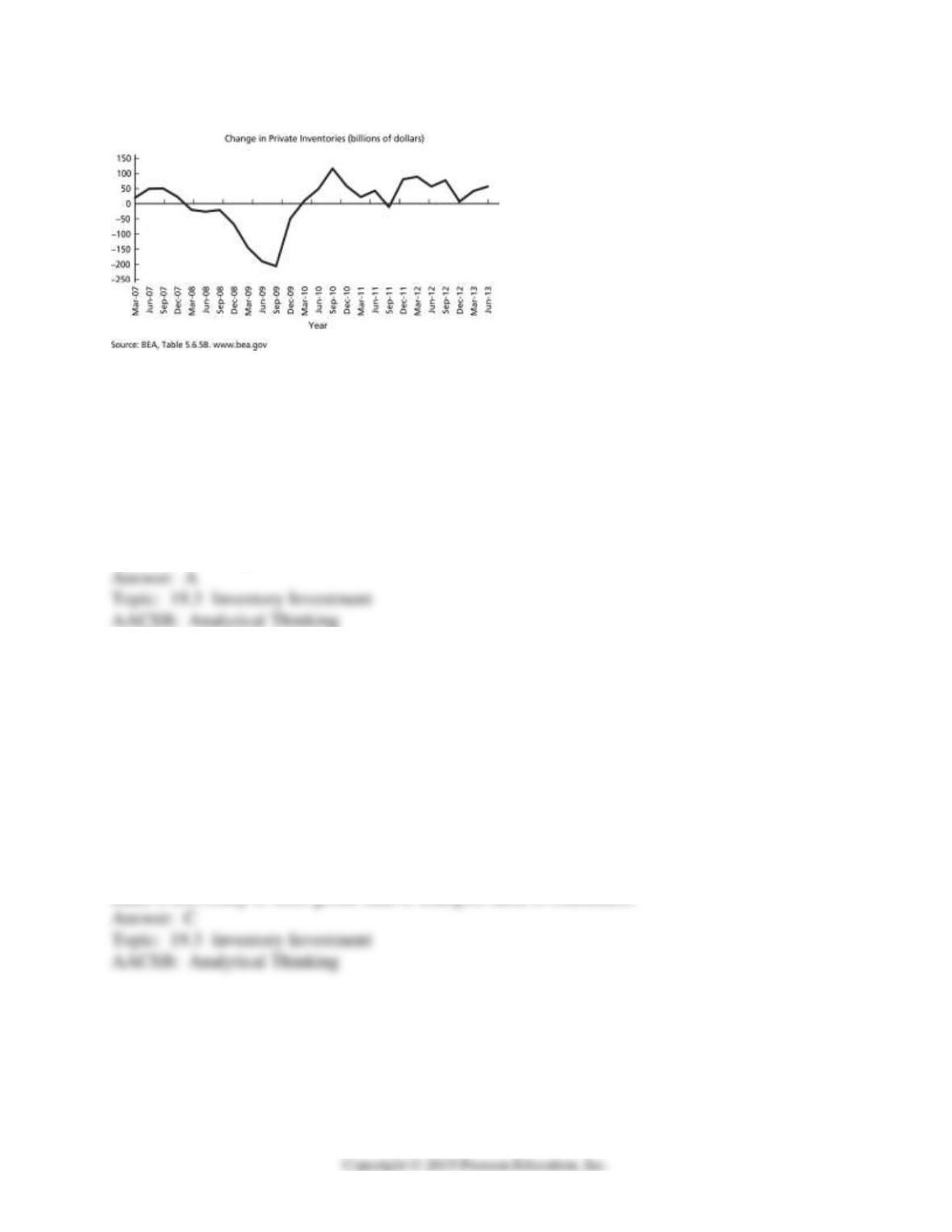
Figure 19.1
15) Which of the following is the most likely explanation for the behavior of private inventories
between September 2007 and September 2009, as depicted in Figure 19.1?
A) a substantial decline in the desired level of inventories, due to a slump in aggregate demand
B) a substantial decline in the desired level of inventories, as improvements in technology have
reduced the size of inventories needed to support both production and customer deliveries
C) an unanticipated draw-down of inventories as the economy was growing much faster than
expected
D) a substantial decline in the desired level of inventories, as changes in the tax code increased
the cost of holding inventories
16) Between September 2009 and September 2010, the recovery of private inventories, as shown
in Figure 19.1, was far stronger than the overall economy’s recovery from the Great Recession.
Which is the most reasonable inference?
A) Persistently weak aggregate demand gave producers no alternative but to place current output
into storage.
B) Businesses overestimated the strength of the recovery, which lead to overstocking of
inventories.
C) Financial constraints had forced businesses to contract inventories by more than they
otherwise would have chosen. The period beginning in September 2009 reflects the attempt by
businesses to correct this.
D) Generally poor weather conditions in the final months of the year in the northern hemisphere
make it less costly to store goods than to transport them to consumers.
13
17) Figure 19.1 displays changes in the size of private inventories. Based on the figure, in which
month is the size of private inventories likely to have been lowest?
A) September 2010
B) September 2011
C) September 2009
D) March 2010
18) Figure 19.1 shows the actual behavior of inventories. Based on the figure, in which month is
the discrepancy between the actual level of inventories and the desired level of inventories likely
to have been smallest?
A) March 2012
B) September 2009
C) March 2010
D) September 2010
19) Four reasons for firms to hold inventories are given in the text. For each reason, indicate
briefly whether and how it helps to explain the high volatility of inventory investment.

19.4 Tobin’s q and Investment
1) Tobin’s q is equal to ________.
A) the market value of a firm times the replacement cost of installed capital
B) the market value of a firm plus the replacement cost of installed capital
C) the market value of a firm divided by the replacement cost of installed capital
D) the market value of a firm minus the replacement cost of installed capital
2) If the market value of a firm is $6 billion and the replacement cost of installed capital is equal
to $3 billion, then Tobin’s q is equal to ________.
A) 9
B) 3
C) 18
D) 2
3) If the market value of a firm is $6 billion and Tobin’s q is equal to 2, then the replacement cost
of installed capital must be ________.
A) $2 billion
B) $3 billion
C) $9 billion
D) $18 billion
4) A rise in stock prices leads to ________.
A) an increase in income
B) an increase in Tobin’s q
C) a decrease in Tobin’s q
D) a decrease in income
5) A decline in Tobin’s q can be caused by ________.
A) a rise in the market value of a firm
B) an increase in stock prices
C) a decline in stock prices
D) a decline in the replacement cost of capital

6) Fluctuations in Tobin’s q are ________, because ________.
A) frequent and substantial; asset prices are volatile
B) frequent and substantial; replacement costs are volatile
C) infrequent and mild; replacement costs are relatively stable
D) infrequent and mild; the marginal product of capital does not change quickly
7) When Tobin’s q is greater than one, ________.
A) a unit of a firm’s stock (equity) is worth more than a unit of the firm’s capital
B) a new unit of capital has more value than a new unit of stock (equity)
C) installed capital is worth less than new capital
D) a unit of capital that a firm owns has more value than a unit it might buy
8) According to Tobin’s q theory, the principal objective of investment is ________.
A) to increase eligibility for the investment tax credit
B) to expand production
C) to increase the market value of the firm
D) to lower the replacement cost of installed capital
9) Which ratio correctly highlights the similarity between neoclassical theory and Tobin’s q
theory?
A) the marginal product of capital divided by the user cost of capital
B) a firm’s stock value divided by the value of its capital stock
C) a firm’s capital stock divided by the value of its inventories
D) a firm’s investment spending divided by the user cost of capital
10) Tobin’s q theory adds to neoclassical theory because it ________.
A) illustrates the important relationship between tax rates and the incentive to labor
B) emphasizes the role played by asset price fluctuations on investment spending
C) highlights the impact of a tax increase on business investment
D) underlines the relationship between financial innovation and the financial crisis of 2007-2009
11) Use Tobin’s q theory and the neoclassical theory of investment to explain how optimistic
scenarios of the “information age” would cause overinvestment in computer-related capital
goods, and how that overinvestment would cause a sudden reversal.
12) In many economies, a substantial fraction of investment is by multinational corporations
(MNCs) whose stock value is determined on global markets. Based on Tobin’s q theory, how
might we expect MNC investment to affect the volatility of aggregate investment in an
economy?
13) Use Tobin’s q theory and the neoclassical theory of investment to explain why investment
rises so rapidly once the economy has passed the trough of a business cycle.
19.5 Residential Investment
1) Applying neoclassical theory to the housing market, a higher marginal product of (housing)
capital may be caused by ________.
A) higher expected household income
B) the inability to buy as much housing at a higher price
C) an expected increase in the relative price of housing
D) a decrease in the cost of building new houses
2) Applying neoclassical theory to the housing market, the idea that “housing is a good
investment” refers to ________.
A) higher expected household income
B) the inability to buy as much housing at a higher price
C) an expected increase in the relative price of housing
D) a decrease in the cost of building new houses
3) Applying neoclassical theory to the housing market, ________ cause a decrease in the desired
stock of houses.
A) higher expected household incomes
B) higher rates of household formation
C) increases in the expected relative price of housing
D) tighter constraints on mortgage financing
4) Applying neoclassical theory to the housing market, ________ cause a decrease in the user
cost of housing.
A) higher expected household incomes
B) higher rates of household formation
C) increases in the expected relative price of housing
D) tighter constraints on mortgage financing
5) An increase in the desired stock of housing would be caused by ________.
A) an increase in household formation
B) higher residential consumption
C) a decrease in expected future income
D) an increase in home prices
6) Through its impact on the desired stock of housing, higher expected income would lead to
________.
A) an increase in residential investment
B) a decrease in expected house price appreciation
C) a decrease in residential investment
D) a decrease in single-family dwellings
7) A decline in real mortgage rates will lead, other things the same, to ________.
A) lower demand for housing
B) tighter financing constraints
C) an increase in residential investment
D) a lower relative price of housing
8) The provision of funds to the mortgage market through the purchase of mortgage-backed
securities and mortgages is performed by ________.
A) Fannie Mae and Freddie Mac
B) the Federal Housing Administration
C) the Federal Reserve System
D) subprime borrowers
9) The federal government has encouraged home ownership through ________.
A) an increase in home prices
B) an increase in domestic interest rates
C) a decrease in the implicit rent on residential housing
D) allowing mortgage interest to be tax deductible
19
10) The federal government of the United States has ________.
A) proven itself unable to significantly influence U.S. home ownership
B) has been able to increase the volume of home ownership in the U.S.
C) proven itself able to effectively control monetary policy
D) has been unable to increase the volume of government spending since WWII
11) Why is residential investment procyclical?