124) China began pegging its currency, the yuan, to the dollar in 1994. Because the yuan was ________
at the pegged exchange rate, the Chinese government increased its reserves of ________ as the
government purchased more ________ to maintain the pegged exchange rate.
A) undervalued; dollars; dollars
B) undervalued; yuan; yuan
C) overvalued; yuan; yuan
D) overvalued; dollars; dollars
125) Although the pegged exchange rate between the yuan and the dollar has ________ the yuan, China
had been reluctant to abandon the peg for fear that abandoning the peg would ________.
A) undervalued; reduce exports
B) undervalued; reduce imports
C) overvalued; increase imports
D) overvalued; reduce exports
126) Thailand’s experience with pegging the baht to the dollar failed because the baht was ________
relative to the dollar, and China’s experience with pegging the yuan to the dollar has run into
difficulties because the yuan has been ________ relative to the dollar.
A) overvalued; overvalued
B) undervalued; overvalued
C) undervalued; undervalued
D) overvalued; undervalued
127) An easy way to determine if a currency is undervalued at a point in time is to use the model of
purchasing power parity.
128) One reason purchasing power parity does not exactly hold is that many goods are not traded
internationally.
129) If purchasing power parity tells us that if the exchange rate is a pound for a dollar, then price of a
haircut in London should cost the same as a haircut in New York.
130) A depreciation of a country’s currency always lowers the domestic firm’s profits.
131) Both countries involved in a pegging of currency must agree to the terms of the pegging.
132) The fact that the prices for McDonald’s Big Mac sandwich are not the same around the world
illustrates one reason why purchasing power does not hold: Many goods are not traded internationally.
133) If the rate of inflation in the United States exceeds the rate of inflation in Great Britain we would
expect the U.S. dollar to depreciate in value against the British pound.
134) If the rate of productivity growth in the United States exceeds the rate of productivity growth in
Great Britain we would expect the U.S. dollar to depreciate in value against the British pound.
135) Adoption of the euro as both a medium of exchange and unit of account in the EU countries serves
to increase competition among European firms and decrease individual countries’ monetary policy
options when confronted by recessions and booms.
136) If a firm in Thailand borrows dollars from a U.S. bank, its interest payments on the loan in bahts
will decrease if the baht appreciates against the dollar.
137) In order to maintain an undervalued yuan to encourage a trade surplus, the Chinese government
must buy dollars and increase the supply of yuan.
138) The model of purchasing power parity is the only way to determine whether a country’s currency
is undervalued or overvalued.
139) What three real-world complications keep purchasing power parity from being a complete
explanation of exchange rate fluctuations in the long run? Explain.
140) Will the use of the euro help increase economic growth in countries in the European Union? Will it
help individual countries using the euro in times of recession? Explain.
141) South Korea, Indonesia, Malaysia, and Thailand all pegged their currencies to the dollar at one
point in time. Because some of these currencies were overvalued at the pegged rate, speculators
anticipated these countries would abandon the peg and speculators began selling those currencies.
Explain how this speculation would affect the ability of a country to maintain a pegged exchange rate.
142) In 1991, Argentina decided to peg its currency (the Argentinean peso) to the U.S. dollar. Most of
Argentina’s trading, however, was with Brazil and Europe, not the United States. What result would
pegging the Argentinean peso to the U.S. dollar have on the cost of imports from and exports to Brazil
and Europe?
143) Why might a country raise interest rates in the face of an exchange rate crisis?
144) Why might a developing country choose to peg the value of its currency to the dollar?
145) Describe the four determinants of exchange rates in the long run.
146) What does it mean when one currency is “pegged” against another currency?
147) Why do countries peg their currencies, and what problems can result from pegging?
148) According to the theory of purchasing power parity, if the inflation rate in the United States is
greater than the inflation rate in Canada, explain what should happen to the exchange rate between the
U.S. dollar and the Canadian dollar.
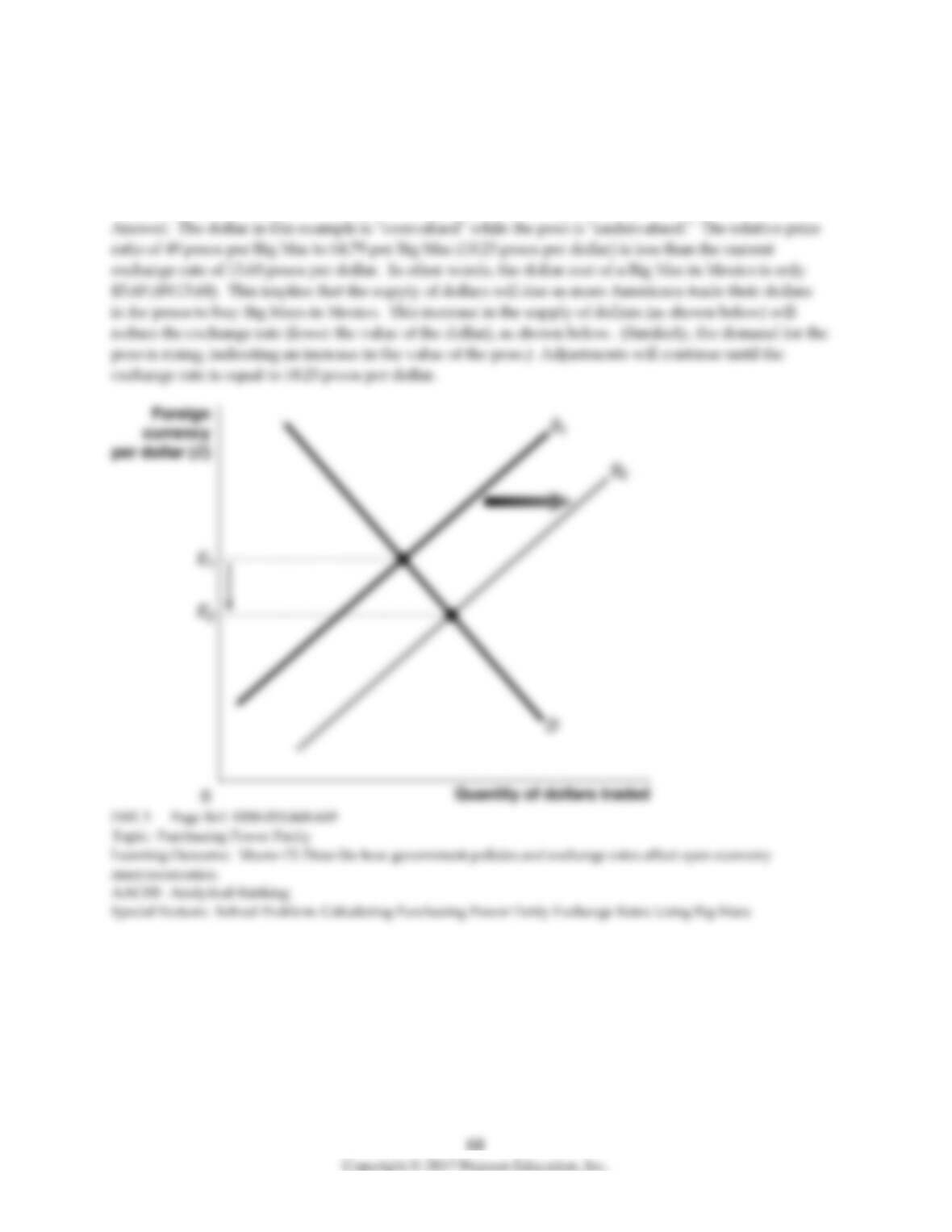
149) The “Big Mac Theory of Exchange Rates” tests the accuracy of purchasing power parity theory. In
July 2015, the Economist reported that the average price of a Big Mac in the United States was $4.79. In
Mexico, the average price of a Big Mac at that time was 49 pesos. If the exchange rate between the
dollar and the peso was 13.60 pesos per dollar, how would purchasing power parity predict the
exchange rate will change in the long run? Support your answer graphically.
150) The “Big Mac Theory of Exchange Rates” tests the accuracy of the purchasing power parity theory.
In July 2015, the Economist reported that the average price of a Big Mac in the United States was $4.79.
In Mexico, the average price of a Big Mac at that time was 49 pesos. If the exchange rate between the
dollar and the peso was 13.60 pesos per dollar, explain how it would be profitable to buy Big Macs in
Mexico instead of in the United States.
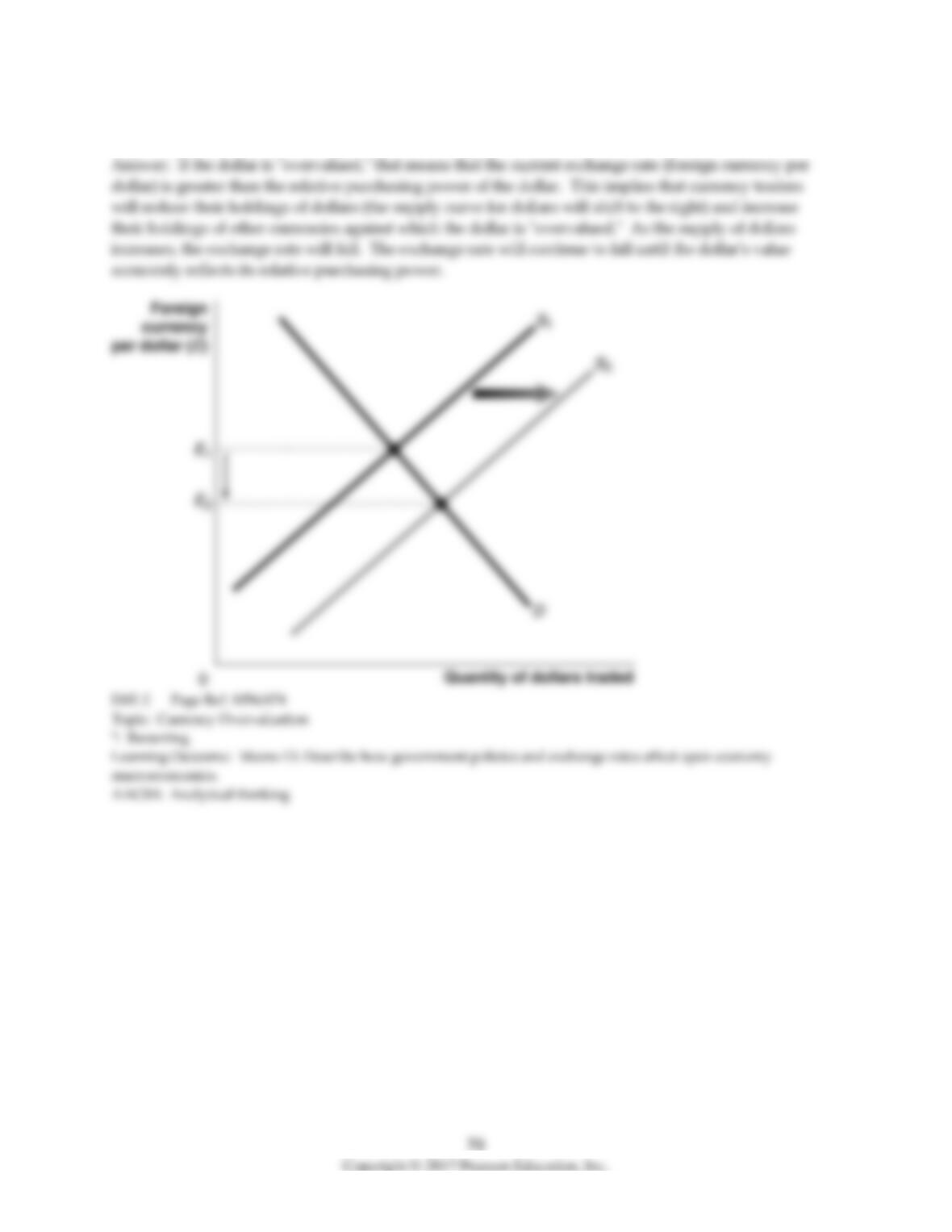
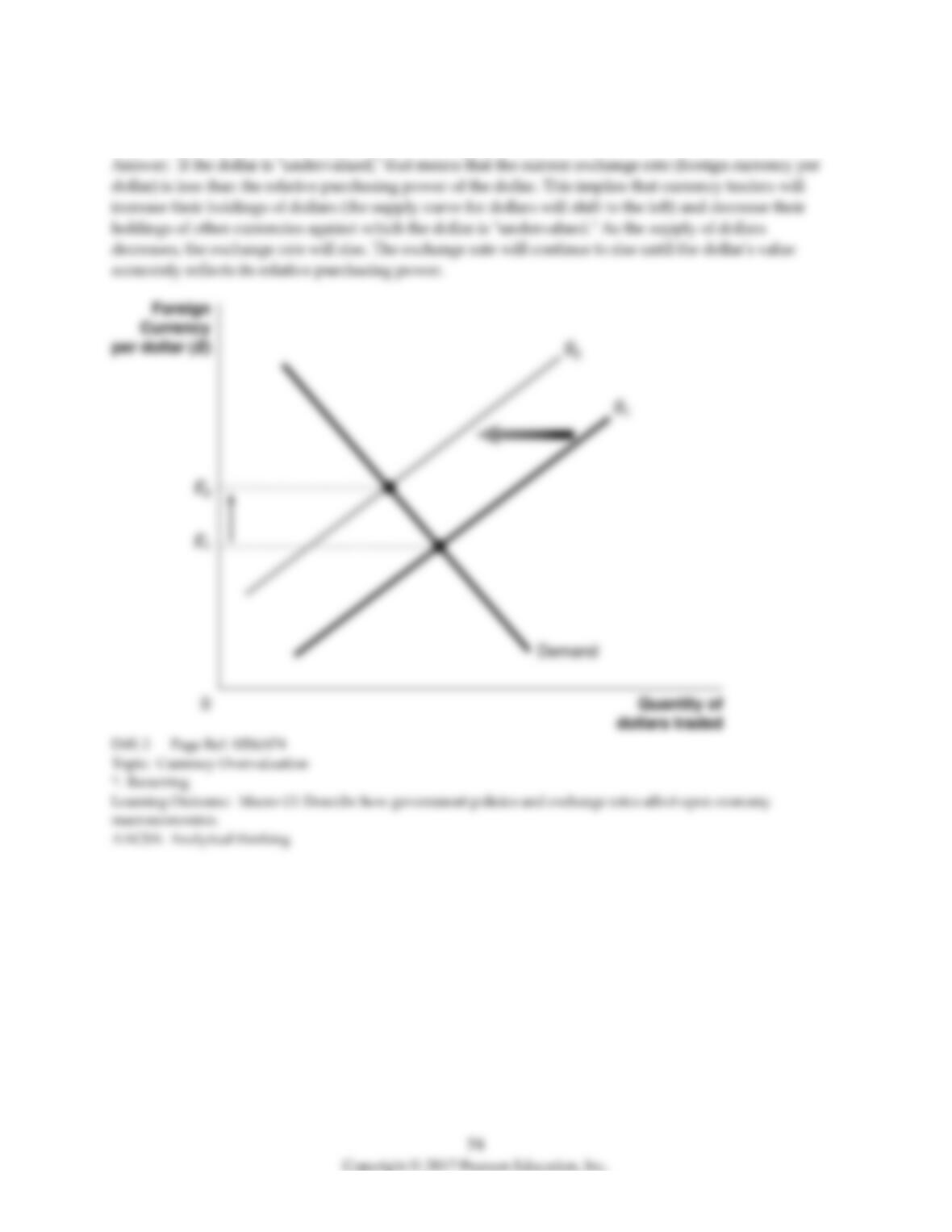
151) What do reports that the dollar is “overvalued” mean? How will foreign exchange markets
respond to this information? Support your answer graphically.
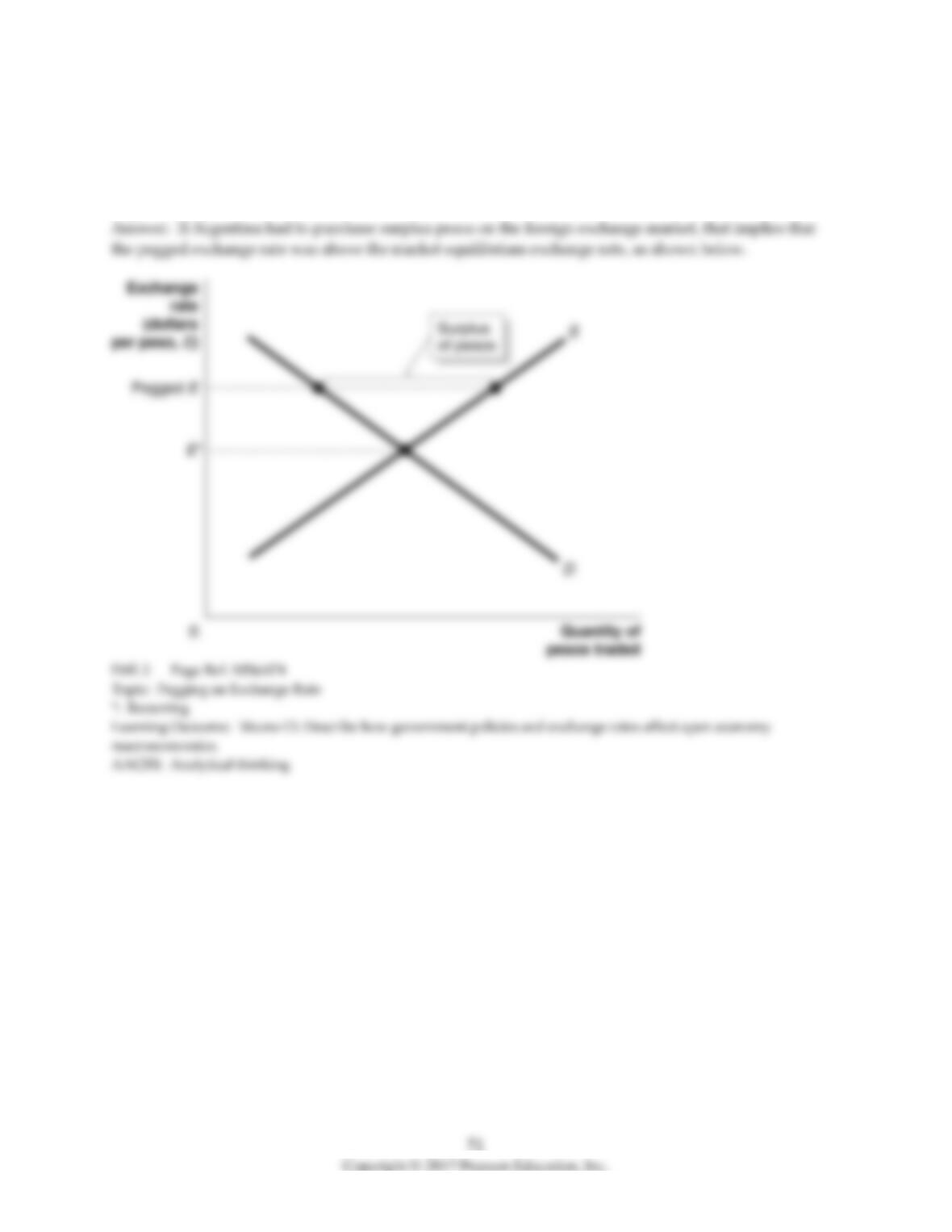
152) In 1991, Argentina decided to peg its currency (the Argentinean peso) to the U.S. dollar. To
maintain the peg, Argentina had to purchase surplus pesos on the foreign exchange market, depleting
its reserves of dollars to such an extent that it eventually had to abandon the peg. Show graphically
what this implies about the peg relative to the equilibrium exchange rate in the market for the
Argentinean peso.
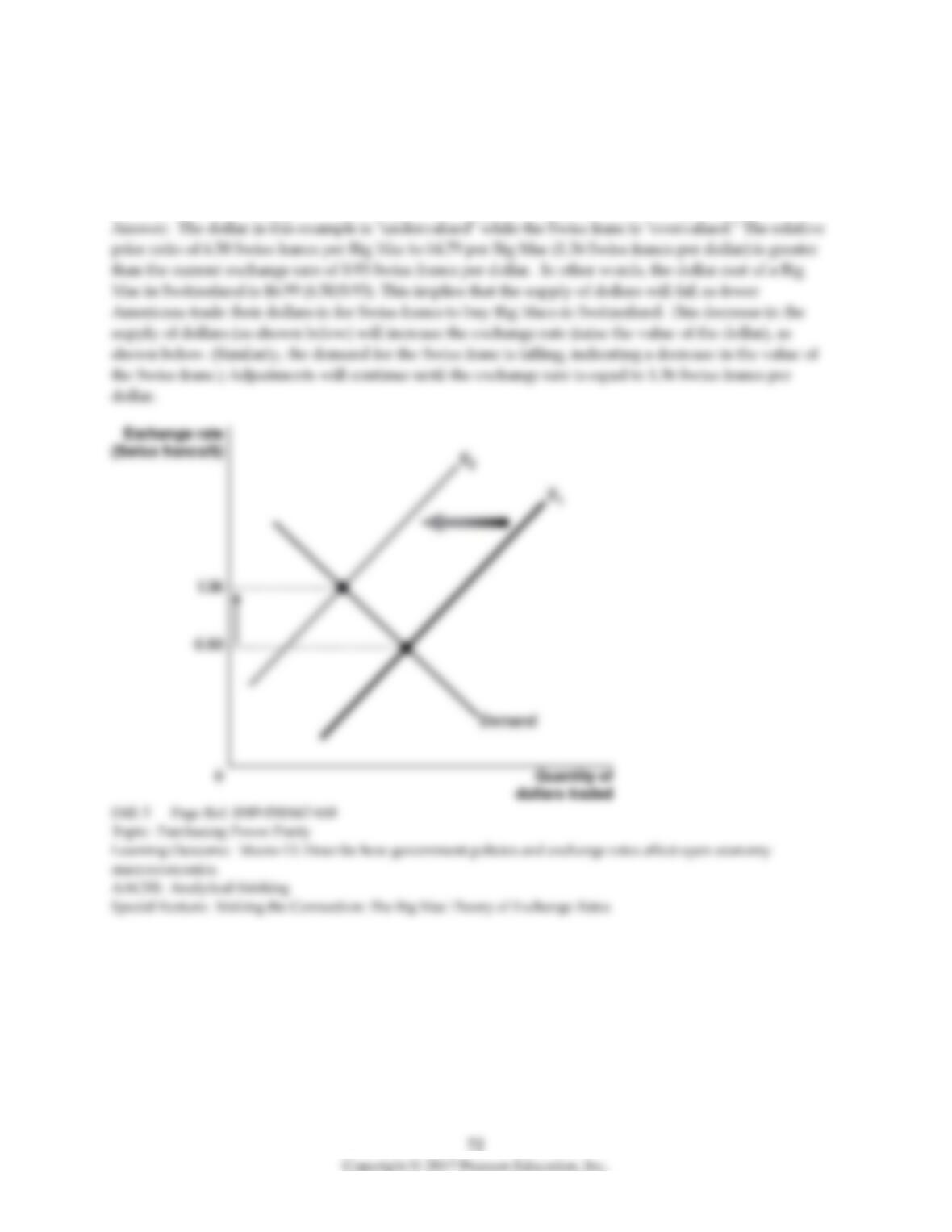
153) The “Big Mac Theory of Exchange Rates” tests the accuracy of purchasing power parity theory. In
July 2015, The Economist reported that the average price of a Big Mac in the United States was $4.79. In
Switzerland, the average price of a Big Mac at that time was 6.50 Swiss francs. If the exchange rate
between the dollar and the Swiss franc was 0.93 Swiss francs per dollar, how would purchasing power
parity predict the exchange rate will change in the long run? Support your answer graphically.
73
154) The “Big Mac Theory of Exchange Rates” tests the accuracy of purchasing power parity theory. In
July 2015, The Economist reported that the average price of a Big Mac in the United States was $4.79. In
Switzerland, the average price of a Big Mac at that time was 6.50 Swiss francs. If the exchange rate
between the dollar and the Swiss franc was 0.93 Swiss francs per dollar, explain how it would be
profitable to buy Big Macs in the United States instead of in Switzerland.
155) What do reports that the dollar is “undervalued” mean? How will foreign exchange markets
respond to this information? Support your answer graphically.
Table 19-1
Country
Big Mac Price
Implied
Exchange Rate
Actual Exchange Rate
Denmark
34.59 kroner
6.81 kroner per dollar
Peru
10.0 new sols
3.18 new sols per dollar
Sweden
43.7 kronor
8.52 kronor per dollar
Turkey
10.25 lire
2.65 lire per dollar
Source: “The Big Mac Index,” Economist, July 16, 2015.
156) Refer to Table 19-1. Fill in the missing values in the above table. Assume the Big Mac is selling for
$4.79 in the United States. Explain whether the U.S. dollar is overvalued or undervalued relative to each
of the other currencies and predict what will happen in the future to each exchange rate.
Denmark
34.59 kroner
7.22 kroner per dollar
6.81 kroner per dollar
Peru
10.0 new sols
2.09 sols per dollar
3.18 new sols per dollar
Sweden
43.7 kronor
9.12 kronor per dollar
8.52 kronor per dollar
Turkey
10.25 lire
2.14 lire per dollar
2.65 lire per dollar
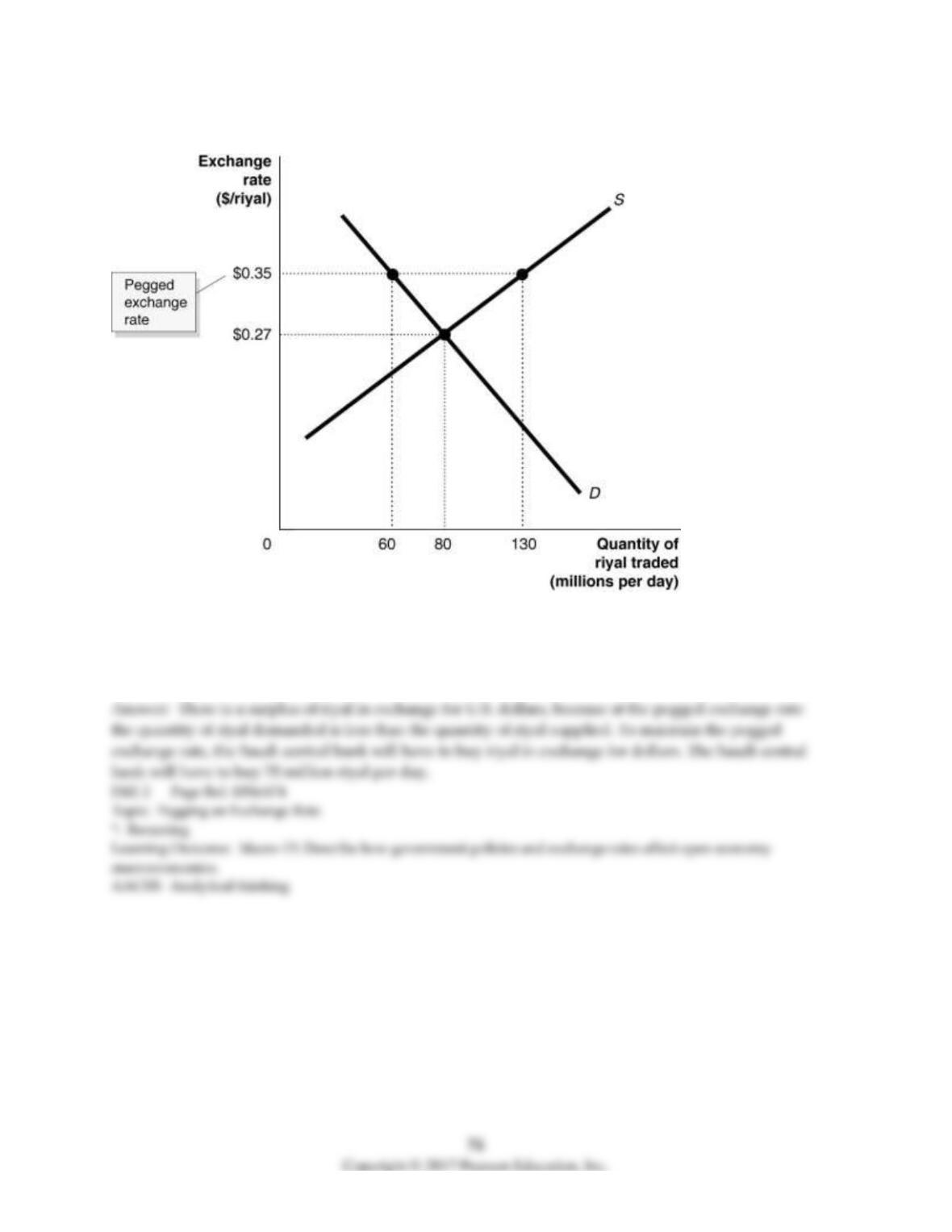
Figure 19-9
157) Refer to Figure 19-9. According to the graph, is there a surplus or shortage of Saudi Arabian riyal in
exchange for U.S. dollars? To maintain the pegged exchange rate, will the Saudi central bank need to
buy riyal in exchange for dollars or sell riyal in exchange for dollars? How many riyal will the Saudi
central bank need to buy or sell?
19.3 International Capital Markets
1) In 2014, foreign purchases of U.S. corporate stocks and bonds
A) doubled.
B) fell.
C) grew at a faster pace than foreign investment in U.S. government bonds.
D) grew at a faster pace than foreign investment in U.S. corporate bonds.
2) Shares of stock and long-term debt, including corporate and government bonds and bank loans, are
bought and sold on
A) the stock market.
B) capital markets.
C) foreign exchange markets.
D) commodity markets.
3) Investors in which two countries accounted for about 25 percent of all foreign purchases of U.S.
stocks and bonds in 2015?
A) Canada and the Cayman Islands
B) Japan and China
C) China and Canada
D) Japan and the United Kingdom
4) If interest rates in the United States rise,
A) the value of the dollar will fall as foreign investors sell their U.S. investments.
B) the value of the dollar will rise as the foreign investors increase their holdings of U.S. investments.
C) the value of the dollar will fall as foreign investors increase their holdings of U.S. investments.
D) the value of the dollar will rise as foreign investors sell their U.S. investments.
5) The three most important international financial centers today are
A) New York, Los Angeles, and London.
B) London, Tokyo, and Beijing.
C) San Francisco, Paris, and Mexico City.
D) Tokyo, London, and New York.
6) Before 1980, most U.S. corporations raised funds
A) in U.S. and foreign banks.
B) in U.S. stock and bond markets or in U.S. banks.
C) in U.S. stock and bond markets or in foreign capital markets.
D) in U.S. banks or in foreign capital markets.
7) If interest rates in the United States fall,
A) the value of the dollar will fall as foreign investors decrease their holdings of U.S. investments.
B) the value of the dollar will rise as foreign investors increase their holdings of U.S. investments.
C) the value of the dollar will fall as foreign investors increase their holdings of U.S. investments.
D) the value of the dollar will rise as foreign investors decrease their holdings of U.S. investments.