1. Nations trade what they produce in excess of their own consumption to:
a.
generate jobs for the domestic economy.
b.
earn “good will” from the World Bank.
c.
prevent chronic surpluses from driving down domestic prices.
d.
acquire other things they want to consume.
e.
reduce the size of their foreign trade deficit.
2. The theory of comparative advantage is based on:
a.
absolute opportunity costs.
b.
relative opportunity costs.
c.
total costs of production.
d.
total costs, including transportation costs.
e.
a comparison of marginal cost with average variable costs.
b
MACR.BOYE.16.96 – ch. 19, 1
Knowledge
3. Whether exchange is between individuals, firms, or countries, voluntary trade occurs because:
a.
only one party is made better off.
b.
both parties are made better off.
c.
financial agents devote resources to arranging such trades.
d.
these trades create employment for the economy.
e.
of mandates from the government.
b
MACR.BOYE.16.96 – ch. 19, 1
Knowledge
4. Which of the following countries receives the largest share of U.S. exports?
a.
Mexico
d
MACR.BOYE.16.96 – ch. 19, 1
Knowledge
b.
Germany
c.
Japan
d.
Canada
e.
United Kingdom
5. Which of the following counties are largely dependent on trade with the United States?
a.
China and Japan
b.
U.K. and Germany
c.
Canada and Mexico
d.
France and Belgium
e.
Canada and U.K
Easy
MACR.BOYE.16.96 – ch. 19, 1
Knowledge
6. Countries tend to export different goods and services because of:
a.
differences in their comparative advantages.
b.
differences in tastes and technological needs.
c.
differences in income.
d.
similarities in resource endowment.
e.
differences in the exchange rates.
Easy
MACR.BOYE.16.96 – ch. 19, 1
Knowledge
7. The most heavily traded category of goods in the world is:
a.
office and telecom equipment.
b.
chemicals.
c.
iron and steel.
d
Easy
MACR.BOYE.16.96 – ch. 19, 1
Knowledge
d.
textiles.
e.
crude petroleum.
8. Which of the following factors are least likely to affect what countries end up trading in the international market?
a.
International trade tariffs
b.
Government debt levels
c.
Comparative advantages
d.
Differences in tastes
e.
Different technological needs
Moderate
MACR.BOYE.16.96 – ch. 19, 1
9. Which of the following lists gives world exports in the order of their value, from highest to lowest?
a.
Aircraft, motor vehicle parts, crude petroleum
b.
Aircraft, crude petroleum, motor vehicle parts
c.
Crude petroleum, office and telecom equipments, automotive parts
d.
Motor vehicle parts, aircraft, crude petroleum
e.
Motor vehicle parts, crude petroleum, aircraft
Easy
MACR.BOYE.16.96 – ch. 19, 1
Knowledge
10. “Most textiles worn by American consumers are produced in Asian and South American countries where the
opportunity costs of production are lower.” This observation refers to the:
a.
law of supply.
b.
income elasticity of demand.
c.
principle of beneficial tariffs.
d.
principle of comparative advantage.
Easy
MACR.BOYE.16.96 – ch. 19, 1
e.
law of decreasing returns to scale.
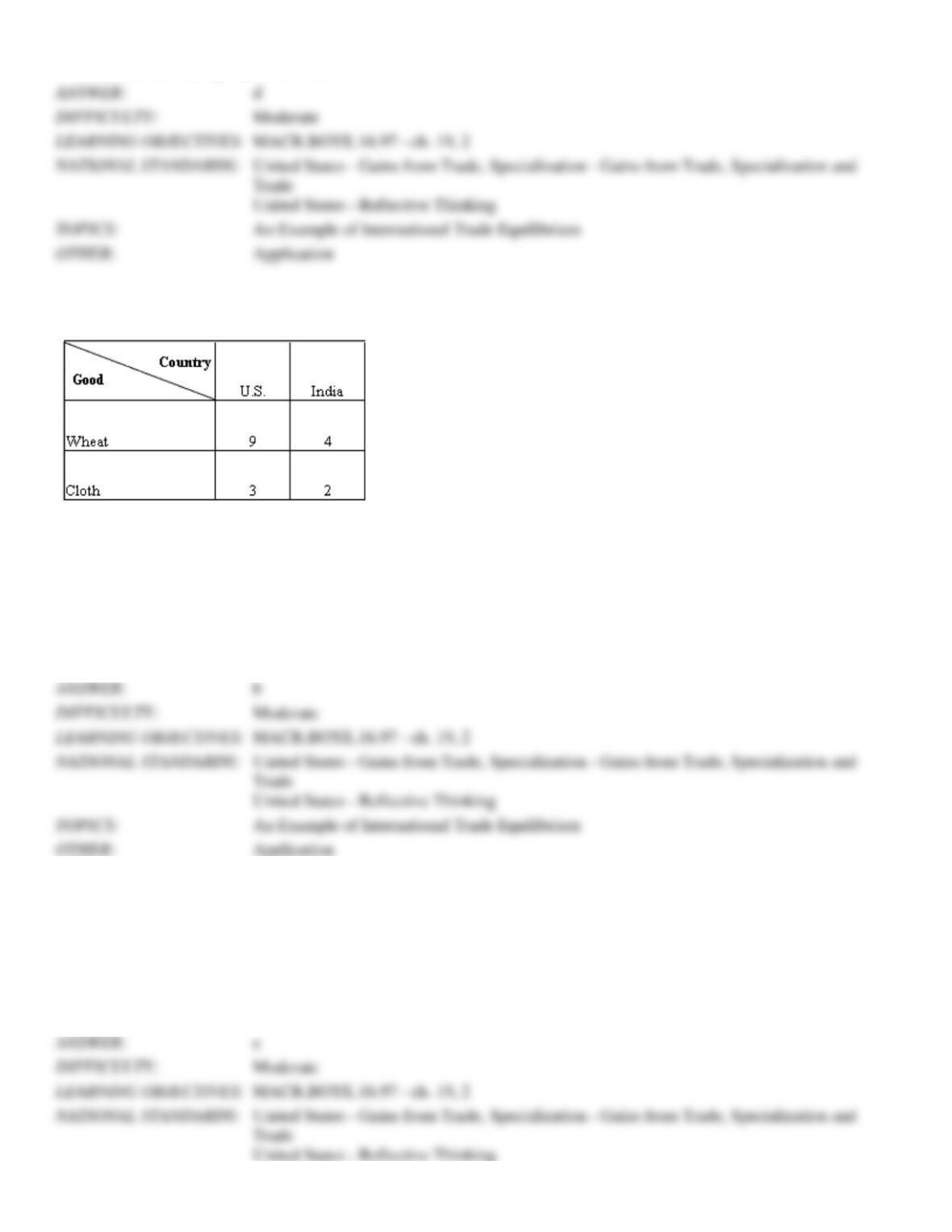
The table below shows units of wheat and cloth produced by each worker per day in both the countries.
Table 20.1
11. Refer to Table 20.1. Which of the following assumptions holds true for the example?
a.
The goods are produced by using different factors of production
b.
Labor productivity alone determines the comparative advantage
c.
Each of the countries will produce and export wheat and cloth
d.
Both the countries have identical factor endowments
e.
The taste and preference of the consumers are dissimilar in the two countries
MACR.BOYE.16.97 – ch. 19, 2
United States – Reflective Thinking
12. Refer to Table 20.1. Which of the following statements is true?
a.
India has an absolute advantage in the production of cloth.
b.
India has an absolute advantage in the production of both wheat and cloth.
c.
The U.S. has an absolute advantage in the production of wheat but not cloth.
d.
The U.S. has an absolute advantage the production of cloth but not wheat.
e.
The U.S. has an absolute advantage in the production of both wheat and cloth.
MACR.BOYE.16.97 – ch. 19, 2
MACR.BOYE.16.97 – ch. 19, 2
13. According to Table 20.1, the opportunity cost of producing wheat in India equals:
a.
half a unit of cloth.
b.
one-third of a unit of cloth.
c.
2 units of cloth.
d.
4 units of cloth.
e.
one-fourth of a unit of cloth.
MACR.BOYE.16.97 – ch. 19, 2
United States – Reflective Thinking
14. Which of the following can be inferred from the information provided in Table 20.1?
a.
India has a comparative advantage in the production of wheat.
b.
India has a comparative advantage in the production of both wheat and cloth.
c.
It will be beneficial for the U.S. to produce and export wheat.
d.
India will be better off by producing and exporting cloth.
e.
The U.S. has a comparative advantage in the production of both wheat and cloth.
MACR.BOYE.16.97 – ch. 19, 2
15. Refer to Table 20.1. Assume that the U.S. has only two workers and the terms of trade are 2 bushels of wheat per rack
of clothing. What would be the gains from trade for the U.S. if it is producing according to its comparative advantage?
a.
2 racks of clothing
b.
2.5 racks of clothing
c.
1.5 racks of clothing
d.
3 racks of clothing
e.
1 rack of clothing
MACR.BOYE.16.97 – ch. 19, 2
16. According to Table 20.1, the opportunity cost of producing wheat in the U.S. equals:
a.
half a unit of cloth.
b.
one-third of a unit of cloth.
c.
one-fourth of a unit of cloth.
d.
4 units of cloth.
e.
8 units of cloth
MACR.BOYE.16.97 – ch. 19, 2
17. According to Table 20.1, the opportunity cost of producing cloth in the U.S. equals:
a.
2 units of wheat.
b.
half a unit of wheat.
c.
3 units of wheat.
d.
one-third of a unit of wheat.
e.
6 units of wheat.
MACR.BOYE.16.97 – ch. 19, 2
18. A country can benefit by indulging in international trade when:
a.
it produces a good in which it has absolute disadvantage.
b.
it produces a good in which its trading partner has an absolute advantage.
c.
it produces a good in which it has comparative advantage.
d.
it produces all the goods which are supported by its resources.
e.
it produces nothing and merely depends on foreign imports.
MACR.BOYE.16.97 – ch. 19, 2
19. A country has a comparative advantage when the opportunity cost of producing a good in terms of:
a.
the monetary value of other forgone goods is lower than that of other nations.
b.
the monetary value of other forgone goods is greater than that of other nations.
c.
forgone output of other goods is higher than that of other nations.
d.
forgone output of other goods is lower than that of other nations.
e.
forgone output of other goods is equal to that of other nations.
20. Between two countries, comparative advantage is found by comparing the:
a.
relative costs of production in each country.
b.
absolute costs of production in each country after accounting for inflation.
c.
labor hours required to produce a bundle of products in each country.
d.
level of interest rates in each country.
e.
shipping and transportation costs of each country.
MACR.BOYE.16.97 – ch. 19, 2
21. For purposes of determining comparative advantage, the cost of producing a good in each of two countries is
measured in terms of:
a.
metric units only.
b.
opportunity costs.
c.
total costs.
d.
the currency of the importing country.
e.
the currency of the exporting country.
MACR.BOYE.16.97 – ch. 19, 2
22. The difference between absolute and comparative advantage is that:
MACR.BOYE.16.97 – ch. 19, 2
a.
absolute advantage refers to input cost, while comparative advantage refers to opportunity cost.
b.
absolute advantage refers to opportunity cost, while comparative advantage refers to input cost.
c.
absolute advantage refers to individuals, and comparative advantage refers to countries.
d.
absolute advantage refers to countries, and comparative advantage refers to individuals.
e.
absolute advantage is applicable to intranational trade, while comparative advantage applies to international
trade.
23. Countries import goods in which they have:
a.
an absolute advantage.
b.
a comparative advantage.
c.
a reputation for good product quality.
d.
a comparative disadvantage.
e.
a surplus domestic production.
MACR.BOYE.16.97 – ch. 19, 2
24. We benefit from trade if we are able to obtain a good from a foreign country:
a.
that has a very low domestic demand.
b.
the production of which requires a steady supply of unskilled labor.
c.
by giving up less of other goods than we would have to give up to obtain the good at home.
d.
by giving up more of other goods than we would have to give up to obtain the good at home.
e.
that has a substantial number of substitutes in the domestic market.
MACR.BOYE.16.97 – ch. 19, 2
United States – Gains from Trade, Specialization – Gains from Trade, Specialization and
Trade
25. If Japan has a comparative advantage over Canada in the production of computers, which of the following must be
true?
MACR.BOYE.16.97 – ch. 19, 2
Trade
a.
Supply of unskilled labor in Japan is higher than that in Canada.
b.
Japan incurs a lower input cost in the production of computers.
c.
Japan incurs a higher input cost in the production of computers.
d.
Japan has a lower opportunity cost in the production of computers.
e.
Japan has a higher opportunity cost in the production of computers.
Scenario 20.1
Suppose labor productivity differences are the only determinants of comparative advantage, and Brazil and Chile both
produce only coffee and sugar. In Chile, either 5 units of coffee or 2 units of sugar can be produced in one day. In Brazil,
a day of labor produces either 2 units of coffee or 1 unit of sugar.
26. Refer to Scenario 20.1. Which of the following statements is true?
a.
Brazil has an absolute advantage in producing only coffee.
b.
Brazil has an absolute advantage in producing only sugar.
c.
Chile has an absolute advantage in the production of both coffee and sugar.
d.
Chile has an absolute advantage in producing only coffee.
e.
Brazil has an absolute advantage in the production of both coffee and sugar.
MACR.BOYE.16.97 – ch. 19, 2
27. Refer to Scenario 20.1. Which of the following statements is true?
a.
Brazil has a comparative advantage in producing coffee.
b.
Brazil has a comparative advantage in producing both coffee and sugar.
c.
Chile has a comparative advantage in producing both coffee and sugar.
d.
Neither Chile nor Brazil has a comparative advantage in producing coffee.
e.
Brazil has a comparative advantage in producing sugar.
MACR.BOYE.16.97 – ch. 19, 2
Trade
United States – Reflective Thinking
MACR.BOYE.16.97 – ch. 19, 2
United States – Gains from Trade, Specialization – Gains from Trade, Specialization and
Trade
28. Refer to Scenario 20.1. Calculate the opportunity cost of producing sugar in Brazil.
a.
Half a pound of coffee
b.
4 pounds of coffee
c.
1 pound of coffee
d.
2 pounds of coffee
e.
One and a half pounds of coffee
29. Refer to Scenario 20.1. What is the opportunity cost of producing coffee in Chile?
a.
Half a pound of sugar
b.
Two-fifth of a pound of sugar
c.
2 pounds of sugar
d.
One-third of a pound of sugar
e.
4 pounds of sugar
MACR.BOYE.16.97 – ch. 19, 2
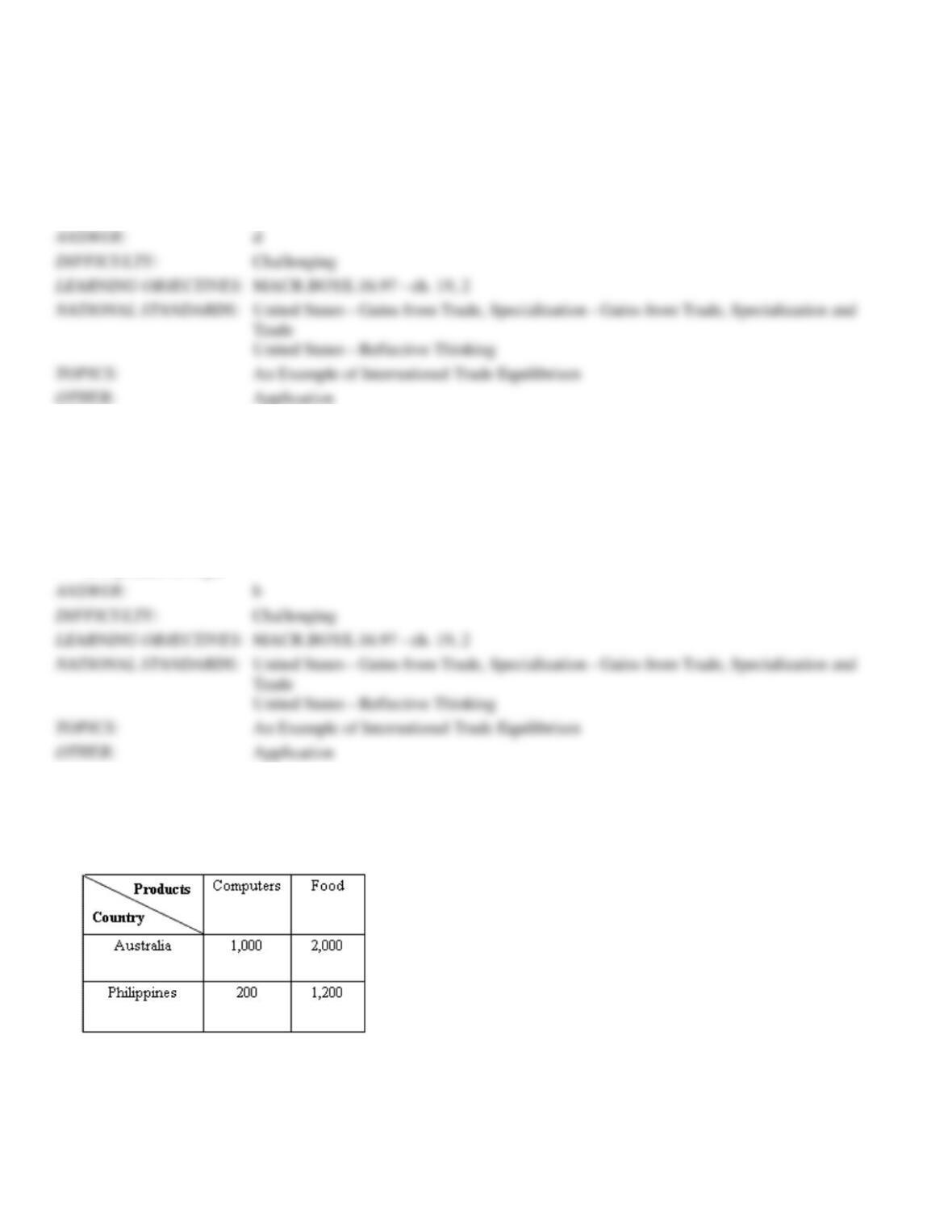
The data in the table below assumes that with the same quantity of resources, both Australia and Philippines produces
food and computers. Australia can make 1,000 computers or 2,000 units of food in a day, and the Philippines can make
200 computers or 1,200 units of food in a day.
Table 20.2
30. According to Table 20.2, Australia has an:
a.
absolute advantage in the production of only food.
b.
absolute advantage in the production of both food and computers.
c.
absolute disadvantage in the production of both food and computers.
MACR.BOYE.16.97 – ch. 19, 2
d.
absolute advantage in the production of only computers.
e.
absolute disadvantage in the production of food.
31. According to Table 20.2, Philippines has an:
a.
absolute advantage in the production of both food and computers.
b.
absolute advantage in the production of only food.
c.
absolute advantage in the production of only computers.
d.
absolute disadvantage in the production of only food.
e.
absolute disadvantage in the production of both food and computers.
MACR.BOYE.16.97 – ch. 19, 2
32. According to Table 20.2, what is the opportunity cost of 1 computer in Australia?
a.
half a unit of food
b.
one-sixth of a unit of food
c.
1 unit of food
d.
6 units of food
e.
2 units of food
MACR.BOYE.16.97 – ch. 19, 2
33. According to Table 20.2, what is the opportunity cost of 1 unit of food in Australia?
a.
Half a unit of computer
b.
6 computers
c.
2 computers
d.
One-sixth of a unit of computers
e.
1 computer
MACR.BOYE.16.97 – ch. 19, 2
United States – Reflective Thinking
34. According to Table 20.2, what is the opportunity cost of 1 computer in the Philippines?
a.
6 units of food
b.
Three-fifths of a unit of food
c.
One-sixth of a unit of food
d.
2 units of food
e.
1 unit of food
MACR.BOYE.16.97 – ch. 19, 2
Trade
United States – Reflective Thinking
35. According to Table 20.2, Australia has:
a.
a comparative disadvantage in the production of both food and computers.
b.
a comparative advantage in the production of computers.
c.
a comparative disadvantage in the production of computers.
d.
a comparative advantage in the production of food.
e.
a comparative advantage in the production of both food and computers.
MACR.BOYE.16.97 – ch. 19, 2
Trade
United States – Reflective Thinking
The following table shows the units of calculators and rice produced by a laborer in a day in Japan and Korea.
Table 20.3
MACR.BOYE.16.97 – ch. 19, 2
Trade
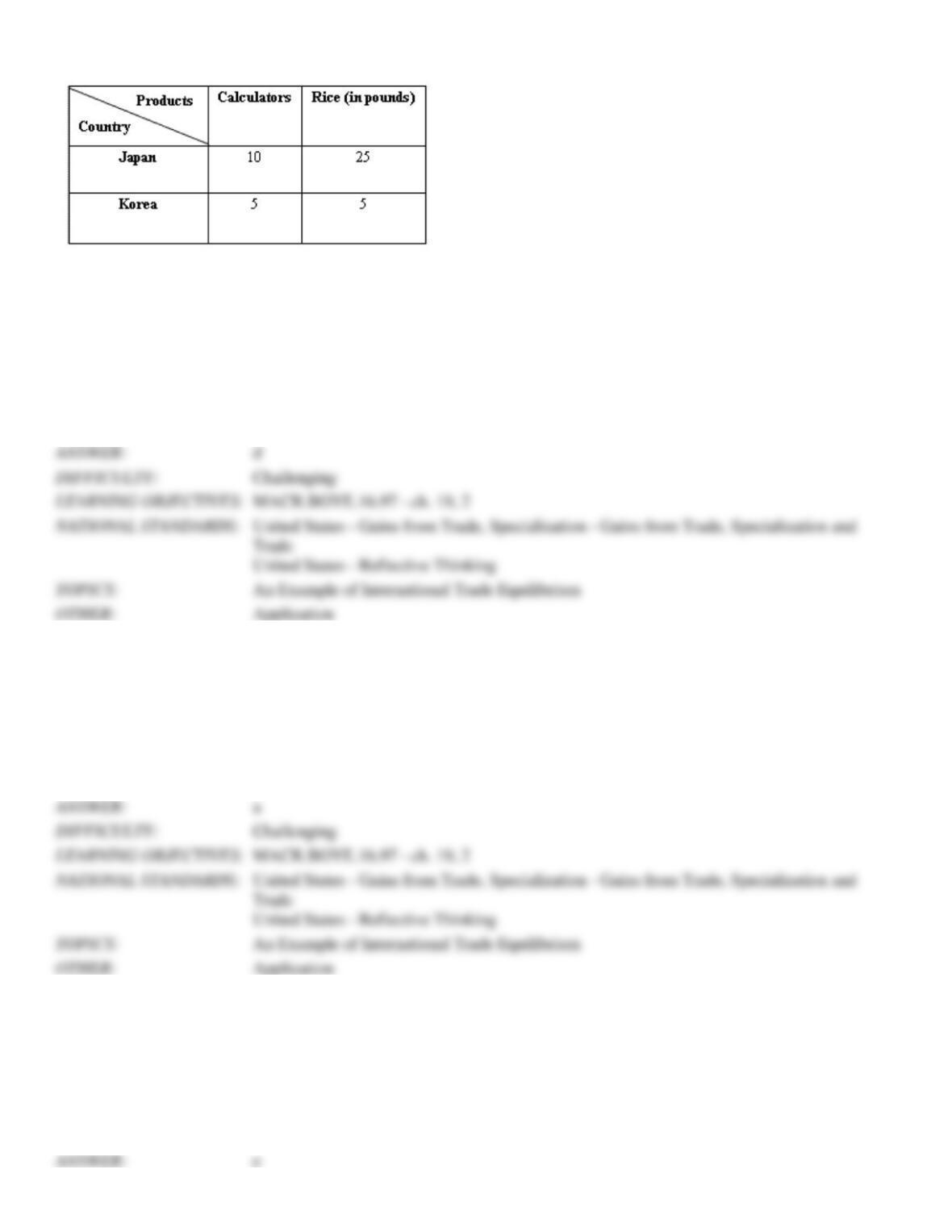
36. Refer to Table 20.3. What is the least amount Japan is willing to accept for 1 calculator?
a.
1 pound of rice
b.
5 pounds of rice
c.
2 pounds of rice
d.
2.5 pounds of rice
e.
Half a pound of rice
37. According to Table 20.3, what is the greatest amount Korea is willing to pay for 1 calculator?
a.
1 pound of rice
b.
5 pounds of rice
c.
2 pounds of rice
d.
2.5 pounds of rice
e.
Half a pound of rice
MACR.BOYE.16.97 – ch. 19, 2
United States – Reflective Thinking
38. Refer to Table 20.3. Determine the limits on the terms of trade for 1 pound of rice.
a.
Between 5 calculators and 10 calculators
b.
Between 1 calculator and 5 calculators
c.
Between 1 calculator and 10 calculators
d.
Between 1 calculator and 2 calculators
e.
Between two-fifths of a calculator and 1 calculator
MACR.BOYE.16.97 – ch. 19, 2
United States – Reflective Thinking
39. The terms of trade is defined as:
a.
the quantity of inputs sacrificed to produce each unit of a good.
b.
the quantity of one good that is exchanged for a quantity of another good.
c.
the ratio of the total cost of production of individual traders.
d.
the marginal cost of producing one good as a percentage of the marginal cost of another good.
e.
the ratio of total exports of a nation to its total production.
MACR.BOYE.16.97 – ch. 19, 2
40. The limits of the terms of trade are determined by the:
a.
distribution costs in each country.
b.
stock of foreign exchange in each country.
c.
average total costs of producing the commodities in each country.
d.
opportunity costs in each country.
e.
currency exchange rate between the trading partners.
MACR.BOYE.16.97 – ch. 19, 2
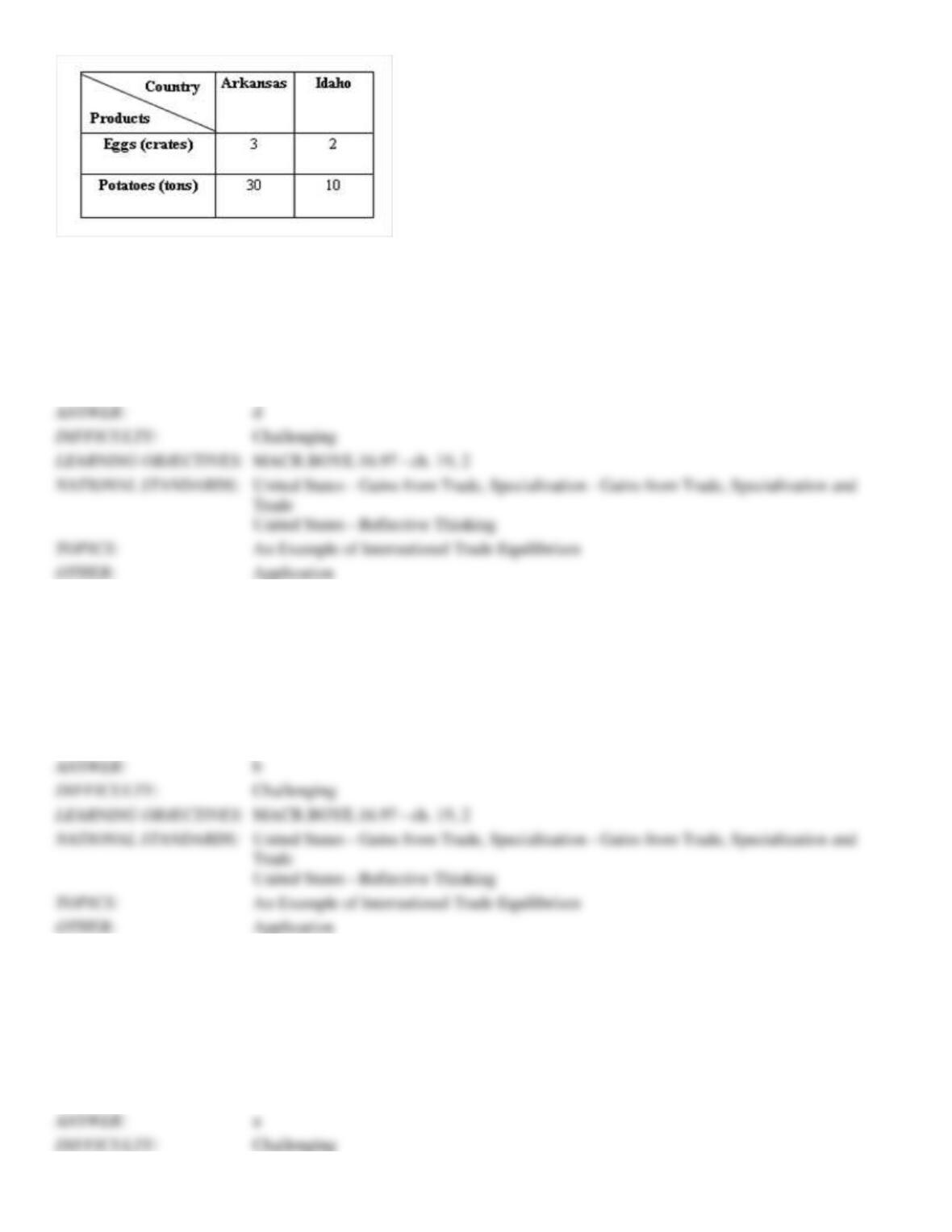
The following table shows that in one day poultry farmers in Arkansas can produce 3 cartons of eggs, while poultry
farmers in Idaho can produce 2 cartons of eggs. It takes Arkansas potato farmers one day to produce 30 tons of potatoes,
while Idaho potato farmers produce 10 tons of potatoes in that same time.
Table 20.4
MACR.BOYE.16.97 – ch. 19, 2
United States – Gains from Trade, Specialization – Gains from Trade, Specialization and
41. According to Table 20.4, what is the opportunity cost of 1 crate of eggs in Idaho?
a.
2 tons of potatoes
b.
One-fifth of a ton of potatoes
c.
10 tons of potatoes
d.
5 tons of potatoes
e.
One-tenth of a ton of potatoes
42. Refer to Table 20.4. Producing 1 more crate of eggs would require Arkansas to:
a.
give up one-fifth of a ton of potatoes.
b.
give up 10 tons of potatoes.
c.
give up 5 tons of potatoes.
d.
give up one-tenth of a ton of potatoes.
e.
2 tons of potatoes.
MACR.BOYE.16.97 – ch. 19, 2
43. According to Table 20.4, the limits to the terms of trade in eggs are 1 carton of eggs in exchange for:
a.
between 5 and 10 tons of potatoes.
b.
between 2 tons and 10 tons of potatoes.
c.
between 10 tons and 30 tons of potatoes.
d.
between one-fifth and one-tenth of a ton of potatoes.
e.
between 1 and 10 tons of potatoes.
MACR.BOYE.16.97 – ch. 19, 2
44. According to Table 20.4, the limits to the terms of trade in potatoes are 1 ton of potatoes in exchange for:
a.
between 5 and 10 cartons of eggs.
b.
between 1 and 10 cartons of eggs.
c.
between one-tenth and one-fifth of a carton of eggs.
d.
between one-fourth and half a carton of eggs.
e.
between 2 and 10 cartons of eggs.
MACR.BOYE.16.97 – ch. 19, 2
Scenario 20.2
Suppose labor productivity differences are the only determinants of comparative advantage, and both Egypt and produce
only corn and cocoa. In Egypt, 10 bushels of corn or 15 pounds of cocoa can be produced in a day. In Ghana, one day of
labor can be used to produce either 2 bushels of corn or 8 pounds of cocoa.
45. Based on Scenario 20.2, which of the following terms of trade would benefit both countries?
a.
1 pound of cocoa is equal to 0.10 bushels of corn
b.
1 pound of cocoa is equal to 2 bushels of corn
c.
1 pound of cocoa is equal to 1 bushels of corn
d.
1 pound of cocoa is equal to 0.5 bushels of corn
e.
1 pound of cocoa is equal to 1.5 bushels of corn
MACR.BOYE.16.97 – ch. 19, 2
46. Refer to Scenario 20.2. Egypt will be willing to trade corn for cocoa if in the international market 1 bushel of corn can
be exchanged for:
a.
more than 1 pound of cocoa.
b.
less than 1 pound of cocoa.
c.
more than 1.5 pounds of cocoa.
d.
less than two-third of a pound of cocoa.
MACR.BOYE.16.97 – ch. 19, 2
United States – Gains from Trade, Specialization – Gains from Trade, Specialization and
e.
more than half a pound of cocoa.
47. Refer to Scenario 20.2. Ghana will be willing to trade cocoa for Egyptian corn if in the international market, 1 pound
of cocoa can be exchanged for:
a.
more than one-eighth of a bushel of corn.
b.
less than one-sixth of a bushel of corn.
c.
more than one-fourth of a bushel of corn.
d.
less than one-fifth of a bushel of corn.
e.
more than one-tenth of a bushel of corn.
MACR.BOYE.16.97 – ch. 19, 2
48. Suppose France can produce 9,000 potatoes or 3,000 lemons per day, and that Italy can produce 3,000 potatoes or
3,000 lemons per day. Which of the following statements in this context is true?
a.
France has an absolute advantage in producing lemons.
b.
Italy has a comparative advantage in producing potatoes.
c.
Italy would be willing to trade one lemon for anything greater than one potato.
d.
Both countries would be willing to trade at a rate of one lemon for one potato.
e.
France has a comparative advantage in producing lemons.
MACR.BOYE.16.97 – ch. 19, 2
49. What is known as the Dutch disease?
a.
The problem that arises when a government cannot meet its foreign debts
b.
The phenomenon of a boom in one industry causing declines in the rest of the economy
c.
A sudden and unexpected devaluation of a currency as a consequence of policy controls
d.
The problem that arises when high imports force an economy to borrow from external sources
MACR.BOYE.16.97 – ch. 19, 2
e.
A deficit in the balance of payments of the economy that arises due to a sudden appreciation of the domestic
currency.
50. The Dutch Disease had occurred in Netherlands because:
a.
the Netherlands government had borrowed heavily from the World Bank to meet its Balance of Payment
deficits.
b.
the price of the primary commodities declined in the international market.
c.
the demand for natural gas exports from Netherlands increased substantially.
d.
the currency of Netherlands depreciated in the international market.
e.
the price of the commodities manufactured by Netherlands declined in the international market.
MACR.BOYE.16.97 – ch. 19, 2
United States – Gains from Trade, Specialization – Gains from Trade, Specialization and
Global Business Insight – The Dutch Disease
51. The proportion of domestic demand for a good that is satisfied by domestic production relative to that supplied by
imports is determined by:
a.
the interplay of domestic demand and supply curves and the domestic equilibrium price of the good.
b.
the interplay of demand and supply curves in the international market and the international equilibrium price
of a good.
c.
domestic supply and demand curves and the international equilibrium price of a good.
d.
the different trade restrictions like tariffs and quotas created by the domestic government.
e.
the interplay of demand and supply curves in the international market and the domestic price of the good
MACR.BOYE.16.97 – ch. 19, 2
United States – Gains from Trade, Specialization – Gains from Trade, Specialization and
The first panel in the following figure shows the domestic demand (D) and supply (S) curves of Columbian coffee and the
second panel shows the import demand and export supply of Columbian coffee in the international market.
Figure 20.1
MACR.BOYE.16.97 – ch. 19, 2
United States – Gains from Trade, Specialization – Gains from Trade, Specialization and
Global Business Insight – The Dutch Disease
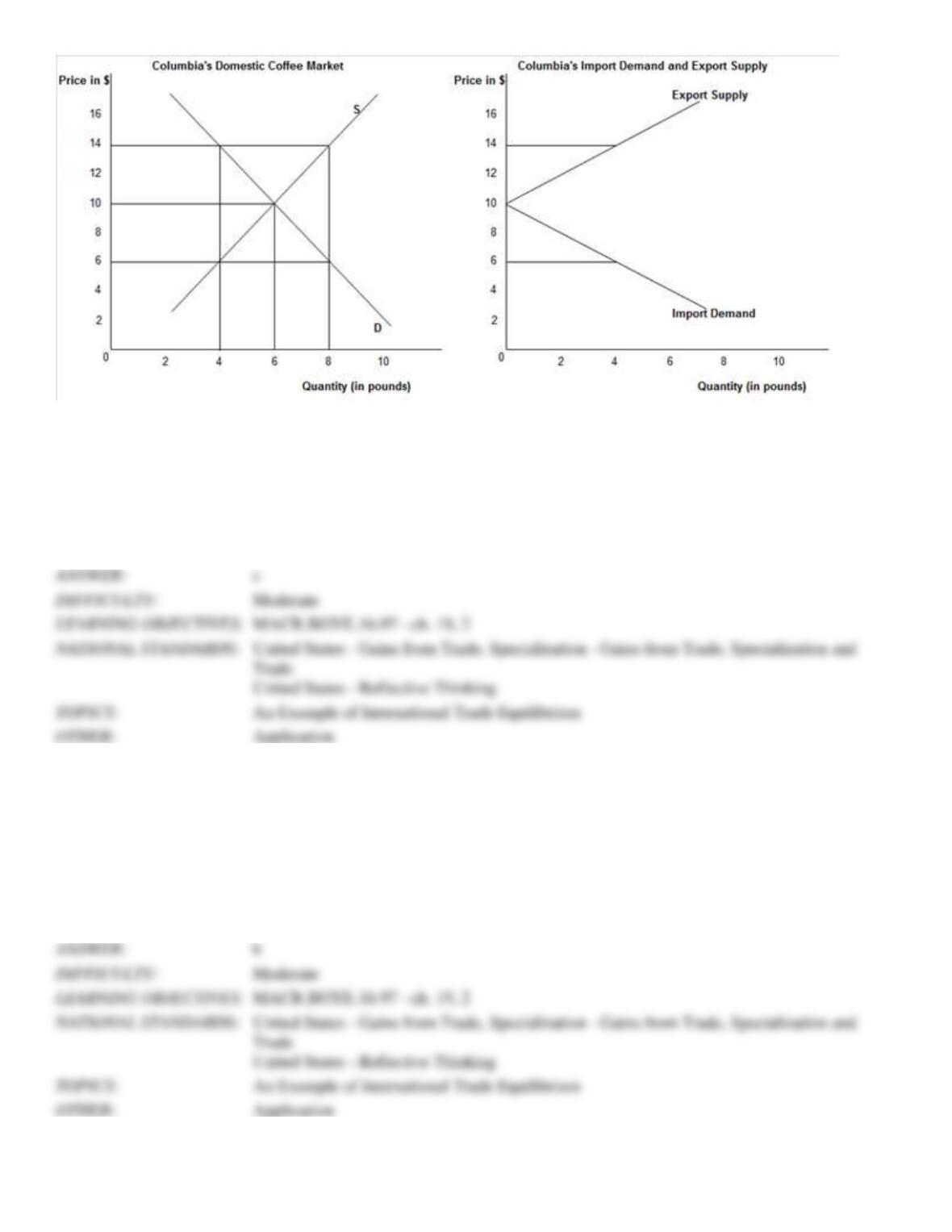
52. Refer to Figure 20.1. The autarky equilibrium price of coffee in Columbia is:
a.
$16.
b.
$8.
c.
$10.
d.
$12.
e.
$14.
53. Refer to Figure 20.1. If the price of Columbian coffee in the international market is $10, Columbia will export _____
pound(s) of coffee.
a.
two
b.
zero
c.
six
d.
eight
e.
ten
b
Moderate
MACR.BOYE.16.97 – ch. 19, 2
United States – Reflective Thinking
54. Refer to Figure 20.1. If the price of coffee in the international market is $14:
Moderate
MACR.BOYE.16.97 – ch. 19, 2
Application