122) If the absolute price elasticity of demand for a product is greater than 1, then
A) the absolute price elasticity of demand is inelastic and consumers are relatively insensitive to
price changes.
B) the absolute price elasticity of demand is inelastic and consumers are relatively sensitive to
price changes.
C) the absolute price elasticity of demand is elastic and consumers are relatively insensitive to
price changes.
D) the absolute price elasticity of demand is elastic and consumers are relatively sensitive to
price changes.
123) If the absolute price elasticity of demand for a product is equal to 1, then
A) the absolute price elasticity of demand is inelastic and consumers are relatively insensitive to
price changes.
B) the absolute price elasticity of demand is inelastic and consumers are relatively sensitive to
price changes.
C) the absolute price elasticity of demand is elastic and consumers are relatively insensitive to
price changes.
D) the absolute price elasticity of demand is unit-elastic and the percentage change in quantity
demanded equals the percentage change in price.
124) Suppose the price change of a good causes no change in quantity demanded, we would say
that the item is
A) perfectly elastic.
B) perfectly inelastic.
C) infinitely elastic.
D) unitary elastic.
125) If demand is elastic and the price of a product decreases by 100 percent, then
A) the change in quantity demanded is less than 100 percent.
B) the change in quantity demanded is equal to 100 percent.
C) the change in quantity demanded is greater than 100 percent.
D) the decrease in quantity demanded is greater than 0 percent.
126) If demand is inelastic and the price of a product decreases by 100 percent, then
A) the change in quantity demanded is less than 100 percent.
B) the change in quantity demanded is equal to 100 percent.
C) the change in quantity demanded is greater than 100 percent.
D) the decrease in quantity demanded is greater than 0 percent.
127) Whenever the absolute value of the price elasticity of demand is greater than 1, but less than
infinite
A) demand is inelastic.
B) demand is unit elastic.
C) demand is elastic.
D) demand is perfectly elastic.
128) A perfectly inelastic demand curve is
A) a horizontal straight line.
B) a vertical straight line.
C) a downward sloping straight line that intersects the horizontal axis at the origin.
D) an upward sloping straight line that crosses the vertical axis.
129) If a 10 percent change in the price of a good caused a 10 percent change in the quantity
demanded of the good, we would say that over this range of prices the good has a(n)
A) elastic demand.
B) inelastic demand.
C) perfectly elastic demand.
D) unit elasticity of demand.
130) When demand is unit elastic, a 7 percent change in the price of the good
A) will cause a change in quantity demanded of less than 7 percent.
B) will cause a change in quantity demanded equal to 7 percent.
C) will cause a change in quantity demanded greater than 7 percent.
D) will not cause any change in quantity demanded.
131) We say that a good has elastic demand whenever the absolute value of the price elasticity of
demand is greater than one. A one percent change in price therefore causes
A) exactly a one percent change in the quantity demanded.
B) a change of less than one percent in the quantity demanded.
C) a greater than one percent change in quantity demanded.
D) a change that cannot be determined based on one percent.
132) Demand is inelastic if
A) a given percentage change in price will result in a less than proportionate percentage change
in the quantity demanded.
B) demand exhibits zero responsiveness to price changes.
C) small price increases will lead to zero quantity demanded.
D) a given percentage change in price will result in a greater than proportionate percentage
change in the quantity demanded.
133) A perfectly inelastic demand would imply what kind of demand curve?
A) horizontal
B) vertical
C) upward sloping
D) downward sloping
134) If ice cream has an absolute price elasticity of demand that is greater than 1, then the
demand for ice cream is
A) elastic.
B) inelastic.
C) perfectly inelastic.
D) unit elastic.
135) The slope of the perfectly inelastic demand curve is ________, the slope of the perfectly
elastic demand curve is ________.
A) undefined, zero
B) one, one
C) zero, undefined
D) one, zero
136) If a good has an absolute price elasticity of 4, the demand for the good is
A) unit elastic.
B) inelastic.
C) perfectly elastic.
D) elastic.
137) If tablets have an absolute price elasticity of 1, the demand for tablets is
A) unit elastic.
B) inelastic.
C) perfectly elastic.
D) elastic.
138) Suppose diamonds have an absolute price elasticity of 0, the demand for the good is
A) unit elastic.
B) inelastic.
C) perfectly inelastic.
D) elastic.
139) A perfectly inelastic demand curve exhibits
A) zero responsiveness to changes in price.
B) zero quantity demanded when there is a slight change in price.
C) a change in quantity demanded that is proportional to the change in price.
D) a change in quantity demanded that is always twenty percent of the change in price.
140) A perfectly elastic demand curve exhibits
A) zero responsiveness to changes in price.
B) that quantity demanded will decrease to zero when there is a slight increase in the price level.
C) a change in quantity demanded that is proportional to the change in price.
D) a change in quantity demanded that is always twenty percent of the change in price.
141) When the price of a textbook is $100, 60 copies are demanded; and when the price of that
textbook goes up to $120, 30 copies are demanded. In the price range between $100 and $120,
the demand for the textbook is
A) elastic.
B) inelastic.
C) unit elastic.
D) perfectly elastic.
142) Which of the following is NOT characteristic of a good with elastic demand?
A) The absolute price elasticity of demand is less than 1.
B) Total revenue decreases if price is increased.
C) Buyers are relatively sensitive to price changes.
D) The percentage change in quantity demanded is greater than the percentage change in price.
143) If demand for a good is perfectly inelastic, then
A) a price increase would cause a fall in quantity demanded.
B) a price increase would cause no change in quantity demanded.
C) a price increase would cause an increase in quantity demanded.
D) a price increase would cause a fall in total revenue.
144) What is the price elasticity of demand? How is the price elasticity of demand calculated?
145) Price elasticity of demand is measured using percentage changes. Why?
146) “The slope of the demand curve gives the elasticity of demand.” Do you agree or disagree?
Why?
147) “Price elasticity measures how many more units of a good that consumers will buy given a
decrease in price.” Do you agree or disagree? Explain.
148) Explain the three possible ranges for price elasticity of demand.
149) What does a perfectly elastic demand curve look like? A perfectly inelastic demand curve?
Explain.
1) When total revenue and price are inversely related, demand is
A) unit-elastic.
B) inelastic.
C) elastic.
D) not related.
2) When total revenue and price are directly related, demand is
A) unit-elastic.
B) inelastic.
C) elastic.
D) not related.
3) When total revenue remain unchanged when there is a change in price, demand is
A) unit-elastic.
B) inelastic.
C) elastic.
D) not related.
4) No matter what the price of orange juice is , Jill spends $20 a week on orange juice. We can
conclude that the absolute value of the price elasticity of demand for orange juice for Jill is
A) greater than 1.
B) equal to 1.
C) less than 1.
D) equal to 0.
5) A firm could lower prices and still increase revenue if
A) demand is elastic.
B) elasticity of demand is equal to unity.
C) demand is inelastic.
D) elasticity of demand is equal to zero.
6) Suppose that the demand for coffee is inelastic. If a coffee shop decided to lower the price of
coffee, total revenue would
A) increase.
B) decrease.
C) stay the same.
D) be maximized.
7) If the price elasticity of demand for pineapples is greater than 1, an increase in pineapple
prices will
A) raise total revenue.
B) lower total revenue.
C) not affect total revenue.
D) either raise or lower total revenue, but it is impossible to determine which.
8) If a seller lowers the price of a product when demand is price inelastic, the seller can expect
revenues to
A) rise.
B) fall.
C) stay the same.
D) either rise or fall, but it is impossible to determine which.
9) If the market price of a product falls and as a result total revenue of firms falls, we can
conclude that
A) demand is elastic in this price range.
B) the product’s price is above the midpoint of its demand curve.
C) demand is inelastic in this price range.
D) the demand curve is horizontal.
10) If the absolute price elasticity of demand for movie tickets is 0.80, an increase in ticket prices
will
A) increase total revenue.
B) decrease total revenue.
C) not change the elasticity of demand.
D) not change total revenue.
11) Suppose the absolute price elasticity of demand for magazine subscriptions is 1.5. In order to
increase the total revenues from subscriptions, the publishers should
A) increase the price of the newsletters.
B) reduce the price of the newsletters.
C) sell the newsletters on the inelastic portion of its demand curve.
D) keep the price the same.
12) An increase in total revenue will result if
A) demand is inelastic and price increases.
B) demand is elastic and price increases.
C) demand is inelastic and price decreases.
D) demand is unitary elastic and price decreases.
13) An increase in total revenue will result if
A) demand is inelastic and price decreases.
B) demand is elastic and price decreases.
C) demand is elastic and price increases.
D) demand is unitary elastic and price increases.
14) A decrease in total revenue will result if
A) demand is inelastic and price increases.
B) demand is elastic and price decreases.
C) demand is inelastic and price decreases.
D) demand is unitary elastic and price decreases.
15) A decrease in total revenue will result if
A) demand is inelastic and price increases.
B) demand is elastic and price increases.
C) demand is elastic and price decreases.
D) demand is unitary elastic and price decreases.
16) When demand is perfectly inelastic, an increase in price will
A) leave total revenue unchanged.
B) increase total revenue.
C) decrease total revenue.
D) either increase total revenue or decrease total revenue, but it is impossible to tell which.
17) When demand is elastic, a decrease in price will
A) decrease total revenue.
B) not change total revenue.
C) increase total revenue.
D) reduce quantity demanded.
18) Given a price elasticity of demand of -0.8, a decrease in price will
A) reduce total revenue.
B) increase total revenue.
C) leave total revenue unchanged.
D) decrease quantity.
19) If the absolute price elasticity of demand of a good is 1.8, then the total revenues will
increase if its market price
A) increases.
B) decreases.
C) stays the same.
D) changes, but we can’t tell without more information if the price increases or decreases.
20) If a price decrease of a product significantly raises its revenues, then the absolute price
elasticity of demand for that product must be
A) less than one.
B) equal to one.
C) greater than one.
D) an example of unit elasticity.
21) The range to the left of the midpoint on a linear demand curve is
A) elastic.
B) infinite.
C) one.
D) inelastic.
22) The range to the right of the midpoint on a linear demand curve is
A) elastic.
B) infinite.
C) one.
D) inelastic.
23) The price elasticity of demand along a linear demand curve is
A) more elastic at higher prices than at low prices.
B) infinite.
C) one.
D) constant.
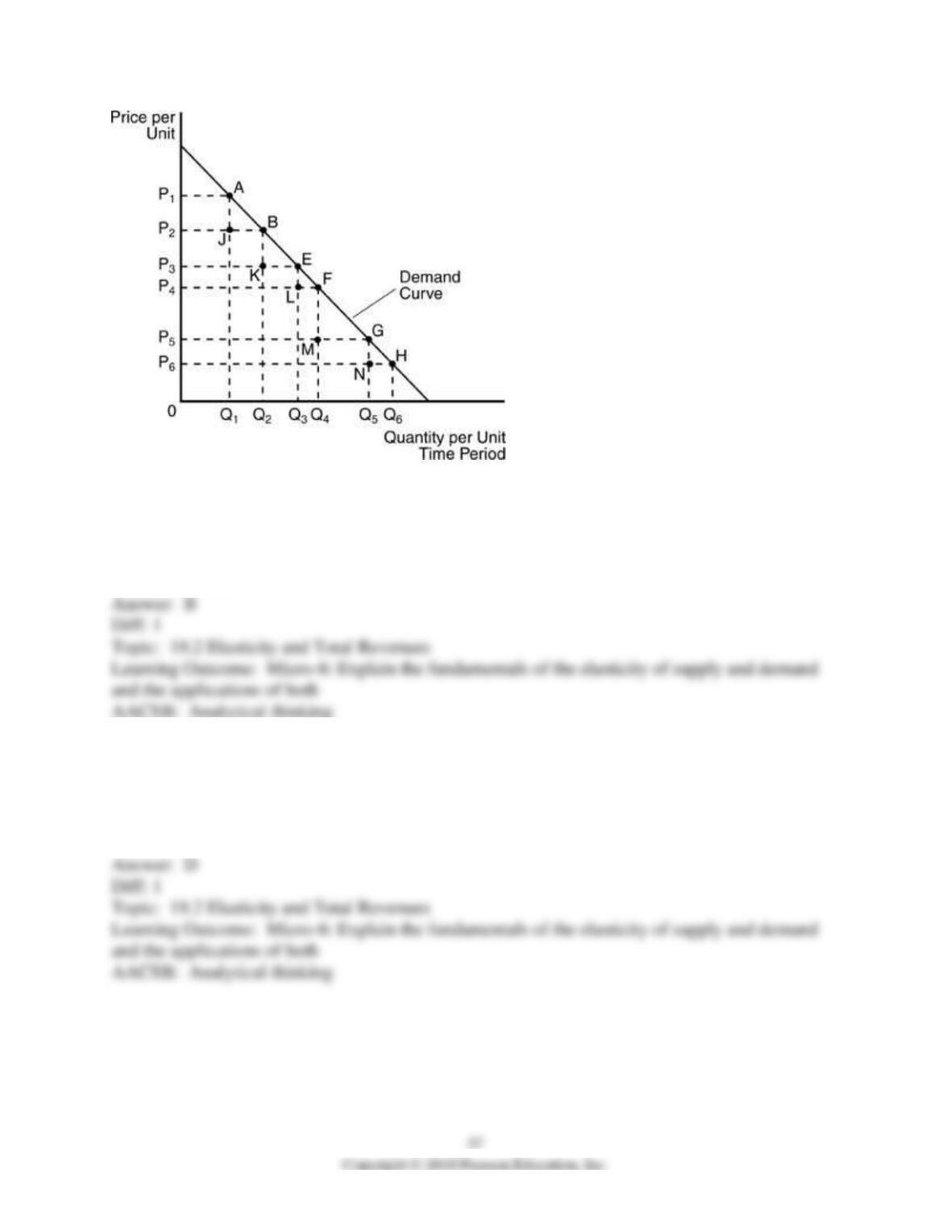
24) In the above figure, over the price range P1P2, demand is
A) unit elastic.
B) elastic.
C) inelastic.
D) perfectly elastic.
25) In the above figure, over the price range P5P6, demand is
A) unit elastic.
B) elastic.
C) perfectly inelastic.
D) inelastic.
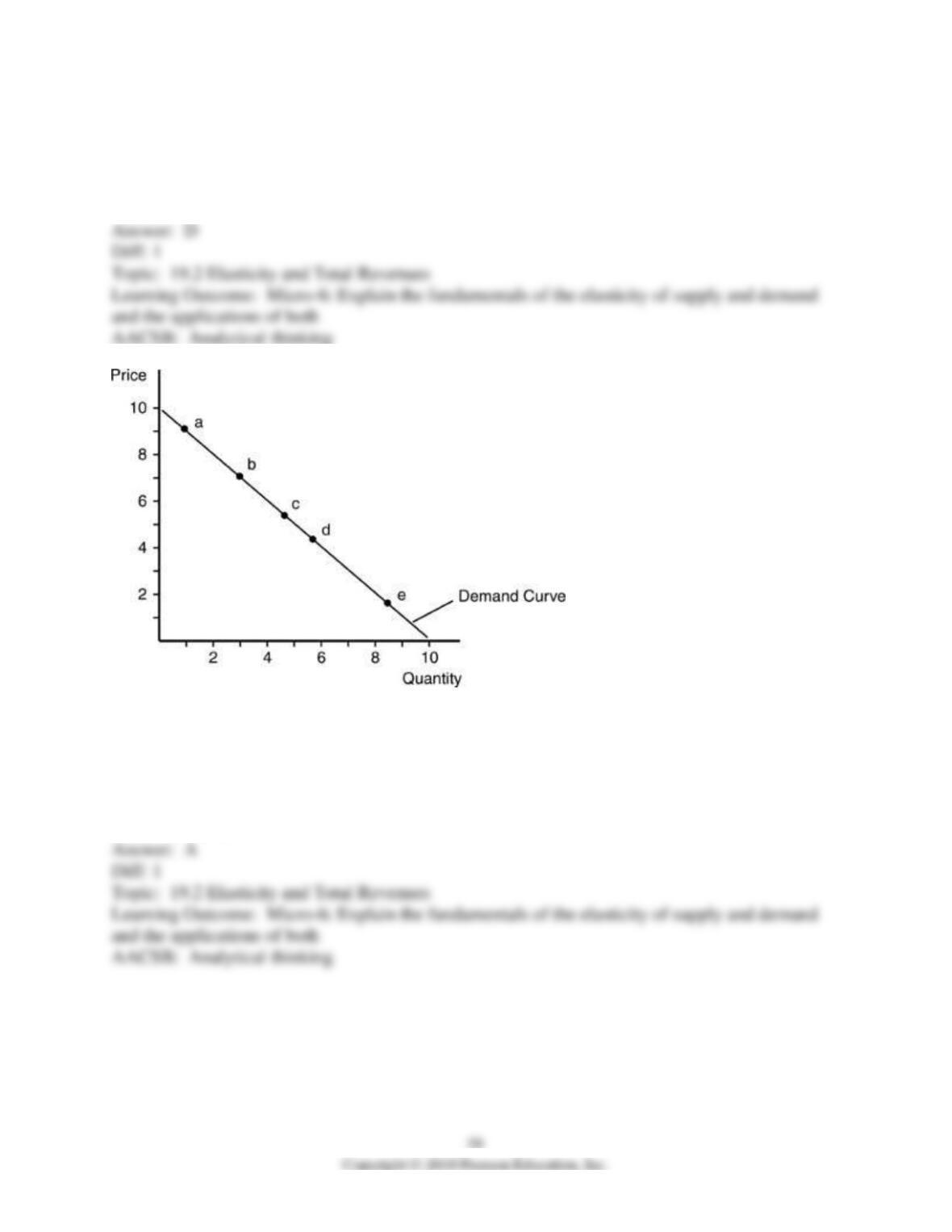
26) In the above figure, through which range would the demand for this good be most inelastic?
A) A-B
B) B-E
C) E-F
D) G-H
27) In the above figure, along the section of the demand curve between point a and point b,
demand is
A) elastic.
B) inelastic.
C) unit elastic.
D) unit inelastic.
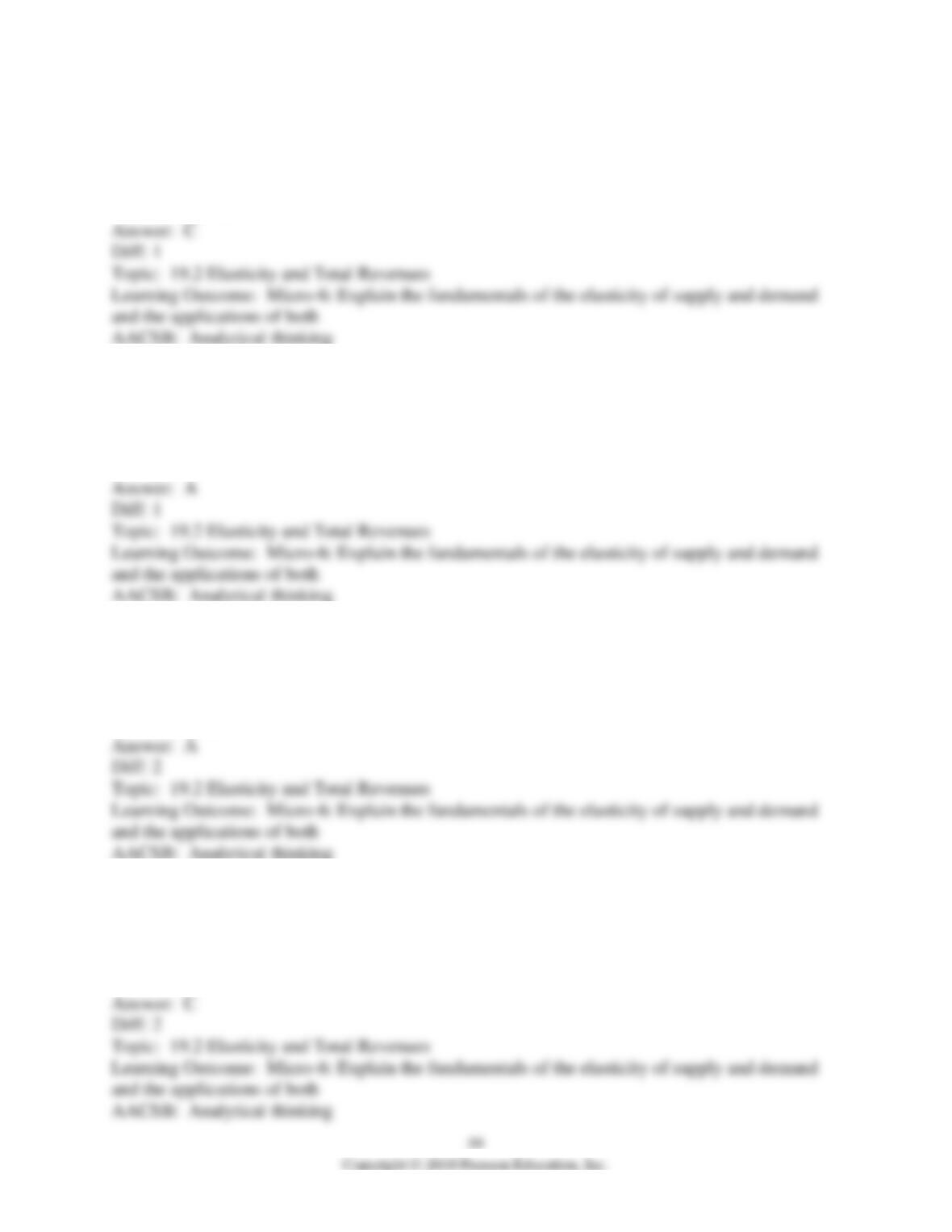
28) In the above figure, the range of unit elasticity occurs
A) on the vertical axis.
B) on the horizontal axis.
C) between point c and point d.
D) below point e.
29) In the above figure, along which range would the demand for this good be most elastic?
A) between point a and point b
B) between point c and point d
C) between point d and point e
D) at point e
30) In the above figure, along which range would total revenue rise by lowering prices?
A) between point a and point b
B) between point c and point d
C) between point d and point e
D) below point e
31) In the above figure, along which range would total revenue rise by raising prices?
A) between point a and point b
B) between point c and point d
C) between point d and point e
D) above point a
32) In the above figure, along which range would total revenue remain unchanged by raising
prices?
A) between point a and point b
B) between point c and point d
C) between point d and point e
D) below point e and above point a.
33) Over the inelastic range of a demand curve, there is
A) a positive relationship between a given percentage change in price and a change in total
revenues.
B) a negative relationship between a given percentage change in price and a change in total
revenues.
C) an increase in total revenues regardless of an increase or decrease in price.
D) no relationship between changes in price and changes in total revenues.
34) If total revenues decline when the market clearing price increases, then we know that
A) demand is inelastic.
B) demand is elastic.
C) demand is unit-elastic.
D) demand has zero elasticity.