2) If the quantity supplied of candy increases by 1% when the price of candy increases by 2%,
which of the following is TRUE?
A) Supply for candy is elastic, and price elasticity of supply = 2.0.
B) Supply for candy is inelastic, and price elasticity of supply = 2.0.
C) Supply for candy is elastic, and price elasticity of supply = 0.5.
D) Supply for candy is inelastic, and price elasticity of supply = 0.5.
3) If the supply of a good is perfectly inelastic, the price elasticity of supply will equal
A) positive infinity.
B) one.
C) zero.
D) none of the above.
4) An 36 percent increase in the price of small cars results in a 20 percent increase in the quantity
supplied. The supply elasticity in this range equals ________.
A) 9/5
B) 5/9
C) 7/10
D) 4/10
5) OLED television prices rise by 10 percent, and in response the quantity of those OLED
televisions supplied increases by 5 percent. The supply elasticity for OLED television sets in that
price range is
A) 0.5.
B) 1.5.
C) 2.0.
D) -2.0.
6) The price elasticity of supply
A) is the slope of the supply curve.
B) is the percentage change in quantity supplied divided by the percentage change in price.
C) is always negative.
D) does not vary between the long and the short run.
7) We expect the price elasticity of supply to be
A) negative.
B) positive.
C) between -1 and +1.
D) zero.
8) When the Gizmo Company could sell a gizmo for $10, it produced 2,500 per month. More
recently, the price of a gizmo has fallen to $9 and so Gizmo is only producing 2,000 units per
month. What is the price elasticity of supply for gizmos?
A) 0.47
B) -0.47
C) -2.11
D) 2.11
9) If the quantity supplied stays the same no matter what the price is, then supply is
A) perfectly inelastic.
B) perfectly elastic.
C) unit elastic.
D) undefined.
10) A vertical supply curve may be described as being
A) relatively elastic.
B) perfectly inelastic.
C) relatively inelastic.
D) perfectly elastic.
11) If the supply curve is vertical, then supply is
A) relatively elastic.
B) perfectly elastic.
C) unit elastic.
D) perfectly inelastic.
12) If a 5 percent increase in price causes a 10 percent increase in quantity supplied, then supply
is
A) elastic.
B) inelastic.
C) unit elastic.
D) infinite.
13) If a 1 percent increase in price causes a 0.5 percent increase in quantity supplied, then supply
is
A) elastic.
B) inelastic.
C) unit elastic.
D) infinite.
14) When the price of computer printers decreased from $100 to $85, the number of computer
printers produced fell from 1,000 per week to 850 per week. Using this information, we know
the supply of computer printers is
A) elastic.
B) inelastic.
C) unit elastic.
D) perfectly inelastic.
15) In the long run, the supply curve
A) is more elastic than it is in the short run.
B) is less elastic than it is in the short run.
C) exhibits no systematic sequence of changes in elasticity.
D) exhibits no change in elasticity at all.
16) Changes in technology over time will result in
A) a more inelastic supply curve.
B) a more elastic supply curve.
C) a unitary elastic supply curve.
D) no change in the elasticity of supply.
17) The most important determinant of the elasticity of supply is
A) whether the good is a durable good or a nondurable good.
B) the price of the good.
C) the time period firms have to adjust to the new price.
D) the proportion of the good in the budget of consumers.
18) If a good’s price increases by 2 percent, then its quantity supplied increases by more than 2
percent. This means
A) supply is elastic.
B) supply is unit-elastic.
C) supply is inelastic.
D) the good has good substitutes.
19) Price elasticity of supply is always
A) positive because of the law of supply.
B) negative because of the law of supply.
C) positive because of diminishing marginal utility.
D) negative because percentages can only be negative.
20) The price elasticity of supply measures
A) the responsiveness of quantity demanded to a change in price.
B) the responsiveness of quantity supplied to a change in price.
C) the change in supply due to a change in input prices.
D) the change in price due to a change in quantity supplied.
21) We generally expect the price elasticity of supply to be
A) zero.
B) negative.
C) positive.
D) positive or negative, depending on demand.
22) When quantity supplied is very responsive to a change in price, supply is
A) elastic.
B) unit-elastic.
C) inelastic.
D) income sensitive.
23) When quantity supplied is NOT very responsive to a change in price, supply is
A) elastic.
B) unit-elastic.
C) inelastic.
D) income sensitive.
24) Which of the following statements is FALSE?
A) A perfectly inelastic supply curve is a vertical line.
B) Time is an important consideration in determining supply elasticity.
C) Price elasticity of supply can never equal 1.
D) A horizontal supply curve is possible.
25) A perfectly inelastic supply curve is
A) an upward sloping straight line that intersects the origin.
B) horizontal.
C) vertical.
D) downward sloping.
26) A perfectly elastic supply curve is
A) an upward sloping straight line that intersects the origin.
B) horizontal.
C) vertical.
D) downward sloping.
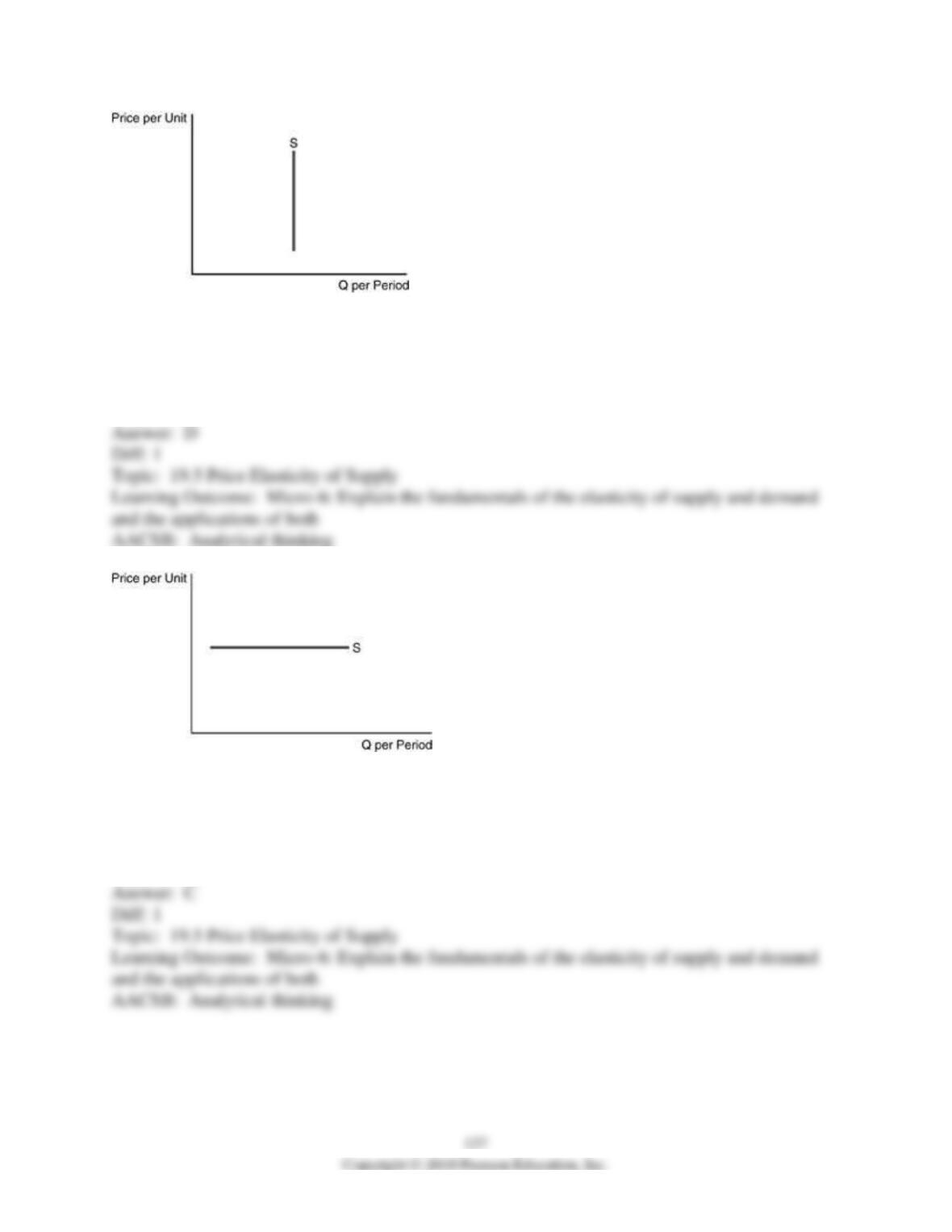
27) Refer to the above figure. The supply curve is
A) elastic at high prices and inelastic at low prices.
B) unitary for all prices.
C) perfectly elastic.
D) perfectly inelastic.
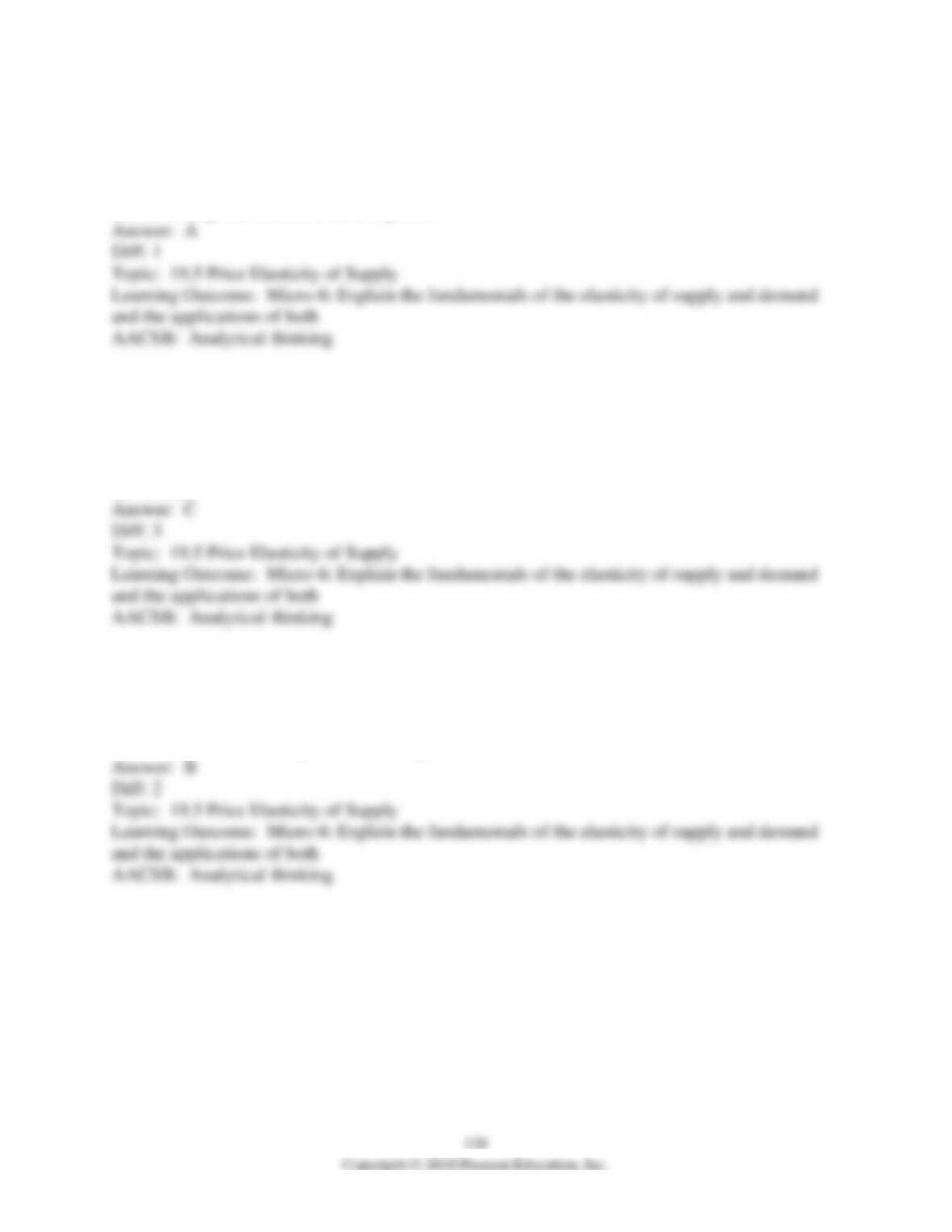
28) Refer to the above figure. The supply curve is
A) elastic at high prices and inelastic at low prices.
B) unitary for all prices.
C) perfectly elastic.
D) perfectly inelastic.
29) Supply will become more elastic when
A) a time period lengthens.
B) the time period shortens.
C) the good is important to consumers.
D) there are good substitutes for the goods.
30) Suppose the short-run supply curve is a straight line of slope +1 that intersects the origin.
The long-run supply curve will be
A) horizontal.
B) steeper.
C) shallower.
D) vertical.
31) The most important determinant of price elasticity of supply is
A) the number of close substitutes there are for the good.
B) the time period firms have to adjust to the new price.
C) the price of the good.
D) the importance of the good in the budgets of consumers.
32) The supply curve for housing in the very short run is likely to be
A) very elastic.
B) very inelastic.
C) unit-elastic elastic.
D) perfectly elastic.
33) Suppose the demand for rental apartments decreased substantially. We would expect to
observe
A) no change in rent and a sharp reduction in quantity supplied in the short run, and an even
larger decrease in quantity supplied in the long run.
B) a large decrease in quantity supplied in the short run, followed by a counter-reaction and an
increase in quantity supplied in the long run.
C) a small decrease in quantity supplied and significantly lower rents in the short run, and
quantity supplied to decrease much more in the long run.
D) a large decrease in quantity supplied in the short run and the long run, but much larger
reductions in rent in the long run.
34) A cafeteria is willing to produce 100 bottles of soda when the price is $1 and 150 bottles of
soda when the price is $1.30, other things being equal. The price elasticity of supply of soda is
A) 1.53.
B) 0.67.
C) 0.10.
D) 0.50.
35) The price elasticity of supply is
A) negative.
B) zero.
C) positive.
D) unknown, depending on other factors.
36) A perfectly elastic supply curve is
A) a straight line that crosses the horizontal axis.
B) a straight line coming out of the origin.
C) a horizontal straight line.
D) a vertical straight line.
37) The price elasticity of supply is higher when
A) the number of buyers in the market decreases.
B) the product in question is an inferior good.
C) the number of buyers in the market increases.
D) producers have more time to adjust to price changes.
38) The price elasticity of supply is higher when
A) the number of producers in the market increases over time.
B) the product in question is a complementary good.
C) the number of buyers in the market increases.
D) producers have less time to adjust to price changes.
39) While the slope of the perfectly inelastic supply curve ________, the slope of the perfectly
elastic supply curve ________.
A) is zero, approaches infinity
B) approaches infinity, is zero
C) is zero, is zero
D) approaches infinity, approaches infinity
40) A situation in which there is a reduction in quantity supplied to zero when there is the
slightest decrease in price is
A) perfectly elastic supply.
B) perfectly elastic demand.
C) perfectly inelastic supply.
D) perfectly inelastic demand.
41) Which of the following statements regarding price elasticity of supply and the length of time
for adjustment is FALSE?
A) The longer is the time period for adjustment, the greater is the price elasticity of supply.
B) The longer is the time period for adjustment, the less is the extent to which resources flow
into (or out of) an industry through expansion (or contraction) of existing firms.
C) The longer is the time period for adjustment, the greater is the extent to which entry or (exit)
of firms increases or (decreases) production in an industry.
D) The shorter the time period for adjustment, the greater is the price elasticity of supply.
42) Usually, price elasticities of supply are
A) positive, because higher prices yield larger quantities supplied.
B) considered short-run adjustments due to supply constraints.
C) ordinarily a negative number based on the law of supply.
D) an inverse relationship between price and quantity supplied.
43) If price elasticity of supply is less than 1
A) supply is elastic.
B) demand is elastic.
C) demand is inelastic.
D) supply is inelastic.
44) The paintings of a world famous artist Vincent Van Gogh have a price elasticity of supply
A) equal to 2.0.
B) equal to 1.0.
C) close to 0.0.
D) approaching infinity.
45) Which of the following statements is correct?
A) Supply is more elastic in the short run than in long run.
B) Supply is more elastic in the long run than in short run.
C) Price elasticity of supply is constant along the supply curve.
D) Price elasticity of supply is always a negative number.
46) Tickets for the Super Bowl are an example of supply that is
A) perfectly elastic.
B) unit elastic.
C) slightly inelastic.
D) perfectly inelastic.
47) For most items, we find the price elasticity of supply will be
A) negative.
B) positive.
C) zero.
D) infinity.
48) The shorter the time period that suppliers have to adjust to price changes, the
A) lower will be the price elasticity of supply.
B) higher will be the price elasticity of supply.
C) higher will be the price elasticity of demand.
D) lower will be the price elasticity of demand.
49) If the price of hotdogs increases by 10 percent and the quantity supplied by meat packing
companies increases by 15 percent, what is the price elasticity of supply?
A) 1.65
B) 1.20
C) 0.67
D) 1.50
50) If the price elasticity of supply is equal to 1, we would say the supply of the item is
A) unit elastic.
B) inelastic.
C) elastic.
D) perfectly elastic.
51) A supply curve that is parallel to the price axis is
A) perfectly elastic.
B) perfectly inelastic.
C) relatively inelastic.
D) unitary elastic.
52) A supply curve that is parallel to the quantity axis is
A) perfectly elastic.
B) perfectly inelastic.
C) relatively inelastic.
D) unitary elastic.
53) The price elasticity of supply is 6. This means that
A) a $10 increase in price would increase quantity supplied by 60.
B) a 10 percent increase in price would increase quantity supplied by 60 percent.
C) a 10 percent increase in quantity will occur when price increases by 0.6 percent.
D) a 10 percent increase in quantity will occur when price increases by 6 percent.
54) Why is the price elasticity of supply greater if there is more time for adjustment to an
increase in the price of an item?
136
55) Why is time such an important determinant in the elasticity of supply? Is time also important
in determining price elasticity of demand? Explain.