
CHAPTER 19: LEASE AND INTERMEDIATE-TERM FINANCING
1. In the net advantage to leasing calculation, all cash flows (except salvage value) are discounted at the firm’s
a. weighted (marginal) cost of capital
b. cost of internal equity capital
c. pretax marginal cost of borrowing
d. after-tax marginal cost of borrowing
2. In the net advantage to leasing calculation, after-tax salvage value is discounted at the firm’s
a. weighted (marginal) cost of capital
b. cost if internal equity capital
c. cost of external equity capital
d. after-tax marginal cost of borrowing
3. In a lease arrangement, the owner of the property is called the
a. lessee
b. lessor
c. equity trustee
d. lender
4. All of the following are attributes of operating leases except
a. lease period normally equals the economic life of the asset
b. lease payments under the initial lease contract are insufficient to recover the full cost of the asset for the
lessor
c. cancelable
d. maintenance and insurance normally are responsibility of lessor
5. All of the following are true of financial leases except
a. non-cancelable
b. lessee is normally responsible for maintenance and insurance
c. lease payments are normally sufficient to amortize the original cost of the asset
d. all financial leases are also leveraged leases

Chapter 19: Lease and Intermediate-Term Financing
6. A sale and leaseback agreement
a. is usually an operating lease
b. is rarely used in today’s leasing agreements
c. is a method of providing liquidity for the lessee
d. frequently is used for machinery financing, but rarely used in real estate
7. A primary difference between leveraged leases and other financial leases is that
a. leveraged leases must be capitalized and shown on the lessee’s balance sheet
b. the lessor in a leveraged lease is invariably the manufacturer of the leased asset
c. leveraged leases involve the use of non-recourse debt
d. unleveraged leases are usually tax motivated
8. Which of the following leases is not likely to be viewed as a lease from the perspective of the Internal Revenue
Service?
a. a 20 year lease for an asset having an economic life estimated to be 40 years
b. a lease offering a renewal option based on the asset’s remaining value at the time of the renewal
c. a lease providing for a purchase option at the end of the lease period for a nominal sum
d. a leveraged lease in which the lessor contributes 40 percent equity
9. All of the following are advantages of leasing except
a. generally lower cost than ownership
b. leasing smoothes out expenses
c. leasing may increase a firm’s liquidity
d. it provides 100% financing
10. All of the following are disadvantages of leasing except
a. difficulty in making property improvements
b. financial leases are non-cancelable
c. normally higher maintenance charges
d. generally higher cost than ownership

Chapter 19: Lease and Intermediate-Term Financing
11. Lease-buy analysis assumes that the alternative to leasing as the source of financing is
a. buying for cash
b. borrowing to buy
c. buying with all equity funds
d. buying with before-tax dollars
12. The contract period of an operating lease tends to
a. be somewhat less than the economic life of an asset
b. be equal to the economic life of the asset
c. be somewhat greater than the economic life of the asset
d. recover the full cost of the asset
13. Leasing offers a number of potential advantages. All of the following are advantages except
a. flexibility
b. effective depreciation of land
c. generally lower costs
d. may be the only source of financing available to the marginally profitable firm
14. The sale and leaseback is advantageous to the lessee because
a. the lessee cannot continue using the asset
b. the lessee receives cash from the sale of the asset
c. the lessee receives title to property at the termination of the lease
d. the lessee is never required to pay taxes and insurance
15. In a(n) , the lessor receives the entire accelerated depreciation tax shield while making a relatively small
equity investment.
a. operating lease
b. capital lease
c. leveraged lease
d. term lease

Chapter 19: Lease and Intermediate-Term Financing
16. Disadvantages of leasing include all of the following except
a. leasing usually decreases a firm’s liquidity
b. leasing is often more expensive than purchasing
c. loss of the asset’s salvage value
d. lessee may have difficulty getting approval to make property improvements on leased real estate
17. Leasing accounts for more than percent of all business investment in equipment.
a. 10
b. 25
c. 50
d. 90
18. Lessees with are most likely to use leveraged leases for large transactions.
a. low profit levels
b. large amounts of tax exempt income
c. low profits and high amounts of tax-exempt income
d. outlays of less than $300,000
19. Normally, when a firm operates under the protection of a bankruptcy court, lease payments .
a. may be suspended
b. must continue to be paid by lessors
c. must be paid to lessors if assets are secured
d. may be suspended if they are “true” leases
20. All of the following have been cited as advantages of leasing by small businesses except:
a. less cash required up front
b. fewer restrictive covenants from lessor than lenders
c. lower effective interest costs relative to borrowing
d. quicker approvals from lessors than from lenders
Chapter 19: Lease and Intermediate-Term Financing
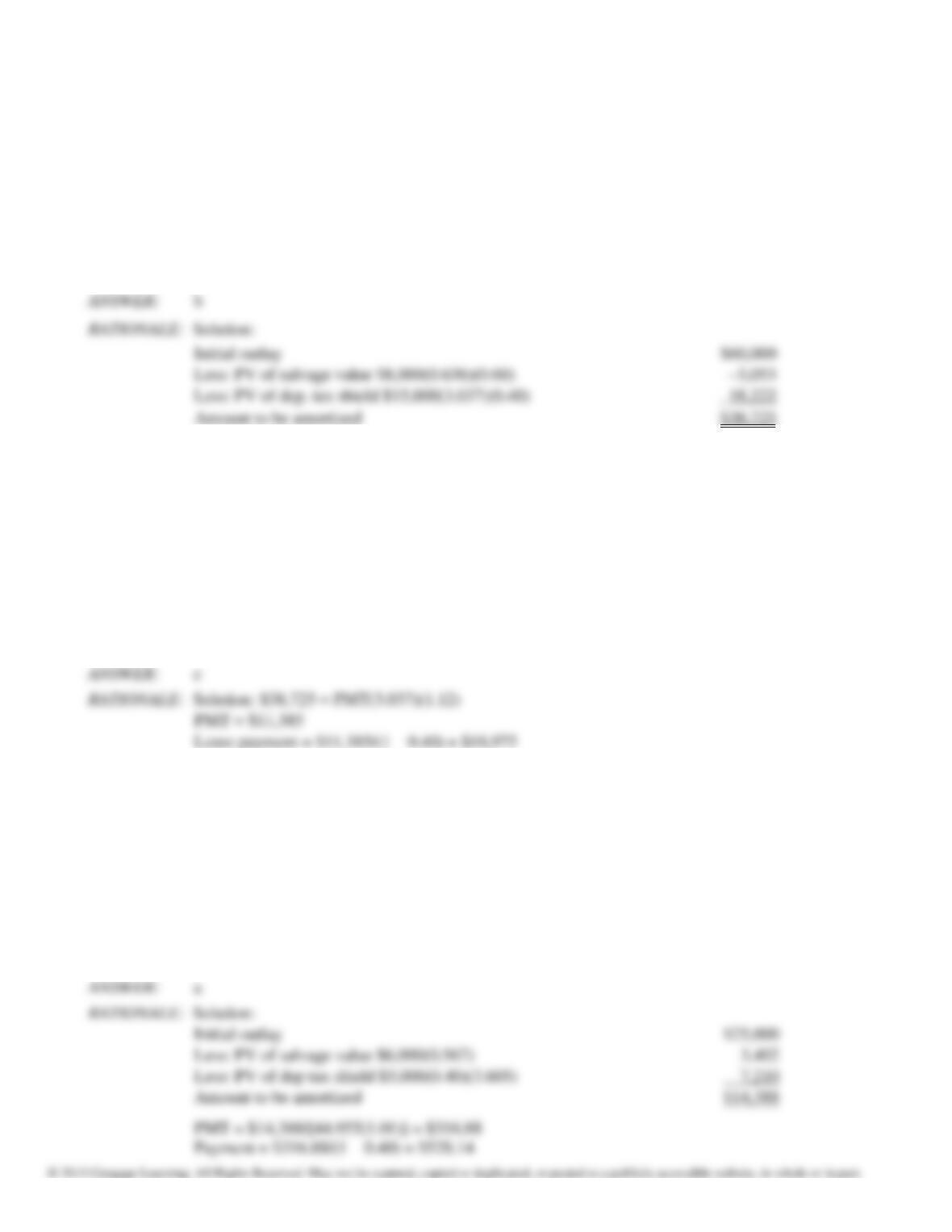
21. Contech (lessee) wishes to lease a printing press valued at $60,000 from Wrenn Capital (lessor) for a period of
4 years. Wrenn expects to depreciate the asset on a straight-line basis to a salvage value of $0. Actual salvage
value is expected to be $8,000 at the end of 4 years. If Wrenn requires a 12 percent after-tax rate of return on
the lease, what is the lessor’s amount to be amortized? Assume Wrenn’s marginal tax rate is 40%.
a. $60,000
b. $38,725
c. $41,778
d. $36,690
22. Contech (lessee) wishes to lease a printing press valued at $60,000 from Wrenn Capital (lessor) for a period of
4 years. Wrenn expects to depreciate the asset on a straight-line basis to a salvage value of $0. Actual salvage
value is expected to be $8,000 at the end of 4 years. If Wrenn requires a 12 percent after-tax return on the lease,
what is the lease payment that Wrenn will require from Contech? Assume a marginal tax rate of 40%. Under
the terms of the lease, payments will be made at the beginning of each of the 4 years.
a. $11,385
b. $28,463
c. $18,975
d. $21,252
23. T. Goho (lessee) wishes to lease a $25,000 car for 5 years. First Union Bank (lessor) has agreed to finance this
lease and estimated the car will have a salvage value of $10,000 at the end of the lease. If First Union expects
to depreciate the car on a straight-line basis to a salvage value of $0, what monthly lease payments will T.
Goho have to make, given that First Union requires a 12% annual rate of return (assume a monthly interest rate
of 1%)? Assume a marginal tax rate of 40%, and payments at the beginning of each month.
a. $528
b. $495
c. $317
d. $653
Chapter 19: Lease and Intermediate-Term Financing
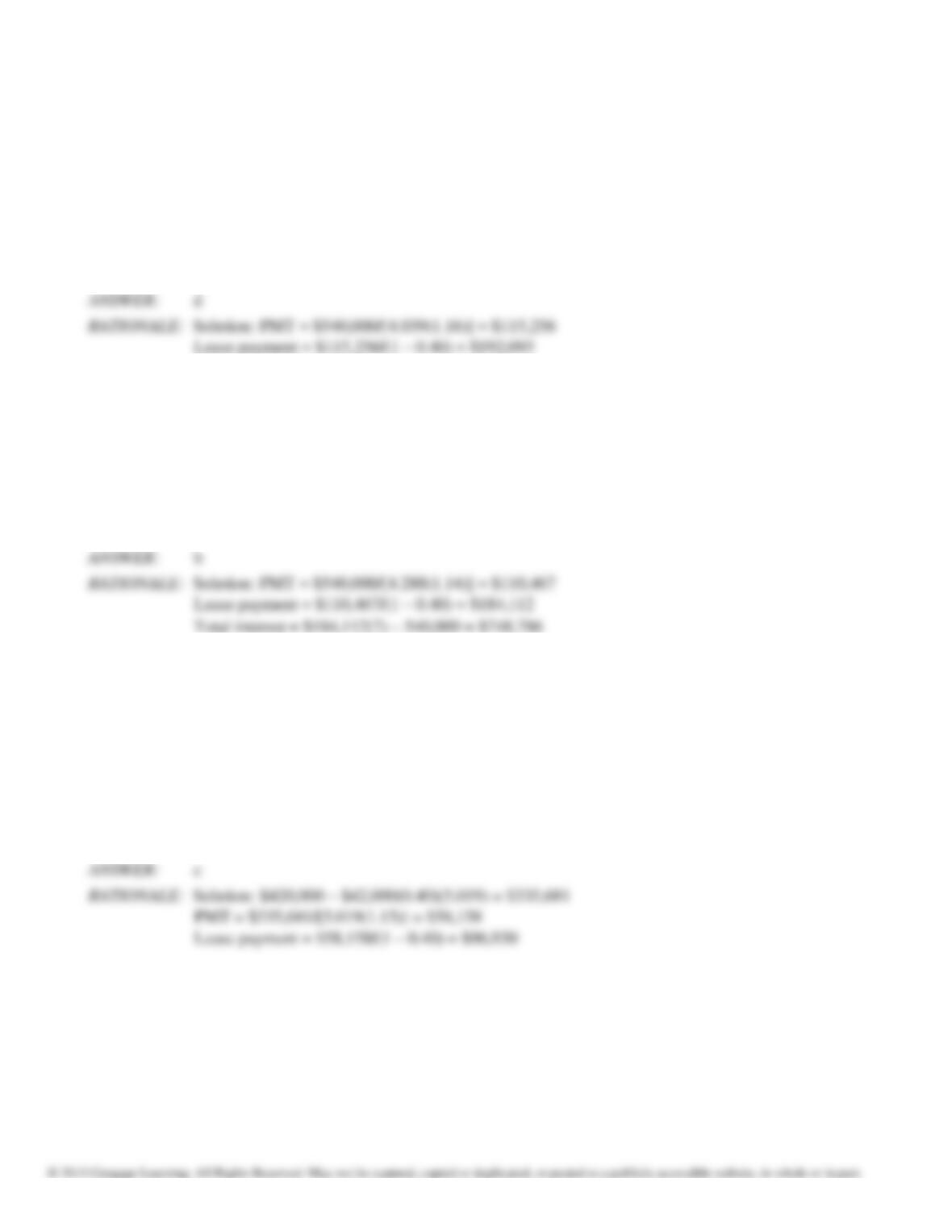
24. Ajax Capital has determined that the amount to be amortized on an extruder is $540,000. What annual lease
payment must Ajax (lessor) require from the lessee if the required rate of return is 16%? Assume that the lease
payments will be made at the beginning of each of the 7 years of the lease agreement and that the marginal tax
rate is 40%.
a. $288,140
b. $222,827
c. $115,256
d. $192,093
25. Ajax Capital has determined the amount to be amortized on an extruder is $540,000. If the required rate of
return is 14%, what will be the total interest received over the life of the lease given that lease payments will be
made at the beginning of each of the 7 years of the lease agreement? Assume a marginal tax rate of 40%.
a. $233,269
b. $748,786
c. $811,080
d. $110,467
26. Leigh Fibers wishes to lease an automated knitting machine valued at $420,000 from Ogden Capital for a
period of 10 years. Ogden expects to depreciate the asset on a straight-line basis to a salvage value of $0.
Actual salvage value is also expected to be $0 at the end of the 10-year period. If Ogden requires a 15% after-
tax rate of return on the lease, what is the lease payment required from Leigh Fiber? Assume that the lease
payments will be made at the beginning of each year and that the marginal tax rate is 40%.
a. $111,470
b. $145,395
c. $96,930
d. $58,158
Chapter 19: Lease and Intermediate-Term Financing
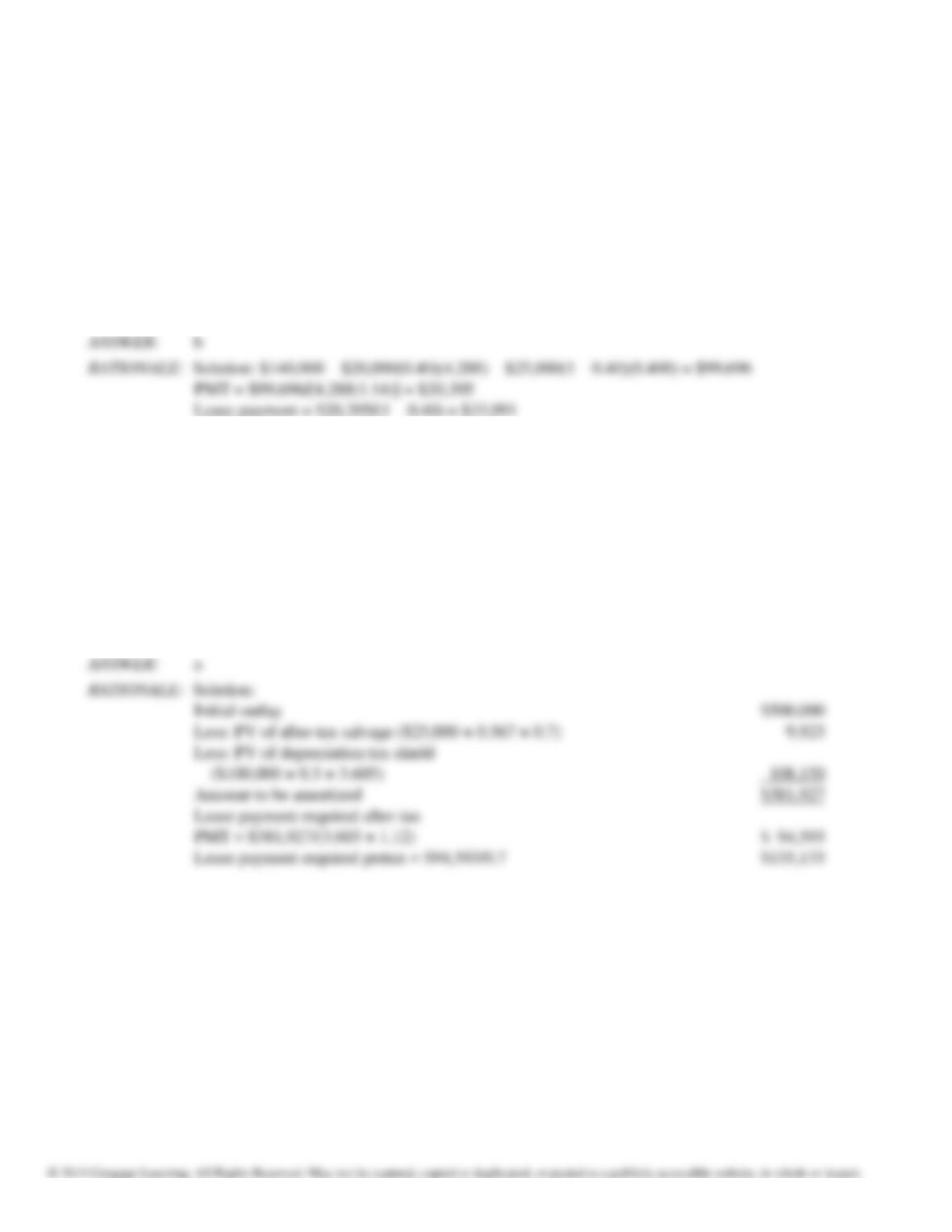
27. Paragon Leasing has been approached by Mid-America Trucking Company (MATC) to provide lease
financing for a fleet of new tractors. Each tractor will cost $140,000 and will be leased by MATC for 7 years
with lease payments made at the beginning of each year. Paragon will depreciate the tractors on a straight-line
basis to $0 but the actual market value at the end of 7 years is estimated to be $25,000. What are the required
annual beginning-of-year lease payments if Paragon desires to earn a 14% after-tax rate of return? Assume a
marginal tax rate of 40%.
a. $36,037
b. $33,991
c. $38,750
d. $20,395
28. Sigma Tools will lease a computerized stamping machine from StarBanc. The machine costs $500,000 and will
be depreciated on a straight-line basis to a zero book value over the next 5 years, which is also the term of the
lease. The expected salvage value in 5 years is $25,000. StarBanc’s marginal tax rate is 30 percent and it
requires an after- tax rate of return of 12 percent on investments of this type. What annual, beginning of the
year, pretax lease payment must StarBanc receive to earn the required 12 percent return?
a. $135,133
b. $93,540
c. $94,593
d. $100,000
Chapter 19: Lease and Intermediate-Term Financing
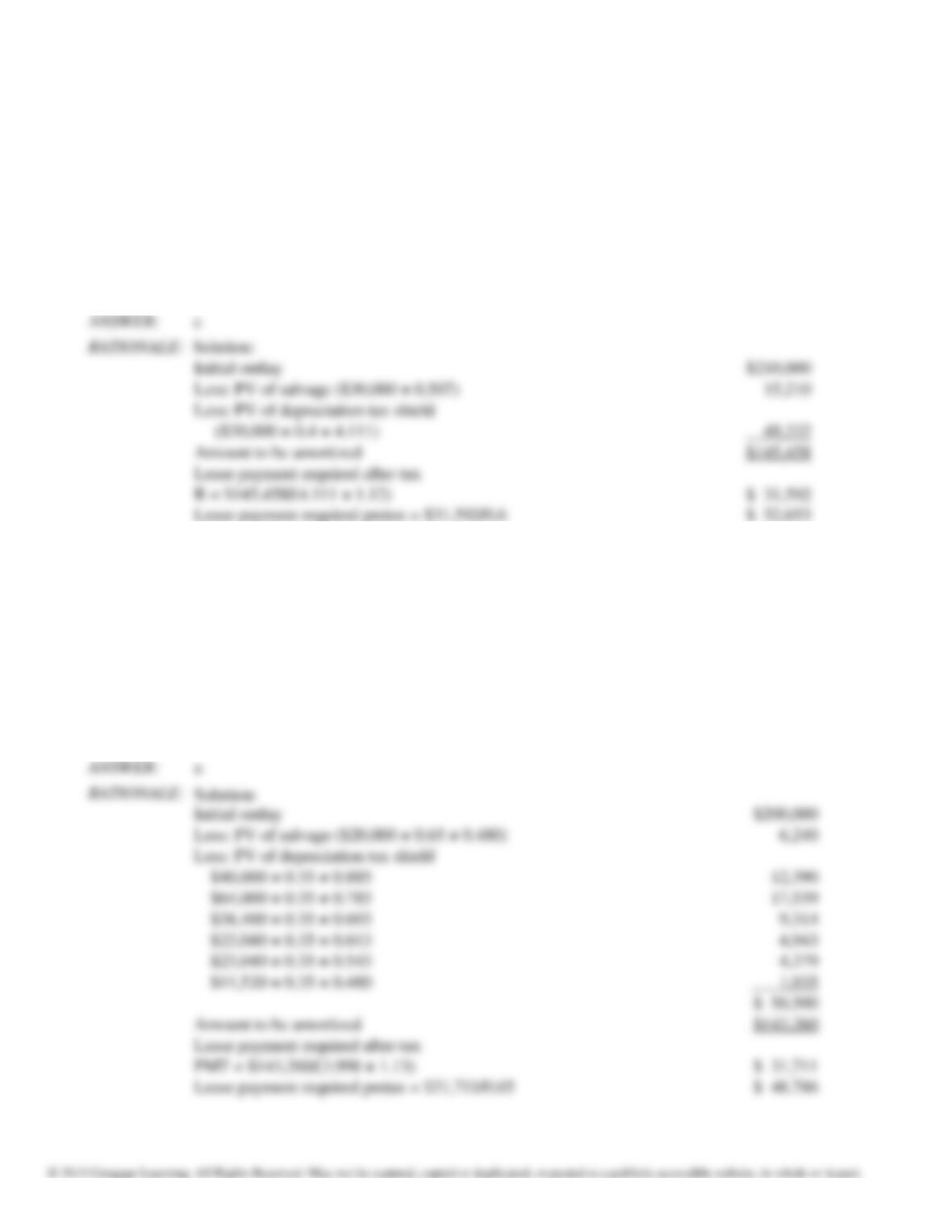
29. ANB Leasing is planning to lease an asset costing $210,000. The lease period will be 6 years. At the end of 6
years, the salvage value is estimated to be $30,000. The asset will be depreciated on a straight-line basis of
$30,000 per year over the 6-year period. ANB’s marginal income tax rate is 40 percent, but its average tax rate
is only 31.5%. If ANB Leasing requires a 12 percent after-tax rate of return on the lease, determine the
required annual beginning of the year lease payments.
a. $45,609
b. $31,592
c. $52,653
d. $46,120
30. Unilog is considering leasing a computer from UniNet under a 6-year lease. The computer costs $200,000 and
will be depreciated as a 5-year MACRS asset. The expected salvage value of the computer after 6 years is
$20,000. UniNet’s marginal tax rate is 35 percent and its average tax rate is 30%. UniNet requires a 13 percent
after-tax rate of return on leases of this type. What annual, pretax, beginning-of-the-year lease payment must
Unilog make to UniNet? (Problem requires MACRS depreciation tables.)
a. $48,786
b. $31,711
c. $50,500
d. $16,848
Chapter 19: Lease and Intermediate-Term Financing
31. Lancit Media Productions wishes to lease a high speed printer that costs $400,000 for a period of 4 years. The
leasing company, GKN Leasing, expects to depreciate the entire value of the printer on a straight-line basis
over the 4 year period. Actual salvage value is expected to be $50,000. If GKN requires a 12% after-tax rate of
return on the lease, what annual lease payments will GKN require? Assume GKN’s marginal tax rate is 35%
and that all lease payments occur at the beginning of each year.
a. $80,270
b. $123,493
c. $138,312
d. $36,172
32. Index Laboratories is considering leasing a thermoplastic molder. The lease would require 7 beginning of the
year payments of $122,000 each. If Index capitalizes this lease for financial reporting purposes at a 12% rate,
what asset amount will be reported initially on its balance sheet?
a. $623,625
b. $969,046
c. $556,808
d. $854,000
33. Uminum, the world’s largest producer of feldspar, is considering leasing a sifter that costs $450,000. The 5
year lease requires 5 beginning of the year payments. The leasing company is depreciating the sifter on a
straight-line basis of $90,000 per year to a salvage value of zero, but assumes the actual salvage value at the
end of 5 years is expected to be $25,000. If the leasing company desires to earn an 11% after-tax rate of return
of the lease, what annual lease payment will they require? Assume a marginal tax rate of 40%.
a. $125,145
b. $75,087
c. $148,517
d. $122,736
Chapter 19: Lease and Intermediate-Term Financing
34. Medarex is considering the lease of an electronic welder costing $210,000 from Key Leasing. The period of the
lease will be 6 years. The welder will be depreciated under MACRS rules for a 5-year class asset. Medarex’s
marginal tax rate is 40%. Annual beginning of the year lease payments will be $50,000. Estimated salvage
value is zero. If Medarex’s after tax cost of borrowing is 15%, compute the net advantage to leasing. (Problem
requires MACRS tables.)
a. $8,527
b. –$17,592
c. –$67,174
d. $21,427
35. Daymark (lessee) wishes to lease a printing press valued at $60,000 from Wrenn Capital (lessor) for a period of
4 years. Wrenn expects to depreciate the press using 3-year MARCS depreciation rates. Actual salvage value is
expected to be $8,000 at the end of 4 years. If Wrenn requires a 12% after-tax rate of return on the lease, what
is the lessor’s amount to be amortized? Assume a marginal tax rate of 40%.
a. $40,693
b. $38,725
c. $37,640
d. $35,613
Chapter 19: Lease and Intermediate-Term Financing
36. Daymark (lessee) wishes to lease a printing press valued at $60,000 from Wrenn Capital (lessor) for a period of
4 years. Wrenn expects to depreciate the press using 3-year MARCS depreciation rates. Actual salvage value is
expected to be $8,000 at the end of 4 years. Under terms of the lease, payments will be made at the beginning
of each of the 4 years. If Wrenn requires a 12% after-tax rate of return on the lease, what is the lease payment
that Wrenn will require from Daymark? Assume a marginal tax rate of 40%.
a. $11,066
b. $18,443
c. $20,656
d. $12,393
37. Sandia, Inc. wants to acquire a $360,000 computer controlled printing press. If owned the press would be
depreciated on a straight-line basis over 10 years to a book salvage value of $0. The actual cash salvage value
is expected to be $25,000 at the end of 10 years. If purchased, Sandia will incur annual maintenance expenses
of $3,000. These expenses would not be incurred if the press is leased. If the press is purchased, Sandia could
borrow the needed funds at an annual pre-tax interest rate of 10%. The lease rate would be $48,000 per year,
payable at the beginning of each year. If Sandia has an after-tax cost of capital of 12% and a marginal tax rate
of 40%, what is the net advantage to leasing?
a. $60,713
b. $65,543
c. $57,173
d. $37,737
38. Prime Care has approached the leasing department of First City Bank to arrange lease financing for a $1.2
million CAT scanner. The economic life of the scanner is estimated to be 10 years. The estimated salvage
value at the end of 10 years is $0. First City plans to depreciate the scanner on a straight-line basis over 10
years. If First City charges a beginning of the year lease payment of $255,395, what after-tax rate of return will
the bank earn on the lease? Assume a marginal tax rate of 40%.
a. 4.7%
b. 16.8%
c. 13%
d. 40%

Chapter 19: Lease and Intermediate-Term Financing
39. In a leveraged lease, how much of the asset’s full purchase price does the lessor supply?
a. 0-10%
b. 20-40%
c. 50-70%
d. 80-100%
40. In a direct lease, the user-lessee first determines all of the following EXCEPT:
a. which manufacturer will supply the equipment
b. what equipment will be leased
c. the terms of the lease
d. what price will be paid for the asset
41. In considering the advantages of leasing, which of the statements is/are correct?
a. Leasing provides approximately 50% of the necessary financing.
b. Leasing can decrease the firm’s liquidity.
c. Both a and b are correct.
d. Neither a nor b is correct.
42. All of the following are types of “true leases” EXCEPT:
a. Operating lease
b. Capital lease
c. Financial lease
d. Maturity lease
43. An operating lease is often referred to as:
I. service lease
II. maintenance lease
a. Only statement I is correct
b. Only statement II is correct
c. Both statements I and II are correct
d. Neither statement I nor II is correct
Chapter 19: Lease and Intermediate-Term Financing
44. A capital lease is considered a(n) agreement.
a. negotiable
b. cancelable
c. noncancelable
d. short-term
45. All of the following are first determined by the lessee before a direct lease EXCEPT:
a. Equipment that will be leased
b. What taxes will be paid based on the lease
c. Options, warranties service agreements that will have to be made
d. What price will be paid for the asset
46. The type of lease that is a three-sided agreement among the lessee, the lessor and the lenders is:
a. Leaseback agreement
b. Direct lease
c. Leveraged lease
d. Operating lease
47. What are the advantages of leasing?
48. What is a term loan?
Chapter 19: Lease and Intermediate-Term Financing
49. Explain a leveraged lease.
50. What are the disadvantages of leasing?
51. In a leveraged lease, what items secure the mortgage bonds of the lender?
Chapter 19: Lease and Intermediate-Term Financing
52. The IRS has general rules pertaining to the tax status of true leases which allow the annual lease payments to
be tax deductible. What are those rules?