61) If the price of a cola increased by 12% and consumers responded by purchasing 24% less
cola, the absolute value of price elasticity of demand for cola would be
A) 0.20.
B) 1.2.
C) 2.
D) 0.5.
62) When discussing the price elasticity of demand we generally refer to the absolute price
elasticity of demand by consumers. This means that we will
A) disregard the law of demand.
B) ignore its relationship to demand.
C) disregard the minus sign.
D) consider absolute rather than relative changes.
63) The price elasticity of demand measures
A) changes in demand.
B) how responsive market prices are to a change in demand.
C) how responsive consumers are to a change in price.
D) how responsive consumers are to a change in income.
64) If the absolute price elasticity of demand is 2.5, a 10 percent increase in the price will cause
A) the quantity demanded to decrease by 2.5 percent.
B) the quantity demanded to decrease by 25 percent.
C) the quantity demanded to decrease by 4 percent.
D) the quantity demanded to decrease by 40 percent.
65) If the absolute price elasticity of demand is 0.2, a 5 percent decrease in the price will cause
A) the quantity demanded to increase by 1 percent.
B) the quantity demanded to increase by 10 percent.
C) the quantity demanded to increase by 0.25 percent.
D) the quantity demanded to increase by 2.5 percent.
66) Consider the following data:
Price of A Quantity Demanded of A
$5 6
$4 10
The absolute value of the price elasticity of demand for product A is
A) 0.44.
B) 1.80.
C) 0.56.
D) 2.25.
67) If the price of gasoline goes up by 50% and the quantity demanded goes down by 25%, the
absolute value of the price elasticity of demand is
A) 0.25.
B) 0.50.
C) 0.75.
D) 1.00.
68) The price elasticity of demand is
A) always negative.
B) sometimes positive.
C) always positive.
D) positive or negative, depending on supply.
69) Owners of a taco shop finds that they can sell 150 tacos a day when the price of a taco is
$1.20. When they price tacos at $1, they sell 170 tacos. The absolute value of the price elasticity
of demand for tacos is
A) 0.69.
B) 1.45.
C) 1.00.
D) infinity.
70) If the absolute price elasticity of demand for a product is less than 1, then
A) consumers are relatively sensitive to price changes.
B) consumers are relatively insensitive to price changes.
C) there is a positive relationship between price changes and the quality of the product.
D) producers are relatively insensitive to price changes.
71) If the absolute price elasticity of demand for a product is less than 1, then
A) consumers are relatively insensitive to price changes.
B) consumers are relatively sensitive to price changes.
C) there is a positive relationship between price changes and total revenue.
D) producers are relatively insensitive to price changes.
72) If the price of coffee increases from $2.50 per cup to $3.00 per cup and the quantity
demanded goes down from 120 cups per week to 115 cups per week, the absolute value of price
elasticity of demand in that price range is approximately
A) 0.23.
B) 4.35.
C) 0.93.
D) 2.34.
73) If the price of nacho chips increases from $2.00 per bag to $3.00 per bag and the quantity
demanded goes down from 100 million bags per week to 50 million bags per week, the absolute
value of price elasticity of demand in that price range is
A) 0.50.
B) 1.67.
C) 0.93.
D) 2.33.
74) At a price of $10, quantity demanded is 30 units. When the price rises to $11, quantity
demanded is 24 units. What is the absolute price elasticity of demand?
A) 0.5
B) 0.43
C) 2.33
D) 6.0
75) If the absolute value of the price elasticity of demand for a product is 2, and the price of a
product increased 10 percent, then the quantity demanded will decline by
A) 20 percent.
B) 10 percent.
C) 5 percent.
D) 2 percent.
76) The smaller is the absolute price elasticity of demand, the
A) smaller is the responsiveness of quantity demanded to the price change.
B) larger is the responsiveness to a price change.
C) larger is the income of the buyer.
D) higher is the change in demand to an income change.
77) Suppose that the absolute price elasticity for cookies equals 0.8. We could then say that the
demand for cookies is
A) elastic.
B) inelastic.
C) unit-elastic.
D) perfectly elastic.
78) When demand is perfectly inelastic, the demand curve is
A) horizontal.
B) vertical.
C) upward sloping.
D) downward sloping.
79) If the absolute value of the price elasticity of demand for a product is less than 1, then
A) quantity demanded is very sensitive to price changes.
B) demand is inelastic.
C) demand is unit-elastic.
D) demand is elastic.
80) If the absolute price elasticity of demand for automobiles is equal to 1.25, we say
A) that demand is elastic.
B) that demand is inelastic.
C) that there is a strong responsiveness of quantity demanded to automobiles price cuts.
D) none of the above is correct.
81) Inelastic demand implies
A) that a one percent increase in price results in a smaller than one percent decrease in quantity
demanded.
B) that a one percent increase in price results in a larger than one percent decrease in quantity
demanded.
C) that a one percent cut in price results in a larger than one percent increase in quantity
demanded.
D) that a one percent decrease or increase in price induces no change in total revenue.
82) Elastic demand implies
A) that a one percent increase in price results in a smaller than one percent decrease in quantity
demanded.
B) that a one percent increase in price results in a larger than one percent decrease in quantity
demanded.
C) that a one percent cut in price results in a larger than one percent increase in quantity
demanded.
D) that a one percent decrease or increase in price induces no change in total revenue.
83) If the calculated price elasticity of demand between two points is -1.5, demand is
A) inelastic.
B) elastic.
C) unresponsive to price.
D) unit-elastic.
84) When the calculated price elasticity of demand is -0.85, demand is
A) perfectly inelastic.
B) elastic.
C) unit-elastic.
D) inelastic.
85) When the absolute percentage change in quantity demanded is just equal to the percentage
change in price, demand is
A) elastic.
B) perfectly inelastic.
C) unit-elastic.
D) relatively inelastic.
86) Price elasticities are calculated for four goods, and the values are: 5.5; 3.5; 1.0; 0.2. Which
price elasticity is most elastic?
A) 5.5
B) 3.5
C) 1.0
D) 0.2
87) The less sensitive buyers are to a change in price, the
A) greater a change in price must be to induce a certain change in quantity demanded.
B) smaller is the price elasticity of demand.
C) greater the price elasticity of demand.
D) closer the price elasticity of demand is to one.
88) An elastic demand indicates that
A) quantity demanded does not vary with changes in the price.
B) relatively small changes in price lead to relatively large changes in quantity demanded.
C) relatively large changes in price are required to obtain a relatively small change in quantity
demanded.
D) relatively large changes in quantity demanded lead to relatively large changes in price.
89) If a two percent increase in the price of bananas leads to a two percent decrease in the
quantity of bananas demanded, then the demand for bananas is
A) elastic.
B) inelastic.
C) unit-elastic.
D) perfectly inelastic.
90) A perfectly horizontal demand curve has
A) zero elasticity.
B) some positive finite elasticity.
C) negative elasticity.
D) elasticity equals infinity.
91) If the demand curve for a product is vertical, then
A) the demand for the product is elastic.
B) the demand for the product is perfectly elastic.
C) only a certain amount of the product will be consumed regardless of price.
D) the price elasticity of the product approaches zero.
92) A vertical demand curve has
A) infinite elasticity.
B) positive elasticity.
C) zero elasticity.
D) negative elasticity.
93) If the demand curve for a product is horizontal, then
A) the demand for the good is perfectly inelastic.
B) consumers are not responsive to price changes.
C) its price elasticity of demand approaches infinity.
D) consumers may purchase all they want to at the established market price.
94) If the quantity demanded of a product is the same for each possible price, demand is
A) unit-elastic.
B) elastic.
C) perfectly elastic.
D) perfectly inelastic.
95) If there is no response in quantity demanded to a change in price, demand is
A) perfectly inelastic.
B) perfectly elastic.
C) elastic.
D) unit-elastic.
96) A perfectly elastic demand curve
A) shows that a slight change in income will lead to a large reduction in price.
B) is a vertical line drawn across from the quantity axis.
C) shows that a slight increase in price will reduce quantity demanded to zero.
D) has a slope of -1.
97) A demand relationship that is a vertical line up from the quantity axis is
A) perfectly elastic.
B) unit-elastic.
C) perfectly inelastic.
D) somewhat elastic.
98) The price elasticity of demand along a vertical demand curve is
A) elastic at high prices and inelastic at low prices.
B) infinite.
C) one.
D) zero.
99) A perfectly elastic demand curve is
A) vertical.
B) horizontal.
C) a rectangular hyperbola.
D) a downward sloping straight line.
100) A consumer is willing and able to buy 100 units of a good at $100, but the consumer’s
quantity demanded falls to zero if the price rises even a fraction of a cent. The consumer’s
demand curve is
A) horizontal and is perfectly inelastic.
B) horizontal and is perfectly elastic.
C) vertical and is perfectly elastic.
D) downward sloping from higher prices down to $10 and then horizontal.
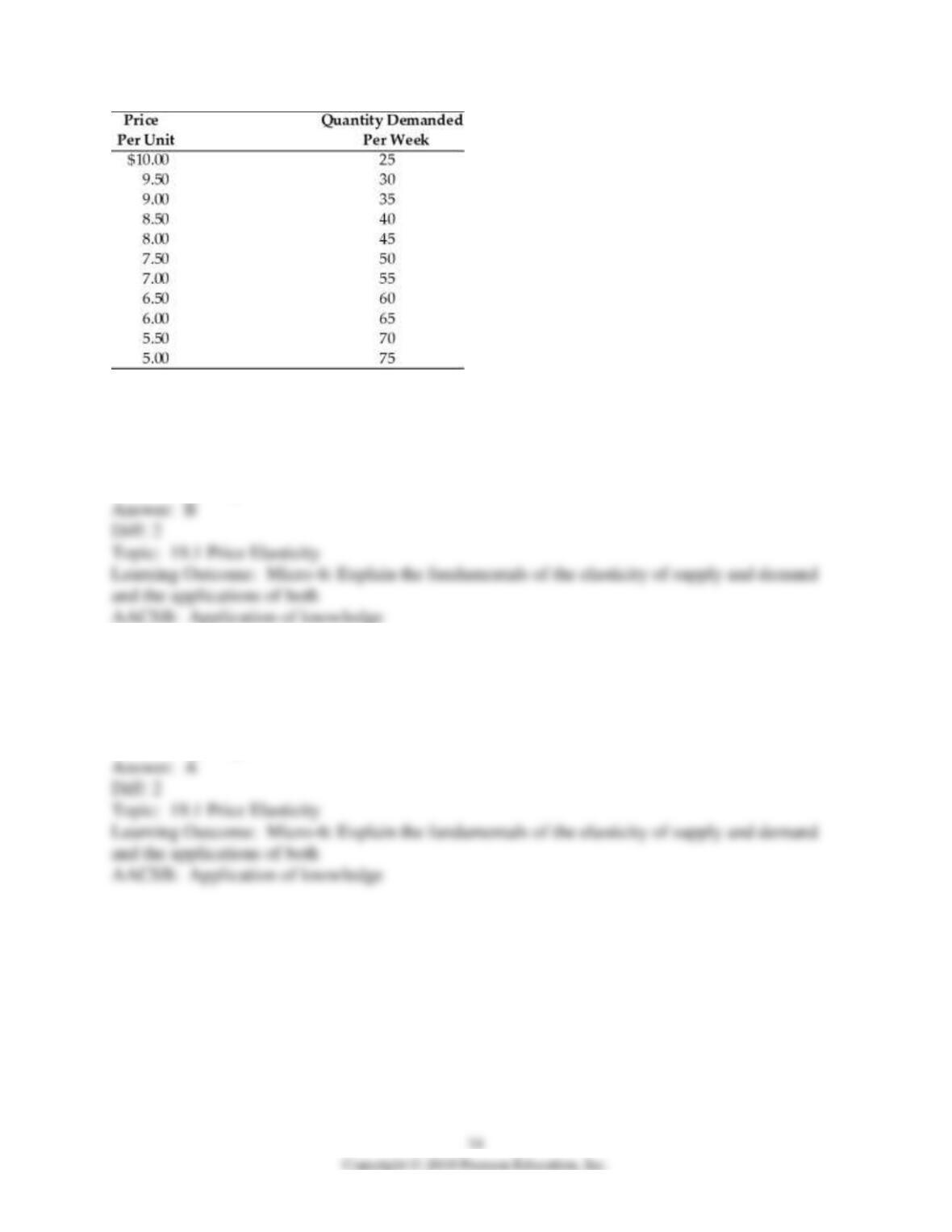
101) Refer to the above table. For which prices is demand elastic?
A) in a range of prices below $6.50
B) in a range of prices above $6.50
C) in a range of prices between $5 and $10
D) in a range of prices above $9.00
102) Refer to the above table. For which prices is demand inelastic?
A) in a range of prices below $6.00
B) in a range of prices above $6.00
C) in a range of prices between $5 and $1
D) in a range of prices above $9.00
103) Refer to the above table. For which prices is demand unit-elastic?
A) in a range of prices below $6.50
B) in a range of prices above $6.50
C) in a range of prices between $5 and $10
D) in a range of prices between $6 and $6.50
104) Refer to the above table. At a price below $5, the absolute price elasticity of demand is
A) 1.0.
B) below 1.
C) between 0.8 and 1.0.
D) greater than 1.
105) To say that demand is elastic means that
A) people do not like the good very much.
B) quantity demanded not very responsive to price changes.
C) relatively small changes in price lead to relatively large changes in quantity demanded.
D) relatively small changes in quantity demanded lead to relatively small changes in price.
106) A demand relationship in which a given percentage change in price will result in a larger
percentage change in quantity demanded is
A) elastic.
B) unit-elastic.
C) inelastic.
D) consistent with zero elasticity.
107) A demand relationship in which the quantity demanded changes exactly in proportion to the
change in price is
A) elastic.
B) unit-elastic.
C) inelastic.
D) consistent with zero elasticity.
108) A demand relationship in which a given percentage change in price will result in a less than
proportionate percentage change in quantity demanded is
A) elastic.
B) unit-elastic.
C) inelastic.
D) consistent with zero elasticity.
109) When demand is elastic
A) a proportionately small change in price leads to a proportionately large change in quantity
supplied.
B) a proportionately small change in price leads to a proportionately small change in quantity
supplied.
C) a proportionately small change in price leads to a proportionately large change in quantity
demanded.
D) a proportionately small change in price leads to a proportionately small change in quantity
demanded.
110) When demand is elastic
A) quantity demanded is very responsive to a change in price.
B) quantity demanded is not very responsive to a change in price.
C) the proportional change in quantity demanded is equal to the proportional change in price.
D) producers react quickly to price changes.
111) When demand is inelastic
A) quantity demanded is very responsive to a change in price.
B) quantity demanded is not very responsive to a change in price.
C) the proportional change in quantity demanded is equal to the proportional change in price.
D) producers react quickly to price changes.
112) If demand is unit elastic, then
A) a ten percent increase in price leads to a one percent decrease in quantity demanded.
B) the unit change in quantity demanded equals the unit change in price.
C) a two percent increase in price leads to a two percent decrease in quantity demanded.
D) an increase in price of any amount leads to quantity demanded falling to zero.
113) The absolute price elasticity of demand for a vertical demand curve
A) is infinite.
B) is 1.0.
C) is 0.
D) depends on where one is on the demand curve.
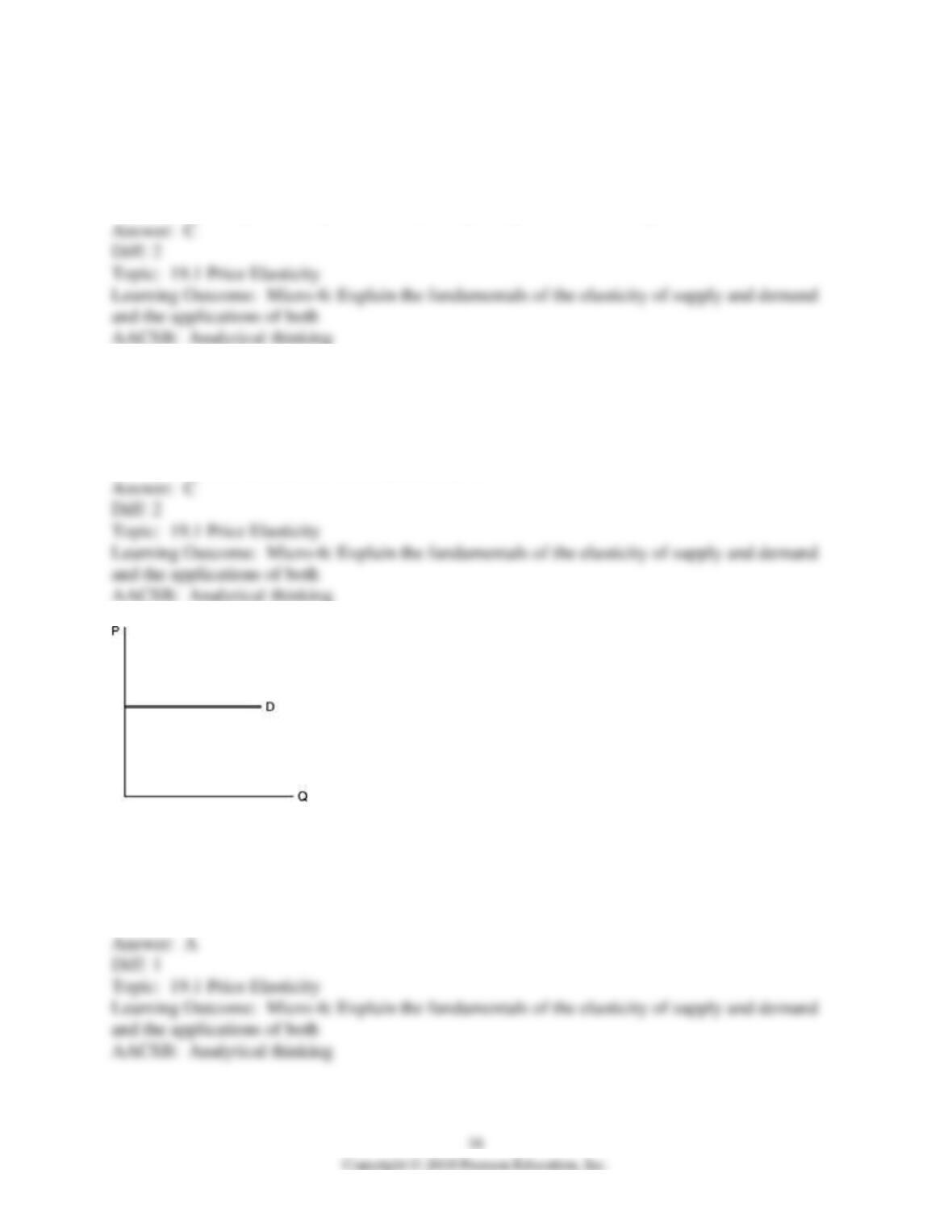
114) Refer to the above figure. Demand is
A) perfectly elastic.
B) unitary elastic.
C) perfectly inelastic.
D) undetermined without more information.
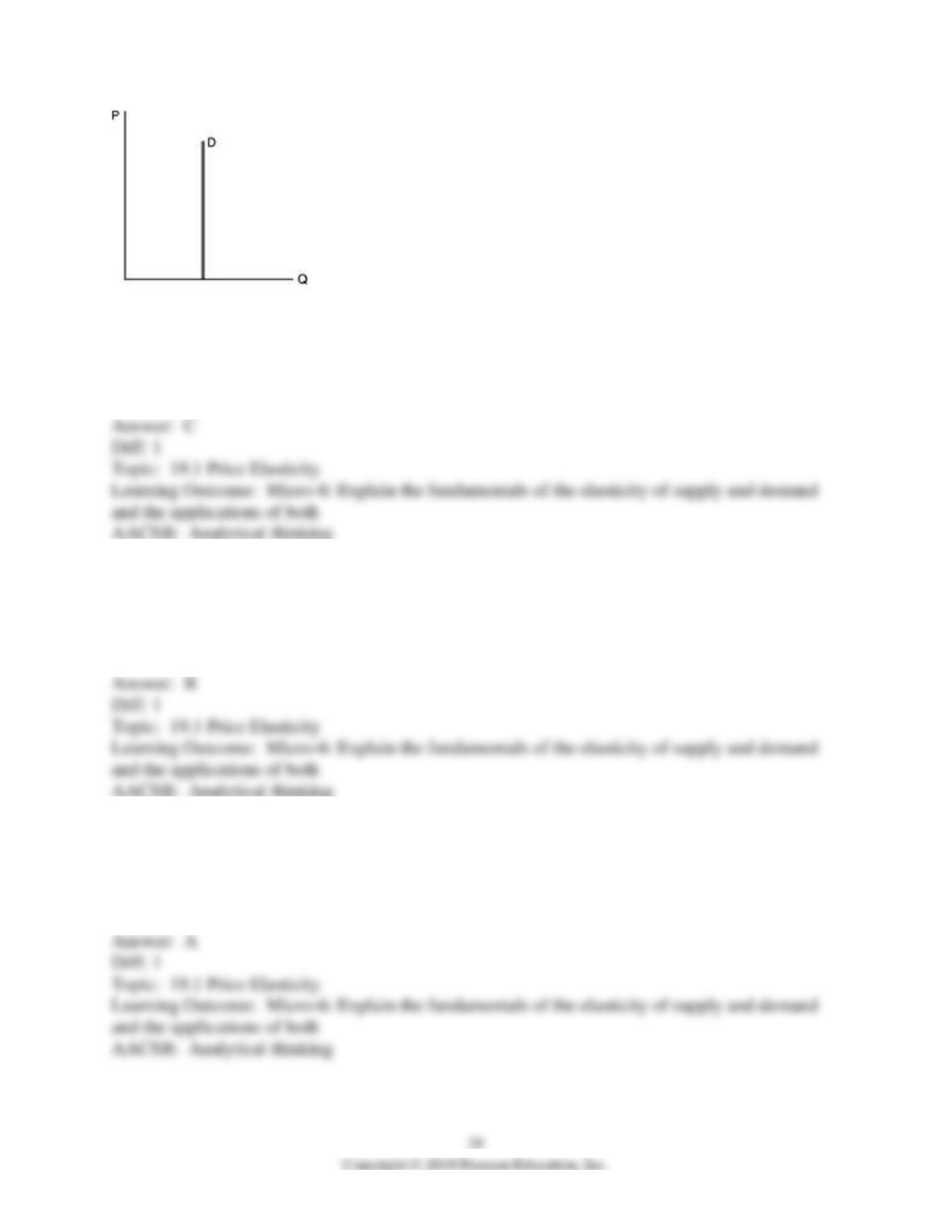
115) Refer to the above figure. Demand is
A) perfectly elastic.
B) unitary elastic.
C) perfectly inelastic.
D) undetermined without more information.
116) When the absolute price elasticity of demand equals 1, demand is
A) elastic.
B) unit-elastic.
C) inelastic.
D) undetermined without more information.
117) When the absolute price elasticity of demand is greater than 1, demand is
A) elastic.
B) unit-elastic.
C) inelastic.
D) undetermined without more information.
118) When the absolute price elasticity of demand is less than 1, demand is
A) elastic.
B) unit-elastic.
C) inelastic.
D) undetermined without more information.
119) When the absolute price elasticity of demand equals 2.5, demand is
A) elastic.
B) unit-elastic.
C) inelastic.
D) undetermined without more information.
120) When the absolute price elasticity of demand equals 0.9, demand is
A) elastic.
B) unit-elastic.
C) inelastic.
D) undetermined without more information.
121) Moving up a straight-line demand curve, the absolute price elasticity of demand
A) decreases.
B) remains constant.
C) increases.
D) varies in uncertain ways.