Economics Today, 19e (Miller)
Chapter 19 Demand and Supply Elasticity
19.1 Price Elasticity
1) The price elasticity of demand is a measure of
A) the responsiveness of the quantity demanded of a good to a changes in the price of the good.
B) the quantity demanded of a good at a given price.
C) the demand for a product holding prices constant.
D) the horizontal shift in the demand curve when the price of a good changes.
2) Suppose that when the price of donuts rises 10%, the quantity demanded of donuts falls 3%.
Based on this information, what is the approximate absolute price elasticity of demand for
donuts?
A) 3.33
B) 0.3
C) 30
D) 1.3
3) The price elasticity of demand measures
A) the consumers’ sensitivity to a price change.
B) the producers’ sensitivity to a price change.
C) how much the market supply changes in response to a change in demand.
D) how much the demand changes in response to a change in income.
4) A good’s price elasticity of demand can be calculated by using the formula of
A) percentage change in price divided by percentage change in quantity demanded.
B) percentage change in quantity demanded divided by percentage change in price.
C) percentage change in price divided by percentage change in income.
D) absolute change in quantity demanded divided by absolute change in price.
5) Which of the following statements about demand and price elasticity of demand is TRUE?
A) As the demand curve has a positive slope, the price elasticity of demand is positive.
B) As the demand curve has a negative slope, the price elasticity of demand is negative.
C) As the demand curve has a positive slope, the price elasticity of demand is negative.
D) As the demand curve has a negative slope, the price elasticity of demand is positive.
6) The price elasticity of demand shows
A) the relationship between market price and household income.
B) the proportionate amount by which the quantity demanded changes in response to a
proportionate change in price.
C) the quantity demanded at a given price.
D) the proportionate amount by which the price changes in response to a proportionate change in
quantity demanded.
7) The price elasticity of demand is
A) always positive, so there is no reason to consider the absolute value of the price elasticity of
demand.
B) always negative, but by convention, economists typically express the price elasticity of
demand as an absolute value.
C) always equal to -1, which by convention economists typically express as an absolute value, or
1.
D) always equal to zero, so there is no reason to consider the absolute value of the price elasticity
of demand.
8) If the absolute price elasticity of demand for good X is 0.5, when there is a 10 percent increase
in price, we can conclude that quantity demanded
A) has fallen by 50 percent.
B) has fallen by 20 percent.
C) has fallen by 10 percent.
D) has fallen by 5 percent.
9) When economists want to obtain a measure of the responsiveness of quantity demanded to
changes in price, they use
A) the slope of the demand curve.
B) the price elasticity of demand.
C) the unit change in quantity demanded.
D) the cross-price elasticity of demand.
10) If the price elasticity of demand for good A is -2, then a 1% increase in
A) consumer income will result in a 2% decrease in the demand for good A.
B) consumer income will result in a 2% increase in the demand for good A.
C) the market price of good A will result in a 2% increase in the quantity demanded of good A.
D) the market price of good A will result in a 2% decrease in the quantity demanded of good A.
11) The formal definition of price elasticity of demand is
A) change in quantity demanded divided by change in price.
B) quantity demanded divided by price.
C) percentage change in quantity demanded divided by percentage change in price.
D) quantity demanded multiplied by price and divided by 100.
12) If price decreases by 10 percent and quantity demanded increases by 3 percent, the price
elasticity of demand will be
A) 3.
B) 0.3.
C) 3.33.
D) 300.
13) If the absolute price elasticity of demand is 2.0, a 10 percent decrease in price will increase
quantity demanded by
A) 10 percent.
B) 20 percent.
C) 5 percent.
D) 12 percent.
14) A 2 percent rise in the price of a good leads to a 4 percent decrease in quantity demanded.
The absolute price elasticity of demand is
A) 2.
B) 0.5.
C) 20.
D) 5.
15) An absolute price elasticity of demand equal to 4 indicates that a
A) 4 percent increase in price leads to a 10 percent decrease in quantity demanded.
B) 1 percent increase in price leads to a 4 percent decrease in quantity demanded.
C) 0.4 percent decrease in price leads to a 1 percent increase in quantity demanded.
D) 10 percent decrease in price leads to a 4 percent increase in quantity demanded.
16) Even though price elasticity of demand is always ________, by convention its absolute value
is always discussed as a ________.
A) negative; prime number
B) positive; negative number
C) a fraction; whole number
D) negative; positive number
17) When the price of a soft drink from the campus vending machine was $0.60 per can, 100
cans were sold each day. After the price increased to $0.75 per can, sales dropped to 85 cans per
day. Over this range, the absolute price elasticity of demand for soft drinks was approximately
equal to
A) 0.15.
B) 0.60.
C) 0.73.
D) 1.67.
18) Six months ago, the price of gasoline was $2.20 per gallon. Now, the price is $2.40 per
gallon. In response to this price increase, the number of gallons of gasoline purchased has
declined by 2 percent. Based on this information, what is the absolute price elasticity of demand
for gasoline?
A) 4.35
B) 1.20
C) 0.23
D) 0.10
19) The local baseball stadium’s concession stands previously sold hot dogs for 80 cents apiece.
At that price, when a baseball fan went to watch a baseball game, he bought 2 hotdogs. But now
that the stadium has a “dime-a-dog night,” he has purchased 6 hot dogs. What is the approximate
value of this individual’s absolute price elasticity of demand for hot dogs?
A) 0.64
B) 0.80
C) 1.00
D) 1.56
20) Suppose the quantity demanded of ice cream cones increases from 400 to 425 cones a day
when the price is reduced from $1.50 to $1.25. In this situation, the elasticity of demand,
calculated using the average method, is
A) 3.
B) 1.
C) 0.33.
D) 1.33.
21) The quantity of raspberries sold at a local store increases from 100 pints to 1,500 pints when
the price is reduced from $4.00 to $1.00. In this situation, the absolute price elasticity of demand
for raspberries is approximately
A) 0.69.
B) 6.7.
C) 1.46.
D) 4.3.
22) Suppose that the price of eggs increases from 75 cents to $1.00 per dozen and as a result a
typical farmer experiences a decrease in egg sales from 300 to 200 dozen per week. Using the
method of average values, the absolute price elasticity of demand is
A) 1.4.
B) 0.8.
C) 3.0.
D) 1.75.
23) If the price of good A increases from $15 to $20 per unit and quantity demanded falls from
150 to 100 units, then by using the method of average values, we can calculate the absolute price
elasticity of demand to be
A) 2.6.
B) 0.75.
C) 1.4.
D) 2.4.
24) When price is $5 per unit, quantity demanded is 12 units. When price is $6 per unit, quantity
demanded is 8 units. The value of the absolute price elasticity of demand is approximately
A) 2.20.
B) 4.00.
C) 1.82.
D) 0.36.
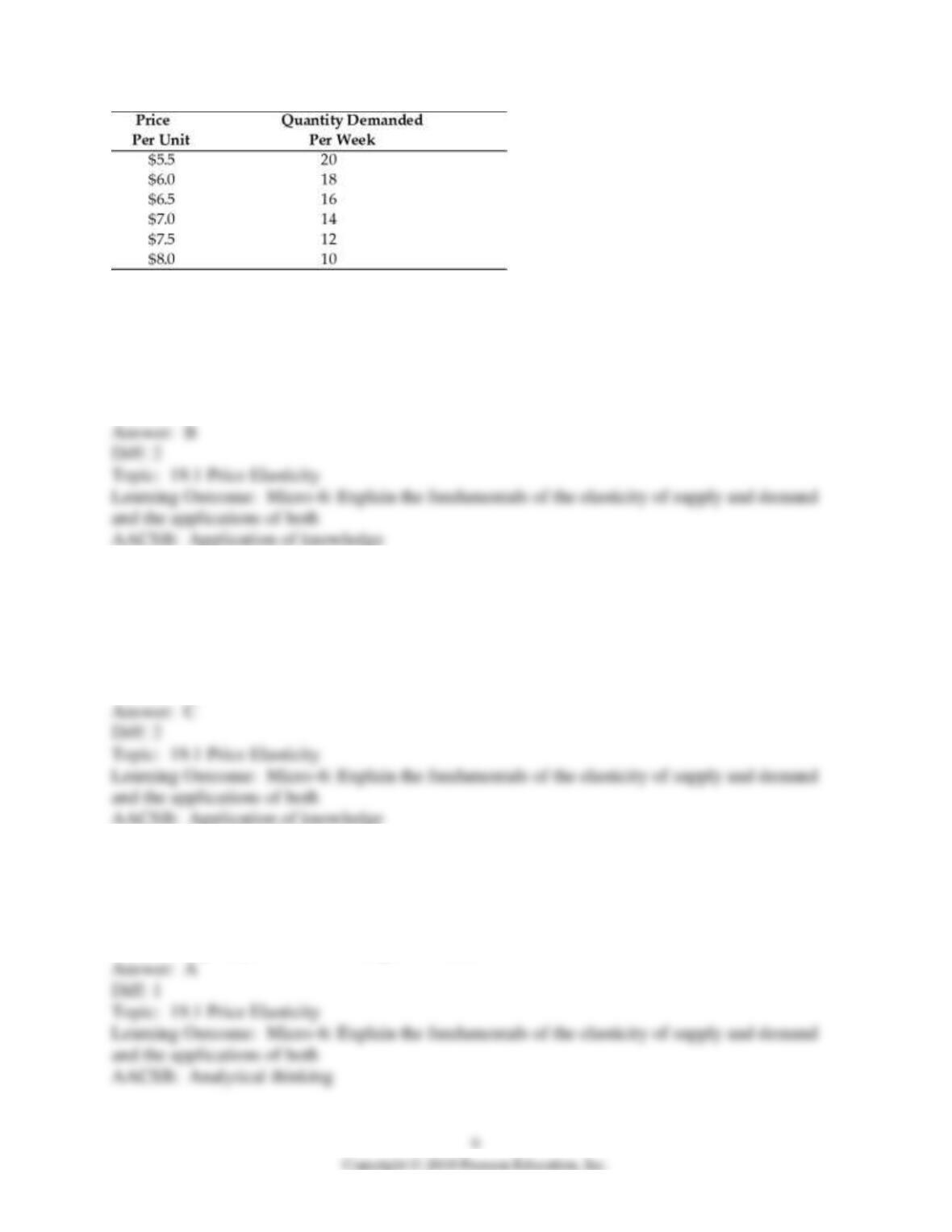
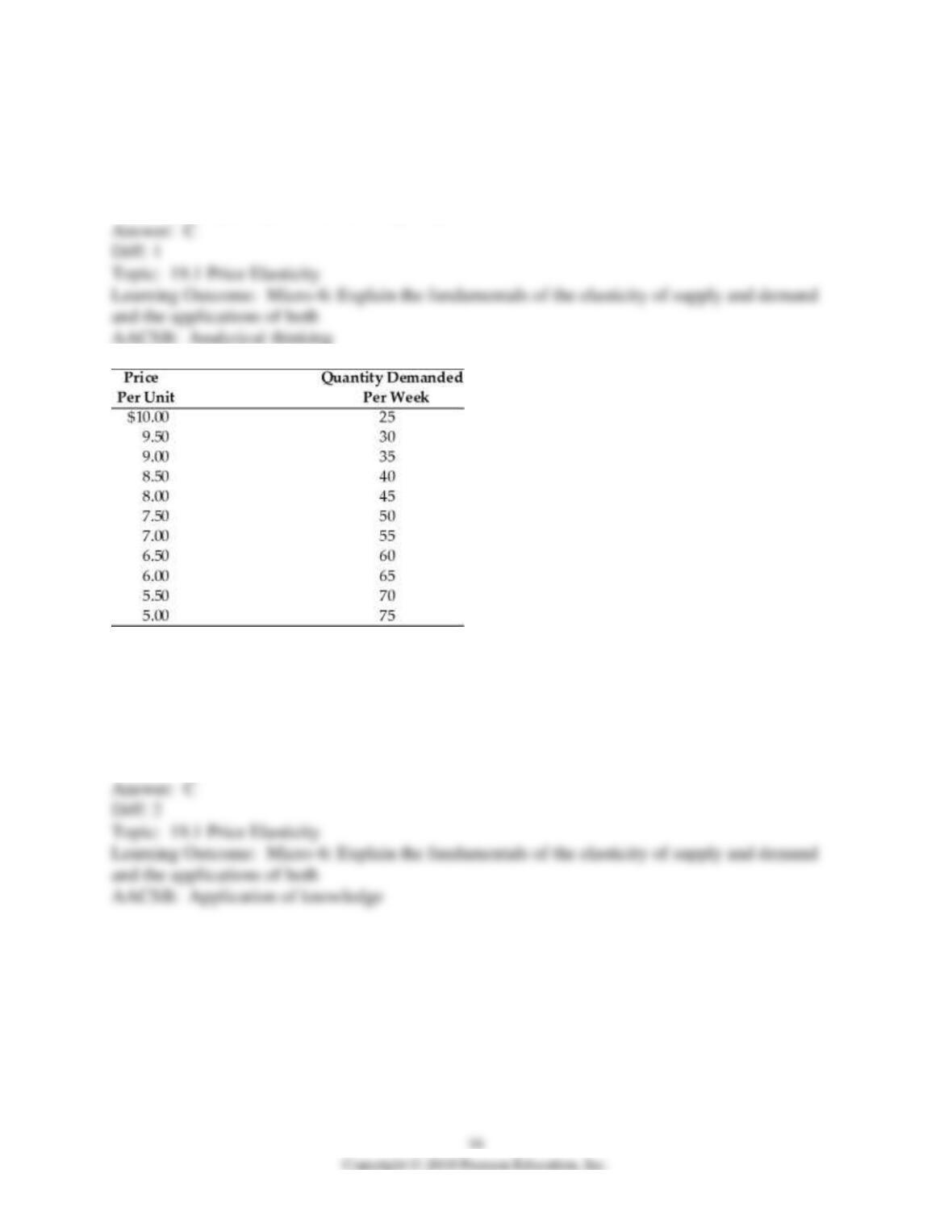
25) According to the above table, what is the absolute price elasticity of demand if price falls
from $8.00 to $7.50?
A) 4.00
B) 2.82
C) 1.80
D) 1.21
26) According to the above table, what is the absolute price elasticity of demand when price rises
from $5.50 to $6?
A) 4.00
B) 2.23
C) 1.21
D) 0.50
27) The price elasticity of demand measures
A) the responsiveness of quantity demanded to a change in price.
B) the responsiveness of price to a change in competition.
C) the change in quantity demanded due to a change consumer income.
D) the change in price due to a change in demand.
28) The responsiveness of quantity demanded of a good to changes in its price is the
A) cross elasticity of demand.
B) quantity elasticity of price.
C) income elasticity.
D) price elasticity of demand.
29) The word best associated with price elasticity of demand is
A) relative.
B) total.
C) absolute.
D) unit.
30) The price elasticity of demand is measured by the
A) percentage change in quantity demanded divided by the percentage change in price.
B) percentage change in price divided by the percentage change in quantity demanded.
C) change in quantity demanded divided by the change in price.
D) change in price divided by the change in quantity demanded.
31) The actual value of the price elasticity of demand is always
A) positive because of the law of demand.
B) negative because of the law of demand.
C) positive because of diminishing marginal utility.
D) negative because percentages can only be negative.
32) A 10 percent increase in the price of tablets leads to a 1 percent decrease in the quantity
demanded of tablets. The absolute price elasticity of demand for tablets is
A) 9.
B) 1.
C) 0.1.
D) 10.
33) A 10 percent increase in the price of portable power banks leads to a 5 percent decrease in
the quantity demanded of portable power banks. The absolute price elasticity of demand is
A) 3.
B) 0.33.
C) 0.5.
D) 2.
34) A 2 percent increase in the price of rice leads to a 2 percent decrease in the quantity
demanded of rice. The absolute price elasticity of demand is
A) 3.
B) 1.
C) 0.1.
D) 6.
35) A 2 percent increase in the price of jeans leads to a 5 percent decrease in the quantity
demanded of jeans. The absolute price elasticity of demand is
A) 2.5.
B) 1.
C) 0.4.
D) 0.2.
36) A value of the absolute price elasticity of demand equal to 0.5 indicates that
A) a 5 percent increase in price leads to a 10 percent decrease in quantity demanded.
B) a 10 percent increase in price leads to a 5 percent decrease in quantity demanded.
C) a 0.5 percent increase in price leads to a 1 percent decrease in quantity demanded.
D) a 1 percent increase in price leads to a 5 percent decrease in quantity demanded.
37) A value of the absolute price elasticity of demand equal to 0.25 indicates that
A) a 10% decrease in price leads to a 4% increase in quantity demanded.
B) a 10% decrease in price leads to a 25% increase in quantity demanded.
C) a 1% decrease in price leads to a 2.5% increase in quantity demanded.
D) a 0.25% decrease in price leads to a 1% increase in quantity.
38) A value of the absolute price elasticity of demand equal to 0.5 indicates that
A) a 0.5% decrease in price leads to a 1% increase in quantity demanded.
B) a 2% decrease in price leads to a 25% increase in quantity demanded.
C) a 1% increase in price leads to a 5% decrease in quantity demanded.
D) a 10% increase in price leads to a 5% decrease in quantity demanded.
39) Absolute price elasticities are calculated for four goods, and the values are: 0.009; 1.0; 3.5;
and 4. Which indicates the most price-responsive situation?
A) 0.009
B) 1.0
C) 3.5
D) 4.0
40) The value of the absolute price elasticity of demand for good A is 4. The absolute price
elasticity for good B is 1. Which good’s quantity demanded is more responsive to a change in
price?
A) Good A
B) Good B
C) They are equally responsive.
D) Not enough information is given.
41) The value of the absolute price elasticity of demand for good A is 3. The absolute price
elasticity for good B is 2. Which good’s quantity demanded is less responsive to a change in
price?
A) Good A
B) Good B
C) They are equally responsive.
D) Not enough information is given.
42) The more sensitive quantity demanded is to a change in price, the
A) smaller a change in price must be to induce a certain change in quantity demanded.
B) greater the absolute price elasticity of demand.
C) smaller the absolute price elasticity of demand.
D) closer the absolute price elasticity of demand is to zero.
43) Gold is sold in world markets, usually priced in terms of troy ounces. In the market for gold,
the price elasticity of demand for gold would be expressed as
A) the number of troy ounces of gold sold.
B) the number of whatever currency is used in purchasing the gold.
C) the number of dollars spent on gold.
D) a unitless number.
44) Relative percentage changes are used in measuring price elasticity of demand, so that
A) it does not matter whether price increases or decreases when calculating the elasticity.
B) it does not matter what units are used to measure prices or quantities.
C) we always obtain a positive number.
D) larger numbers indicate greater responsiveness.
45) The actual value of price elasticity of demand
A) measures the relative change in quantity demanded when there is a change in price.
B) will change when the units good is measured in changes.
C) varies with changes in supply.
D) is always negative.
46) The absolute price elasticity of demand for good A is 1.2 when price is measured in dollars.
If price were measured in cents, the price elasticity elasticity of demand would equal
A) 1200.
B) 12.
C) 1.2.
D) 0.8.
47) The price elasticity of demand can be computed as
A) change in total utility/change in quantity.
B) change in price/change in quantity demanded.
C) percentage change in quantity demanded/percentage change in price.
D) change in quantity demanded/change in price.
48) Refer to the above table. What is the absolute price elasticity of demand if a price falls from
$7 to $6.50?
A) 0.85
B) 1.08
C) 1.17
D) 0.92
49) Refer to the above table. What is the absolute price elasticity of demand if a price falls from
$7.50 to $7?
A) 10
B) 1.38
C) 0.724
D) 0.1
50) Refer to the above table. What is the absolute price elasticity of demand when a price rises
from $9 to $9.50?
A) 0.35
B) 0.55
C) 2.57
D) 2.85
51) Refer to the above table. What is the absolute price elasticity of demand when a price rises
from $8 to $8.50?
A) 5.15
B) 1.94
C) 0.515
D) 0.194
52) Refer to the above table. What is the absolute price elasticity of demand when price changes
from $5.50 to $5.00?
A) 0.72
B) 0.79
C) 1.38
D) 5.0
53) Refer to the above table. Demand is least price elastic at a price of
A) $10.00.
B) $7.50.
C) $7.00.
D) $5.00.
54) Refer to the above table. Demand is unit elastic between the prices of
A) $5.00 and $10.00.
B) $6.00 and $7.00.
C) $6.00 and $6.50.
D) $7.00 and $7.50
55) Refer to the above table. What is the absolute price elasticity of demand when price changes
from $6.00 to $6.50?
A) 1.60
B) 1.00
C) 0.65
D) 0.60
56) Price elasticity of demand is the responsiveness of
A) the quantity demanded to a change in price.
B) demand to a change in supply.
C) demand to a change in income.
D) demand for a good to a change in the demand for another good.
57) The price elasticity of demand is the
A) percentage change in quantity demanded divided by the percentage change in price.
B) change in quantity demanded divided by the change in price.
C) percentage change in price divided by the percentage change in quantity demanded.
D) change in price divided by the change in quantity demanded.
58) The result of the calculation of the price elasticity of demand is
A) always positive.
B) always negative.
C) sometimes positive, sometimes negative.
D) always greater than one.
59) Price elasticity of demand basically measures
A) the reliability of a product.
B) the responsiveness of consumers to price changes.
C) the variability of price changes.
D) the percentage change in market price as a result of a change in demand.
60) If the price of gasoline increased by 5% and consumers responded by purchasing 5% less
gasoline, the absolute value of price elasticity of demand for gasoline would equal
A) 0.1.
B) 0.5.
C) 5.
D) 1.