72) The currency adopted by most countries in ________ is referred to as the euro.
A) Western Europe
B) Eastern Europe
C) Europe and Asia
D) Southern Europe and Northern Africa
73) All else being equal, if the rate of growth in productivity in Spain is greater than the rate of growth
in productivity in the United States, the euro
A) will decrease in value relative the U.S. dollar.
B) will increase in value relative to the U.S. dollar.
C) will nominally appreciate against the dollar, but its real value relative to the dollar will remain
unchanged.
D) will nominally depreciate against the dollar, but its real value relative to the dollar will remain
unchanged.
74) An increase in the value of the U.S. dollar relative to the Japanese yen would be ________ for
Japanese owners of U.S. houses who wish to sell those houses, and ________ for Japanese manufacturers
operating factories in the United States that export their products back to Japan.
A) good news; good news
B) good news; bad news
C) bad news; good news
D) bad news; bad news
75) If one U.S. dollar could be exchanged for one Australian dollar in 1970, and one U.S. dollar can now
be exchanged for 0.98 Australian dollars, which of the following is true?
A) The U.S. dollar gained value against the Australian dollar.
B) The Australian dollar lost value against the U.S. dollar.
C) The Australian dollar gained value against the U.S. dollar.
D) Both A and C are true.
76) What factors are most important for determining exchange rate fluctuations in the long run?
A) relative price levels across countries
B) relative rates of productivity growth across countries
C) preferences for domestic and foreign goods across countries
D) All of the above are correct.
77) All of the following are considered among the four most important determinants in explaining
exchange rate fluctuations in the long run except
A) tariffs and quotas.
B) preferences for domestic and foreign goods.
C) interest rates.
D) relative rates of productivity growth across countries.
78) If the average productivity of Indian firms is rising more quickly than the average productivity of
American firms, which of the following would you expect to see? (India’s currency is the rupee.)
A) a decrease in the value of the rupee relative to the dollar
B) an increase in the prices of Indian products
C) an increase in the quantity demanded of Indian products relative to American products
D) All of the above are correct.
79) How will the exchange rate (foreign currency per dollar) respond to a decrease in the relative rate of
productivity growth in the United States in the long run?
A) Exchange rates will rise.
B) Exchange rates will fall.
C) Exchange rates will be unaffected by changes in the relative rate of productivity growth in the United
States, both in the short run and in the long run.
D) The exchange rate will be affected in the short run, but not in the long run.
80) How will the exchange rate (foreign currency per dollar) respond to an increase in preference for
imported goods in the United States in the long run?
A) Exchange rates will rise.
B) Exchange rates will fall.
C) Exchange rates will be unaffected by changes in the relative rate of productivity growth in the United
States, both in the short run and in the long run.
D) The exchange rate will be affected in the short run, but not in the long run.
44
81) If inflation in Mexico is lower than it is in the United States,
A) the purchasing power of the peso in buying Mexican goods will fall relative to the dollar.
B) the value of the dollar will rise in the long run.
C) the value of the peso will rise in the long run.
D) the purchasing power of the dollar in buying American goods will rise relative to the peso.
82) Which of the following would decrease the value of the dollar in the long run?
A) a decrease in inflation in the United States relative to other countries
B) a decrease in the demand for American goods relative to goods from other countries
C) an increase in U.S. tariffs on foreign goods
D) a decrease in the supply of dollars on the foreign exchange market
45
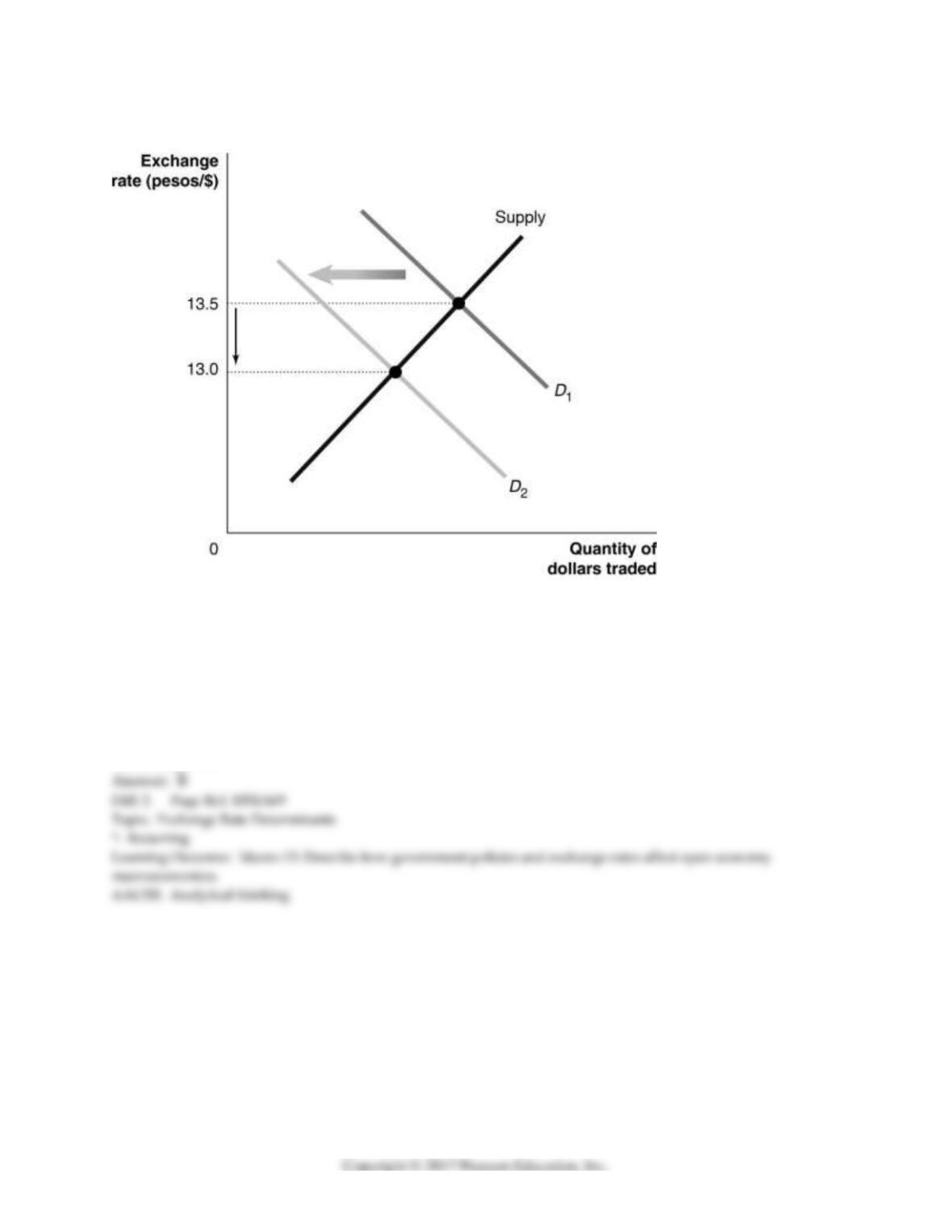
Figure 19-6
83) Refer to Figure 19-6. Which of the following would cause the change depicted in the figure above?
A) An increase in investment in infrastructure causes U.S. productivity to rise relative to Mexican
productivity.
B) A declining preference for Kentucky bourbon causes Mexican consumers to decrease their
preferences for U.S.-produced alcohol relative to Mexican-produced alcohol.
C) Dumping accusations result in the United States placing tariffs on produce imported from Mexico.
D) A contractionary monetary policy causes a decrease in the price level of U.S. goods relative to
Mexican goods.
84) Refer to Figure 19-6. Which of the following would cause the change depicted in the figure above?
A) Lack of investment in infrastructure causes Mexican productivity to fall relative to American
productivity.
B) A possibility of diseased poultry in The United States causes Mexican consumers to decrease their
preferences for U.S.-raised chickens relative to Mexican-raised chickens.
C) A new trade agreement with Mexico results in the United States removing all tariffs on sugar
imported from Mexico.
D) An expansionary monetary policy in Mexico causes an increase in the price level of Mexican goods
relative to U.S. goods.
85) Purchasing power parity is the theory that, in the long run, exchange rates move to equalize
A) nominal interest rates across countries.
B) real GDP across countries.
C) corporate profits across countries.
D) the relative purchasing power of currencies across countries.
86) If the exchange rate between the U.S. dollar and the Mexican peso (pesos per dollar) is less than the
relative purchasing power between the two countries, which of the following would be true?
A) There are opportunities for profit by purchasing goods in the United States and then selling them in
Mexico.
B) Purchasing power parity predicts that the value of the dollar will fall as traders take advantage of
arbitrage opportunities.
C) Purchasing power parity predicts that the dollar is overvalued as traders take advantage of arbitrage
opportunities.
D) There are no arbitrage opportunities for which traders can take advantage.
87) If the purchasing power of a dollar is less than the purchasing power of the euro, purchasing power
parity would predict that
A) in the short run, exchange rates will move to equalize the purchasing power of the dollar and the
euro.
B) in the long run, exchange rates will move to equalize the purchasing power of the dollar and the
euro.
C) in the long run, interest rates will move to equalize the purchasing power of the dollar and the euro.
D) in the short run, interest rates will move to equalize the purchasing power of the dollar and the euro.
88) A Big Mac costs $4.79 in the United States and 9.6 zlotys in Poland. If the exchange rate is 3 zlotys
per dollar, what is the dollar cost of a Big Mac in Poland?
A) $1.60
B) $2.00
C) $3.20
D) $4.64
89) A Big Mac costs $4.79 in the United States and 9.6 zlotys in Poland. If the exchange rate is 3 zlotys
per dollar, purchasing power parity predicts that
A) the dollar will appreciate as the demand for dollars rises in the long run.
B) the dollar will appreciate as the supply of dollars falls in the long run.
C) the dollar will depreciate as the demand for dollars falls in the long run.
D) the dollar will depreciate as the supply of dollars rises in the long run.
90) A Big Mac costs $4.79 in the United States and 9.6 zlotys in Poland. If the exchange rate is 3 zlotys
per dollar, purchasing power parity predicts that
A) the dollar is undervalued.
B) the dollar is overvalued.
C) the zloty is overvalued.
D) both the zloty and dollar are undervalued.
91) The “Big Mac Theory of Exchange Rates” tests the accuracy of purchasing power parity theory. In
July 2015, The Economist reported that the average price of a Big Mac in the United States was $4.79. In
India, the average price of a Big Mac at that time was 116.25 rupees. What is the “implied exchange rate”
between the yen and the dollar?
A) 0.04 rupees per dollar
B) 24.27 rupees per dollar
C) 60.47 rupees per dollar
D) 556.84 rupees per dollar
92) If the implied exchange rate between Big Mac prices in the United States and the Philippines is 68
pesos per dollar, but the actual exchange rate between the United States and the Philippines is 43 pesos
per dollar, which of the following would you expect to see?
A) a depreciation of the dollar
B) an increase in the demand for dollars
C) a decrease in the demand for dollars
D) an appreciation of the Philippine pesos
93) All of the following explain why purchasing power parity does not completely explain long-run
fluctuations in exchange rates except
A) not all goods and services produced in any country are traded internationally.
B) consumer preferences for goods and services differ across countries.
C) some countries impose barriers to trade.
D) most countries have free markets with little, if any, government regulation.
94) If the purchasing power of the dollar is less than the purchasing power of the British pound,
purchasing power parity predicts that the exchange rate will
A) increase if the exchange rate is greater than 1 pound per dollar.
B) decrease if the exchange rate is less than 1 pound per dollar.
C) be equal to the relative purchasing power across the currencies in the long run.
D) All of the above are correct.
95) If, at the current exchange rate between the dollar and the South African rand of 6.92 rand per
dollar, the dollar is “undervalued,” how do you expect demand and supply in the foreign exchange
markets to respond?
A) The demand for the dollar will rise, while the supply of the rand will fall.
B) The demand for the dollar will fall, while the supply of the rand will rise.
C) The demand for the dollar will rise, while the supply of the rand will rise.
D) The supply of the dollar will fall, while the demand for the rand will rise.
96) If, at the current exchange rate between the dollar and the South African rand of 6.92 rand per
dollar, the rand is “undervalued,” how do you expect demand and supply in the foreign exchange
markets to respond?
A) The demand for the dollar will fall, while the supply of the rand will rise.
B) The demand for the dollar will rise, while the supply of the rand will fall.
C) The supply of the dollar will rise, while the demand for the rand will rise.
D) The supply of the dollar will rise, while the demand for the rand will fall.
97) By 2015, ________ members of the European Union were using the euro as their currency.
A) 12
B) 19
C) 28
D) 57
98) The year in which euro coins and paper currency were introduced and participating “euro zone”
countries withdrew old domestic currencies from circulation was
A) 2007.
B) 2002.
C) 1999.
D) 1995.
99) Pegging a country’s exchange rate to the dollar can be advantageous in all of the following situations
except
A) if the country has extensive trade with the United States.
B) if investors believe the dollar to be more stable than the domestic country’s currency.
C) if a country wishes to conduct independent monetary policy.
D) if imports are a significant fraction of the goods the country’s consumers buy.
100) If a country’s currency ________ the dollar, its exchange rate is fixed.
A) is exchanged in currency markets for
B) depreciates against
C) is pegged to
D) has a floating exchange rate value which is equal to
101) A currency pegged at a value above the market equilibrium exchange rate is
A) overvalued.
B) undervalued.
C) achieving purchasing power parity.
D) depreciating in value relative to its pegged currency.
102) If a country sets a pegged exchange rate that is below the equilibrium exchange rate, how can the
country maintain the peg?
A) by purchasing surplus domestic currency at the pegged rate
B) by selling surplus domestic currency at the pegged rate
C) by purchasing surplus domestic currency at the equilibrium exchange rate
D) by decreasing the pegged exchange rate
Article Summary
In an effort to reform its economy, Cuba is likely to eliminate its dual currency system, perhaps as
soon as the end of 2015. Presently, Cuba has two official currencies, the peso (CUP) and the
convertible peso (CUC). The CUP is the currency used by most businesses and citizens, and the CUC,
which will probably be removed from circulation, was designed to be used primarily in the tourism
industry and for foreign trade. The CUC is worth 25 times the CUP, with the CUP being pegged to
the U.S. dollar on a one-for-one basis since 1959. Until recently, the two currencies were used in
separate markets, but there have been signs of both currencies being used at the same locations.
Economists have said that eliminating the dual currency system ignores the primary issue at hand,
which is the need of a CUP devaluation. Economist Pavel Vidal has stated that “A real monetary
reform implies a significant devaluation of the CUP exchange rate. This would change the financial
situation of state companies — some of which would fold — improve competitiveness of the sectors
operating within the global economy and promote more transparency in financial accounts.”
Source: Mark Franc, “Cuba likely to end dual currency system,” Financial Times, June 15, 2015.
103) Refer to the Article Summary. The convertible peso (CUC) is worth 25 times the peso (CUP), yet
Cuban officials have for years treated the two currencies as being of equal value. This indicates that the
peso (CUP) is ________ compared to the convertible peso (CUC), and would need to be ________ for the
two currencies to reach the market equilibrium exchange rate.
A) undervalued; revalued
B) undervalued; devalued
C) overvalued; revalued
D) overvalued; devalued
104) The Danish currency, the krone, is pegged to the euro at a rate of 7.46 kroner (kroner is the plural of
krone) to the euro. At the pegged exchange rate, how many euros would be exchanged for one krone?
A) 0.07
B) 0.13
C) 1.76
D) 7.46
105) The Bulgarian currency, the lev, is pegged to the euro at a rate of 1.96 leva (leva is the plural of lev)
to the euro. At the pegged exchange rate, how many euros would be exchanged for one lev?
A) 0.51
B) 1.00
C) 1.96
D) 3.84
106) Compared to a situation in which there is no change in the value of the dollar relative to the peso,
in which of the following situations would you be worse off?
A) you borrow 10,000 pesos, you earn income in dollars, the dollar appreciates against the peso, you
must pay back the loan in pesos
B) you borrow $10,000, you earn income in pesos, the dollar depreciates against the peso, you must pay
back the loan in dollars
C) you borrow $10,000, you earn income in pesos, the dollar appreciates against the peso, you must pay
back the loan in dollars
D) you borrow 10,000 pesos, you earn income in pesos, the dollar depreciates against the peso, you
must pay back the loan in pesos
107) Fluctuating exchange rates can alter a multinational firm’s profits and losses. The U.S. automobile
manufacturer Tesla produces vehicles in the United States and sells them in Norway. (Norway is Tesla’s
largest overseas market.) If the dollar appreciates against the Norwegian krone, then Tesla’s revenues
from these operations should ________ and its profits from these operations should ________.
A) rise; fall
B) rise; rise
C) fall; fall
D) fall; rise
108) You decide to work in London for the next 5 years, accumulate some savings, then move back to
the United States and convert your savings from British pounds to dollars. At the time of your move,
economists predict that consumers in the United States have lost their affinity for British products, and
expect that this declining preference for British products will continue for the next decade. How should
this influence your decision to work and save in London?
A) You should be discouraged as the declining U.S. preference for British goods should increase the
value of the pound to the dollar and decrease the value of your savings when converted to dollars.
B) You should be discouraged as the declining U.S. preference for British goods should decrease the
value of the pound to the dollar and decrease the value of your savings when converted to dollars.
C) You should be encouraged as the declining U.S. preference for British goods should decrease the
value of the pound to the dollar and raise the value of your savings when converted to dollars.
D) You should be encouraged as the declining U.S. preference for British goods should increase the
value of the pound to the dollar and raise the value of your savings when converted to dollars.
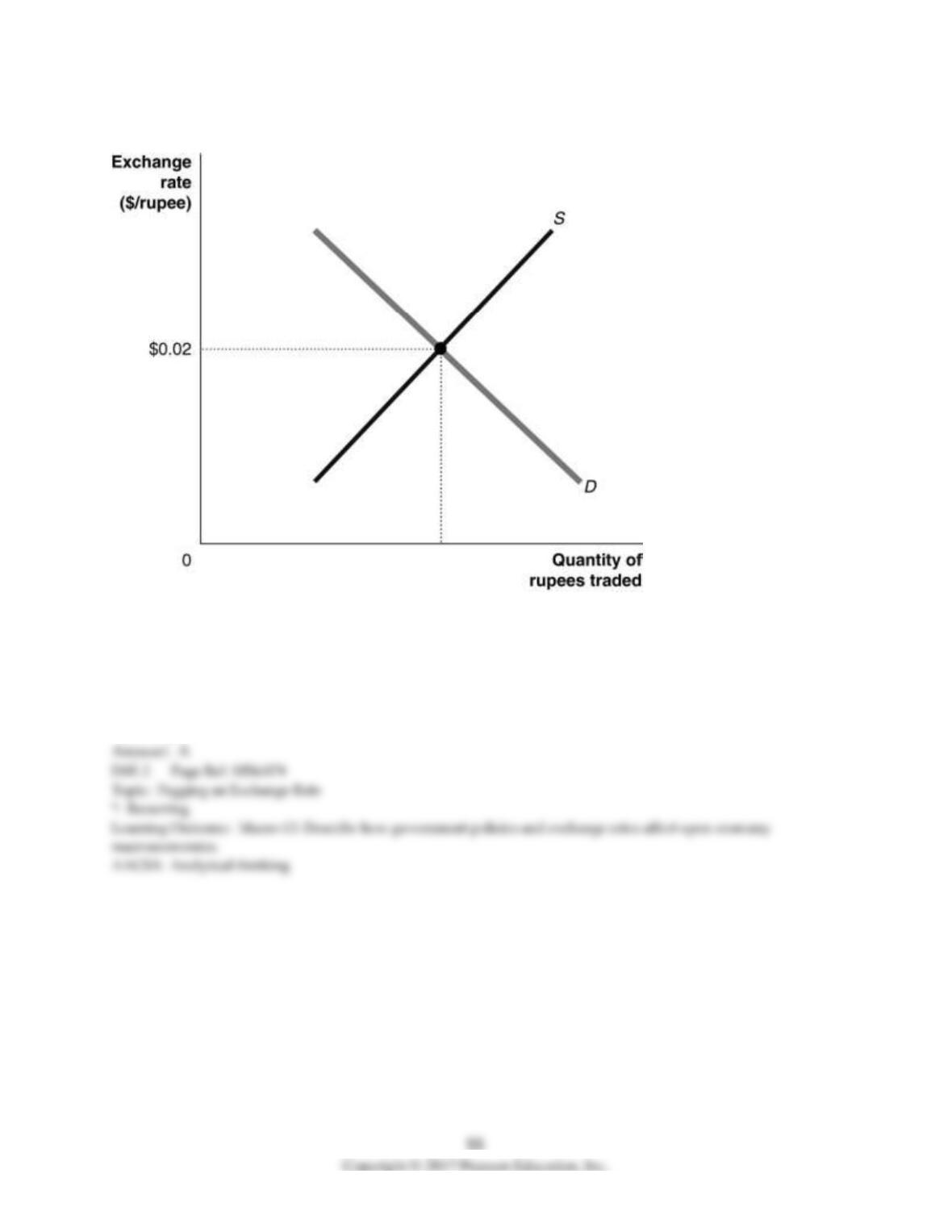
Figure 19-7
109) Refer to Figure 19-7. At what level should the Indian government peg its currency to the dollar to
make U.S. imports cheaper in India?
A) greater than $.02/rupee
B) less than $.02/rupee
C) equal to $.02/rupee
D) $1/rupee
110) Refer to Figure 19-7. Which of the following is true?
A) U.S. imports are more expensive at exchange rates greater than $.02/rupee than at the equilibrium
exchange rate.
B) The rupee is overvalued at exchange rates less than $.02/rupee.
C) To achieve an exchange rate greater than $.02/rupee, the Reserve Bank of India must buy surplus
dollars with rupees.
D) Indian exports to the United States are more expensive at exchange rates greater than $.02/rupee
than at the equilibrium exchange rate.
111) Refer to Figure 19-7. If the Indian government pegs its currency to the dollar at a value below
$.02/rupee, we would say the currency is
A) undervalued.
B) overvalued.
C) parity valued.
D) equilibrium valued.
112) Refer to Figure 19-7. If the Indian government pegs its currency to the dollar at a value above
$.02/rupee, we would say the currency is
A) undervalued.
B) overvalued.
C) parity valued.
D) equilibrium valued.
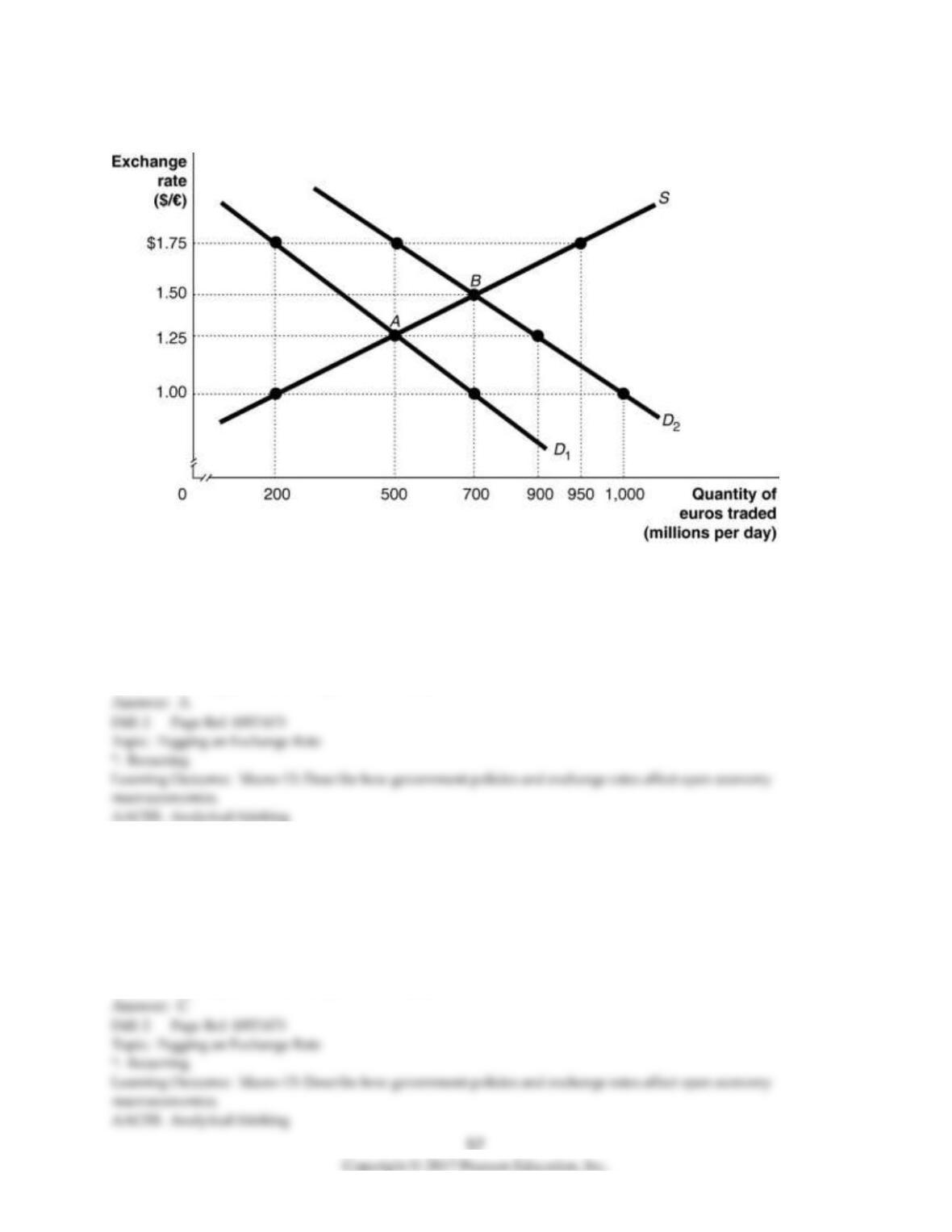
Figure 19-8
113) Refer to Figure 19-8. The equilibrium exchange rate is at A, $1.25/euro. Suppose the European
Central Bank pegs its currency at $1.00/euro. At the pegged exchange rate,
A) there is a shortage of euros equal to 500 million.
B) there is a surplus of euros equal to 300 million.
C) there is a shortage of euros equal to 200 million.
D) there is a surplus of euros equal to 700 million.
114) Refer to Figure 19-8. The equilibrium exchange rate is at A, $1.25/euro. Suppose the European
Central Bank pegs its currency at $1.00/euro. Speculators expect that the value of the euro will rise and
this shifts the demand curve for euro to D2. After the shift,
A) there is a shortage of euros equal to 1,000 million.
B) there is a surplus of euros equal to 400 million.
C) there is a shortage of euros equal to 800 million.
D) there is a surplus of euros equal to 500 million.
115) Refer to Figure 19-8. The equilibrium exchange rate is originally at A, $1.25/euro. Suppose the
European Central Bank pegs its currency at $1.00/euro. Speculators expect that the value of the euro will
rise and this shifts the demand curve for euro to D2. If the European Central Bank abandons the peg,
the equilibrium exchange rate would be
A) $1.00/euro.
B) $1.25/euro.
C) $1.50/euro.
D) $1.75/euro.
116) During the Chinese experience with pegging the yuan to the dollar, the yuan was ________. As a
result, there was a ________ of dollars on the market, and the Chinese government had to purchase
dollars to maintain the peg.
A) overvalued; shortage
B) undervalued; surplus
C) overvalued; surplus
D) undervalued; shortage
117) When foreign investors in Thailand began to realize that Thailand could not maintain its peg to the
dollar indefinitely, they began to ________ in Thailand and exchange ________. This change in
investment by foreigners is termed capital flight.
A) purchase more investments; dollars for baht to purchase these investments
B) sell off their investments; the baht they received for dollars
C) sell off their investments; the dollars they received for baht
D) purchase more investments; baht for dollars to purchase these investments
118) All of the following actions were taken by the Thai government to help Thailand maintain its peg
against the dollar in the 1990s except
A) borrowing dollars from the International Monetary Fund in exchange for baht.
B) buying baht on the foreign exchange market to support higher demand for the baht.
C) increasing domestic interest rates to attract more foreign investors.
D) imposing restrictions on exports to the United States to prevent too many dollars from entering the
economy.
119) Firms in Thailand that had ________ while the baht was pegged to the dollar faced interest
payments that were higher than they had planned once the Thai government abandoned the peg
because the baht had been pegged ________ the equilibrium exchange rate for the baht.
A) borrowed dollars; above
B) borrowed baht; above
C) borrowed dollars; below
D) borrowed baht; below
120) Actions taken by investors who sell a country’s currency in anticipation of buying it back later at a
lower price is known as
A) purchasing power parity.
B) currency arbitrage.
C) destabilizing speculation.
D) exchange rate manipulation.
121) In Thailand in the late 1990s, there was pressure for the value of the baht to decline as foreign
investors began to
A) sell off investments they had made in Thailand and traded in their baht for dollars.
B) sell off investments they had made in Thailand and traded in their dollars for baht.
C) increase their investments in Thailand and exchanged their baht for dollars.
D) increase their investments in Thailand and exchanged their dollars for baht.
122) If the U.S. government removes tariffs it had placed on imports from countries that have been
accused of deliberately undervaluing their currencies, the price of these imports will ________ and the
demand for the undervalued currency will ________.
A) rise; rise
B) rise; fall
C) fall; rise
D) fall; fall
123) China began pegging its currency, the yuan, to the dollar in 1994. Because the yuan was ________
at the pegged exchange rate, the level of Chinese exports remained ________ than they would have been
if the exchange rate were allowed to float freely.
A) undervalued; higher
B) undervalued; lower
C) overvalued; higher
D) overvalued; lower