8) Which of the following statements about capital markets is true?
A) The U.S. capital market is currently larger than all other capital markets combined.
B) At one time, the U.S. capital market was larger than all other capital markets combined, but that is no
longer the case.
C) There are currently large capital markets in Europe, but none in Asia.
D) The largest capital markets in the world today are in East Asia and Latin America.
9) European governments removed many restrictions on flows of capital into and out of Europe in the
________. This policy increased both U.S. investment in European stocks and bonds and European
investment in U.S. stocks and bonds.
A) 1950s and 1960s
B) 1960s and 1970s
C) 1970s and 1980s
D) 1980s and 1990s
10) Foreign purchases of stocks and bonds issued by U.S. corporations ________ between 1995 and 2007
and ________ in 2014.
A) increased at a slow but steady pace; increased dramatically
B) remained stagnant; declined sharply
C) increased dramatically; declined
D) decreased slightly; increased slightly
11) Among countries that purchased U.S. stocks and bonds in 2015, China was the biggest customer,
accounting for over 50 percent of all purchases.
12) Foreign portfolio investment in the United States has continually declined since 1995.
13) Before 1980, U.S. investors rarely invested in foreign capital markets.
14) The three most important financial centers in the world today are New York, London, and Tokyo.
15) International flows of capital increase both efficiency and growth in countries around the world.
16) Explain why international capital markets have expanded since the 1980s.
17) Why are foreign investors more likely to invest in U.S. government bonds than in U.S. corporate
stocks and bonds?
18) Which aspects of globalization help to increase growth in the world economy?
19) What are capital controls? Why might a financial crisis lead to a reconsideration of using capital
controls, and what problems might result from the reinstatement of capital controls?
19.4 Appendix: The Gold Standard and the Bretton Woods System
1) Suppose Mexico and the United States are on the gold standard. If there is a half an ounce of gold in
the dollar, and one quarter an ounce of gold in the peso, then the exchange rate is
A) $1 = 2 pesos.
B) $1 = 4 pesos.
C) $1 = 1/2 peso.
D) $1 = 1/4 peso.
E) $0.50 = 1/2 peso.
2) Suppose the United States decides to go back on the gold standard. This should
A) decrease the Federal Reserve’s ability to pursue active monetary policy.
B) increase the effectiveness of contractionary monetary policy.
C) increase the effectiveness of expansionary monetary policy.
D) improve the Federal Reserve’s ability to target inflation.
3) Countries that abandoned the gold standard early in the Great Depression suffered an average
decline in production of 3 percent between 1929 and 1934. Countries that stayed on the gold standard
until 1933 or later suffered an average decline in production of
A) 12 percent.
B) 18 percent.
C) 24 percent.
D) > 30 percent.
4) A decrease in a fixed exchange rate from $1.75 per pound to $1.60 per pound is called a(n) ________
of the pound.
A) devaluation
B) depreciation
C) appreciation
D) revaluation
5) A persistent surplus of pounds at a given fixed exchange rate (in dollars per pound) is evidence that
the pound is ________ versus the dollar. This surplus can be reduced or eliminated through a ________
of the pound.
A) undervalued; devaluation
B) undervalued; revaluation
C) overvalued; revaluation
D) overvalued; devaluation
6) In order to support an undervalued euro, the European Central Bank must ________ dollars. Over
time, this action will cause the rate of inflation in the EU to ________.
A) buy; decrease
B) buy; increase
C) sell; increase
D) sell; decrease
84
7) The Bretton Woods system confronted severe problems in the 1960s, problems which included
A) some countries with overvalued currencies refused to devalue their currencies.
B) dollars held by foreign central banks exceeded gold reserves held by the United States.
C) the increased demand for gold brought about by lifting the prohibition against U.S. citizens owning
gold.
D) all of the above
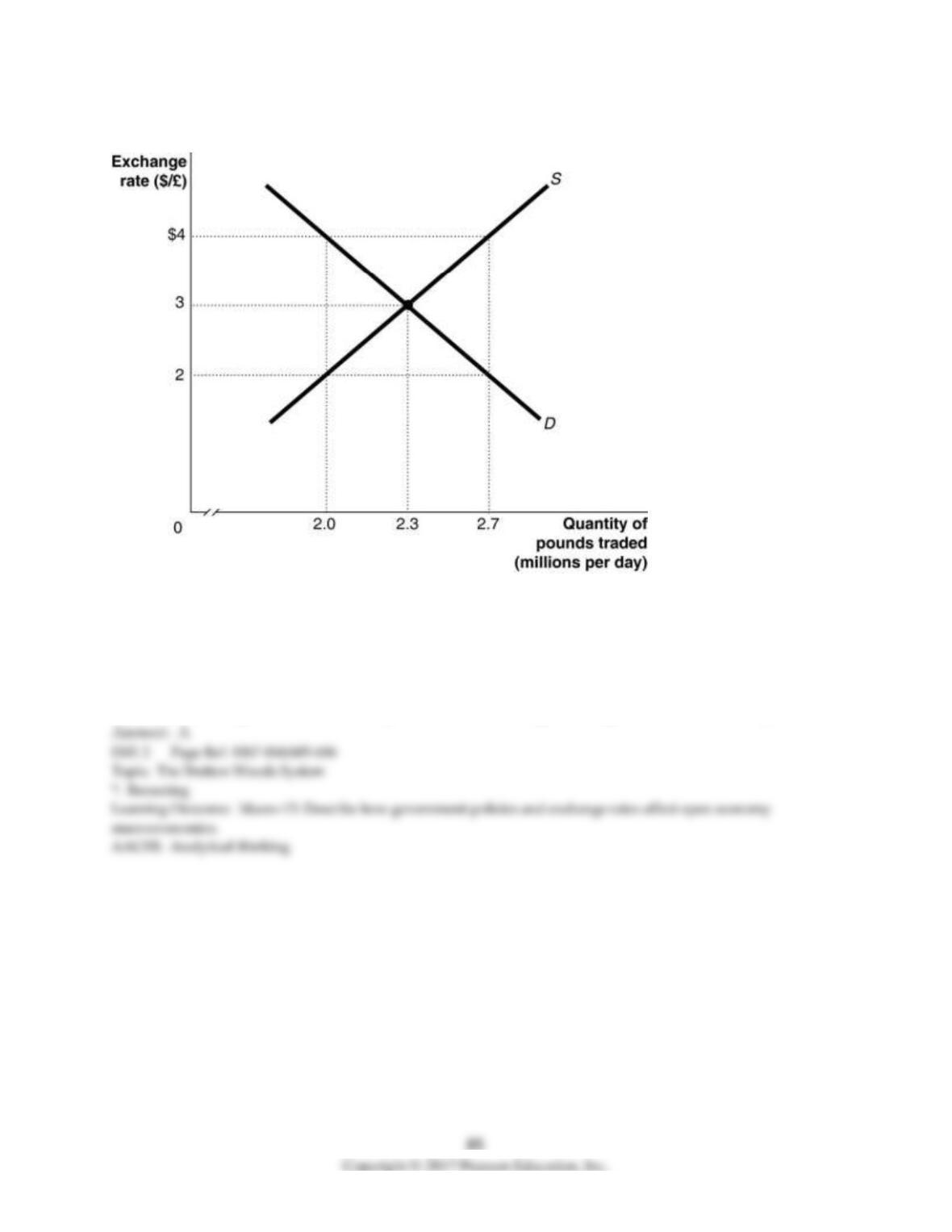
Figure 19-10
8) Refer to Figure 19-10. Under the Bretton Woods System of exchange rates, if the par exchange rate
was $4 per pound in the figure above, then which of the following is true?
A) The Bank of England would have to buy 0.7 million pounds per day with dollars.
B) There is a shortage of pounds equal to 0.7 million.
C) The Bank of England would have to sell 0.7 million pounds per day in exchange for dollars.
D) The par exchange rate is below the equilibrium rate, causing a shortage of domestic currency.
86
9) Refer to Figure 19-10. Under the Bretton Woods System of exchange rates, if the par exchange rate
was $2 per pound in the figure above, and equilibrium persisted at $3, then this was evidence of
________ and the IMF would allow a ________ in the exchange rate.
A) fundamental disequilibrium; revaluation
B) fundamental disequilibrium; devaluation
C) fundamental overvaluation; devaluation
D) fundamental overvaluation; revaluation
10) Refer to Figure 19-10. Under the Bretton Woods System of exchange rates, if the par exchange rate
was $2 per pound in the figure above, and equilibrium persisted at $3, then a revaluation of the
currency would have
A) increased the price of British exports to the United States.
B) increased the price of imports to Britain.
C) led to a current account surplus.
D) led to a balance of trade surplus.
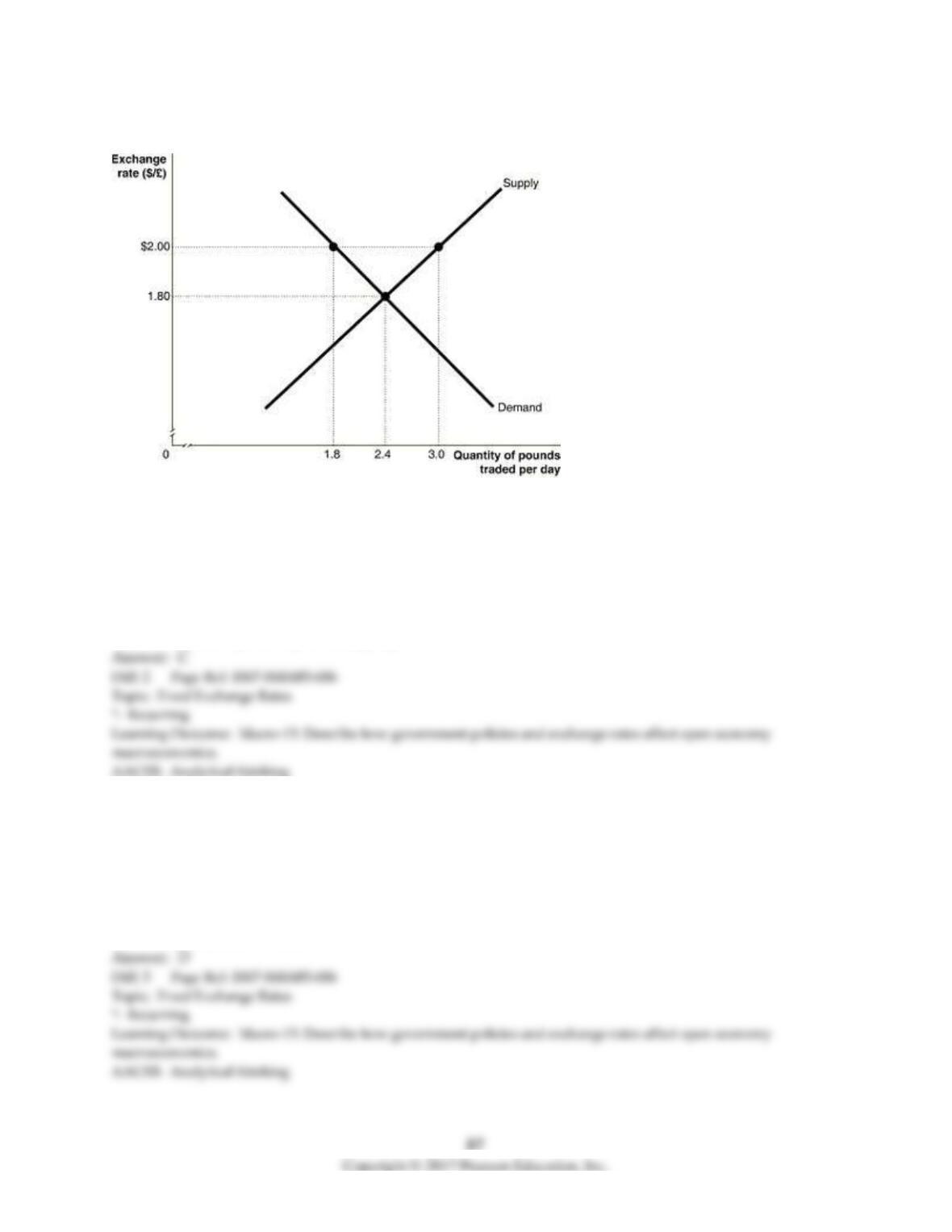
Figure 19-11
11) Refer to Figure 19-11. The graph above depicts supply and demand for British pounds during a
trading day, where the quantity is millions of pounds. In order to support a fixed exchange rate of $2.00
per pound, the British central bank must
A) buy 0.6 million pounds per trading day.
B) sell 0.6 million pounds per trading day.
C) buy 1.2 million pounds per trading day.
D) sell 1.2 million pounds per trading day.
12) Refer to Figure 19-11. The graph above depicts supply and demand for British pounds during a
trading day. At a fixed exchange rate of $2.00 per pound, the pound is ________ versus the dollar. A
________ of the pound would correct the fundamental disequilibrium that exists in this market.
A) undervalued; devaluation
B) undervalued; revaluation
C) overvalued; revaluation
D) overvalued; devaluation
13) Suppose the U.S. dollar is backed by one-sixth of an ounce of gold and the British pound is backed
by one-third of an ounce of gold. The exchange rate between the U.S. dollar and the British pound
equals ________ per pound.
A) $0.50
B) $1.00
C) $1.50
D) $2.00
14) In 1931, the first major country to abandon the gold standard — in order to increase its policy
options in face of the Great Depression — was
A) Great Britain.
B) the United States.
C) Germany.
D) France.
15) When the Bretton Woods system was set up, the United States agreed initially to buy and sell gold
at a price of ________ per ounce.
A) $24
B) $35
C) $42
D) $48
89
16) Americans, other than jewelers or rare coin collectors, were not allowed to own gold from the early
1930s until the
A) 1950s.
B) 1960s.
C) 1970s.
D) 1980s.
17) Under the Bretton Woods system, a fixed exchange rate supported by central banks was known as
a(n) ________ exchange rate.
A) par
B) equilibrium
C) fundamental
D) target
18) A persistent shortage or surplus of a currency under the Bretton Woods system was evidence of
A) failure to support the existing fixed exchange rate by central banks.
B) fundamental disequilibrium in the country’s exchange rate.
C) speculation against the currency by speculators in world exchange markets.
D) all of the above
19) An increase in a fixed exchange rate from $2.00 per pound to $2.10 per pound is called a(n) ________
of the pound.
A) devaluation
B) depreciation
C) appreciation
D) revaluation
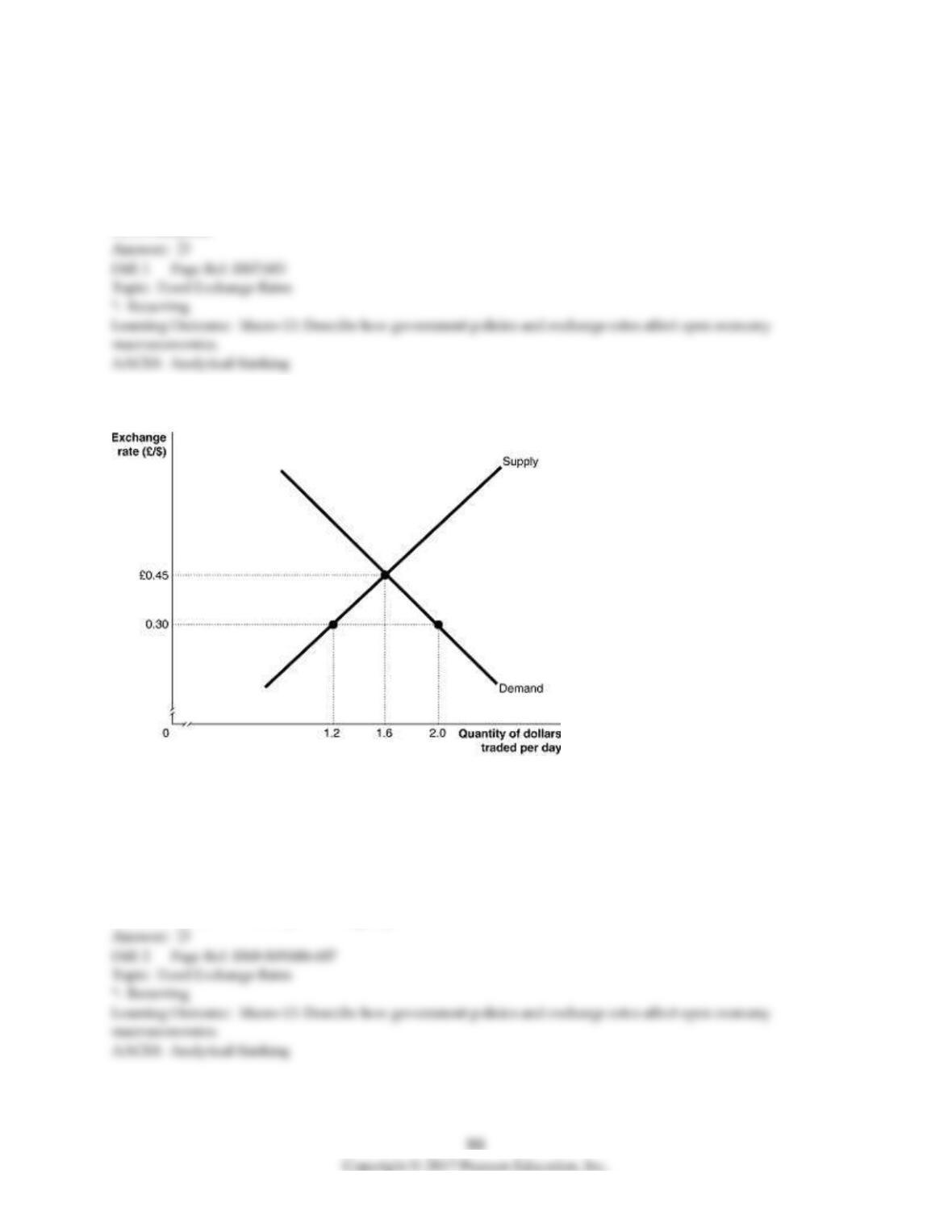
Figure 19-12
20) Refer to Figure 19-12. The graph above depicts supply and demand for U.S. dollars during a trading
day, where the quantity is millions of dollars. In order to support a fixed exchange rate of 0.30 pounds
per dollar, the U.S. central bank must
A) buy 0.4 million dollars per trading day.
B) sell 0.4 million dollars per trading day.
C) buy 0.8 million dollars per trading day.
D) sell 0.8 million dollars per trading day.
21) Refer to Figure 19-12. The graph above, depicts supply and demand for U.S. dollars during a trading
day. At a fixed exchange rate of 0.30 pounds per dollar, the dollar is ________ versus the pound. A
________ of the dollar would correct the fundamental disequilibrium that exists in this market.
A) undervalued; devaluation
B) undervalued; revaluation
C) overvalued; revaluation
D) overvalued; devaluation
22) A persistent shortage of yen at a given fixed exchange rate (in dollars per yen) is evidence that the
yen is ________ versus the dollar. This shortage can be reduced or eliminated through a ________ of
the yen.
A) undervalued; devaluation
B) undervalued; revaluation
C) overvalued; revaluation
D) overvalued; devaluation
23) Limits on the flow of foreign exchange and financial investment across countries are called
A) capital controls.
B) fixed exchange rates.
C) credit constraints.
D) currency restrictions.
24) If speculators believe a currency is undervalued, their trades in international exchange markets will
A) increase the surplus of the currency at the existing fixed exchange rate.
B) decrease the surplus of the currency at the existing fixed exchange rate.
C) decrease the shortage of the currency at the existing fixed exchange rate.
D) increase the shortage of the currency at the existing fixed exchange rate.
25) Under the Bretton Woods system, central bankers could obtain foreign currency loans from the
A) U.S. Treasury Department.
B) World Trade Organization.
C) International Monetary Fund.
D) Bank of England.
26) The International Monetary Fund was created to facilitate the borrowing and lending of dollar
reserves to central banks of the countries participating in the Bretton Wood System.
27) Under the Bretton Woods system, the World Trade Organization (WTO) provided foreign currency
loans to central banks and approved adjustments to the agreed upon fixed exchange rates.
28) In order to reduce or eliminate a chronic shortage in the market for a currency under a fixed
exchange rate system, we must devalue the currency.
29) If speculators believe a currency is soon going to be revalued, they will increase their demand for
that currency.
30) The German central bank, the Bundesbank, faced the risk of increased inflation caused by its actions
to support an overvalued deutsche mark in the 1960s.
31) Increasing a fixed exchange rate is called a revaluation.
32) If the equilibrium exchange rate exceeds the par exchange rate in the market for pounds, the pound
is overvalued.
33) In a fixed exchange rate system, speculation regarding an expected revaluation or devaluation of a
currency makes it more difficult to maintain the existing exchange rate.
34) By the late 1950s, dollars held by foreign central banks exceeded the official dollar value of U.S. gold
reserves.
35) What is the difference between a devaluation and a revaluation of a currency?
36) What is destabilizing speculation? What role did it play in the collapse of the Bretton Woods
system?
95
37) What determined the exchange rates among currencies under the gold standard, and what caused
the gold standard to collapse?
38) Briefly describe how the Bretton Woods system operated.