
KEYWORDS:
BLOOM’S: Comprehension
76. A bilateral monopoly is a market situation in which there is only one buyer and only one seller.
a.
True
b.
False
ANSWER:
True
POINTS:
DIFFICULTY:
Moderate
Monopoly
TOPICS:
KEYWORDS:
BLOOM’S: Comprehension
77. With a monopsony in the labor market, a union can often raise wages and the number of workers hired.
a.
True
b.
False
ANSWER:
True
POINTS:
DIFFICULTY:
Moderate
TOPICS:
KEYWORDS:
BLOOM’S: Comprehension
78. The relationship between professional basketball players and the owners’ association is an example of a bilateral
monopoly.
a.
True
b.
False
ANSWER:
True
POINTS:
DIFFICULTY:
Easy
TOPICS:
KEYWORDS:
BLOOM’S: Comprehension
79. Firms use collective bargaining to set higher market prices for their products.
a.
True
b.
False
ANSWER:
False
DIFFICULTY:
Easy

80. Collective bargaining is a process used by unions and management to settle upon the terms of a labor contract.
a.
True
b.
False
True
Easy
81. When unions and management fail to reach agreement and the public interest is compromised, the government may
require the union and management to undertake mediation.
a.
True
b.
False
True
Moderate
82. The United States suffers more from strikes than Japan but fewer strikes than Canada.
a.
True
b.
False
True
Moderate
83. Most collective bargaining situations lead to strikes.
a.
True
b.
False
False

Easy
84. The percentage of work time lost due to strikes in the United States has been increasing over time.
a.
True
b.
False
False
Easy
85. The percentage of work time lost due to strikes is greater than the percentage of work time lost due to coffee breaks.
a.
True
b.
False
False
Easy
86. More goods are available to the average American today than two hundred years ago, but today an American has to
work more hours to earn the money to purchase most items.
a.
True
b.
False
False
Easy
87. During the twentieth century, the real income of the average American grew by a factor of more than seven.

a.
True
b.
False
True
Easy
88. The process by which new product or production methods are introduced is called the Industrial Revolution.
a.
True
b.
False
False
Easy
89. Labor productivity refers to the total amount of output a worker produces in some period of time (an hour, a week, a
month, a year).
a.
True
b.
False
True
Easy
90. Rising labor productivity means that less labor is needed to produce the same level of output.
a.
True
b.
False
True
Easy

91. Innovation refers to the introduction of new products and processes into the market.
a.
True
b.
False
True
Easy
92. One of the great strengths of the market system is the way it acts as an engine of economic growth and innovation.
a.
True
b.
False
True
Easy
93. Capitalism is an economic system in which there is public ownership of the means of production and resource
allocation is determined through markets.
a.
True
b.
False
False
Easy
94. Capitalism is an economic system in which the production process is controlled primarily by private firms operating in
markets.
a.
True
b.
False
True

Easy
economics
95. The Industrial Revolution refers to the period 1950-1970, which was characterized by rapid manufacturing sector
growth in the United States.
a.
True
b.
False
False
Moderate
96. The Industrial Revolution refers to the stream of new technology and the resulting growth of output than began in
England toward the end of the eighteenth century.
a.
True
b.
False
True
Moderate
97. Average growth rates of per capita income were close to zero, on average, prior to the Industrial Revolution.
a.
True
b.
False
True
Moderate

98. Invention alone does not explain why free market societies have experienced such rapid rates of economic growth.
a.
True
b.
False
True
Easy
99. Research and development refers to the activity of firms, universities, and government agencies that seek to invent
new products and processes.
a.
True
b.
False
True
Easy
100. It required less labor time to buy a college education in 1995 than it did in 1965.
a.
True
b.
False
False
Easy
101. The more money firms spend on R&D the faster the economy is expected to grow.
a.
True
b.
False
True

102. A firm will generally believe that if it increases its spending on R&D its competitors will not follow, but if it
decreases its spending they will follow.
a.
True
b.
False
False
Difficult
103. A firm will tend to follow competitors when they increase spending on R&D, but will not follow them when they
decrease such spending.
a.
True
b.
False
True
Difficult
104. The proliferation of new products that we are used to today has been occurring since the advent of the Industrial
Revolution.
a.
True
b.
False
True
Moderate
105. Most innovation comes from universities and governments, which are inherently market driven.
a.
True
b.
False

False
Moderate
106. Most innovations come from just a few large industries.
a.
True
b.
False
False
Moderate
107. Innovative firms face competition much more quickly than they did one hundred years ago.
a.
True
b.
False
True
Moderate
108. One of the reasons for the growth performance of free market economies is firms’ use of innovation to compete with
one another.
a.
True
b.
False
True
Moderate

109. Price competition among firms has proved to be more important than the introduction of new products.
a.
True
b.
False
False
Moderate
110. Collaborative research is especially important in high-technology sectors because a single firm might not have the
resources to develop a significant innovation.
a.
True
b.
False
True
Moderate
111. Innovation tends to be an extremely competitive activity that allows few opportunities for firms to share information
with one another.
a.
True
b.
False
False
Moderate
112. The story of innovation battles among firms is analogous to the story of armaments races among countries.
a.
True
b.
False
True
Moderate

113. Spending on R&D among a group of firms is equally likely to increase or to decrease.
a.
True
b.
False
False
Moderate
114. Firms operating in competitive markets have little choice but to innovate.
a.
True
b.
False
True
Moderate
115. Firms that set prices equal to marginal costs will usually recover all of their R&D costs.
a.
True
b.
False
False
Moderate
116. Globalization was much more pervasive in the 1800s than it is today.
a.
True
b.
False
False

Easy
DISC: Markets, market failure, a – DISC: Markets, market failure, and externalities
United States – BPROG: Analytic
Markets, market failure, and ext – Markets, market failure, and externalities
Sources of Free-Market Innovation: The Role of the Entrepreneur
117. Most entrepreneurs are self-employed.
a.
True
b.
False
True
Moderate
DISC: Productivity and growth
United States – BPROG: Analytic
Productivity and growth
Entrepreneurship and Growth
118. Under the U.S. patent system, a patent application must provide evidence that the invention works, and that is based
on another invention.
a.
True
b.
False
False
Easy
DISC: The role of government
United States – BPROG: Analytic
The role of government
Institutions and the Supply of Innovative Entrepreneurship
119. When a patent is awarded, no one but the patent owner may produce the invention without his permission.
a.
True
b.
False
True
Moderate
DISC: The role of incentives
United States – BPROG: Analytic
The role of incentives
Institutions and the Supply of Innovative Entrepreneurship
Multiple Choice

120. Average hours worked per week have ____ since the early 1900s.
a.
declined by almost 7 percent
b.
risen by almost 15 percent
c.
risen by almost 7 percent
d.
declined by almost 35 percent
DISC: Labor markets
United States – BPROG: Analytic
Labor markets
The Markets for Labor
121. All of the following are examples of fringe benefits except
a.
health insurance.
b.
retirement payments.
c.
overtime payments.
d.
education subsidies.
DISC: Labor markets
United States – BPROG: Analytic
Labor markets
The Markets for Labor
122. Which of the following observations concerning labor cost patterns over the last century is true?
a.
Average real wages started rising after 1973.
b.
Hourly compensation rates have fallen dramatically.
c.
Compensation growth slowed markedly.
d.
Average hours worked per week have increased by almost 50 percent.
DISC: Labor markets
United States – BPROG: Analytic
Labor markets
The Markets for Labor
123. During most of the 1990s, average hours worked per week ____, then, after 2000, started to ____.
a.
rose steadily; level off
b.
remained virtually constant; drop slowly.
c.
were on the upswing; fall slowly.
d.
continued to decline; level off
Moderate
DISC: Labor markets
United States – BPROG: Analytic
Labor markets
The Markets for Labor
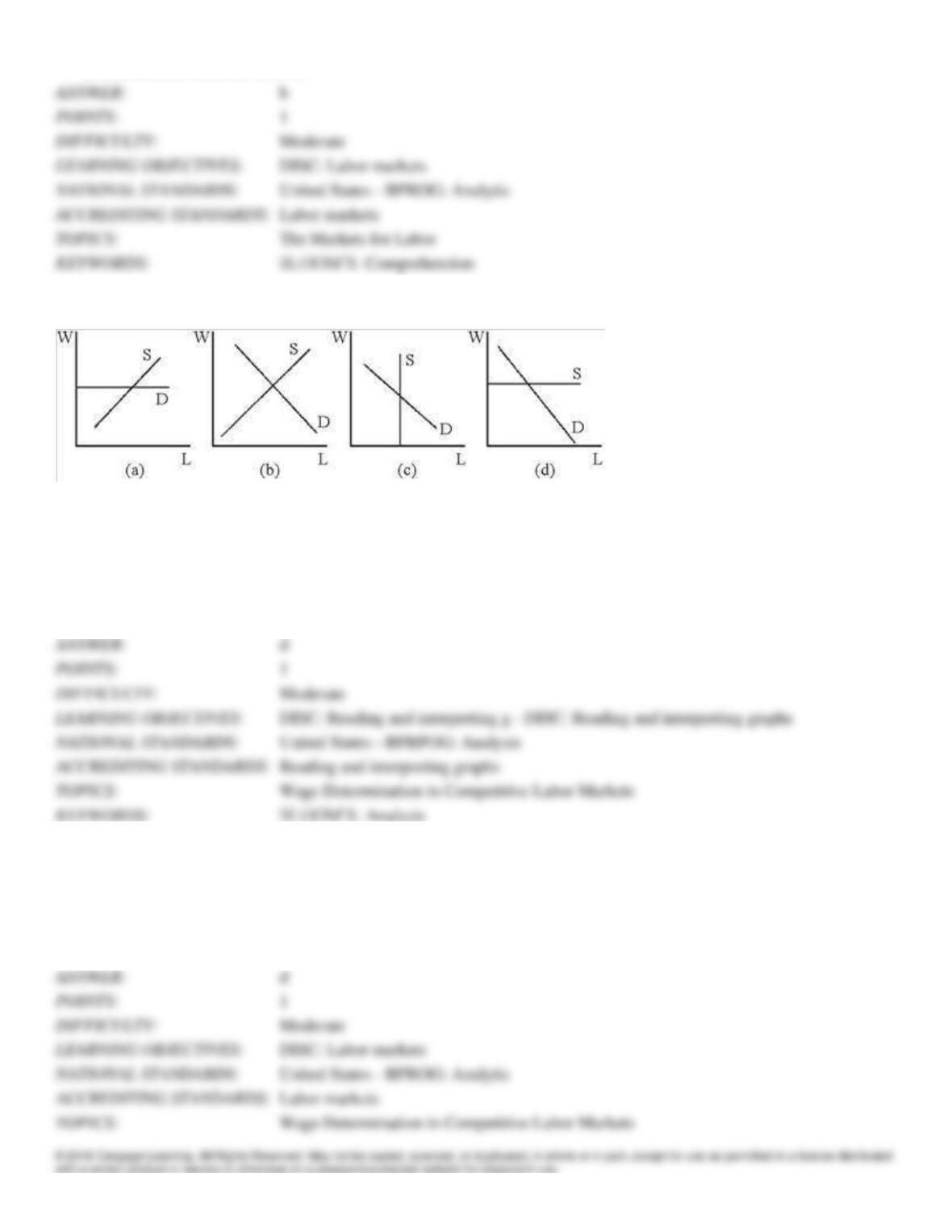
Figure 20-1
124. Which of the diagrams in Figure 20-1 shows the situation of an individual firm that hires labor in a perfectly
competitive market?
a.
A
b.
B
c.
C
d.
D
Moderate
DISC: Reading and interpreting g – DISC: Reading and interpreting graphs
United States – BPRPOG: Analysis
Reading and interpreting graphs
Wage Determination in Competitive Labor Markets
125. In a competitive labor market
a.
wages would be determined by supply and demand.
b.
the demand curve for labor is derived like the demand curve for any other input.
c.
the demand curve for labor is the downward-sloping portion of the MRP curve.
d.
All of the above answers are correct.
Moderate
DISC: Labor markets
United States – BPROG: Analytic
Labor markets
Wage Determination in Competitive Labor Markets

126. The demand for labor is derived from the
a.
demand for leisure.
b.
supply of labor.
c.
demand for final-output goods.
d.
supply of final-output goods.
DISC: Labor markets
United States – BPROG: Analytic
Labor markets
Wage Determination in Competitive Labor Markets
127. A firm’s demand curve for labor shifts when the
a.
price of its output changes.
b.
wage rate changes.
c.
number of available workers changes.
d.
All of the above are correct.
DISC: Labor markets
United States – BPROG: Analytic
Labor markets
Wage Determination in Competitive Labor Markets
128. The supply curve of truck drivers is upward sloping and demand curve is downward sloping. A reduction in the price
of hauling freight by truck relative to the price of hauling freight by rail will ____ the equilibrium wage of truck drivers
and ____ the number of drivers employed.
a.
decrease; decrease
b.
decrease; increase
c.
increase; decrease
d.
increase; increase
DISC: Supply and demand
United States – BPROG: Analytic
Supply and demand
Wage Determination in Competitive Labor Markets
BLOOMS: Application

129. The demand curve for labor slopes downward because
a.
few workers work at low wages.
b.
capital has been substituted for labor in most industries.
c.
of the diminishing marginal product of labor.
d.
All of the above are true.
c
Easy
DISC: Labor markets
United States – BPROG: Analytic
Labor markets
Wage Determination in Competitive Labor Markets
130. The demand for labor is a derived demand. Employers hire workers until the
a.
wage rate equals the average product of labor.
b.
wage rate equals the marginal revenue product of labor.
c.
last worker hired adds nothing to total output.
d.
average product of labor is zero.
Moderate
DISC: Labor markets
United States – BPROG: Analytic
Labor markets
Wage Determination in Competitive Labor Markets
131. The impact of an increase in oil prices stemming from the growth of demand is probably going to ____ the wages of
petroleum engineers.
a.
decrease
b.
increase
c.
leave unaffected
d.
be impossible to predict
Easy
DISC: Supply and demand
United States – BPROG: Analytic
Supply and demand
Wage Determination in Competitive Labor Markets
132. Theoretically, the price of a field hand on the New Orleans slave market would have
a.
varied directly with the price of cotton.
b.
risen as interest rates fell.

c.
risen when the importation of slaves became illegal.
d.
All of the above are true.
DISC: Labor markets
United States – BPROG: Analytic
Labor markets
Wage Determination in Competitive Labor Markets
133. The derived demand and, consequently, the demand curve for labor are determined by
a.
labor’s wage.
b.
labor’s marginal revenue.
c.
the marginal cost of the input labor.
d.
labor’s marginal revenue product.
DISC: Labor markets
United States – BPROG: Analytic
Labor markets
Wage Determination in Competitive Labor Markets
134. Increased productivity of workers in manufacturing has
a.
increased employment in manufacturing.
b.
increased employment in agriculture.
c.
decreased employment in agriculture.
d.
decreased employment in services.
e.
increased employment in services.
DISC: Labor markets
United States – BPROG: Analytic
Labor markets
Wage Determination in Competitive Labor Markets
135. A decision to supply labor or not to supply it is also a decision to
a.
earn the highest possible wage.
b.
demand or forgo a certain amount of leisure.
c.
be as productive as possible.
d.
join the union.

DISC: Labor markets
United States – BPROG: Analytic
Labor markets
The Supply of Labor
136. Given a fixed amount of time, a decision to supply labor or not is simultaneously a decision to
a.
demand goods and services or not.
b.
demand leisure or not.
c.
supply capital and land or not.
d.
supply leisure or not.
DISC: Labor markets
United States – BPROG: Analytic
Labor markets
The Supply of Labor
137. The income effect of a wage increase is expected to increase
a.
supply of labor.
b.
supply of goods and services.
c.
demand for leisure.
d.
demand for labor.
DISC: Labor markets
United States – BPROG: Analytic
Labor markets
The Supply of Labor
138. Income effect of lower wages implies
a.
workers prefer leisure to work.
b.
an increase in the productivity of labor.
c.
a fall in the demand for labor.
d.
workers would want to work more.
DISC: Labor markets
United States – BPROG: Analytic

Labor markets
The Supply of Labor
139. The substitution effect of a wage increase
a.
probably leads most workers to want to work more.
b.
certainly leads all workers to want to work more.
c.
probably leads most workers to want to work less.
d.
certainly leads most firms to want to employ more workers.
a
Moderate
DISC: Labor markets
United States – BPROG: Reflective Thinking – BPROG: Analysis
Labor markets
The Supply of Labor
140. Statistical studies in the United States have reached the conclusion that for most workers the response of labor supply
to wage changes is
a.
quite strong.
b.
not very strong.
c.
inverted.
d.
always zero.
Moderate
DISC: Labor markets
United States – BPROG: Reflective Thinking – BPROG: Analysis
Labor markets
The Supply of Labor
141. Statistical studies in the United States have reached the conclusion that for low-income workers
a.
the substitution effect is greater than the income effect.
b.
the income effect is greater than the substitution effect.
c.
the income effect is about equal to the substitution effect.
d.
the substitution effect is of the “wrong” sign.
a
Moderate
DISC: Labor markets
United States – BPROG: Reflective Thinking – BPROG: Analysis
Labor markets
The Supply of Labor

142. The shortened work week coupled with rising hourly wages in the U.S. economy shows that
a.
the income effect has been dominant.
b.
the substitution effect does not exist at all.
c.
the U.S. worker is no longer productive.
d.
workers have become increasingly lazy.
DISC: Labor markets
United States – BPROG: Reflective Thinking – BPROG: Analysis
Labor markets
The Supply of Labor
143. A tax on wages will
a.
reduce labor supply since leisure becomes cheaper.
b.
raise labor supply since income is reduced.
c.
have an unpredictable impact on labor supply since there are both substitution and income effects.
d.
have a predictable impact since economists know substitution effects will dominate.
DISC: Labor markets
United States – BPROG: Reflective Thinking – BPROG: Analysis
Labor markets
The Supply of Labor
144. The labor supply curve starts to bend backward at the point where
a.
the total utility of leisure exceeds the total disutility of labor.
b.
the marginal utility of additional income becomes zero.
c.
the income effect comes to dominate the substitution effect.
d.
the substitution effect comes to dominate the income effect.
DISC: Labor markets
United States – BPROG: Analytic
Labor markets
The Supply of Labor
145. Assume that the government provides a cash transfer to each family regardless of their market earnings. Given this
transfer, which of the following hypotheses about labor supply is correct?
a.
Labor supply will increase because the income effect outweighs the substitution effect.