4 Income Redistribution
1) A tax is progressive if the average tax rate
A) increases as income increases.
B) increases as income decreases.
C) is negative.
D) is positive.
2) An income tax in which the average tax rate increases with income is called a
A) regressive income tax.
B) proportional income tax.
C) flat-rate income tax.
D) progressive income tax.
3) A progressive income tax is one that
A) taxes income so that the average tax rate decreases with the level of income.
B) taxes all income above the guaranteed minimum at an average rate that decreases with
income.
C) taxes income so that the average tax rate increases with the level of income.
D) taxes income at a constant rate, regardless of the level of income.
4) A progressive income tax is defined as a tax for which
A) total taxes paid increase with the level of income.
B) total taxes paid are independent of the level of income.
C) the average tax rate increases with the level of income.
D) the average tax rate decreases with the level of income.
5) The more that Clayton earns, the higher is his average tax rate. Clayton faces a ________
income tax.
A) regressive
B) proportional
C) progressive
D) flat-rate
6) The federal income tax in the United States is
A) regressive.
B) proportional.
C) progressive.
D) a flat-rate tax.
7) Last year you earned $45,000 and paid $9,000 in income taxes. This year you earned $60,000
and paid $15,000 in income taxes. What kind of income tax do you face?
A) regressive
B) progressive
C) proportional
D) traditional
8) Albert, Betty, and Cecile live in Norland. Their annual incomes and the amounts they pay in
income tax are shown in the table below.
Income
Tax
Albert
40,000
8,000
Betty
30,000
4,500
Cecile
60,000
18,000
The income tax in Norland is
A) proportional.
B) fair.
C) regressive.
D) progressive.
Income before
tax
(dollars)
Tax plan A
(dollars)
Tax plan B
(dollars)
Tax plan C
(dollars)
0
0
0
3,000
20,000
2,000
1,000
3,000
40,000
5,000
2,000
3,000
60,000
10,000
3,000
3,000
80,000
20,000
4,000
3,000
9) The government in the country of Zappoo is trying to decide which tax plan to implement.
The table above shows three alternative plans. If the government decides to implement a
progressive income tax, it will implement tax plan ________.
A) A
B) B
C) C
D) A or B
10) The government in the country of Zappoo is trying to decide which tax plan to implement.
The table above shows three alternative plans. If the government decides to implement a
proportional income tax, it will implement tax plan ________.
A) A
B) B
C) C
D) None of the above because none of the above are proportional taxes.
11) An income tax for which the average tax rate decreases with income is called a
A) regressive income tax.
B) proportional income tax.
C) flat-rate income tax.
D) progressive income tax.
12) Consider the country of Inland. In Inland, people’s average tax rates decrease with the level
of income. Inland has a ________ tax structure.
A) progressive
B) regressive
C) proportional
D) flat-rate
13) A tax is regressive if the average tax rate
A) increases as income increases.
B) increases as income decreases.
C) is negative.
D) is less than one.
14) A regressive income tax is defined as a tax for which
A) total taxes paid increase with the level of income.
B) total taxes paid are independent of the level of income.
C) the average tax rate increases with the level of income.
D) the average tax rate decreases with the level of income.
15) An income tax system in which the average tax rate decreases with the level of income is
called a
A) progressive income tax system.
B) proportional income tax system.
C) regressive income tax system.
D) flat-rate income tax system.
16) Regressive income taxes are
A) an important form of income redistribution.
B) present when the average tax rate decreases as income decreases.
C) present when the average tax rate decreases as income increases.
D) Both answers A and B are correct.
17) A worker pays a tax for Social Security at a constant rate up until a certain level of income is
reached. Beyond that income level, no more Social Security tax is paid. The Social Security tax
is an example of a
A) progressive tax.
B) regressive tax.
C) proportional tax.
D) sales tax.
18) Joe earns $100,000 per year. He pays a tax rate of 28 percent on the first $60,000 of income
and a tax rate of 15 percent on income above $60,000. This tax system is an example of a
A) regressive income tax.
B) negative income tax.
C) progressive income tax.
D) proportional income tax.
Income
(dollars)
Tax paid
(dollars)
12,000
1,200
20,000
1,600
50,000
3,000
19) What type of income tax is reflected in the table above?
A) regressive income tax
B) proportional income tax
C) progressive income tax
D) negative income tax
20) Alice, Bob, and Cody live in Wesland. Their annual incomes and the amounts they pay in
income tax are shown in the table below.
Income
Tax
Alice
30,000
6,000
Bob
50,000
7,500
Cody
100,000
12,000
The income tax in Wesland is
A) proportional.
B) regressive.
C) flat-rate.
D) progressive.
21) A proportional income tax is defined as a tax for which
A) total taxes paid increase with the level of income.
B) total taxes paid are independent of the level of income.
C) the average tax rate increases with the level of income.
D) the average tax rate is the same at all levels of income.
22) An income tax for which the average tax rate is constant called a
A) regressive income tax.
B) proportional income tax.
C) marginal income tax.
D) progressive income tax.
23) A flat-rate income tax is also called ________.
A) an excise tax
B) a property tax
C) a proportional income tax
D) a constant rate tax
24) With a proportional tax
A) a poor household pays a larger percentage of its income in taxes than a rich one.
B) a rich household pays a larger percentage of its income in taxes than a poor one.
C) all households pay the same total amount of tax.
D) all households pay the same percentage of their income as taxes.
25) If both rich and poor families pay 25 percent of their income in taxes, the tax scheme is
________.
A) proportional
B) regressive
C) negative
D) progressive
26) Consider the country of Outland. In Outland, people pay 10 percent of their income as a tax
whether they earn $10,000 or $100,000 annually. Outland has ________ tax structure.
A) a progressive
B) a regressive
C) a proportional
D) an excessive
27) Alex, Bill, and Cid live in Souland. Their annual incomes and the amounts they pay in
income tax are shown in the table below.
Income
Tax
Alex
30,000
6,000
Bill
20,000
4,000
Cid
40,000
8,000
The income tax in Souland is
A) proportional.
B) disproportional.
C) regressive.
D) progressive.
Gross income
(dollars)
Plan A: tax
payment
(dollars)
Plan B: tax
payment
(dollars)
Plan C: tax
payment
(dollars)
0
0
0
0
1,000
100
100
200
2,000
200
400
250
4,000
400
1,600
300
28) In the above table, which tax plan is progressive?
A) only plan A
B) only plan B
C) only plan C
D) both plan B and plan C
29) In the above table, which tax plan is regressive?
A) only plan A
B) only plan B
C) only plan C
D) both plan A and plan C
30) In the above table, which tax plan is proportional?
A) only plan A
B) only plan B
C) only plan C
D) both plan A and plan C
31) In the above table, which plan is a flat-rate tax?
A) only plan A
B) only plan B
C) only plan C
D) both plan A and plan C
32) Which of the following taxes causes the greatest shift of the Lorenz curve toward the line of
equality?
A) proportional income tax
B) regressive income tax
C) flat-rate income tax
D) progressive income tax
33) Social security provides payments
A) for food so that the poor can obtain a basic diet.
B) to aid married families with dependents.
C) to unemployed able-bodied workers.
D) to retired and disabled workers.
34) The U.S. government provides monthly payments to retired workers under which program?
A) the Old Age, Survivors, Disability and Health Insurance (OASDHI)
B) the Temporary Assistance for Needy Households (TANF)
C) the Supplementary Security Income (SSI)
D) a series of income tax rebates
35) An example of an income maintenance program is
A) a proportional income tax.
B) low-cost college tuition.
C) unemployment compensation.
D) rent control.
36) Unemployment compensation is an example of
A) a subsidized service.
B) a regressive income program.
C) a Social Security benefit.
D) an income maintenance program.
37) Which of the following is NOT a government-run income maintenance program?
A) Social Security
B) unemployment compensation
C) temporary Assistance of Needy Households
D) life insurance
38) Social Security is an example of
A) a progressive income tax.
B) a subsidized service.
C) an income maintenance program.
D) an unemployment benefit.
39) All of the following are programs that redistribute income by making direct payments to
people in the lower part of the income distribution EXCEPT
A) social security programs.
B) welfare programs.
C) Individual Retirement Accounts.
D) unemployment compensation.
40) Considering the tax and transfer system in the United States, the poor receive
A) less in benefits than they pay in taxes, and so do the rich.
B) more in benefits than they pay in taxes, and so do the rich.
C) less in benefits than they pay in taxes, and the rich receive more in benefits than they pay in
taxes.
D) more in benefits than they pay in taxes, and the rich receive less in benefits than they pay in
taxes.
41) The public education system is an example of
A) an income maintenance program.
B) a negative income tax.
C) the poor paying more than the market price for a service they receive.
D) a subsidized service.
42) State colleges are an example of
A) income maintenance programs.
B) Social Security.
C) welfare programs.
D) subsidized services.
43) Which of the following is an example of a subsidized service?
A) Social Security payments to retirees
B) Social Security payments to widows
C) welfare payments to the unemployed
D) Medicare reimbursements to hospitals
44) The income that measures a household’s earnings in the absence of government redistribution
is called
A) market income.
B) real income.
C) money income.
D) cash income.
45) The income that includes a household’s earnings in addition to cash transfers from the
government is called
A) market income.
B) real income.
C) money income.
D) cash income.
46) In the country of Wilkes, taxes are $5 million and benefits are $4 million. Income from labor
is $25 million and income from capital is $15 million. What is market income?
A) $20 million
B) $39 million
C) $40 million
D) $9 million
47) Market income in the United States is distributed
A) more unequally than income after taxes and benefits.
B) less unequally than income after taxes and benefits.
C) the same as income after taxes and benefits.
D) according to a big tradeoff between equity and equality
48) The U.S. tax system at both the federal and state levels is ________.
A) regressive
B) proportional
C) progressive
D) negative
49) The U.S. tax system
A) reduces inequality and shifts the Lorenz curve away from the line of equality.
B) reduces inequality and shifts the Lorenz curve toward the line of equality.
C) increases inequality and shifts the Lorenz curve toward the line of equality.
D) increases inequality and shifts the Lorenz curve away from the line of equality.
50) Taxes and transfers in the United States
A) shift the Lorenz curve inward.
B) shift the Lorenz curve outward.
C) cancel out so that the Lorenz curve does not shift.
D) shift the Lorenz curve inward at low incomes, outward at high incomes.
The table shows the distributions of market income and money income in the United States in
2007.
Households
Market
income
(percent of
total)
Money
income
(percent of
total)
Lowest 20%
1.1
3.4
Second 20%
7.1
8.6
Third 20%
13.9
14.6
Fourth 20%
22.8
23.0
Highest 20%
55.1
50.4
51) According to the table above, ________ percent of total income is redistributed from the
highest income group.
A) 4.7
B) 2.3
C) 1.5
D) 3.8
52) According to the table above, ________ percent of total income is redistributed to the lowest
income group.
A) 4.7
B) 2.3
C) 1.5
D) 3.8
53) According to the table above, income is redistributed from the ________ of households to
the ________ of households.
A) richest 20%; rest
B) richest 20%; poorest 20%
C) richest 40%; rest
D) poorest 40%; richest 20%
54) According to the table above, the money income distribution is ________ unequal than the
market income distribution because ________ income reflects income redistribution through
taxes and benefits.
A) less; money
B) less; market
C) more; money
D) more; market
Household grouped by
income
Group income
(dollars)
Lowest 20 percent
100,000
Second 20 percent
400,000
Third 20 percent
500,000
Fourth 20 percent
1,500,000
Fifth 20 percent
2,500,000
55) The table above shows the distribution of income in Swacko. The government of Swacko
imposes a 20 percent tax on the people with the highest 40 percent of income. The government
then distributes 50 percent of the tax collected to the lowest 20 percent and 25 percent to the
second 20 percent and the middle 20 percent. Suppose that the before-tax group incomes remain
as above. Before and after the distribution, what percentage of national income belongs to the
lowest 20 percent?
A) 2 percent; 10 percent
B) 20 percent; 20 percent
C) 5 percent; 25 percent
D) 2 percent; 2 percent
56) The table above shows the distribution of income in Swacko. The government of Swacko
imposes a 20 percent tax on people with the highest 40 percent of income. The government then
distributes 40 percent of the tax collected to the lowest 20 percent and 30 percent to the second
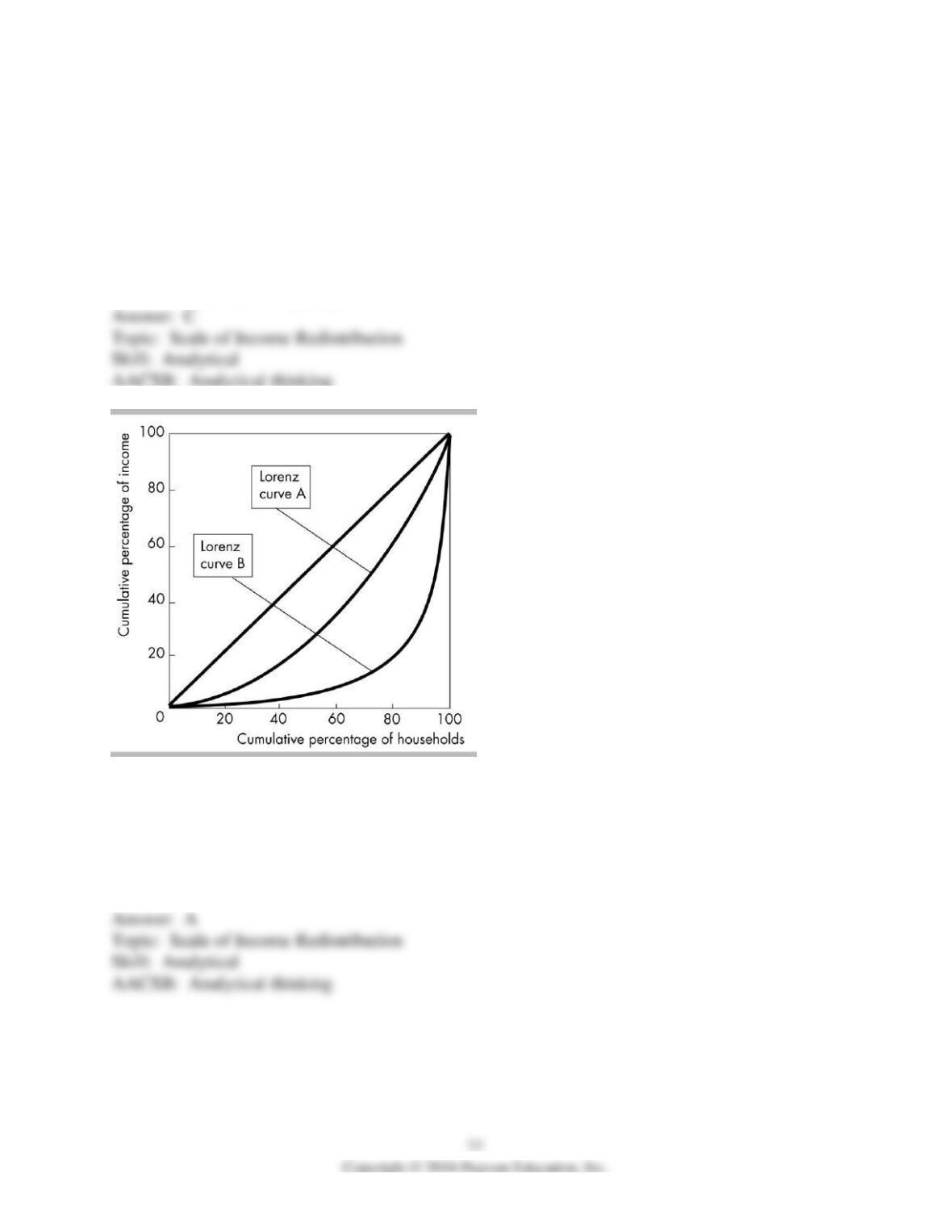
20 percent and the middle 20 percent. After the redistribution, the Lorenz curve for income
________.
A) is equal to the line of equality
B) equals the Lorenz curve for wealth
C) is closer to the line of equality
D) is above the line of equality
57) The figure above shows two Lorenz curves, one before income redistribution and one after
income redistribution. Lorenz curve B represents
A) market income.
B) money income.
C) money income before taxes.
D) income after taxes.
58) The figure above shows two Lorenz curves, one before income redistribution and one after
income redistribution. The difference between the two curves equals
A) market income.
B) money income.
C) the redistribution of income.
D) the amount of taxes paid.
59) The “big tradeoff” refers to the tradeoff between
A) work and leisure.
B) equity and efficiency.
C) public goods and private goods.
D) taxes and transfers.
60) The “big tradeoff” refers to the tradeoff between
A) money and market income.
B) equity and efficiency.
C) progressive and regressive taxes.
D) flat-rate and proportional taxes.
61) The redistribution of income creates the big tradeoff, which is a tradeoff between ________.
A) income and wealth
B) equity and efficiency
C) rich and poor
D) Supplementary Security Income and the Food Stamp program
62) Income redistribution ________.
A) creates an income distribution that is less equal than the market distribution
B) is efficient because it makes the distribution of income more equal.
C) eliminates the big tradeoff between rich and poor
D) creates a deadweight loss
63) Redistribution programs create a disincentive to work among
A) taxpayers only.
B) benefit recipients only.
C) both taxpayers and benefit recipients.
D) neither taxpayers nor benefit recipients.
64) The inefficiency created by income taxation occurs due to
A) the cost of collecting taxes and making welfare payments.
B) motivating welfare recipients to work less.
C) motivating income earners to work less.
D) All of the above answers are correct.
65) Using the government as a means of redistribution generates equity at the cost of efficiency,
in part because
A) the process of redistribution uses up some of society’s resources.
B) the process of redistribution creates new resources for society.
C) redistribution creates new incentives to work for both rich and poor.
D) redistribution would not take place otherwise.
66) With respect to redistribution, one reason “The Big Tradeoff” exists is because
A) government programs employ resources that could have been productive elsewhere.
B) government policymakers must choose between funding the various programs.
C) government programs only employ resources that had no value to society otherwise.
D) government programs only pay workers their opportunity cost.
67) With respect to redistribution, one reason “The Big Tradeoff” exists is because
A) low income households do not pay enough taxes.
B) government policymakers must choose between funding the various programs.
C) government programs only employ resources that had no value to society otherwise.
D) redistribution weakens the incentive to work.
68) The decrease in the incentive to work created by welfare payments programs
A) only affects low income taxpayers.
B) only affects taxpayers but not welfare recipients.
C) only affects high income executives.
D) affects both taxpayers and welfare recipients.
69) The big tradeoff between equality and efficiency exists because
A) redistribution uses resources and weakens incentives to work.
B) redistribution uses resources and strengthens incentives to work.
C) redistribution creates additional resources and weakens incentives to work.
D) redistribution creates additional resources and strengthens incentives to work.