
4) Since 1970, the world Gini ratio has ________ indicating that the world distribution of income
has ________.
A) risen; become more equal
B) fallen; become more equal
C) risen; become less equal
D) not changed; not changed
5) The world distribution of income has become more equal since 1970 because
A) the distribution of income within most countries has become more equal.
B) foreign aid programs from rich nations have increased in size and especially in effectiveness.
C) average incomes in poor nations, such as China, have risen faster than average incomes in
rich nations, such as the United States.
D) None of the above answers are correct.
6) The Gini ratio in Brazil was over 0.6 in 1990 and fell to 0.5 in 2010. This change means that
over this time inequality ________ and the Lorenz curve moved ________ the 45 degree line.
A) increased; closer to
B) increased; further away from
C) decreased; closer to
D) decreased; further away from
3 The Sources of Economic Inequality
1) By human capital, economists mean
A) machines that replace humans.
B) machines engineered to avoid operator injury.
C) the accumulated skill and knowledge of humans.
D) humans who perform repetitive tasks.

2) Which of the following is NOT an example of the opportunity cost of investing in human
capital?
A) lost wages while in school
B) lost wages while in on-the-job training
C) tuition payments
D) apartment rent while working and going to school part-time
3) High-skilled workers have
A) a lower value of marginal product because they have higher wages.
B) the same labor supply curve as do low-skilled workers.
C) more human capital than do low-skilled workers.
D) None of the above answers is correct.
4) The median wage among physicians is over $166K a year, while the median salary for
physician assistants is $86K a year. These salaries suggest that physicians have ________ human
capital than physician assistants and hence the demand for labor for physicians is ________ than
the demand for labor for physician assistants.
A) more; less
B) more; greater
C) less; greater
D) less; less
5) Relative to the demand curve for low-skilled workers, the demand curve for high-skilled
workers lies
A) to the right.
B) to the left.
C) below.
D) in the same place.

6) Because of their higher value of marginal product
A) the demand curve for high-skilled workers lies to the right of the demand curve for low-
skilled workers.
B) the demand curve for high-skilled workers lies to the left of the demand curve for low-skilled
workers.
C) the supply curve for high-skilled workers lies to the right of the supply curve for low-skilled
workers.
D) the demand curve for high-skilled workers lies to the left of the supply curve for low-skilled
workers.
7) The demand curve for high-skilled labor lies to the right of the demand curve for low-skilled
labor because
A) there are more high-skilled workers than low-skilled workers.
B) high-skilled workers require more compensation to convince them to work than do low-
skilled workers.
C) high-skilled labor is more productive than low-skilled labor.
D) firms need not be concerned with the minimum wage in the market for high-skilled labor.
8) The demand curve for low-skilled labor lies to the left of the demand curve for high-skilled
labor because
A) there are more high-skilled workers than low-skilled workers.
B) high-skilled workers require more compensation than low-skilled workers.
C) high-skilled workers are more productive than low-skilled labor.
D) firms do not see any difference between high-skilled labor and low-skilled labor.
9) Relative to the supply curve of high-skilled workers, the supply curve of low-skilled workers
is
A) to the right.
B) above.
C) to the left.
D) on top of the high-skilled worker supply curve.

10) The supply curve for high-skilled labor lies to the
A) right of the supply curve for low-skilled labor because more people want a high-skilled job.
B) left of the supply curve for low-skilled labor because more people want a high-skilled job.
C) left of the supply curve for low-skilled labor because it is costly to acquire skills.
D) right of the supply curve for low-skilled labor because fewer high-skilled people are willing
to work for a low wage.
11) Because skills are costly to obtain, at a given wage rate, the
A) quantity demanded of high-skilled labor is less than the quantity demanded of low-skilled
labor.
B) quantity demanded of high-skilled labor is greater than the quantity demanded of low-skilled
labor.
C) quantity supplied of high-skilled labor is less than the quantity supplied of low-skilled labor.
D) quantity supplied of high-skilled labor is greater than the quantity supplier of low-skilled
labor.
12) Suppose there are two types of labor, high skilled and low skilled. The demand curve for
high skilled labor lies ________ the demand curve for low skilled labor and the supply curve of
high skilled labor lies ________ the supply curve of low skilled labor.
A) above; above
B) above; below
C) below; below
D) below; above
13) High-skilled workers earn more than low-skilled workers in part because
A) high-skilled workers have higher value of marginal products.
B) of government legislation.
C) the supply of high-skilled workers is more elastic.
D) the demand for high-skilled workers is more elastic.
14) The wage rate for high-skilled labor is higher than that for low-skilled labor because
A) both the demand for and the supply of high-skilled labor is greater than that for low-skilled
labor.
B) the demand for high-skilled labor is greater than the demand for low-skilled labor and the
supply of high-skilled labor is less than the supply of low-skilled labor.
C) the demand for high-skilled labor is less than the demand for low-skilled labor and the supply
of high-skilled labor is greater than the supply of low-skilled labor.
D) both the demand for and the supply of high-skilled labor is less than that for low-skilled labor.
15) Welding has changed dramatically over the last decade with more welding jobs dependent on
the use of computers. This change increased the demand for welders with computer skills and
decreased the demand for welders who lack these skills and is an example of when technology is
a ________ to a high-skilled job and a ________ to a low-skilled job.
A) complement; substitute
B) complement; complement
C) substitute; complement
D) substitute; substitute
16) Welding has changed dramatically over the last decade with more welding jobs dependent on
the use of computers. Computers are a complement only for high-skilled welders, so as more
welding companies buy computers the wages of high-skilled welders will ________ and the
wages of low-skilled welders will ________.
A) fall; rise
B) rise; fall
C) fall; fall
D) rise; rise
17) Computers and laser scanners are ________ for low-skilled labor and ________ for high-
skilled labor. The introduction of these technologies ________ the wage rate of high-skilled
workers and ________ the wage rate of low-skilled workers.
A) complements; substitutes; raises; lowers
B) substitutes; complements; lowers; raises
C) substitutes; complements; raises; lowers
D) complements; substitutes; lowers; raises
18) Information technologies are a ________ for low-skilled labor and a ________ for high-
skilled labor.
A) substitute; substitute
B) complement; complement
C) substitute; complement
D) complement; substitute
19) One possible reason the U.S. income distribution has become more unequal is
A) information technology has decreased the demand for unskilled labor.
B) information technology has increased the demand for unskilled labor.
C) information technology has increased the supply of unskilled labor.
D) information technology has decreased the supply of unskilled labor.
20) High skilled labor and information technology are ________ while low skilled labor and
information technology are ________.
A) complements; substitutes
B) substitutes; substitutes
C) substitutes; complements
D) complements; complements

21) Information technologies ________ the demand for low-skilled labor, increase the ________
high-skilled labor, lower the wage rate of ________ labor, and raise the wage rate of ________
labor.
A) decrease; demand for; low-skilled; high-skilled
B) decrease; supply of; low-skilled; high-skilled
C) do not change; supply of; high-skilled; low-skilled
D) do not change; demand for; high-skilled; low-skilled
22) The distribution of income in the United States became more unequal in the 1990s. One
explanation for this trend is that advances in information technologies have ________ low-
skilled labor and ________ high-skilled labor.
A) decreased the demand for; increased the demand for
B) increased the demand for; decreased the demand for
C) decreased the supply of; increased the supply of
D) increased the supply of; decreased the supply of
23) In recent years, information technology such as computers and scanners have been a
________ for low-skilled labor and have led to ________ wage rates for low-skilled workers.
A) substitute; higher
B) substitute; lower
C) complement; higher
D) complement; lower
24) The entry of China and other developing countries into the global economy ________ the
value of marginal product of factory workers in the United States and ________ their wage rate.
A) increases; lowers
B) decreases; raises
C) decreases; lowers
D) increases; raises

25) The entry of China and other developing countries into the global economy ________ the
wages of low-skilled workers and ________ the wages of high-skilled workers in the United
States.
A) lowers; lowers
B) raises; raises
C) raises; lowers
D) lowers; raises
26) Globalization has ________ the price of many goods, which has caused the value marginal
product of unskilled labor to ________ and the demand for unskilled labor to ________.
A) decreased; decrease; decrease
B) decreased; decrease; increase
C) decreased; increase; increase
D) increased; increase; increase
27) In the United States, globalization has caused the demand for unskilled labor to ________
and the demand for skilled labor to ________.
A) decrease; increase
B) decrease; decrease
C) increase; increase
D) increase; decrease

Wage rate
(dollars per
hour)
Quantity of labor
demanded
(hours per day)
Quantity of labor
supplied
(hours per day)
2
80
50
4
70
55
6
60
60
8
50
65
10
40
70
28) The table above shows the demand for labor and supply of labor schedules for low-skilled
labor. If the labor market is competitive, what is the wage rate of low-skilled labor and what is
the quantity of low-skilled labor employed?
A) $6 an hour; 60 hours a day
B) $6 an hour; 65 hours a day
C) $4 an hour; 70 hours a day
D) $4 an hour; 55 hours a day
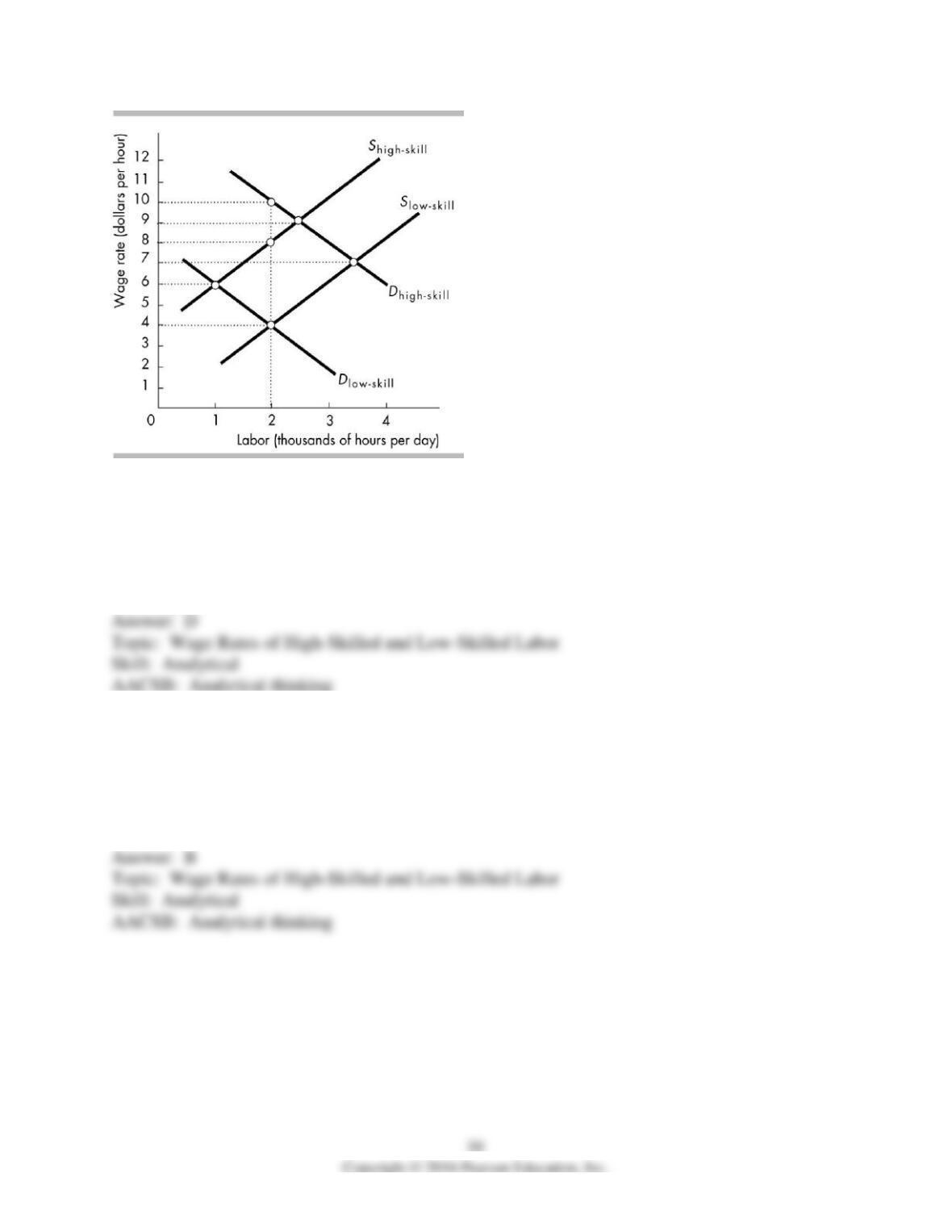
29) The above figure shows the demand and supply curves for high-skilled and low-skilled labor.
The wage rate
A) of high-skilled labor is $7.00 and of low-skilled labor is $6.00.
B) of high-skilled labor is $9.00 and of low-skilled labor is $7.00.
C) of high-skilled labor is $6.00 and of low-skilled labor is $4.00.
D) of high-skilled labor is $9.00 and of low-skilled labor is $4.00.
30) The above figure shows the demand and supply curves for high-skilled and low-skilled labor.
The wage differential between high-skilled and low-skilled labor is
A) $4.00.
B) $5.00.
C) $6.00.
D) $7.00.
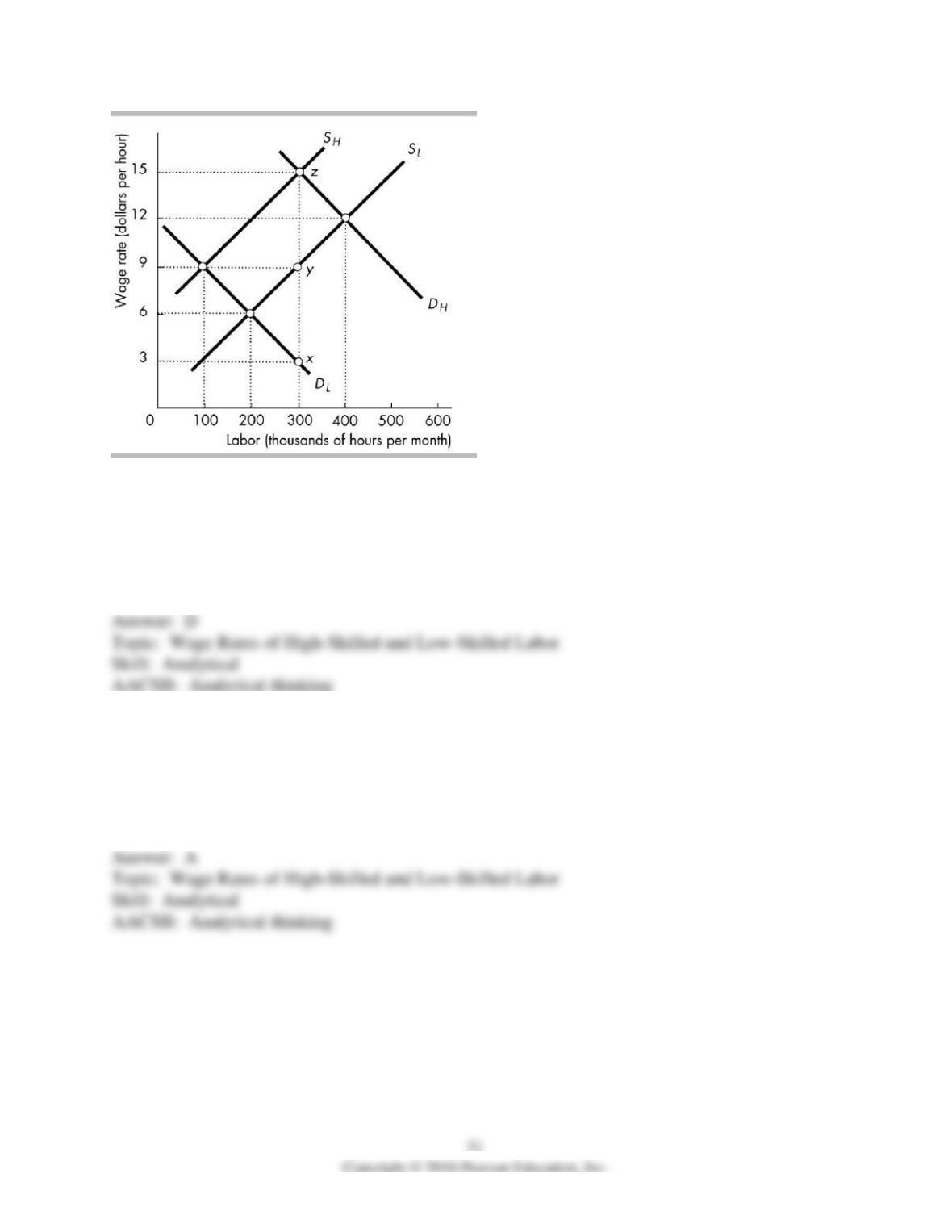
31) The above figure shows the supply and demand curves for high-skilled and low-skilled labor.
Low-skilled workers earn a wage rate of
A) $15 per hour.
B) $12 per hour.
C) $9 per hour.
D) $6 per hour.
32) The above figure shows the supply and demand curves for high-skilled and low-skilled labor.
High-skilled workers earn a wage rate of
A) $15 per hour.
B) $12 per hour.
C) $9 per hour.
D) $6 per hour.
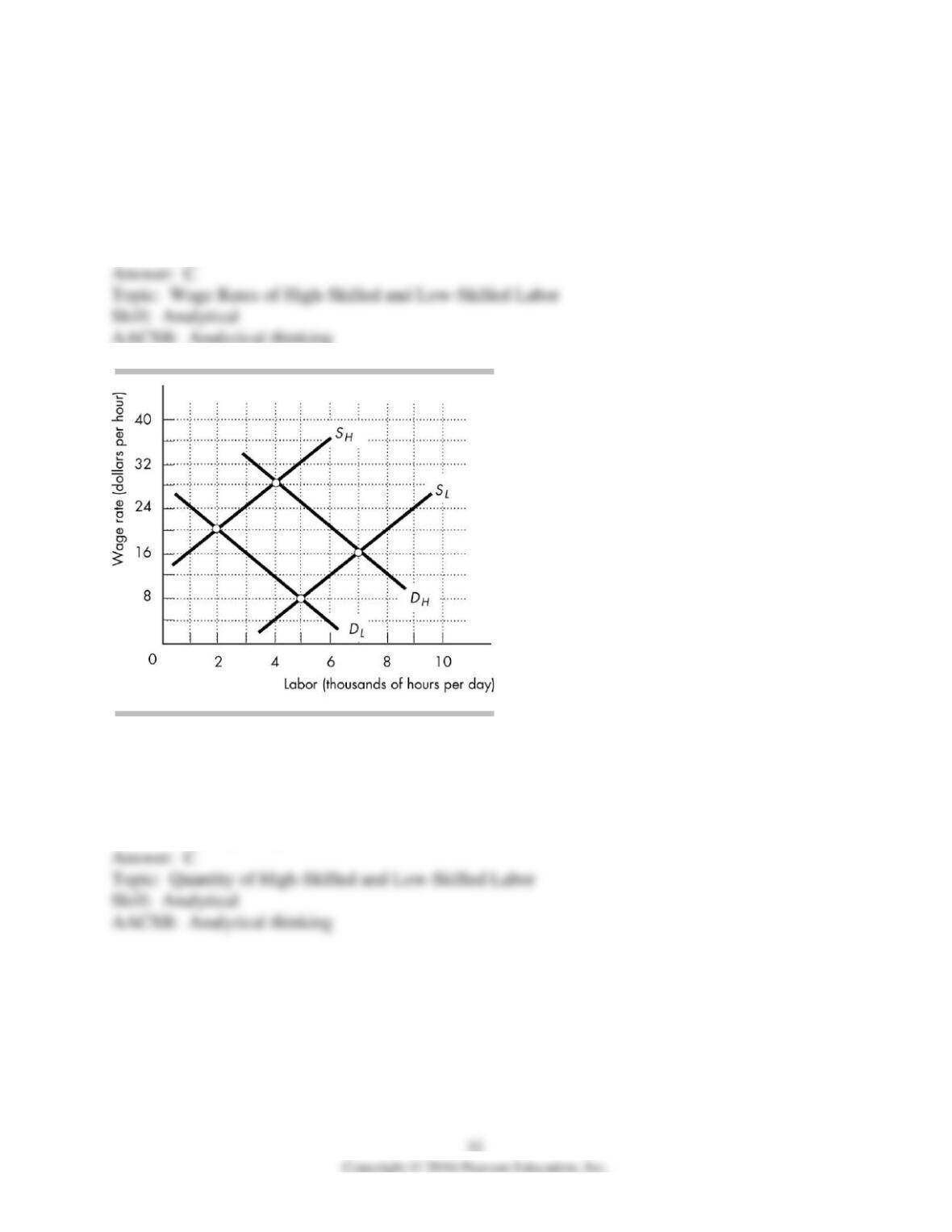
33) The above figure shows the supply and demand curves for high-skilled and low-skilled labor.
The figure shows that high-skilled workers earn a wage rate greater than low-skilled workers
because
A) the supply of high-skilled labor is greater than the supply of low-skilled labor.
B) high-skilled labor has a lower value of marginal product.
C) of both the cost of acquiring skills and the differences in the value of marginal products.
D) of discrimination.
34) In the figure above, the quantity of low-skilled labor employed is
A) 2,000 hours per day.
B) 4,000 hours per day.
C) 5,000 hours per day.
D) 7,000 hours per day.

35) In the figure above, the quantity of high-skilled labor employed is
A) 2,000 hours per day.
B) 4,000 hours per day.
C) 5,000 hours per day.
D) 7,000 hours per day.
36) In the figure above, in the market for low-skilled labor, the equilibrium wage rate is
A) $16.
B) $8.
C) $20.
D) $28.
37) In the figure above in the market for high-skilled labor, the equilibrium wage rate is
A) $16.
B) $8.
C) $20.
D) $28.
38) In the figure above, the difference in wage rate between low-skilled and high-skilled labor is
A) $16.
B) $8.
C) $20.
D) $28.
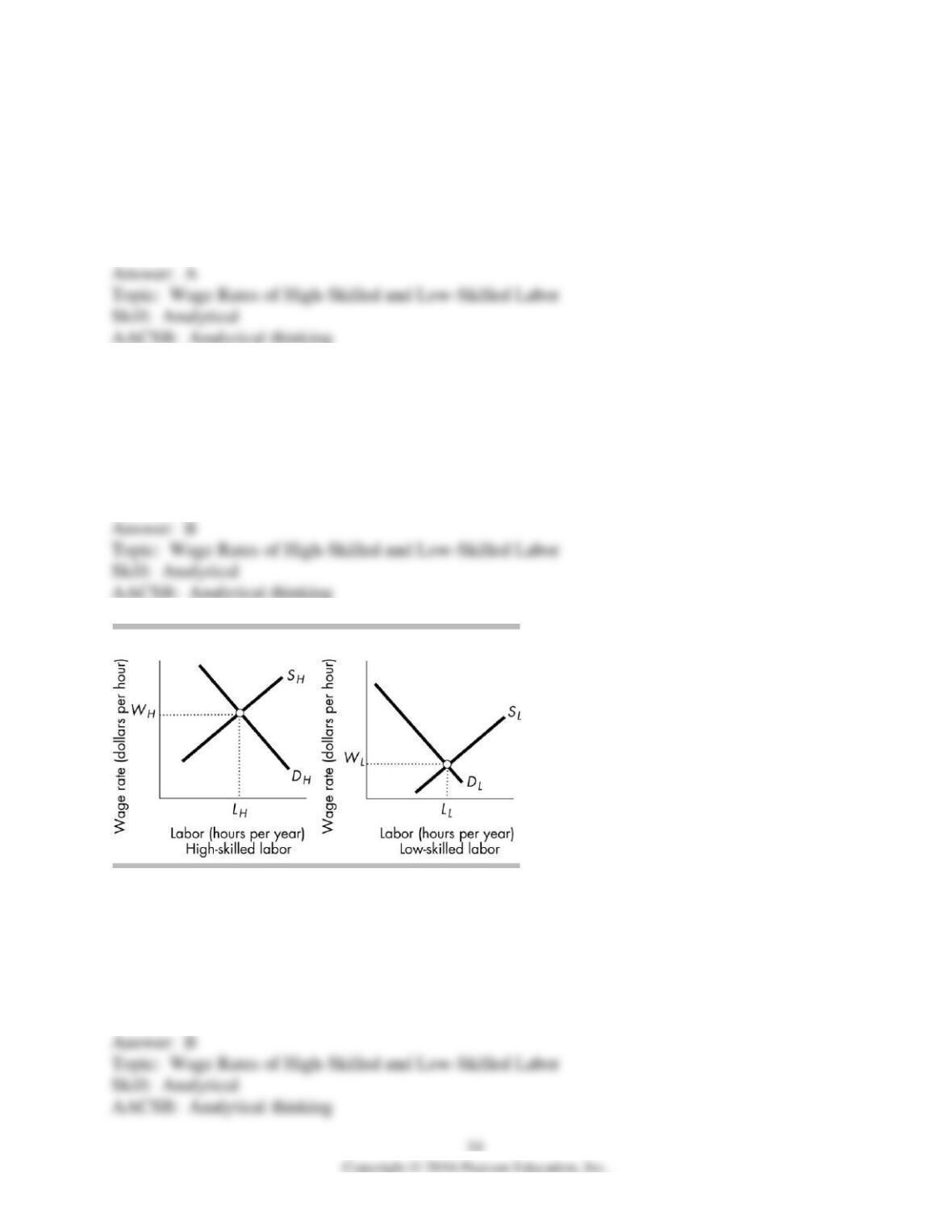
39) In the figure above, if information technologies are introduced that are complements for
high-skilled workers and substitutes for low-skilled workers, the wage rate of high-skilled
workers will ________ and the wage rate of low-skilled workers will ________.
A) rise; fall
B) fall; rise
C) fall; fall
D) rise; rise
40) In the figure above, if the government starts to provide university education at no charge, in
the long run, the wage rate of high-skilled workers will ________ and the wage rate of low-
skilled workers will ________.
A) rise; fall
B) fall; rise
C) fall; fall
D) rise; rise
41) In the above figure, an innovation that increases the demand for high-skilled workers and
decreases the demand for low-skilled workers will
A) reduce the amount by which WH exceeds WL.
B) increase the amount by which WH exceeds WL.
C) shift the SH curve leftward.
D) shift the SL curve rightward.
42) In the above figure, the long-run effect of providing university education at no charge to all
qualified applicants would be to shift the curve SH
A) and the curve SL leftward.
B) and the curve SL rightward.
C) leftward and the curve SL rightward.
D) rightward and the curve SL leftward.
43) Lee earns more than does Pat. Which of the following can explain why?
A) Pat is discriminated against.
B) Lee has more human capital.
C) Lee has a greater degree of specialization in earning an income.
D) All of the above could be a factor leading to the wage difference.
44) When a group is discriminated against, its
A) wages fall but its employment does not.
B) employment and its wages decrease.
C) employment decreases but its wages do not.
D) employment and its wages are unaffected.
45) Customer discrimination against black investment advisers ________ the salaries of black
investment advisors and ________ the number of black investment advisers.
A) decreases; decreases
B) decreases; does not change
C) does not change; decreases
D) does not change; does not change

46) Discrimination ________ the group being discriminated against and ________ the group
being favored.
A) decreases the demand for; increases the demand for
B) increases the demand for; decreases the demand for
C) decreases the supply of; increases the supply of
D) increases the supply of; decreases the supply of
47) A firm that discriminates has ________ a nonprejudiced firm and ________.
A) the same costs as; competes most often with imported goods and services
B) the same costs as; can successfully maximize profit in a competitive industry
C) lower costs than; drives other firms out of a competitive industry
D) higher costs than; cannot survive in a competitive industry
48) If customer discrimination does not exist, firms that discriminate on the basis of race or sex
will
A) have higher costs than those that do not.
B) have the same level of costs as those that do not.
C) have lower costs than those that do not.
D) tend to survive whereas firms that do not discriminate will tend to fail.
49) Discrimination by customers creates a wage differential between two groups by creating a
difference in the two groups’ perceived
A) supply of labor.
B) value of marginal product.
C) marginal cost of labor.
D) minimum wage.

50) Customer discrimination against female realtors ________ the number of female realtors and
________ their perceived value of marginal product.
A) decreases; decreases
B) decreases; increases
C) increases; decreases
D) increases; increases
51) Moe’s Sweaters is a firm in perfect competition. Moe’s customers don’t know who the firm’s
workers are. If Moe is the only employer in the market who discriminates against women by
paying them less than he pays to equally qualified men, his firm will
A) lower its labor cost and receive a greater economic economic profit than its competitors.
B) receive a positive economic profit while its competitors will only receive a normal profit.
C) not maximize its economic profit and will not survive.
D) be able to lower its price and undercut the competitors.
52) There is discrimination in the labor market on the planet of Yerk between two groups of
people, the Mirks and the Morks. If the discrimination is against the Mirks, then the VMP curve
for Mirks is ________ the VMP curve for Morks, and the Mirks receive ________ than the
Morks.
A) to the left of; the same wage rate, but fewer are employed
B) to the right of; the same wage rate, but fewer are employed
C) to the left of; a lower wage rate
D) to the right of; a lower wage rate
53) With respect to market and nonmarket production, on average working women are ________
diversified than men and receive ________ pay as a result.
A) less; lower
B) less; higher
C) more; lower
D) more; higher
54) Specialization of productive activity between men and women might explain why
A) a married woman earns less than a married man.
B) a never-married man earns more than a never-married woman.
C) a never-married man earns the same as a married man.
D) None of the above answers is correct.
55) Economists who have compared the incomes of never-married men and women have found
that with equal amounts of human capital, ________.
A) the wages of these two groups are the same
B) men earn significantly more than women
C) women earn significantly more than men
D) men specialize more in home production
56) Globalization means that firms recruit top talent from the global talent pool. Globalization
means that the payoffs won by the contest winners ________.
A) increase in size
B) do not change in size
C) might increase, decrease, or not change depending on whether the demand for contests
changes by more than, less than, or the same amount as the supply of contests.
D) decrease in size
57) Because of assortative mating, wealth becomes ________ and the distribution of wealth
becomes more ________.
A) more concentrated in a small number of families; equal
B) more concentrated in a small number of families; unequal
C) spread out among more families; equal
D) spread out among more families; unequal
58) Assortative mating means that
A) poor women and rich men tend to marry.
B) rich women and rich men tend to marry.
C) rich women and poor men tend to marry.
D) there are limited incentives to marry anyone.
59) Assortative mating results in
A) many people being able to marry their way out of poverty.
B) wealth becoming more concentrated among families.
C) the Lorenz curve moving rightward closer to the line of equality.
D) people marrying at a later age.
60) The distribution of wealth is skewed in part because people with high wealth
A) save very little.
B) tend to marry people with similar wealth.
C) have very little skills.
D) do not earn much more than those with low incomes.
61) Making the distribution of wealth ________ equal is ________.
A) more; differences in degrees of specialization
B) less; differences in degrees of specialization
C) more; assortative mating
D) less; assortative mating
62) The higher the cost of acquiring skills, the ________ are the high-skilled and low-skilled
labor ________ curves.
A) closer together; demand
B) farther apart; demand
C) closer together; supply
D) farther apart; supply
63) Which of the following is a reason why the wage rate of high-skilled workers exceeds the
wage rate of low-skilled workers?
A) The market for high-skilled workers is more competitive than the market for low-skilled
labor.
B) The demand for high-skilled workers exceeds the demand for low-skilled workers.
C) The number of high-skilled workers exceeds the number of low-skilled workers.
D) Low-skilled workers often are in the process of acquiring more human capital.
64) Which of the following is NOT a potential reason for wage differences by race or sex?
A) discrimination
B) differences in human capital
C) differences in the degree of specialization
D) All of the above are potential reasons for wage differences by race or sex.
65) Which of the following will NOT increase a worker’s human capital?
A) more work experience
B) more training
C) more schooling
D) a higher wage rate